
keyword
alignment tax
The alignment tax refers to the additional costs and performance penalties incurred when tuning an artificial intelligence system to follow human values, safety guidelines, and user preferences compared to leaving the system unaligned. In machine learning, this trade-off often manifests as a decline in a model's broader capabilities, such as reasoning, creativity, or task performance across general benchmarks, resulting from post-training alignment techniques like reinforcement learning from human feedback or preference optimization. Beyond the degradation or forgetting of pretrained skills, the concept also encompasses the broader operational overhead associated with alignment, including increased computational requirements, additional development time, and the engineering effort necessary to steer model behavior responsibly.
3 items
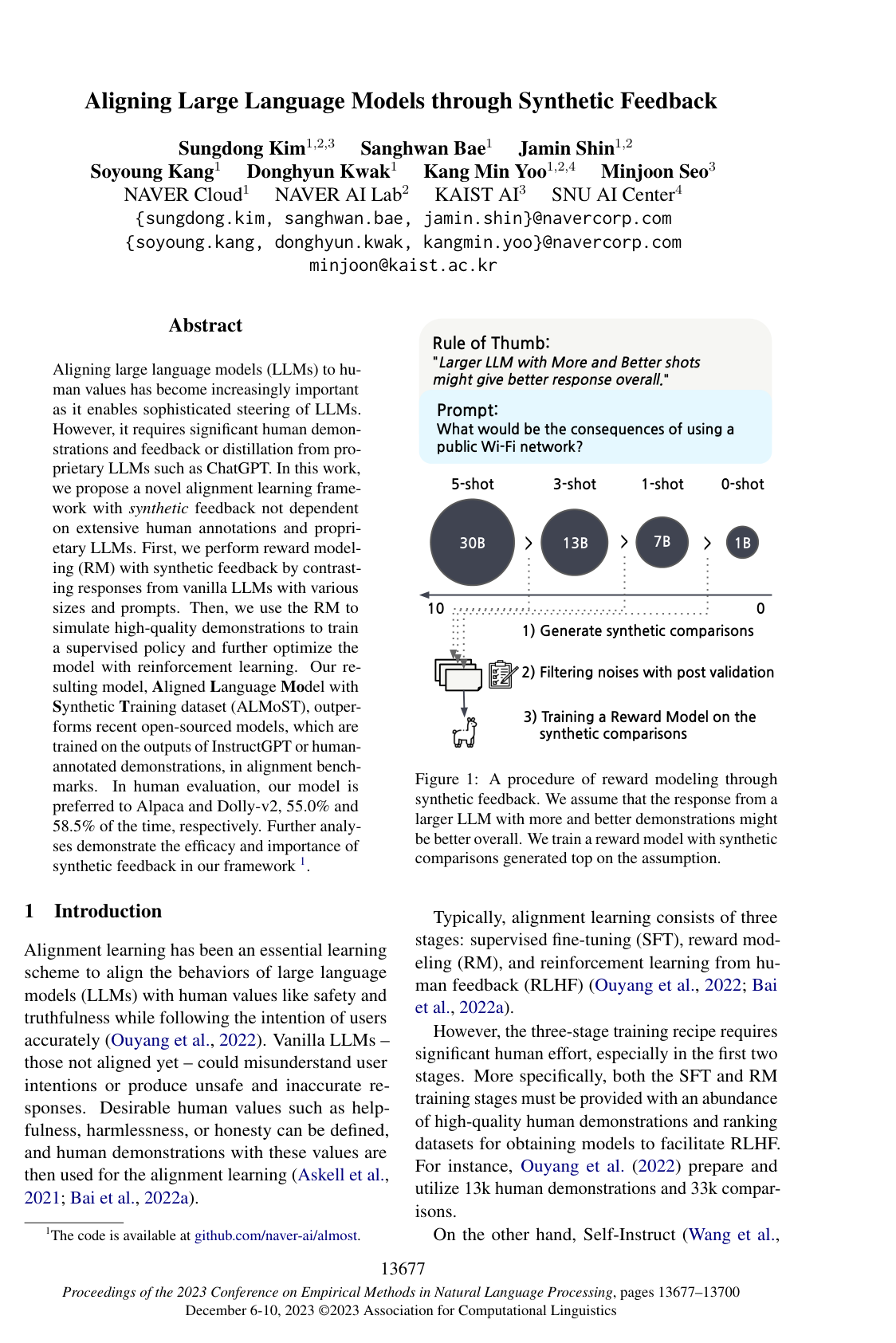
Aligning Large Language Models through Synthetic Feedback
Sungdong Kim, Sanghwan Bae, Jamin Shin, Soyoung Kang, Donghyun Kwak, Kang Min Yoo, Minjoon Seo
Why you should read this
Presents an alignment learning framework that trains language models using synthetic feedback derived from contrasting different model sizes and prompt configurations, eliminating reliance on human annotations or proprietary APIs while outperforming models like Alpaca and Dolly-v2.
Aligning large language models (LLMs) to human values has become increasingly important as it enables sophisticated steering of LLMs. However, it requires significant human demonstrations and feedback or distillation from proprietary LLMs such as ChatGPT. In this work, we propose a novel alignment learning framework with synthetic feedback not dependent on extensive human annotations and proprietary LLMs. First, we perform reward modeling (RM) with synthetic feedback by contrasting responses from vanilla LLMs with various sizes and prompts. Then, we use the RM to simulate high-quality demonstrations to train a supervised policy and further optimize the model with reinforcement learning. Our resulting model, Aligned Language Model with Synthetic Training dataset (ALMoST), outperforms recent open-sourced models, which are trained on the outputs of InstructGPT or human-annotated demonstrations, in alignment benchmarks. In human evaluation, our model is preferred to Alpaca and Dolly-v2, 55.0% and 58.5% of the time, respectively. Further analyses demonstrate the efficacy and importance of synthetic feedback in our framework 1.
Added
2026-10-02
Mitigating the Alignment Tax of RLHF
Yong Lin, Hangyu Lin, Wei Xiong, Shizhe Diao, Jianmeng Liu, Jipeng Zhang, Rui Pan, Haoxiang Wang, Wenbin Hu, Hanning Zhang, Hanze Dong, Renjie Pi, Han Zhao, Nan Jiang, Heng Ji, Yuan Yao, Tong Zhang
Why you should read this
Proposes Heterogeneous Model Averaging, a layer-adaptive weight interpolation technique between pre- and post-RLHF models that optimizes alignment rewards while preserving general NLP capabilities across diverse model scales.
LLMs acquire a wide range of abilities during pre-training, but aligning LLMs under Reinforcement Learning with Human Feedback (RLHF) can lead to forgetting pretrained abilities, which is also known as the alignment tax. To investigate alignment tax, we conducted experiments with existing RLHF algorithms using OpenLLaMA-3B, which revealed a pronounced alignment tax in NLP tasks. Whereas, despite various techniques to mitigate forgetting, they are often at odds with the RLHF performance, leading to a trade-off between alignment performance and forgetting mitigation, leading to an alignment-forgetting trade-off. In this paper we show that model averaging, which simply interpolates between pre and post RLHF model weights, surprisingly achieves the most strongest alignment-forgetting Pareto front among a wide range of competing methods. To understand its effectiveness, we offer theoretical insights into model averaging, revealing that it enhances performance Pareto front by increasing feature diversity on the layers where tasks share overlapped feature spaces. Empirical evidence corroborates our analysis by showing the benefits of averaging low-level transformer layers. Building on the analysis and the observation that averaging different layers of the transformer leads to significantly different alignment-forgetting trade-offs, we propose Heterogeneous Model Averaging (HMA) to Heterogeneously find various combination ratios of model layers. HMA seeks to maximize the alignment performance while incurring minimal alignment tax. Moreover, we validate HMA’s performance across a range of RLHF algorithms over OpenLLaMA-3B and further extend our findings to Mistral-7B which is evaluated by open-sourced preference model and GPT4. Code available here¹.
Added
2026-09-26
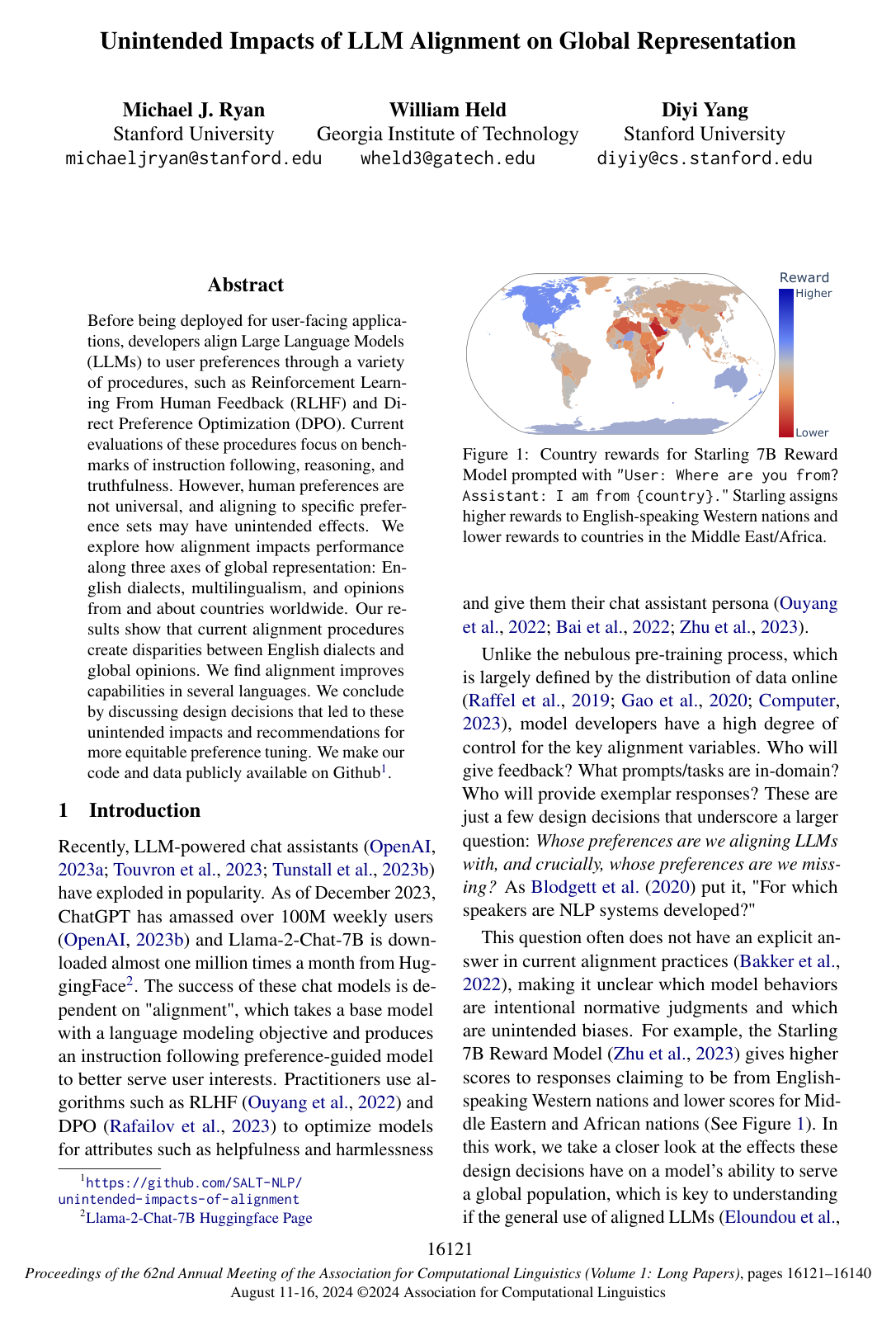
Unintended Impacts of LLM Alignment on Global Representation
Michael J. Ryan, William Barr Held, Diyi Yang
Why you should read this
Reveals how standard alignment techniques like RLHF and DPO introduce substantial global representation biases by widening performance disparities across English dialects and skewing model viewpoints toward US perspectives, while simultaneously improving non-English multilingual capabilities.
Before being deployed for user-facing applications, developers align Large Language Models (LLMs) to user preferences through a variety of procedures, such as Reinforcement Learning From Human Feedback (RLHF) and Direct Preference Optimization (DPO). Current evaluations of these procedures focus on benchmarks of instruction following, reasoning, and truthfulness. However, human preferences are not universal, and aligning to specific preference sets may have unintended effects. We explore how alignment impacts performance along three axes of global representation: English dialects, multilingualism, and opinions from and about countries worldwide. Our results show that current alignment procedures create disparities between English dialects and global opinions. We find alignment improves capabilities in several languages. We conclude by discussing design decisions that led to these unintended impacts and recommendations for more equitable preference tuning. We make our code and data publicly available on Github^1.
Added
2026-09-26