
keyword
Massive Multitask Language Understanding
Massive Multitask Language Understanding (MMLU) is a standardized benchmark designed to evaluate the factual knowledge, reasoning capability, and academic problem-solving skills of large language models across a wide spectrum of disciplines. Introduced to assess how well artificial intelligence models acquire and apply general world knowledge, the benchmark consists of multiple-choice questions covering 57 distinct subjects spanning the humanities, social sciences, STEM fields, medicine, and professional law. These questions range in difficulty from elementary levels to advanced collegiate and professional standards, typically evaluated in zero-shot or few-shot settings to measure a model's breadth of comprehension and multitask generalization without task-specific fine-tuning.
34 items
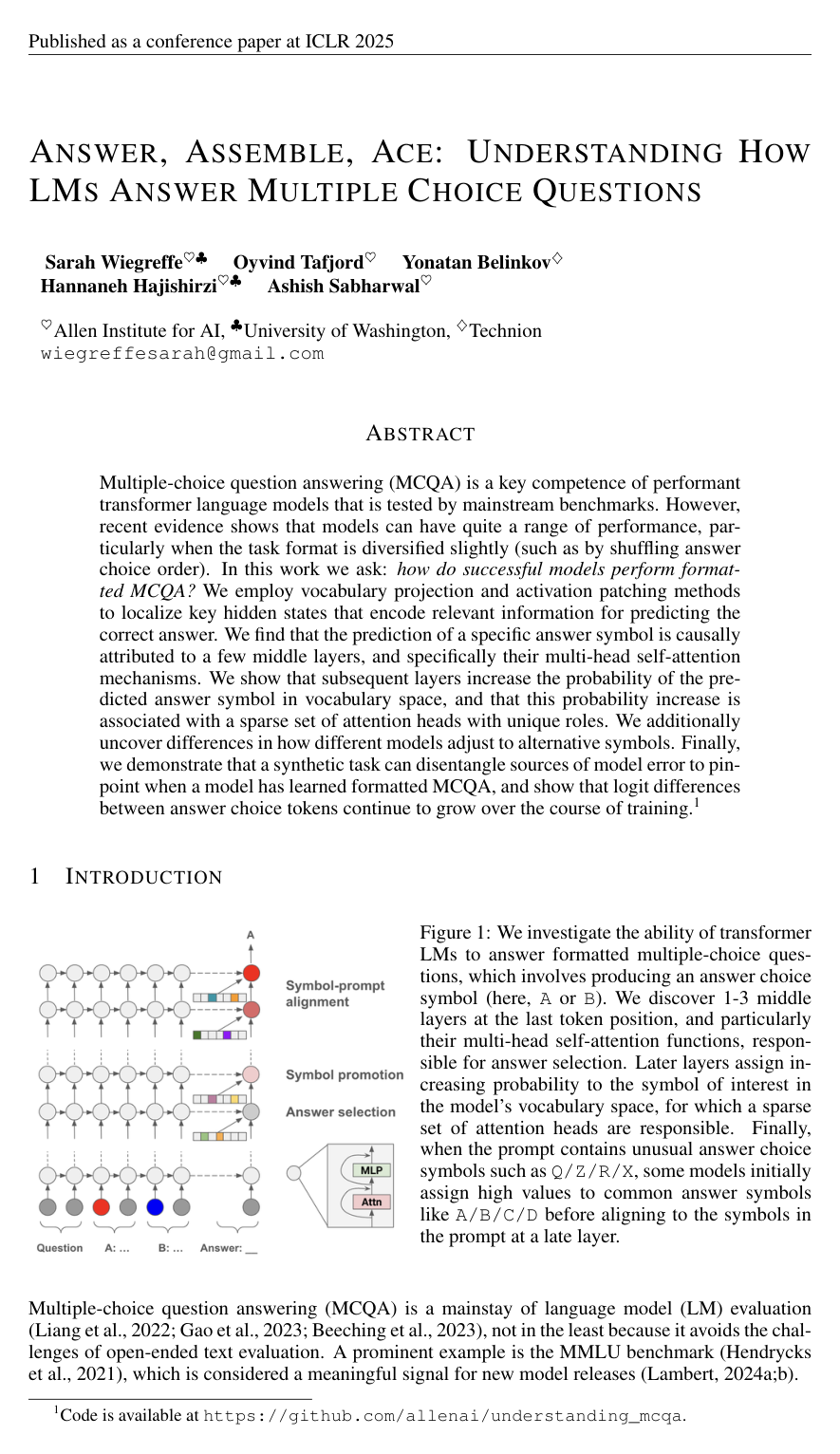
Answer, Assemble, Ace: Understanding How LMs Answer Multiple Choice Questions
Sarah Wiegreffe, Oyvind Tafjord, Yonatan Belinkov, Hannaneh Hajishirzi, Ashish Sabharwal
Why you should read this
Reveals how language models internally process multiple-choice questions by identifying the specific middle-layer attention heads that select candidate choices and the late-stage circuits that amplify the predicted answer symbol.
Multiple-choice question answering (MCQA) is a key competence of performant transformer language models that is tested by mainstream benchmarks. However, recent evidence shows that models can have quite a range of performance, particularly when the task format is diversified slightly (such as by shuffling answer choice order). In this work we ask: how do successful models perform formatted MCQA? We employ vocabulary projection and activation patching methods to localize key hidden states that encode relevant information for predicting the correct answer. We find that the prediction of a specific answer symbol is causally attributed to a few middle layers, and specifically their multi-head self-attention mechanisms. We show that subsequent layers increase the probability of the predicted answer symbol in vocabulary space, and that this probability increase is associated with a sparse set of attention heads with unique roles. We additionally uncover differences in how different models adjust to alternative symbols. Finally, we demonstrate that a synthetic task can disentangle sources of model error to pinpoint when a model has learned formatted MCQA, and show that logit differences between answer choice tokens continue to grow over the course of training.
Added
2026-10-05
A Simple and Effective Pruning Approach for Large Language Models
Mingjie Sun, Zhuang Liu, Anna Bair, J. Kolter
Why you should read this
Introduces Wanda, a post-training pruning method that sparsifies large language models by evaluating the product of weight magnitudes and input activations, matching computationally expensive alternatives without requiring retraining or weight updates.
As their size increases, Large Languages Models (LLMs) are natural candidates for network pruning methods: approaches that drop a subset of network weights while striving to preserve performance. Existing methods, however, require either retraining, which is rarely affordable for billion-scale LLMs, or solving a weight reconstruction problem reliant on second-order information, which may also be computationally expensive. In this paper, we introduce a novel, straightforward yet effective pruning method, termed Wanda (Pruning by Weights and activations), designed to induce sparsity in pretrained LLMs. Motivated by the recent observation of emergent large magnitude features in LLMs, our approach prunes weights with the smallest magnitudes multiplied by the corresponding input activations, on a per-output basis. Notably, Wanda requires no retraining or weight update, and the pruned LLM can be used as is. We conduct a thorough evaluation of our method Wanda on LLaMA and LLaMA-2 across various language benchmarks. Wanda significantly outperforms the established baseline of magnitude pruning and performs competitively against recent method involving intensive weight update. Code is available at this https URL.
Added
2026-10-05
IrokoBench: A New Benchmark for African Languages in the Age of Large Language Models
David Ifeoluwa Adelani, Jessica Ojo, Israel Abebe Azime, Jian Yun Zhuang, Jesujoba Oluwadara Alabi, Xuanli He, Millicent Ochieng, Sara Hooker, Andiswa Bukula, En-Shiun Annie Lee, Chiamaka Ijeoma Chukwuneke, Happy Buzaaba, Blessing K. Sibanda, Godson Koffi Kalipe, Jonathan Mukiibi, Salomon Kabongo Kabenamualu, Foutse Yuehgoh, Mmasibidi Setaka, Lolwethu Ndolela, Nkiruka Odu, Rooweither Mabuya, Salomey Osei, Shamsuddeen Hassan Muhammad, Sokhar Samb, Tadesse Kebede Guge, Tombekai Vangoni Sherman, Pontus Stenetorp
Why you should read this
Introduces IrokoBench, a human-translated benchmark across 17 African languages that evaluates 16 open and proprietary language models on natural language inference, mathematical reasoning, and question answering to measure performance disparities against high-resource languages.
Despite the widespread adoption of Large language models (LLMs), their remarkable capabilities remain limited to a few high-resource languages. Additionally, many low-resource languages (\eg African languages) are often evaluated only on basic text classification tasks due to the lack of appropriate or comprehensive benchmarks outside of high-resource languages. In this paper, we introduce IrokoBench -- a human-translated benchmark dataset for 17 typologically-diverse low-resource African languages covering three tasks: natural language inference~(AfriXNLI), mathematical reasoning~(AfriMGSM), and multi-choice knowledge-based question answering~(AfriMMLU). We use IrokoBench to evaluate zero-shot, few-shot, and translate-test settings~(where test sets are translated into English) across 10 open and six proprietary LLMs. Our evaluation reveals a significant performance gap between high-resource languages~(such as English and French) and low-resource African languages. We observe a significant performance gap between open and proprietary models, with the highest performing open model, Gemma 2 27B only at 63\% of the best-performing proprietary model GPT-4o performance. In addition, machine translating the test set to English before evaluation helped to close the gap for larger models that are English-centric, such as Gemma 2 27B and LLaMa 3.1 70B. These findings suggest that more efforts are needed to develop and adapt LLMs for African languages.
Added
2026-10-04
MoH: Multi-Head Attention as Mixture-of-Head Attention
Peng Jin, Bo Zhu, Li Yuan, Shuicheng Yan
Why you should read this
Proposes Mixture-of-Head attention, a parameter-neutral architecture that dynamically routes tokens to a subset of attention heads using weighted summation to cut computation while improving accuracy across vision models, diffusion models, and large language models.
In this work, we upgrade the multi-head attention mechanism, the core of the Transformer model, to reduce computational costs while maintaining or surpassing the previous accuracy level. We show that multi-head attention can be expressed in the summation form. Drawing on the insight that not all attention heads hold equal significance, we propose Mixture-of-Head attention (MoH), a new architecture that treats attention heads as experts in the Mixture-of-Experts (MoE) mechanism. MoH has two significant advantages: First, MoH enables each token to select the appropriate attention heads, enhancing inference efficiency without compromising accuracy or increasing the number of parameters. Second, MoH replaces the standard summation in multi-head attention with a weighted summation, introducing flexibility to the attention mechanism and unlocking extra performance potential. Extensive experiments on ViT, DiT, and LLMs demonstrate that MoH outperforms multi-head attention by using only 50%~90% of the attention heads. Moreover, we demonstrate that pre-trained multi-head attention models, such as LLaMA3-8B, can be further continue-tuned into our MoH models. Notably, MoH-LLaMA3-8B achieves an average accuracy of 64.0% across 14 benchmarks, outperforming LLaMA3-8B by 2.4% by utilizing only 75% of the attention heads. We believe the proposed MoH is a promising alternative to multi-head attention and provides a strong foundation for developing advanced and efficient attention-based models. The code is available at https://github.com/SkyworkAI/MoH.
Added
2026-10-04
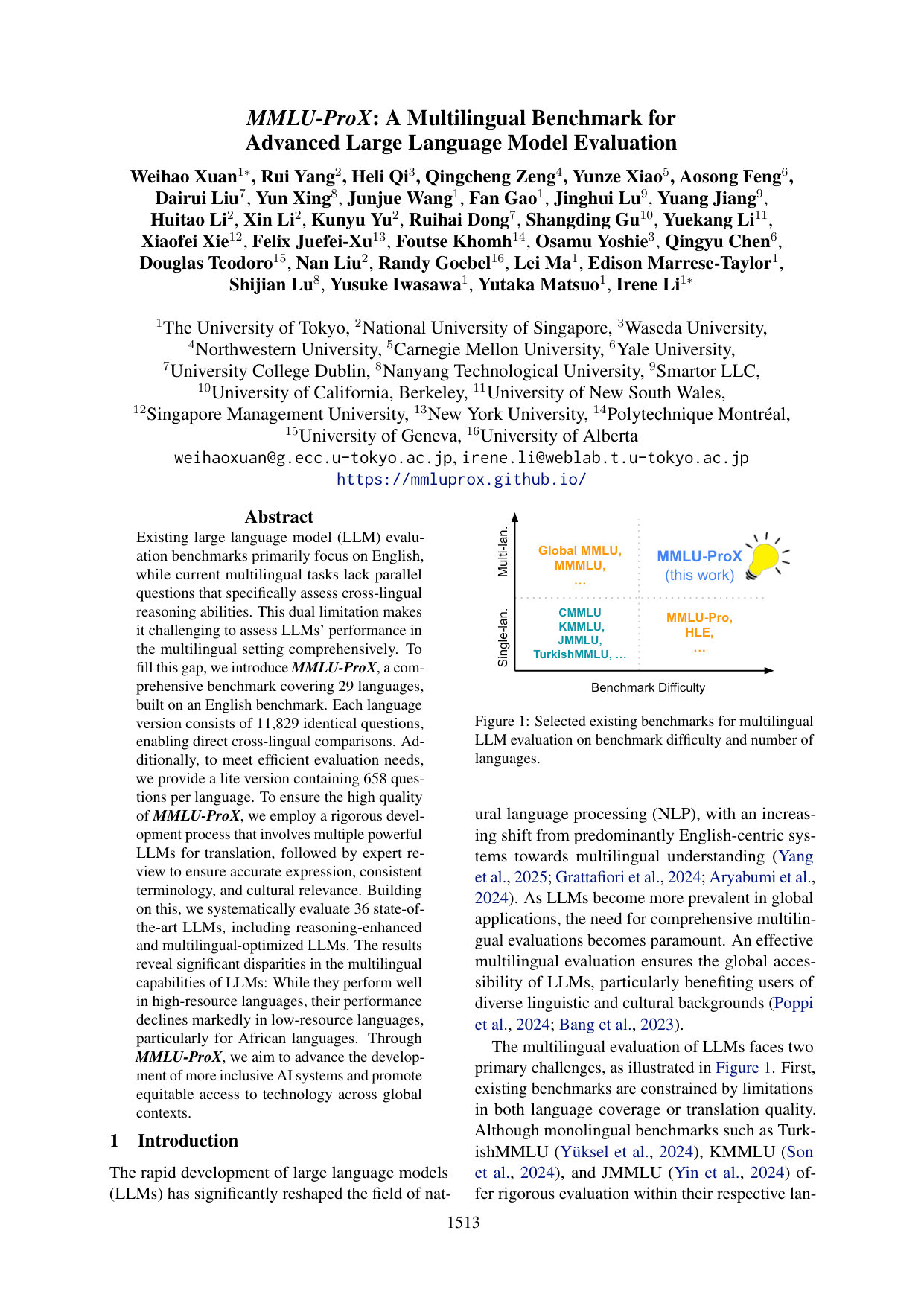
MMLU-ProX: A Multilingual Benchmark for Advanced Large Language Model Evaluation
Weihao Xuan, Rui Yang, Heli Qi, Qingcheng Zeng, Yunze Xiao, Aosong Feng, Dairui Liu, Yun Xing, Junjue Wang, Fan Gao, Jinghui Lu, Yuang Jiang, Huitao Li, Xin Li, Kunyu Yu, Ruihai Dong, Shangding Gu, Yuekang Li, Xiaofei Xie, Felix Juefei-Xu, Foutse Khomh, Osamu Yoshie, Qingyu Chen, Douglas Teodoro, Nan Liu, Randy Goebel, Lei Ma, Edison Marrese-Taylor, Shijian Lu, Yusuke Iwasawa, Yutaka Matsuo, Irene Li
Why you should read this
Presents MMLU-ProX, an expert-verified benchmark spanning 29 languages with parallel 10-choice questions, exposing critical cross-lingual reasoning performance drops in low-resource languages across 36 state-of-the-art large language models.
Existing large language model (LLM) evaluation benchmarks primarily focus on English, while current multilingual tasks lack parallel questions that specifically assess cross-lingual reasoning abilities. This dual limitation makes it challenging to assess LLMs’ performance in the multilingual setting comprehensively. To fill this gap, we introduce MMLU-ProX, a comprehensive benchmark covering 29 languages, built on an English benchmark. Each language version consists of 11,829 identical questions, enabling direct cross-lingual comparisons. Additionally, to meet efficient evaluation needs, we provide a lite version containing 658 questions per language. To ensure the high quality of MMLU-ProX, we employ a rigorous development process that involves multiple powerful LLMs for translation, followed by expert review to ensure accurate expression, consistent terminology, and cultural relevance. Building on this, we systematically evaluate 36 state-of-the-art LLMs, including reasoning-enhanced and multilingual-optimized LLMs. The results reveal significant disparities in the multilingual capabilities of LLMs: While they perform well in high-resource languages, their performance declines markedly in low-resource languages, particularly for African languages. Through MMLU-ProX, we aim to advance the development of more inclusive AI systems and promote equitable access to technology across global contexts.
Added
2026-10-03
ChiMed-GPT: A Chinese Medical Large Language Model with Full Training Regime and Better Alignment to Human Preferences
Yuanhe Tian, Ruyi Gan, Yan Song, Jiaxing Zhang, Yongdong Zhang
Why you should read this
Develops ChiMed-GPT, an open-source Chinese medical large language model trained through continual pre-training, supervised fine-tuning, and rejection-sampling-based reinforcement learning from human feedback to generate accurate, safe clinical responses with an extended context window.
Added
2026-10-02
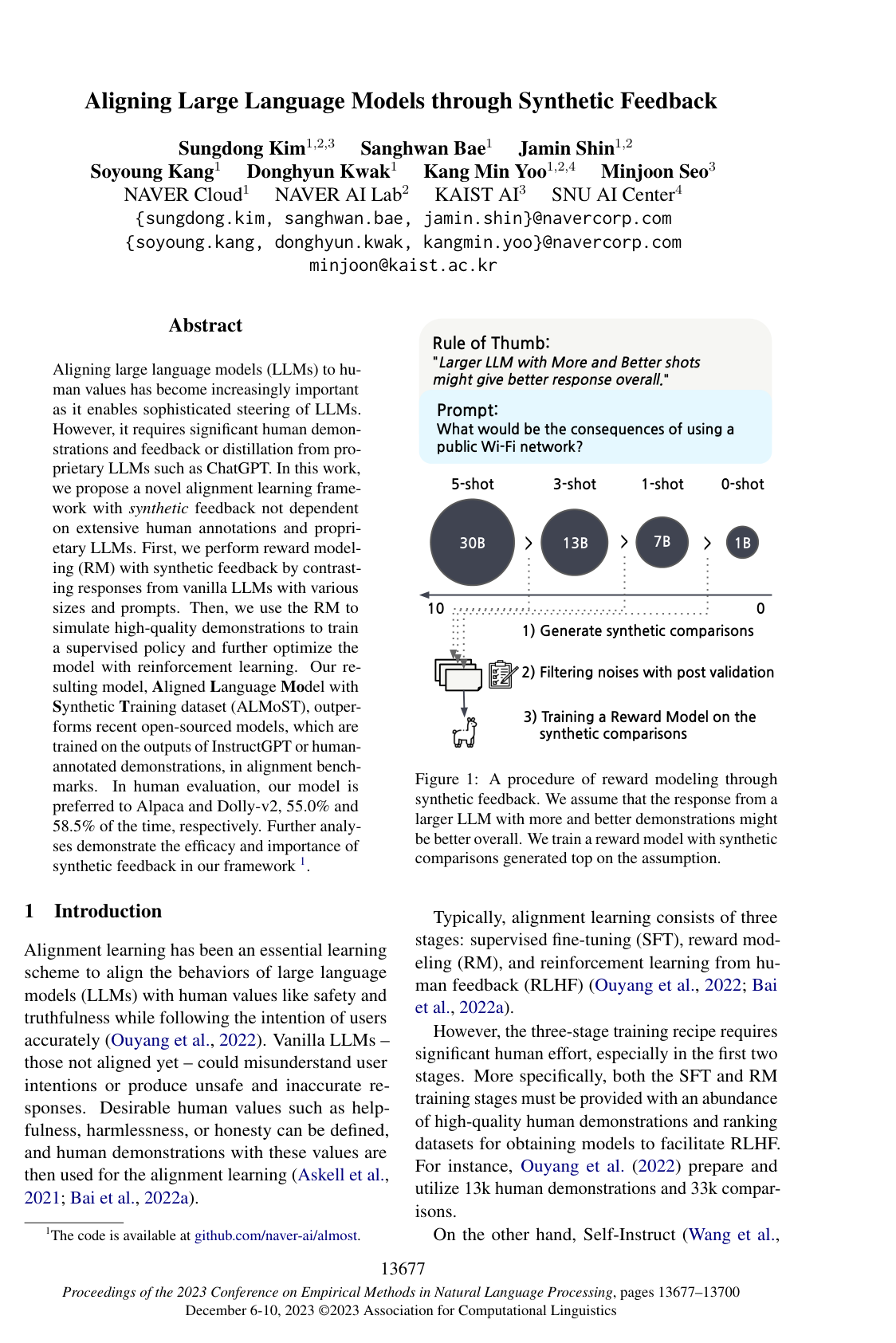
Aligning Large Language Models through Synthetic Feedback
Sungdong Kim, Sanghwan Bae, Jamin Shin, Soyoung Kang, Donghyun Kwak, Kang Min Yoo, Minjoon Seo
Why you should read this
Presents an alignment learning framework that trains language models using synthetic feedback derived from contrasting different model sizes and prompt configurations, eliminating reliance on human annotations or proprietary APIs while outperforming models like Alpaca and Dolly-v2.
Aligning large language models (LLMs) to human values has become increasingly important as it enables sophisticated steering of LLMs. However, it requires significant human demonstrations and feedback or distillation from proprietary LLMs such as ChatGPT. In this work, we propose a novel alignment learning framework with synthetic feedback not dependent on extensive human annotations and proprietary LLMs. First, we perform reward modeling (RM) with synthetic feedback by contrasting responses from vanilla LLMs with various sizes and prompts. Then, we use the RM to simulate high-quality demonstrations to train a supervised policy and further optimize the model with reinforcement learning. Our resulting model, Aligned Language Model with Synthetic Training dataset (ALMoST), outperforms recent open-sourced models, which are trained on the outputs of InstructGPT or human-annotated demonstrations, in alignment benchmarks. In human evaluation, our model is preferred to Alpaca and Dolly-v2, 55.0% and 58.5% of the time, respectively. Further analyses demonstrate the efficacy and importance of synthetic feedback in our framework 1.
Added
2026-10-02
Rationale-Guided Retrieval Augmented Generation for Medical Question Answering
Jiwoong Sohn, Yein Park, Chanwoong Yoon, Sihyeon Park, Hyeon Hwang, Mujeen Sung, Hyunjae Kim, Jaewoo Kang
Why you should read this
Proposes a biomedical question-answering framework that boosts accuracy by using model-generated rationales for query formulation, balancing retrieval across diverse medical corpora, and filtering out distracting context with a perplexity-trained lightweight model.
Large language models (LLM) hold significant potential for applications in biomedicine, but they struggle with hallucinations and outdated knowledge. While retrieval-augmented generation (RAG) is generally employed to address these issues, it also has its own set of challenges: (1) LLMs are vulnerable to irrelevant or unhelpful context, (2) medical queries are often not well-targeted for helpful information, and (3) retrievers are prone to bias toward the specific source corpus they were trained on. In this study, we present RAG² (Rationale-Guided RAG), a new framework for enhancing the reliability of RAG in biomedical contexts. RAG² incorporates three key innovations: a small filtering model trained on perplexity-based labels of rationales, which selectively augments informative snippets of documents while filtering out distractors; LLM-generated rationales as queries to improve the utility of retrieved snippets; a structure designed to retrieve snippets evenly from a comprehensive set of four biomedical corpora, effectively mitigating retriever bias. Our experiments demonstrate that RAG² improves the state-of-the-art LLMs of varying sizes, with improvements of up to 6.1%, and it outperforms the previous best medical RAG model by up to 5.6% across three medical question-answering benchmarks. Our code is available at https://github.com/dmis-lab/RAG2
Added
2026-09-26
Machine Unlearning of Pre-trained Large Language Models
Jin Yao, Eli Chien, Minxin Du, Xinyao Niu, Tianhao Wang, Zezhou Cheng, Xiang Yue
Why you should read this
Presents a unified framework and benchmark evaluating seven machine unlearning methods on pre-trained large language models, demonstrating that targeted gradient-based updates can remove copyrighted or private training data over 100,000 times faster than full retraining while preserving overall model utility.
This study investigates the concept of the ‘right to be forgotten’ within the context of large language models (LLMs). We explore machine unlearning as a pivotal solution, with a focus on pre-trained models–a notably under-researched area. Our research delineates a comprehensive framework for machine unlearning in pre-trained LLMs, encompassing a critical analysis of seven diverse unlearning methods. Through rigorous evaluation using curated datasets from arXiv, books, and GitHub, we establish a robust benchmark for unlearning performance, demonstrating that these methods are over 10⁵ times more computationally efficient than retraining. Our results show that integrating gradient ascent with gradient descent on in-distribution data improves hyperparameter robustness. We also provide detailed guidelines for efficient hyperparameter tuning in the unlearning process. Our findings advance the discourse on ethical AI practices, offering substantive insights into the mechanics of machine unlearning for pre-trained LLMs and underscoring the potential for responsible AI development.
Added
2026-09-26
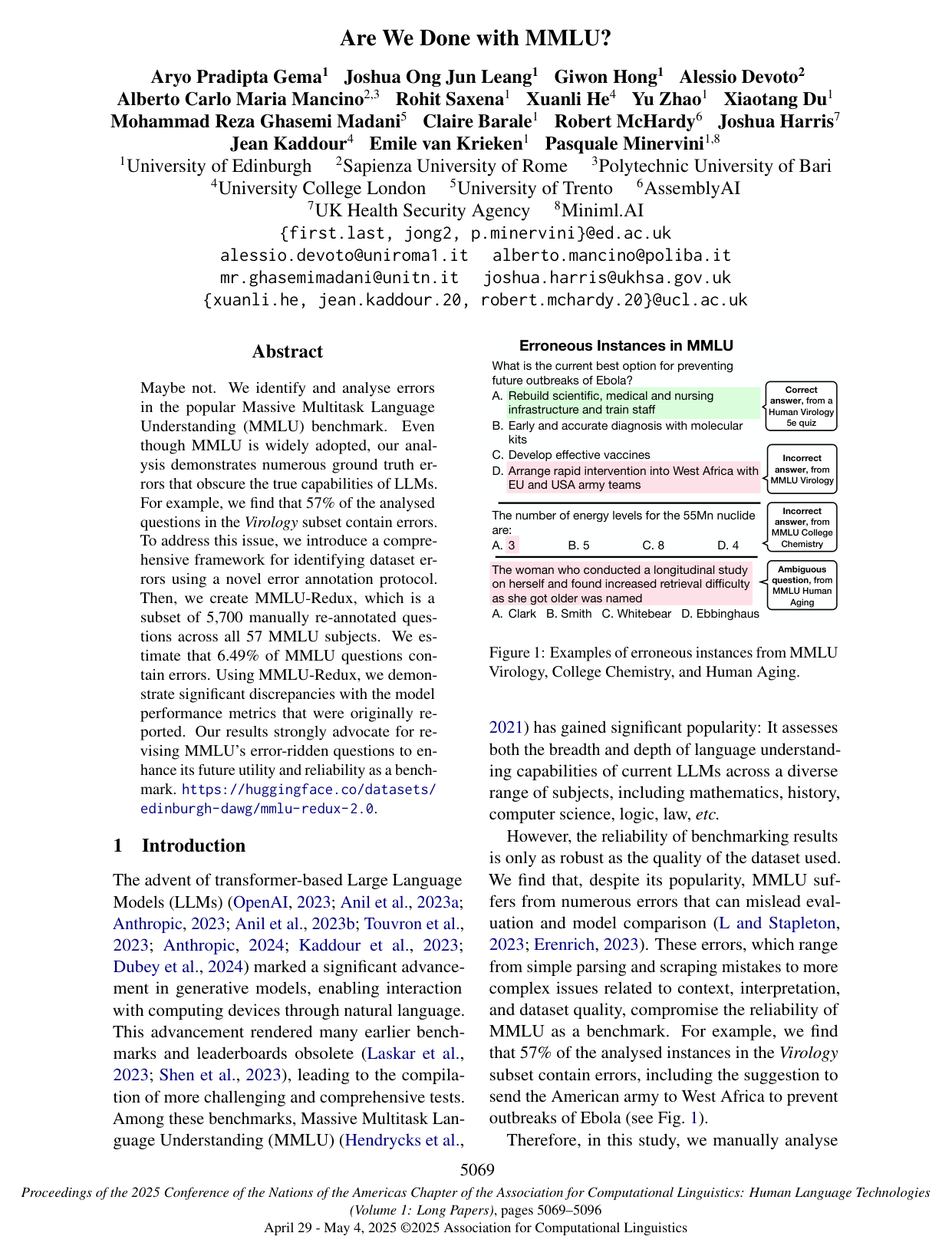
Are We Done with MMLU?
Aryo Pradipta Gema, Joshua Ong Jun Leang, Giwon Hong, Alessio Devoto, Alberto Carlo Maria Mancino, Rohit Saxena, Xuanli He, Yu Zhao, Xiaotang Du, Mohammad Reza Ghasemi Madani, Claire Barale, Robert McHardy, Joshua Harris, Jean Kaddour, Emile van Krieken, Pasquale Minervini
Why you should read this
Reveals widespread ground-truth errors across the MMLU benchmark and provides a corrected 5,700-question dataset that alters established large language model rankings.
Maybe not. We identify and analyse errors in the popular Massive Multitask Language Understanding (MMLU) benchmark. Even though MMLU is widely adopted, our analysis demonstrates numerous ground truth errors that obscure the true capabilities of LLMs. For example, we find that 57% of the analysed questions in the Virology subset contain errors. To address this issue, we introduce a comprehensive framework for identifying dataset errors using a novel error annotation protocol. Then, we create MMLU-Redux, which is a subset of 5,700 manually re-annotated questions across all 57 MMLU subjects. We estimate that 6.49% of MMLU questions contain errors. Using MMLU-Redux, we demonstrate significant discrepancies with the model performance metrics that were originally reported. Our results strongly advocate for revising MMLU's error-ridden questions to enhance its future utility and reliability as a benchmark. https://huggingface.co/datasets/edinburgh-dawg/mmlu-redux-2.0.
Added
2026-09-26
Position: TrustLLM: Trustworthiness in Large Language Models
Yue Huang, Lichao Sun, Haoran Wang, Siyuan Wu, Qihui Zhang, Yuan Li, Chujie Gao, Yixin Huang, Wenhan Lyu, Yixuan Zhang, Xiner Li, Hanchi Sun, Zhengliang Liu, Yixin Liu, Yijue Wang, Zhikun Zhang, Bertie Vidgen, Bhavya Kailkhura, Caiming Xiong, Chaowei Xiao, Chunyuan Li, Eric P. Xing, Furong Huang, Hao Liu, Heng Ji, Hongyi Wang, Huan Zhang, Huaxiu Yao, Manolis Kellis, Marinka Zitnik, Meng Jiang, Mohit Bansal, James Zou, Jian Pei, Jian Liu, Jianfeng Gao, Jiawei Han, Jieyu Zhao, Jiliang Tang, Jindong Wang, Joaquin Vanschoren, John C. Mitchell, Kai Shu, Kaidi Xu, Kai-Wei Chang, Lifang He, Lifu Huang, Michael Backes, Neil Zhenqiang Gong, Philip S. Yu, Pin-Yu Chen, Quanquan Gu, Ran Xu, Rex Ying, Shuiwang Ji, Suman Jana, Tianlong Chen, Tianming Liu, Tianyi Zhou, William Wang, Xiang Li, Xiangliang Zhang, Xiao Wang, Xing Xie, Xun Chen, Xuyu Wang, Yan Liu, Yanfang Ye, Yinzhi Cao, Yong Chen, Yue Zhao
Why you should read this
Establishes a standardized framework and 30-dataset benchmark across six core dimensions to rigorously evaluate the trustworthiness of 16 mainstream large language models, revealing key performance gaps between proprietary and open-source systems.
Large language models (LLMs) have gained considerable attention for their excellent natural language processing capabilities. Nonetheless, these LLMs present many challenges, particularly in the realm of trustworthiness. This paper introduces TRUSTLLM, a comprehensive study of trustworthiness in LLMs, including principles for different dimensions of trustworthiness, established benchmark, evaluation, and analysis of trustworthiness for mainstream LLMs, and discussion of open challenges and future directions. Specifically, we first propose a set of principles for trustworthy LLMs that span eight different dimensions. Based on these principles, we further establish a benchmark across six dimensions including truthfulness, safety, fairness, robustness, privacy, and machine ethics. We then present a study evaluating 16 mainstream LLMs in TRUSTLLM, consisting of over 30 datasets. Our findings firstly show that in general trustworthiness and capability (i.e., functional effectiveness) are positively related. Secondly, our observations reveal that proprietary LLMs generally outperform most open-source counterparts in terms of trustworthiness, raising concerns about the potential risks of widely accessible open-source LLMs. However, a few open-source LLMs come very close to proprietary ones, suggesting that open-source models can achieve high levels of trustworthiness without additional mechanisms like moderator, offering valuable insights for developers in this field. Thirdly, it is important to note that some LLMs may be overly calibrated towards exhibiting trustworthiness, to the extent that they compromise their utility by mistakenly treating benign prompts as harmful and consequently not responding. Besides these observations, we've uncovered key insights into the multifaceted trustworthiness in LLMs. We emphasize the importance of ensuring transparency not only in the models themselves but also in the technologies that underpin trustworthiness. We advocate that the establishment of an AI alliance between industry, academia, and the open-source community to foster collaboration is imperative to advance the
Added
2026-09-26
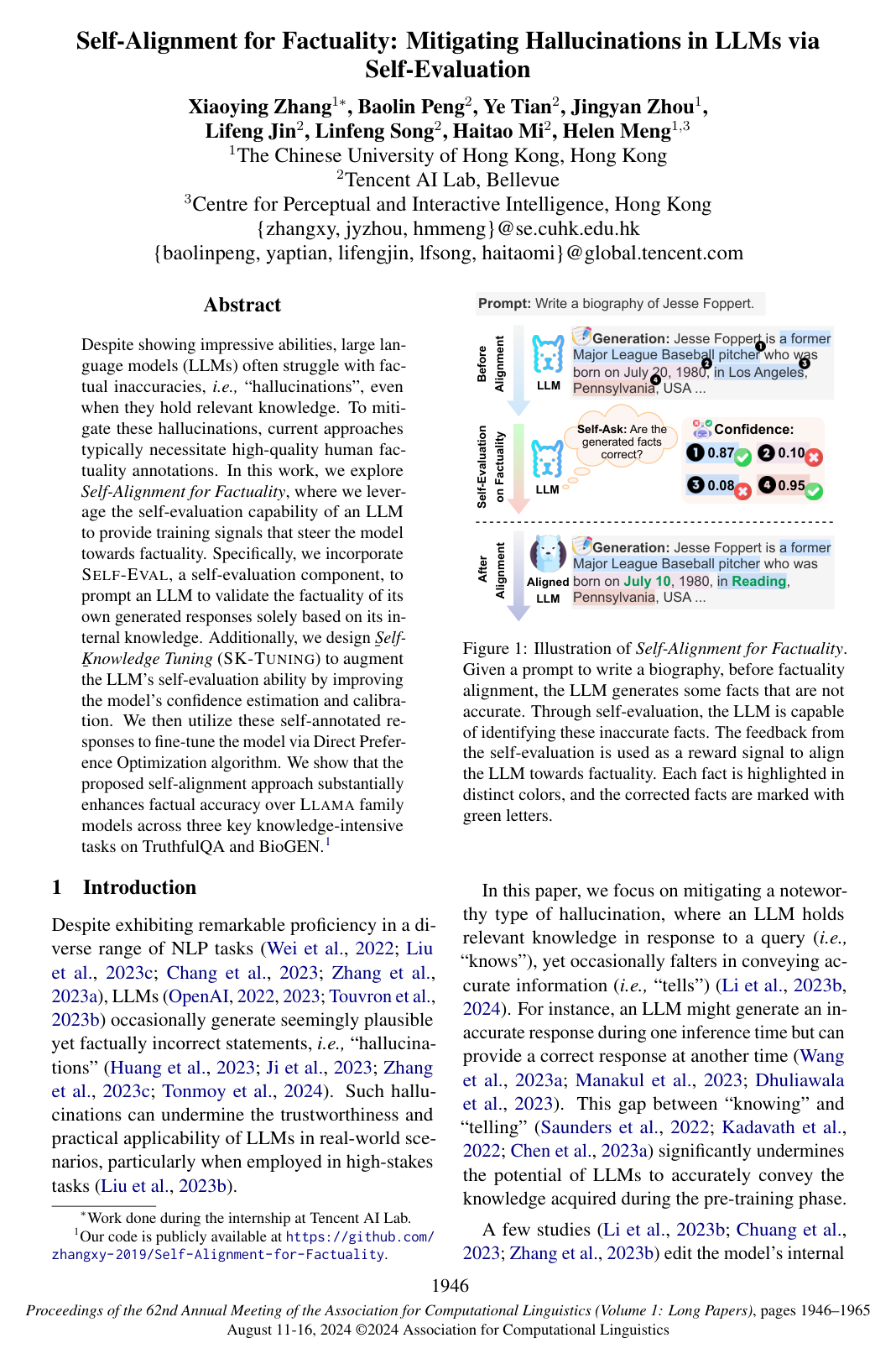
Self-Alignment for Factuality: Mitigating Hallucinations in LLMs via Self-Evaluation
Xiaoying Zhang, Baolin Peng, Ye Tian, Jingyan Zhou, Lifeng Jin, Linfeng Song, Haitao Mi, Helen Meng
Why you should read this
Proposes a self-alignment framework that mitigates hallucinations by training large language models to self-evaluate their own factual accuracy and using those internal confidence scores to guide preference optimization without human annotations.
Despite showing impressive abilities, large language models (LLMs) often struggle with factual inaccuracies, i.e., “hallucinations”, even when they hold relevant knowledge. To mitigate these hallucinations, current approaches typically necessitate high-quality human factuality annotations. In this work, we explore Self-Alignment for Factuality, where we leverage the self-evaluation capability of an LLM to provide training signals that steer the model towards factuality. Specifically, we incorporate Self-Eval, a self-evaluation component, to prompt an LLM to validate the factuality of its own generated responses solely based on its internal knowledge. Additionally, we design Self-Knowledge Tuning (SK-Tuning) to augment the LLM’s self-evaluation ability by improving the model’s confidence estimation and calibration. We then utilize these self-annotated responses to fine-tune the model via Direct Preference Optimization algorithm. We show that the proposed self-alignment approach substantially enhances factual accuracy over LLAMA family models across three key knowledge-intensive tasks on TruthfulQA and BioGEN.¹
Added
2026-09-26
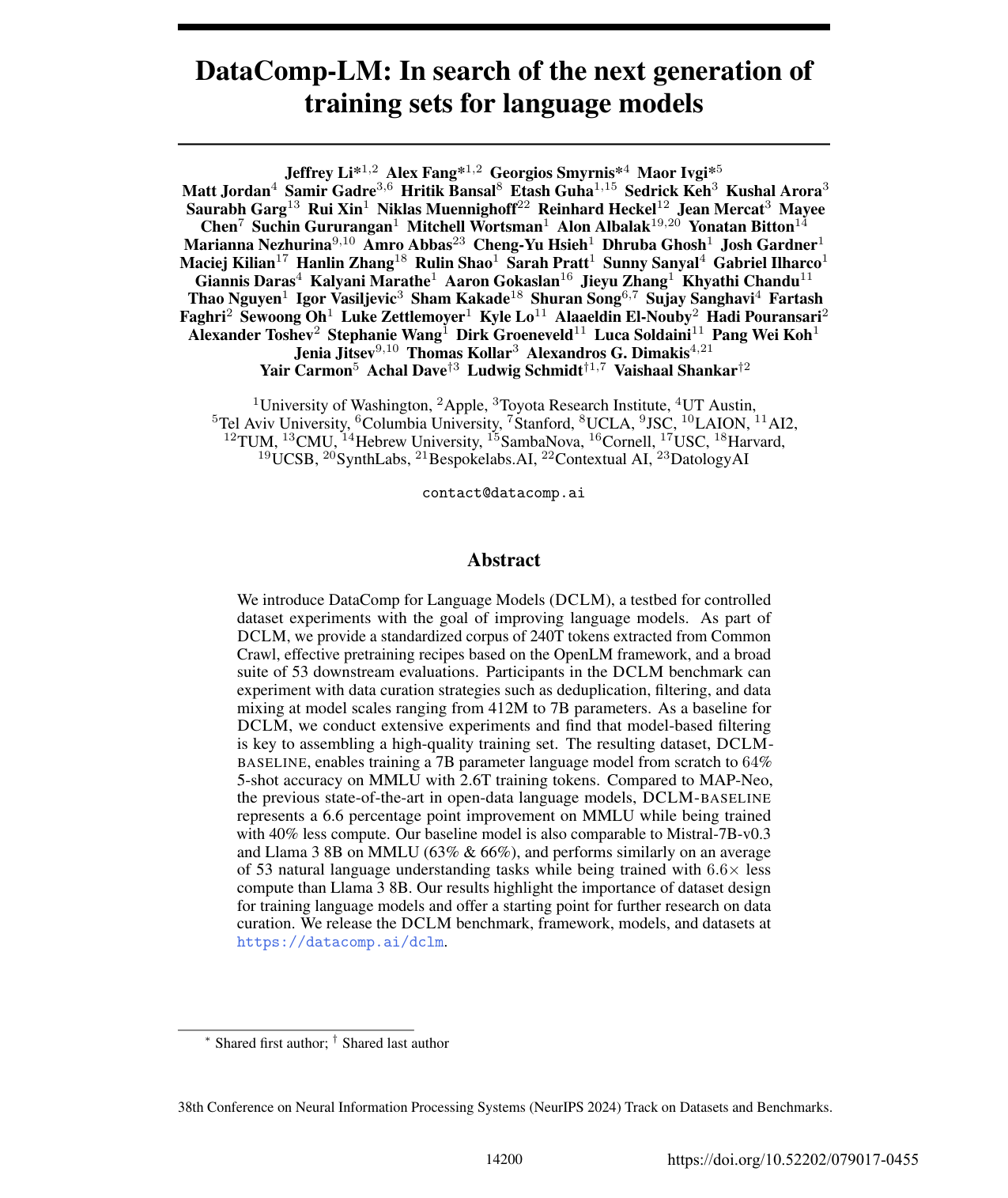
DataComp-LM: In search of the next generation of training sets for language models
Jeffrey Li, Alex Fang, Georgios Smyrnis, Maor Ivgi, Matt Jordan, Samir Yitzhak Gadre, Hritik Bansal, Etash Kumar Guha, Sedrick Scott Keh, Kushal Arora, Saurabh Garg, Rui Xin, Niklas Muennighoff, Reinhard Heckel, Jean Mercat, Mayee F. Chen, Suchin Gururangan, Mitchell Wortsman, Alon Albalak, Yonatan Bitton, Marianna Nezhurina, Amro Abbas, Cheng-Yu Hsieh, Dhruba Ghosh, Josh Gardner, Maciej Kilian, Hanlin Zhang, Rulin Shao, Sarah M. Pratt, Sunny Sanyal, Gabriel Ilharco, Giannis Daras, Kalyani Marathe, Aaron Gokaslan, Jieyu Zhang, Khyathi Raghavi Chandu, Thao Nguyen, Igor Vasiljevic, Sham M. Kakade, Shuran Song, Sujay Sanghavi, Fartash Faghri, Sewoong Oh, Luke Zettlemoyer, Kyle Lo, Alaaeldin El-Nouby, Hadi Pouransari, Alexander Toshev, Stephanie Wang, Dirk Groeneveld, Luca Soldaini, Pang Wei Koh, Jenia Jitsev, Thomas Kollar, Alex Dimakis, Yair Carmon, Achal Dave, Ludwig Schmidt, Vaishaal Shankar
Why you should read this
Introduces a standardized benchmark and 240-trillion-token corpus for controlled data curation experiments, yielding an open training dataset that enables a 7B-parameter language model to match leading open-weight models while requiring up to six times less compute.
We introduce DataComp for Language Models (DCLM), a testbed for controlled dataset experiments with the goal of improving language models. As part of DCLM, we provide a standardized corpus of 240T tokens extracted from Common Crawl, effective pretraining recipes based on the OpenLM framework, and a broad suite of 53 downstream evaluations. Participants in the DCLM benchmark can experiment with data curation strategies such as deduplication, filtering, and data mixing at model scales ranging from 412M to 7B parameters. As a baseline for DCLM, we conduct extensive experiments and find that model-based filtering is key to assembling a high-quality training set. The resulting dataset, DCLM-BASELINE, enables training a 7B parameter language model from scratch to 64% 5-shot accuracy on MMLU with 2.6T training tokens. Compared to MAP-Neo, the previous state-of-the-art in open-data language models, DCLM-BASELINE represents a 6.6 percentage point improvement on MMLU while being trained with 40% less compute. Our baseline model is also comparable to Mistral-7B-v0.3 and Llama 3 8B on MMLU (63% & 66%), and performs similarly on an average of 53 natural language understanding tasks while being trained with 6.6× less compute than Llama 3 8B. Our results highlight the importance of dataset design for training language models and offer a starting point for further research on data curation. We release the DCLM benchmark, framework, models, and datasets at https://datacomp.ai/dclm.
Added
2026-09-26
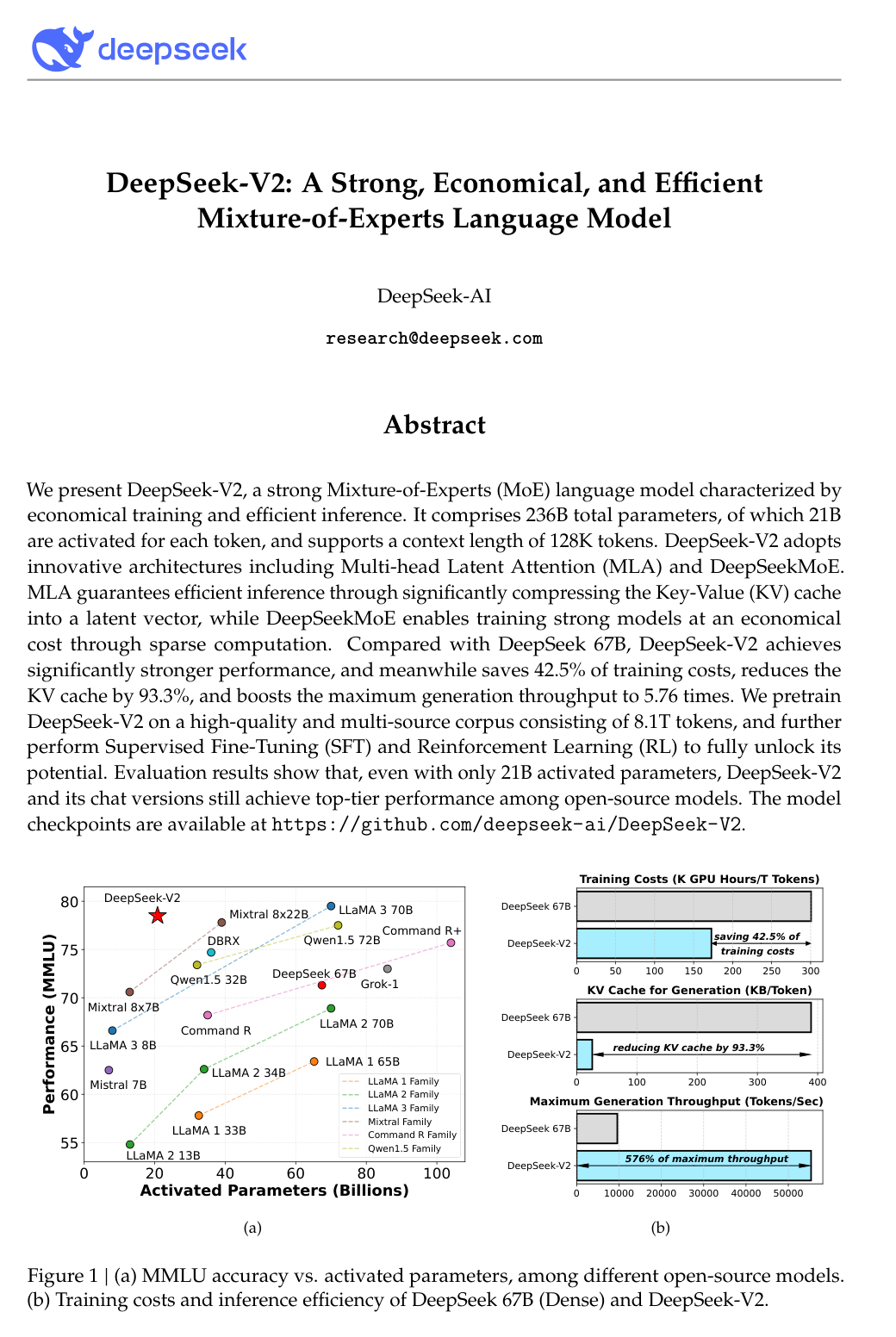
DeepSeek-V2: A Strong, Economical, and Efficient Mixture-of-Experts Language Model
Zhihong Shao, Damai Dai, Daya Guo, Zihan Wang, Huajian Xin
Why you should read this
Introduces DeepSeek-V2, a 236-billion-parameter Mixture-of-Experts model that activates only 21 billion parameters per token and uses Multi-head Latent Attention to reduce Key-Value cache memory by 93.3% while achieving top-tier open-source performance at significantly lower training and inference costs.
We present DeepSeek-V2, a strong Mixture-of-Experts (MoE) language model characterized by economical training and efficient inference. It comprises 236B total parameters, of which 21B are activated for each token, and supports a context length of 128K tokens. DeepSeek-V2 adopts innovative architectures including Multi-head Latent Attention (MLA) and DeepSeekMoE. MLA guarantees efficient inference through significantly compressing the Key-Value (KV) cache into a latent vector, while DeepSeekMoE enables training strong models at an economical cost through sparse computation. Compared with DeepSeek 67B, DeepSeek-V2 achieves significantly stronger performance, and meanwhile saves 42.5% of training costs, reduces the KV cache by 93.3%, and boosts the maximum generation throughput to 5.76 times. We pretrain DeepSeek-V2 on a high-quality and multi-source corpus consisting of 8.1T tokens, and further perform Supervised Fine-Tuning (SFT) and Reinforcement Learning (RL) to fully unlock its potential. Evaluation results show that, even with only 21B activated parameters, DeepSeek-V2 and its chat versions still achieve top-tier performance among open-source models.
Added
2026-09-25
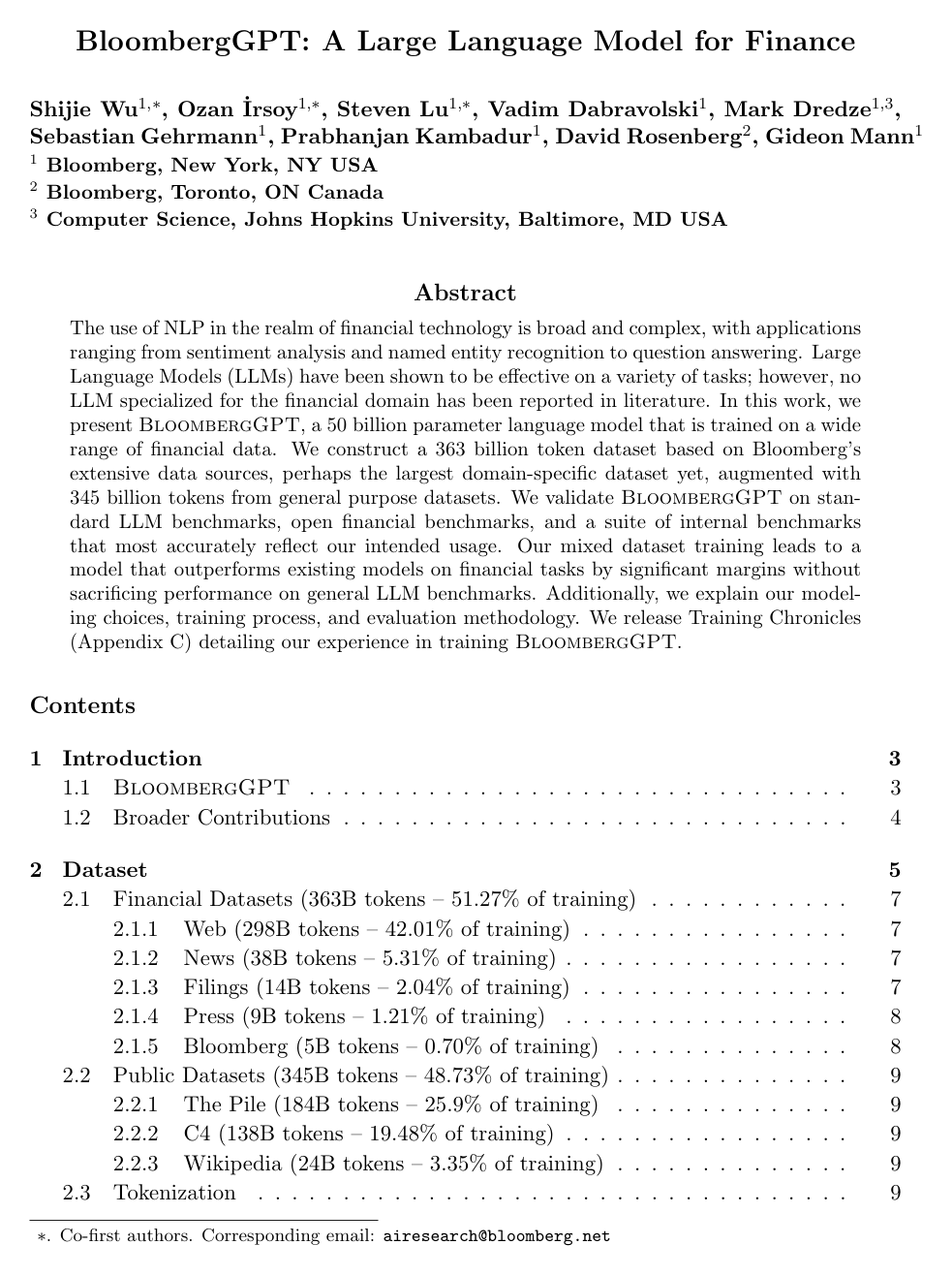
BloombergGPT: A Large Language Model for Finance
Shijie Wu, Ozan Irsoy, Steven Lu, Vadim Dabravolski, Mark Dredze, Sebastian Gehrmann, Prabhanjan Kambadur, David Rosenberg, Gideon Mann
Why you should read this
Introduces BloombergGPT, a 50-billion-parameter model trained on over 700 billion financial and general tokens that demonstrates how domain-specific pretraining significantly improves financial task performance while maintaining general language capabilities.
The use of NLP in the realm of financial technology is broad and complex, with applications ranging from sentiment analysis and named entity recognition to question answering. Large Language Models (LLMs) have been shown to be effective on a variety of tasks; however, no LLM specialized for the financial domain has been reported in literature. In this work, we present BloombergGPT, a 50 billion parameter language model that is trained on a wide range of financial data. We construct a 363 billion token dataset based on Bloomberg's extensive data sources, perhaps the largest domain-specific dataset yet, augmented with 345 billion tokens from general purpose datasets. We validate BloombergGPT on standard LLM benchmarks, open financial benchmarks, and a suite of internal benchmarks that most accurately reflect our intended usage. Our mixed dataset training leads to a model that outperforms existing models on financial tasks by significant margins without sacrificing performance on general LLM benchmarks. Additionally, we explain our modeling choices, training process, and evaluation methodology. We release Training Chronicles (Appendix C) detailing our experience in training BloombergGPT.
Added
2026-09-25
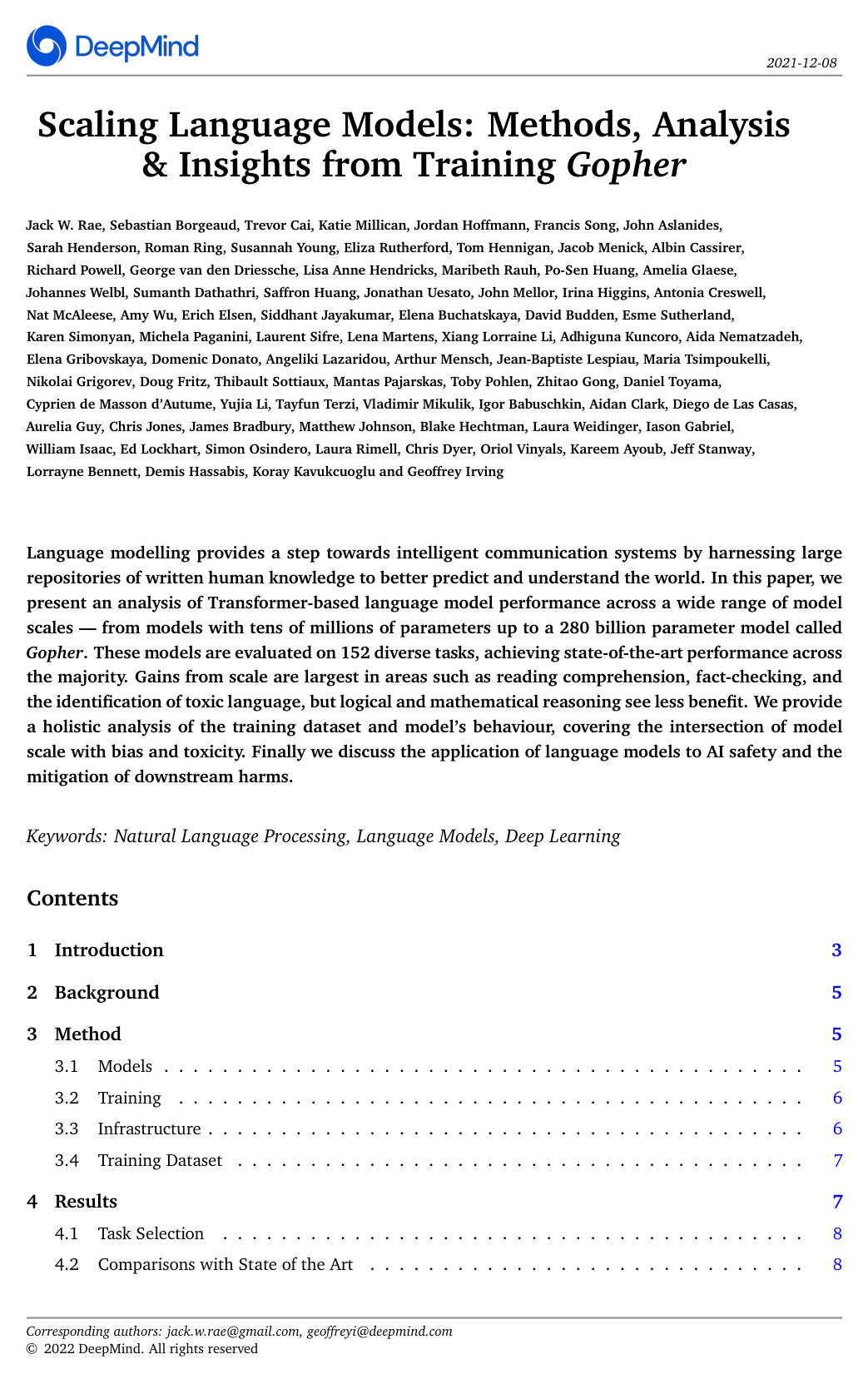
Scaling Language Models: Methods, Analysis & Insights from Training Gopher
Jack W. Rae, Sebastian Borgeaud, Trevor Cai, Katie Millican, Jordan Hoffmann, Francis Song, John Aslanides, Sarah Henderson, Roman Ring, Susannah Young, Eliza Rutherford, Tom Hennigan, Jacob Menick, Albin Cassirer, Richard Powell, George van den Driessche, Lisa Anne Hendricks, Maribeth Rauh, Po-Sen Huang, Amelia Glaese, Johannes Welbl, Sumanth Dathathri, Saffron Huang, Jonathan Uesato, John Mellor, Irina Higgins, Antonia Creswell, Nat McAleese, Amy Wu, Erich Elsen, Siddhant Jayakumar, Elena Buchatskaya, David Budden, Esme Sutherland, Karen Simonyan, Michela Paganini, Laurent Sifre, Lena Martens, Xiang Lorraine Li, Adhiguna Kuncoro, Aida Nematzadeh, Elena Gribovskaya, Domenic Donato, Angeliki Lazaridou, Arthur Mensch, Jean-Baptiste Lespiau, Maria Tsimpoukelli, Nikolai Grigorev, Doug Fritz, Thibault Sottiaux, Mantas Pajarskas, Toby Pohlen, Zhitao Gong, Daniel Toyama, Cyprien de Masson d'Autume, Yujia Li, Tayfun Terzi, Vladimir Mikulik, Igor Babuschkin, Aidan Clark, Diego de Las Casas, Aurelia Guy, Chris Jones, James Bradbury, Matthew Johnson, Blake Hechtman, Laura Weidinger, Iason Gabriel, William Isaac, Ed Lockhart, Simon Osindero, Laura Rimell, Chris Dyer, Oriol Vinyals, Kareem Ayoub, Jeff Stanway, Lorrayne Bennett, Demis Hassabis, Koray Kavukcuoglu, Geoffrey Irving
Why you should read this
Analyzes the performance of Transformer language models scaled up to the 280-billion-parameter Gopher across 152 tasks, providing empirical evidence on which capabilities improve with size and where logical reasoning and safety limitations persist.
Language modelling provides a step towards intelligent communication systems by harnessing large repositories of written human knowledge to better predict and understand the world. In this paper, we present an analysis of Transformer-based language model performance across a wide range of model scales -- from models with tens of millions of parameters up to a 280 billion parameter model called Gopher. These models are evaluated on 152 diverse tasks, achieving state-of-the-art performance across the majority. Gains from scale are largest in areas such as reading comprehension, fact-checking, and the identification of toxic language, but logical and mathematical reasoning see less benefit. We provide a holistic analysis of the training dataset and model's behaviour, covering the intersection of model scale with bias and toxicity. Finally we discuss the application of language models to AI safety and the mitigation of downstream harms.
Added
2026-09-24
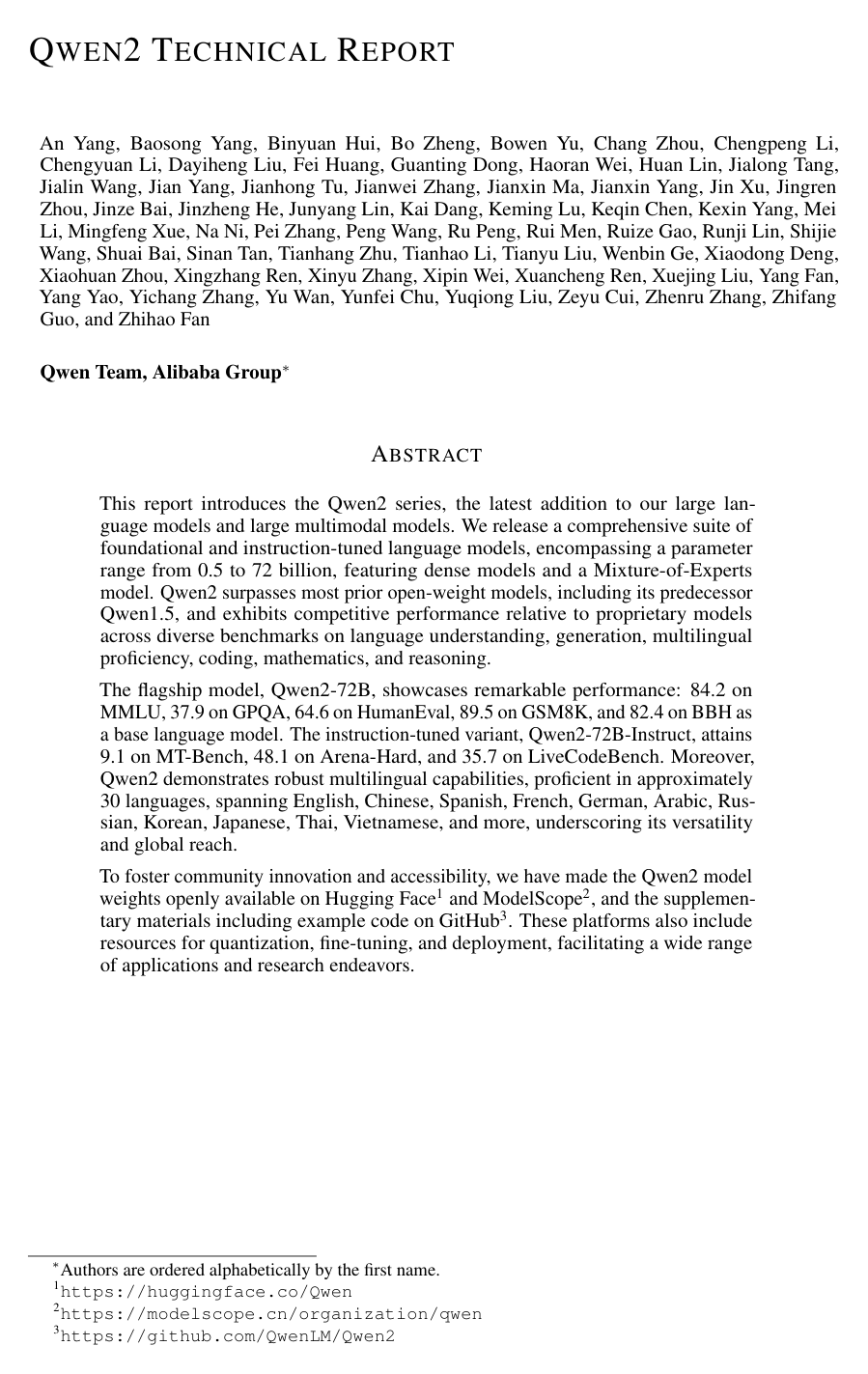
Qwen2 Technical Report
An Yang, Baosong Yang, Binyuan Hui, Bo Zheng, Bowen Yu, Chang Zhou, Chengpeng Li, Chengyuan Li, Dayiheng Liu, Fei Huang, Guanting Dong, Haoran Wei, Huan Lin, Jialong Tang, Jia-Lin Wang, Jian Yang, Jianhong Tu, Jianwei Zhang, Jianxin Ma, Jin Xu, Jingren Zhou, Jinze Bai, Jinzheng He, Junyang Lin, K. Dang, Keming Lu, Ke-Yang Chen, Kexin Yang, Mei Li, Min Xue, Na Ni, Pei Zhang, Peng Wang, Ru Peng, Rui Men, Ruize Gao, Runji Lin, Shijie Wang, Shuai Bai, Sinan Tan, Tianhang Zhu, Tianhao Li, Tianyu Liu, Wenbin Ge, Xiaodong Deng, Xiaohuan Zhou, Xingzhang Ren, Xinyu Zhang, Xipin Wei, Xuancheng Ren, Yang Fan, Yang Yao, Yichang Zhang, Yunyang Wan, Yunfei Chu, Zeyu Cui, Zhen-Ru Zhang, Zhi-Wei Fan
Why you should read this
Presents the Qwen2 family of open-weight dense and Mixture-of-Experts large language models ranging from 0.5B to 72B parameters, detailing training strategies and architectures that achieve performance competitive with leading proprietary systems across coding, mathematics, reasoning, and multilingual benchmarks in approximately 30 languages.
This report introduces the Qwen2 series, the latest addition to our large language models and large multimodal models. We release a comprehensive suite of foundational and instruction-tuned language models, encompassing a parameter range from 0.5 to 72 billion, featuring dense models and a Mixture-of-Experts model. Qwen2 surpasses most prior open-weight models, including its predecessor Qwen1.5, and exhibits competitive performance relative to proprietary models across diverse benchmarks on language understanding, generation, multilingual proficiency, coding, mathematics, and reasoning. The flagship model, Qwen2-72B, showcases remarkable performance: 84.2 on MMLU, 37.9 on GPQA, 64.6 on HumanEval, 89.5 on GSM8K, and 82.4 on BBH as a base language model. The instruction-tuned variant, Qwen2-72B-Instruct, attains 9.1 on MT-Bench, 48.1 on Arena-Hard, and 35.7 on LiveCodeBench. Moreover, Qwen2 demonstrates robust multilingual capabilities, proficient in approximately 30 languages, spanning English, Chinese, Spanish, French, German, Arabic, Russian, Korean, Japanese, Thai, Vietnamese, and more, underscoring its versatility and global reach. To foster community innovation and accessibility, we have made the Qwen2 model weights openly available on Hugging Face and ModelScope, and the supplementary materials including example code on GitHub. These platforms also include resources for quantization, fine-tuning, and deployment, facilitating a wide range of applications and research endeavors.
Added
2026-09-24
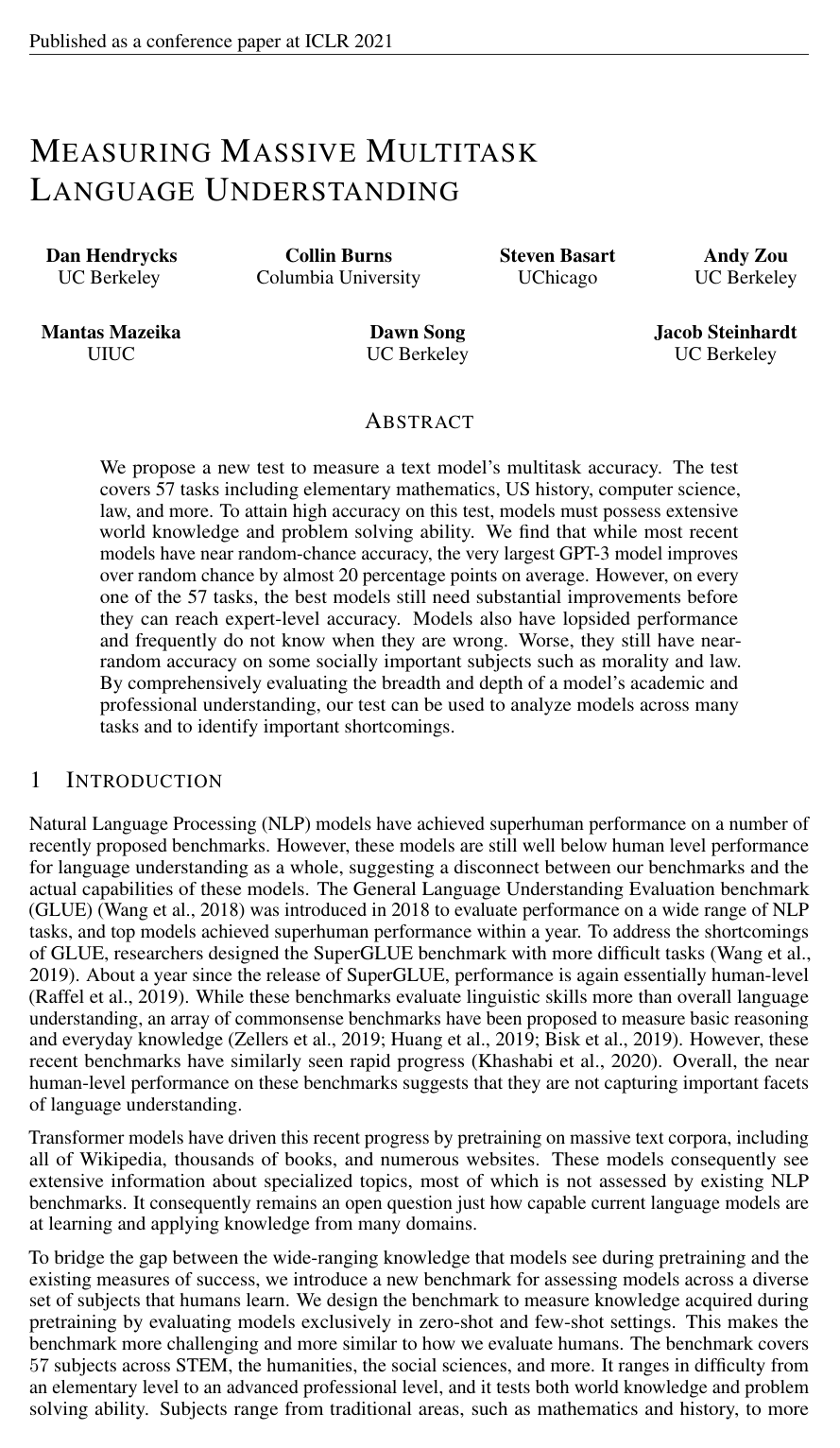
Measuring Massive Multitask Language Understanding
Dan Hendrycks, Collin Burns, Steven Basart, Andy Zou, Mantas Mazeika, Dawn Song, Jacob Steinhardt
Why you should read this
Introduces the Massive Multitask Language Understanding benchmark, spanning 57 subjects across STEM, the humanities, and professional fields, to systematically evaluate the breadth of world knowledge and expose critical reasoning limitations in large language models.
We propose a new test to measure a text model's multitask accuracy. The test covers 57 tasks including elementary mathematics, US history, computer science, law, and more. To attain high accuracy on this test, models must possess extensive world knowledge and problem solving ability. We find that while most recent models have near random-chance accuracy, the very largest GPT-3 model improves over random chance by almost 20 percentage points on average. However, on every one of the 57 tasks, the best models still need substantial improvements before they can reach expert-level accuracy. Models also have lopsided performance and frequently do not know when they are wrong. Worse, they still have near-random accuracy on some socially important subjects such as morality and law. By comprehensively evaluating the breadth and depth of a model's academic and professional understanding, our test can be used to analyze models across many tasks and to identify important shortcomings.
Added
2026-09-19
License
Published with permission
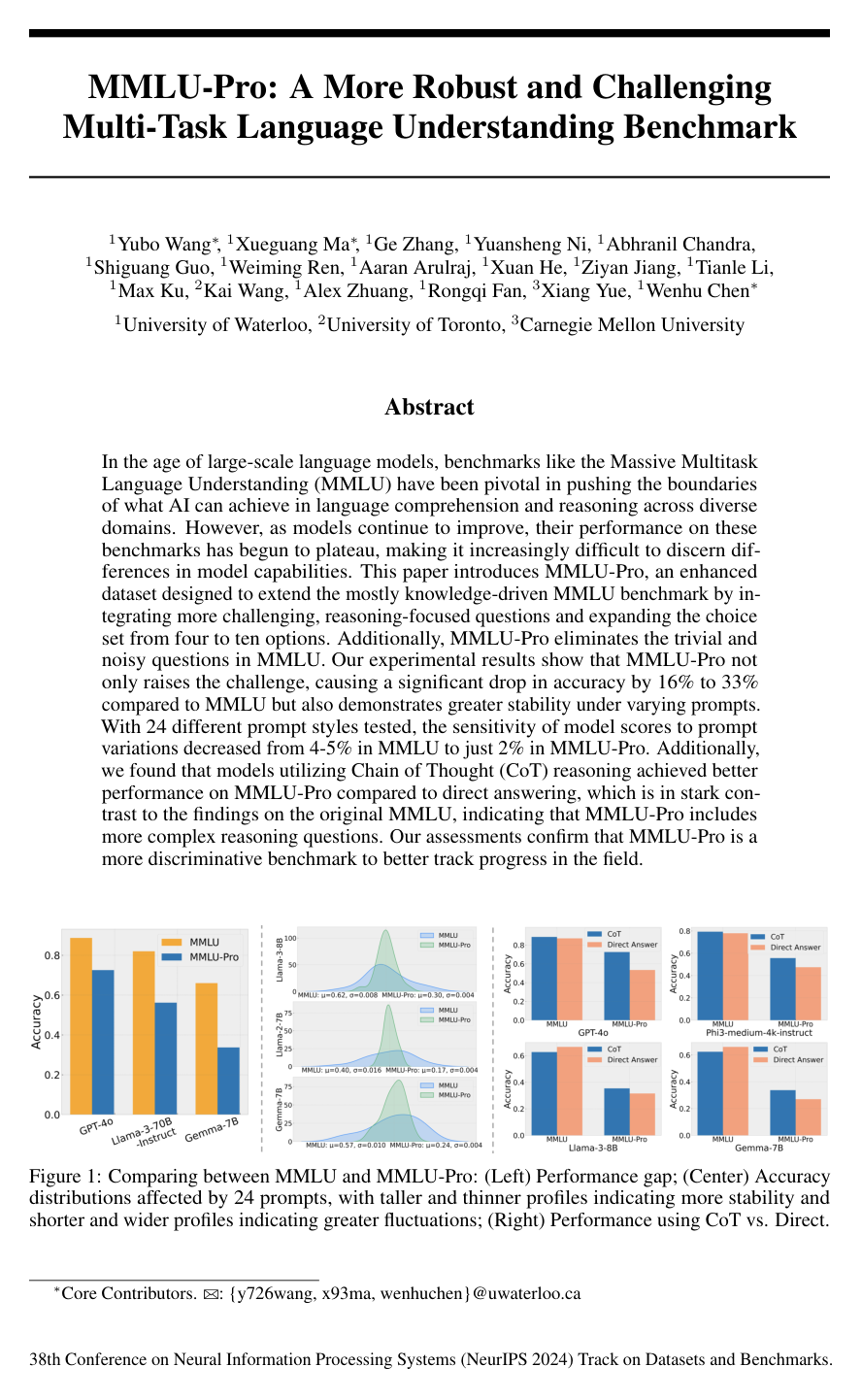
MMLU-Pro: A More Robust and Challenging Multi-Task Language Understanding Benchmark
Yubo Wang, Xueguang Ma, Ge Zhang, Yuansheng Ni, Abhranil Chandra, Shiguang Guo, Weiming Ren, Aaran Arulraj, Xuan He, Ziyan Jiang, Tianle Li, Max W.F. Ku, Kai Wang, Alex Zhuang, Rongqi "Richard" Fan, Xiang Yue, Wenhu Chen
Why you should read this
Introduces MMLU-Pro, an upgraded benchmark that expands multiple-choice options from four to ten and prioritizes complex reasoning to resolve score saturation and reliably differentiate top-tier language models.
In the age of large-scale language models, benchmarks like the Massive Multitask Language Understanding (MMLU) have been pivotal in pushing the boundaries of what AI can achieve in language comprehension and reasoning across diverse domains. However, as models continue to improve, their performance on these benchmarks has begun to plateau, making it increasingly difficult to discern differences in model capabilities. This paper introduces MMLU-Pro, an enhanced dataset designed to extend the mostly knowledge-driven MMLU benchmark by integrating more challenging, reasoning-focused questions and expanding the choice set from four to ten options. Additionally, MMLU-Pro eliminates the trivial and noisy questions in MMLU. Our experimental results show that MMLU-Pro not only raises the challenge, causing a significant drop in accuracy by 16% to 33% compared to MMLU but also demonstrates greater stability under varying prompts. With 24 different prompt styles tested, the sensitivity of model scores to prompt variations decreased from 4-5% in MMLU to just 2% in MMLU-Pro. Additionally, we found that models utilizing Chain of Thought (CoT) reasoning achieved better performance on MMLU-Pro compared to direct answering, which is in stark contrast to the findings on the original MMLU, indicating that MMLU-Pro includes more complex reasoning questions. Our assessments confirm that MMLU-Pro is a more discriminative benchmark to better track progress in the field.
Added
2026-09-18
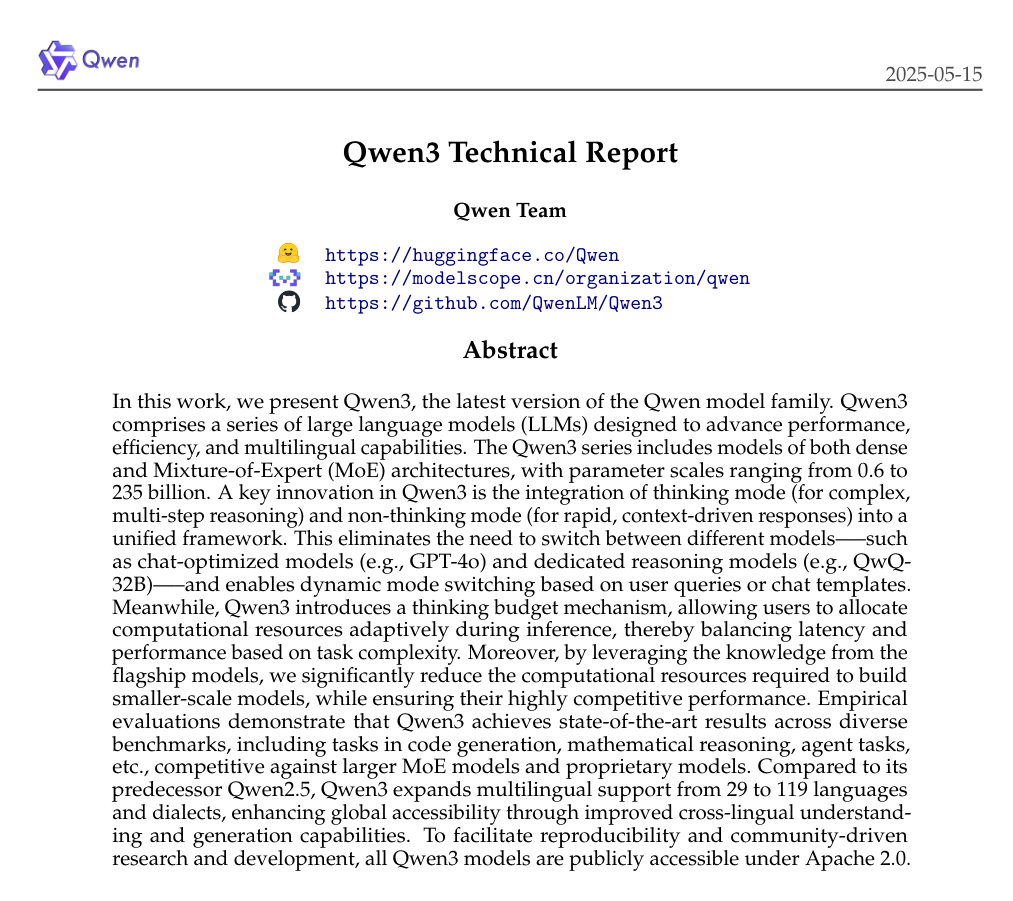
Qwen3 Technical Report
An Yang, An-Feng Li, Baosong Yang, Beichen Zhang, Binyuan Hui, Bo Zheng, Bo-Wen Yu, Chang Gao, Chengen Huang, Chenxu Lv, Chujie Zheng, Dayiheng Liu, Fan Zhou, Fei Huang, Feng Hu, Hao Ge, Haoran Wei, Huan Lin, Jialong Tang, Jian Yang, Jianhong Tu, Jianwei Zhang, Jianxin Yang, Jiaxin Yang, Jingren Zhou, Junyan Lin, Kai Dang, Keqin Bao, Ke‐Pei Yang, Le Yu, Li-Chun Deng, Mei Li, Min Xue, Ming-Ze Li, Pei Zhang, Peng Wang, Qin Zhu, Rui Men, Ruize Gao, Shixuan Liu, Shuang Luo, Tianhao Li, Tianyi Tang, Wenbiao Yin, Xingzhang Ren, Xinyu Wang, Xinyu Zhang, Xuancheng Ren, Yang Fan, Yang Su, Yi-Chao Zhang, Ying-Er Zhang, Yu Wan, Yuqiong Liu, Zekun Wang, Zeyu Cui, Zhen-Ru Zhang, Zhipeng Zhou, Zihan Qiu
Why you should read this
Presents an open-source family of dense and mixture-of-experts models spanning 0.6B to 235B parameters that unifies rapid conversational responses and complex reasoning into a single architecture with dynamic compute budgets across 119 languages.
In this work, we present Qwen3, the latest version of the Qwen model family. Qwen3 comprises a series of large language models (LLMs) designed to advance performance, efficiency, and multilingual capabilities. The Qwen3 series includes models of both dense and Mixture-of-Expert (MoE) architectures, with parameter scales ranging from 0.6 to 235 billion. A key innovation in Qwen3 is the integration of thinking mode (for complex, multi-step reasoning) and non-thinking mode (for rapid, context-driven responses) into a unified framework. This eliminates the need to switch between different models--such as chat-optimized models (e.g., GPT-4o) and dedicated reasoning models (e.g., QwQ-32B)--and enables dynamic mode switching based on user queries or chat templates. Meanwhile, Qwen3 introduces a thinking budget mechanism, allowing users to allocate computational resources adaptively during inference, thereby balancing latency and performance based on task complexity. Moreover, by leveraging the knowledge from the flagship models, we significantly reduce the computational resources required to build smaller-scale models, while ensuring their highly competitive performance. Empirical evaluations demonstrate that Qwen3 achieves state-of-the-art results across diverse benchmarks, including tasks in code generation, mathematical reasoning, agent tasks, etc., competitive against larger MoE models and proprietary models. Compared to its predecessor Qwen2.5, Qwen3 expands multilingual support from 29 to 119 languages and dialects, enhancing global accessibility through improved cross-lingual understanding and generation capabilities. To facilitate reproducibility and community-driven research and development, all Qwen3 models are publicly accessible under Apache 2.0.
Added
2026-09-16