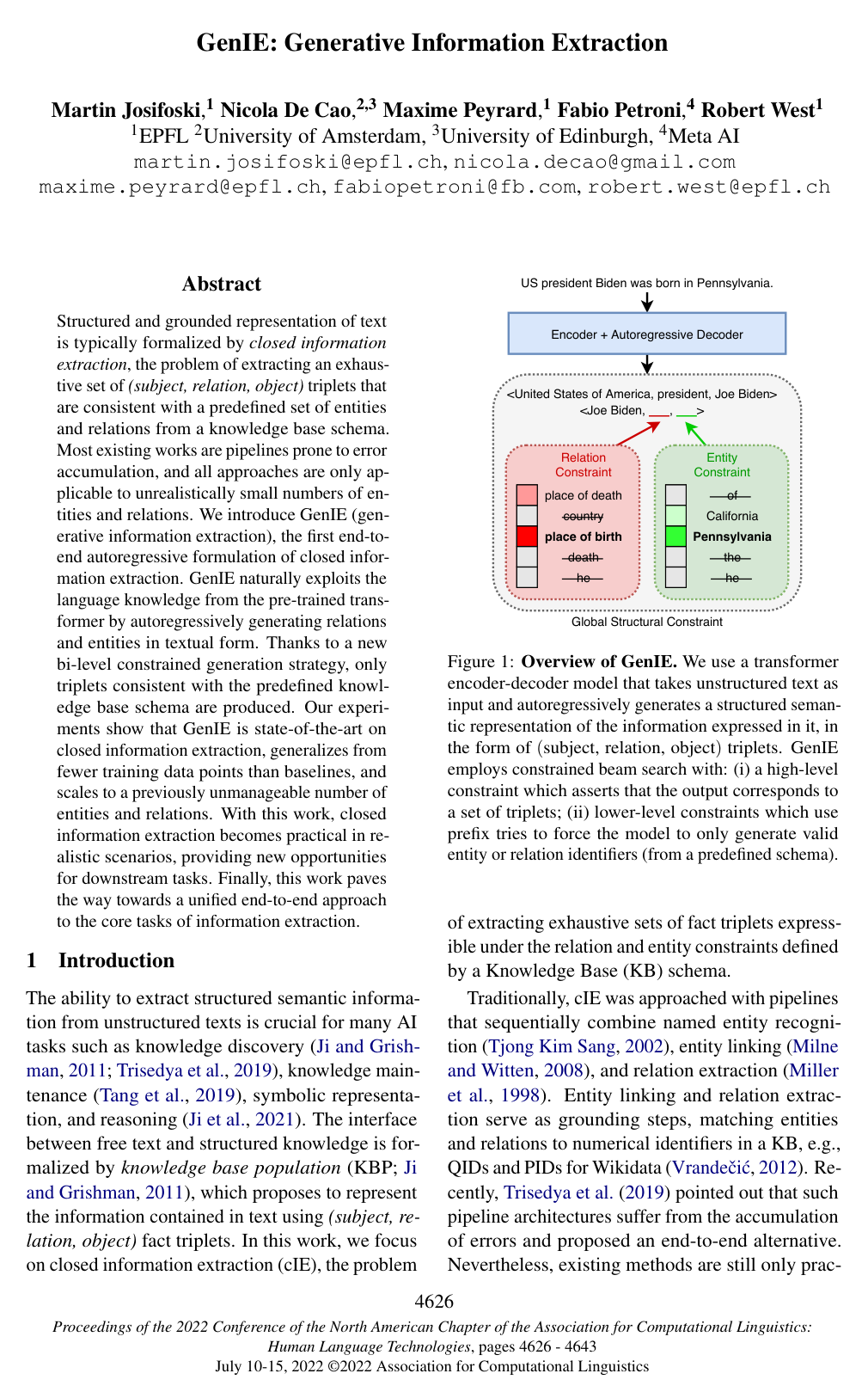
GenIE: Generative Information Extraction

Martin JosifoskiNicola De CaoMaxime PeyrardFabio PetroniRobert West

article2022NAACL99 citations

Introduces the first end-to-end autoregressive framework for closed information extraction, using bi-level constrained generation to scale structured, knowledge-base-grounded fact extraction to millions of entities.

Listen

Extracting structured, factual knowledge from unstructured text into formal entity-and-relation statements is critical for artificial intelligence applications such as automated reasoning, knowledge discovery, and enterprise data management. However, traditional closed information extraction systems rely on multi-step pipeline architectures that sequentially identify entities, link them to an external database, and classify relations. These pipelines suffer from severe error accumulation across stages, fail under severe data imbalances, and break down when scaled beyond small, artificial schemas. Existing alternatives cannot handle realistic knowledge bases containing millions of entities and hundreds of relations.

The article introduces and evaluates GenIE (Generative Information Extraction), the first end-to-end generative system designed to perform closed information extraction at scale. The primary objective is to demonstrate that an autoregressive sequence-to-sequence model can directly generate structured factual statements from raw text while strictly adhering to large, predefined knowledge base schemas.

To achieve this, the approach employs a pre-trained sequence-to-sequence transformer model coupled with a bi-level constrained beam search decoding strategy. Instead of treating extraction as an unmanageable multi-class classification problem, GenIE dynamically generates entity and relation names in textual form. It enforces valid outputs using compact prefix search structures that restrict generation to valid schema components. The authors evaluated the system on large-scale datasets, including an annotated benchmark derived from Wikipedia and Wikidata containing nearly six million entities and 857 relations, alongside standard benchmarks such as Wiki-NRE, Geo-NRE, and FewRel.

The findings show that GenIE establishes a new state of the art, significantly outperforming prior end-to-end and multi-stage pipeline methods. On the large-scale benchmark, GenIE achieved an overall micro-F1 accuracy score of 68.9%, compared to 42.5% for a strong multi-step pipeline baseline—representing an approximate 60% relative improvement. Across underrepresented relations, GenIE demonstrated exceptional few-shot learning capability, reaching strong accuracy on relations with as few as 64 training examples, whereas the pipeline baseline required over 16,000 examples to achieve comparable quality. Furthermore, error disentanglement revealed that GenIE's unified architecture eliminates the severe initial drop-off caused by pipeline entity recognition errors, allowing entity and relation extraction to reinforce each other.

These results demonstrate that closed information extraction can transition from narrow academic setups to large-scale, real-world knowledge graphs. By replacing brittle multi-model pipelines with a single end-to-end model, organizations can reduce engineering complexity, maintenance overhead, and compounding pipeline errors. The ability to generalize from fewer data points per relation also lowers the substantial data annotation costs traditionally needed to expand schemas.

For practical adoption, organizations should consider deploying generative architectures for knowledge base population and semantic graph construction. Future technical work should focus on extending the constrained decoding mechanism to support literal text values—such as dates, measurements, and numerical properties—and expanding the system into multilingual extraction environments. While confidence in the experimental findings is high across multiple benchmarks, practitioners should note that performance still moderates on extremely rare relations, indicating that modest human-in-the-loop validation remains prudent for highly sensitive, low-frequency data domains.

arXiv: 2112.08340
Cover for GenIE: Generative Information Extraction

Table of Contents

  • 1 Introduction
  • Contributions
  • 2 Background and Related Work
  • 2.1 Closed Information Extraction
  • 2.2 Autoregressive Entity Linking
  • 3 Method
  • 3.1 Model
  • 3.2 Output Linearization
  • 3.3 Inference with Constrained Beam Search
  • 4 Experimental Setup
  • 4.1 Knowledge Base: Wikidata
  • 4.2 Datasets and Evaluation Metrics
  • 4.3 Baselines
  • 5 Results
  • 5.1 Performance Evaluation
  • 5.2 Analysis of Performance as a Function of the Relation Occurrence Count
  • 5.3 Disentangling the Errors
  • 6 Discussion
  • 7 Conclusion
  • Acknowledgments
  • References
  • A Additional Background and Related Work
  • A.1 Generative Open Information Extraction
  • B Datasets
  • C Performance Metrics
  • D Note on End-to-End Baselines
  • E Implementation Details
  • E.1 GenIE
  • E.2 SotA Pipeline
  • F Additional Experiments
  • F.1 Analysis of Performance as a Function of the Number of Relations
  • G Additional Results

Knowls

  1. Knowl 1 — Closed information extraction as schema-grounded fact-set prediction

    definition

    Closed information extraction (cIE) maps an input text to the exhaustive set of facts expressed in that text that can be represented under a fixed knowledge-base schema. A schema consists of entities EE, relations RR, and facts in E×R×EE \times R \times E, where each fact is a subject–relation–object triplet. Unlike open information extraction, cIE requires both entities and relations in each output triplet to correspond to items in the schema.

  2. Knowl 2 — GenIE models cIE as autoregressive sequence generation

    model/method

    GenIE uses a BART encoder–decoder to map input text xx to a token sequence yy representing the facts expressed in xx. For model parameters θ\theta, it assigns the sequence the conditional probability

    pθ(y∣x)=∏i=1∣y∣pθ(yi∣y<i,x),p_\theta(y\mid x)=\prod_{i=1}^{|y|}p_\theta(y_i\mid y_{<i},x),

    where yiy_i is the token at position ii and y<iy_{<i} is the preceding prefix. Training maximizes the target sequence’s conditional log-likelihood using teacher forcing and cross-entropy, with dropout and label smoothing for regularization. Generating entity and relation names token by token lets the model use language information learned during pretraining while jointly predicting the structured facts.

  3. Knowl 3 — Triplet serialization and deterministic target ordering

    model/method

    GenIE linearizes each subject–relation–object triplet with the markers <sub>, <rel>, <obj>, and <et>: the first three mark the start of the subject, relation, and object fields, and <et> ends the object and the triplet. The sequence for a fact set is formed by concatenating its serialized triplets. Because a set has no intrinsic ordering but a sequence does, training targets use a consistent order: triplets are ordered by the textual position of the subject entity’s mention, with ties broken by the object mention’s position, whenever the entities can be linked to mentions in the input.

  4. Knowl 4 — Bi-level constrained beam search restricts generation to valid structures and identifiers

    model/method

    GenIE’s output space is compositional: with millions of candidate entities and hundreds of relations, enumerating and scoring all possible fact sets is infeasible. At inference, constrained beam search instead expands the most promising eligible next tokens. A high-level structural constraint controls which field is being generated and enforces the triplet serialization pattern. Lower-level prefix-trie constraints restrict subject and object fields to valid entity names and relation fields to valid relation names; the applicable trie is selected according to the current field, allowing valid prefixes to be generated compositionally rather than precomputing a trie over every possible triplet or output set. The experiments use 10 beams. These constraints enforce schema validity and output structure; they do not by themselves establish that a generated fact is entailed by the input.

  5. Knowl 5 — Evaluation uses both small schemas and a Wikidata-scale schema

    experimental setup

    The target knowledge base is Wikidata, filtered to entities with English Wikipedia pages so that entity names are unique. The resulting full catalog has 5,891,959 entities; the union of relations in the datasets has 857 relations. Wiki-NRE and Geo-NRE are evaluated with their smaller schemas (approximately 300,000 entities and 157 relations for Wiki-NRE; 124 entities and 11 relations for Geo-NRE), while REBEL uses the large schema. Models are trained on Wiki-NRE (W), REBEL (R), or REBEL followed by Wiki-NRE fine-tuning (R+W); Geo-NRE and FewRel are test-only. REBEL contains 1,899,331 training documents and 5,147,836 training triplets, with 104,960 validation documents and 284,268 triplets, and 105,516 test documents and 284,936 triplets. FewRel has human-annotated examples with one triplet per input but does not annotate every fact expressed, so it is used to measure recall rather than precision or F1. Reported confidence intervals are one standard deviation from 50 bootstrap samples. Micro metrics weight examples equally; macro metrics average performance across relation types.

  6. Knowl 6 — GenIE improves cIE performance across schemas and training conditions

    empirical result

    The following results report F1, except that FewRel reports recall only. Each value is the mean with the reported one-standard-deviation bootstrap interval. W denotes Wiki-NRE training, R denotes REBEL training, and R+W denotes REBEL pretraining followed by Wiki-NRE fine-tuning. Macro scores are unavailable for SetGenNet. The comparison shows strong results on the small-schema benchmarks and, when trained on REBEL, a large advantage over the pipeline baseline on the 857-relation REBEL schema and on FewRel.

    Model Training Wiki micro Wiki macro Geo micro Geo macro REBEL micro REBEL macro FewRel micro recall FewRel macro recall
    SetGenNet W 80.07 ±\pm 0.27 – 86.10 ±\pm 0.34 – – – – –
    Pipeline W 60.11 ±\pm 0.22 10.56 ±\pm 0.43 64.32 ±\pm 1.45 20.39 ±\pm 2.72 – – – –
    Pipeline R 55.90 ±\pm 0.20 15.93 ±\pm 0.93 60.53 ±\pm 1.45 25.24 ±\pm 3.21 42.50 ±\pm 0.13 9.48 ±\pm 0.21 17.89 ±\pm 0.24 19.67 ±\pm 0.26
    Pipeline R+W 59.30 ±\pm 0.21 17.76 ±\pm 1.01 66.43 ±\pm 1.45 35.14 ±\pm 5.09 – – – –
    GenIE W 88.24 ±\pm 0.13 38.39 ±\pm 1.71 86.80 ±\pm 1.03 52.79 ±\pm 6.27 – – – –
    GenIE R 39.50 ±\pm 0.14 29.27 ±\pm 1.26 47.45 ±\pm 1.62 30.67 ±\pm 5.23 68.93 ±\pm 0.12 30.46 ±\pm 0.62 30.77 ±\pm 0.27 30.78 ±\pm 0.26
    GenIE R+W 91.48 ±\pm 0.12 47.08 ±\pm 1.68 92.48 ±\pm 0.88 72.59 ±\pm 7.32 – – – –
  7. Knowl 7 — Pretraining raises recall and out-of-domain performance; constraints improve F1

    empirical result

    An ablation compares random initialization (GenIE), BART pretrained-language-model initialization (GenIE–PLM), initialization from the pretrained GENRE entity-retrieval model (GenIE–GENRE), and random initialization without constrained generation. The table reports REBEL F1 and FewRel recall. Pretrained initializations substantially raise FewRel recall, while GENRE initialization gives the highest REBEL micro-F1 among these variants. Removing constrained generation lowers REBEL micro-F1 from 68.93 to 66.20 and macro-F1 from 30.46 to 28.20. The paper also reports that competitive performance takes about 3–5k training steps from GENRE, 5–10k from a pretrained language model, and 40–50k from random initialization.

    Initialization / decoding REBEL micro F1 REBEL macro F1 FewRel micro recall FewRel macro recall
    Random, constrained (GenIE) 68.93 ±\pm 0.12 30.46 ±\pm 0.62 30.77 ±\pm 0.27 30.78 ±\pm 0.26
    BART PLM, constrained 67.31 ±\pm 0.10 33.85 ±\pm 0.58 46.95 ±\pm 0.27 46.96 ±\pm 0.25
    GENRE, constrained 69.81 ±\pm 0.10 33.40 ±\pm 0.62 46.62 ±\pm 0.25 46.63 ±\pm 0.24
    Random, unconstrained 66.20 ±\pm 0.11 28.20 ±\pm 0.50 26.15 ±\pm 0.27 26.14 ±\pm 0.24
  8. Knowl 8 — GenIE performs better than the pipeline baseline in low-resource relation buckets

    empirical result

    On REBEL, relations were grouped by their training occurrence counts: bucket ii contains relations occurring at least 2i2^i and fewer than 2i+12^{i+1} times. The plotted bucket-level F1 results show GenIE ahead of the state-of-the-art-component pipeline in every bucket. Performance declines for both systems as relation counts decrease, but GenIE already performs well for relations with at least 64 training occurrences. The paper reports that the pipeline needs about 16,384 occurrences to reach a comparable performance level, and does not exceed GenIE’s result for the 64-occurrence bucket until it has at least 524,288 training occurrences. The analysis therefore indicates that GenIE’s aggregate advantage is not limited to the most frequent relations.

  9. Knowl 9 — GenIE retains micro-F1 as the REBEL relation schema grows

    empirical result

    The REBEL schema was restricted to its 100, 400, or 857 most frequent relations at both training and test time. Micro-F1 for GenIE was 70.36 ±\pm 0.10, 68.82 ±\pm 0.12, and 68.93 ±\pm 0.12, respectively; the pipeline scored 47.67 ±\pm 0.16, 44.25 ±\pm 0.11, and 42.50 ±\pm 0.13. Macro-F1 was 52.75 ±\pm 0.24, 38.12 ±\pm 0.51, and 30.46 ±\pm 0.62 for GenIE, versus 25.87 ±\pm 0.15, 14.73 ±\pm 0.37, and 9.48 ±\pm 0.21 for the pipeline. Thus GenIE maintains nearly constant micro-F1 across these schema sizes, while both systems’ macro-F1 falls as rarer relations are included; GenIE remains substantially higher at every size.

  10. Knowl 10 — Error analysis suggests interaction between entity linking and relation prediction

    empirical result

    The paper attributes pipeline errors to named-entity recognition (NER), entity linking (NEL), and relation classification (RC), and estimates corresponding GenIE errors by greedily matching each gold triplet to a predicted triplet, preferring matches by shared relation and entities. In the pipeline, exact NER misses account for an 18% error, with another 12 percentage points associated with partial rather than exact mention matching. Although NEL accounts for only a few percentage points of difference between the pipeline and GenIE, the pipeline’s RC component adds about 30% to its inherited error. For GenIE, the NEL and RC errors considered separately do not sum to its total cIE error. The authors interpret this pattern as evidence of coupled entity and relation prediction, and hypothesize that improvements in either subtask may benefit the other through information sharing; this is an interpretation, not a separately established causal result.

Coverage note — Omitted auxiliary baseline comparisons and implementation-specific hardware details because they do not add a separate central method or result. The discussion’s proposed extensions to literal-valued objects, multilingual extraction, and a unified information-extraction model are future directions rather than evaluated contributions.

References

  1. 1.Alan Akbik, Tanja Bergmann, Duncan Blythe, Kashif Rasul, Stefan Schweter, and Roland Vollgraf. 2019. FLAIR: An easy-to-use framework for state-of-the-art NLP. In Proceedings of the 2019 Conference of the North American Chapter of the Association for Computational Linguistics (Demonstrations), pages 54–59, Minneapolis, Minnesota. Association for Computational Linguistics.
  2. 2.Gabor Angeli, Melvin Jose Johnson Premkumar, and Christopher D. Manning. 2015a. Leveraging linguistic structure for open domain information extraction. In Proceedings of the 53rd Annual Meeting of the Association for Computational Linguistics and the 7th International Joint Conference on Natural Language Processing (Volume 1: Long Papers), pages 344–354, Beijing, China. Association for Computational Linguistics.
  3. 3.Gabor Angeli, Victor Zhong, Danqi Chen, Arun Tejasvi Chaganty, Jason Bolton, Melvin Jose Johnson Premkumar, Panupong Pasupat, Sonal Gupta, and Christopher D. Manning. 2015b. Bootstrapped self training for knowledge base population. In Proceedings of the 2015 Text Analysis Conference.
  4. 4.Akhil Arora, Alberto Garcia-Duran, and Robert West. 2021. Low-rank subspaces for unsupervised entity linking. In Proceedings of the 2021 Conference on Empirical Methods in Natural Language Processing, pages 8037–8054, Online and Punta Cana, Dominican Republic. Association for Computational Linguistics.
  5. 5.Michele Banko, Michael J. Cafarella, Stephen Soderland, Matt Broadhead, and Oren Etzioni. 2007. Open information extraction from the web. In Proceedings of the 20th International Joint Conference on Artificial Intelligence, IJCAI’07, page 2670–2676, San Francisco, CA, USA. Morgan Kaufmann Publishers Inc.
  6. 6.Samuel Broscheit, Kiril Gashteovski, and Martin Achenbach. 2017. OpenIE for Slot Filling at TAC KBP 2017 - System Description. In proceedings of the Text Analysis Conference. NIST.
  7. 7.Thiago Castro Ferreira, Claire Gardent, Nikolai Ilinykh, Chris van der Lee, Simon Mille, Diego Moussallem, and Anastasia Shimorina. 2020. The 2020 bilingual, bi-directional WebNLG+ shared task: Overview and evaluation results (WebNLG+ 2020). In Proceedings of the 3rd International Workshop on Natural Language Generation from the Semantic Web (WebNLG+), pages 55–76, Dublin, Ireland (Virtual). Association for Computational Linguistics.
  8. 8.Arun Chaganty, Ashwin Paranjape, Percy Liang, and Christopher D. Manning. 2017. Importance sampling for unbiased on-demand evaluation of knowledge base population. In Proceedings of the 2017 Conference on Empirical Methods in Natural Language Processing, pages 1038–1048, Copenhagen, Denmark. Association for Computational Linguistics.
  9. 9.Kevin Clark and Christopher D. Manning. 2016. Deep reinforcement learning for mention-ranking coreference models. In Proceedings of the 2016 Conference on Empirical Methods in Natural Language Processing, pages 2256–2262, Austin, Texas. Association for Computational Linguistics.
  10. 10.Luciano Del Corro and Rainer Gemulla. 2013. ClausIE: clause-based open information extraction. In 22nd International World Wide Web Conference, WWW ’13, Rio de Janeiro, Brazil, May 13-17, 2013, pages 355–366. International World Wide Web Conferences Steering Committee / ACM.
  11. 11.Nicola De Cao, Wilker Aziz, and Ivan Titov. 2021a. Highly parallel autoregressive entity linking with discriminative correction. In Proceedings of the 2021 Conference on Empirical Methods in Natural Language Processing, pages 7662–7669, Online and Punta Cana, Dominican Republic. Association for Computational Linguistics.
  12. 12.Nicola De Cao, Gautier Izacard, Sebastian Riedel, and Fabio Petroni. 2021b. Autoregressive entity retrieval. In 9th International Conference on Learning Representations, ICLR 2021, Virtual Event, Austria, May 3-7, 2021. OpenReview.net.
  13. 13.Nicola De Cao, Ledell Wu, Kashyap Popat, Mikel Artetxe, Naman Goyal, Mikhail Plekhanov, Luke Zettlemoyer, Nicola Cancedda, Sebastian Riedel, and Fabio Petroni. 2022. Multilingual Autoregressive Entity Linking. Transactions of the Association for Computational Linguistics, 10:274–290.
  14. 14.Jacob Devlin, Ming-Wei Chang, Kenton Lee, and Kristina Toutanova. 2019. BERT: Pre-training of deep bidirectional transformers for language understanding. In Proceedings of the 2019 Conference of the North American Chapter of the Association for Computational Linguistics: Human Language Technologies, Volume 1 (Long and Short Papers), pages 4171–4186, Minneapolis, Minnesota. Association for Computational Linguistics.
  15. 15.Pierre Dognin, Inkit Padhi, Igor Melnyk, and Payel Das. 2021. ReGen: Reinforcement learning for text and knowledge base generation using pretrained language models. In Proceedings of the 2021 Conference on Empirical Methods in Natural Language Processing, pages 1084–1099, Online and Punta Cana, Dominican Republic. Association for Computational Linguistics.
  16. 16.Hady Elsahar, Pavlos Vougiouklis, Arslen Remaci, Christophe Gravier, Jonathon Hare, Frederique Laforest, and Elena Simperl. 2018. T-REx: A large scale alignment of natural language with knowledge base triples. In Proceedings of the Eleventh International Conference on Language Resources and Evaluation (LREC 2018), Miyazaki, Japan. European Language Resources Association (ELRA).
  17. 17.Luis Galárraga, Geremy Heitz, Kevin Murphy, and Fabian M. Suchanek. 2014. Canonicalizing open knowledge bases. In Proceedings of the 23rd ACM International Conference on Conference on Information and Knowledge Management, CIKM 2014, Shanghai, China, November 3-7, 2014, pages 1679–1688. ACM.
  18. 18.Octavian-Eugen Ganea and Thomas Hofmann. 2017. Deep joint entity disambiguation with local neural attention. In Proceedings of the 2017 Conference on Empirical Methods in Natural Language Processing, pages 2619–2629, Copenhagen, Denmark. Association for Computational Linguistics.
  19. 19.Juri Ganitkevitch, Benjamin Van Durme, and Chris Callison-Burch. 2013. PPDB: The paraphrase database. In Proceedings of the 2013 Conference of the North American Chapter of the Association for Computational Linguistics: Human Language Technologies, pages 758–764, Atlanta, Georgia. Association for Computational Linguistics.
  20. 20.Kiril Gashteovski, Rainer Gemulla, and Luciano del Corro. 2017. MinIE: Minimizing facts in open information extraction. In Proceedings of the 2017 Conference on Empirical Methods in Natural Language Processing, pages 2630–2640, Copenhagen, Denmark. Association for Computational Linguistics.
  21. 21.Kiril Gashteovski, Rainer Gemulla, Bhushan Kotnis, Sven Hertling, and Christian Meilicke. 2020. On aligning OpenIE extractions with knowledge bases: A case study. In Proceedings of the First Workshop on Evaluation and Comparison of NLP Systems, pages 143–154, Online. Association for Computational Linguistics.
  22. 22.Adam Grycner and Gerhard Weikum. 2016. POLY: Mining relational paraphrases from multilingual sentences. In Proceedings of the 2016 Conference on Empirical Methods in Natural Language Processing, pages 2183–2192, Austin, Texas. Association for Computational Linguistics.
  23. 23.Jiatao Gu, James Bradbury, Caiming Xiong, Victor O. K. Li, and Richard Socher. 2018. Non-autoregressive neural machine translation. In 6th International Conference on Learning Representations, ICLR 2018, Vancouver, BC, Canada, April 30 - May 3, 2018, Conference Track Proceedings. OpenReview.net.
  24. 24.Qipeng Guo, Zhijing Jin, Xipeng Qiu, Weinan Zhang, David Wipf, and Zheng Zhang. 2020. CycleGT: Unsupervised graph-to-text and text-to-graph generation via cycle training. In Proceedings of the 3rd International Workshop on Natural Language Generation from the Semantic Web (WebNLG+), pages 77–88, Dublin, Ireland (Virtual). Association for Computational Linguistics.
  25. 25.Xu Han, Hao Zhu, Pengfei Yu, Ziyun Wang, Yuan Yao, Zhiyuan Liu, and Maosong Sun. 2018. FewRel: A large-scale supervised few-shot relation classification dataset with state-of-the-art evaluation. In Proceedings of the 2018 Conference on Empirical Methods in Natural Language Processing, pages 4803–4809, Brussels, Belgium. Association for Computational Linguistics.
  26. 26.Johannes Hoffart, Mohamed Amir Yosef, Ilaria Bordino, Hagen Fürstenau, Manfred Pinkal, Marc Spaniol, Bilyana Taneva, Stefan Thater, and Gerhard Weikum. 2011. Robust disambiguation of named entities in text. In Proceedings of the 2011 Conference on Empirical Methods in Natural Language Processing, pages 782–792, Edinburgh, Scotland, UK. Association for Computational Linguistics.
  27. 27.Hongzhao Huang, Larry Heck, and Heng Ji. 2015. Leveraging deep neural networks and knowledge graphs for entity disambiguation. ArXiv preprint, abs/1504.07678.
  28. 28.Pere-Lluís Huguet Cabot and Roberto Navigli. 2021. REBEL: Relation extraction by end-to-end language generation. In Findings of the Association for Computational Linguistics: EMNLP 2021, pages 2370–2381, Punta Cana, Dominican Republic. Association for Computational Linguistics.
  29. 29.Heng Ji and Ralph Grishman. 2011. Knowledge base population: Successful approaches and challenges. In Proceedings of the 49th Annual Meeting of the Association for Computational Linguistics: Human Language Technologies, pages 1148–1158, Portland, Oregon, USA. Association for Computational Linguistics.
  30. 30.Shaoxiong Ji, Shirui Pan, Erik Cambria, Pekka Marttinen, and Philip S. Yu. 2021. A survey on knowledge graphs: Representation, acquisition and applications. IEEE transactions on neural networks and learning systems.
  31. 31.Diederik P Kingma and Jimmy Ba. 2015. Adam: A method for stochastic optimization. Proceedings of the 3rd International Conference on Learning Representations (ICLR).
  32. 32.Nikolaos Kolitsas, Octavian-Eugen Ganea, and Thomas Hofmann. 2018. End-to-end neural entity linking. In Proceedings of the 22nd Conference on Computational Natural Language Learning, pages 519–529, Brussels, Belgium. Association for Computational Linguistics.
  33. 33.Zhenzhong Lan, Mingda Chen, Sebastian Goodman, Kevin Gimpel, Piyush Sharma, and Radu Soricut. 2020. ALBERT: A lite BERT for self-supervised learning of language representations. In 8th International Conference on Learning Representations, ICLR 2020, Addis Ababa, Ethiopia, April 26-30, 2020. OpenReview.net.
  34. 34.Phong Le and Ivan Titov. 2018. Improving entity linking by modeling latent relations between mentions. In Proceedings of the 56th Annual Meeting of the Association for Computational Linguistics (Volume 1: Long Papers), pages 1595–1604, Melbourne, Australia. Association for Computational Linguistics.
  35. 35.Mike Lewis, Yinhan Liu, Naman Goyal, Marjan Ghazvininejad, Abdelrahman Mohamed, Omer Levy, Veselin Stoyanov, and Luke Zettlemoyer. 2020. BART: Denoising sequence-to-sequence pre-training for natural language generation, translation, and comprehension. In Proceedings of the 58th Annual Meeting of the Association for Computational Linguistics, pages 7871–7880, Online. Association for Computational Linguistics.
  36. 36.Yankai Lin, Shiqi Shen, Zhiyuan Liu, Huanbo Luan, and Maosong Sun. 2016. Neural relation extraction with selective attention over instances. In Proceedings of the 54th Annual Meeting of the Association for Computational Linguistics (Volume 1: Long Papers), pages 2124–2133, Berlin, Germany. Association for Computational Linguistics.
  37. 37.Yinhan Liu, Myle Ott, Naman Goyal, Jingfei Du, Mandar Joshi, Danqi Chen, Omer Levy, Mike Lewis, Luke Zettlemoyer, and Veselin Stoyanov. 2019. Roberta: A robustly optimized bert pretraining approach. ArXiv preprint, abs/1907.11692.
  38. 38.Yue Liu, Tongtao Zhang, Zhicheng Liang, Heng Ji, and Deborah L. McGuinness. 2018. Seq2RDF: An End-to-end Application for Deriving Triples from Natural Language Text. In Proceedings of the ISWC 2018 Posters & Demonstrations, Industry and Blue Sky Ideas Tracks co-located with 17th International Semantic Web Conference (ISWC 2018), Monterey, USA, October 8th - to - 12th, 2018.
  39. 39.Filipe Mesquita, Matteo Cannaviccio, Jordan Schmidek, Paramita Mirza, and Denilson Barbosa. 2019. KnowledgeNet: A benchmark dataset for knowledge base population. In Proceedings of the 2019 Conference on Empirical Methods in Natural Language Processing and the 9th International Joint Conference on Natural Language Processing (EMNLP-IJCNLP), pages 749–758, Hong Kong, China. Association for Computational Linguistics.
  40. 40.Scott Miller, Michael Crystal, Heidi Fox, Lance Ramshaw, Richard Schwartz, Rebecca Stone, and Ralph Weischedel. 1998. Algorithms that learn to extract information BBN: TIPSTER phase III. In TIPSTER TEXT PROGRAM PHASE III: Proceedings of a Workshop held at Baltimore, Maryland, October 13-15, 1998, pages 75–89, Baltimore, Maryland, USA. Association for Computational Linguistics.
  41. 41.David Milne and Ian H. Witten. 2008. Learning to link with wikipedia. In Proceedings of the 17th ACM Conference on Information and Knowledge Management, CIKM ’08, page 509–518, New York, NY, USA. Association for Computing Machinery.
  42. 42.Ndapandula Nakashole, Gerhard Weikum, and Fabian Suchanek. 2012. PATTY: A taxonomy of relational patterns with semantic types. In Proceedings of the 2012 Joint Conference on Empirical Methods in Natural Language Processing and Computational Natural Language Learning, pages 1135–1145, Jeju Island, Korea. Association for Computational Linguistics.
  43. 43.Tapas Nayak and Hwee Tou Ng. 2020. Effective modeling of encoder-decoder architecture for joint entity and relation extraction. Proceedings of the AAAI Conference on Artificial Intelligence, 34(05):8528–8535.
  44. 44.Fabio Petroni, Aleksandra Piktus, Angela Fan, Patrick Lewis, Majid Yazdani, Nicola De Cao, James Thorne, Yacine Jernite, Vladimir Karpukhin, Jean Maillard, Vassilis Plachouras, Tim Rocktäschel, and Sebastian Riedel. 2021. KILT: a benchmark for knowledge intensive language tasks. In Proceedings of the 2021 Conference of the North American Chapter of the Association for Computational Linguistics: Human Language Technologies, pages 2523–2544, Online. Association for Computational Linguistics.
  45. 45.Wei Shen, Jianyong Wang, and Jiawei Han. 2015. Entity linking with a knowledge base: Issues, techniques, and solutions. IEEE Transactions on Knowledge and Data Engineering.
  46. 46.Nitish Srivastava, Geoffrey Hinton, Alex Krizhevsky, Ilya Sutskever, and Ruslan Salakhutdinov. 2014. Dropout: A simple way to prevent neural networks from overfitting. Journal of Machine Learning Research, 15(56):1929–1958.
  47. 47.Dianbo Sui, Chenhao Wang, Yubo Chen, Kang Liu, Jun Zhao, and Wei Bi. 2021. Set generation networks for end-to-end knowledge base population. In Proceedings of the 2021 Conference on Empirical Methods in Natural Language Processing, pages 9650–9660, Online and Punta Cana, Dominican Republic. Association for Computational Linguistics.
  48. 48.Mihai Surdeanu. 2013. Overview of the tac2013 knowledge base population evaluation: English slot filling and temporal slot filling. Theory and Applications of Categories.
  49. 49.Ilya Sutskever, James Martens, and Geoffrey E. Hinton. 2011. Generating text with recurrent neural networks. In Proceedings of the 28th International Conference on Machine Learning, ICML 2011, Bellevue, Washington, USA, June 28 - July 2, 2011, pages 1017–1024. Omnipress.
  50. 50.Ilya Sutskever, Oriol Vinyals, and Quoc V. Le. 2014. Sequence to sequence learning with neural networks. In Advances in Neural Information Processing Systems 27: Annual Conference on Neural Information Processing Systems 2014, December 8-13 2014, Montreal, Quebec, Canada, pages 3104–3112.
  51. 51.Christian Szegedy, Vincent Vanhoucke, Sergey Ioffe, Jonathon Shlens, and Zbigniew Wojna. 2016. Rethinking the inception architecture for computer vision. In 2016 IEEE Conference on Computer Vision and Pattern Recognition, CVPR 2016, Las Vegas, NV, USA, June 27-30, 2016, pages 2818–2826. IEEE Computer Society.
  52. 52.Bruno Taillé, Vincent Guigue, Geoffrey Scoutheeten, and Patrick Gallinari. 2020. Let’s Stop Incorrect Comparisons in End-to-end Relation Extraction! In Proceedings of the 2020 Conference on Empirical Methods in Natural Language Processing (EMNLP), pages 3689–3701, Online. Association for Computational Linguistics.
  53. 53.Jizhi Tang, Yansong Feng, and Dongyan Zhao. 2019. Learning to update knowledge graphs by reading news. In Proceedings of the 2019 Conference on Empirical Methods in Natural Language Processing and the 9th International Joint Conference on Natural Language Processing (EMNLP-IJCNLP), pages 2632–2641, Hong Kong, China. Association for Computational Linguistics.
  54. 54.Erik F. Tjong Kim Sang. 2002. Introduction to the CoNLL-2002 shared task: Language-independent named entity recognition. In COLING-02: The 6th Conference on Natural Language Learning 2002 (CoNLL-2002).
  55. 55.Bayu Distiawan Trisedya, Gerhard Weikum, Jianzhong Qi, and Rui Zhang. 2019. Neural relation extraction for knowledge base enrichment. In Proceedings of the 57th Annual Meeting of the Association for Computational Linguistics, pages 229–240, Florence, Italy. Association for Computational Linguistics.
  56. 56.Ashish Vaswani, Noam Shazeer, Niki Parmar, Jakob Uszkoreit, Llion Jones, Aidan N. Gomez, Lukasz Kaiser, and Illia Polosukhin. 2017. Attention is all you need. In Advances in Neural Information Processing Systems 30: Annual Conference on Neural Information Processing Systems 2017, December 4-9, 2017, Long Beach, CA, USA, pages 5998–6008.
  57. 57.Denny Vrandečić. 2012. Wikidata: A new platform for collaborative data collection. In Proceedings of the 21st International Conference on World Wide Web, WWW ’12 Companion, page 1063–1064, New York, NY, USA. Association for Computing Machinery.
  58. 58.Ledell Wu, Fabio Petroni, Martin Josifoski, Sebastian Riedel, and Luke Zettlemoyer. 2020. Scalable zero-shot entity linking with dense entity retrieval. In Proceedings of the 2020 Conference on Empirical Methods in Natural Language Processing (EMNLP), pages 6397–6407, Online. Association for Computational Linguistics.
  59. 59.Ikuya Yamada, Akari Asai, Jin Sakuma, Hiroyuki Shindo, Hideaki Takeda, Yoshiyasu Takefuji, and Yuji Matsumoto. 2020. Wikipedia2Vec: An efficient toolkit for learning and visualizing the embeddings of words and entities from Wikipedia. In Proceedings of the 2020 Conference on Empirical Methods in Natural Language Processing: System Demonstrations, pages 23–30, Online. Association for Computational Linguistics.

Citation

MLA
Josifoski, M., et al. “GenIE: Generative Information Extraction”. Proceedings of the 2022 Conference of the North American Chapter of the Association for Computational Linguistics: Human Language Technologies, 2022, pp. 4626–43, https://doi.org/10.18653/v1/2022.naacl-main.342.
APA
Josifoski, M., Cao, N. D., Peyrard, M., Petroni, F., & West, R. (2022). GenIE: Generative Information Extraction. Proceedings of the 2022 Conference of the North American Chapter of the Association for Computational Linguistics: Human Language Technologies, 4626–4643. https://doi.org/10.18653/v1/2022.naacl-main.342
Chicago
Josifoski, M., N. D. Cao, M. Peyrard, F. Petroni, and R. West. 2022. “GenIE: Generative Information Extraction”. Proceedings of the 2022 Conference of the North American Chapter of the Association for Computational Linguistics: Human Language Technologies, 4626–43. https://doi.org/10.18653/v1/2022.naacl-main.342.
Harvard
Josifoski, M. et al. (2022) “GenIE: Generative Information Extraction”, Proceedings of the 2022 Conference of the North American Chapter of the Association for Computational Linguistics: Human Language Technologies. Association for Computational Linguistics, pp. 4626–4643. Available at: https://doi.org/10.18653/v1/2022.naacl-main.342.
Vancouver
1. Josifoski M, Cao ND, Peyrard M, Petroni F, West R (2022) GenIE: Generative Information Extraction. In: Proceedings of the 2022 Conference of the North American Chapter of the Association for Computational Linguistics: Human Language Technologies. Association for Computational Linguistics, pp 4626–4643

BibTeX

@inproceedings{josifoski-etal-2022-genie,
    title = "{G}en{IE}: Generative Information Extraction",
    author = "Josifoski, Martin  and
      De Cao, Nicola  and
      Peyrard, Maxime  and
      Petroni, Fabio  and
      West, Robert",
    editor = "Carpuat, Marine  and
      de Marneffe, Marie-Catherine  and
      Meza Ruiz, Ivan Vladimir",
    booktitle = "Proceedings of the 2022 Conference of the North American Chapter of the Association for Computational Linguistics: Human Language Technologies",
    month = jul,
    year = "2022",
    address = "Seattle, United States",
    publisher = "Association for Computational Linguistics",
    url = "https://aclanthology.org/2022.naacl-main.342/",
    doi = "10.18653/v1/2022.naacl-main.342",
    pages = "4626--4643"
}
Metadata:ACL Anthology

Access the Paper

This paper is available from its original source. Click below to access the PDF.

Open PDF
License: https://creativecommons.org/licenses/by/4.0/