Unified Structure Generation for Universal Information Extraction
Yaojie LuQing LiuDai DaiXinyan XiaoHongyu LinXianpei HanLe SunHua Wu
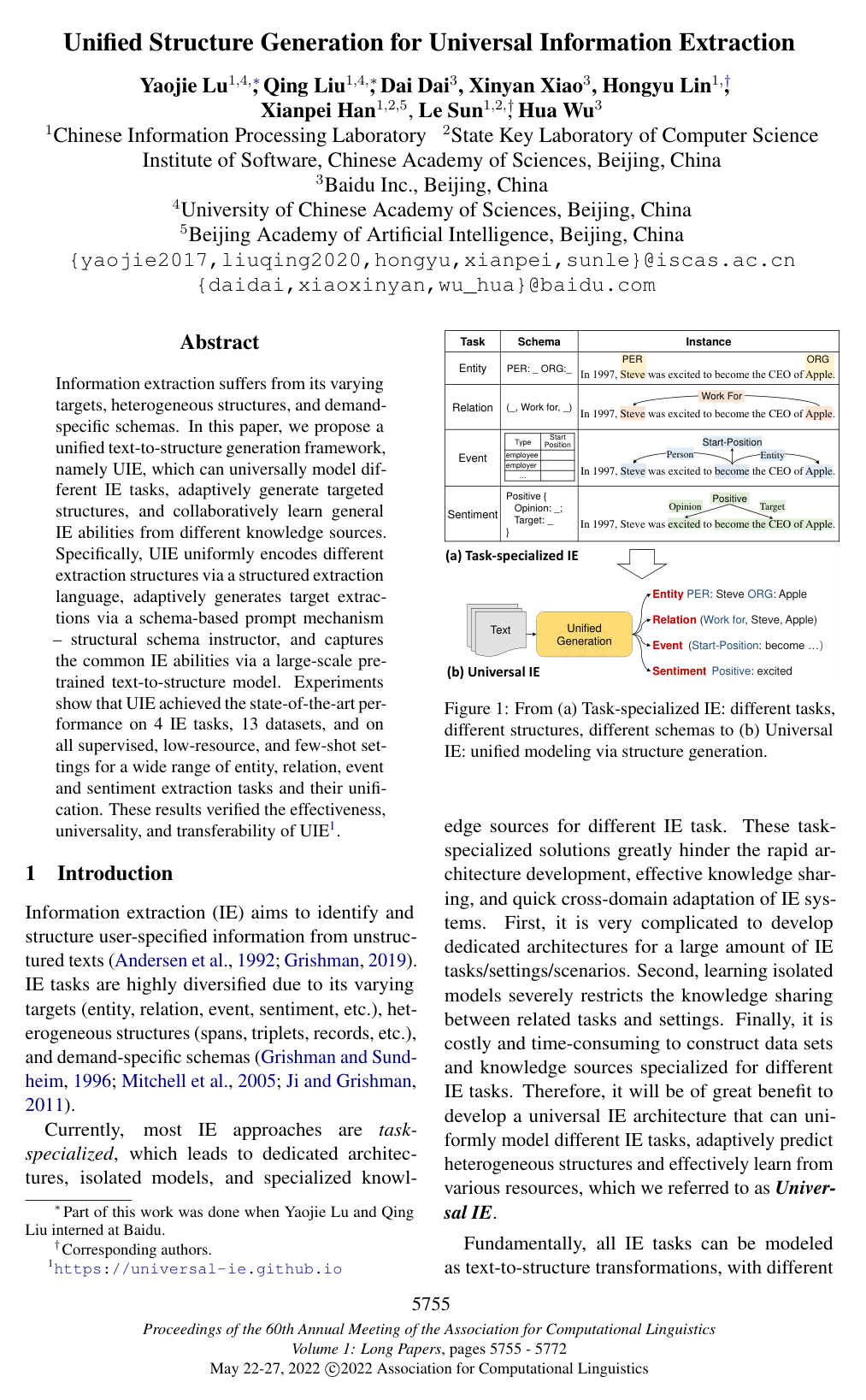
Proposes a unified text-to-structure generation framework that models diverse information extraction tasks—including entity, relation, event, and sentiment extraction—under a single pre-trained architecture using schema-based prompts and a structured extraction language.
Organizations often need to convert unstructured text into organized data records to support analytics, automation, and decision-making. Historically, information extraction has relied on specialized systems tailored to narrow goals, such as identifying names, mapping relationships, detecting events, or analyzing sentiment. Developing, maintaining, and adapting these isolated tools requires substantial engineering effort, separate data sets, and costly manual labeling, which slows deployment and increases operational overhead.
The article demonstrates a universal text-to-structure generation framework called UIE. The primary objective is to evaluate whether a single, unified architecture can capture diverse extraction tasks, adapt dynamically to varying requirements, and transfer core extraction abilities across domains.
The authors designed a standardized extraction format that reduces information extraction to two core operations: locating specific spans of text and associating those spans based on predefined relationships. To direct the model, they introduced a prompting mechanism that specifies what types of information to target. The system was pre-trained on large-scale web sources comprising parallel text-structure records, structural databases, and unstructured text, and was subsequently evaluated across 13 benchmark datasets covering entity, relation, event, and sentiment extraction in standard, low-resource, and few-shot environments.
The findings establish that a unified system can match or surpass specialized extraction models. In fully supervised settings, the model achieved an average improvement of 1.42% in accuracy across the tested datasets. The system showed even larger advantages in low-resource and few-shot conditions, where training data is scarce; the prompting mechanism improved average accuracy scores by 4.16 and 3.30 points across sample-limited settings. Furthermore, introducing a rejection mechanism during training, which teaches the model to discard irrelevant categories, improved extraction precision by an average of 13.16 points. Crucially, the model transferred structural knowledge effectively to event and sentiment tasks, despite having minimal exposure to those specific domains during pre-training.
These results indicate that enterprises can replace multiple fragmented natural language pipelines with a single shared extraction engine. Consolidating extraction into one foundation model lowers engineering maintenance costs, accelerates system rollout, and significantly reduces the manual data labeling required when entering new business domains.
Decision-makers should consider piloting unified generative extraction architectures to simplify existing text processing systems, especially for workflows with limited labeled training data. Future implementation should explore expanding the architecture to document-level context and knowledge-base linking. While confidence in the reported performance gains across benchmark datasets is high, practitioners should note that the current approach relies on basic text-matching heuristics to map extracted text spans back to exact document offsets, which may introduce minor errors in highly complex enterprise documents.
- Paper: Exploring the Limits of Transfer Learning with a Unified Text-to-Text Transformer, Colin Raffel et al. (2020). It establishes the foundational text-to-text unified sequence-to-sequence framework and pre-training methodology upon which UIE's universal text-to-structure paradigm is directly built.
- Paper: ERNIE: Enhanced Language Representation with Informative Entities, Zhengyan Zhang et al. (2019). It provides foundational insights into integrating structured factual knowledge and entity representations into language model pre-training, directly informing UIE's structured extraction objectives.
- Paper: Multi-Task Deep Neural Networks for Natural Language Understanding, Xiaodong Liu et al. (2019). It introduces multi-task representation learning across diverse NLP tasks, providing key conceptual background for UIE's collaborative multi-task extraction architecture.
- Paper: A Survey on Deep Learning for Named Entity Recognition, Jing Li et al. (2018). It surveys foundational neural information extraction and named entity recognition architectures, contextualizing the limitations of task-specific pipelines that UIE replaces.
- Paper: Generative Knowledge Graph Construction: A Review, Hongbin Ye et al. (2022). It systematically reviews and categorizes generative information extraction and knowledge graph construction paradigms, contextualizing UIE within the broader taxonomy of linearized structure generation.
- Paper: Grammar-Constrained Decoding for Structured NLP Tasks without Finetuning, Saibo Geng et al. (2023). It extends generative information extraction by enforcing grammar-constrained decoding over language models to guarantee syntactically valid structured outputs without task-specific fine-tuning.
- Paper: De-Bias for Generative Extraction in Unified NER Task, Shuai Zhang et al. (2022). It investigates and resolves the sequential and pre-context generation biases that emerge when applying unified generative text-to-structure extraction across diverse entity formats.
- Paper: Revisiting Relation Extraction in the era of Large Language Models, Somin Wadhwa et al. (2023). It investigates generative relation extraction in modern large language models, continuing UIE's line of research into generative extraction and evaluating evaluation metrics and reasoning prompts.
- Paper: GLiNER: Generalist Model for Named Entity Recognition using Bidirectional Transformer, Urchade Zaratiana et al. (2024). It proposes a generalist schema-prompted extraction framework as an efficient bidirectional alternative to autoregressive text-to-structure generation models like UIE.
- Paper: Extract, Define, Canonicalize: An LLM-based Framework for Knowledge Graph Construction, Bowen Zhang et al. (2024). It builds on unified extraction concepts to tackle knowledge graph construction under large or open schemas via modular extraction, definition generation, and canonicalization.