Grammar-Constrained Decoding for Structured NLP Tasks without Finetuning
Saibo GengMartin JosifoskiMaxime PeyrardRobert West
Proposes a unified grammar-constrained decoding framework using input-dependent grammars to enforce strict structural and vocabulary constraints on off-the-shelf language models during inference, outperforming unconstrained baselines and rivaling task-specific finetuned models across diverse structured prediction tasks.
Large language models excel at producing fluent, free-form text, but they frequently struggle with structured language processing tasks that require strict adherence to predefined syntax or restricted vocabularies, such as extracting facts or linking entities. Standard approaches typically rely on task-specific model finetuning, which requires substantial computational resources and large labeled datasets that are often unavailable in specialized domains.
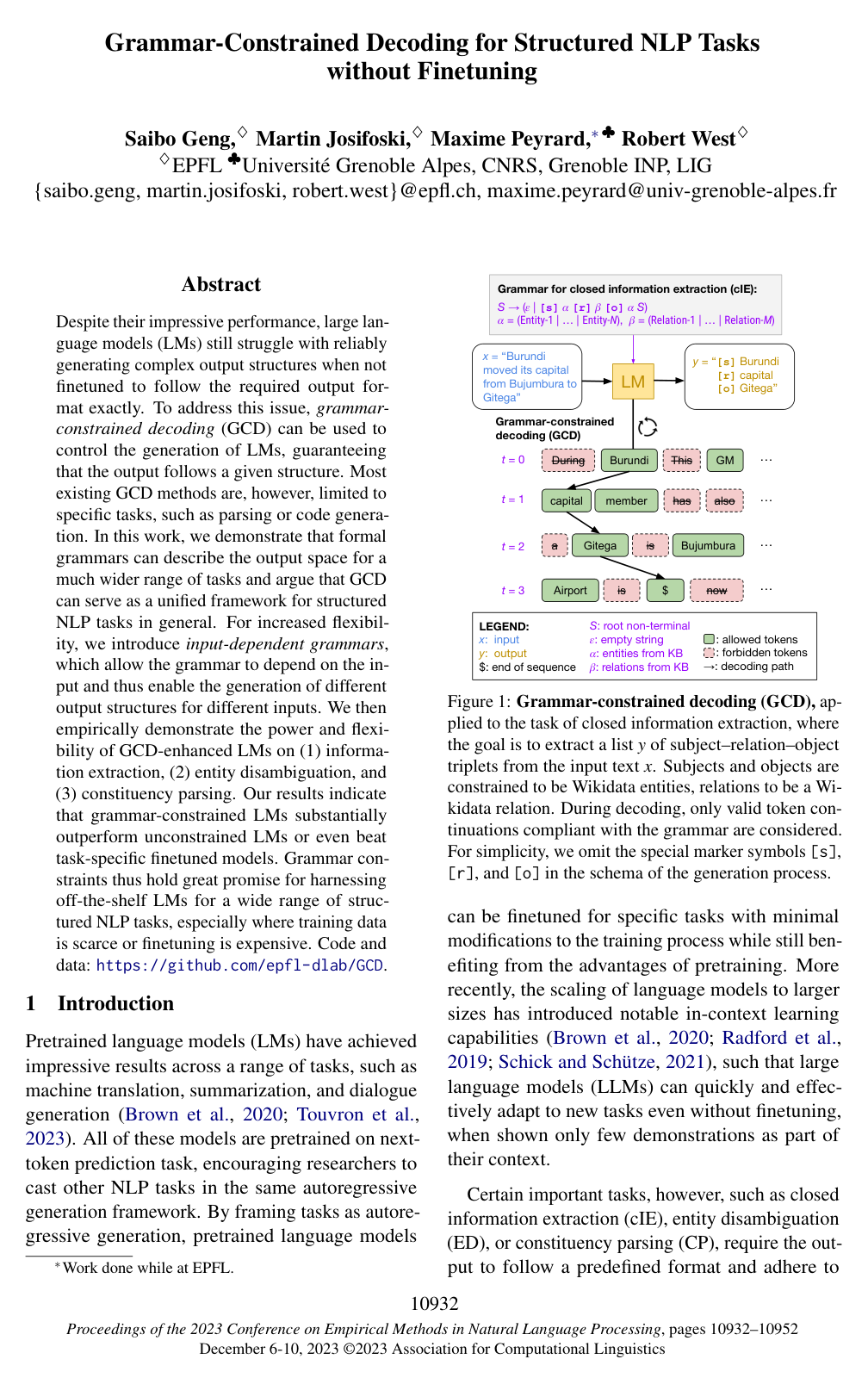
The article investigates whether a technique called grammar-constrained decoding can serve as a universal framework to force off-the-shelf, pretrained language models to produce perfectly valid structured outputs during generation without requiring any model finetuning.
To evaluate this approach, the researchers formalized the output requirements of 14 common language processing tasks into formal grammars and introduced input-dependent grammars to dynamically restrict model outputs based on specific inputs. They tested this method across several model sizes (LLaMA and Vicuna ranging from 7 billion to 33 billion parameters) in few-shot prompt settings across three benchmark tasks: closed information extraction, entity disambiguation across six standard datasets, and constituency parsing on Penn Treebank data.
The evaluation revealed several key findings. First, grammar-constrained decoding dramatically improved performance over unconstrained models; for example, on closed information extraction, a grammar-constrained 33-billion-parameter model achieved an F1 score of 36.0, doubling the unconstrained baseline of 17.5 and surpassing a dedicated, finetuned baseline model. Second, in entity disambiguation, input-dependent grammars boosted average accuracy from 54.1% unconstrained to 80.3%, outperforming models trained solely on domain data. Third, in syntactic parsing, grammar constraints guaranteed 100% structurally valid parse trees, compared to 54% to 69% validity for unconstrained models, although overall syntactic accuracy remained below specialized, fully supervised parsers. Additionally, parsing overhead added minimal latency (1 to 4 milliseconds per token) for entity and parsing tasks, though grammars with millions of rules introduced larger delays.
These findings demonstrate that grammar constraints provide a rapid, cost-effective way to adapt large language models to complex structured workflows without expensive retraining pipelines. This capability significantly lowers implementation costs and reduces compliance and operational risks associated with invalid or hallucinated outputs in low-resource environments.
Organizations operating in data-scarce domains should consider grammar-constrained decoding as an immediate, lightweight alternative to model finetuning for semantic tasks like information extraction and entity linking, using the largest accessible models and most restrictive grammars possible. However, where extensive labeled datasets exist or where deep syntactic parsing is required, dedicated finetuned models remain preferable.
Confidence in these findings is high for semantic extraction and disambiguation tasks across open-weight models. Readers should note two practical limitations: the technique cannot be directly used with closed, commercial application programming interfaces (such as proprietary cloud models) that hide token probabilities, and extremely large knowledge-base grammars can add computational latency that may require further parser optimization before deployment in high-throughput production systems.
- Paper: Fine-Grained Controllable Text Generation Using Non-Residual Prompting, Fredrik Carlsson et al. (2022). This paper establishes the trade-offs and mechanisms of fine-grained controllable text generation and decoding-level constraints in pre-trained models.
- Paper: Diffusion-LM Improves Controllable Text Generation, Xiang Lisa Li et al. (2022). It explores generating text under fine-grained syntactic tree and semantic constraints without retraining, providing key context for non-finetuning control paradigms.
- Paper: Natural Language to Code Translation with Execution, Freda Shi et al. (2022). It introduces inference-time selection and execution-guided decoding to enforce syntactic and semantic correctness in structured generation without model retraining.
- Paper: Head-Driven Statistical Models for Natural Language Parsing, Michael Collins (2003). This foundational work details statistical parsing and context-free formalisms on the Penn Treebank, which serve as direct benchmark tasks and grammar specifications in the source.
- Paper: The Curious Case of Neural Text Degeneration, Ari Holtzman et al. (2020). It provides the foundational analysis of standard autoregressive decoding algorithms and the failure modes that motivate constrained decoding interventions.
- Paper: Controlled Text Generation with Natural Language Instructions, Wangchunshu Zhou et al. (2023). This work explores an alternative training-time instruction paradigm to enforce structural constraints without incurring the latency overhead of runtime grammar parsers.
- Paper: StructGPT: A General Framework for Large Language Model to Reason over Structured Data, Jinhao Jiang et al. (2023). It extends the principle of zero-shot structured reasoning by enabling language models to interface with and extract information from structured data schemas without fine-tuning.
- Paper: Mitigating Large Language Model Hallucinations via Autonomous Knowledge Graph-Based Retrofitting, Xinyan Guan et al. (2024). It builds upon the need for strict factual grounding by using knowledge graph structures at inference time to autonomously retrofit and validate generation steps.
- Paper: Plan-on-Graph: Self-Correcting Adaptive Planning of Large Language Model on Knowledge Graphs, Liyi Chen et al. (2024). It advances constrained and structured generation over knowledge graphs by introducing dynamic planning and self-correction to navigate multi-hop constraints.
- Paper: EAGLE-2: Faster Inference of Language Models with Dynamic Draft Trees, Yuhui Li et al. (2024). It addresses the inference-time latency challenges of autoregressive generation by using dynamic tree drafting during decoding.