FreeCustom: Tuning-Free Customized Image Generation for Multi-Concept Composition
Ganggui DingCanyu ZhaoWen WangZhen YangZide LiuHao ChenChunhua Shen
Proposes a tuning-free framework that composes multiple user-specified concepts into customized images using only a single reference image per subject, eliminating the need for test-time fine-tuning through multi-reference self-attention and weighted masking.
Generating customized images that seamlessly combine specific subjects or objects has become a key requirement across industries such as digital advertising, virtual try-on, and creative media. Existing artificial intelligence methods typically focus on single-subject customization and require time-consuming fine-tuning or retraining on extensive datasets. When applied to complex tasks involving multiple subjects, these models often suffer from identity distortion, conceptual confusion, and severe computational delays, limiting their practical deployment.
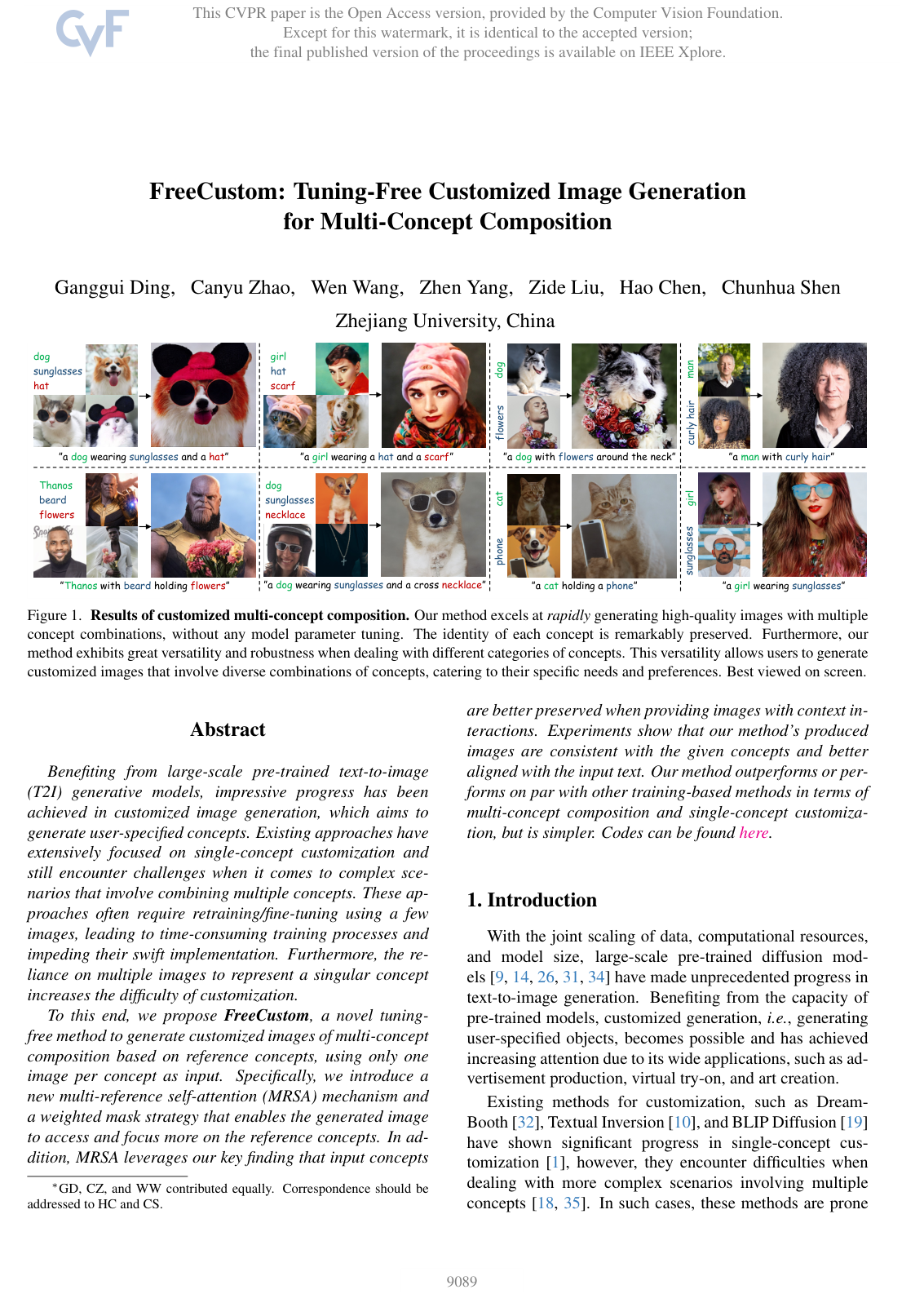
The article demonstrates FreeCustom, a tuning-free method for customized image generation that composes multiple distinct concepts using only a single reference image per concept. The primary objective is to evaluate how effectively this approach can preserve subject identities and align with text prompts across multiple base models without requiring any model retraining or parameter fine-tuning.
To achieve this, the authors designed a dual-path pipeline that extracts reference image features and integrates them during the standard image generation process. The core mechanism, termed multi-reference self-attention, injects features from reference images into deep network layers. A weighted masking strategy isolates the target subjects from their backgrounds to prevent unwanted visual clutter from bleeding into the output. The evaluation benchmarked the approach on a diverse dataset spanning animals, clothing, accessories, and human faces, comparing it against established tuning-based and tailored customization baselines across automated metrics and human user studies.
The findings show that FreeCustom matches or exceeds existing methods in image-text alignment and visual quality while eliminating preprocessing overhead. In multi-concept tasks, it achieved significantly higher user study ratings—scoring 4.40 out of 5 for text alignment, 4.65 for concept consistency, and 4.17 for image quality, compared to top baseline scores of 1.91, 2.53, and 2.48 respectively. Operationally, the method generated multi-concept images in 36 to 58 seconds with zero preprocessing time, whereas competing methods required up to several minutes of fine-tuning or days of prior model retraining. Additionally, providing input images that feature contextual interactions—such as a hat being worn rather than isolated on a blank background—substantially improved identity preservation.
These results demonstrate that complex, personalized visual content can be synthesized on demand without expensive retraining infrastructure or long turnaround times. The approach integrates directly into existing diffusion models in a plug-and-play manner, dramatically reducing operational compute costs and shortening product development cycles. Organizations looking to deploy scalable personalized media generation should adopt tuning-free attention injection architectures. However, decision-makers should note that the system currently lacks an explicit structural perception module to handle complex geometric relationships, and incorporating future enhancements like specialized image adapters is recommended for further accuracy.
- Paper: Multi-Concept Customization of Text-to-Image Diffusion, Nupur Kumari et al. (2022). Custom Diffusion establishes the foundational paradigm of multi-concept customization in text-to-image models, which FreeCustom directly aims to improve upon by eliminating fine-tuning.
- Paper: DreamBooth: Fine Tuning Text-to-Image Diffusion Models for Subject-Driven Generation, Nataniel Ruiz et al. (2023). DreamBooth provides the foundational subject-driven fine-tuning approach for text-to-image diffusion models that motivates FreeCustom's tuning-free multi-concept alternative.
- Paper: An Image is Worth One Word: Personalizing Text-to-Image Generation using Textual Inversion, Rinon Gal et al. (2022). Textual Inversion introduces the core problem setup of personalizing pre-trained diffusion models using reference images without modifying the underlying weights.
- Paper: Prompt-to-Prompt Image Editing with Cross Attention Control, Amir Hertz et al. (2022). Prompt-to-Prompt introduces direct attention manipulation during the diffusion process to control visual elements without retraining, laying the conceptual groundwork for FreeCustom's multi-reference self-attention.
- Paper: T2I-CompBench: A Comprehensive Benchmark for Open-world Compositional Text-to-image Generation, Kaiyi Huang et al. (2023). T2I-CompBench defines standard benchmarks and diagnostic metrics for multi-concept compositional text-to-image generation against which multi-concept fidelity is assessed.
- Paper: MIGC: Multi-Instance Generation Controller for Text-to-Image Synthesis, Dewei Zhou et al. (2024). MIGC provides an advanced spatial controller to resolve instance attribute leakage and position binding when generating complex multi-concept scenes.
- Paper: Kosmos-G: Generating Images in Context with Multimodal Large Language Models, Xichen Pan et al. (2024). Kosmos-G extends tuning-free multi-subject generation by unifying multimodal large language models with diffusion generators to process interleaved text and multi-image inputs in context.
- Paper: DisenBooth: Identity-Preserving Disentangled Tuning for Subject-Driven Text-to-Image Generation, Hong Chen et al. (2024). DisenBooth explores explicit disentanglement between subject identity and context features, offering complementary techniques for preserving identity fidelity across complex backgrounds.
- Paper: Towards Understanding Cross and Self-Attention in Stable Diffusion for Text-Guided Image Editing, Bingyan Liu et al. (2024). This paper analyzes the internal mechanics and semantic behavior of cross- and self-attention layers in Stable Diffusion during tuning-free image manipulation.
- Paper: VideoBooth: Diffusion-based Video Generation with Image Prompts, Yuming Jiang et al. (2024). VideoBooth extends single-image prompt customization into the temporal domain to achieve tuning-free video generation of customized subjects.