
keyword
text-to-image generation
Text-to-image generation is a task within artificial intelligence and computer vision that involves automatically synthesizing visual images from natural language text prompts. Deep learning systems for text-to-image generation typically employ architectures such as diffusion models, autoregressive transformers, or generative adversarial networks that are trained on large datasets of paired images and descriptive captions. By learning cross-modal mappings between linguistic semantics and visual representations, these models translate descriptive concepts, including specific objects, attributes, spatial relationships, and artistic styles, into coherent and novel visual outputs. Beyond standard image synthesis, text-to-image frameworks support applications such as digital art creation, localized image editing, and visual personalization, with system performance commonly evaluated by aesthetic quality, visual realism, and semantic faithfulness to the input text.
13 items
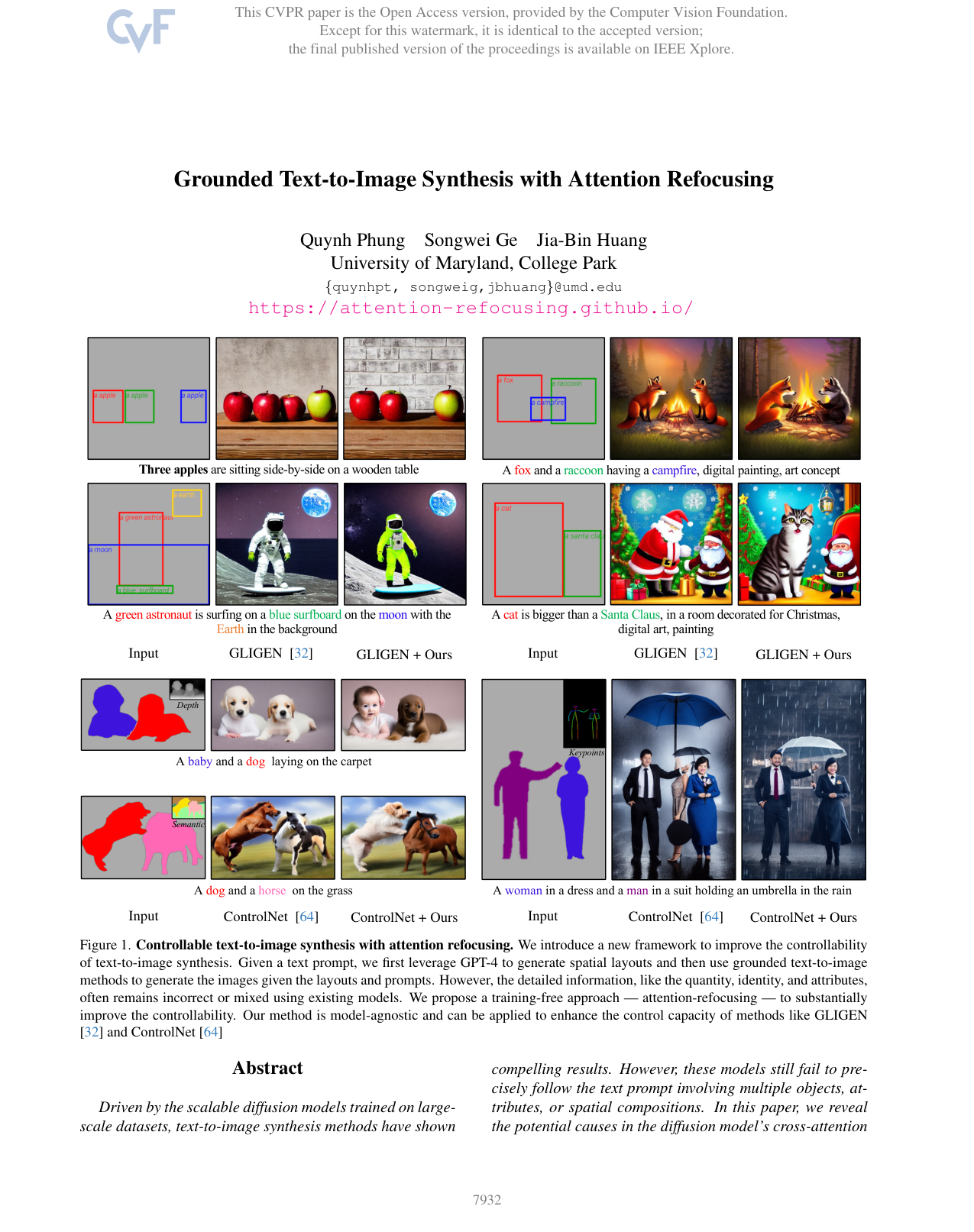
Grounded Text-to-Image Synthesis with Attention Refocusing
Quynh Phung, Songwei Ge, Jia-Bin Huang
Why you should read this
Introduces a training-free framework that regularizes both cross- and self-attention maps during diffusion sampling to prevent object omission and attribute mixing using LLM-generated spatial layouts.
Driven by the scalable diffusion models trained on large-scale datasets, text-to-image synthesis methods have shown compelling results. However, these models still fail to precisely follow the text prompt involving multiple objects, attributes, or spatial compositions. In this paper, we reveal the potential causes in the diffusion model's cross-attention
Added
2026-10-05
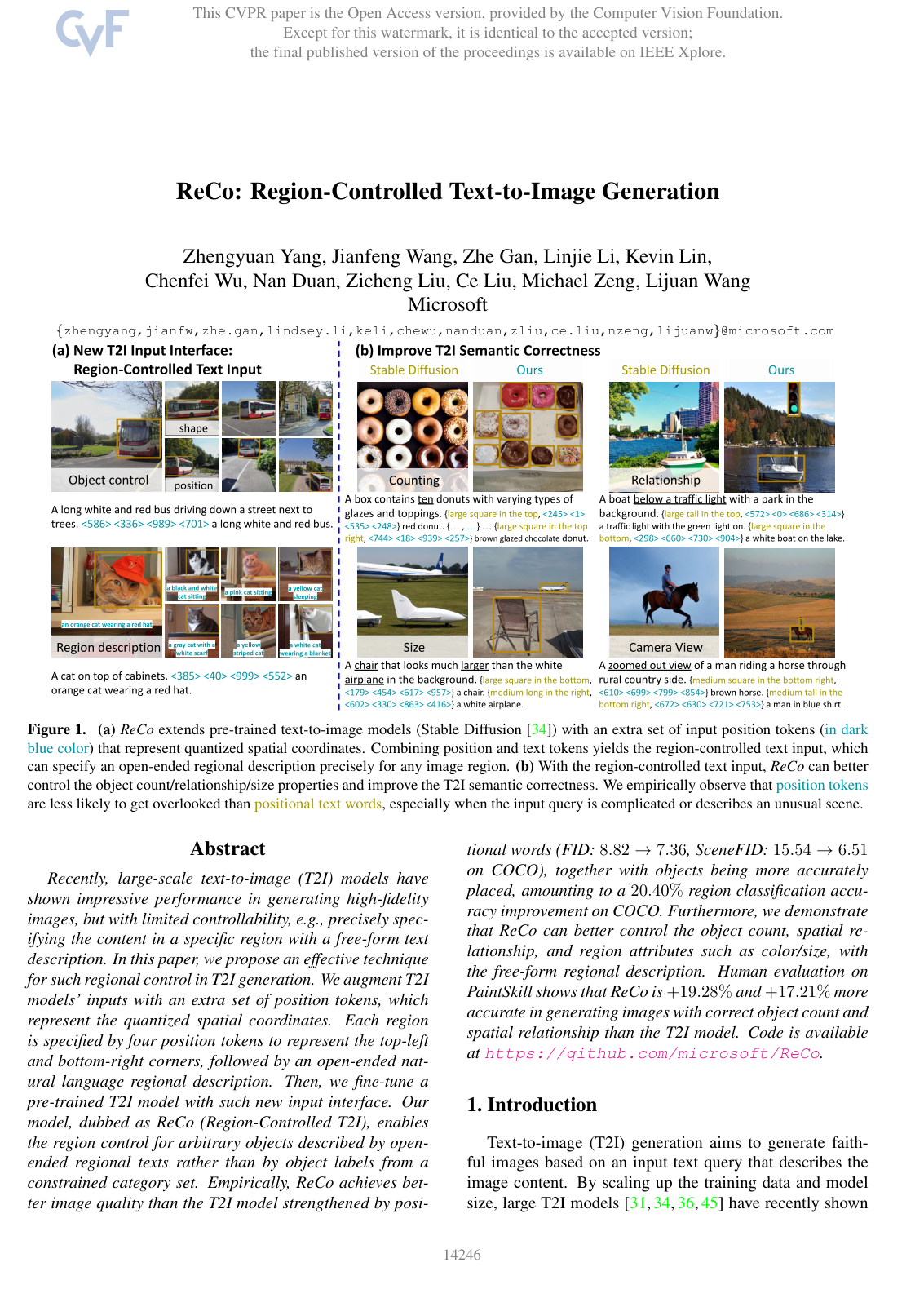
ReCo: Region-Controlled Text-to-Image Generation
Zhengyuan Yang, Jianfeng Wang, Zhe Gan, Linjie Li, Kevin Lin, Chenfei Wu, Nan Duan, Zicheng Liu, Ce Liu, Michael Zeng, Lijuan Wang
Why you should read this
Proposes ReCo, an approach that incorporates quantized spatial coordinate tokens into text-to-image models to enable precise regional control over object locations, counts, and attributes via free-form natural language prompts.
Recently, large-scale text-to-image (T2I) models have shown impressive performance in generating high-fidelity images, but with limited controllability, e.g., precisely specifying the content in a specific region with a free-form text description. In this paper, we propose an effective technique for such regional control in T2I generation. We augment T2I models’ inputs with an extra set of position tokens, which represent the quantized spatial coordinates. Each region is specified by four position tokens to represent the top-left and bottom-right corners, followed by an open-ended natural language regional description. Then, we fine-tune a pre-trained T2I model with such new input interface. Our model, dubbed as ReCo (Region-Controlled T2I), enables the region control for arbitrary objects described by open-ended regional texts rather than by object labels from a constrained category set. Empirically, ReCo achieves better image quality than the T2I model strengthened by positional words (FID: 8.82 → 7.36, SceneFID: 15.54 → 6.51 on COCO), together with objects being more accurately placed, amounting to a 20.40% region classification accuracy improvement on COCO. Furthermore, we demonstrate that ReCo can better control the object count, spatial relationship, and region attributes such as color/size, with the free-form regional description. Human evaluation on PaintSkill shows that ReCo is +19.28% and +17.21% more accurate in generating images with correct object count and spatial relationship than the T2I model. Code is available at https://github.com/microsoft/ReCo.
Added
2026-10-05
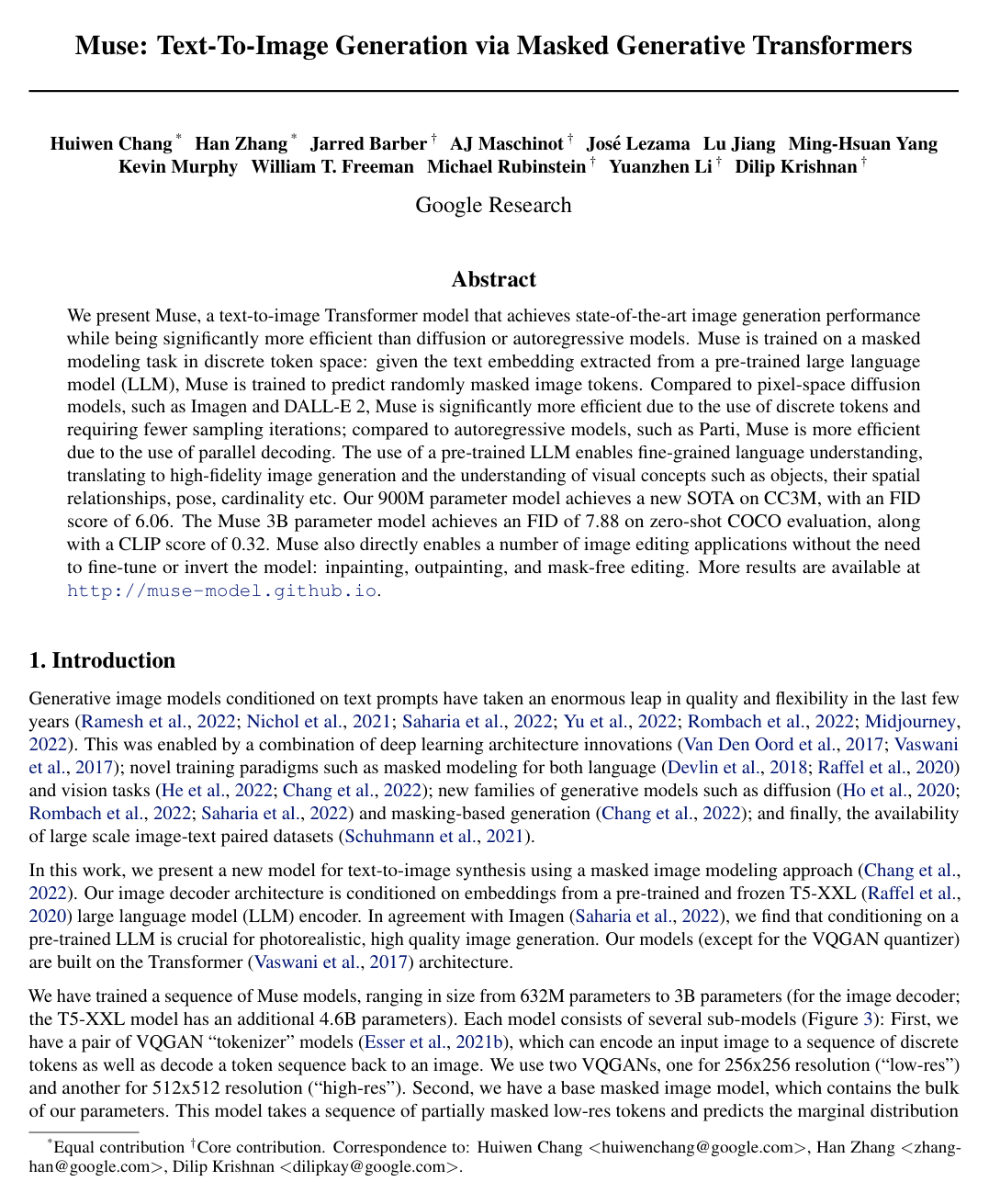
Muse: Text-To-Image Generation via Masked Generative Transformers
Huiwen Chang, Han Zhang, Jarred Barber, Aaron Maschinot, José Lezama, Lu Jiang, Ming-Hsuan Yang, Kevin Patrick Murphy, William T. Freeman, Michael Rubinstein, Yuanzhen Li, Dilip Krishnan
Why you should read this
Presents Muse, a text-to-image Transformer based on masked discrete token modeling that achieves state-of-the-art generation fidelity significantly faster than diffusion or autoregressive baselines while enabling zero-shot editing without model fine-tuning.
We present Muse, a text-to-image Transformer model that achieves state-of-the-art image generation performance while being significantly more efficient than diffusion or autoregressive models. Muse is trained on a masked modeling task in discrete token space: given the text embedding extracted from a pre-trained large language model (LLM), Muse is trained to predict randomly masked image tokens. Compared to pixel-space diffusion models, such as Imagen and DALL-E 2, Muse is significantly more efficient due to the use of discrete tokens and requiring fewer sampling iterations; compared to autoregressive models, such as Parti, Muse is more efficient due to the use of parallel decoding. The use of a pre-trained LLM enables fine-grained language understanding, translating to high-fidelity image generation and the understanding of visual concepts such as objects, their spatial relationships, pose, cardinality etc. Our 900M parameter model achieves a new SOTA on CC3M, with an FID score of 6.06. The Muse 3B parameter model achieves an FID of 7.88 on zero-shot COCO evaluation, along with a CLIP score of 0.32. Muse also directly enables a number of image editing applications without the need to fine-tune or invert the model: inpainting, outpainting, and mask-free editing. More results are available at this https URL
Added
2026-10-05
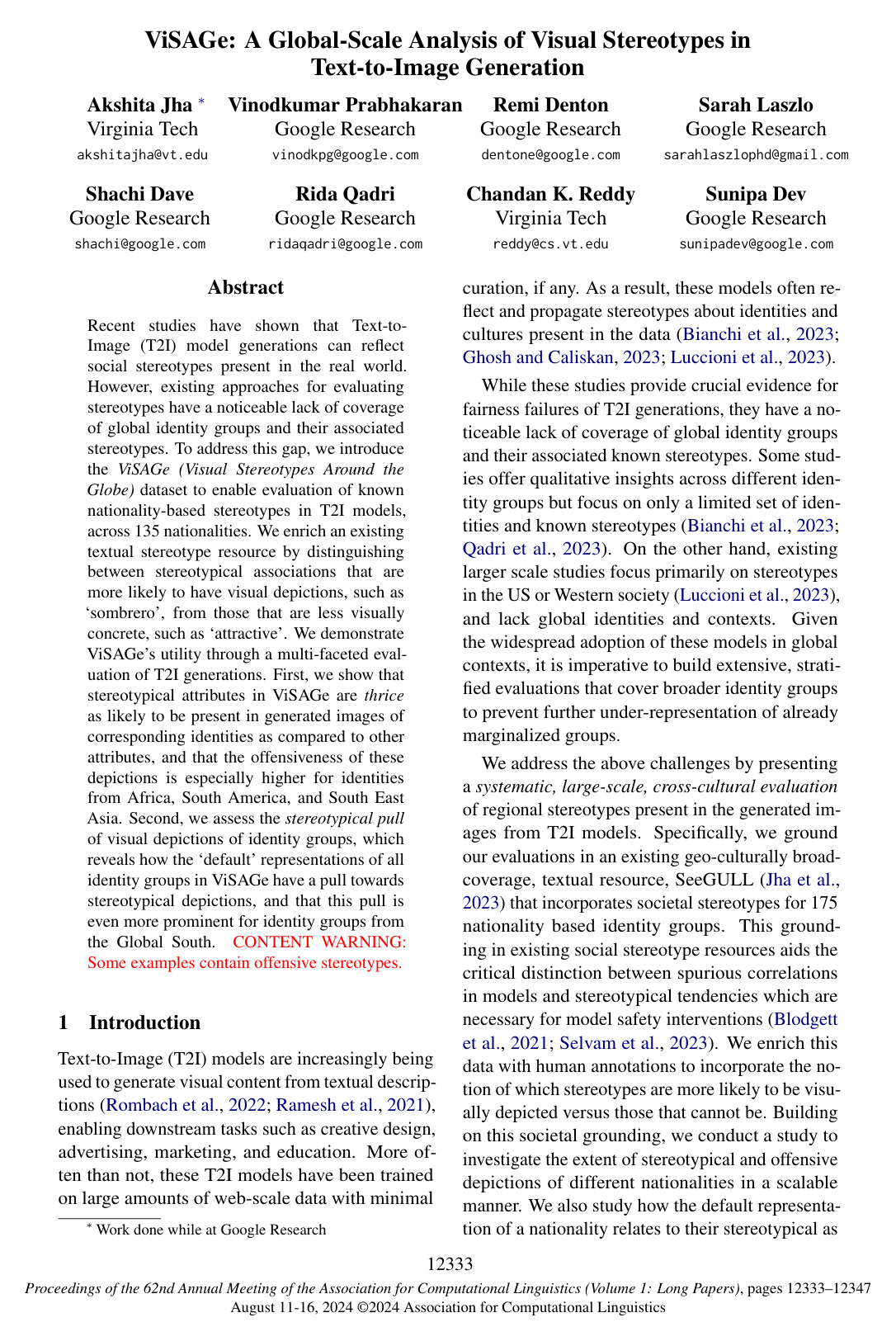
ViSAGe: A Global-Scale Analysis of Visual Stereotypes in Text-to-Image Generation
Akshita Jha, Vinodkumar Prabhakaran, Remi Denton, Sarah Laszlo, Shachi Dave, Rida Qadri, Chandan K. Reddy, Sunipa Dev
Why you should read this
Introduces the ViSAGe dataset covering 135 nationalities to evaluate visual stereotypes in text-to-image models, revealing that generative systems disproportionately produce offensive depictions of people from the Global South.
Recent studies have shown that Text-to-Image (T2I) model generations can reflect social stereotypes present in the real world. However, existing approaches for evaluating stereotypes have a noticeable lack of coverage of global identity groups and their associated stereotypes. To address this gap, we introduce the ViSAGe (Visual Stereotypes Around the Globe) dataset to enable the evaluation of known nationality-based stereotypes in T2I models, across 135 nationalities. We enrich an existing textual stereotype resource by distinguishing between stereotypical associations that are more likely to have visual depictions, such as `sombrero', from those that are less visually concrete, such as 'attractive'. We demonstrate ViSAGe's utility through a multi-faceted evaluation of T2I generations. First, we show that stereotypical attributes in ViSAGe are thrice as likely to be present in generated images of corresponding identities as compared to other attributes, and that the offensiveness of these depictions is especially higher for identities from Africa, South America, and South East Asia. Second, we assess the stereotypical pull of visual depictions of identity groups, which reveals how the 'default' representations of all identity groups in ViSAGe have a pull towards stereotypical depictions, and that this pull is even more prominent for identity groups from the Global South. CONTENT WARNING: Some examples contain offensive stereotypes.
Added
2026-10-05
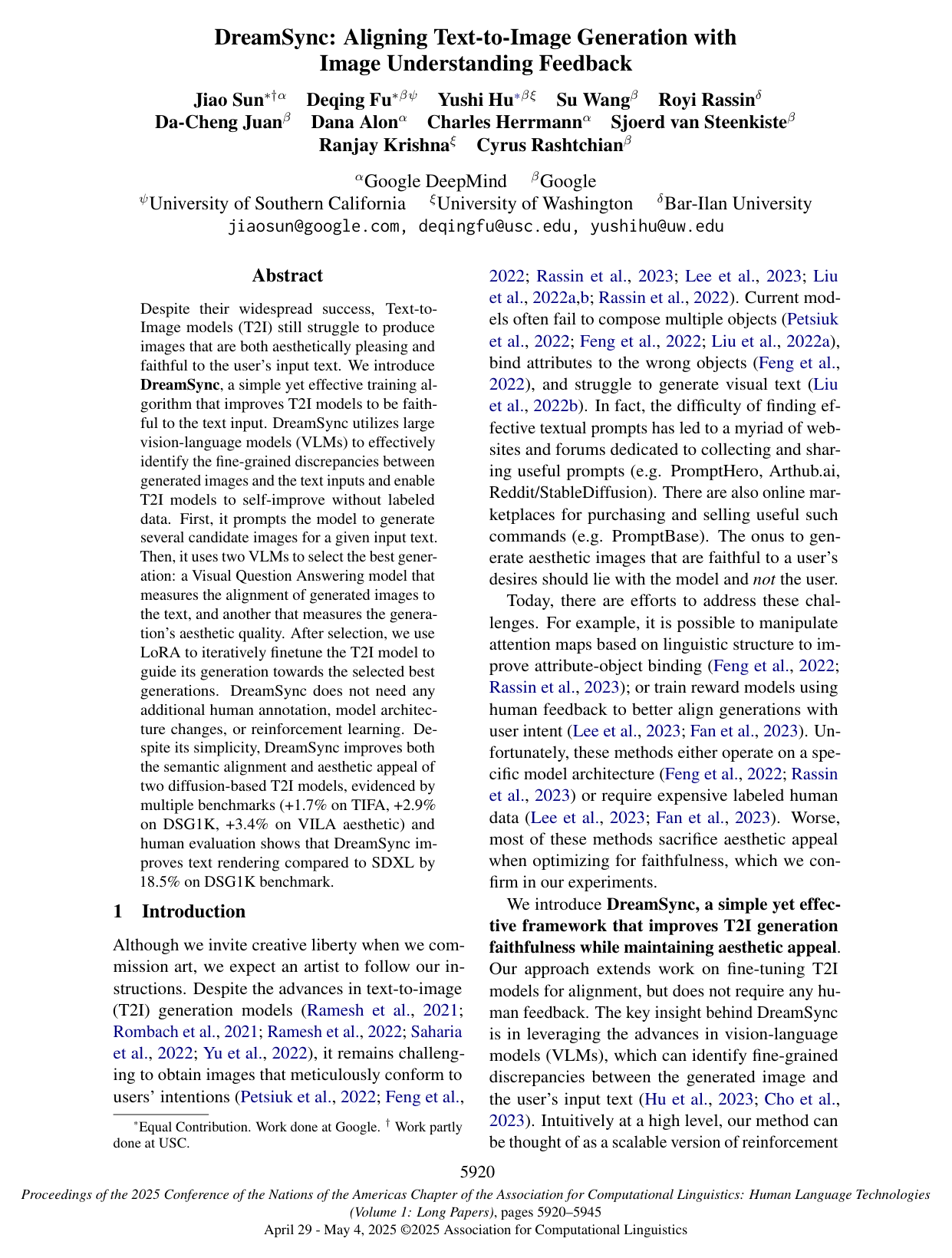
DreamSync: Aligning Text-to-Image Generation with Image Understanding Feedback
Jiao Sun, Deqing Fu, Yushi Hu, Su Wang, Royi Rassin, Da-Cheng Juan, Dana Alon, Charles Herrmann, Sjoerd van Steenkiste, Ranjay Krishna, Cyrus Rashtchian
Why you should read this
Presents DreamSync, an iterative self-training framework that uses vision-language models for automated text-alignment and aesthetic scoring to fine-tune text-to-image diffusion models with LoRA without requiring human labels or reinforcement learning.
Despite their widespread success, Text-to-Image models (T2I) still struggle to produce images that are both aesthetically pleasing and faithful to the user’s input text. We introduce DreamSync, a simple yet effective training algorithm that improves T2I models to be faithful to the text input. DreamSync utilizes large vision-language models (VLMs) to effectively identify the fine-grained discrepancies between generated images and the text inputs and enable T2I models to self-improve without labeled data. First, it prompts the model to generate several candidate images for a given input text. Then, it uses two VLMs to select the best generation: a Visual Question Answering model that measures the alignment of generated images to the text, and another that measures the generation’s aesthetic quality. After selection, we use LoRA to iteratively finetune the T2I model to guide its generation towards the selected best generations. DreamSync does not need any additional human annotation, model architecture changes, or reinforcement learning. Despite its simplicity, DreamSync improves both the semantic alignment and aesthetic appeal of two diffusion-based T2I models, evidenced by multiple benchmarks (+1.7% on TIFA, +2.9% on DSG1K, +3.4% on VILA aesthetic) and human evaluation shows that DreamSync improves text rendering compared to SDXL by 18.5% on DSG1K benchmark.
Added
2026-10-03
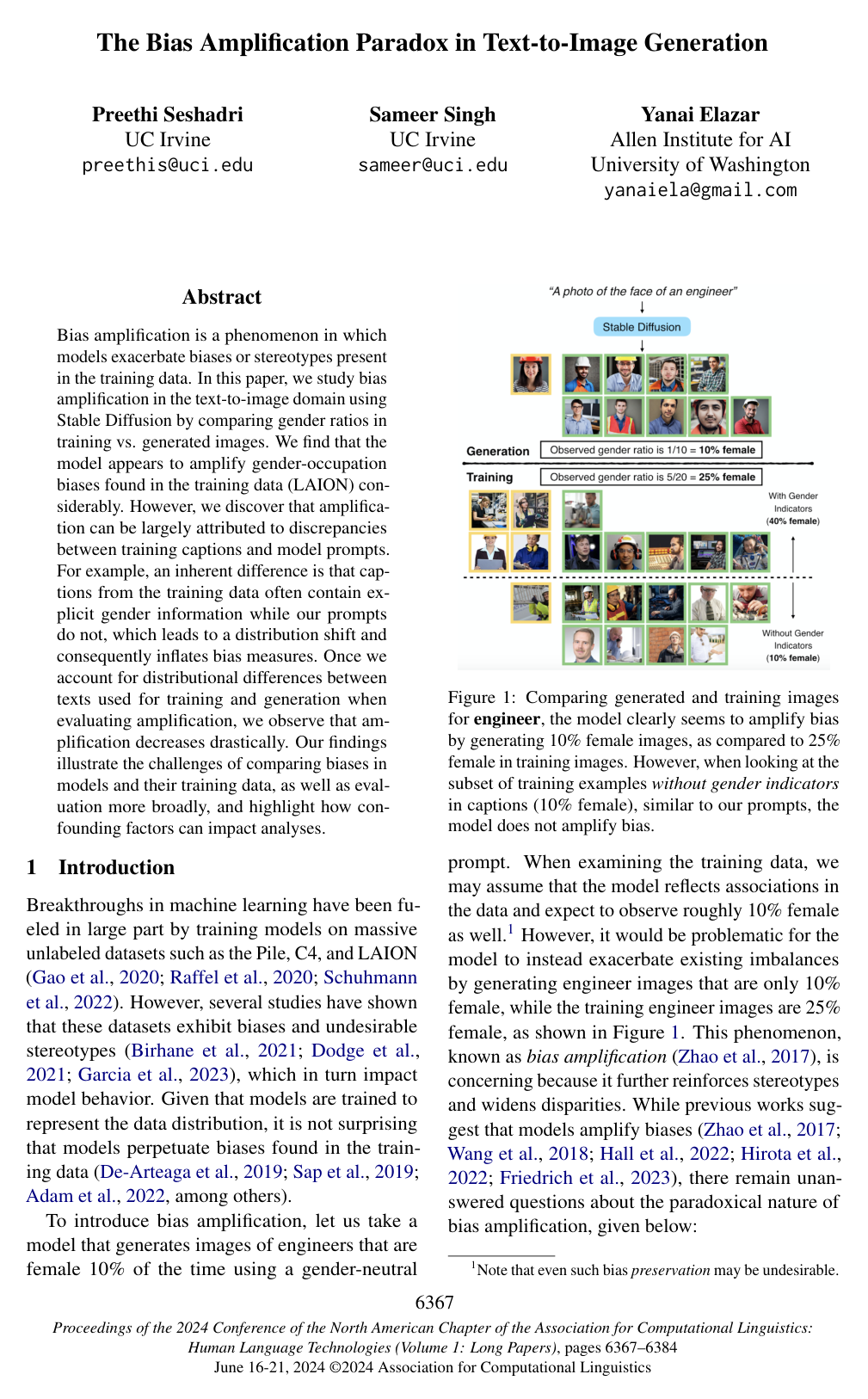
The Bias Amplification Paradox in Text-to-Image Generation
Preethi Seshadri, Sameer Singh, Yanai Elazar
Why you should read this
Demonstrates that apparent gender-bias amplification in text-to-image models is largely an artifact of distribution shifts between training captions and evaluation prompts, providing a more accurate method to evaluate whether models truly exaggerate dataset biases.
Bias amplification is a phenomenon in which models exacerbate biases or stereotypes present in the training data. In this paper, we study bias amplification in the text-to-image domain using Stable Diffusion by comparing gender ratios in training vs. generated images. We find that the model appears to amplify gender-occupation biases found in the training data (LAION) considerably. However, we discover that amplification can be largely attributed to discrepancies between training captions and model prompts. For example, an inherent difference is that captions from the training data often contain explicit gender information while our prompts do not, which leads to a distribution shift and consequently inflates bias measures. Once we account for distributional differences between texts used for training and generation when evaluating amplification, we observe that amplification decreases drastically. Our findings illustrate the challenges of comparing biases in models and their training data, as well as evaluation more broadly, and highlight how confounding factors can impact analyses.
Added
2026-10-02
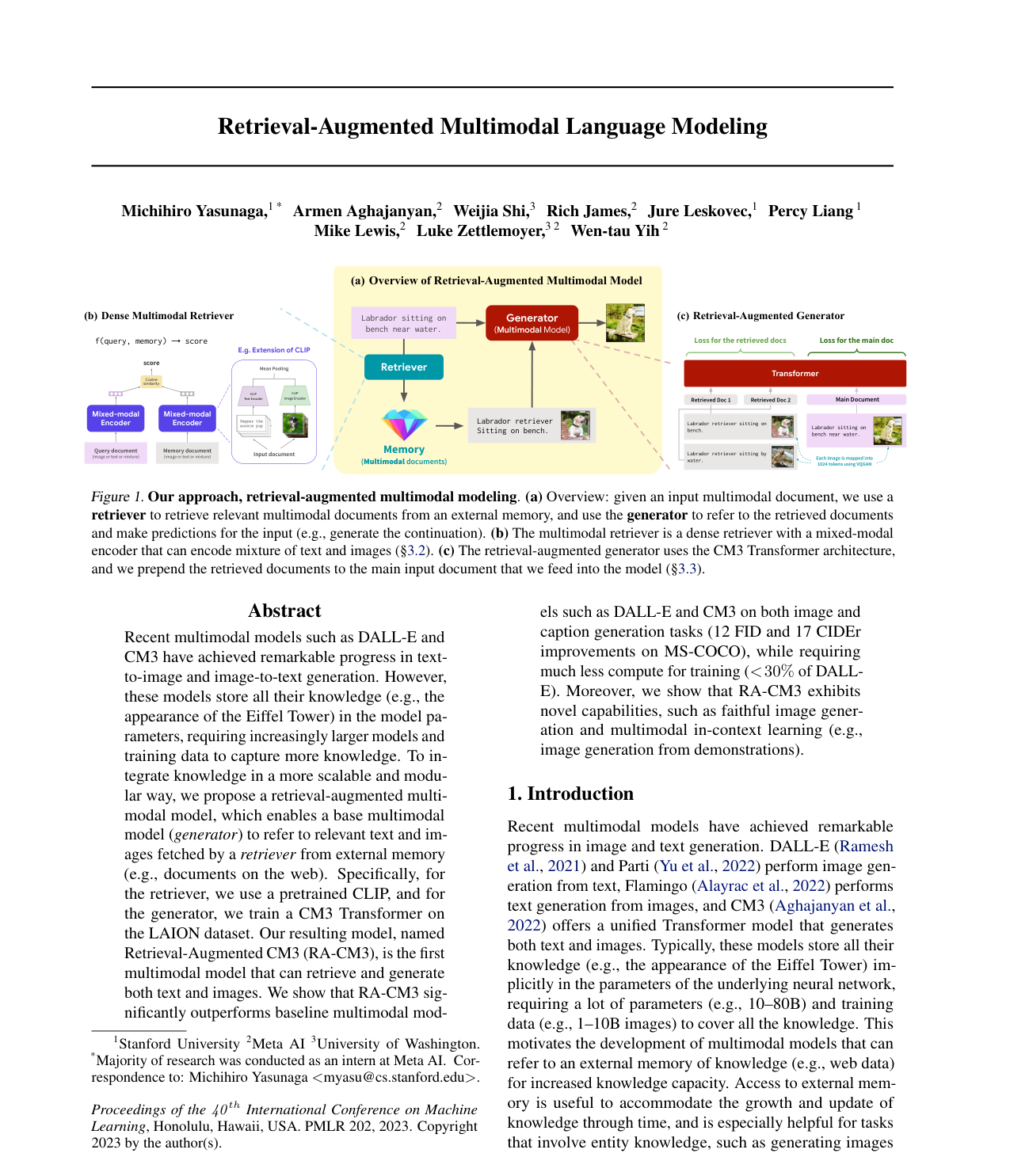
Retrieval-Augmented Multimodal Language Modeling
Michihiro Yasunaga, Armen Aghajanyan, Weijia Shi, Richard James, Jure Leskovec, Percy Liang, Mike Lewis, Luke Zettlemoyer, Wen-Tau Yih
Why you should read this
Proposes RA-CM3, a retrieval-augmented multimodal architecture that fetches relevant text-image documents to generate both modalities, significantly cutting training compute while outperforming models like DALL-E and enabling multimodal in-context learning.
Recent multimodal models such as DALL-E and CM3 have achieved remarkable progress in text-to-image and image-to-text generation. However, these models store all their knowledge (e.g., the appearance of the Eiffel Tower) in the model parameters, requiring increasingly larger models and training data to capture more knowledge. To integrate knowledge in a more scalable and modular way, we propose a retrieval-augmented multimodal model, which enables a base multimodal model (generator) to refer to relevant text and images fetched by a retriever from external memory (e.g., documents on the web). Specifically, for the retriever, we use a pretrained CLIP, and for the generator, we train a CM3 Transformer on the LAION dataset. Our resulting model, named Retrieval-Augmented CM3 (RA-CM3), is the first multimodal model that can retrieve and generate both text and images. We show that RA-CM3 significantly outperforms baseline multimodal models such as DALL-E and CM3 on both image and caption generation tasks (12 FID and 17 CIDEr improvements on MS-COCO), while requiring much less compute for training (<30% of DALL-E). Moreover, we show that RA-CM3 exhibits novel capabilities, such as faithful image generation and multimodal in-context learning (e.g., image generation from demonstrations).
Added
2026-10-01
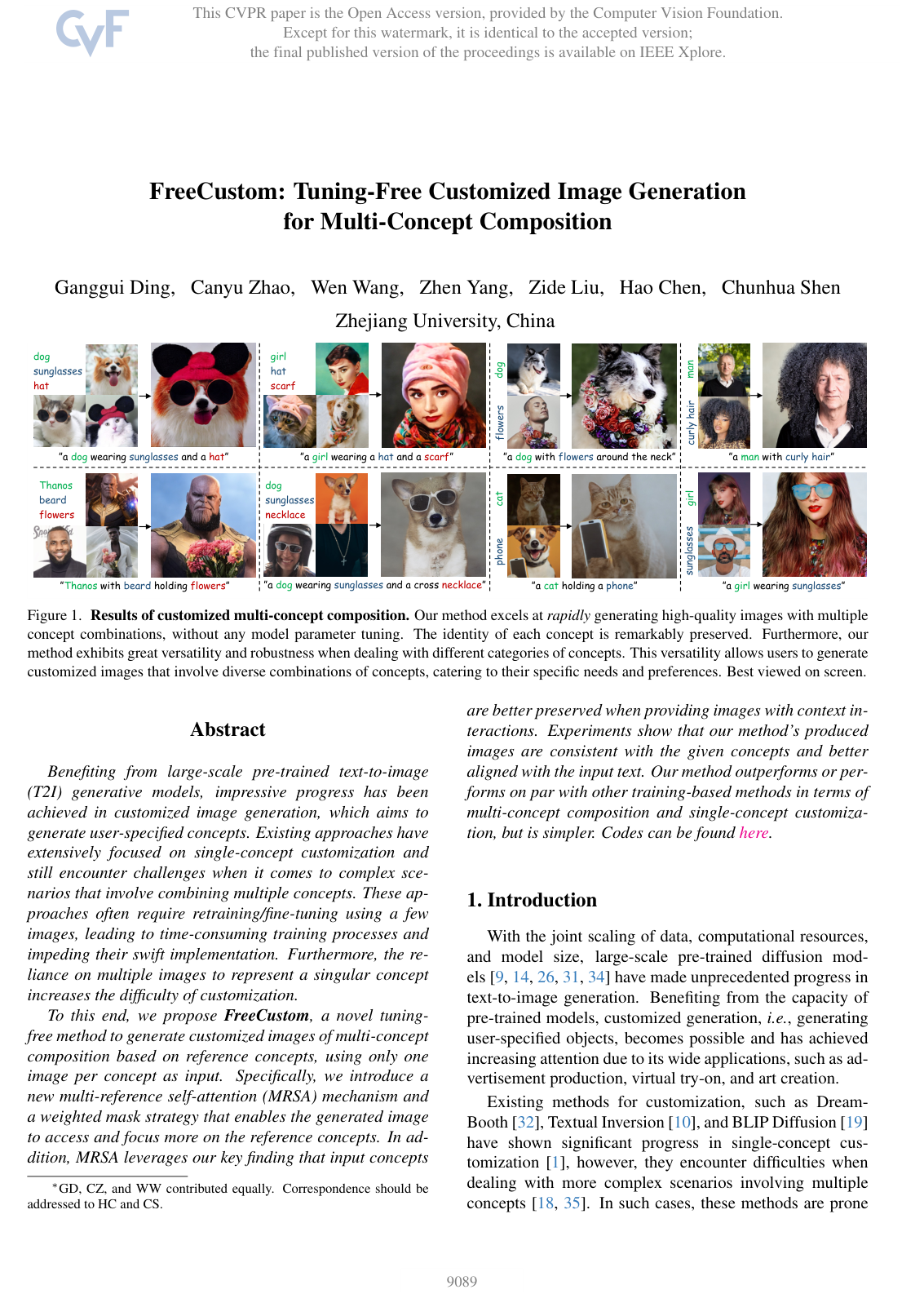
FreeCustom: Tuning-Free Customized Image Generation for Multi-Concept Composition
Ganggui Ding, Canyu Zhao, Wen Wang, Zhen Yang, Zide Liu, Hao Chen, Chunhua Shen
Why you should read this
Proposes a tuning-free framework that composes multiple user-specified concepts into customized images using only a single reference image per subject, eliminating the need for test-time fine-tuning through multi-reference self-attention and weighted masking.
Benefiting from large-scale pre-trained text-to-image (T2I) generative models, impressive progress has been achieved in customized image generation, which aims to generate user-specified concepts. Existing approaches have extensively focused on single-concept customization and still encounter challenges when it comes to complex scenarios that involve combining multiple concepts. These approaches often require retraining/fine-tuning using a few images, leading to time-consuming training processes and impeding their swift implementation. Furthermore, the reliance on multiple images to represent a singular concept increases the difficulty of customization. To this end, we propose FreeCustom, a novel tuning-free method to generate customized images of multi-concept composition based on reference concepts, using only one image per concept as input. Specifically, we introduce a new multi-reference self-attention (MRSA) mechanism and a weighted mask strategy that enables the generated image to access and focus more on the reference concepts. In addition, MRSA leverages our key finding that input concepts are better preserved when providing images with context interactions. Experiments show that our method's produced images are consistent with the given concepts and better aligned with the input text. Our method outperforms or performs on par with other training-based methods in terms of multi-concept composition and single-concept customization, but is simpler. Codes can be found here.
Added
2026-09-26
Optimizing Prompts for Text-to-Image Generation
Yaru Hao, Zewen Chi, Li Dong, Furu Wei
Why you should read this
Proposes PROMPTIST, a framework combining supervised fine-tuning and reinforcement learning to automatically rewrite plain text inputs into optimized prompts that boost image aesthetics in text-to-image models while preserving user intent.
Well-designed prompts can guide text-to-image models to generate amazing images. However, the performant prompts are often model-specific and misaligned with user input. Instead of laborious human engineering, we propose prompt adaptation, a general framework that automatically adapts original user input to model-preferred prompts. Specifically, we first perform supervised fine-tuning with a pretrained language model on a small collection of manually engineered prompts. Then we use reinforcement learning to explore better prompts. We define a reward function that encourages the policy to generate more aesthetically pleasing images while preserving the original user intentions. Experimental results on Stable Diffusion show that our method outperforms manual prompt engineering in terms of both automatic metrics and human preference ratings. Moreover, reinforcement learning further boosts performance, especially on out-of-domain prompts. The pretrained checkpoints are available at https://aka.ms/promptist. The demo can be found at https://aka.ms/promptist-demo.
Added
2026-09-26
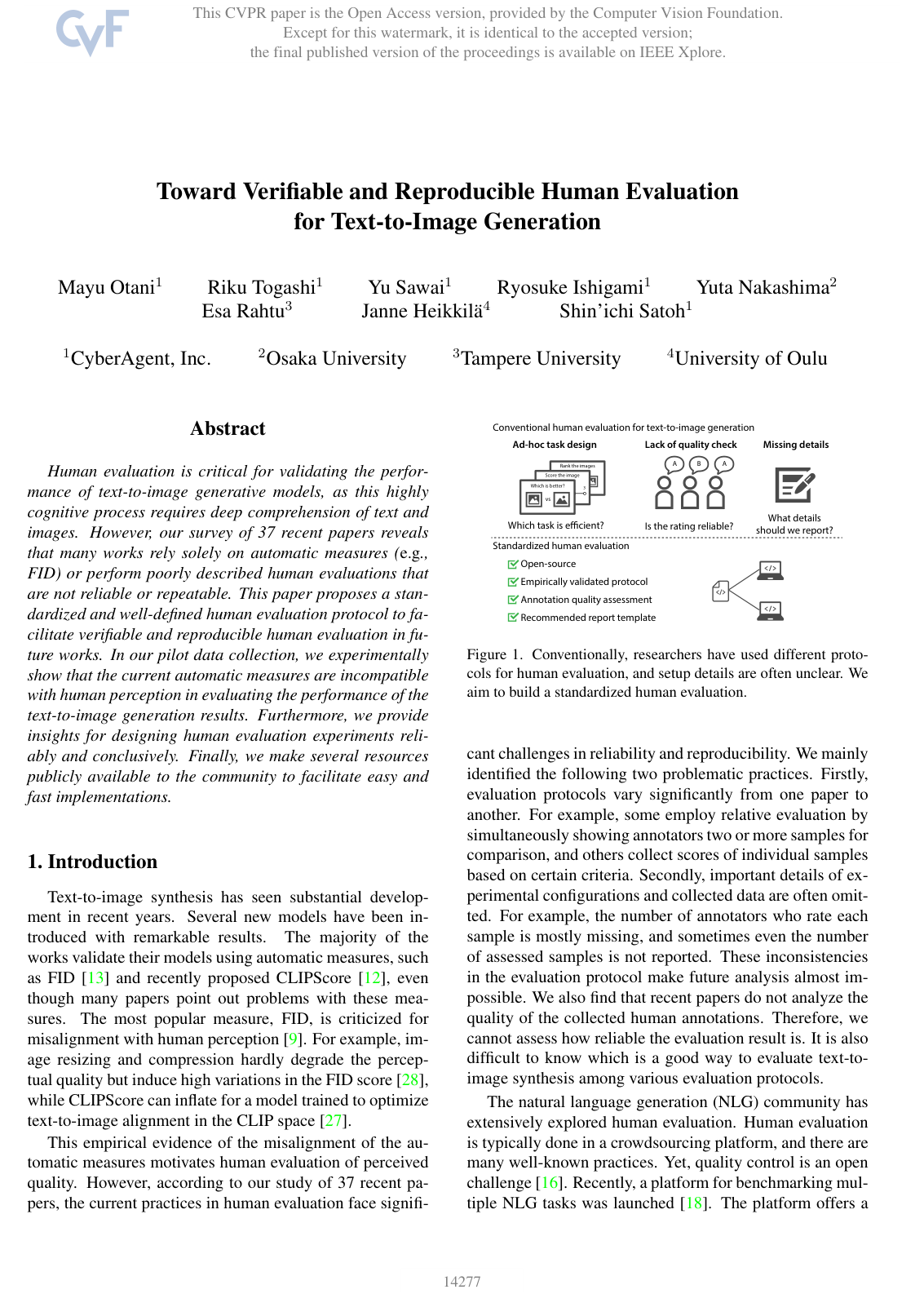
Toward Verifiable and Reproducible Human Evaluation for Text-to-Image Generation
Mayu Otani, Riku Togashi, Yu Sawai, Ryosuke Ishigami, Yuta Nakashima, Esa Rahtu, Janne Heikkilä, Shin'ichi Satoh
Why you should read this
Establishes a standardized, open-source crowdsourcing protocol and reporting framework for text-to-image human evaluation while demonstrating the misalignment and saturation of popular automated metrics like FID and CLIPScore.
Human evaluation is critical for validating the performance of text-to-image generative models, as this highly cognitive process requires deep comprehension of text and images. However, our survey of 37 recent papers reveals that many works rely solely on automatic measures (e.g., FID) or perform poorly described human evaluations that are not reliable or repeatable. This paper proposes a standardized and well-defined human evaluation protocol to facilitate verifiable and reproducible human evaluation in future works. In our pilot data collection, we experimentally show that the current automatic measures are incompatible with human perception in evaluating the performance of the text-to-image generation results. Furthermore, we provide insights for designing human evaluation experiments reliably and conclusively. Finally, we make several resources publicly available to the community to facilitate easy and fast implementations.
Added
2026-09-26
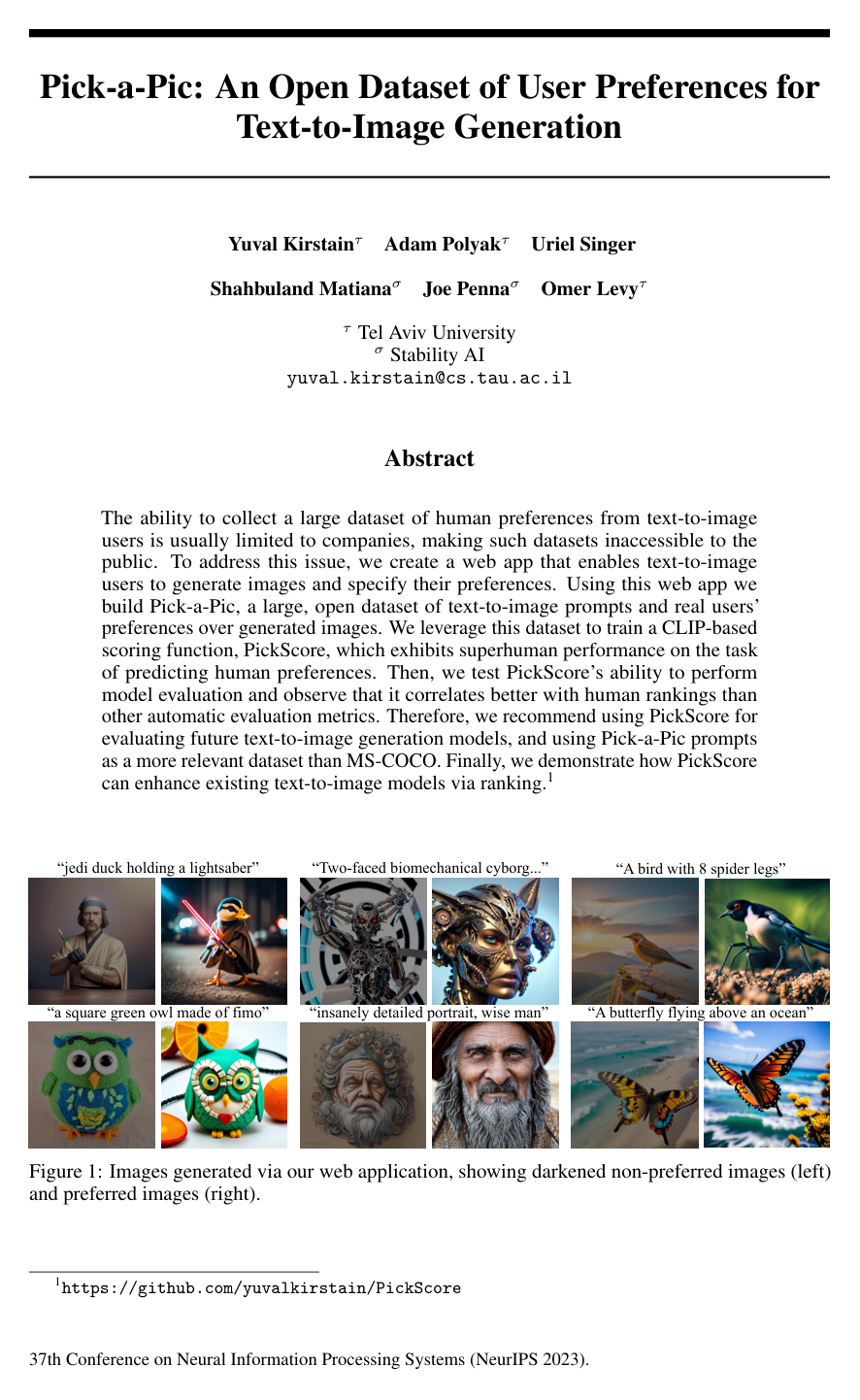
Pick-a-Pic: An Open Dataset of User Preferences for Text-to-Image Generation
Yuval Kirstain, Adam Polyak, Uriel Singer, Shahbuland Matiana, Joe Penna, Omer Levy
Why you should read this
Introduces an open dataset of real user preferences for text-to-image synthesis alongside PickScore, a scoring function that predicts human judgment more accurately than existing metrics to improve automated evaluation and model ranking.
The ability to collect a large dataset of human preferences from text-to-image users is usually limited to companies, making such datasets inaccessible to the public. To address this issue, we create a web app that enables text-to-image users to generate images and specify their preferences. Using this web app we build Pick-a-Pic, a large, open dataset of text-to-image prompts and real users' preferences over generated images. We leverage this dataset to train a CLIP-based scoring function, PickScore, which exhibits superhuman performance on the task of predicting human preferences. Then, we test PickScore's ability to perform model evaluation and observe that it correlates better with human rankings than other automatic evaluation metrics. Therefore, we recommend using PickScore for evaluating future text-to-image generation models, and using Pick-a-Pic prompts as a more relevant dataset than MS-COCO. Finally, we demonstrate how PickScore can enhance existing text-to-image models via ranking.
Added
2026-09-26
Scaling Autoregressive Models for Content-Rich Text-to-Image Generation
Jiahui Yu, Yuanzhong Xu, Jing Yu Koh, Thang Luong, Gunjan Baid, Zirui Wang, Vijay Vasudevan, Alexander Ku, Yinfei Yang, Burcu Karagol Ayan, Ben Hutchinson, Wei Han, Zarana Parekh, Xin Li, Han Zhang, Jason Baldridge, Yonghui Wu
Why you should read this
Demonstrates that scaling an autoregressive sequence-to-sequence model up to 20 billion parameters achieves state-of-the-art text-to-image synthesis quality and effectively handles complex, compositionally rich prompts.
We present the Pathways Autoregressive Text-to-Image (Parti) model, which generates high-fidelity photorealistic images and supports content-rich synthesis involving complex compositions and world knowledge. Parti treats text-to-image generation as a sequence-to-sequence modeling problem, akin to machine translation, with sequences of image tokens as the target outputs rather than text tokens in another language. This strategy can naturally tap into the rich body of prior work on large language models, which have seen continued advances in capabilities and performance through scaling data and model sizes. Our approach is simple: First, Parti uses a Transformer-based image tokenizer, ViT-VQGAN, to encode images as sequences of discrete tokens. Second, we achieve consistent quality improvements by scaling the encoder-decoder Transformer model up to 20B parameters, with a new state-of-the-art zero-shot FID score of 7.23 and finetuned FID score of 3.22 on MS-COCO. Our detailed analysis on Localized Narratives as well as PartiPrompts (P2), a new holistic benchmark of over 1600 English prompts, demonstrate the effectiveness of Parti across a wide variety of categories and difficulty aspects. We also explore and highlight limitations of our models in order to define and exemplify key areas of focus for further improvements. See this https URL for high-resolution images.
Added
2026-09-24
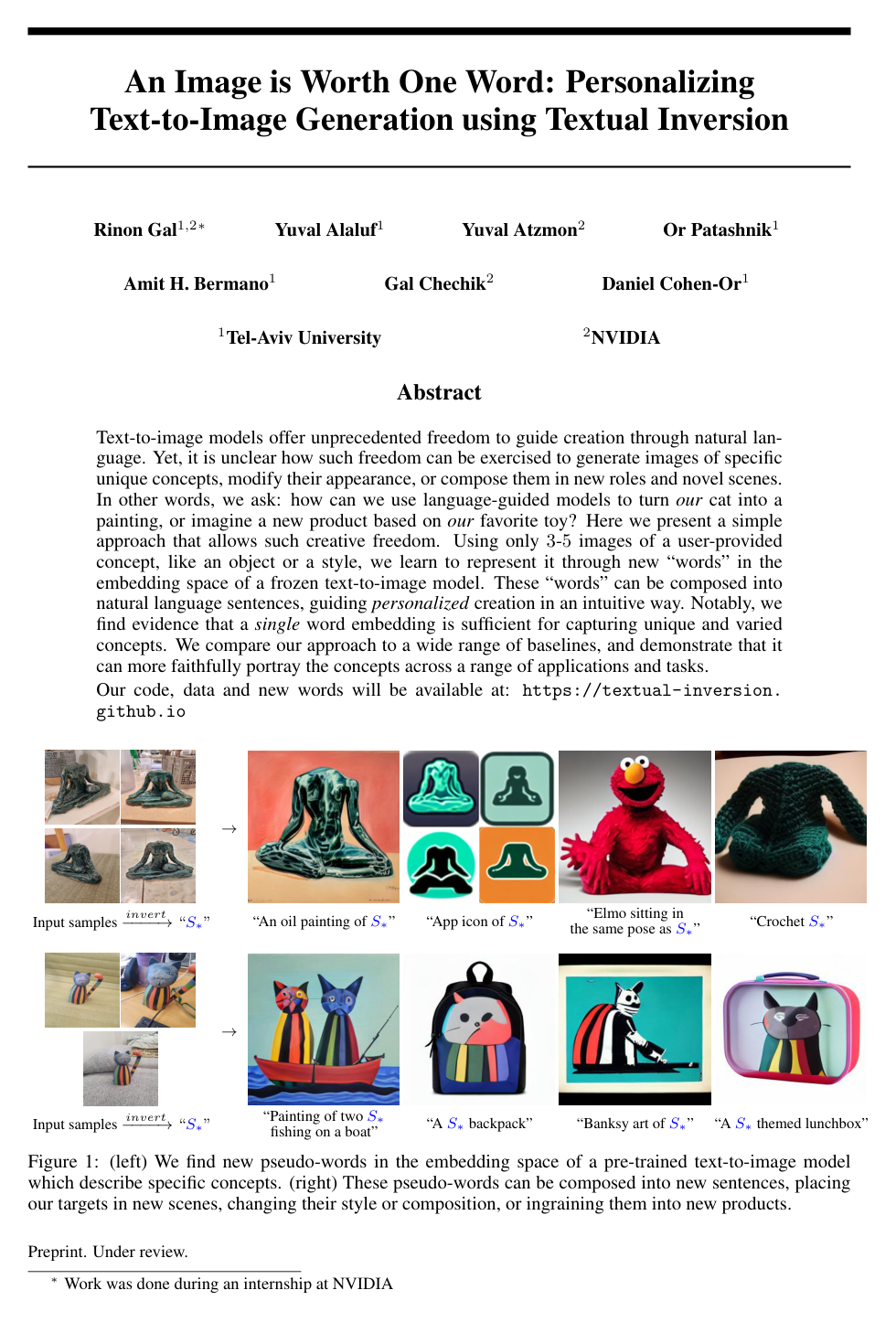
An Image is Worth One Word: Personalizing Text-to-Image Generation using Textual Inversion
Rinon Gal, Yuval Alaluf, Yuval Atzmon, Or Patashnik, Amit H. Bermano, Gal Chechik, Daniel Cohen-Or
Why you should read this
Introduces Textual Inversion, a technique that captures user-provided visual concepts into single word embeddings within a frozen text-to-image model, enabling precise personalized generation from natural language prompts using only a handful of reference images.
Text-to-image models offer unprecedented freedom to guide creation through natural language. Yet, it is unclear how such freedom can be exercised to generate images of specific unique concepts, modify their appearance, or compose them in new roles and novel scenes. In other words, we ask: how can we use language-guided models to turn our cat into a painting, or imagine a new product based on our favorite toy? Here we present a simple approach that allows such creative freedom. Using only 3-5 images of a user-provided concept, like an object or a style, we learn to represent it through new "words" in the embedding space of a frozen text-to-image model. These "words" can be composed into natural language sentences, guiding personalized creation in an intuitive way. Notably, we find evidence that a single word embedding is sufficient for capturing unique and varied concepts. We compare our approach to a wide range of baselines, and demonstrate that it can more faithfully portray the concepts across a range of applications and tasks. Our code, data and new words will be available at: this https URL
Added
2026-09-14