
keyword
video classification
Video classification is a computer vision task that involves analyzing a video clip or sequence and assigning it one or more predefined category labels based on its content. Unlike static image classification, which evaluates only two-dimensional spatial features such as objects and scenes within a single frame, video classification requires capturing both spatial appearance and temporal dynamics across consecutive frames to understand motion and events over time. Commonly applied to domains such as human action recognition, sports analysis, and gesture detection, models for video classification typically process spatiotemporal data using approaches such as three-dimensional convolutional neural networks, multi-stream networks, or spatiotemporal vision transformers.
21 items
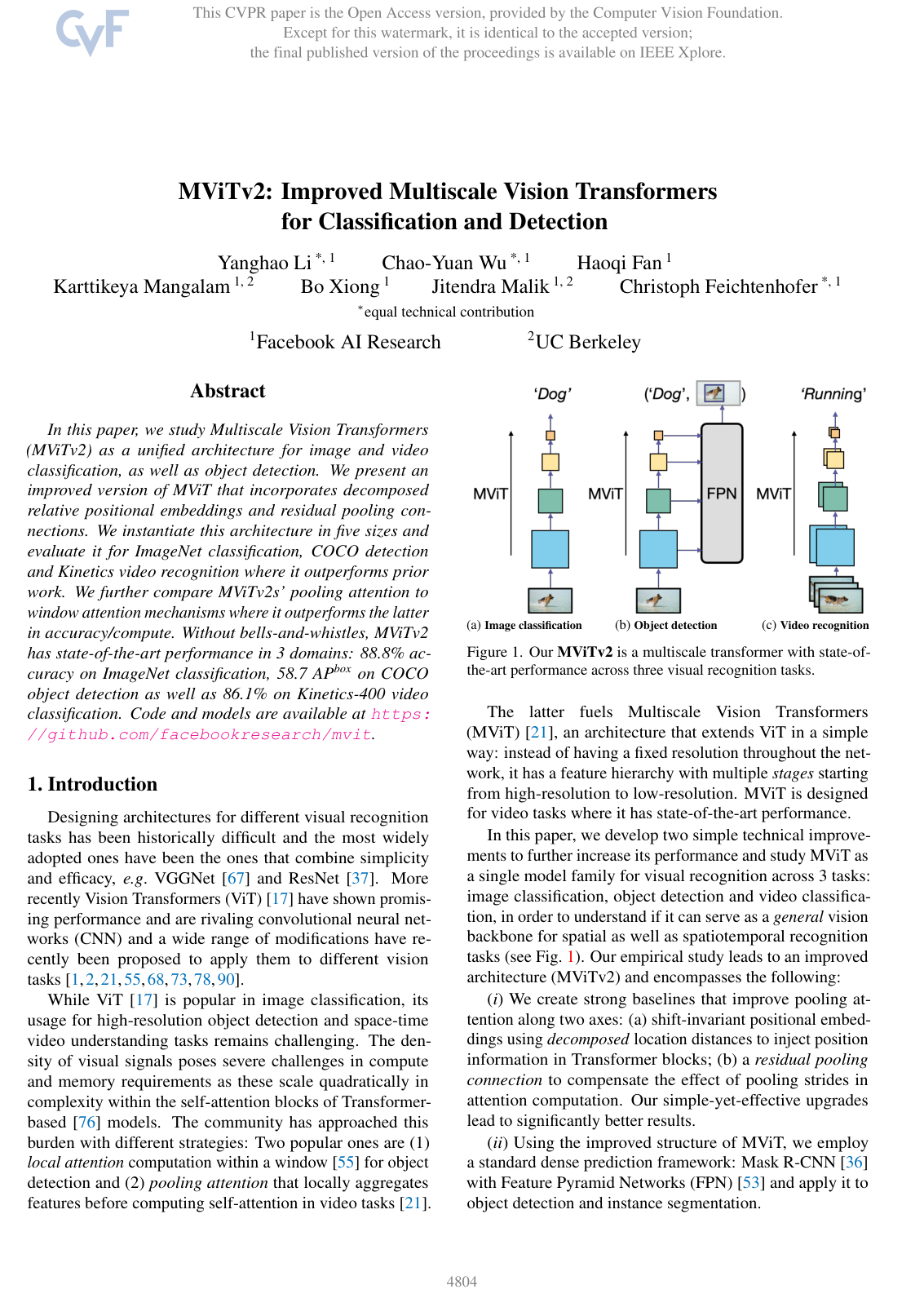
MViTv2: Improved Multiscale Vision Transformers for Classification and Detection
Yanghao Li, Chao-Yuan Wu, Haoqi Fan, Karttikeya Mangalam, Bo Xiong, Jitendra Malik, Christoph Feichtenhofer
Why you should read this
Proposes an improved Multiscale Vision Transformer architecture that integrates decomposed relative positional embeddings and residual pooling connections to establish state-of-the-art performance across image classification, object detection, and video recognition.
In this paper, we study Multiscale Vision Transformers (MViTv2) as a unified architecture for image and video classification, as well as object detection. We present an improved version of MViT that incorporates decomposed relative positional embeddings and residual pooling connections. We instantiate this architecture in five sizes and evaluate it for ImageNet classification, COCO detection and Kinetics video recognition where it outperforms prior work. We further compare MViTv2s' pooling attention to window attention mechanisms where it outperforms the latter in accuracy/compute. Without bells-and-whistles, MViTv2 has state-of-the-art performance in 3 domains: 88.8% accuracy on ImageNet classification, 58.7 AP^box on COCO object detection as well as 86.1% on Kinetics-400 video classification. Code and models are available at https://github.com/facebookresearch/mvit.
Added
2026-10-05
S4ND: Modeling Images and Videos as Multidimensional Signals with State Spaces
Eric Nguyen, Karan Goel, Albert Gu, Gordon W. Downs, Preey Shah, Tri Dao, Stephen Baccus, Christopher Ré
Why you should read this
Extends deep state space models to multidimensional signals with S4ND, enabling continuous-signal modeling of images and videos that matches or exceeds standard vision architectures while supporting zero-shot resolution adaptation and faster training via progressive resizing.
Visual data such as images and videos are typically modeled as discretizations of inherently continuous, multidimensional signals. Existing continuous-signal models attempt to exploit this fact by modeling the underlying signals of visual (e.g., image) data directly. However, these models have not yet been able to achieve competitive performance on practical vision tasks such as large-scale image and video classification. Building on a recent line of work on deep state space models (SSMs), we propose S4ND, a new multidimensional SSM layer that extends the continuous-signal modeling ability of SSMs to multidimensional data including images and videos. We show that S4ND can model large-scale visual data in 1D, 2D, and 3D as continuous multidimensional signals and demonstrates strong performance by simply swapping Conv2D and self-attention layers with S4ND layers in existing state-of-the-art models. On ImageNet-1k, S4ND exceeds the performance of a Vision Transformer baseline by 1.5% when training with a 1D sequence of patches, and matches ConvNeXt when modeling images in 2D. For videos, S4ND improves on an inflated 3D ConvNeXt in activity classification on HMDB-51 by 4%. S4ND implicitly learns global, continuous convolutional kernels that are resolution invariant by construction, providing an inductive bias that enables generalization across multiple resolutions. By developing a simple bandlimiting modification to S4 to overcome aliasing, S4ND achieves strong zero-shot (unseen at training time) resolution performance, outperforming a baseline Conv2D by 40% on CIFAR-10 when trained on 8 × 8 and tested on 32 × 32 images. When trained with progressive resizing, S4ND comes within ~1% of a high-resolution model while training 22% faster.
Added
2026-09-26
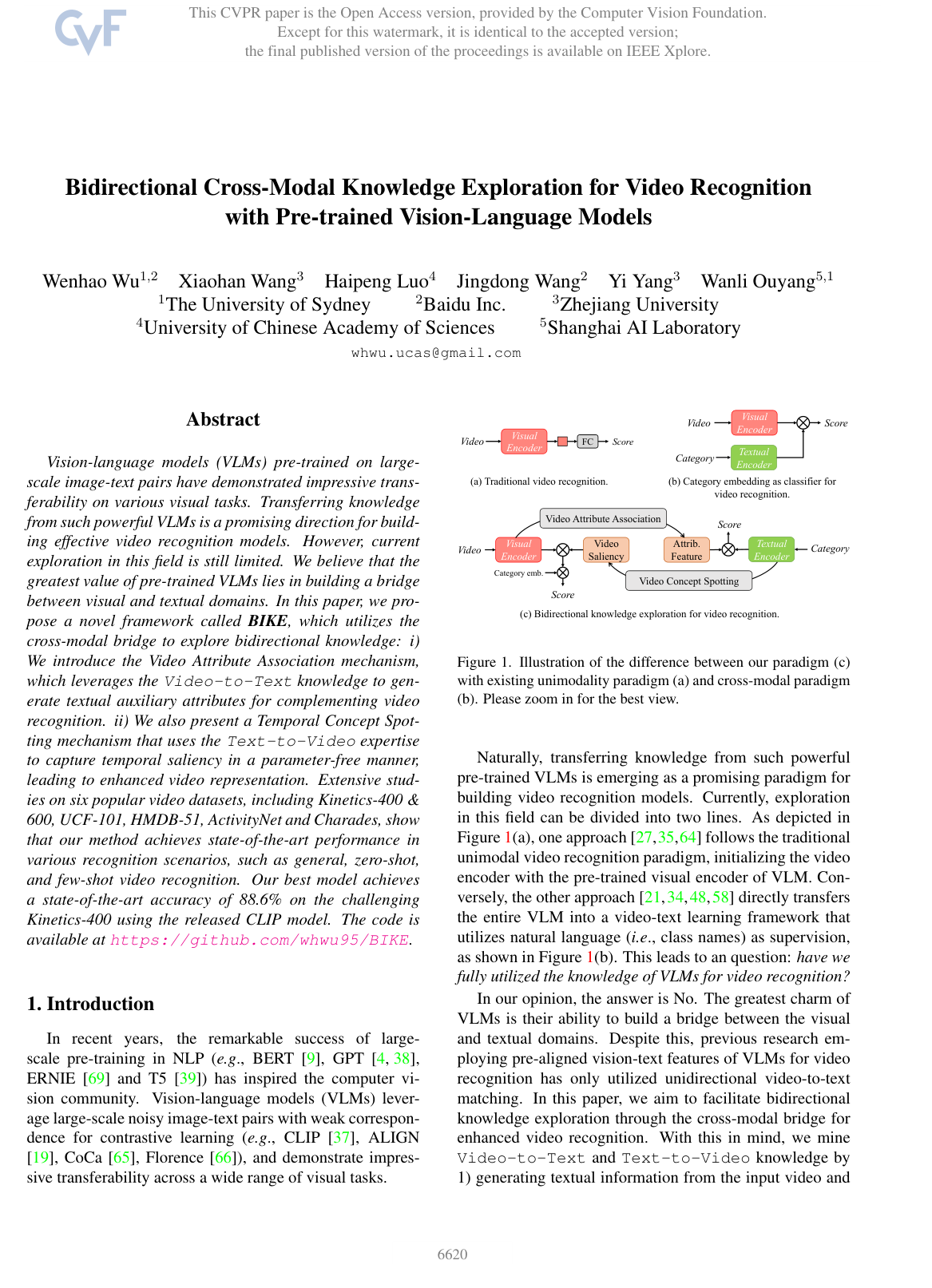
Bidirectional Cross-Modal Knowledge Exploration for Video Recognition with Pre-trained Vision-Language Models
Wenhao Wu, Xiaohan Wang, Haipeng Luo, Jingdong Wang, Yi Yang, Wanli Ouyang
Why you should read this
Proposes a bidirectional framework called BIKE that transfers pre-trained vision-language knowledge into video recognition by retrieving complementary textual attributes and using category concepts to capture frame-level temporal saliency.
Vision-language models (VLMs) pre-trained on large-scale image-text pairs have demonstrated impressive transferability on various visual tasks. Transferring knowledge from such powerful VLMs is a promising direction for building effective video recognition models. However, current exploration in this field is still limited. We believe that the greatest value of pre-trained VLMs lies in building a bridge between visual and textual domains. In this paper, we propose a novel framework called BIKE, which utilizes the cross-modal bridge to explore bidirectional knowledge: i) We introduce the Video Attribute Association mechanism, which leverages the Video-to-Text knowledge to generate textual auxiliary attributes for complementing video recognition. ii) We also present a Temporal Concept Spotting mechanism that uses the Text-to-Video expertise to capture temporal saliency in a parameter-free manner, leading to enhanced video representation. Extensive studies on six popular video datasets, including Kinetics-400 & 600, UCF-101, HMDB-51, ActivityNet and Charades, show that our method achieves state-of-the-art performance in various recognition scenarios, such as general, zero-shot, and few-shot video recognition. Our best model achieves a state-of-the-art accuracy of 88.6% on the challenging Kinetics-400 using the released CLIP model. The code is available at https://github.com/whwu95/BIKE.
Added
2026-09-26
Uni-Perceiver-MoE: Learning Sparse Generalist Models with Conditional MoEs
Jinguo Zhu, Xizhou Zhu, Wenhai Wang, Xiaohua Wang, Hongsheng Li, Xiaogang Wang, Jifeng Dai
Why you should read this
Proposes Conditional Mixture-of-Experts routing strategies for generalist models to resolve cross-task and cross-modality parameter interference, achieving state-of-the-art multi-task and zero-shot performance with minimal data and computational cost.
To build an artificial neural network like the biological intelligence system, recent works have unified numerous tasks into a generalist model, which can process various tasks with shared parameters and do not have any task-specific modules. While generalist models achieve promising results on various benchmarks, they have performance degradation on some tasks compared with task-specialized models. In this work, we find that interference among different tasks and modalities is the main factor to this phenomenon. To mitigate such interference, we introduce the Conditional Mixture-of-Experts (Conditional MoEs) to generalist models. Routing strategies under different levels of conditions are proposed to take both the training/inference cost and generalization ability into account. By incorporating the proposed Conditional MoEs, the recently proposed generalist model Uni-Perceiver can effectively mitigate the interference across tasks and modalities, and achieves state-of-the-art results on a series of downstream tasks via prompt tuning on 1% of downstream data. Moreover, the introduction of Conditional MoEs still holds the generalization ability of generalist models to conduct zero-shot inference on new tasks, e.g., video-text retrieval and video caption. Code and pre-trained generalist models are publicly released at https://github.com/fundamentalvision/Uni-Perceiver.
Added
2026-09-26
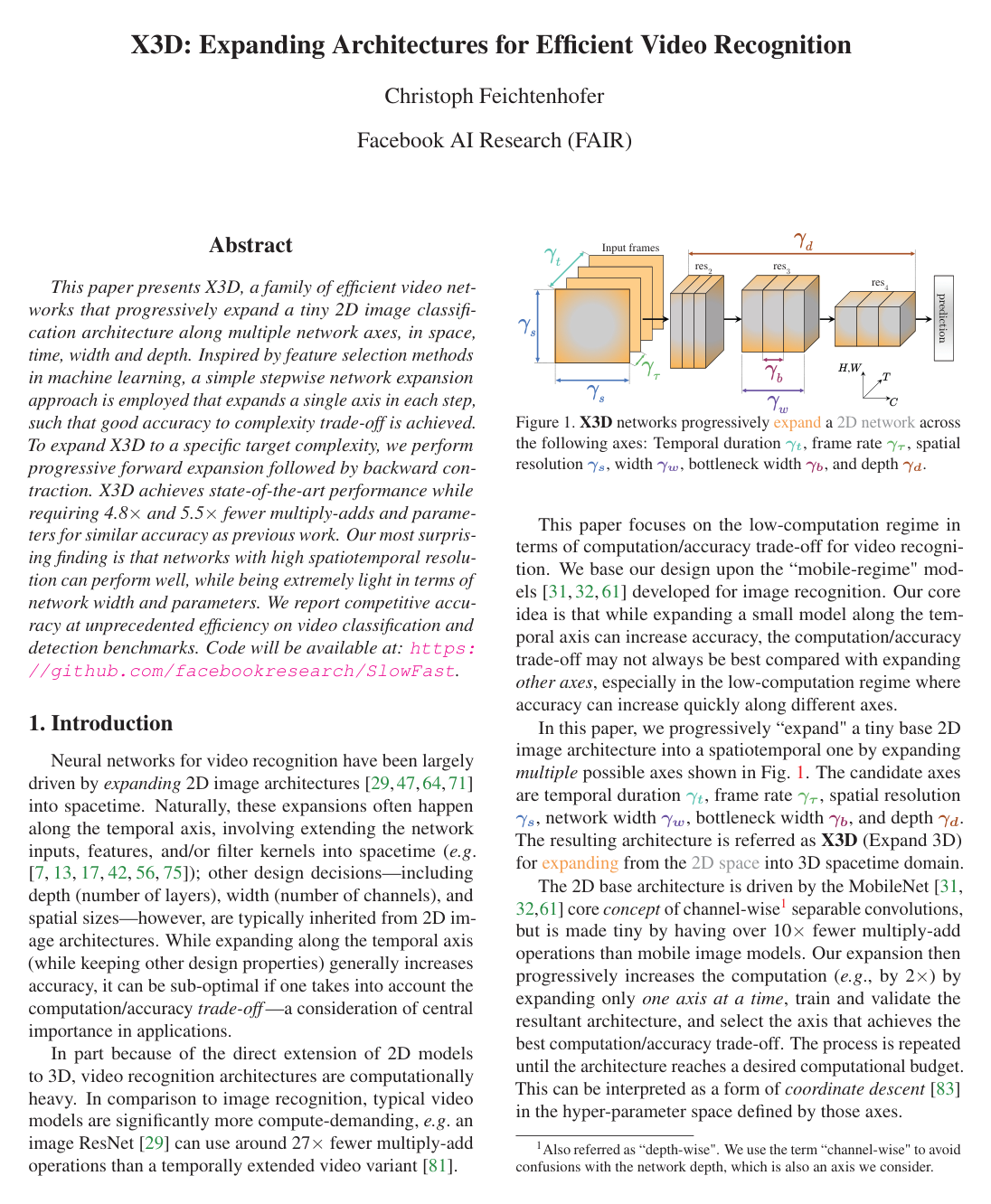
X3D: Expanding Architectures for Efficient Video Recognition
Christoph Feichtenhofer
Why you should read this
Presents an efficient family of video recognition networks by progressively expanding a tiny 2D base model across space, time, width, and depth, achieving top-tier accuracy on video benchmarks with up to five times fewer parameters and operations than existing models.
This paper presents X3D, a family of efficient video networks that progressively expand a tiny 2D image classification architecture along multiple network axes, in space, time, width and depth. Inspired by feature selection methods in machine learning, a simple stepwise network expansion approach is employed that expands a single axis in each step, such that good accuracy to complexity trade-off is achieved. To expand X3D to a specific target complexity, we perform progressive forward expansion followed by backward contraction. X3D achieves state-of-the-art performance while requiring 4.8x and 5.5x fewer multiply-adds and parameters for similar accuracy as previous work. Our most surprising finding is that networks with high spatiotemporal resolution can perform well, while being extremely light in terms of network width and parameters. We report competitive accuracy at unprecedented efficiency on video classification and detection benchmarks. Code will be available at: this https URL
Added
2026-09-25
Rethinking Spatiotemporal Feature Learning: Speed-Accuracy Trade-offs in Video Classification
Saining Xie, Chen Sun, Jonathan Huang, Zhuowen Tu, Kevin Murphy
Why you should read this
Demonstrates that replacing early 3D convolutions with low-cost 2D operations improves both accuracy and computational efficiency in video classification, establishing that temporal modeling is most effective on high-level semantic features.
Despite the steady progress in video analysis led by the adoption of convolutional neural networks (CNNs), the relative improvement has been less drastic as that in 2D static image classification. Three main challenges exist including spatial (image) feature representation, temporal information representation, and model/computation complexity. It was recently shown by Carreira and Zisserman that 3D CNNs, inflated from 2D networks and pretrained on ImageNet, could be a promising way for spatial and temporal representation learning. However, as for model/computation complexity, 3D CNNs are much more expensive than 2D CNNs and prone to overfit. We seek a balance between speed and accuracy by building an effective and efficient video classification system through systematic exploration of critical network design choices. In particular, we show that it is possible to replace many of the 3D convolutions by low-cost 2D convolutions. Rather surprisingly, best result (in both speed and accuracy) is achieved when replacing the 3D convolutions at the bottom of the network, suggesting that temporal representation learning on high-level semantic features is more useful. Our conclusion generalizes to datasets with very different properties. When combined with several other cost-effective designs including separable spatial/temporal convolution and feature gating, our system results in an effective video classification system that that produces very competitive results on several action classification benchmarks (Kinetics, Something-something, UCF101 and HMDB), as well as two action detection (localization) benchmarks (JHMDB and UCF101-24).
Added
2026-09-25
Explainable Artificial Intelligence: Understanding, Visualizing and Interpreting Deep Learning Models
Wojciech Samek, Thomas Wiegand, Klaus-Robert Müller
Why you should read this
Presents and evaluates two practical interpretability methods—input sensitivity analysis and decision decomposition—to explain how complex deep learning models arrive at their predictions across diverse classification tasks.
With the availability of large databases and recent improvements in deep learning methodology, the performance of AI systems is reaching or even exceeding the human level on an increasing number of complex tasks. Impressive examples of this development can be found in domains such as image classification, sentiment analysis, speech understanding or strategic game playing. However, because of their nested non-linear structure, these highly successful machine learning and artificial intelligence models are usually applied in a black box manner, i.e., no information is provided about what exactly makes them arrive at their predictions. Since this lack of transparency can be a major drawback, e.g., in medical applications, the development of methods for visualizing, explaining and interpreting deep learning models has recently attracted increasing attention. This paper summarizes recent developments in this field and makes a plea for more interpretability in artificial intelligence. Furthermore, it presents two approaches to explaining predictions of deep learning models, one method which computes the sensitivity of the prediction with respect to changes in the input and one approach which meaningfully decomposes the decision in terms of the input variables. These methods are evaluated on three classification tasks.
Added
2026-09-25
Learning Spatio-Temporal Representation with Pseudo-3D Residual Networks
Zhaofan Qiu, Ting Yao, Tao Mei
Why you should read this
Proposes Pseudo-3D Residual Networks (P3D ResNet), an architecture that factorizes 3D convolutions into separable 2D spatial and 1D temporal filters within residual blocks, drastically cutting computation and memory costs while outperforming standard 3D CNNs on video classification benchmarks.
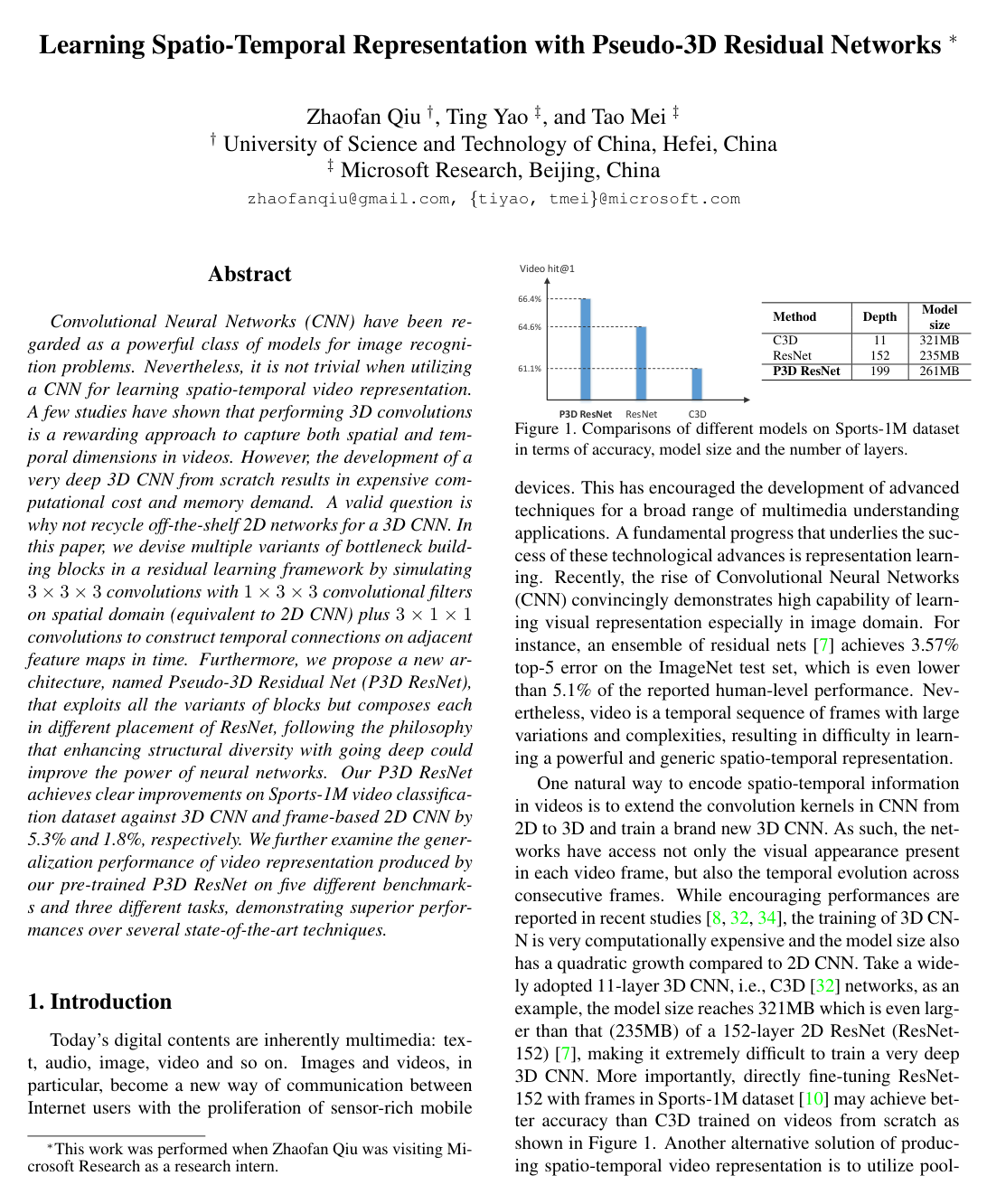
Convolutional Neural Networks (CNN) have been regarded as a powerful class of models for image recognition problems. Nevertheless, it is not trivial when utilizing a CNN for learning spatio-temporal video representation. A few studies have shown that performing 3D convolutions is a rewarding approach to capture both spatial and temporal dimensions in videos. However, the development of a very deep 3D CNN from scratch results in expensive computational cost and memory demand. A valid question is why not recycle off-the-shelf 2D networks for a 3D CNN. In this paper, we devise multiple variants of bottleneck building blocks in a residual learning framework by simulating convolutions with convolutional filters on spatial domain (equivalent to 2D CNN) plus convolutions to construct temporal connections on adjacent feature maps in time. Furthermore, we propose a new architecture, named Pseudo-3D Residual Net (P3D ResNet), that exploits all the variants of blocks but composes each in different placement of ResNet, following the philosophy that enhancing structural diversity with going deep could improve the power of neural networks. Our P3D ResNet achieves clear improvements on Sports-1M video classification dataset against 3D CNN and frame-based 2D CNN by 5.3% and 1.8%, respectively. We further examine the generalization performance of video representation produced by our pre-trained P3D ResNet on five different benchmarks and three different tasks, demonstrating superior performances over several state-of-the-art techniques.
Added
2026-09-18
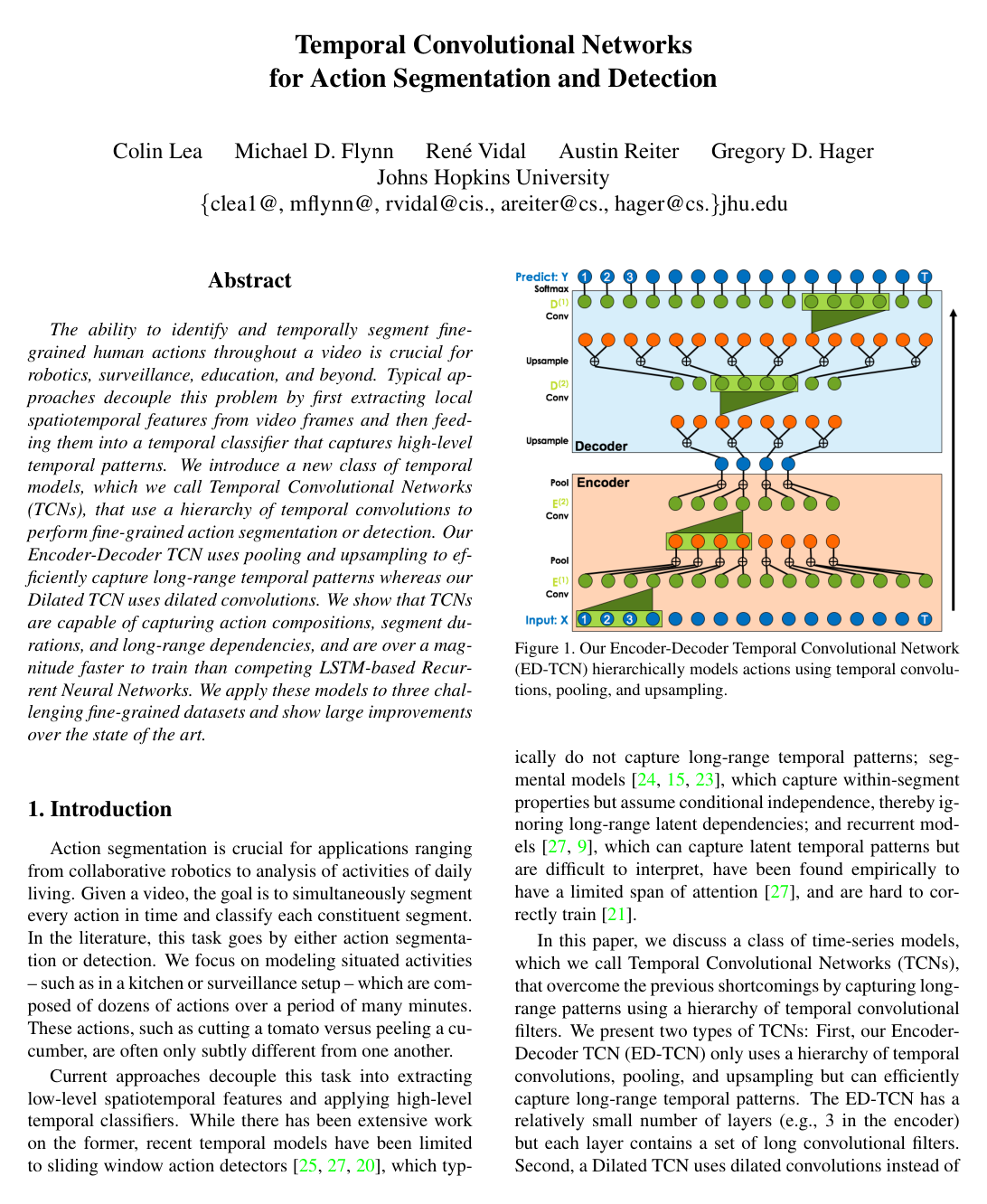
Temporal Convolutional Networks for Action Segmentation and Detection
Colin Lea, Michael D. Flynn, Rene Vidal, Austin Reiter, Gregory D. Hager
Why you should read this
Proposes Temporal Convolutional Networks for fine-grained video action segmentation, providing an architecture that captures long-range temporal dependencies more effectively and trains an order of magnitude faster than standard recurrent models.
The ability to identify and temporally segment fine-grained human actions throughout a video is crucial for robotics, surveillance, education, and beyond. Typical approaches decouple this problem by first extracting local spatiotemporal features from video frames and then feeding them into a temporal classifier that captures high-level temporal patterns. We introduce a new class of temporal models, which we call Temporal Convolutional Networks (TCNs), that use a hierarchy of temporal convolutions to perform fine-grained action segmentation or detection. Our Encoder-Decoder TCN uses pooling and upsampling to efficiently capture long-range temporal patterns whereas our Dilated TCN uses dilated convolutions. We show that TCNs are capable of capturing action compositions, segment durations, and long-range dependencies, and are over a magnitude faster to train than competing LSTM-based Recurrent Neural Networks. We apply these models to three challenging fine-grained datasets and show large improvements over the state of the art.
Added
2026-09-16
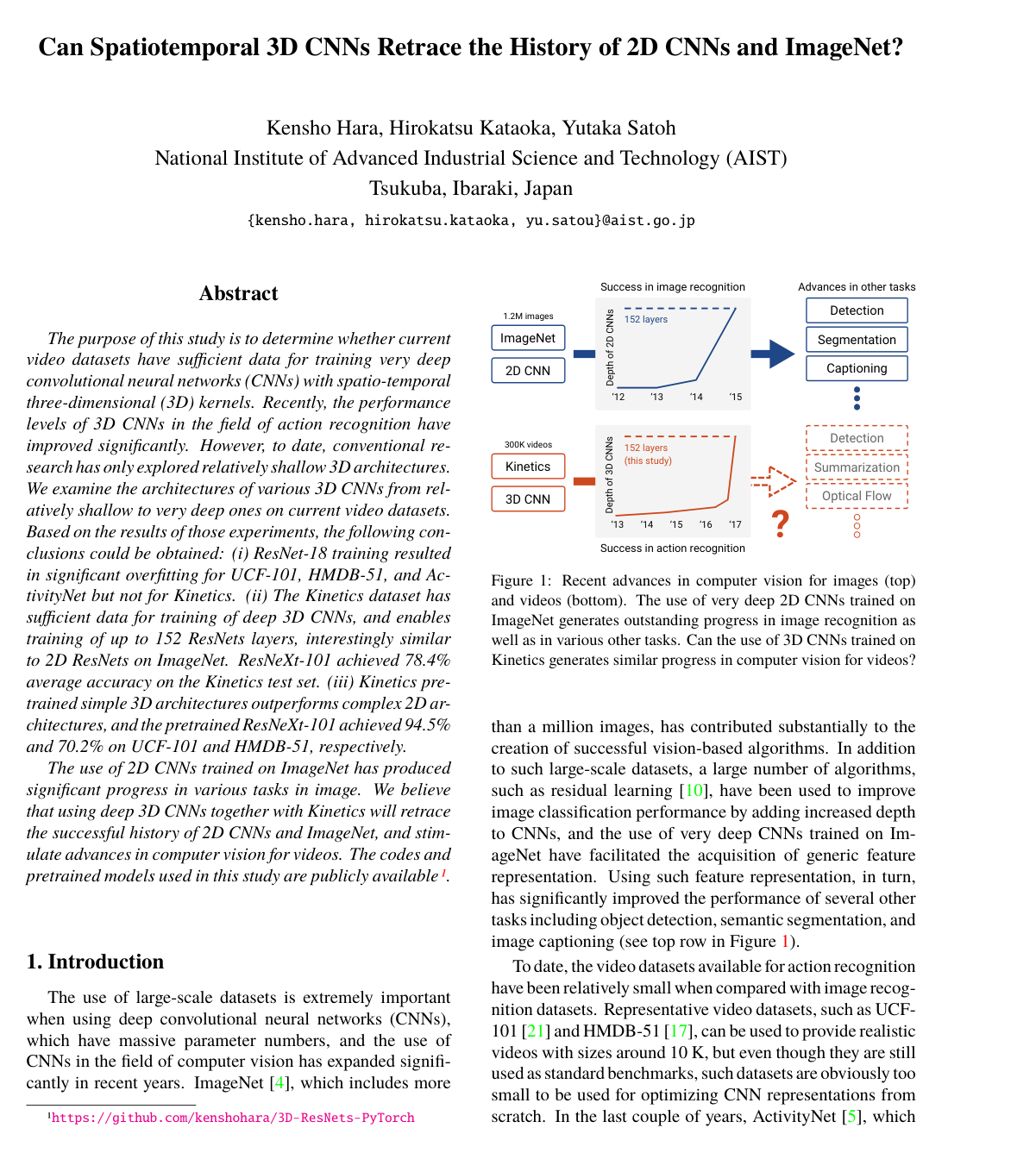
Can Spatiotemporal 3D CNNs Retrace the History of 2D CNNs and ImageNet?
Kensho Hara, Hirokatsu Kataoka, Yutaka Satoh
Why you should read this
Demonstrates that the Kinetics dataset enables successful training of deep 3D CNN architectures up to 152 layers without overfitting, providing effective pretrained video models that outperform complex 2D approaches on action recognition benchmarks.
The purpose of this study is to determine whether current video datasets have sufficient data for training very deep convolutional neural networks (CNNs) with spatio-temporal three-dimensional (3D) kernels. Recently, the performance levels of 3D CNNs in the field of action recognition have improved significantly. However, to date, conventional research has only explored relatively shallow 3D architectures. We examine the architectures of various 3D CNNs from relatively shallow to very deep ones on current video datasets. Based on the results of those experiments, the following conclusions could be obtained: (i) ResNet-18 training resulted in significant overfitting for UCF-101, HMDB-51, and ActivityNet but not for Kinetics. (ii) The Kinetics dataset has sufficient data for training of deep 3D CNNs, and enables training of up to 152 ResNets layers, interestingly similar to 2D ResNets on ImageNet. ResNeXt-101 achieved 78.4% average accuracy on the Kinetics test set. (iii) Kinetics pretrained simple 3D architectures outperforms complex 2D architectures, and the pretrained ResNeXt-101 achieved 94.5% and 70.2% on UCF-101 and HMDB-51, respectively. The use of 2D CNNs trained on ImageNet has produced significant progress in various tasks in image. We believe that using deep 3D CNNs together with Kinetics will retrace the successful history of 2D CNNs and ImageNet, and stimulate advances in computer vision for videos. The codes and pretrained models used in this study are publicly available. this https URL
Added
2026-09-16
Video Swin Transformer
Ze Liu, Jia Ning, Yue Cao, Yixuan Wei, Zheng Zhang, Stephen Lin, Han Hu
Why you should read this
Extends the Swin Transformer architecture to video recognition via localized 3D spatio-temporal attention, establishing state-of-the-art accuracy on action recognition benchmarks with vastly superior parameter and data efficiency compared to global transformer models.
The vision community is witnessing a modeling shift from CNNs to Transformers, where pure Transformer architectures have attained top accuracy on the major video recognition benchmarks. These video models are all built on Transformer layers that globally connect patches across the spatial and temporal dimensions. In this paper, we instead advocate an inductive bias of locality in video Transformers, which leads to a better speed-accuracy trade-off compared to previous approaches which compute self-attention globally even with spatial-temporal factorization. The locality of the proposed video architecture is realized by adapting the Swin Transformer designed for the image domain, while continuing to leverage the power of pre-trained image models. Our approach achieves state-of-the-art accuracy on a broad range of video recognition benchmarks, including on action recognition (84.9 top-1 accuracy on Kinetics-400 and 86.1 top-1 accuracy on Kinetics-600 with ~20x less pre-training data and ~3x smaller model size) and temporal modeling (69.6 top-1 accuracy on Something-Something v2). The code and models will be made publicly available at this https URL.
Added
2026-09-16
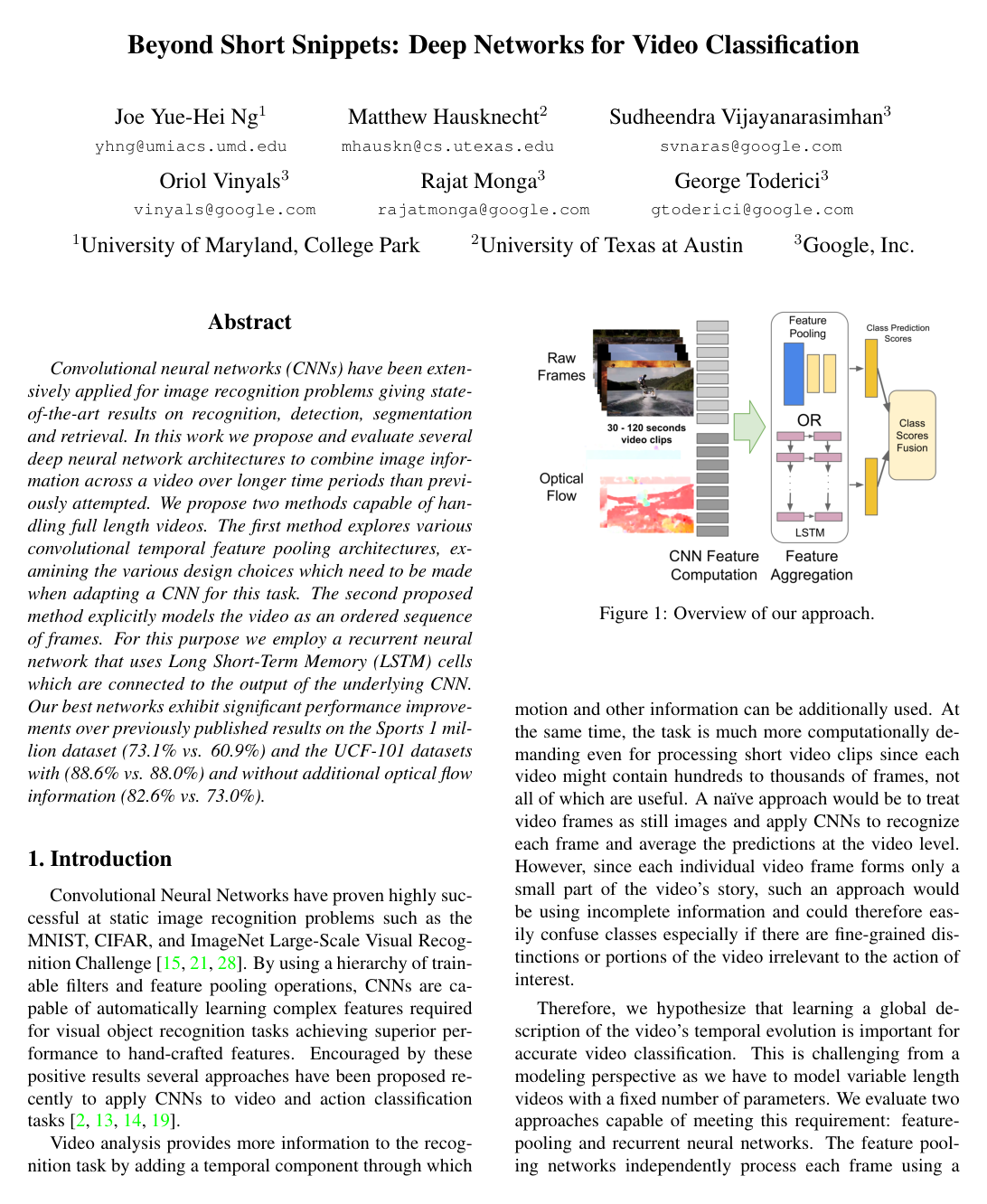
Beyond short snippets: Deep networks for video classification
Joe Yue-Hei Ng, Matthew Hausknecht, Sudheendra Vijayanarasimhan, Oriol Vinyals, Rajat Monga, George Toderici
Why you should read this
Proposes convolutional temporal pooling and recurrent LSTM architectures that extend deep convolutional networks to full-length video classification, substantially outperforming prior methods on Sports-1M and UCF-101.
Convolutional neural networks (CNNs) have been extensively applied for image recognition problems giving state-of-the-art results on recognition, detection, segmentation and retrieval. In this work we propose and evaluate several deep neural network architectures to combine image information across a video over longer time periods than previously attempted. We propose two methods capable of handling full length videos. The first method explores various convolutional temporal feature pooling architectures, examining the various design choices which need to be made when adapting a CNN for this task. The second proposed method explicitly models the video as an ordered sequence of frames. For this purpose we employ a recurrent neural network that uses Long Short-Term Memory (LSTM) cells which are connected to the output of the underlying CNN. Our best networks exhibit significant performance improvements over previously published results on the Sports 1 million dataset (73.1% vs. 60.9%) and the UCF-101 datasets with (88.6% vs. 88.0%) and without additional optical flow information (82.6% vs. 72.8%).
Added
2026-09-14
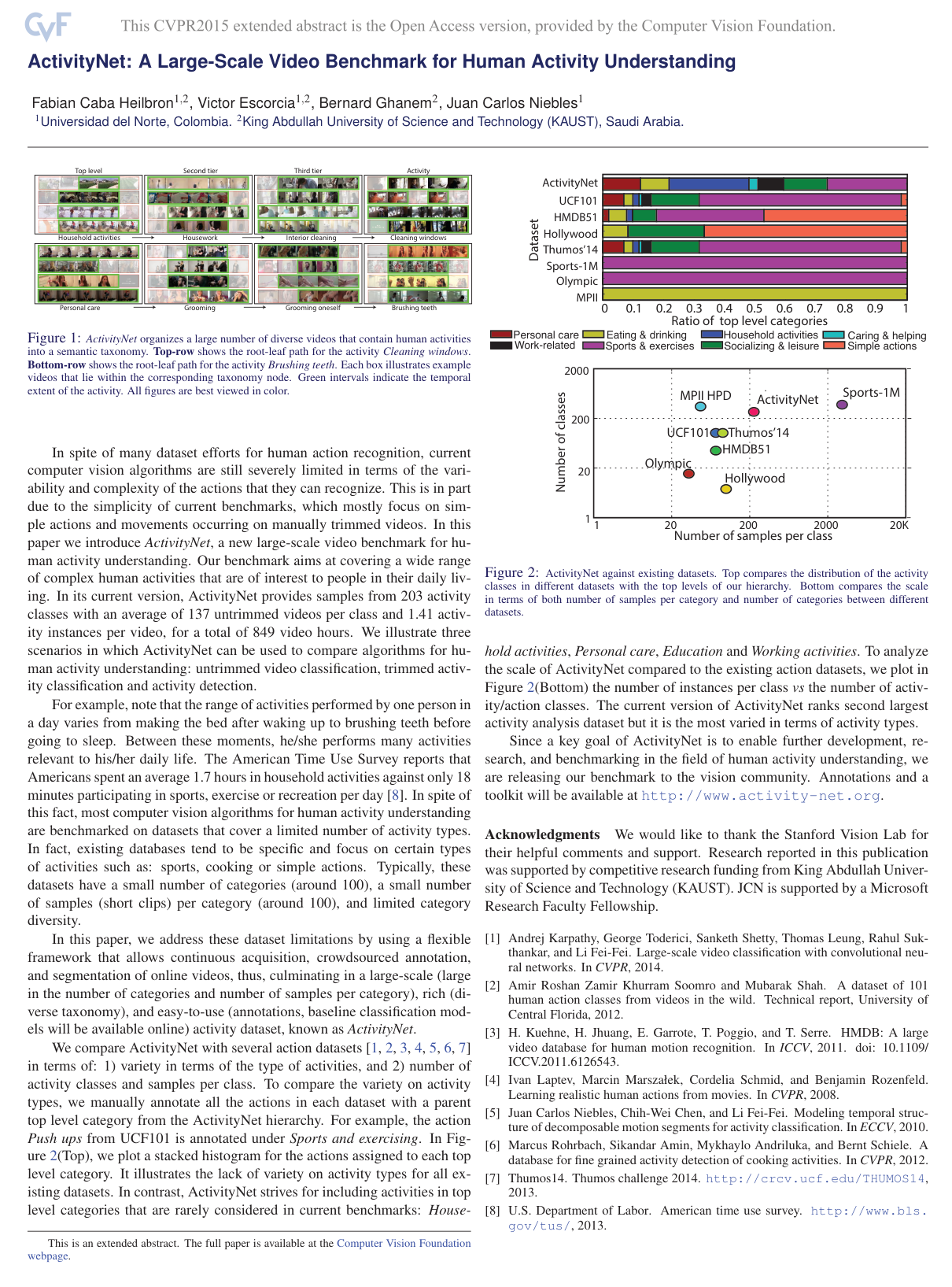
ActivityNet: A large-scale video benchmark for human activity understanding
Fabian Caba Heilbron, Victor Escorcia, Bernard Ghanem, Juan Carlos Niebles
Why you should read this
Introduces ActivityNet, a large-scale video benchmark spanning 203 rich daily-living activity categories across 849 hours of untrimmed video to evaluate trimmed recognition, untrimmed classification, and temporal activity detection.
In spite of many dataset efforts for human action recognition, current computer vision algorithms are still severely limited in terms of the variability and complexity of the actions that they can recognize. This is in part due to the simplicity of current benchmarks, which mostly focus on simple actions and movements occurring on manually trimmed videos. In this paper we introduce ActivityNet, a new large-scale video benchmark for human activity understanding. Our benchmark aims at covering a wide range of complex human activities that are of interest to people in their daily living. In its current version, ActivityNet provides samples from 203 activity classes with an average of 137 untrimmed videos per class and 1.41 activity instances per video, for a total of 849 video hours. We illustrate three scenarios in which ActivityNet can be used to compare algorithms for human activity understanding: untrimmed video classification, trimmed activity classification and activity detection.
Added
2026-09-13
ViViT: A Video Vision Transformer
Anurag Arnab, Mostafa Dehghani, Georg Heigold, Chen Sun, Mario Lučić, Cordelia Schmid
Why you should read this
Introduces ViViT, an efficient pure-transformer framework for video classification that factorizes spatio-temporal dimensions and leverages pretrained image models to surpass standard 3D convolutional networks across major benchmarks.
We present pure-transformer based models for video classification, drawing upon the recent success of such models in image classification. Our model extracts spatio-temporal tokens from the input video, which are then encoded by a series of transformer layers. In order to handle the long sequences of tokens encountered in video, we propose several, efficient variants of our model which factorise the spatial- and temporal-dimensions of the input. Although transformer-based models are known to only be effective when large training datasets are available, we show how we can effectively regularise the model during training and leverage pretrained image models to be able to train on comparatively small datasets. We conduct thorough ablation studies, and achieve state-of-the-art results on multiple video classification benchmarks including Kinetics 400 and 600, Epic Kitchens, Something-Something v2 and Moments in Time, outperforming prior methods based on deep 3D convolutional networks. To facilitate further research, we release code at this https URL
Added
2026-09-12
Is Space-Time Attention All You Need for Video Understanding?
Gedas Bertasius, Heng Wang, Lorenzo Torresani
Why you should read this
Introduces TimeSformer, a pure transformer architecture using divided space-time self-attention that achieves state-of-the-art video action recognition while training faster and processing much longer clips than standard 3D convolutional networks.
We present a convolution-free approach to video classification built exclusively on self-attention over space and time. Our method, named "TimeSformer," adapts the standard Transformer architecture to video by enabling spatiotemporal feature learning directly from a sequence of frame-level patches. Our experimental study compares different self-attention schemes and suggests that "divided attention," where temporal attention and spatial attention are separately applied within each block, leads to the best video classification accuracy among the design choices considered. Despite the radically new design, TimeSformer achieves state-of-the-art results on several action recognition benchmarks, including the best reported accuracy on Kinetics-400 and Kinetics-600. Finally, compared to 3D convolutional networks, our model is faster to train, it can achieve dramatically higher test efficiency (at a small drop in accuracy), and it can also be applied to much longer video clips (over one minute long). Code and models are available at: this https URL.
Added
2026-09-11

A Closer Look at Spatiotemporal Convolutions for Action Recognition
Du Tran, Heng Wang, Lorenzo Torresani, Jamie Ray, Yann LeCun, Manohar Paluri
Why you should read this
Introduces the R(2+1)D architecture, which factorizes 3D spatiotemporal convolutions into separate 2D spatial and 1D temporal operations to surpass conventional 3D CNNs across major action recognition benchmarks.
In this paper we discuss several forms of spatiotemporal convolutions for video analysis and study their effects on action recognition. Our motivation stems from the observation that 2D CNNs applied to individual frames of the video have remained solid performers in action recognition. In this work we empirically demonstrate the accuracy advantages of 3D CNNs over 2D CNNs within the framework of residual learning. Furthermore, we show that factorizing the 3D convolutional filters into separate spatial and temporal components yields significantly advantages in accuracy. Our empirical study leads to the design of a new spatiotemporal convolutional block "R(2+1)D" which gives rise to CNNs that achieve results comparable or superior to the state-of-the-art on Sports-1M, Kinetics, UCF101 and HMDB51.
Added
2026-09-11
The Kinetics Human Action Video Dataset
Will Kay, Joao Carreira, Karen Simonyan, Brian Zhang, Chloe Hillier, Sudheendra Vijayanarasimhan, Fabio Viola, Tim Green, Trevor Back, Paul Natsev, Mustafa Suleyman, Andrew Zisserman
Why you should read this
Introduces Kinetics, a large-scale human action video dataset covering 400 classes across hundreds of thousands of YouTube clips alongside baseline neural network evaluations to advance action recognition research.
We describe the DeepMind Kinetics human action video dataset. The dataset contains 400 human action classes, with at least 400 video clips for each action. Each clip lasts around 10s and is taken from a different YouTube video. The actions are human focussed and cover a broad range of classes including human-object interactions such as playing instruments, as well as human-human interactions such as shaking hands. We describe the statistics of the dataset, how it was collected, and give some baseline performance figures for neural network architectures trained and tested for human action classification on this dataset. We also carry out a preliminary analysis of whether imbalance in the dataset leads to bias in the classifiers.
Added
2026-09-10
License
Published with permission
Two-Stream Convolutional Networks for Action Recognition in Videos
Karen Simonyan, Andrew Zisserman
Why you should read this
Introduces the two-stream convolutional network architecture that processes spatial appearance from still frames and temporal motion from dense optical flow in parallel, establishing a core paradigm for video action recognition.
We investigate architectures of discriminatively trained deep Convolutional Networks (ConvNets) for action recognition in video. The challenge is to capture the complementary information on appearance from still frames and motion between frames. We also aim to generalise the best performing hand-crafted features within a data-driven learning framework. Our contribution is three-fold. First, we propose a two-stream ConvNet architecture which incorporates spatial and temporal networks. Second, we demonstrate that a ConvNet trained on multi-frame dense optical flow is able to achieve very good performance in spite of limited training data. Finally, we show that multi-task learning, applied to two different action classification datasets, can be used to increase the amount of training data and improve the performance on both. Our architecture is trained and evaluated on the standard video actions benchmarks of UCF-101 and HMDB-51, where it is competitive with the state of the art. It also exceeds by a large margin previous attempts to use deep nets for video classification.
Added
2026-09-07
Learning Spatiotemporal Features with 3D Convolutional Networks
Du Tran, Lubomir Bourdev, Rob Fergus, Lorenzo Torresani, Manohar Paluri
Why you should read this
Proposes C3D, a 3D convolutional network architecture with 3x3x3 filters that extracts compact, efficient spatiotemporal features capable of surpassing state-of-the-art video analysis methods across diverse action recognition benchmarks.
We propose a simple, yet effective approach for spatiotemporal feature learning using deep 3-dimensional convolutional networks (3D ConvNets) trained on a large scale supervised video dataset. Our findings are three-fold: 1) 3D ConvNets are more suitable for spatiotemporal feature learning compared to 2D ConvNets; 2) A homogeneous architecture with small 3x3x3 convolution kernels in all layers is among the best performing architectures for 3D ConvNets; and 3) Our learned features, namely C3D (Convolutional 3D), with a simple linear classifier outperform state-of-the-art methods on 4 different benchmarks and are comparable with current best methods on the other 2 benchmarks. In addition, the features are compact: achieving 52.8% accuracy on UCF101 dataset with only 10 dimensions and also very efficient to compute due to the fast inference of ConvNets. Finally, they are conceptually very simple and easy to train and use.
Added
2026-09-07
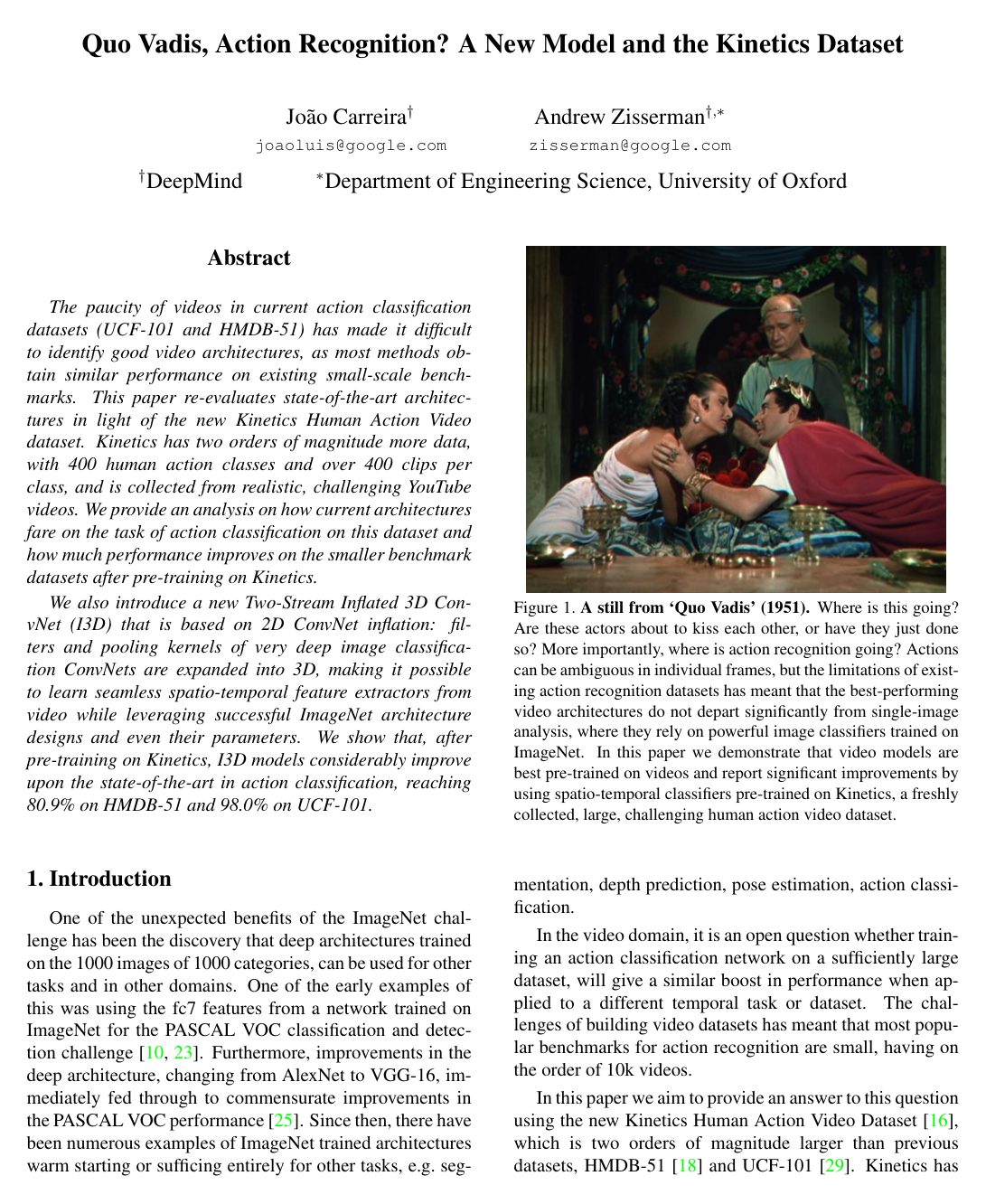
Quo Vadis, Action Recognition? A New Model and the Kinetics Dataset
João Carreira, Andrew Zisserman
Why you should read this
Introduces the large-scale Kinetics dataset and Inflated 3D ConvNet (I3D) architecture, demonstrating how inflating successful 2D image models into 3D video networks sets a new benchmark in human action recognition.
The paucity of videos in current action classification datasets (UCF-101 and HMDB-51) has made it difficult to identify good video architectures, as most methods obtain similar performance on existing small-scale benchmarks. This paper re-evaluates state-of-the-art architectures in light of the new Kinetics Human Action Video dataset. Kinetics has two orders of magnitude more data, with 400 human action classes and over 400 clips per class, and is collected from realistic, challenging YouTube videos. We provide an analysis on how current architectures fare on the task of action classification on this dataset and how much performance improves on the smaller benchmark datasets after pre-training on Kinetics. We also introduce a new Two-Stream Inflated 3D ConvNet (I3D) that is based on 2D ConvNet inflation: filters and pooling kernels of very deep image classification ConvNets are expanded into 3D, making it possible to learn seamless spatio-temporal feature extractors from video while leveraging successful ImageNet architecture designs and even their parameters. We show that, after pre-training on Kinetics, I3D models considerably improve upon the state-of-the-art in action classification, reaching 80.9% on HMDB-51 and 98.0% on UCF-101.
Added
2026-09-07