Learning Spatio-Temporal Representation with Pseudo-3D Residual Networks
Zhaofan QiuTing YaoTao Mei
Proposes Pseudo-3D Residual Networks (P3D ResNet), an architecture that factorizes 3D convolutions into separable 2D spatial and 1D temporal filters within residual blocks, drastically cutting computation and memory costs while outperforming standard 3D CNNs on video classification benchmarks.
Digital video content has grown rapidly, driving a strong need for automated multimedia analysis in applications such as action and scene recognition. While convolutional neural networks excel at image understanding, extending them directly to full three-dimensional video convolutions requires immense computing memory and processing cost. Conversely, standard two-dimensional frame-based models and recurrent architectures often fail to capture motion connections across low-level features, limiting their ability to model complex temporal dynamics.
The article evaluates whether decomposing three-dimensional convolutions into separate spatial and temporal operations within a residual neural network architecture can achieve state-of-the-art video understanding while keeping computational complexity and model size manageable.
To test this concept, the authors created three modular building blocks combining two-dimensional spatial filters with one-dimensional temporal filters in parallel and cascaded configurations. They then introduced the Pseudo-3D Residual Net (P3D ResNet), an architecture that interleaves these three block designs to increase structural diversity across network layers. The model leverages pre-trained two-dimensional image features from ImageNet and was trained on over one million videos from the Sports-1M dataset before being evaluated across five benchmark datasets covering action recognition, action similarity labeling, and scene recognition.
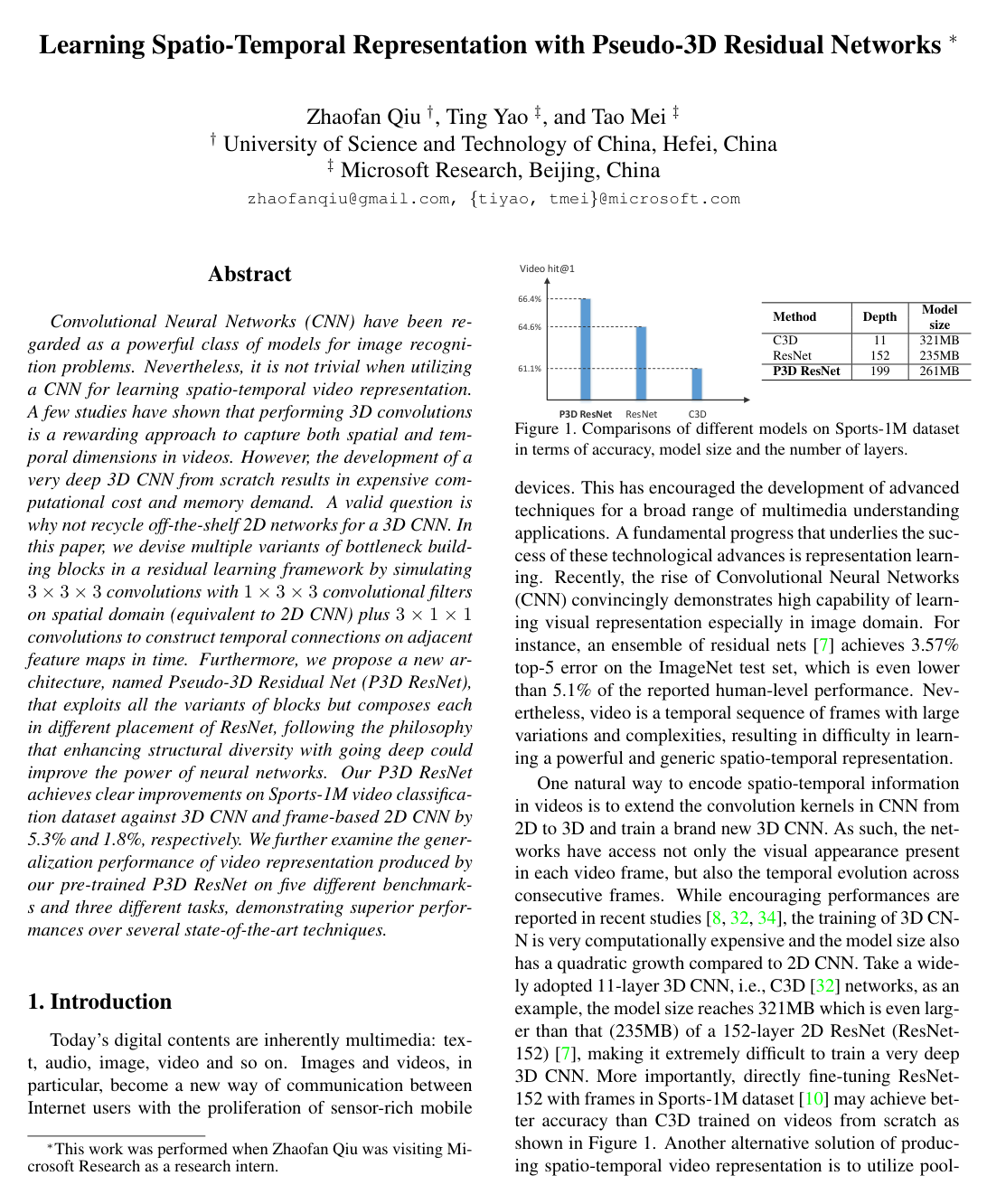
The experimental findings show significant performance advantages. On the Sports-1M classification benchmark, P3D ResNet achieved a 66.4% top-1 video accuracy, surpassing conventional three-dimensional networks by 5.3% and standard deep two-dimensional networks by 1.8%, while maintaining a compact 261 MB model size. In action recognition benchmarks, P3D ResNet achieved 88.6% accuracy on UCF101 using frame inputs alone—outperforming competing frame-based methods—and reached 93.7% when combined with trajectory features. On ActivityNet, the architecture improved top-1 accuracy to 75.12%, outperforming standard two-dimensional networks by 3.7% and three-dimensional networks by 9.3%. It also achieved top scores on action similarity (80.8% accuracy on ASLAN) and scene classification (99.5% accuracy on YUPENN and 94.6% on Dynamic Scene).
These results indicate that decoupling spatial and temporal convolutions provides an effective, computationally efficient path to deep video representation. Organizations can achieve higher accuracy without the prohibitive hardware costs and long training times typically required to train deep three-dimensional networks from scratch. Furthermore, initializing spatial layers with existing image recognition models helps bridge data domain gaps and preserves performance even when representations are compressed to lower dimensions.
Based on these outcomes, organizations developing video analytics solutions should consider adopting factorized pseudo-three-dimensional architectures instead of standard full three-dimensional convolutions. For future system enhancement, practitioners and researchers should explore incorporating attention mechanisms, training on longer video clips, and integrating additional modalities such as optical flow and audio streams.
Confidence in these findings is high across standard academic benchmarks, though stakeholders should note certain limitations. About 9.2% of the initial Sports-1M dataset was inaccessible during training due to expired links, and tests relied primarily on short 16-frame clips covering less than half a second. Deployments requiring long-range temporal reasoning over minutes or hours may need additional architectural adaptation.
- Paper: Deep Residual Learning for Image Recognition, Kaiming He et al. (2016). Read this first to understand the residual-learning backbone that P3D adapts for spatiotemporal video representation.
- Paper: Learning Spatiotemporal Features with 3D Convolutional Networks, Du Tran et al. (2015). Its C3D architecture establishes the full 3D-convolution approach that P3D decomposes into spatial and temporal operations.
- Paper: Two-Stream Convolutional Networks for Action Recognition in Videos, Karen Simonyan et al. (2014). The two-stream model provides the appearance-versus-motion framework that contextualizes P3D’s effort to learn temporal information within a unified network.
- Paper: A Closer Look at Spatiotemporal Convolutions for Action Recognition, Du Tran et al. (2017). This later study directly develops spatial-then-temporal convolution in residual networks, extending P3D’s factorization idea through controlled architectural comparisons.