
keyword
transformer encoder
A transformer encoder is a neural network architecture component that converts a sequence of input tokens into rich, contextualized representations using self-attention mechanisms. It operates by processing all elements of an input sequence—such as words, image patches, audio spectrogram segments, or time series steps—simultaneously rather than sequentially. Structurally, it consists of a stack of identical layers, where each layer contains a multi-head self-attention module, a position-wise feed-forward network, residual connections, and layer normalization. By computing attention weights across all token pairs at each stage, the transformer encoder captures global relationships and long-range dependencies across the entire input, generating output embeddings that can be fed into downstream prediction heads or paired with a decoder for sequence generation and dense estimation tasks.
17 items
Overcoming a Theoretical Limitation of Self-Attention
David Chiang, Peter Cholak
Why you should read this
Proves that standard transformers can recognize challenging regular languages like PARITY with perfect accuracy and shows that scaling attention logits by the logarithm of sequence length resolves severe length generalization failures in practice.
Although transformers are remarkably effective for many tasks, there are some surprisingly easy-looking regular languages that they struggle with. Hahn shows that for languages where acceptance depends on a single input symbol, a transformer's classification decisions become less and less confident (that is, with cross-entropy approaching 1 bit per string) as input strings get longer and longer. We examine this limitation using two languages: PARITY, the language of bit strings with an odd number of 1s, and FIRST, the language of bit strings starting with a 1. We demonstrate three ways of overcoming the limitation suggested by Hahn's lemma. First, we settle an open question by constructing a transformer that recognizes PARITY with perfect accuracy, and similarly for FIRST. Second, we use layer normalization to bring the cross-entropy of both models arbitrarily close to zero. Third, when transformers need to focus on a single position, as for FIRST, we find that they can fail to generalize to longer strings; we offer a simple remedy to this problem that also improves length generalization in machine translation.
Added
2026-10-01
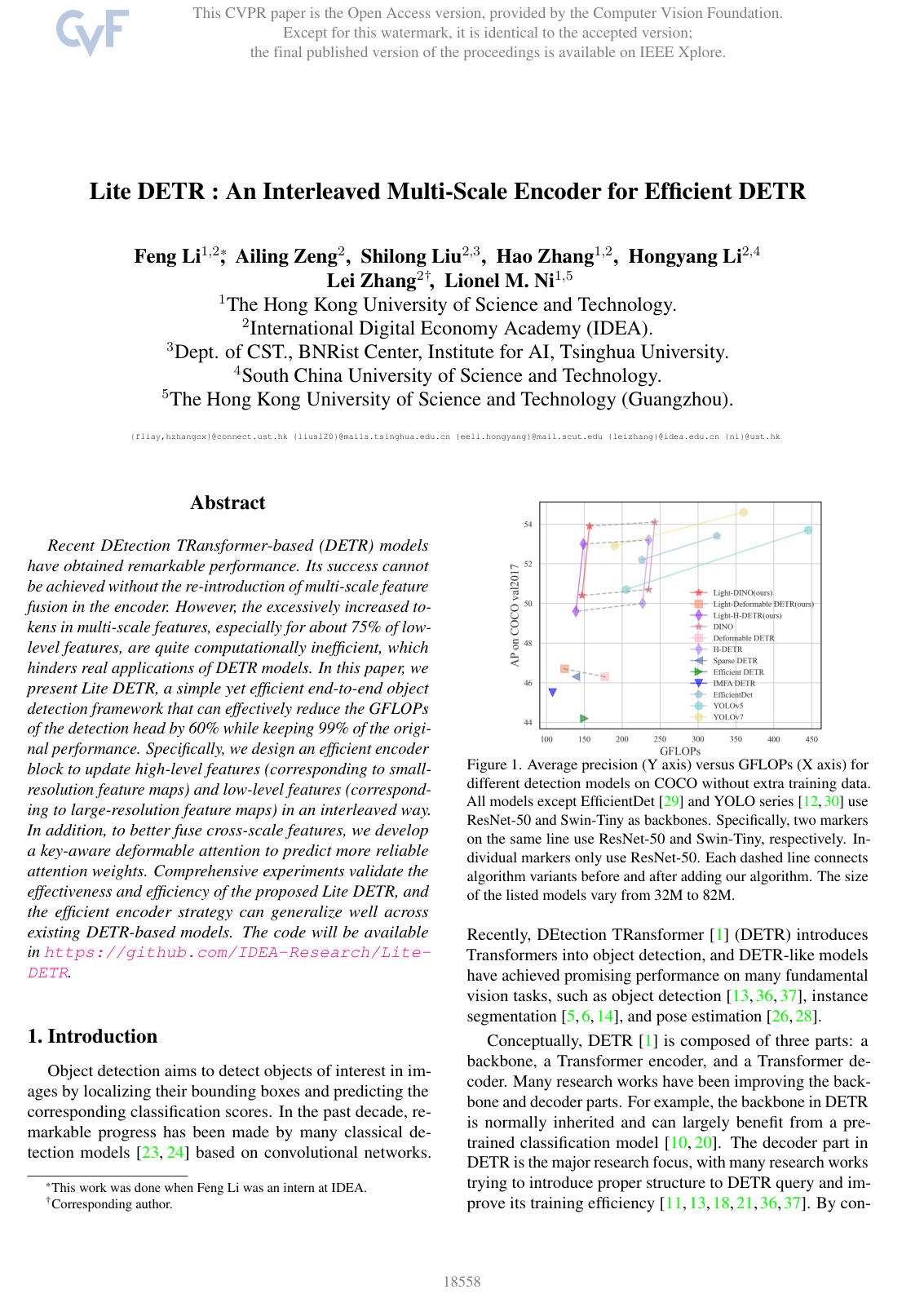
Lite DETR : An Interleaved Multi-Scale Encoder for Efficient DETR
Feng Li, Ailing Zeng, Shilong Liu, Hao Zhang, Hongyang Li, Lei Zhang, Lionel M. Ni
Why you should read this
Proposes an interleaved multi-scale encoder and key-aware deformable attention for DETR architectures, cutting detection head computational cost by 60% while retaining 99% of original detection performance.
Recent DEtection TRansformer-based (DETR) models have obtained remarkable performance. Its success cannot be achieved without the re-introduction of multi-scale feature fusion in the encoder. However, the excessively increased tokens in multi-scale features, especially for about 75% of low-level features, are quite computationally inefficient, which hinders real applications of DETR models. In this paper, we present Lite DETR, a simple yet efficient end-to-end object detection framework that can effectively reduce the GFLOPs of the detection head by 60% while keeping 99% of the original performance. Specifically, we design an efficient encoder block to update high-level features (corresponding to small-resolution feature maps) and low-level features (corresponding to large-resolution feature maps) in an interleaved way. In addition, to better fuse cross-scale features, we develop a key-aware deformable attention to predict more reliable attention weights. Comprehensive experiments validate the effectiveness and efficiency of the proposed Lite DETR, and the efficient encoder strategy can generalize well across existing DETR-based models. The code will be available in https://github.com/IDEA-Research/Lite-DETR.
Added
2026-09-26
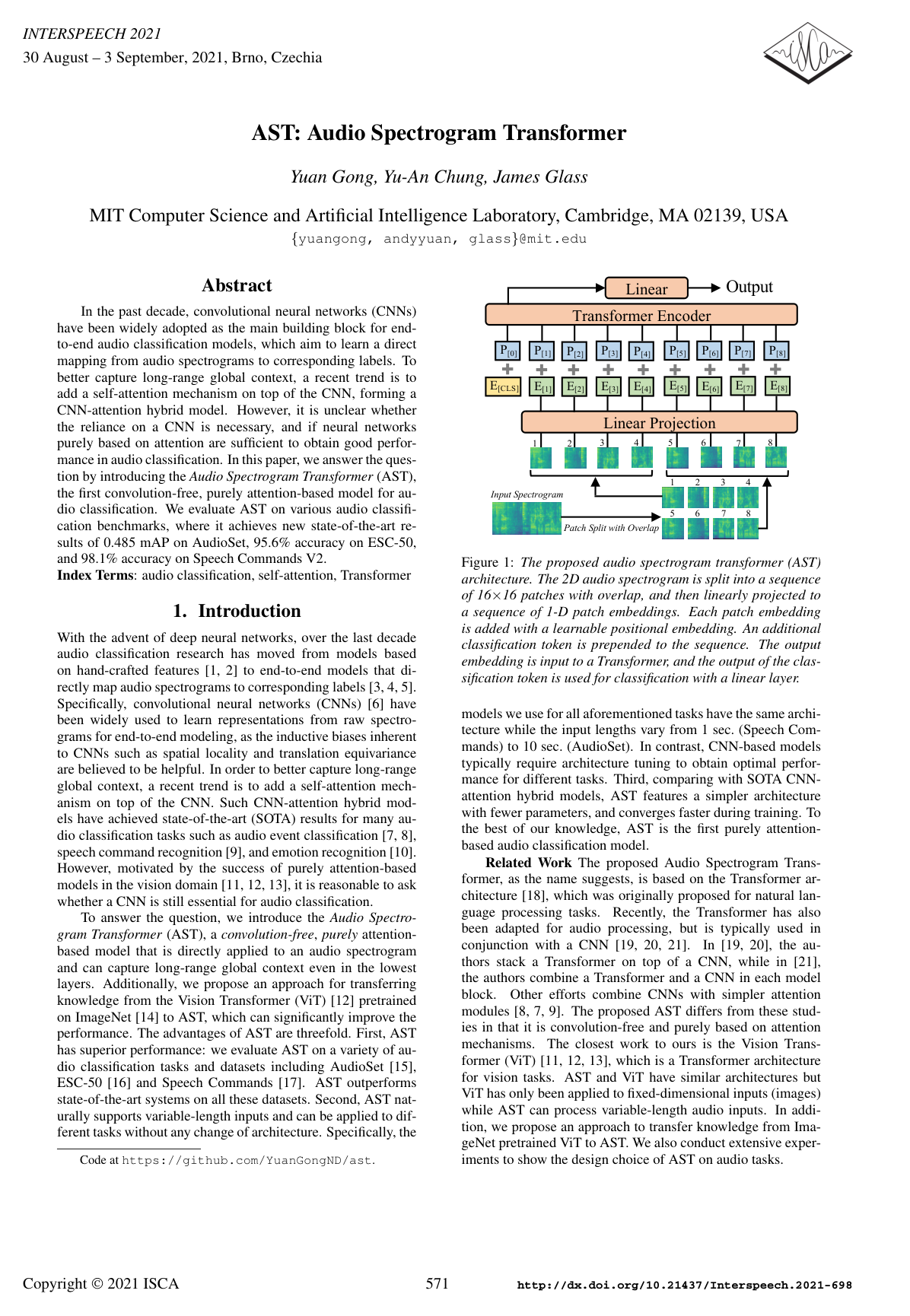
AST: Audio Spectrogram Transformer
Yuan Gong, Yu-An Chung, James R. Glass
Why you should read this
Introduces the Audio Spectrogram Transformer, the first convolution-free, purely attention-based architecture for audio classification, proving that self-attention alone outperforms standard convolutional networks across major audio and speech benchmarks.
In the past decade, convolutional neural networks (CNNs) have been widely adopted as the main building block for end-to-end audio classification models, which aim to learn a direct mapping from audio spectrograms to corresponding labels. To better capture long-range global context, a recent trend is to add a self-attention mechanism on top of the CNN, forming a CNN-attention hybrid model. However, it is unclear whether the reliance on a CNN is necessary, and if neural networks purely based on attention are sufficient to obtain good performance in audio classification. In this paper, we answer the question by introducing the Audio Spectrogram Transformer (AST), the first convolution-free, purely attention-based model for audio classification. We evaluate AST on various audio classification benchmarks, where it achieves new state-of-the-art results of 0.485 mAP on AudioSet, 95.6% accuracy on ESC-50, and 98.1% accuracy on Speech Commands V2.
Added
2026-09-25
A Transformer-based Framework for Multivariate Time Series Representation Learning
George Zerveas, Srideepika Jayaraman, Dhaval Patel, Anuradha Bhamidipaty, Carsten Eickhoff
Why you should read this
Proposes an unsupervised transformer-based representation learning framework for multivariate time series that outperforms state-of-the-art supervised methods on downstream classification and regression tasks, even under limited training data settings.
In this work we propose for the first time a transformer-based framework for unsupervised representation learning of multivariate time series. Pre-trained models can be potentially used for downstream tasks such as regression and classification, forecasting and missing value imputation. By evaluating our models on several benchmark datasets for multivariate time series regression and classification, we show that not only does our modeling approach represent the most successful method employing unsupervised learning of multivariate time series presented to date, but also that it exceeds the current state-of-the-art performance of supervised methods; it does so even when the number of training samples is very limited, while offering computational efficiency. Finally, we demonstrate that unsupervised pre-training of our transformer models offers a substantial performance benefit over fully supervised learning, even without leveraging additional unlabeled data, i.e., by reusing the same data samples through the unsupervised objective.
Added
2026-09-24
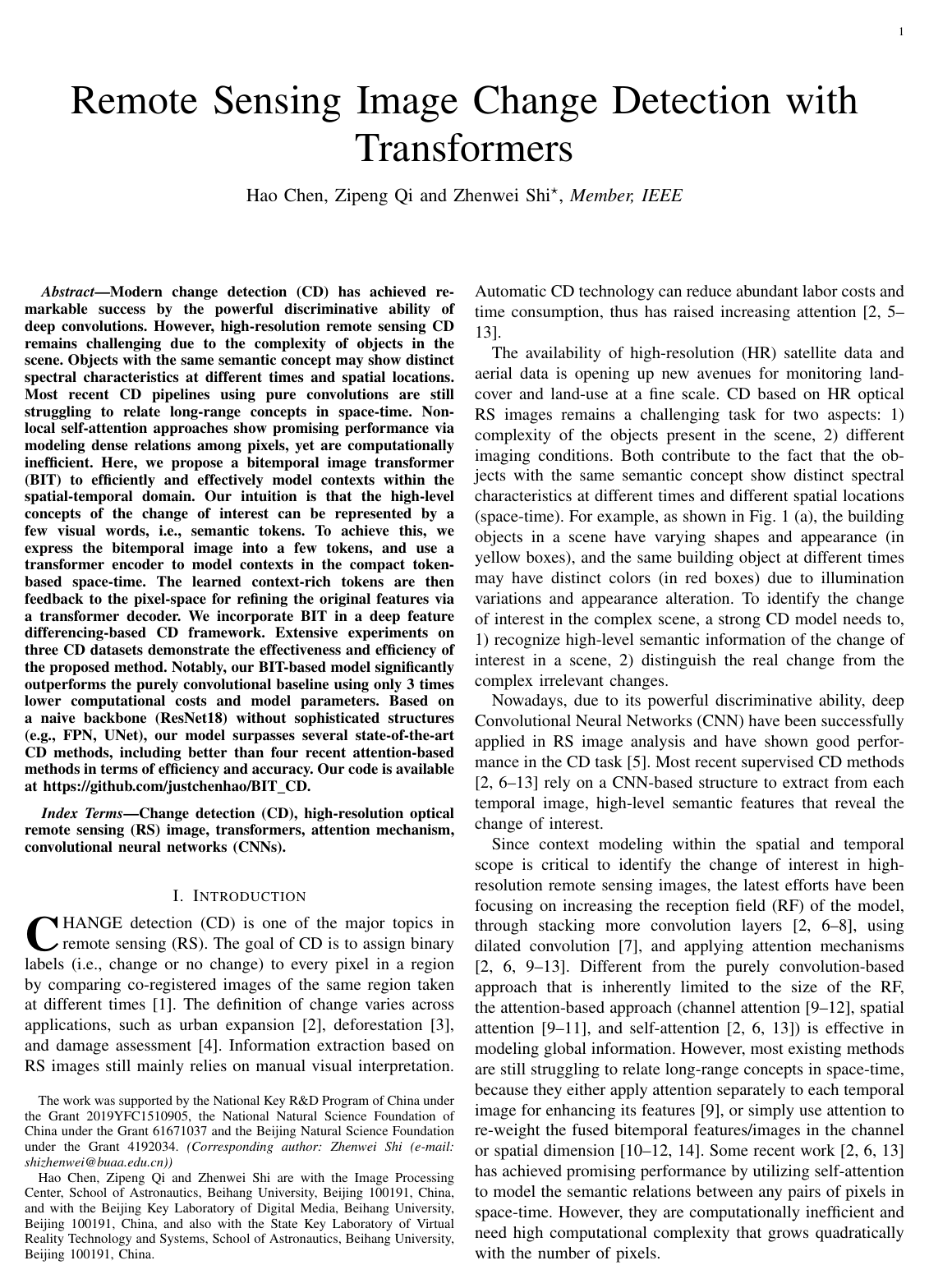
Remote Sensing Image Change Detection With Transformers
Hao Chen, Zipeng Qi, Zhenwei Shi
Why you should read this
Proposes a bitemporal image transformer that captures long-range spatiotemporal contexts using compact semantic tokens, outperforming conventional convolutional and attention-based change detection methods while significantly reducing computational costs.
Modern change detection (CD) has achieved remarkable success by the powerful discriminative ability of deep convolutions. However, high-resolution remote sensing CD remains challenging due to the complexity of objects in the scene. Objects with the same semantic concept may show distinct spectral characteristics at different times and spatial locations. Most recent CD pipelines using pure convolutions are still struggling to relate long-range concepts in space-time. Non-local self-attention approaches show promising performance via modeling dense relations among pixels, yet are computationally inefficient. Here, we propose a bitemporal image transformer (BIT) to efficiently and effectively model contexts within the spatial-temporal domain. Our intuition is that the high-level concepts of the change of interest can be represented by a few visual words, i.e., semantic tokens. To achieve this, we express the bitemporal image into a few tokens, and use a transformer encoder to model contexts in the compact token-based space-time. The learned context-rich tokens are then feedback to the pixel-space for refining the original features via a transformer decoder. We incorporate BIT in a deep feature differencing-based CD framework. Extensive experiments on three CD datasets demonstrate the effectiveness and efficiency of the proposed method. Notably, our BIT-based model significantly outperforms the purely convolutional baseline using only 3 times lower computational costs and model parameters. Based on a naive backbone (ResNet18) without sophisticated structures (e.g., FPN, UNet), our model surpasses several state-of-the-art CD methods, including better than four recent attention-based methods in terms of efficiency and accuracy. Our code is available at this https URL\_CD.
Added
2026-09-24
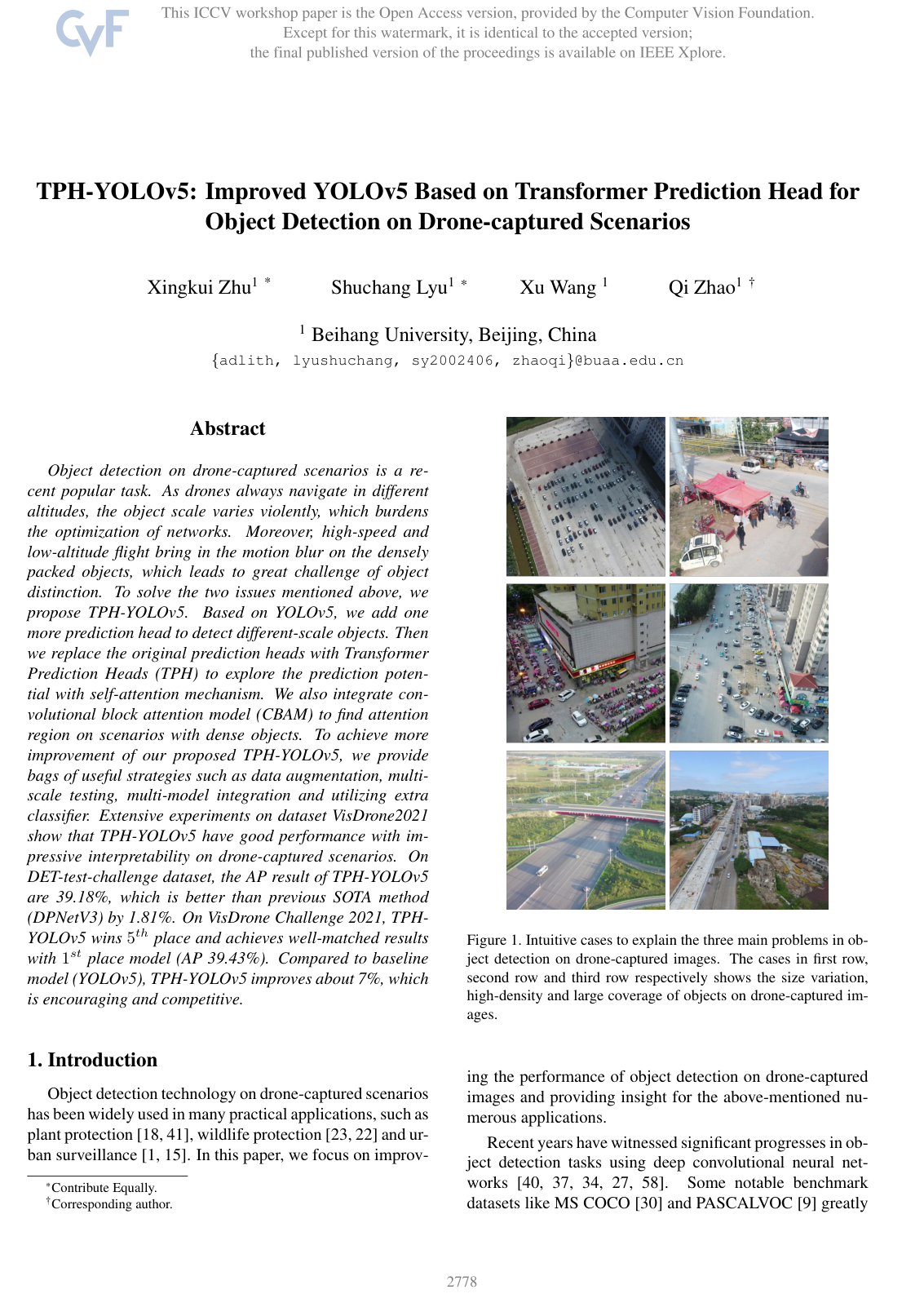
TPH-YOLOv5: Improved YOLOv5 Based on Transformer Prediction Head for Object Detection on Drone-captured Scenarios
Xingkui Zhu, Shuchang Lyu, Xu Wang, Qi Zhao
Why you should read this
Proposes TPH-YOLOv5, an aerial object detector that incorporates Transformer-based prediction heads and attention modules into YOLOv5 to effectively identify densely packed, scale-varying objects in drone imagery.
Object detection on drone-captured scenarios is a recent popular task. As drones always navigate in different altitudes, the object scale varies violently, which burdens the optimization of networks. Moreover, high-speed and low-altitude flight bring in the motion blur on the densely packed objects, which leads to great challenge of object distinction. To solve the two issues mentioned above, we propose TPH-YOLOv5. Based on YOLOv5, we add one more prediction head to detect different-scale objects. Then we replace the original prediction heads with Transformer Prediction Heads (TPH) to explore the prediction potential with self-attention mechanism. We also integrate convolutional block attention model (CBAM) to find attention region on scenarios with dense objects. To achieve more improvement of our proposed TPH-YOLOv5, we provide bags of useful strategies such as data augmentation, multiscale testing, multi-model integration and utilizing extra classifier. Extensive experiments on dataset VisDrone2021 show that TPH-YOLOv5 have good performance with impressive interpretability on drone-captured scenarios. On DET-test-challenge dataset, the AP result of TPH-YOLOv5 are 39.18%, which is better than previous SOTA method (DPNetV3) by 1.81%. On VisDrone Challenge 2021, TPHYOLOv5 wins 5th place and achieves well-matched results with 1st place model (AP 39.43%). Compared to baseline model (YOLOv5), TPH-YOLOv5 improves about 7%, which is encouraging and competitive.
Added
2026-09-20
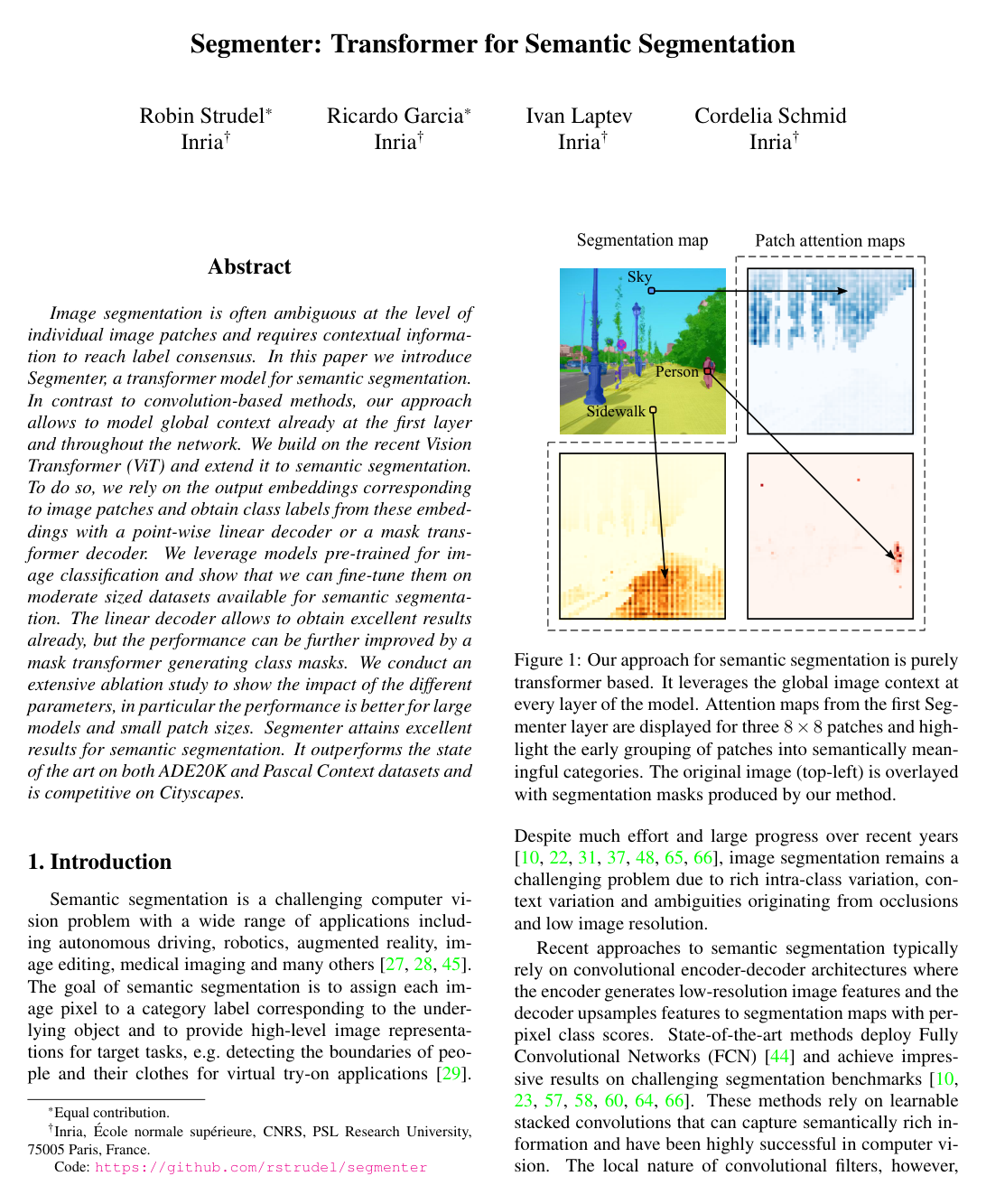
Segmenter: Transformer for Semantic Segmentation
Robin Strudel, Ricardo Garcia, Ivan Laptev, Cordelia Schmid
Why you should read this
Introduces Segmenter, an end-to-end Vision Transformer architecture for semantic segmentation that captures global context throughout the network using a mask transformer decoder, surpassing convolutional baselines on the ADE20K and Pascal Context benchmarks.
Image segmentation is often ambiguous at the level of individual image patches and requires contextual information to reach label consensus. In this paper we introduce Segmenter, a transformer model for semantic segmentation. In contrast to convolution-based methods, our approach allows to model global context already at the first layer and throughout the network. We build on the recent Vision Transformer (ViT) and extend it to semantic segmentation. To do so, we rely on the output embeddings corresponding to image patches and obtain class labels from these embeddings with a point-wise linear decoder or a mask transformer decoder. We leverage models pre-trained for image classification and show that we can fine-tune them on moderate sized datasets available for semantic segmentation. The linear decoder allows to obtain excellent results already, but the performance can be further improved by a mask transformer generating class masks. We conduct an extensive ablation study to show the impact of the different parameters, in particular the performance is better for large models and small patch sizes. Segmenter attains excellent results for semantic segmentation. It outperforms the state of the art on both ADE20K and Pascal Context datasets and is competitive on Cityscapes.
Added
2026-09-17
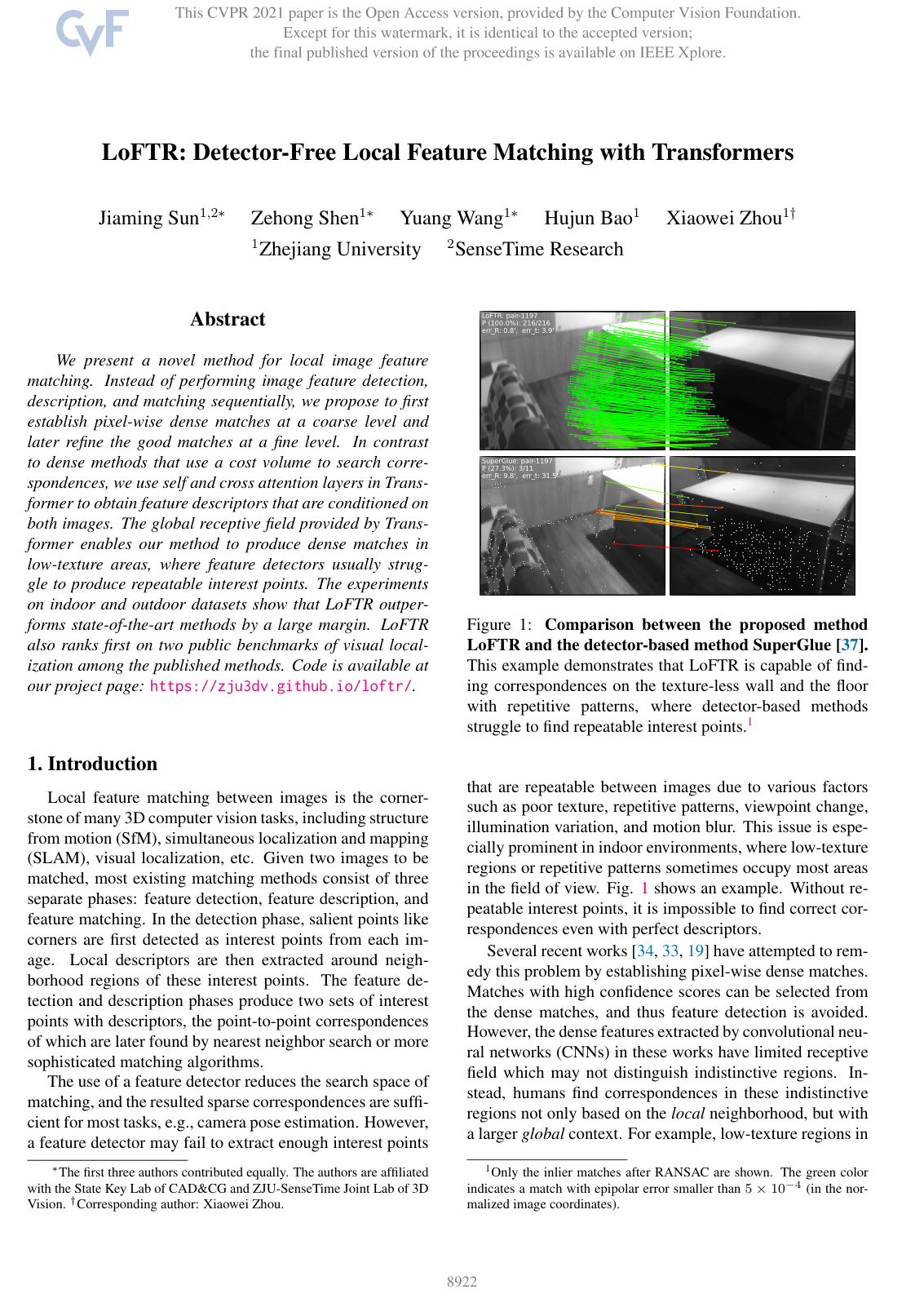
LoFTR: Detector-Free Local Feature Matching with Transformers
Jiaming Sun, Zehong Shen, Yuang Wang, Hujun Bao, Xiaowei Zhou
Why you should read this
Presents a detector-free local feature matching framework that uses Transformer attention to establish dense coarse-to-fine correspondences, successfully matching low-texture regions where traditional keypoint detectors fail.
We present a novel method for local image feature matching. Instead of performing image feature detection, description, and matching sequentially, we propose to first establish pixel-wise dense matches at a coarse level and later refine the good matches at a fine level. In contrast to dense methods that use a cost volume to search correspondences, we use self and cross attention layers in Transformer to obtain feature descriptors that are conditioned on both images. The global receptive field provided by Transformer enables our method to produce dense matches in low-texture areas, where feature detectors usually struggle to produce repeatable interest points. The experiments on indoor and outdoor datasets show that LoFTR outperforms state-of-the-art methods by a large margin. LoFTR also ranks first on two public benchmarks of visual localization among the published methods.
Added
2026-09-17
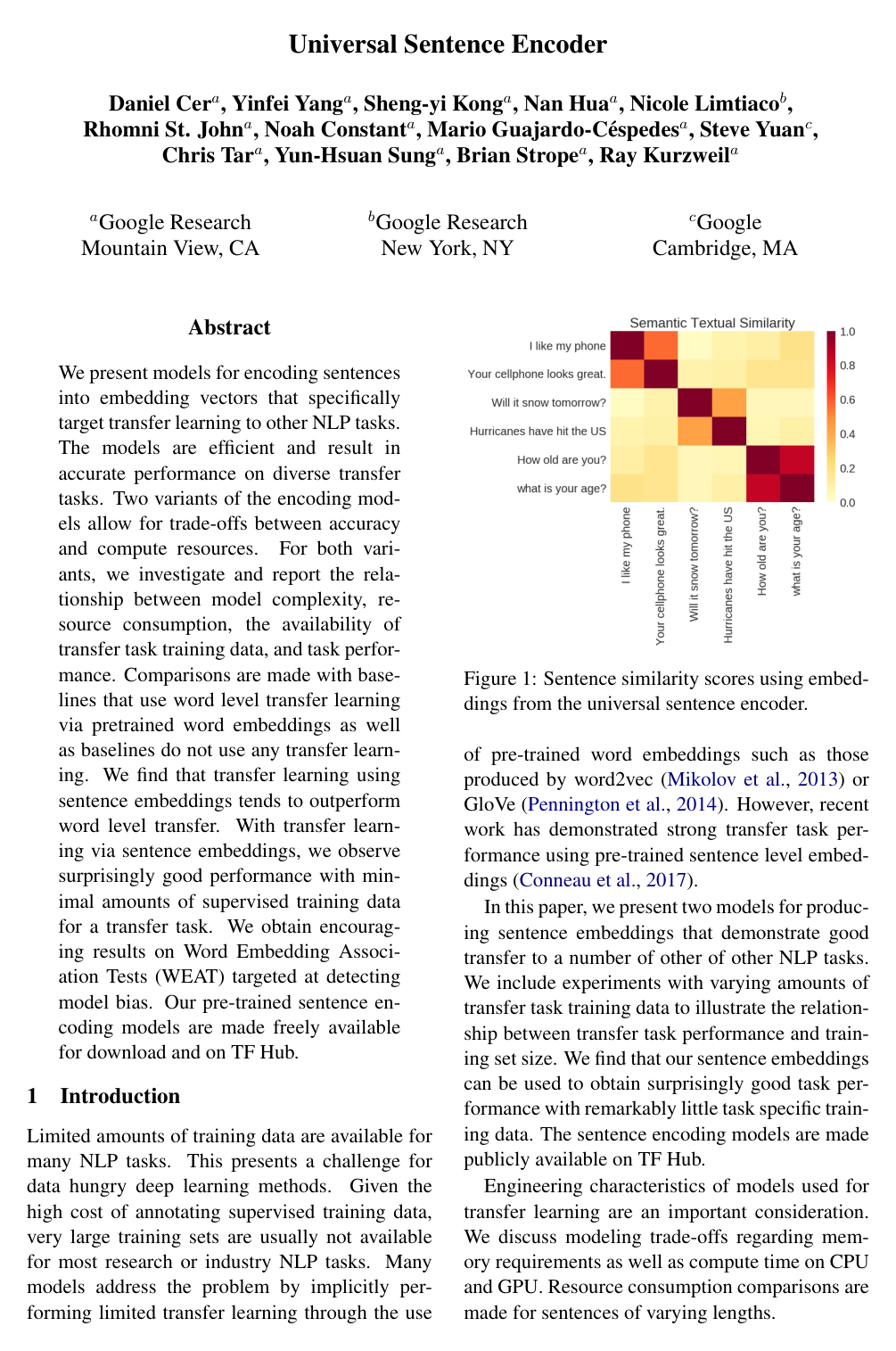
Universal Sentence Encoder
Daniel Cer, Yinfei Yang, Sheng-yi Kong, Nan Hua, Nicole Limtiaco, Rhomni St. John, Noah Constant, Mario Guajardo-Cespedes, Steve Yuan, Chris Tar, Yun-Hsuan Sung, Brian Strope, Ray Kurzweil
Why you should read this
Introduces the Universal Sentence Encoder, providing two pre-trained embedding architectures that balance computational efficiency with accuracy to deliver strong transfer learning performance across diverse language tasks with minimal training data.
We present models for encoding sentences into embedding vectors that specifically target transfer learning to other NLP tasks. The models are efficient and result in accurate performance on diverse transfer tasks. Two variants of the encoding models allow for trade-offs between accuracy and compute resources. For both variants, we investigate and report the relationship between model complexity, resource consumption, the availability of transfer task training data, and task performance. Comparisons are made with baselines that use word level transfer learning via pretrained word embeddings as well as baselines do not use any transfer learning. We find that transfer learning using sentence embeddings tends to outperform word level transfer. With transfer learning via sentence embeddings, we observe surprisingly good performance with minimal amounts of supervised training data for a transfer task. We obtain encouraging results on Word Embedding Association Tests (WEAT) targeted at detecting model bias. Our pre-trained sentence encoding models are made freely available for download and on TF Hub.
Added
2026-09-16
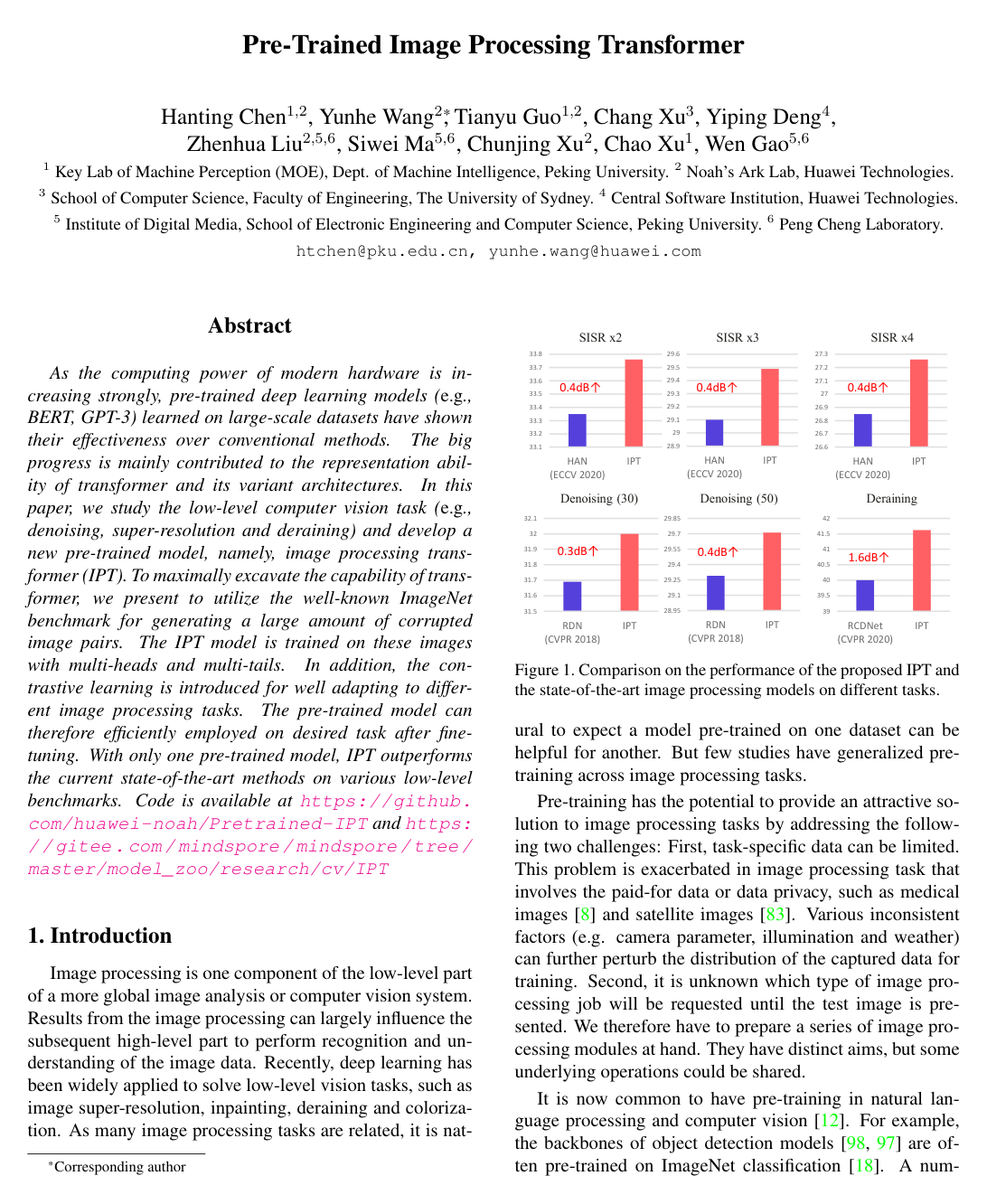
Pre-Trained Image Processing Transformer
Hanting Chen, Yunhe Wang, Tianyu Guo, Chang Xu, Yiping Deng, Zhenhua Liu, Siwei Ma, Chunjing Xu, Chao Xu, Wen Gao
Why you should read this
Introduces the Image Processing Transformer (IPT), a unified pre-trained architecture trained on large-scale corrupted datasets with contrastive learning to outperform specialized models across multiple low-level vision tasks such as super-resolution, denoising, and deraining.
As the computing power of modern hardware is increasing strongly, pre-trained deep learning models (e.g., BERT, GPT-3) learned on large-scale datasets have shown their effectiveness over conventional methods. The big progress is mainly contributed to the representation ability of transformer and its variant architectures. In this paper, we study the low-level computer vision task (e.g., denoising, super-resolution and deraining) and develop a new pre-trained model, namely, image processing transformer (IPT). To maximally excavate the capability of transformer, we present to utilize the well-known ImageNet benchmark for generating a large amount of corrupted image pairs. The IPT model is trained on these images with multi-heads and multi-tails. In addition, the contrastive learning is introduced for well adapting to different image processing tasks. The pre-trained model can therefore efficiently employed on desired task after fine-tuning. With only one pre-trained model, IPT outperforms the current state-of-the-art methods on various low-level benchmarks. Code is available at this https URL and this https URL
Added
2026-09-15
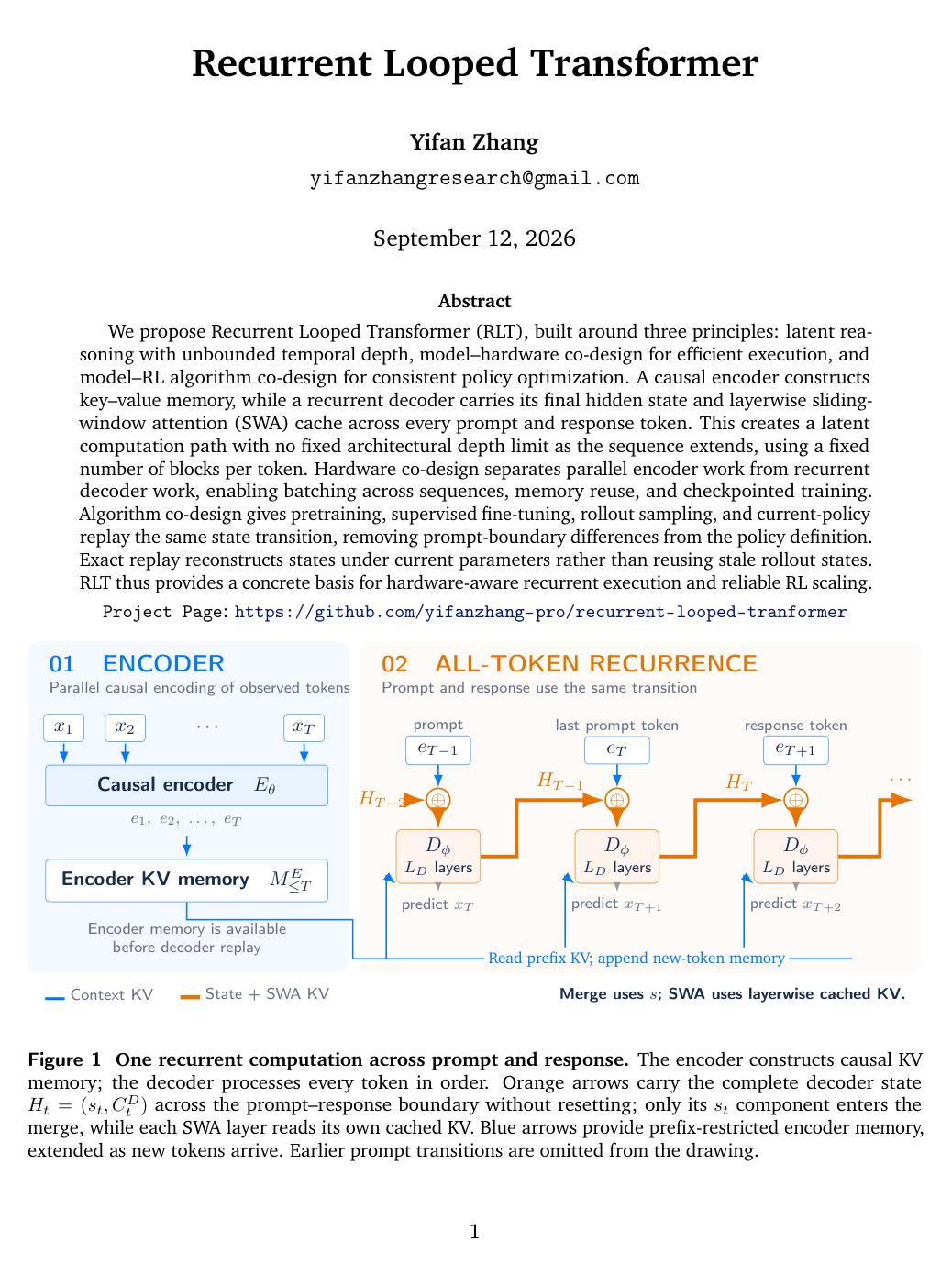
Recurrent Looped Transformer
Yifan Zhang
Why you should read this
Introduces an architecture that combines unbounded temporal depth with hardware-aware execution and consistent reinforcement learning algorithms.
We propose Recurrent Looped Transformer (RLT), built around three principles: latent reasoning with unbounded temporal depth, model-hardware co-design for efficient execution, and model-RL algorithm co-design for consistent policy optimization. A causal encoder constructs key-value memory, while a recurrent decoder carries its final hidden state and layerwise sliding-window attention cache across every prompt and response token. This creates a latent computation path with no fixed architectural depth limit as the sequence extends, using a fixed number of blocks per token.
Added
2026-09-14

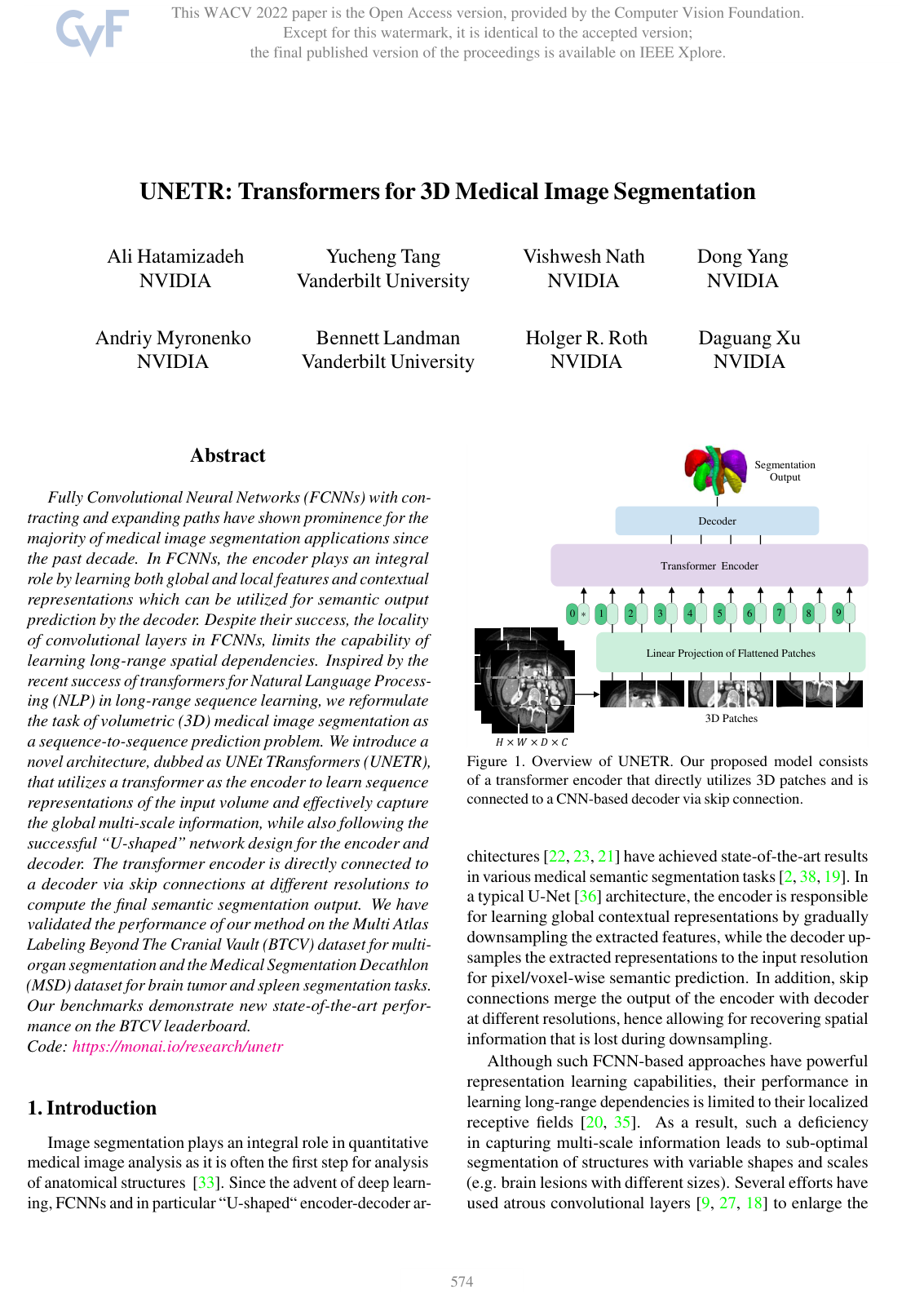
UNETR: Transformers for 3D Medical Image Segmentation
Ali Hatamizadeh, Dong Yang, Holger R. Roth, Daguang Xu
Why you should read this
Introduces UNETR, a volumetric medical image segmentation architecture that connects a pure vision transformer encoder to a CNN decoder via multi-scale skip connections, achieving state-of-the-art performance on 3D CT and MRI benchmarks by capturing global spatial dependencies.
Fully Convolutional Neural Networks (FCNNs) with con-tracting and expanding paths have shown prominence for the majority of medical image segmentation applications since the past decade. In FCNNs, the encoder plays an integral role by learning both global and local features and contextual representations which can be utilized for semantic output prediction by the decoder. Despite their success, the locality of convolutional layers in FCNNs, limits the capability of learning long-range spatial dependencies. Inspired by the recent success of transformers for Natural Language Process-ing (NLP) in long-range sequence learning, we reformulate the task of volumetric (3D) medical image segmentation as a sequence-to-sequence prediction problem. We introduce a novel architecture, dubbed as UNEt TRansformers (UNETR), that utilizes a transformer as the encoder to learn sequence representations of the input volume and effectively capture the global multi-scale information, while also following the successful “U-shaped” network design for the encoder and decoder. The transformer encoder is directly connected to a decoder via skip connections at different resolutions to compute the final semantic segmentation output. We have validated the performance of our method on the Multi Atlas Labeling Beyond The Cranial Vault (BTCV) dataset for multi-organ segmentation and the Medical Segmentation Decathlon (MSD) dataset for brain tumor and spleen segmentation tasks. Our benchmarks demonstrate new state-of-the-art perfor-mance on the BTCV leaderboard. Code: https://monai.io/research/unetr
Added
2026-09-14
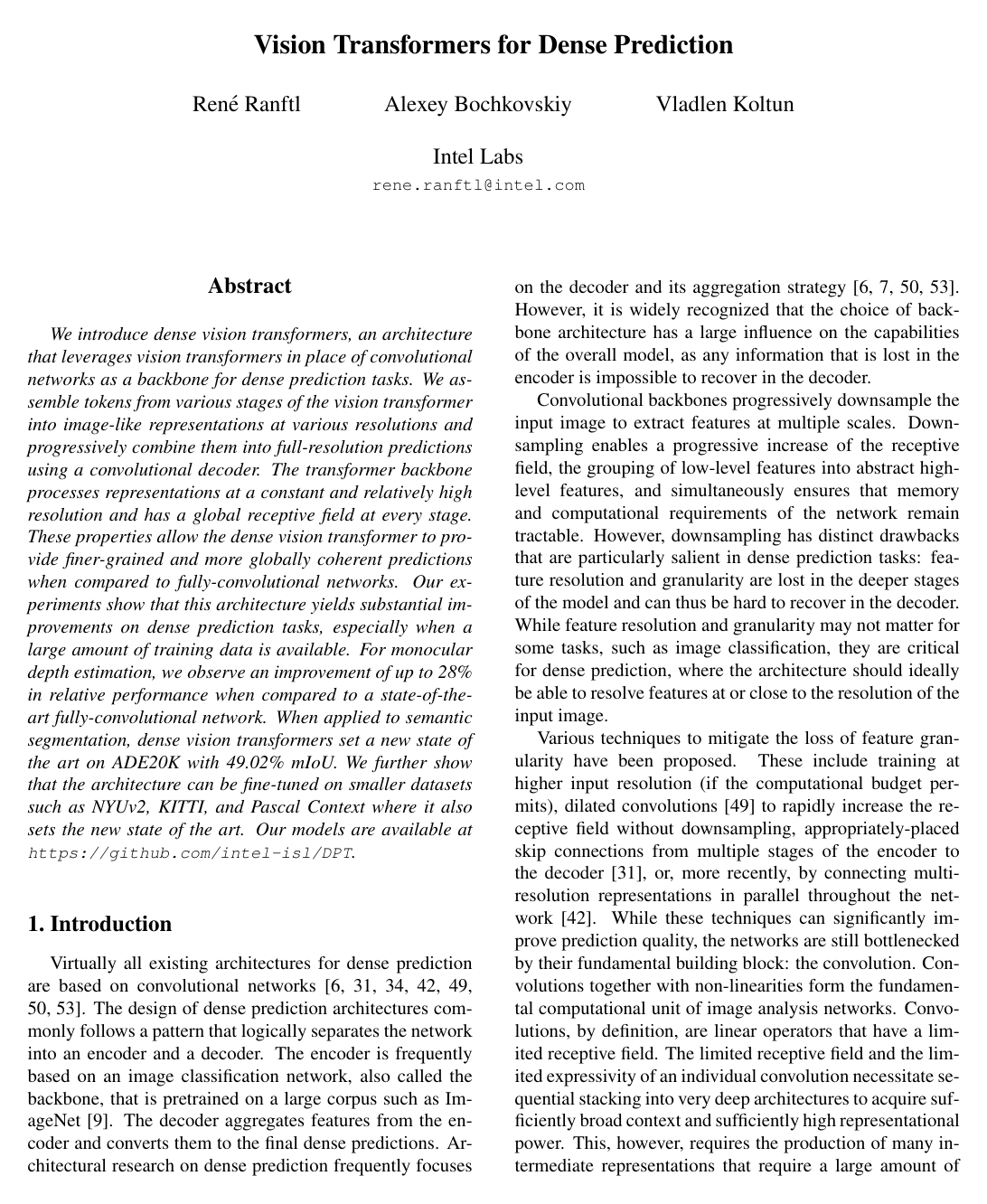
Vision Transformers for Dense Prediction
René Ranftl, Alexey Bochkovskiy, Vladlen Koltun
Why you should read this
Develops Dense Vision Transformers to replace convolutional backbones with vision transformers, assembling multi-stage token representations into full-resolution outputs that achieve state-of-the-art accuracy in monocular depth estimation and semantic segmentation.
We introduce dense vision transformers, an architecture that leverages vision transformers in place of convolutional networks as a backbone for dense prediction tasks. We assemble tokens from various stages of the vision transformer into image-like representations at various resolutions and progressively combine them into full-resolution predictions using a convolutional decoder. The transformer backbone processes representations at a constant and relatively high resolution and has a global receptive field at every stage. These properties allow the dense vision transformer to provide finer-grained and more globally coherent predictions when compared to fully-convolutional networks. Our experiments show that this architecture yields substantial improvements on dense prediction tasks, especially when a large amount of training data is available. For monocular depth estimation, we observe an improvement of up to 28% in relative performance when compared to a state-of-the-art fully-convolutional network. When applied to semantic segmentation, dense vision transformers set a new state of the art on ADE20K with 49.02% mIoU. We further show that the architecture can be fine-tuned on smaller datasets such as NYUv2, KITTI, and Pascal Context where it also sets the new state of the art. Our models are available at this https URL.
Added
2026-09-13
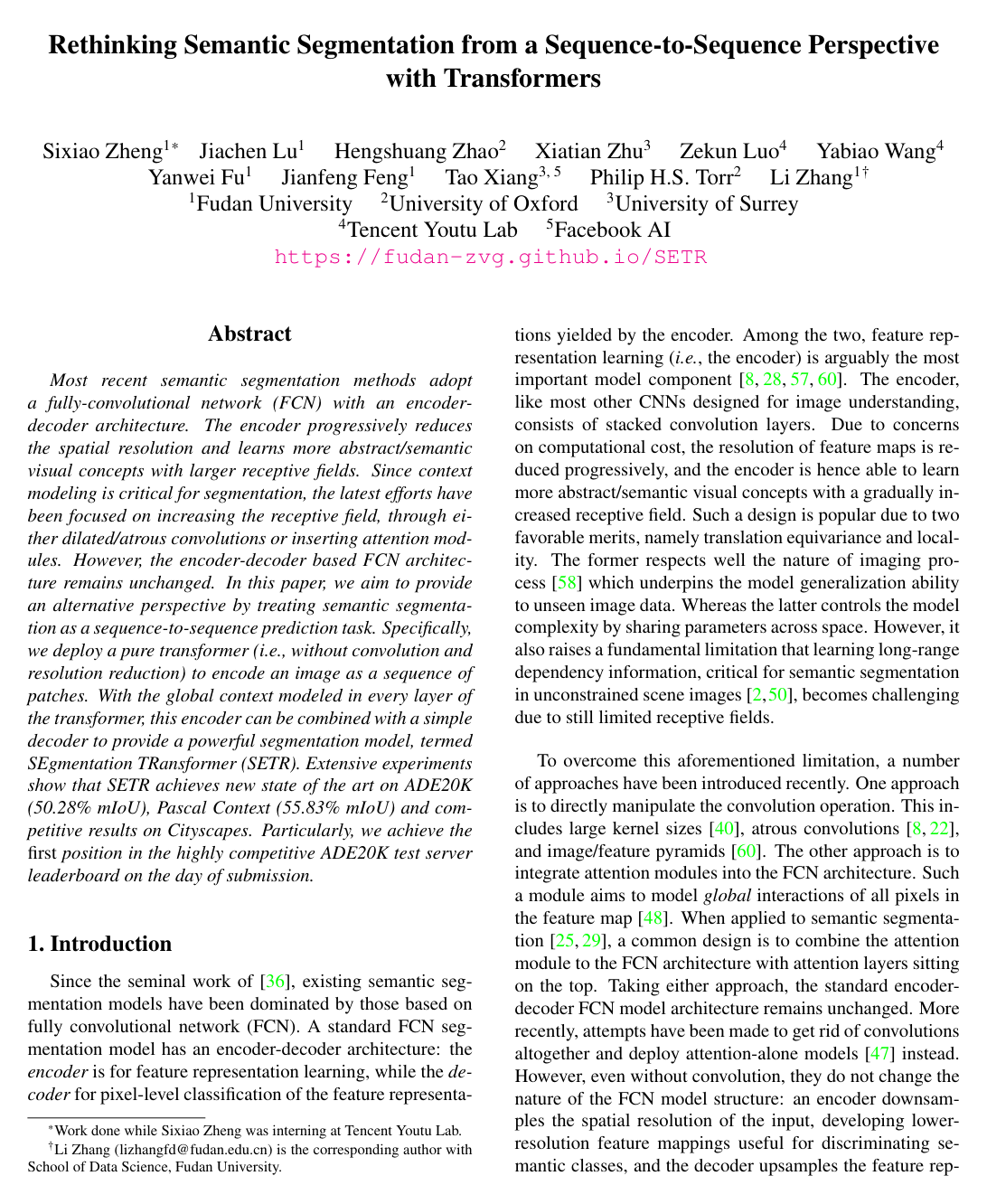
Rethinking Semantic Segmentation from a Sequence-to-Sequence Perspective with Transformers
Sixiao Zheng, Jiachen Lu, Hengshuang Zhao, Xiatian Zhu, Zekun Luo, Yabiao Wang, Yanwei Fu, Jianfeng Feng, Tao Xiang, Philip H. S. Torr, Li Zhang
Why you should read this
Introduces the SEgmentation TRansformer (SETR), replacing traditional convolutional encoder-decoder models with a pure sequence-to-sequence transformer that extracts global visual context across every layer to achieve state-of-the-art accuracy on major benchmarks like ADE20K.
Most recent semantic segmentation methods adopt a fully-convolutional network (FCN) with an encoder-decoder architecture. The encoder progressively reduces the spatial resolution and learns more abstract/semantic visual concepts with larger receptive fields. Since context modeling is critical for segmentation, the latest efforts have been focused on increasing the receptive field, through either dilated/atrous convolutions or inserting attention modules. However, the encoder-decoder based FCN architecture remains unchanged. In this paper, we aim to provide an alternative perspective by treating semantic segmentation as a sequence-to-sequence prediction task. Specifically, we deploy a pure transformer (ie, without convolution and resolution reduction) to encode an image as a sequence of patches. With the global context modeled in every layer of the transformer, this encoder can be combined with a simple decoder to provide a powerful segmentation model, termed SEgmentation TRansformer (SETR). Extensive experiments show that SETR achieves new state of the art on ADE20K (50.28% mIoU), Pascal Context (55.83% mIoU) and competitive results on Cityscapes. Particularly, we achieve the first position in the highly competitive ADE20K test server leaderboard on the day of submission.
Added
2026-09-11

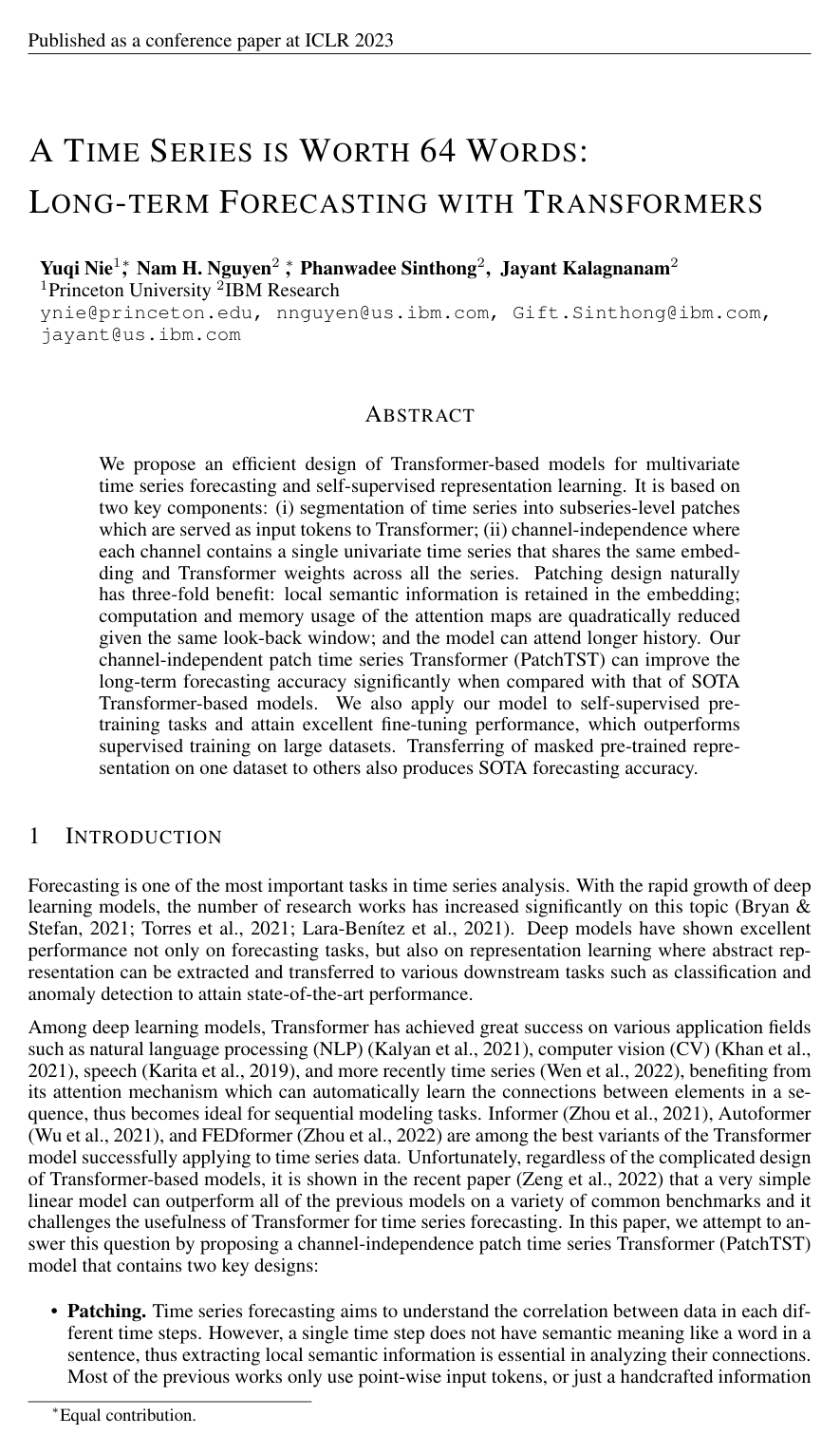
A Time Series is Worth 64 Words: Long-term Forecasting with Transformers
Yuqi Nie, Nam H. Nguyen, Phanwadee Sinthong, Jayant Kalagnanam
Why you should read this
Establishes a revolutionary state-of-the-art framework by intelligently patching time series segments into distinct tokens to preserve local semantics while simultaneously conquering the quadratic memory bottleneck of long-range transformers.
We propose an efficient design of Transformer-based models for multivariate time series forecasting and self-supervised representation learning. It is based on two key components: (i) segmentation of time series into subseries-level patches which are served as input tokens to Transformer; (ii) channel-independence where each channel contains a single univariate time series that shares the same embedding and Transformer weights across all the series. Patching design naturally has three-fold benefit: local semantic information is retained in the embedding; computation and memory usage of the attention maps are quadratically reduced given the same look-back window; and the model can attend longer history. Our channel-independent patch time series Transformer (PatchTST) can improve the long-term forecasting accuracy significantly when compared with that of SOTA Transformer-based models. We also apply our model to self-supervised pre-training tasks and attain excellent fine-tuning performance, which outperforms supervised training on large datasets. Transferring of masked pre-trained representation on one dataset to others also produces SOTA forecasting accuracy. Code is available at: https://github.com/yuqinie98/PatchTST.
Added
2026-06-27
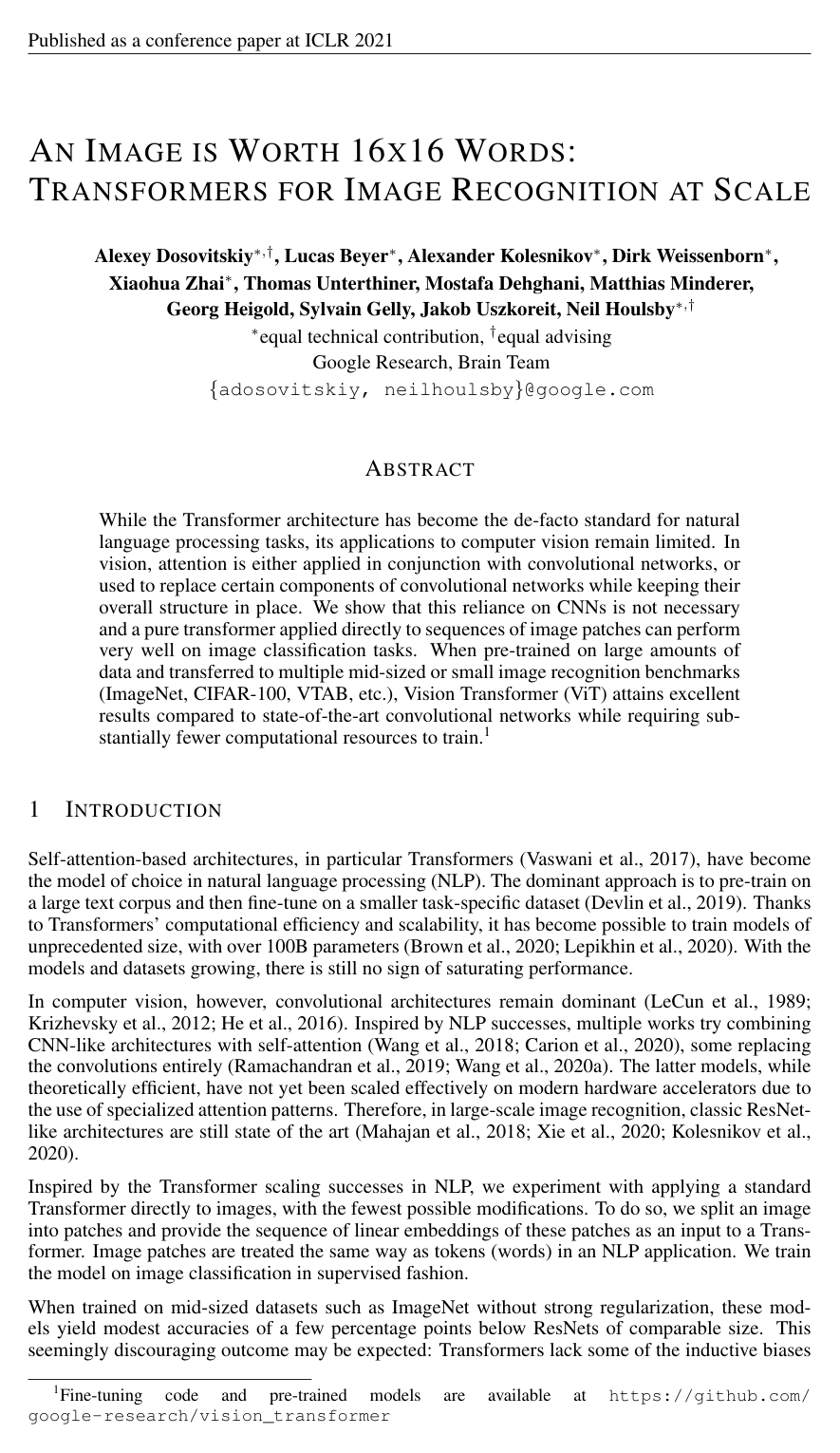
An Image is Worth 16x16 Words: Transformers for Image Recognition at Scale
Alexey Dosovitskiy, Lucas Beyer, Alexander Kolesnikov, Dirk Weissenborn, Xiaohua Zhai, Thomas Unterthiner, Mostafa Dehghani, Matthias Minderer, Georg Heigold, Sylvain Gelly, Jakob Uszkoreit, Neil Houlsby
Why you should read this
Demonstrates that pure Transformers, without reliance on convolutional networks, can achieve state-of-the-art results in image classification while requiring fewer computational resources, fundamentally reshaping our understanding of vision models.
While the Transformer architecture has become the de-facto standard for natural language processing tasks, its applications to computer vision remain limited. In vision, attention is either applied in conjunction with convolutional networks, or used to replace certain components of convolutional networks while keeping their overall structure in place. We show that this reliance on CNNs is not necessary and a pure transformer applied directly to sequences of image patches can perform very well on image classification tasks. When pre-trained on large amounts of data and transferred to multiple mid-sized or small image recognition benchmarks (ImageNet, CIFAR-100, VTAB, etc.), Vision Transformer (ViT) attains excellent results compared to state-of-the-art convolutional networks while requiring substantially fewer computational resources to train.
Added
2026-03-25
License
Published with permission
LXMERT: Learning Cross-Modality Encoder Representations from Transformers
Hao Tan, Mohit Bansal
Why you should read this
Proposes a massive cross-modality encoder explicitly designed to model the interactions between vision and language after initial unimodal processing.
Hao Tan, Mohit Bansal. Proceedings of the 2019 Conference on Empirical Methods in Natural Language Processing and the 9th International Joint Conference on Natural Language Processing (EMNLP-IJCNLP). 2019.
Added
2026-01-28