
keyword
sentiment analysis
Sentiment analysis is a natural language processing and text analysis technique used to systematically identify, extract, and quantify the subjective opinions, feelings, and attitudes expressed within written text. Often referred to as opinion mining, it evaluates linguistic content across various granularities, including entire documents, individual sentences, phrases, or specific entity aspects, to determine semantic polarity, commonly categorizing sentiment as positive, negative, or neutral, or mapping it onto fine-grained emotional scales. Methodologies for performing this task range from rule-based systems and polarity lexicons to supervised machine learning and deep neural network models that capture contextual and syntactic patterns. The technique is widely utilized in data science, commercial market research, customer feedback systems, and social media monitoring to automatically gauge public perception, consumer satisfaction, and user viewpoints.
19 items
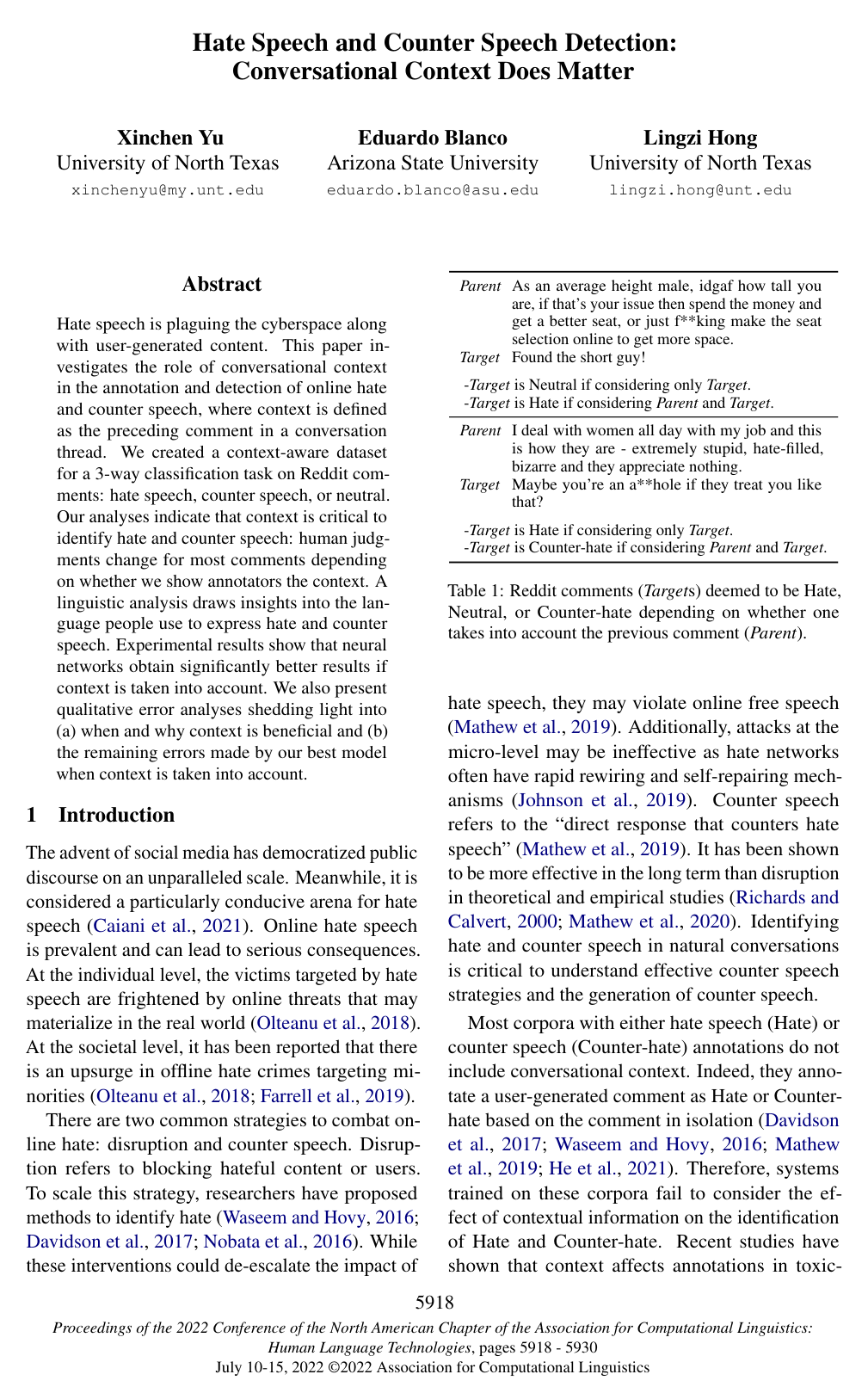
Hate Speech and Counter Speech Detection: Conversational Context Does Matter
Xinchen Yu, Eduardo Blanco, Lingzi Hong
Why you should read this
Presents a context-aware dataset of Reddit comments to demonstrate that incorporating conversational history substantially alters human annotations and significantly boosts neural network performance when detecting hate speech and counter speech.
Hate speech is plaguing the cyberspace along with user-generated content. This paper investigates the role of conversational context in the annotation and detection of online hate and counter speech, where context is defined as the preceding comment in a conversation thread. We created a context-aware dataset for a 3-way classification task on Reddit comments: hate speech, counter speech, or neutral. Our analyses indicate that context is critical to identify hate and counter speech: human judgments change for most comments depending on whether we show annotators the context. A linguistic analysis draws insights into the language people use to express hate and counter speech. Experimental results show that neural networks obtain significantly better results if context is taken into account. We also present qualitative error analyses shedding light into (a) when and why context is beneficial and (b) the remaining errors made by our best model when context is taken into account.
Added
2026-09-26
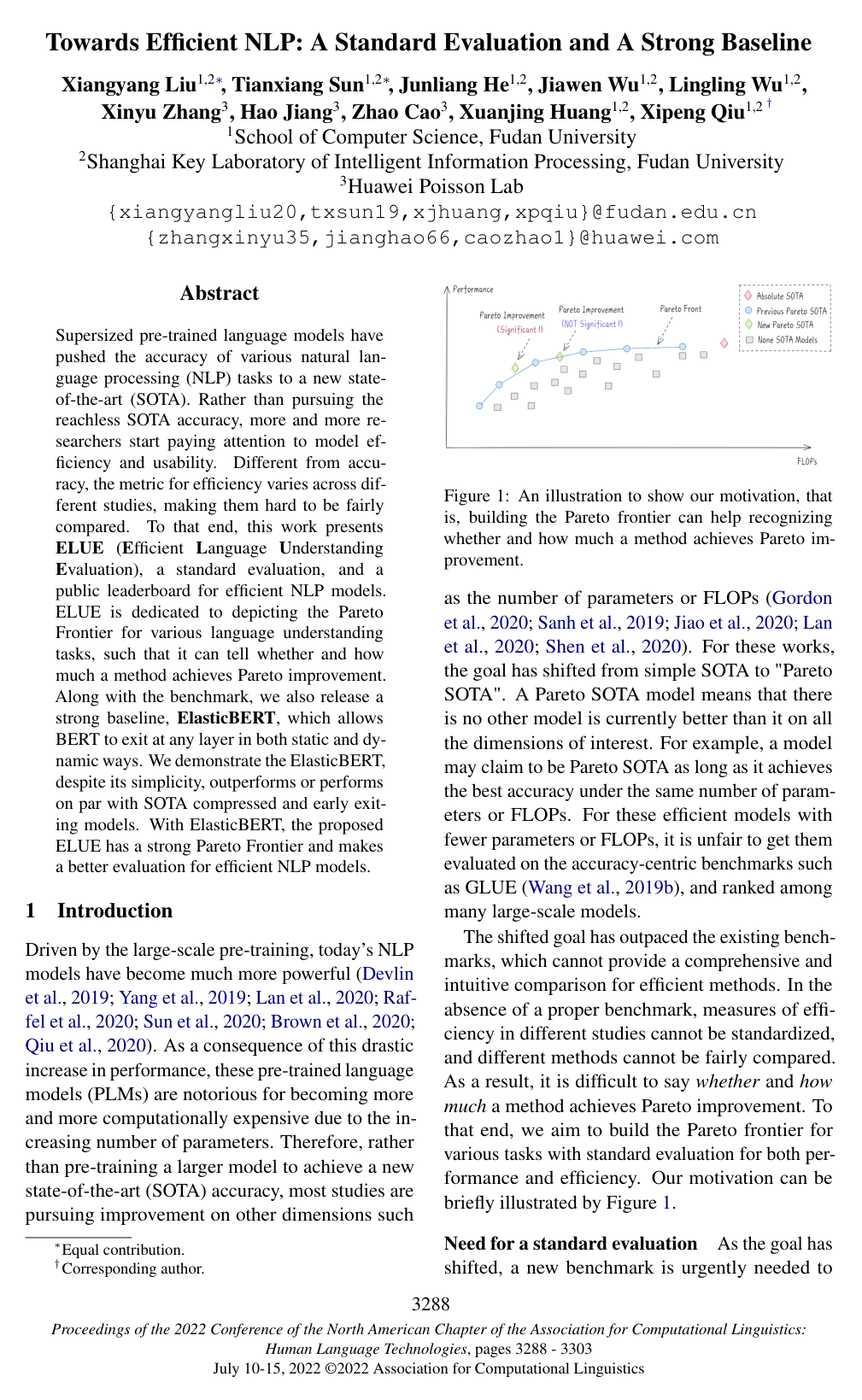
Towards Efficient NLP: A Standard Evaluation and A Strong Baseline
Xiangyang Liu, Tianxiang Sun, Junliang He, Jiawen Wu, Lingling Wu, Xinyu Zhang, Hao Jiang, Zhao Cao, Xuanjing Huang, Xipeng Qiu
Why you should read this
Establishes ELUE, a standardized evaluation benchmark with a public leaderboard to measure Pareto improvements across accuracy and computational cost, while introducing ElasticBERT as a strong baseline capable of both static and dynamic early exiting across any layer.
Supersized pre-trained language models have pushed the accuracy of various natural language processing (NLP) tasks to a new state-of-the-art (SOTA). Rather than pursuing the reachless SOTA accuracy, more and more researchers start paying attention to model efficiency and usability. Different from accuracy, the metric for efficiency varies across different studies, making them hard to be fairly compared. To that end, this work presents ELUE (Efficient Language Understanding Evaluation), a standard evaluation, and a public leaderboard for efficient NLP models. ELUE is dedicated to depicting the Pareto Frontier for various language understanding tasks, such that it can tell whether and how much a method achieves Pareto improvement. Along with the benchmark, we also release a strong baseline, ElasticBERT, which allows BERT to exit at any layer in both static and dynamic ways. We demonstrate the ElasticBERT, despite its simplicity, outperforms or performs on par with SOTA compressed and early exiting models. With ElasticBERT, the proposed ELUE has a strong Pareto Frontier and makes a better evaluation for efficient NLP models.
Added
2026-09-26
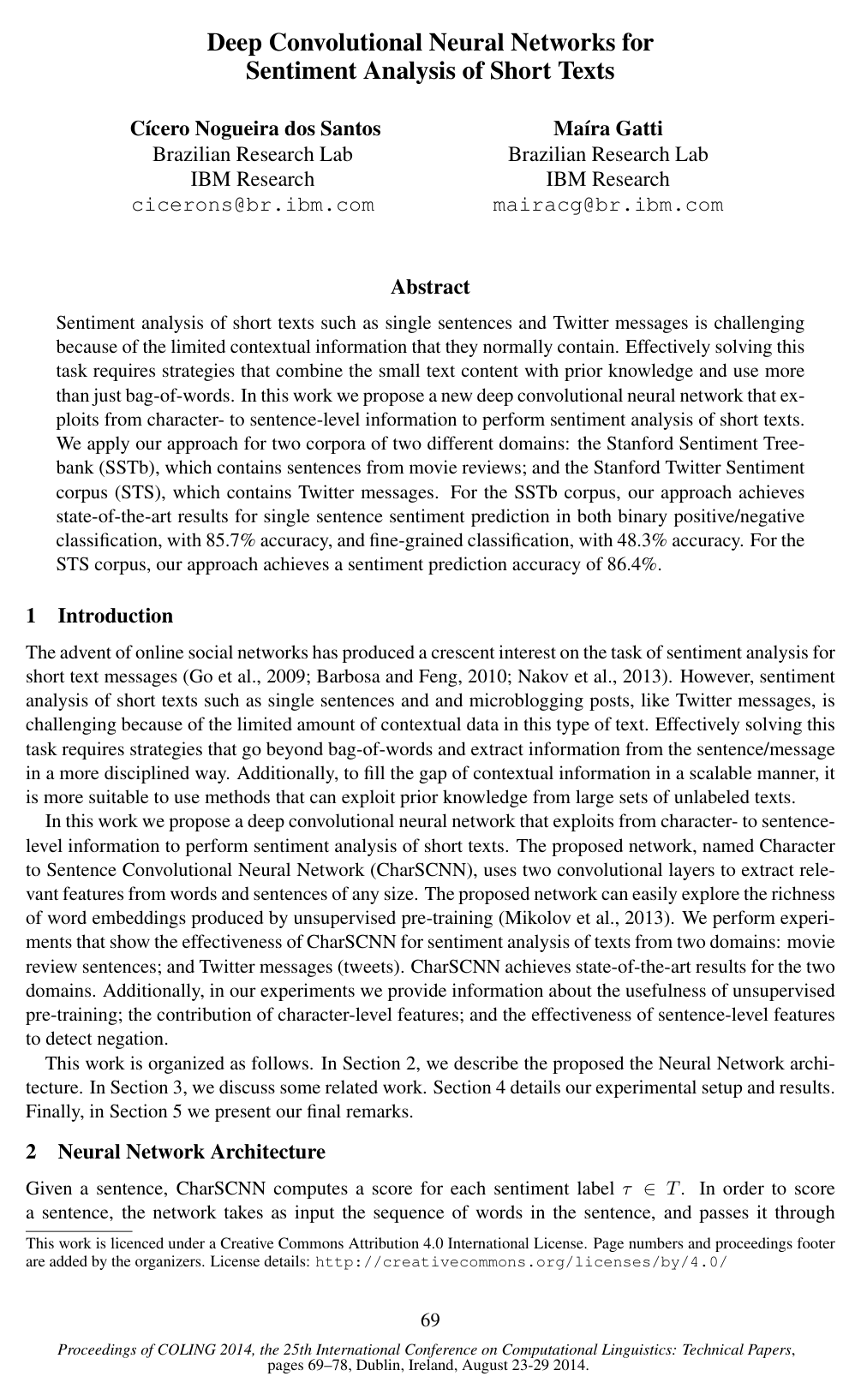
Deep Convolutional Neural Networks for Sentiment Analysis of Short Texts
Cícero Nogueira dos Santos, Maíra Gatti
Why you should read this
Proposes CharSCNN, a deep convolutional neural network that jointly extracts character- and sentence-level representations to improve sentiment classification performance on short texts across movie review and Twitter benchmarks.
Sentiment analysis of short texts such as single sentences and Twitter messages is challenging because of the limited contextual information that they normally contain. Effectively solving this task requires strategies that combine the small text content with prior knowledge and use more than just bag-of-words. In this work we propose a new deep convolutional neural network that exploits from character- to sentence-level information to perform sentiment analysis of short texts. We apply our approach for two corpora of two different domains: the Stanford Sentiment Treebank (SSTb), which contains sentences from movie reviews; and the Stanford Twitter Sentiment corpus (STS), which contains Twitter messages. For the SSTb corpus, our approach achieves state-of-the-art results for single sentence sentiment prediction in both binary positive/negative classification, with 85.7% accuracy, and fine-grained classification, with 48.3% accuracy. For the STS corpus, our approach achieves a sentiment prediction accuracy of 86.4%.
Added
2026-09-25
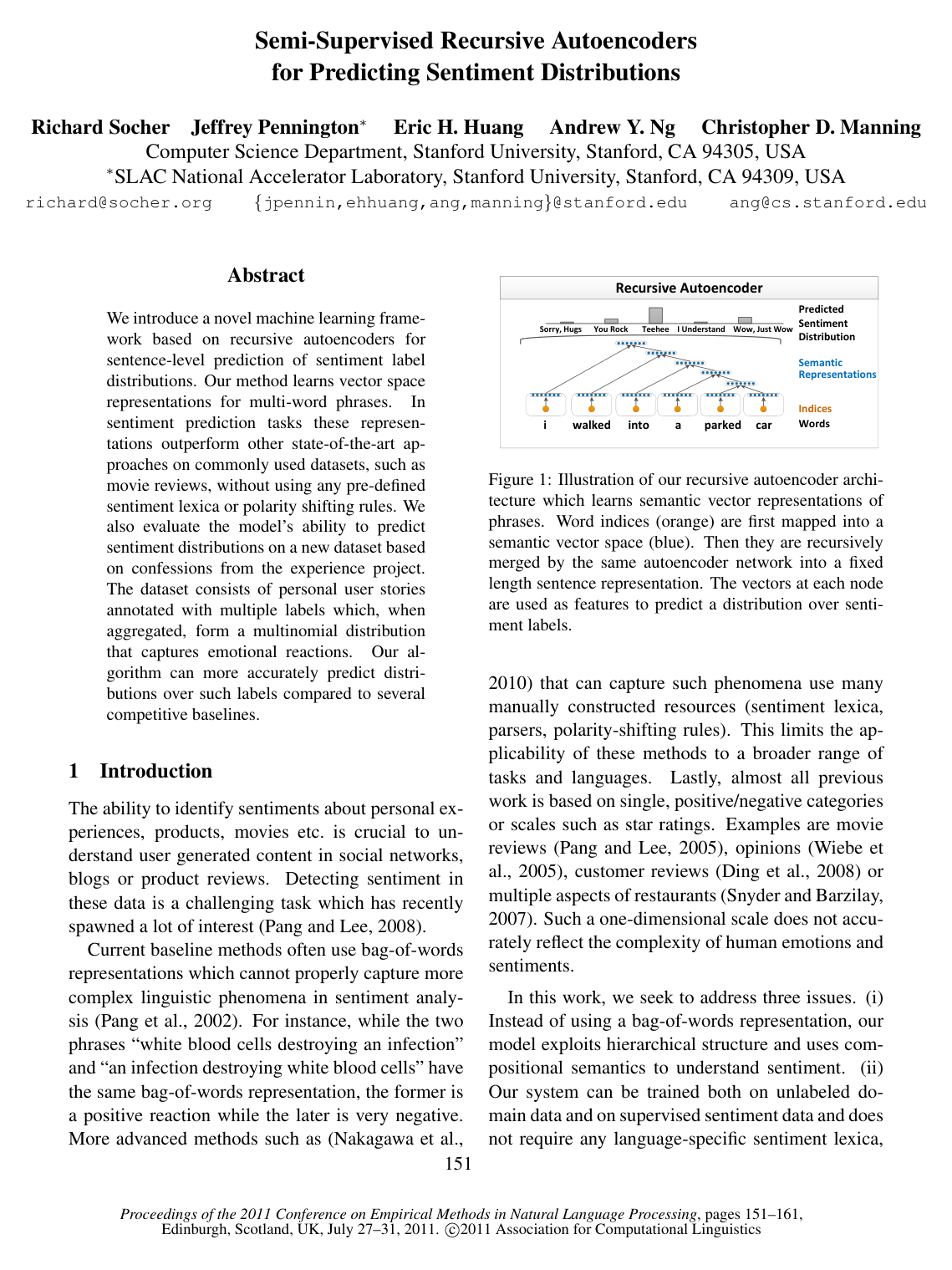
Semi-Supervised Recursive Autoencoders for Predicting Sentiment Distributions
Richard Socher, Jeffrey Pennington, Eric H. Huang, Andrew Y. Ng, Christopher D. Manning
Why you should read this
Proposes semi-supervised recursive autoencoders that learn hierarchical vector representations of variable-length phrases directly from text to predict complex multi-label sentiment distributions without relying on handcrafted lexicons or parsers.
We introduce a novel machine learning framework based on recursive autoencoders for sentence-level prediction of sentiment label distributions. Our method learns vector space representations for multi-word phrases. In sentiment prediction tasks these representations outperform other state-of-the-art approaches on commonly used datasets, such as movie reviews, without using any pre-defined sentiment lexica or polarity shifting rules. We also evaluate the model's ability to predict sentiment distributions on a new dataset based on confessions from the experience project. The dataset consists of personal user stories annotated with multiple labels which, when aggregated, form a multinomial distribution that captures emotional reactions. Our algorithm can more accurately predict distributions over such labels compared to several competitive baselines.
Added
2026-09-25
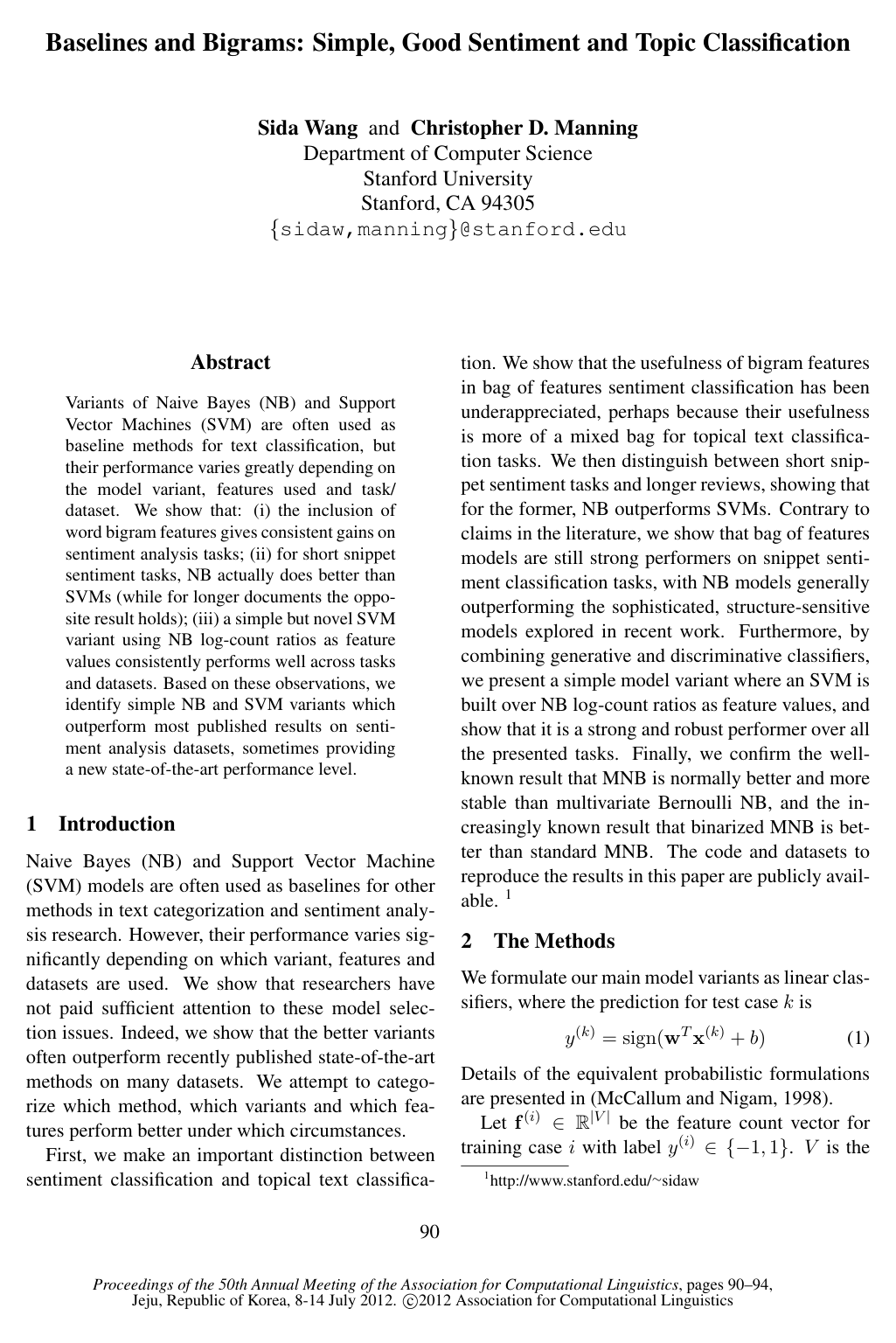
Baselines and Bigrams: Simple, Good Sentiment and Topic Classification
Sida I. Wang, Christopher D. Manning
Why you should read this
Demonstrates that simple Naive Bayes and Support Vector Machine baselines with word bigrams—particularly the hybrid NBSVM model—can outperform complex, structure-sensitive methods across standard sentiment and topic classification benchmarks.
Variants of Naive Bayes (NB) and Support Vector Machines (SVM) are often used as baseline methods for text classification, but their performance varies greatly depending on the model variant, features used and task/dataset. We show that: (i) the inclusion of word bigram features gives consistent gains on sentiment analysis tasks; (ii) for short snippet sentiment tasks, NB actually does better than SVMs (while for longer documents the opposite result holds); (iii) a simple but novel SVM variant using NB log-count ratios as feature values consistently performs well across tasks and datasets. Based on these observations, we identify simple NB and SVM variants which outperform most published results on sentiment analysis datasets, sometimes providing a new state-of-the-art performance level.
Added
2026-09-25
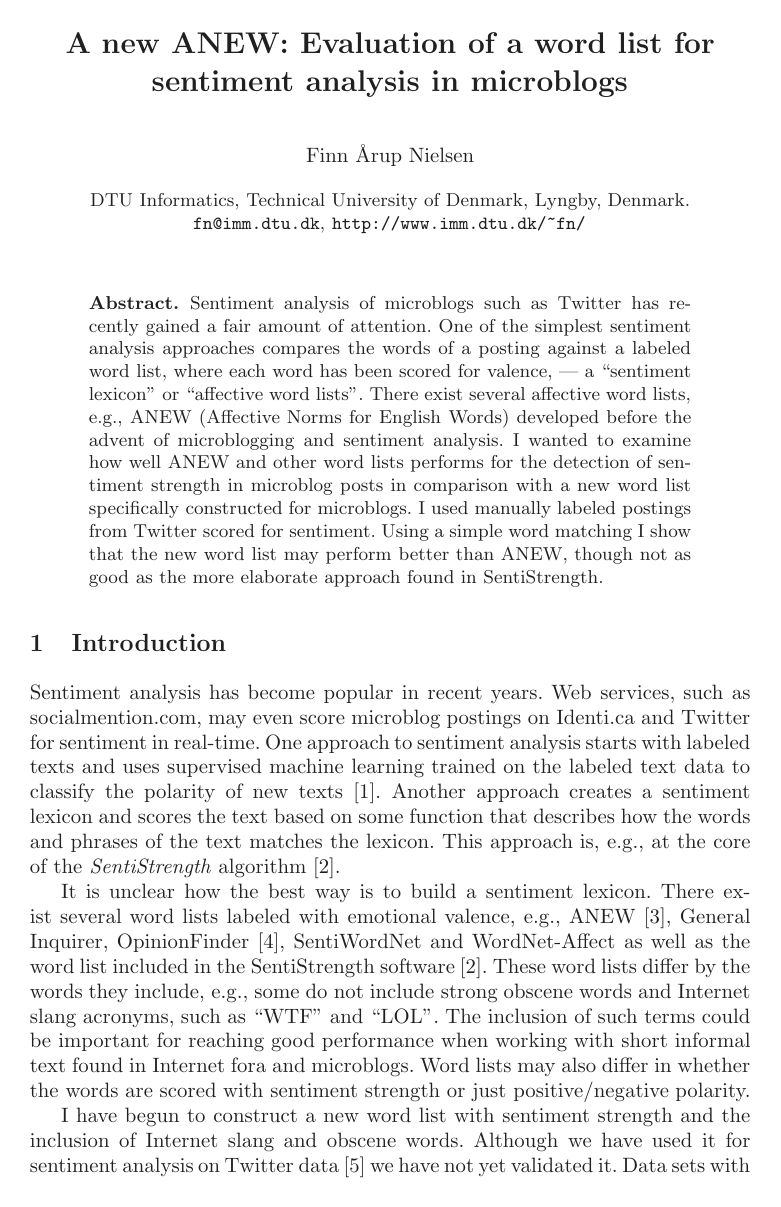
A New ANEW: Evaluation of a Word List for Sentiment Analysis in Microblogs
Finn Årup Nielsen
Why you should read this
Presents a sentiment lexicon specifically designed for microblogs, demonstrating that adapting affective word lists to informal Twitter text improves valence scoring compared to traditional resources like ANEW.
Sentiment analysis of microblogs such as Twitter has recently gained a fair amount of attention. One of the simplest sentiment analysis approaches compares the words of a posting against a labeled word list, where each word has been scored for valence, -- a 'sentiment lexicon' or 'affective word lists'. There exist several affective word lists, e.g., ANEW (Affective Norms for English Words) developed before the advent of microblogging and sentiment analysis. I wanted to examine how well ANEW and other word lists performs for the detection of sentiment strength in microblog posts in comparison with a new word list specifically constructed for microblogs. I used manually labeled postings from Twitter scored for sentiment. Using a simple word matching I show that the new word list may perform better than ANEW, though not as good as the more elaborate approach found in SentiStrength.
Added
2026-09-25
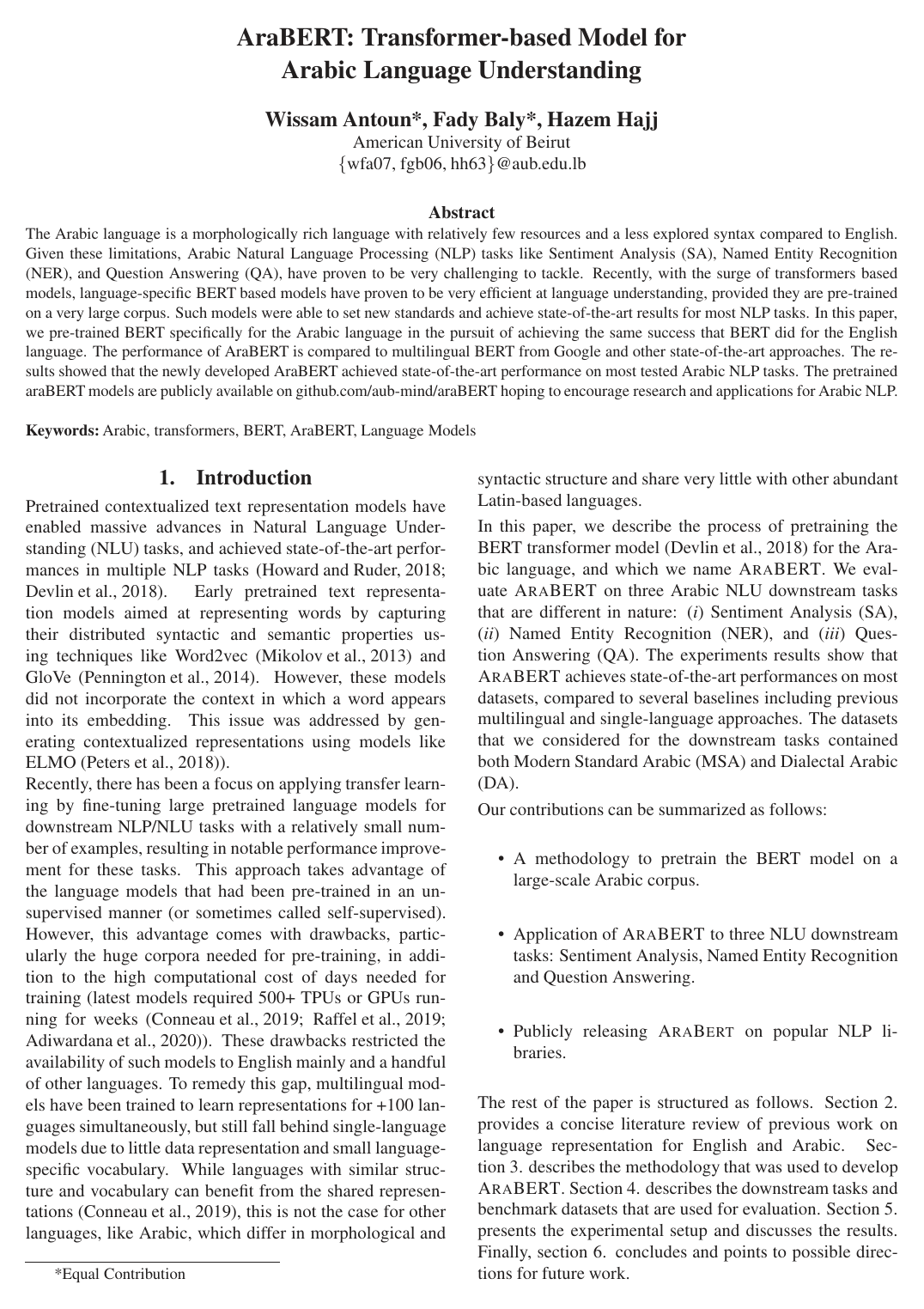
AraBERT: Transformer-based Model for Arabic Language Understanding
Wissam Antoun, Fady Baly, Hazem M. Hajj
Why you should read this
Introduces AraBERT, an Arabic-specific transformer model pretrained on large-scale text that outperforms multilingual BERT across sentiment analysis, named entity recognition, and question answering benchmarks.
The Arabic language is a morphologically rich language with relatively few resources and a less explored syntax compared to English. Given these limitations, Arabic Natural Language Processing (NLP) tasks like Sentiment Analysis (SA), Named Entity Recognition (NER), and Question Answering (QA), have proven to be very challenging to tackle. Recently, with the surge of transformers based models, language-specific BERT based models have proven to be very efficient at language understanding, provided they are pre-trained on a very large corpus. Such models were able to set new standards and achieve state-of-the-art results for most NLP tasks. In this paper, we pre-trained BERT specifically for the Arabic language in the pursuit of achieving the same success that BERT did for the English language. The performance of AraBERT is compared to multilingual BERT from Google and other state-of-the-art approaches. The results showed that the newly developed AraBERT achieved state-of-the-art performance on most tested Arabic NLP tasks. The pretrained araBERT models are publicly available on this https URL hoping to encourage research and applications for Arabic NLP.
Added
2026-09-25
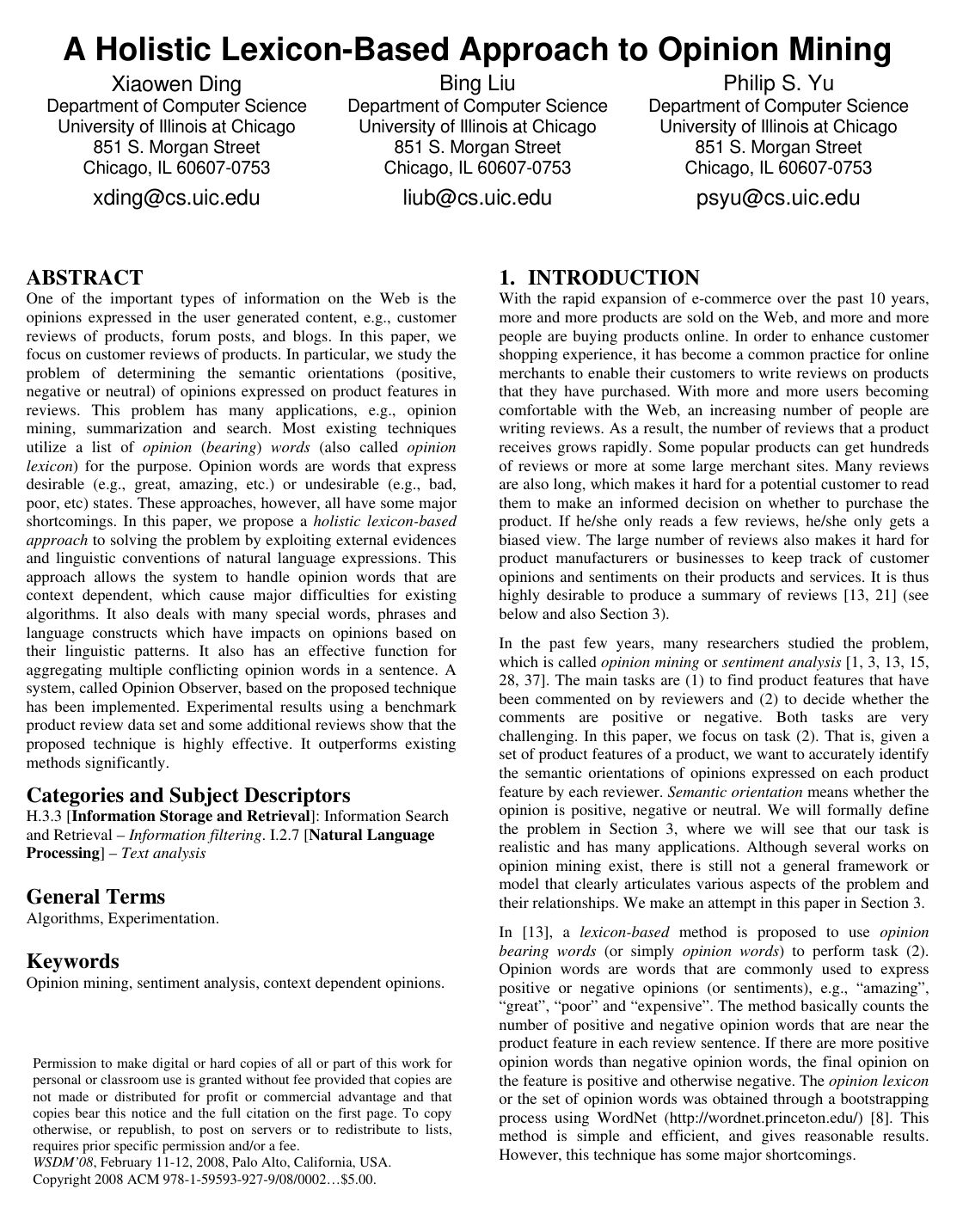
A holistic lexicon-based approach to opinion mining
Xiaowen Ding, B. Liu, Philip S. Yu
Why you should read this
Proposes a holistic lexicon-based framework that accurately identifies feature-level sentiment in customer reviews by resolving context-dependent opinion words and aggregating conflicting sentiment expressions through linguistic conventions and external evidence.
One of the important types of information on the Web is the opinions expressed in the user generated content, e.g., customer reviews of products, forum posts, and blogs. In this paper, we focus on customer reviews of products. In particular, we study the problem of determining the semantic orientations (positive, negative or neutral) of opinions expressed on product features in reviews. This problem has many applications, e.g., opinion mining, summarization and search. Most existing techniques utilize a list of opinion (bearing) words (also called opinion lexicon) for the purpose. Opinion words are words that express desirable (e.g., great, amazing, etc.) or undesirable (e.g., bad, poor, etc) states. These approaches, however, all have some major shortcomings. In this paper, we propose a holistic lexicon-based approach to solving the problem by exploiting external evidences and linguistic conventions of natural language expressions. This approach allows the system to handle opinion words that are context dependent, which cause major difficulties for existing algorithms. It also deals with many special words, phrases and language constructs which have impacts on opinions based on their linguistic patterns. It also has an effective function for aggregating multiple conflicting opinion words in a sentence. A system, called Opinion Observer, based on the proposed technique has been implemented. Experimental results using a benchmark product review data set and some additional reviews show that the proposed technique is highly effective. It outperforms existing methods significantly.
Added
2026-09-24
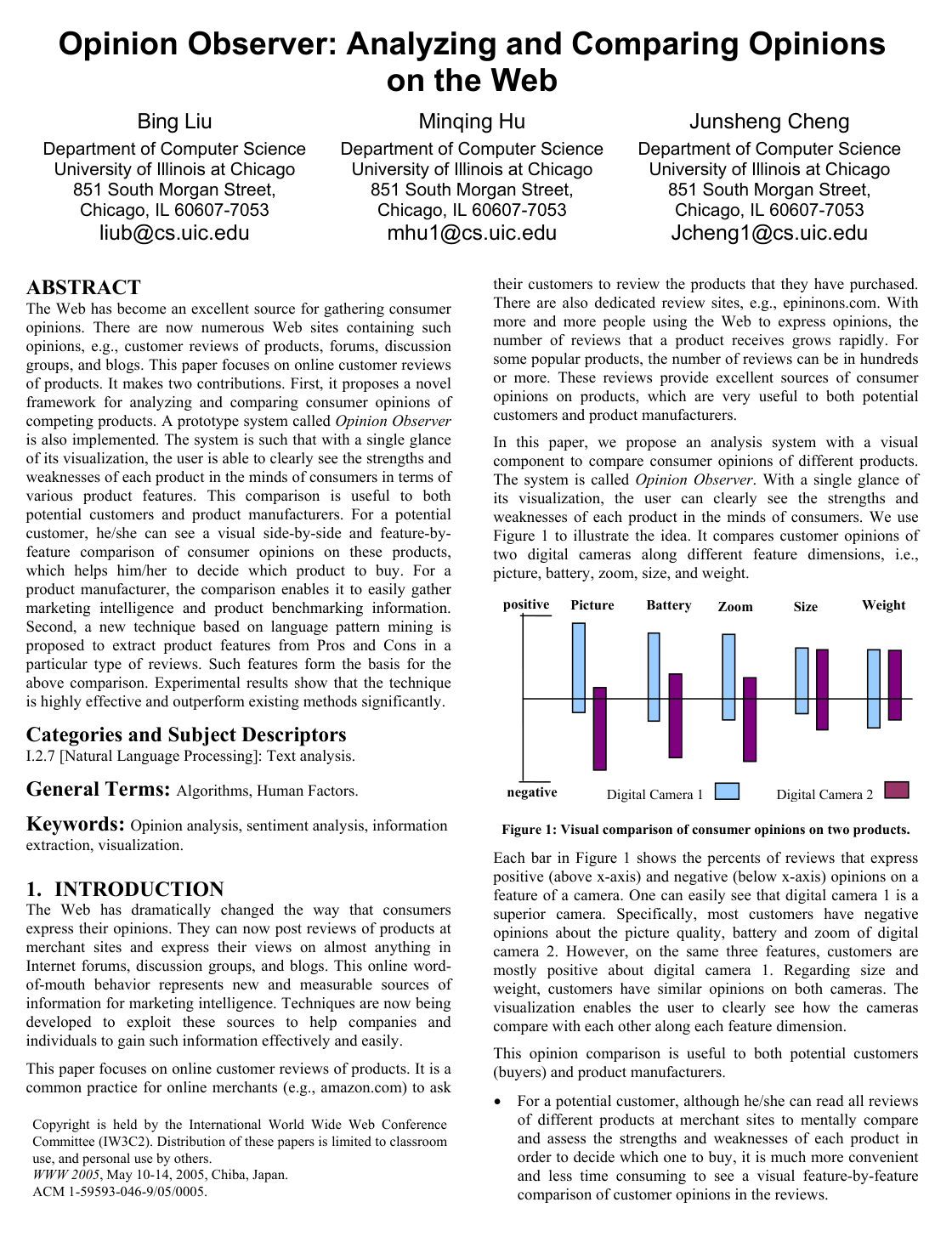
Opinion observer: analyzing and comparing opinions on the Web
Bing Liu, Minqing Hu, Junsheng Cheng
Why you should read this
Presents Opinion Observer, a framework that mines product features from customer reviews using supervised language pattern mining and visually compares consumer sentiments across competing products feature by feature.
The Web has become an excellent source for gathering consumer opinions. There are now numerous Web sites containing such opinions, e.g., customer reviews of products, forums, discussion groups, and blogs. This paper focuses on online customer reviews of products. It makes two contributions. First, it proposes a novel framework for analyzing and comparing consumer opinions of competing products. A prototype system called Opinion Observer is also implemented. The system is such that with a single glance of its visualization, the user is able to clearly see the strengths and weaknesses of each product in the minds of consumers in terms of various product features. This comparison is useful to both potential customers and product manufacturers. For a potential customer, he/she can see a visual side-by-side and feature-by-feature comparison of consumer opinions on these products, which helps him/her to decide which product to buy. For a product manufacturer, the comparison enables it to easily gather marketing intelligence and product benchmarking information. Second, a new technique based on language pattern mining is proposed to extract product features from Pros and Cons in a particular type of reviews. Such features form the basis for the above comparison. Experimental results show that the technique is highly effective and outperform existing methods significantly.
Added
2026-09-18
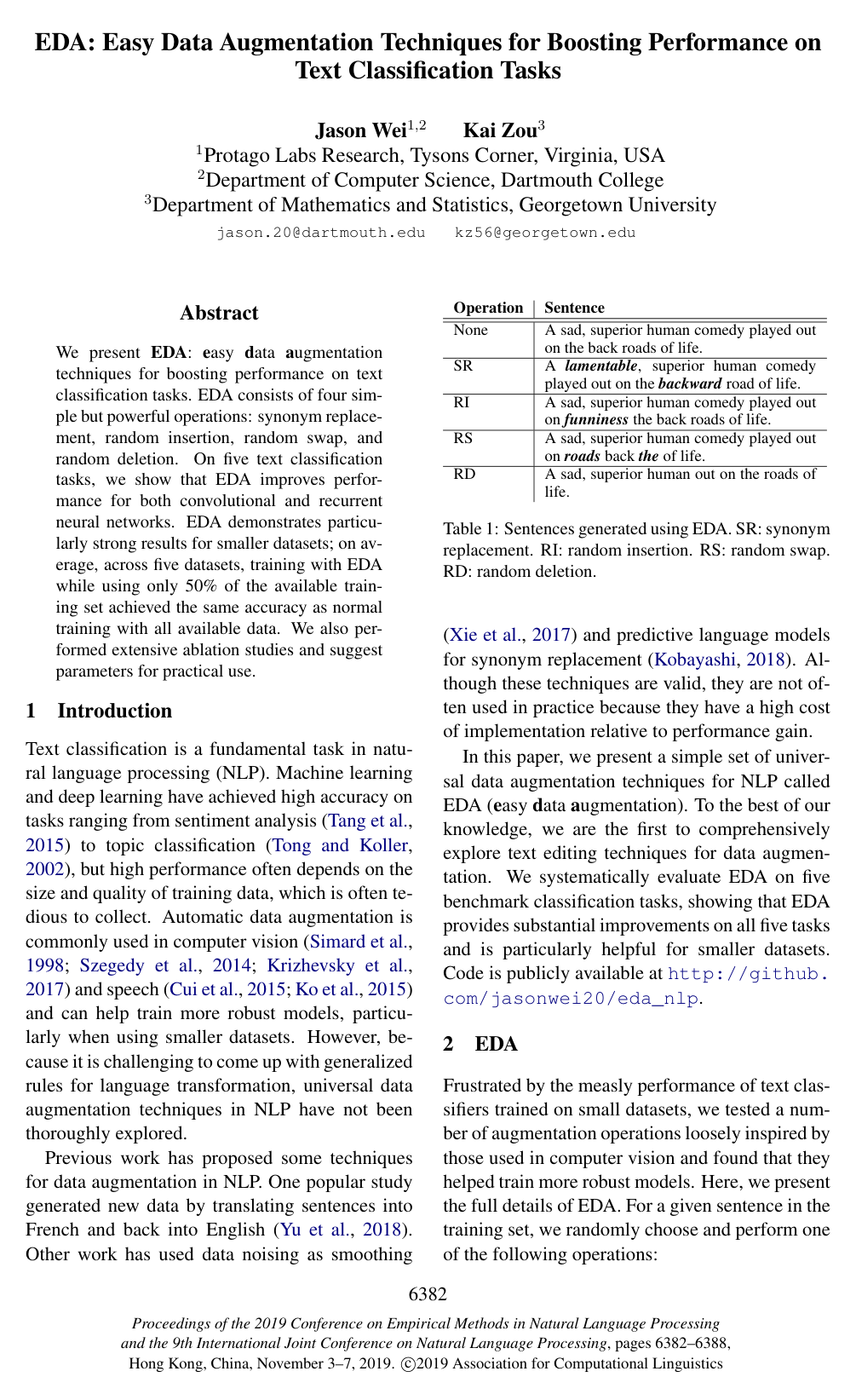
EDA: Easy Data Augmentation Techniques for Boosting Performance on Text Classification Tasks
Jason Wei, Kai Zou
Why you should read this
Proposes four simple text data augmentation techniques—synonym replacement, random insertion, random swap, and random deletion—that improve classification performance and allow models trained on half the data to match full-dataset accuracy.
We present EDA: easy data augmentation techniques for boosting performance on text classification tasks. EDA consists of four simple but powerful operations: synonym replacement, random insertion, random swap, and random deletion. On five text classification tasks, we show that EDA improves performance for both convolutional and recurrent neural networks. EDA demonstrates particularly strong results for smaller datasets; on average, across five datasets, training with EDA while using only 50% of the available training set achieved the same accuracy as normal training with all available data. We also performed extensive ablation studies and suggest parameters for practical use.
Added
2026-09-14
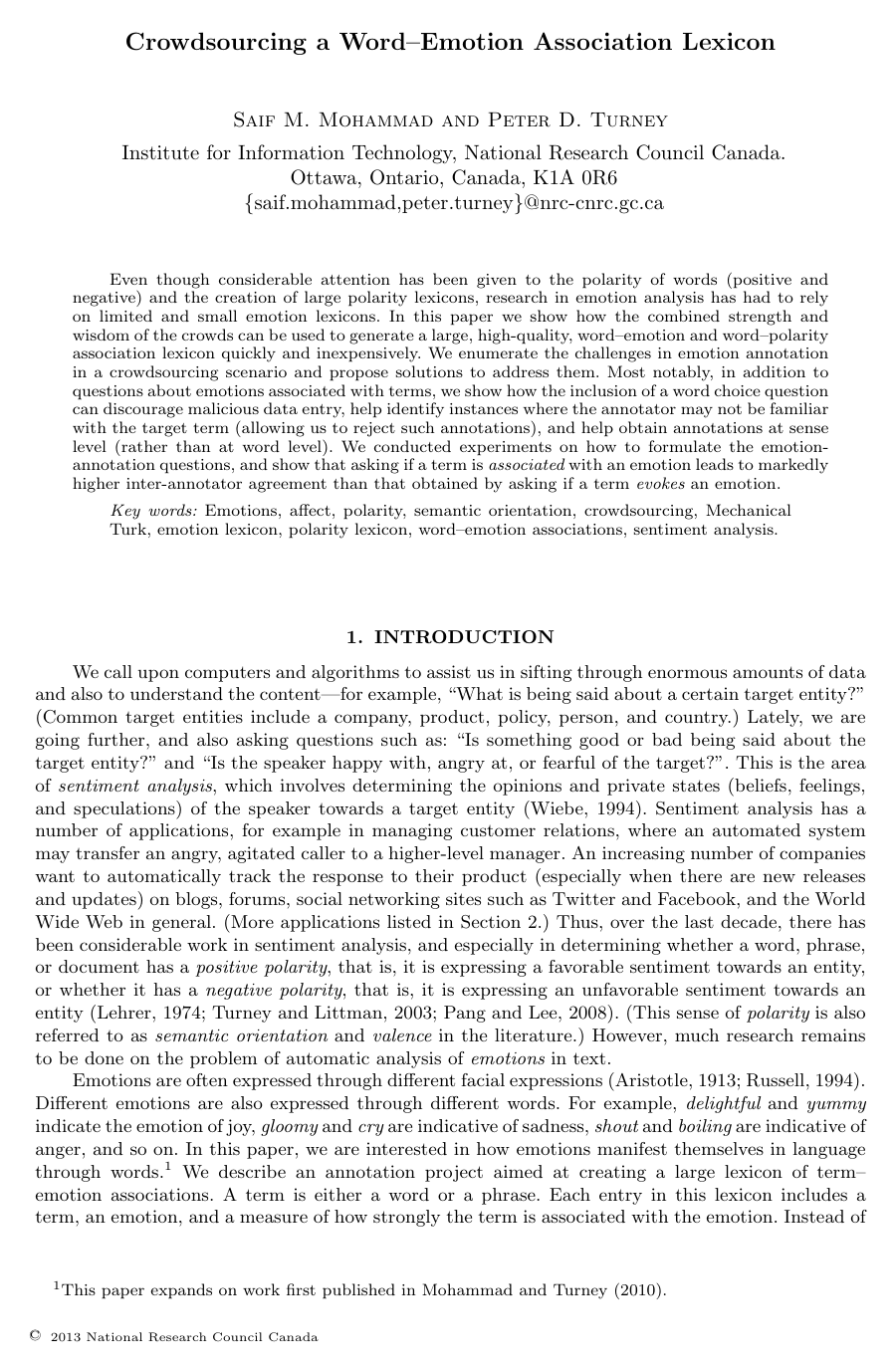
CROWDSOURCING A WORD–EMOTION ASSOCIATION LEXICON
Saif M. Mohammad, Peter D. Turney
Why you should read this
Presents a practical crowdsourcing methodology for constructing large-scale word-emotion lexicons, proving that sense-verification questions and association-based framing substantially increase annotation quality and inter-annotator agreement.
Even though considerable attention has been given to the polarity of words (positive and negative) and the creation of large polarity lexicons, research in emotion analysis has had to rely on limited and small emotion lexicons. In this paper we show how the combined strength and wisdom of the crowds can be used to generate a large, high-quality, word-emotion and word-polarity association lexicon quickly and inexpensively. We enumerate the challenges in emotion annotation in a crowdsourcing scenario and propose solutions to address them. Most notably, in addition to questions about emotions associated with terms, we show how the inclusion of a word choice question can discourage malicious data entry, help identify instances where the annotator may not be familiar with the target term (allowing us to reject such annotations), and help obtain annotations at sense level (rather than at word level). We conducted experiments on how to formulate the emotion-annotation questions, and show that asking if a term is associated with an emotion leads to markedly higher inter-annotator agreement than that obtained by asking if a term evokes an emotion.
Added
2026-09-14
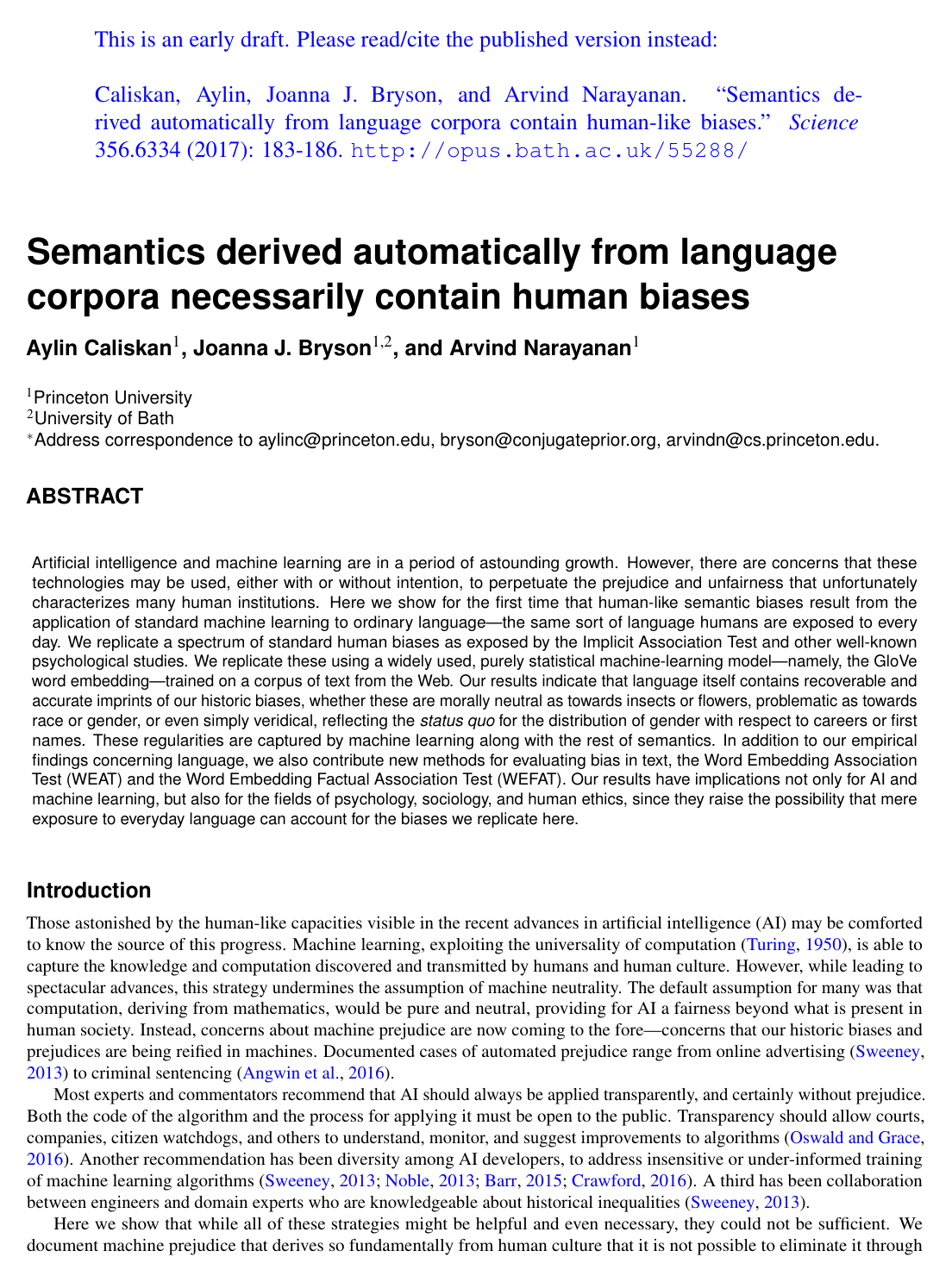
Semantics derived automatically from language corpora contain human-like biases
Aylin Caliskan, Joanna J. Bryson, Arvind Narayanan
Why you should read this
Establishes that standard word embeddings automatically acquire human racial, gender, and social prejudices from ordinary text, introducing the Word Embedding Association Test to measure implicit bias in machine learning models.
Artificial intelligence and machine learning are in a period of astounding growth. However, there are concerns that these technologies may be used, either with or without intention, to perpetuate the prejudice and unfairness that unfortunately characterizes many human institutions. Here we show for the first time that human-like semantic biases result from the application of standard machine learning to ordinary language---the same sort of language humans are exposed to every day. We replicate a spectrum of standard human biases as exposed by the Implicit Association Test and other well-known psychological studies. We replicate these using a widely used, purely statistical machine-learning model---namely, the GloVe word embedding---trained on a corpus of text from the Web. Our results indicate that language itself contains recoverable and accurate imprints of our historic biases, whether these are morally neutral as towards insects or flowers, problematic as towards race or gender, or even simply veridical, reflecting the {\em status quo} for the distribution of gender with respect to careers or first names. These regularities are captured by machine learning along with the rest of semantics. In addition to our empirical findings concerning language, we also contribute new methods for evaluating bias in text, the Word Embedding Association Test (WEAT) and the Word Embedding Factual Association Test (WEFAT). Our results have implications not only for AI and machine learning, but also for the fields of psychology, sociology, and human ethics, since they raise the possibility that mere exposure to everyday language can account for the biases we replicate here.
Added
2026-09-12
A Sentimental Education: Sentiment Analysis Using Subjectivity Summarization Based on Minimum Cuts
Bo Pang, Lillian Lee
Why you should read this
Proposes a graph min-cut method to isolate subjective sentences using cross-sentence contextual constraints, significantly improving document-level sentiment classification.
Sentiment analysis seeks to identify the viewpoint(s) underlying a text span; an example application is classifying a movie review as "thumbs up" or "thumbs down". To determine this sentiment polarity, we propose a novel machine-learning method that applies text-categorization techniques to just the subjective portions of the document. Extracting these portions can be implemented using efficient techniques for finding minimum cuts in graphs; this greatly facilitates incorporation of cross-sentence contextual constraints.
Added
2026-09-11
Bag of Tricks for Efficient Text Classification
Armand Joulin, Edouard Grave, Piotr Bojanowski, Tomas Mikolov
Why you should read this
Presents fastText, a lightweight linear model that matches the accuracy of deep neural networks on text classification benchmarks while training orders of magnitude faster on standard CPU hardware.
This paper explores a simple and efficient baseline for text classification. Our experiments show that our fast text classifier fastText is often on par with deep learning classifiers in terms of accuracy, and many orders of magnitude faster for training and evaluation. We can train fastText on more than one billion words in less than ten minutes using a standard multicore~CPU, and classify half a million sentences among~312K classes in less than a minute.
Added
2026-09-10

Learning Word Vectors for Sentiment Analysis
Andrew L. Maas, Raymond E. Daly, Peter T. Pham, Dan Huang, Andrew Y. Ng, Christopher Potts
Why you should read this
Proposes a semi-supervised framework for learning word vectors that capture both semantic meaning and sentiment polarity, while establishing the widely used IMDb movie review dataset for sentiment classification.
Unsupervised vector-based approaches to semantics can model rich lexical meanings, but they largely fail to capture sentiment information that is central to many word meanings and important for a wide range of NLP tasks. We present a model that uses a mix of unsupervised and supervised techniques to learn word vectors capturing semantic term–document information as well as rich sentiment content. The proposed model can leverage both continuous and multi-dimensional sentiment information as well as non-sentiment annotations. We instantiate the model to utilize the document-level sentiment polarity annotations present in many online documents (e.g. star ratings). We evaluate the model using small, widely used sentiment and subjectivity corpora and find it out-performs several previously introduced methods for sentiment classification. We also introduce a large dataset of movie reviews to serve as a more robust benchmark for work in this area.
Added
2026-09-09
The Stanford CoreNLP Natural Language Processing Toolkit
Christopher D. Manning, Mihai Surdeanu, John Bauer, Jenny Finkel, Steven J. Bethard, David McClosky
Why you should read this
Presents the architecture and design of Stanford CoreNLP, a unified and extensible pipeline that integrates essential linguistic analysis components to support both academic research and large-scale text processing applications.
We describe the design and use of the Stanford CoreNLP toolkit, an extensible pipeline that provides core natural language analysis. This toolkit is quite widely used, both in the research NLP community and also among commercial and government users of open source NLP technology. We suggest that this follows from a simple, approachable design, straightforward interfaces, the inclusion of robust and good quality analysis components, and not requiring use of a large amount of associated baggage.
Added
2026-09-08
Distributed Representations of Sentences and Documents
Quoc V. Le, Tomas Mikolov
Why you should read this
Introduces Paragraph Vector, an unsupervised framework that extends word embeddings to entire sentences and documents, capturing semantic context and word order to outperform traditional bag-of-words models across text classification and sentiment analysis benchmarks.
Many machine learning algorithms require the input to be represented as a fixed-length feature vector. When it comes to texts, one of the most common fixed-length features is bag-of-words. Despite their popularity, bag-of-words features have two major weaknesses: they lose the ordering of the words and they also ignore semantics of the words. For example, "powerful," "strong" and "Paris" are equally distant. In this paper, we propose Paragraph Vector, an unsupervised algorithm that learns fixed-length feature representations from variable-length pieces of texts, such as sentences, paragraphs, and documents. Our algorithm represents each document by a dense vector which is trained to predict words in the document. Its construction gives our algorithm the potential to overcome the weaknesses of bag-of-words models. Empirical results show that Paragraph Vectors outperform bag-of-words models as well as other techniques for text representations. Finally, we achieve new state-of-the-art results on several text classification and sentiment analysis tasks.
Added
2026-09-07
License
Published with permission
Recursive Deep Models for Semantic Compositionality Over a Sentiment Treebank
Richard Socher, Alex Perelygin, Jean Wu, Jason Chuang, Christopher D. Manning, Andrew Y. Ng, Christopher Potts
Why you should read this
Introduces the Stanford Sentiment Treebank and Recursive Neural Tensor Networks, establishing a framework to accurately model phrase-level semantic compositionality and negation scope across parse trees.
Semantic word spaces have been very useful but cannot express the meaning of longer phrases in a principled way. Further progress towards understanding compositionality in tasks such as sentiment detection requires richer supervised training and evaluation resources and more powerful models of composition. To remedy this, we introduce a Sentiment Treebank. It includes fine grained sentiment labels for 215,154 phrases in the parse trees of 11,855 sentences and presents new challenges for sentiment compositionality. To address them, we introduce the Recursive Neural Tensor Network. When trained on the new treebank, this model outperforms all previous methods on several metrics. It pushes the state of the art in single sentence positive/negative classification from 80% up to 85.4%. The accuracy of predicting fine-grained sentiment labels for all phrases reaches 80.7%, an improvement of 9.7% over bag of features baselines. Lastly, it is the only model that can accurately capture the effects of negation and its scope at various tree levels for both positive and negative phrases.
Added
2026-09-07
Convolutional Neural Networks for Sentence Classification
Yoon Kim
Why you should read this
Demonstrates that simple convolutional neural networks trained on pre-trained word vectors achieve state-of-the-art accuracy across multiple standard sentence classification benchmarks with minimal hyperparameter tuning.
We report on a series of experiments with convolutional neural networks (CNN) trained on top of pre-trained word vectors for sentence-level classification tasks. We show that a simple CNN with little hyperparameter tuning and static vectors achieves excellent results on multiple benchmarks. Learning task-specific vectors through fine-tuning offers further gains in performance. We additionally propose a simple modification to the architecture to allow for the use of both task-specific and static vectors. The CNN models discussed herein improve upon the state of the art on 4 out of 7 tasks, which include sentiment analysis and question classification.
Added
2026-09-06