Hate Speech and Counter Speech Detection: Conversational Context Does Matter
Xinchen YuEduardo BlancoLingzi Hong
Presents a context-aware dataset of Reddit comments to demonstrate that incorporating conversational history substantially alters human annotations and significantly boosts neural network performance when detecting hate speech and counter speech.
Online hate speech continues to pose severe threats to individuals and society, often leading to real-world harm and targeted aggression. While platforms frequently combat this issue by blocking hateful users, an increasingly promising long-term strategy is counter speech, which directly challenges and neutralizes hateful rhetoric. Most existing automated content moderation systems evaluate comments in complete isolation. This approach risks misinterpreting user intent because online communication depends heavily on context. The article evaluates whether conversational context—specifically the immediately preceding comment—alters human perception of hate and counter speech, and demonstrates whether incorporating this context improves the accuracy of automated detection models.
To investigate these questions, the authors compiled a dataset of 6,846 English Reddit comment-reply pairs. Human crowd workers annotated these comments under two separate experimental setups: first by viewing the target reply alone, and second by viewing the target alongside its parent comment. Using this annotated benchmark, the authors trained and evaluated language models using a transformer-based neural network architecture. They tested context-unaware configurations against context-aware configurations that ingested both parent and reply texts, while also evaluating performance enhancements such as blending noisy annotations and pretraining on related conversational tasks like stance detection.
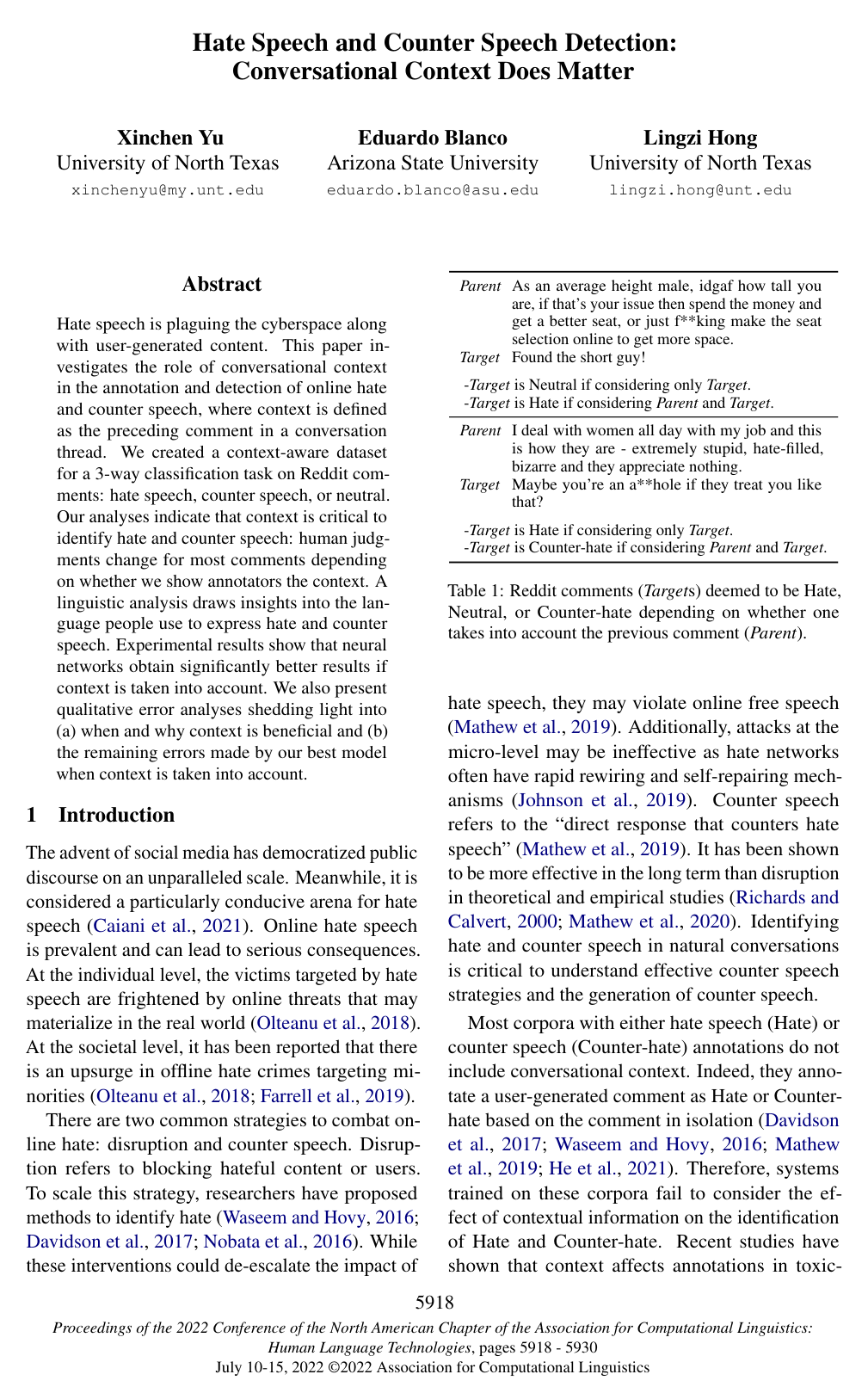
The findings establish that conversational context is essential for accurate classification. First, providing context fundamentally shifts the ground truth, causing human judgment to change for 38.3% of the evaluated comments; specifically, 34.2% of comments seen as hate in isolation and 55.1% seen as counter-hate in isolation shifted to neutral once context was visible. Second, context-aware machine learning models consistently outperformed isolated text models across all evaluation categories, achieving the highest overall performance score of 0.64 when combined with stance pretraining and data blending, compared to 0.58 for basic isolated models. Third, linguistic analysis revealed distinct contextual cues: counter speech frequently relies on question marks and problem-solving language, whereas hate speech concentrates high profanity directly within the reply. Finally, error analysis showed that incorporating context resolves major failure modes in automated systems, fixing 48% of errors caused by a lack of standalone information and 19% of errors driven by sarcasm or irony.
These findings have significant implications for platform governance, content moderation costs, and compliance risks. Conventional moderation tools that evaluate posts in isolation risk penalizing legitimate counter speech while failing to catch indirect or sarcastic hate speech. Inaccurate flagging can alienate users, infringe on open discourse, and create regulatory and safety liabilities. By demonstrating that conversation-level understanding significantly enhances detection precision, the article shows that digital safety systems must account for dialogue structure to remain reliable.
Organizations developing or deploying automated moderation tools should transition from single-comment classifiers to context-aware models that incorporate preceding conversational turns. Engineering teams should also leverage stance-detection data during model pretraining, as identifying agreement or disagreement substantially aids in distinguishing hate from counter-interventions. However, decision-makers should recognize existing limitations: the analysis was confined to Reddit discussions, utilized single-level parent context rather than full conversation threads, and relied on keyword-assisted data sampling. Further pilot testing across diverse platforms and expanded dialogue structures is recommended before broad operational rollout.
- Paper: Automated Hate Speech Detection and the Problem of Offensive Language, Thomas Davidson et al. (2017). This foundational paper establishes the multi-class framing and linguistic baseline for separating targeted hate speech from general offensive language in social media.
- Paper: Hateful Symbols or Hateful People? Predictive Features for Hate Speech Detection on Twitter, Zeerak Waseem et al. (2016). It provides the standard annotation guidelines and early predictive modeling methodologies for identifying abusive and hateful content on social platforms.
- Paper: RealToxicityPrompts: Evaluating Neural Toxic Degeneration in Language Models, Samuel Gehman et al. (2020). It benchmarks neural toxic degeneration and highlights how context and prompts systematically induce toxic text generation.
- Paper: Annotation Artifacts in Natural Language Inference Data, Suchin Gururangan et al. (2018). It illustrates how models exploit superficial context-free annotation artifacts, motivating the need for explicit conversational context modeling.
- Paper: Llama Guard: LLM-based Input-Output Safeguard for Human-AI Conversations, Hakan Inan et al. (2023). It extends context-aware hate and safety classification into a deployable, instruction-tuned safeguard framework designed specifically for conversational human-AI interactions.
- Paper: From Pretraining Data to Language Models to Downstream Tasks: Tracking the Trails of Political Biases Leading to Unfair NLP Models, Shangbin Feng et al. (2023). It investigates how underlying social and political biases in language models propagate to create unfair performance disparities in downstream hate speech detection.
- Paper: ChatGPT outperforms crowd workers for text-annotation tasks, Fabrizio Gilardi et al. (2023). It explores how modern large language models perform against human crowd workers in complex text annotation tasks like stance and frame detection.