
keyword
abusive language
Abusive language is any form of communication that employs hurtful, derogatory, insulting, or threatening expression intended to demean, harass, or harm individuals or groups. In computational linguistics and online content moderation, it serves as an overarching concept that encompasses several specific subcategories of harmful communication, including hate speech aimed at protected identity characteristics such as race, gender, religion, or sexual orientation, as well as cyberbullying, personal attacks, and aggressive profanity. Because abusive communication often manifests through subtle or implicit forms, such as sarcasm, veiled hostility, or coded phrases, its identification relies heavily on interpreting the broader conversational context, pragmatic meaning, and social dynamics rather than solely relying on explicit keywords.
3 items
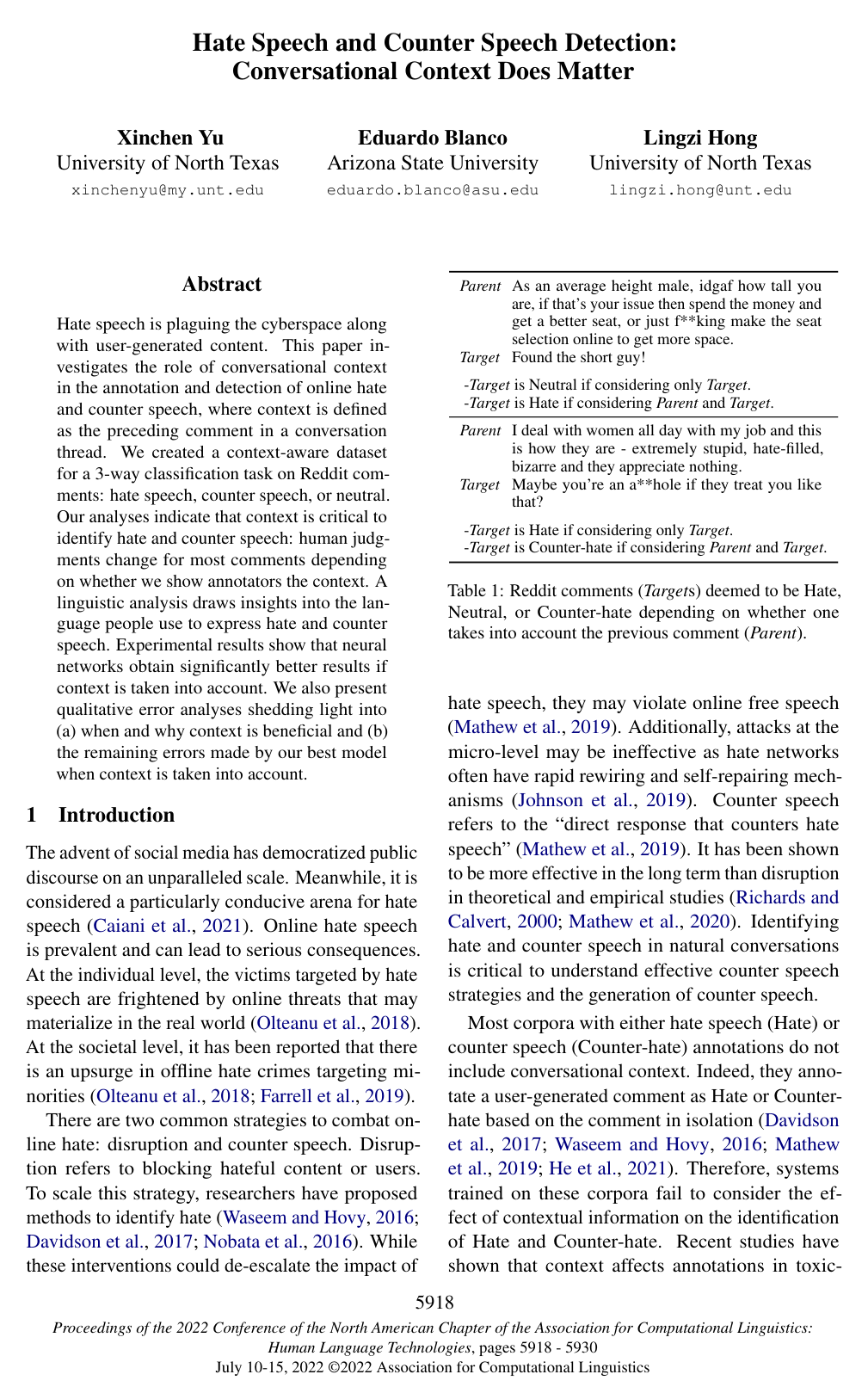
Hate Speech and Counter Speech Detection: Conversational Context Does Matter
Xinchen Yu, Eduardo Blanco, Lingzi Hong
Why you should read this
Presents a context-aware dataset of Reddit comments to demonstrate that incorporating conversational history substantially alters human annotations and significantly boosts neural network performance when detecting hate speech and counter speech.
Hate speech is plaguing the cyberspace along with user-generated content. This paper investigates the role of conversational context in the annotation and detection of online hate and counter speech, where context is defined as the preceding comment in a conversation thread. We created a context-aware dataset for a 3-way classification task on Reddit comments: hate speech, counter speech, or neutral. Our analyses indicate that context is critical to identify hate and counter speech: human judgments change for most comments depending on whether we show annotators the context. A linguistic analysis draws insights into the language people use to express hate and counter speech. Experimental results show that neural networks obtain significantly better results if context is taken into account. We also present qualitative error analyses shedding light into (a) when and why context is beneficial and (b) the remaining errors made by our best model when context is taken into account.
Added
2026-09-26
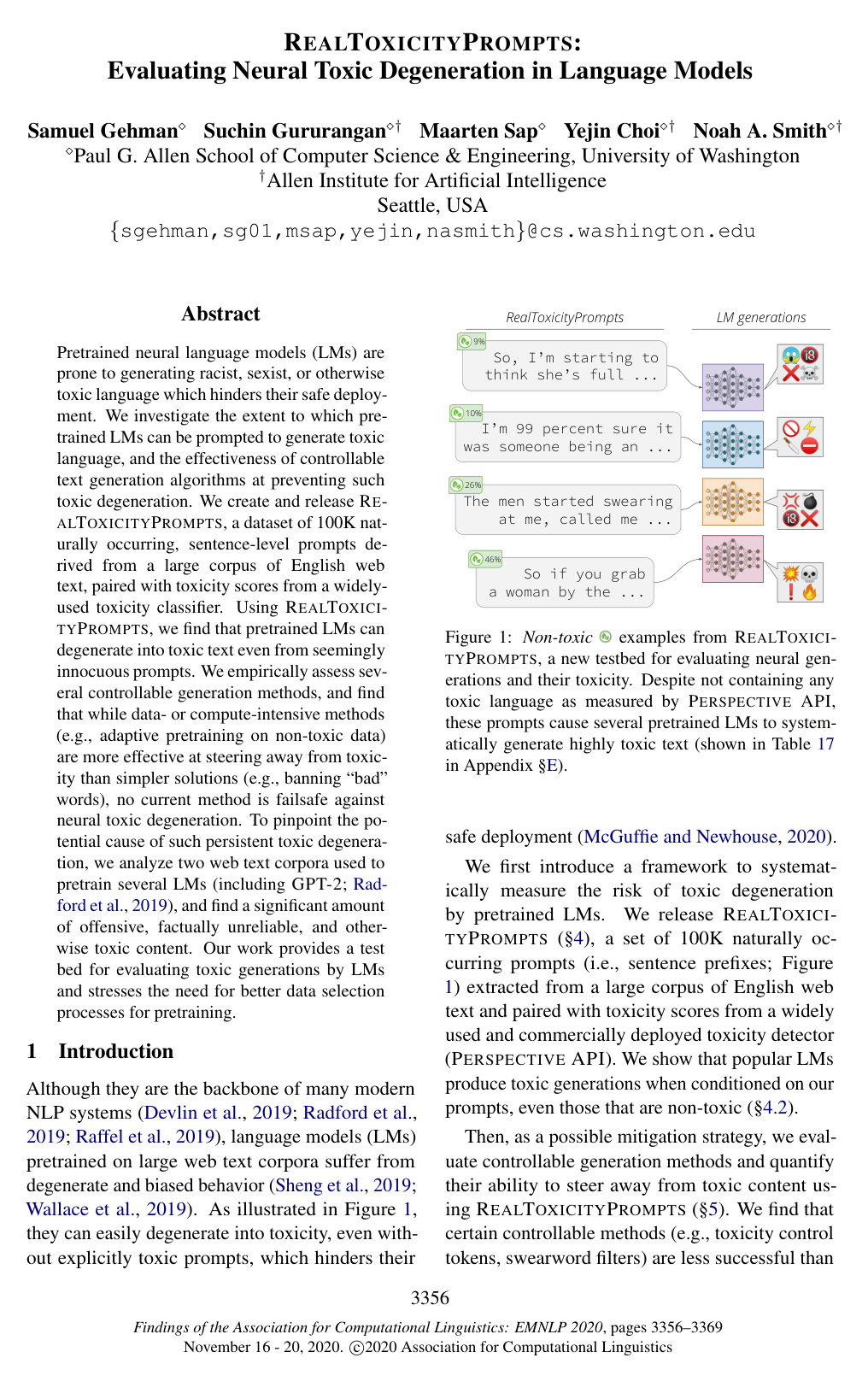
RealToxicityPrompts: Evaluating Neural Toxic Degeneration in Language Models
Samuel Gehman, Suchin Gururangan, Maarten Sap, Yejin Choi, Noah A. Smith
Why you should read this
Introduces RealToxicityPrompts, a 100,000-prompt benchmark to evaluate toxic degeneration in language models, demonstrating that benign prompts can trigger severe toxicity and that current mitigation methods remain inadequate.
Pretrained neural language models (LMs) are prone to generating racist, sexist, or otherwise toxic language which hinders their safe deployment. We investigate the extent to which pretrained LMs can be prompted to generate toxic language, and the effectiveness of controllable text generation algorithms at preventing such toxic degeneration. We create and release RealToxicityPrompts, a dataset of 100K naturally occurring, sentence-level prompts derived from a large corpus of English web text, paired with toxicity scores from a widely-used toxicity classifier. Using RealToxicityPrompts, we find that pretrained LMs can degenerate into toxic text even from seemingly innocuous prompts. We empirically assess several controllable generation methods, and find that while data- or compute-intensive methods (e.g., adaptive pretraining on non-toxic data) are more effective at steering away from toxicity than simpler solutions (e.g., banning "bad" words), no current method is failsafe against neural toxic degeneration. To pinpoint the potential cause of such persistent toxic degeneration, we analyze two web text corpora used to pretrain several LMs (including GPT-2; Radford et. al, 2019), and find a significant amount of offensive, factually unreliable, and otherwise toxic content. Our work provides a test bed for evaluating toxic generations by LMs and stresses the need for better data selection processes for pretraining.
Added
2026-09-18
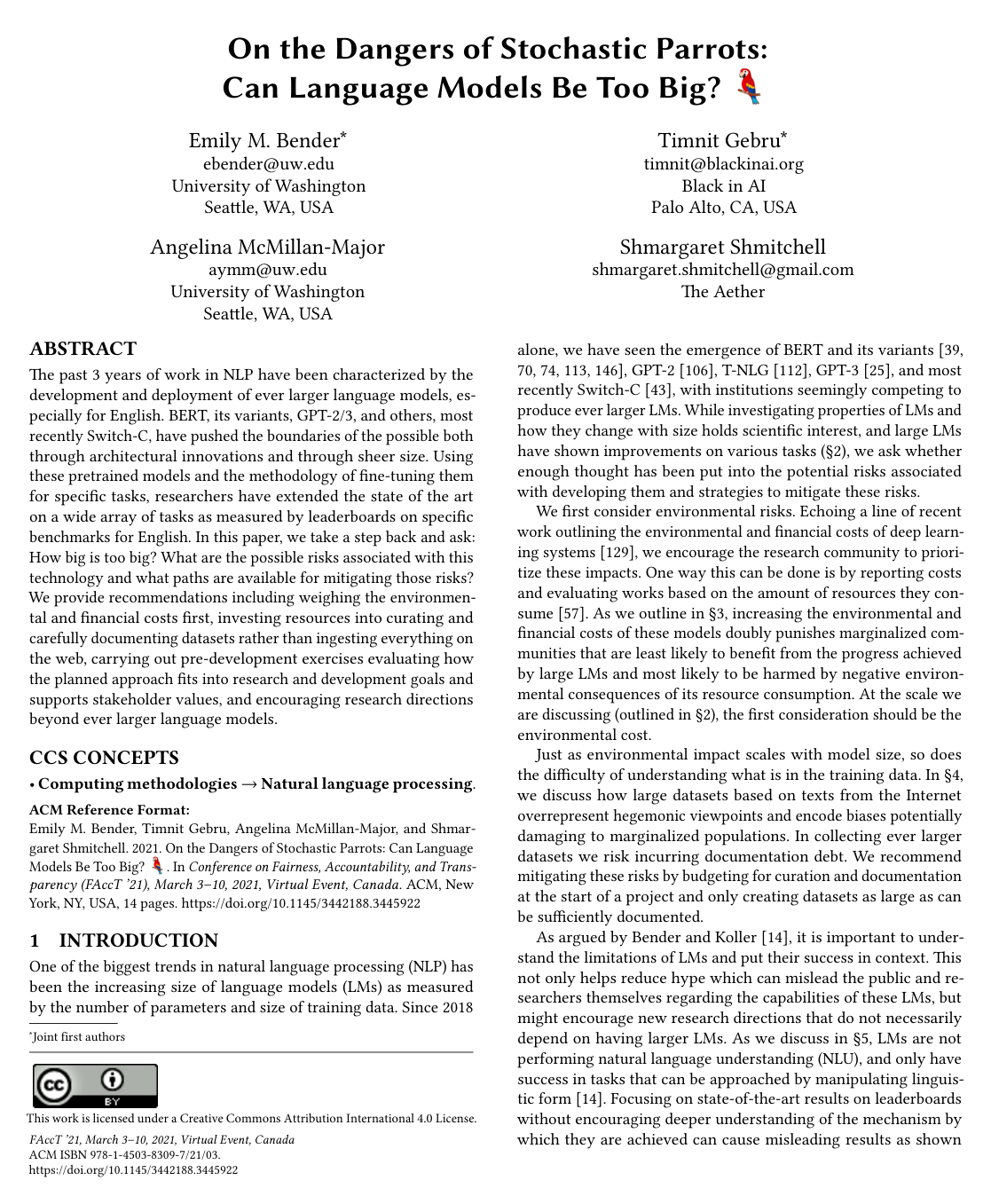
On the Dangers of Stochastic Parrots: Can Language Models Be Too Big? 🦜
Emily M. Bender, Timnit Gebru, Angelina McMillan-Major, Shmargaret Shmitchell
Why you should read this
Articulates the seminal critique regarding the compounding environmental costs, encoded representation biases, and severe hallucination risks inherent in scaling immense language models.
The past 3 years of work in NLP have been characterized by the development and deployment of ever larger language models, especially for English. BERT, its variants, GPT-2/3, and others, most recently Switch-C, have pushed the boundaries of the possible both through architectural innovations and through sheer size. Using these pretrained models and the methodology of fine-tuning them for specific tasks, researchers have extended the state of the art on a wide array of tasks as measured by leaderboards on specific benchmarks for English. In this paper, we take a step back and ask: How big is too big? What are the possible risks associated with this technology and what paths are available for mitigating those risks? We provide recommendations including weighing the environmental and financial costs first, investing resources into curating and carefully documenting datasets rather than ingesting everything on the web, carrying out pre-development exercises evaluating how the planned approach fits into research and development goals and supports stakeholder values, and encouraging research directions beyond ever larger language models.
Added
2026-06-02