Semi-Supervised Recursive Autoencoders for Predicting Sentiment Distributions
Richard SocherJeffrey PenningtonEric H. HuangAndrew Y. NgChristopher D. Manning
Proposes semi-supervised recursive autoencoders that learn hierarchical vector representations of variable-length phrases directly from text to predict complex multi-label sentiment distributions without relying on handcrafted lexicons or parsers.
Understanding human sentiment in user-generated text—such as social media posts, blogs, and customer feedback—is increasingly vital for decision-makers. Traditional automated sentiment analysis models rely heavily on simple bag-of-words methods, which ignore word order and context, or depend on labor-intensive, hand-crafted linguistic resources such as sentiment dictionaries and rule-based parsing systems. Furthermore, most existing systems simplify sentiment into one-dimensional positive or negative ratings, failing to capture the rich, multi-dimensional emotional reactions present in everyday human communication.
The main objective of the article is to demonstrate a semi-supervised recursive autoencoder model that automatically learns phrase and sentence structures directly from text. It evaluates this framework on both standard binary sentiment tasks and the prediction of complex, multi-dimensional sentiment distributions without requiring pre-defined sentiment lexicons or hand-crafted linguistic rules.
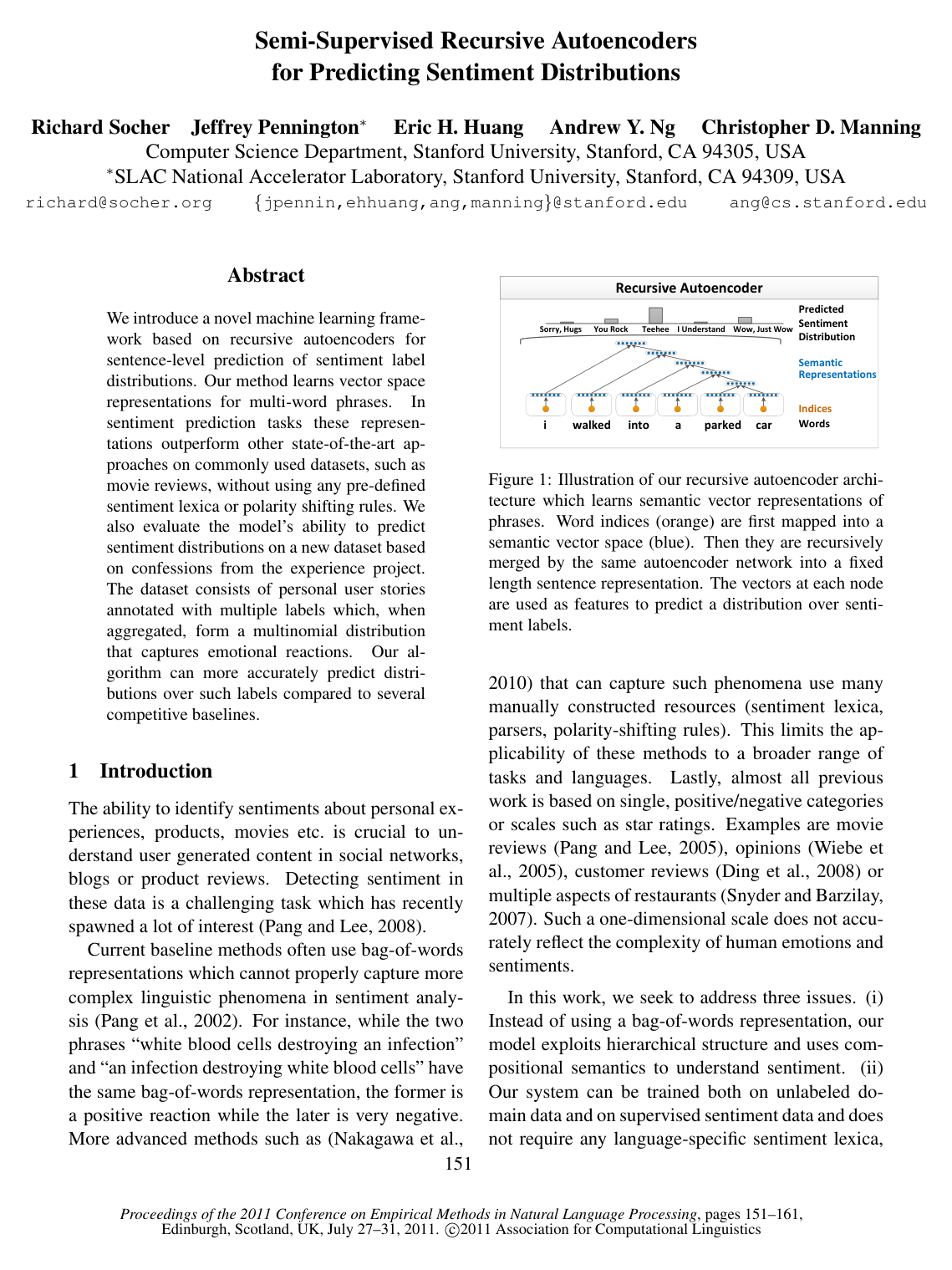
The researchers developed a neural network architecture that begins with continuous word vector embeddings and greedily constructs hierarchical sentence representations by minimizing reconstruction error. To evaluate performance across different domains, the team tested the model on standard binary sentiment benchmarks—including movie reviews and the MPQA opinion dataset—as well as a newly analyzed dataset of over 31,000 anonymous personal confessions from the Experience Project. This confession dataset features user votes across five distinct emotional reactions: sympathy, approval, amusement, empathy, and shock. The model was evaluated on its ability to classify binary polarity, select the single most frequent emotional reaction, and accurately predict the complete proportional distribution across all five emotional categories.
The findings show that the proposed framework consistently outperforms competitive baseline models and established state-of-the-art approaches. First, on the Experience Project dataset, the model achieved 50.1% accuracy in predicting the top emotional reaction, surpassing a heavily engineered feature baseline using external sentiment lexicons and spelling normalizers by about 3.1 percentage points. Second, the model more accurately predicted full emotional probability distributions, lowering the average divergence error relative to word vector and bag-of-words baselines. Third, on binary benchmarks, the model reached 77.7% accuracy on movie reviews and 86.4% on opinion polarity, outperforming previous tree-based conditional random field models while eliminating reliance on external parsers or sentiment rules. Finally, the analysis revealed that balancing supervised classification with unsupervised structure reconstruction prevented overfitting, with optimal performance occurring when reconstruction error was weighted at twenty percent.
These results demonstrate that organizations can accurately extract nuanced, multi-faceted human emotions from text without investing substantial time and capital into building expensive, language-specific dictionaries and grammar rules. Because the framework learns semantic representations directly from raw text, it significantly reduces development costs, mitigates the risk of missing context-dependent meaning, and speeds up deployment across diverse domains. Operational efficiency is further supported by reasonable computational requirements: the model trained in 3 to 12 hours on standard 4-core hardware and performed inference on hundreds of texts within seconds.
Organizations seeking to analyze complex customer feedback or user sentiment should consider deploying recursive neural models over traditional keyword-matching and bag-of-words systems. For practical implementation, technical teams should leverage unsupervised pre-trained word embeddings and retain a modest reconstruction loss weighting to ensure model stability. If initial domain vocabularies contain rare or unseen terms, incorporating domain-specific lexicons into training can yield slight performance gains. Further work should explore applying this architecture across additional languages and multi-sentence document structures.
While the model delivers robust predictive performance across diverse benchmarks, stakeholders should note certain limitations. Performance on the confession dataset was evaluated specifically on entries with at least four user votes (6,129 entries) to ensure reliable ground truth, meaning predictions on extremely sparse or unvoted text may exhibit greater variance. Additionally, the greedy tree-construction algorithm approximates linguistic hierarchy for speed rather than strict syntactic grammar. Confidence in the reported results is high, as the findings are validated across multiple public datasets using cross-validation and standard statistical evaluation metrics.
- Paper: Parsing Natural Scenes and Natural Language with Recursive Neural Networks, Richard Socher et al. (2011). Introduces the foundational recursive neural network architecture for continuous syntactic tree composition that this work adapts into recursive autoencoders.
- Paper: Thumbs up? Sentiment Classification using Machine Learning Techniques, Bo Pang et al. (2002). Establishes the standard benchmark datasets and machine learning baselines for sentence- and review-level sentiment classification.
- Paper: A Neural Probabilistic Language Model, Yoshua Bengio et al. (2003). Provides the foundational distributed continuous word representation framework upon which recursive phrase-level compositional embeddings are built.
- Paper: A Sentimental Education: Sentiment Analysis Using Subjectivity Summarization Based on Minimum Cuts, Bo Pang et al. (2004). Introduces the standard movie review sentence polarity dataset widely used to evaluate compositional sentiment models.
- Paper: Semantic Compositionality through Recursive Matrix-Vector Spaces, Richard Socher et al. (2012). Extends the recursive compositional framework by pairing each constituent with an operator matrix to better handle complex linguistic modifications like negation.
- Paper: Recursive Deep Models for Semantic Compositionality Over a Sentiment Treebank, Richard Socher et al. (2013). Advances recursive sentiment composition using tensor-based neural combinations evaluated over fully annotated phrase parse trees in the Stanford Sentiment Treebank.
- Paper: Improved Semantic Representations From Tree-Structured Long Short-Term Memory Networks, Kai Sheng Tai et al. (2015). Generalizes tree-structured semantic composition by replacing standard recursive units with gated Tree-LSTM architectures.
- Paper: Convolutional Neural Networks for Sentence Classification, Yoon Kim (2014). Offers an alternative neural sentence classification paradigm that achieves strong sentiment prediction without relying on recursive syntactic parse trees.
- Paper: Deep learning for sentiment analysis: A survey, Lei Zhang et al. (2018). Surveys the broader evolution of deep learning architectures for sentiment analysis, placing recursive neural models in context with modern recurrent, convolutional, and attention-based methods.