Baselines and Bigrams: Simple, Good Sentiment and Topic Classification
Sida I. WangChristopher D. Manning
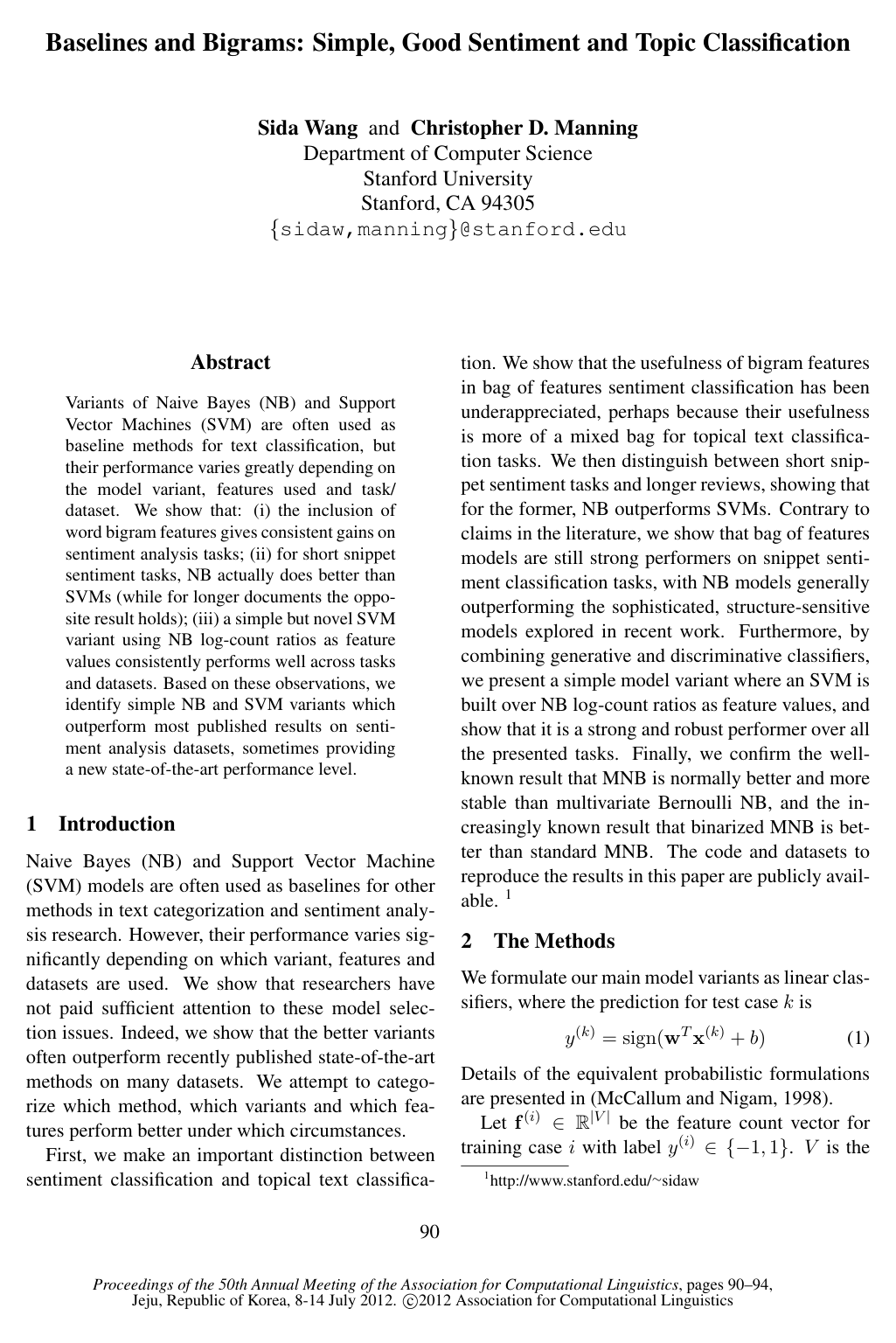
Demonstrates that simple Naive Bayes and Support Vector Machine baselines with word bigrams—particularly the hybrid NBSVM model—can outperform complex, structure-sensitive methods across standard sentiment and topic classification benchmarks.
Organizations often deploy complex and computationally expensive machine learning models to analyze text sentiment and topic categories, under the assumption that basic baseline algorithms cannot handle nuanced language. However, standard baselines vary widely in performance depending on their specific mathematical formulation, the input features provided, and the length of the processed text. Without well-tuned baseline benchmarks, teams risk investing substantial resources into complex architectures that may deliver inferior performance compared to simpler alternatives.
The main objective of the article is to systematically evaluate simple linear classification methods—specifically variants of Naive Bayes and Support Vector Machines—across multiple text lengths and classification tasks to establish rigorous, lightweight performance baselines.
The researchers conducted an empirical evaluation using standard benchmark datasets covering short sentence snippets, full-length movie reviews up to 50,000 documents, and topic-based newsgroup classifications. The analysis evaluated simple feature representations (single words and two-word pairs) without relying on external linguistic lexicons, rule systems, or complex parsing structures, testing standard algorithms alongside a hybrid model that uses Naive Bayes log-count ratios as features within a Support Vector Machine.
The key findings demonstrate that baseline choice depends heavily on document length and task type. First, for short text snippets, Multinomial Naive Bayes consistently outperformed Support Vector Machines, achieving top accuracies between 79.0% and 93.6% and beating complex rule-based and deep neural models. Second, for long reviews, Support Vector Machines outperformed Naive Bayes, while the hybrid model delivered the strongest results (89.45% and 91.22% accuracy), matching or setting new state-of-the-art benchmarks. Third, adding two-word phrase features consistently improved sentiment classification across all datasets, whereas they offered little to no benefit for topic-based classification. Finally, the hybrid model proved exceptionally robust across all dataset lengths and task types.
These findings imply that engineering teams can achieve state-of-the-art text and sentiment classification without the computational cost, implementation complexity, or runtime overhead of highly specialized architectures. The results challenge the assumption that short text fragments require intricate, hand-crafted linguistic rules or heavy deep learning models, showing instead that simple, well-tuned linear classifiers capture sentiment patterns more effectively at a fraction of the operational cost.
Decision-makers and practitioners should adopt the hybrid model as the standard, default baseline before greenlighting more complex natural language processing models. Teams should ensure that text representations use binary word indicators rather than raw frequency counts, include two-word phrases for sentiment analysis tasks, and rely on Multinomial rather than multivariate Bernoulli Naive Bayes formulations. If deploying the hybrid model, teams should set its interpolation parameter within the recommended range of one-quarter to one-half for stable general performance.
Confidence in these findings is high across the evaluated English benchmark tasks, given the consistent empirical validation across varying sample sizes. However, readers should note that the evaluations were restricted to standard linear models on English text classifications, meaning validation on proprietary or multilingual domain data remains necessary before full operational rollout.
- Paper: Thumbs up? Sentiment Classification using Machine Learning Techniques, Bo Pang et al. (2002). This foundational study established the core benchmark of testing Naive Bayes and Support Vector Machines with n-gram features on movie review sentiment classification.
- Paper: A comparison of event models for naive bayes text classification, Andrew McCallum et al. (1998). This paper establishes the formal distinction between multinomial and multivariate Bernoulli event models in Naive Bayes text classification, which directly motivates the source's baseline choices.
- Paper: Learning Word Vectors for Sentiment Analysis, Andrew L. Maas et al. (2011). This work introduced the widely used 50,000-document IMDB benchmark dataset and evaluated baseline linear classifiers that the source directly builds upon.
- Paper: On Discriminative vs. Generative Classifiers: A comparison of logistic regression and naive Bayes, Andrew Ng et al. (2001). This seminal comparison of generative and discriminative classifiers explains why Naive Bayes and linear models exhibit distinct error regimes across varying data and document scales.
- Paper: A re-examination of text categorization methods, Yiming Yang et al. (1999). This empirical study provides foundational comparative analysis on how linear SVMs and Naive Bayes perform across standard text categorization benchmarks.
- Paper: Mining the peanut gallery: opinion extraction and semantic classification of product reviews, Kushal Dave et al. (2003). This early work demonstrates the impact of n-gram feature representations and simple statistical scoring methods for product review sentiment classification.
- Paper: Convolutional Neural Networks for Sentence Classification, Yoon Kim (2014). This influential paper demonstrates how lightweight convolutional neural networks with pretrained word embeddings offer a next-step neural baseline for sentence and sentiment classification.
- Paper: A Simple but Tough-to-Beat Baseline for Sentence Embeddings, Sanjeev Arora et al. (2017). This work extends the source's philosophy of tough-to-beat simple baselines by creating an unsupervised, weighted sentence embedding method for downstream classification.
- Paper: EDA: Easy Data Augmentation Techniques for Boosting Performance on Text Classification Tasks, Jason Wei et al. (2019). This research explores lightweight data augmentation techniques to boost performance on text and sentiment classification tasks without complex architectures.
- Paper: Recurrent Convolutional Neural Networks for Text Classification, Siwei Lai et al. (2015). This study advances text classification beyond linear n-gram baselines by introducing recurrent convolutional neural networks to capture broader context.
- Paper: Document Modeling with Gated Recurrent Neural Network for Sentiment Classification, Duyu Tang et al. (2015). This paper tackles document-level sentiment classification for long reviews using hierarchical gated recurrent neural networks, contrasting with linear n-gram models.
- Paper: Deep learning for sentiment analysis: A survey, Lei Zhang et al. (2018). This comprehensive survey provides an overview of the deep learning architectures that succeeded traditional n-gram baselines in sentiment analysis.
- Paper: How to Fine-Tune BERT for Text Classification?, Chi Sun et al. (2019). This paper investigates optimal fine-tuning practices for Transformer-based architectures on the standard text and sentiment classification benchmarks evaluated in the source.