
keyword
selective classification
Selective classification, also known as classification with a reject option, is a machine learning framework in which a predictive model is permitted to abstain from making a prediction on instances where its confidence is insufficient or uncertainty is high. By combining a predictive classifier with a selection mechanism, the system filters out difficult, ambiguous, or out-of-distribution inputs rather than committing to potentially erroneous decisions. This framework establishes a controllable trade-off between coverage, which represents the proportion of samples the model agrees to classify, and selective risk, which represents the error rate evaluated only on those accepted samples. Selective classification is widely utilized in safety-critical and high-stakes domains, such as medical diagnostics, automated driving, and financial risk assessment, where the cost of incorrect predictions is substantial and abstained cases can be safely deferred to human experts or secondary fallback systems.
6 items
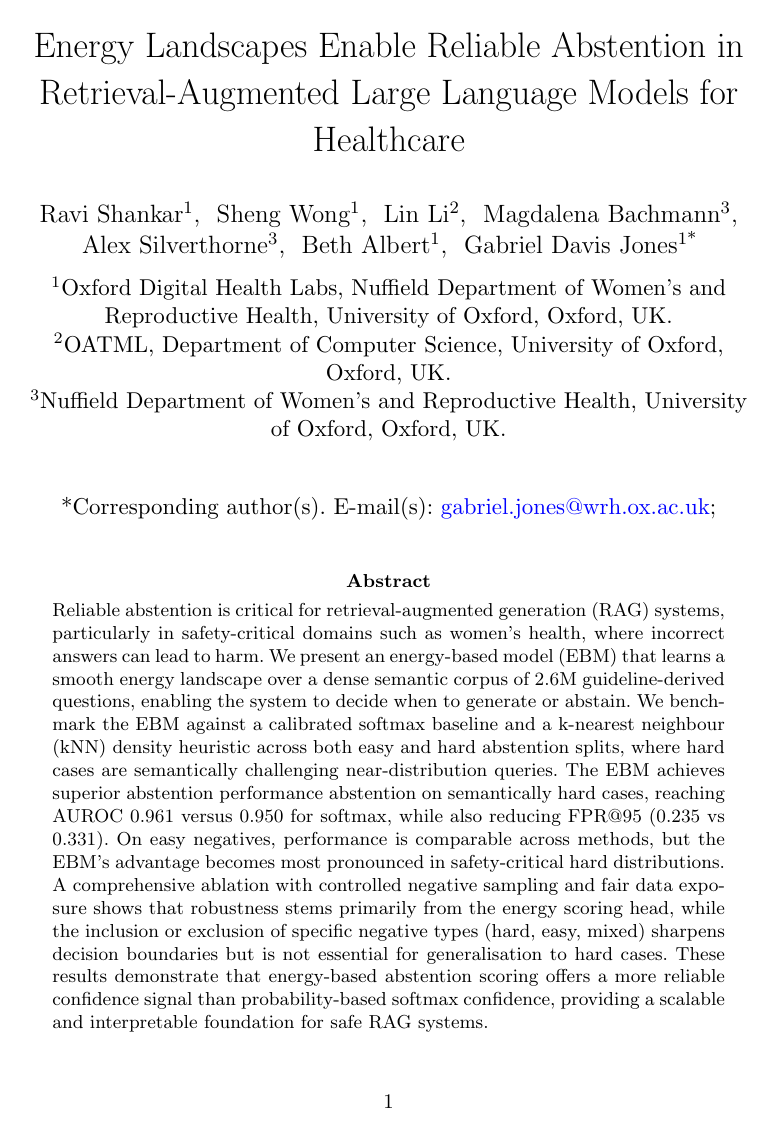
Energy Landscapes Enable Reliable Abstention in Retrieval-Augmented Large Language Models for Healthcare
Ravi Shankar, Sheng Wong, Lin Li, Magdalena Bachmann, Alex Silverthorne, Beth Albert, Gabriel Jones
Why you should read this
Proposes an energy-based modeling approach that significantly outperforms calibrated softmax confidence for selective abstention in healthcare retrieval-augmented generation, substantially reducing false positive rates on hard near-distribution queries.
Reliable abstention is critical for retrieval-augmented generation (RAG) systems, particularly in safety-critical domains such as women's health, where incorrect answers can lead to harm. We present an energy-based model (EBM) that learns a smooth energy landscape over a dense semantic corpus of 2.6M guideline-derived questions, enabling the system to decide when to generate or abstain. We benchmark the EBM against a calibrated softmax baseline and a k-nearest neighbour (kNN) density heuristic across both easy and hard abstention splits, where hard cases are semantically challenging near-distribution queries. The EBM achieves superior abstention performance abstention on semantically hard cases, reaching AUROC 0.961 versus 0.950 for softmax, while also reducing FPR@95 (0.235 vs 0.331). On easy negatives, performance is comparable across methods, but the EBM's advantage becomes most pronounced in safety-critical hard distributions. A comprehensive ablation with controlled negative sampling and fair data exposure shows that robustness stems primarily from the energy scoring head, while the inclusion or exclusion of specific negative types (hard, easy, mixed) sharpens decision boundaries but is not essential for generalisation to hard cases. These results demonstrate that energy-based abstention scoring offers a more reliable confidence signal than probability-based softmax confidence, providing a scalable and interpretable foundation for safe RAG systems.
Added
2026-10-04
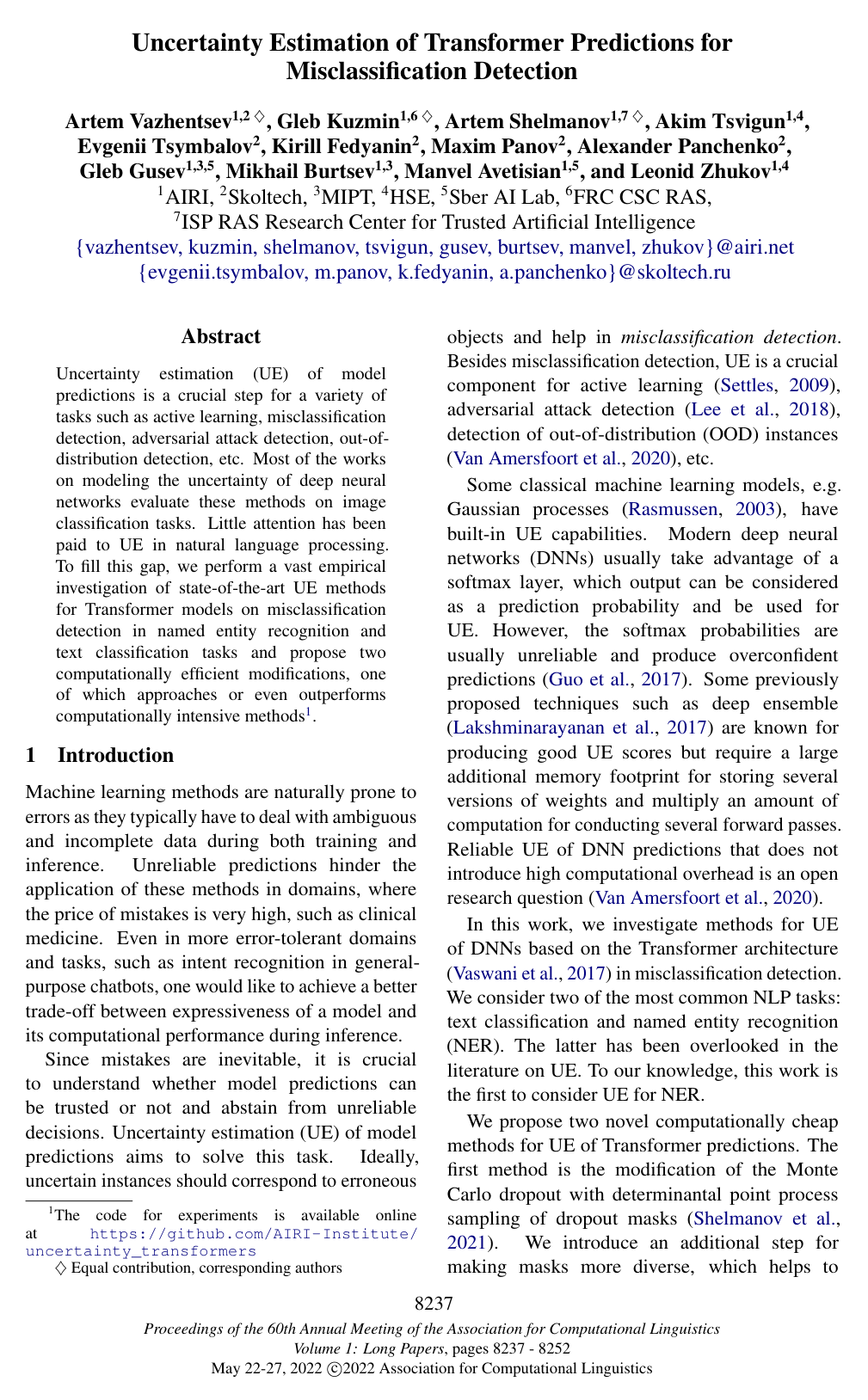
Uncertainty Estimation of Transformer Predictions for Misclassification Detection
Artem Vazhentsev, Gleb Kuzmin, Artem Shelmanov, Akim Tsvigun, Evgenii Tsymbalov, Kirill Fedyanin, Maxim Panov, Alexander Panchenko, Gleb Gusev, Mikhail Burtsev, Manvel Avetisian, Leonid Zhukov
Why you should read this
Develops computationally efficient uncertainty estimation methods for Transformer models in text classification and named entity recognition, demonstrating that a spectral-normalized Mahalanobis distance approach can rival or exceed heavy deep ensembles at detecting misclassifications.
Uncertainty estimation (UE) of model predictions is a crucial step for a variety of tasks such as active learning, misclassification detection, adversarial attack detection, out-of-distribution detection, etc. Most of the works on modeling the uncertainty of deep neural networks evaluate these methods on image classification tasks. Little attention has been paid to UE in natural language processing. To fill this gap, we perform a vast empirical investigation of state-of-the-art UE methods for Transformer models on misclassification detection in named entity recognition and text classification tasks and propose two computationally efficient modifications, one of which approaches or even outperforms computationally intensive methods1.
Added
2026-10-03
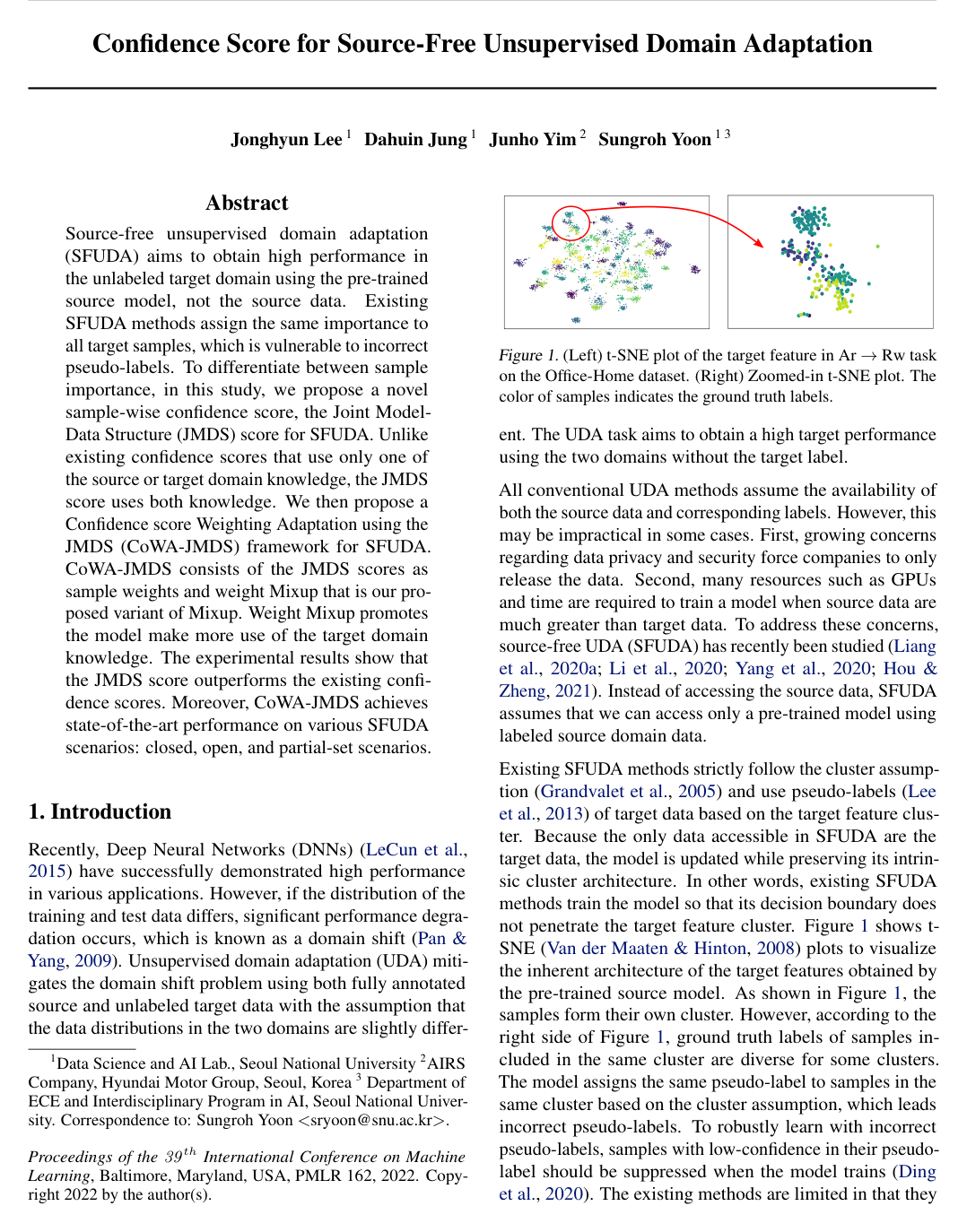
Confidence Score for Source-Free Unsupervised Domain Adaptation
Jonghyun Lee, Dahuin Jung, Junho Yim, Sungroh Yoon
Why you should read this
Proposes a joint model-data structure confidence score and sample-weighted adaptation framework that mitigates noisy pseudo-labeling in source-free unsupervised domain adaptation by combining source model probabilities with target feature cluster distributions.
Source-free unsupervised domain adaptation (SFUDA) aims to obtain high performance in the unlabeled target domain using the pre-trained source model, not the source data. Existing SFUDA methods assign the same importance to all target samples, which is vulnerable to incorrect pseudo-labels. To differentiate between sample importance, in this study, we propose a novel sample-wise confidence score, the Joint Model-Data Structure (JMDS) score for SFUDA. Unlike existing confidence scores that use only one of the source or target domain knowledge, the JMDS score uses both knowledge. We then propose a Confidence score Weighting Adaptation using the JMDS (CoWA-JMDS) framework for SFUDA. CoWA-JMDS consists of the JMDS scores as sample weights and weight Mixup that is our proposed variant of Mixup. Weight Mixup promotes the model make more use of the target domain knowledge. The experimental results show that the JMDS score outperforms the existing confidence scores. Moreover, CoWA-JMDS achieves state-of-the-art performance on various SFUDA scenarios: closed, open, and partial-set scenarios.
Added
2026-09-26
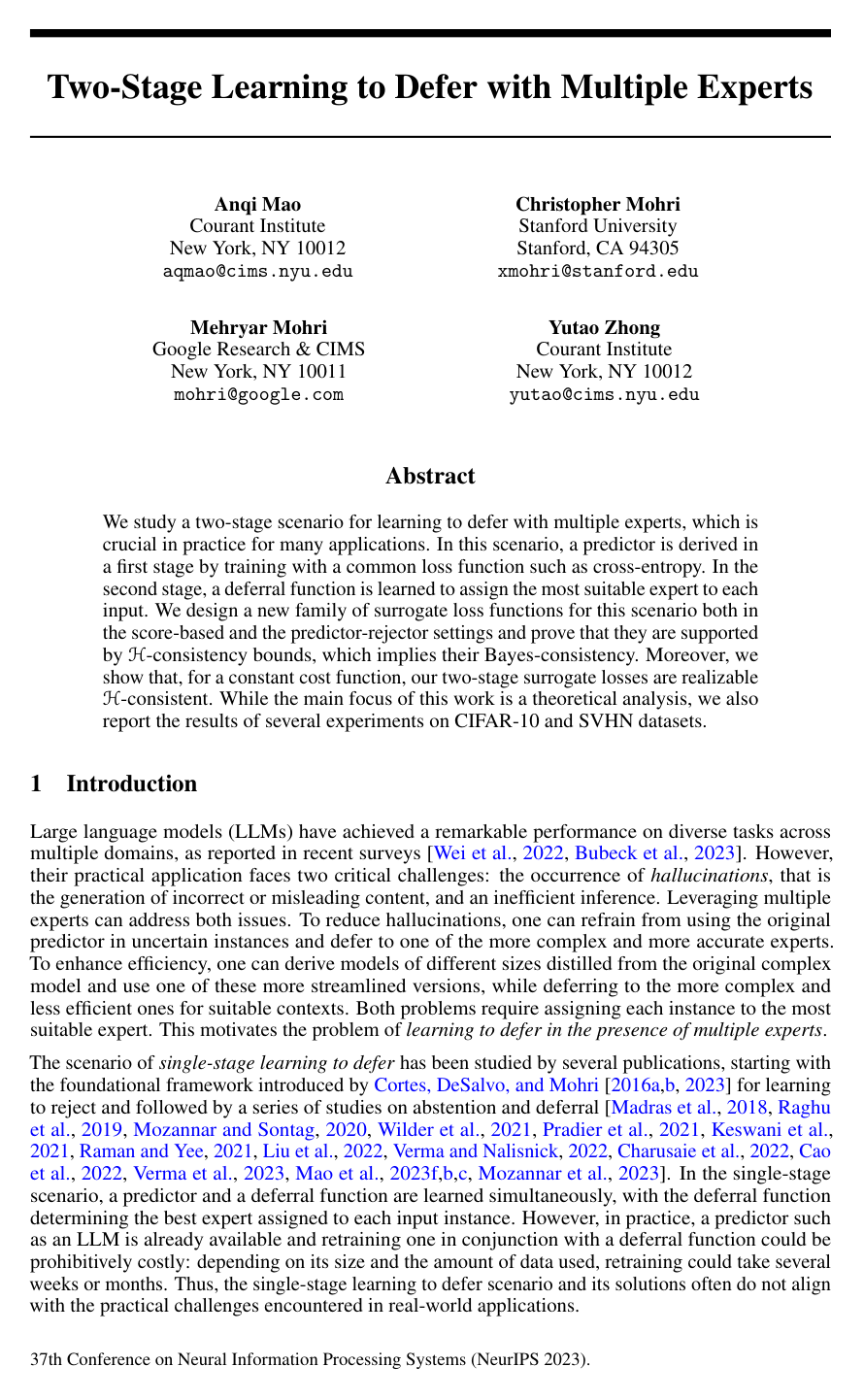
Two-Stage Learning to Defer with Multiple Experts
Anqi Mao, Christopher Mohri, Mehryar Mohri, Yutao Zhong
Why you should read this
Proposes a theoretically grounded framework for two-stage learning to defer with multiple experts by designing surrogate losses with rigorous -consistency guarantees that enable efficient post-hoc deferral without retraining the underlying predictor.
We study a two-stage scenario for learning to defer with multiple experts, which is crucial in practice for many applications. In this scenario, a predictor is derived in a first stage by training with a common loss function such as cross-entropy. In the second stage, a deferral function is learned to assign the most suitable expert to each input. We design a new family of surrogate loss functions for this scenario both in the score-based and the predictor-rejector settings and prove that they are supported by H-consistency bounds, which implies their Bayes-consistency. Moreover, we show that, for a constant cost function, our two-stage surrogate losses are realizable H-consistent. While the main focus of this work is a theoretical analysis, we also report the results of several experiments on CIFAR-10 and SVHN datasets.
Added
2026-09-26
Optimal Strategies for Reject Option Classifiers
Vojtech Franc, Daniel Prusa, Václav Vorácek
Why you should read this
Unifies cost-based, bounded-improvement, and bounded-abstention selective classification models by proving they share the same optimal strategy, while developing two Fisher consistent algorithms to learn optimal rejection functions for arbitrary black-box classifiers across diverse prediction tasks.
In classification with a reject option, the classifier is allowed in uncertain cases to abstain from prediction. The classical cost-based model of a reject option classifier requires the rejection cost to be defined explicitly. The alternative bounded-improvement model and the bounded-abstention model avoid the notion of the reject cost. The bounded-improvement model seeks a classifier with a guaranteed selective risk and maximal cover. The bounded-abstention model seeks a classifier with guaranteed cover and minimal selective risk. We prove that despite their different formulations the three rejection models lead to the same prediction strategy: the Bayes classifier endowed with a randomized Bayes selection function. We define the notion of a proper uncertainty score as a scalar summary of the prediction uncertainty sufficient to construct the randomized Bayes selection function. We propose two algorithms to learn the proper uncertainty score from examples for an arbitrary black-box classifier. We prove that both algorithms provide Fisher consistent estimates of the proper uncertainty score and demonstrate their efficiency in different prediction problems, including classification, ordinal regression, and structured output classification.
Added
2026-09-26
WILDS: A Benchmark of in-the-Wild Distribution Shifts
Pang Wei Koh, Shiori Sagawa, Henrik Marklund, Sang Michael Xie, Marvin Zhang, Akshay Balsubramani, Weihua Hu, Michihiro Yasunaga, Richard Lanas Phillips, Irena Gao, Tony Lee, Etienne David, Ian Stavness, Wei Guo, Berton A. Earnshaw, Imran S. Haque, Sara Beery, Jure Leskovec, Anshul Kundaje, Emma Pierson, Sergey Levine, Chelsea Finn, Percy Liang
Why you should read this
Introduces WILDS, a benchmark of ten real-world datasets across diverse applications, demonstrating that standard algorithms fail under naturally occurring distribution shifts and providing standardized evaluations to develop models with better out-of-distribution generalization.
Distribution shifts -- where the training distribution differs from the test distribution -- can substantially degrade the accuracy of machine learning (ML) systems deployed in the wild. Despite their ubiquity in the real-world deployments, these distribution shifts are under-represented in the datasets widely used in the ML community today. To address this gap, we present WILDS, a curated benchmark of 10 datasets reflecting a diverse range of distribution shifts that naturally arise in real-world applications, such as shifts across hospitals for tumor identification; across camera traps for wildlife monitoring; and across time and location in satellite imaging and poverty mapping. On each dataset, we show that standard training yields substantially lower out-of-distribution than in-distribution performance. This gap remains even with models trained by existing methods for tackling distribution shifts, underscoring the need for new methods for training models that are more robust to the types of distribution shifts that arise in practice. To facilitate method development, we provide an open-source package that automates dataset loading, contains default model architectures and hyperparameters, and standardizes evaluations. Code and leaderboards are available at this https URL.
Added
2026-09-17