
keyword
probabilistic forecasting
Probabilistic forecasting is a prediction technique that models and outputs a full probability distribution or an ensemble of possible future outcomes conditioned on historical observations, rather than estimating a single deterministic point value. By characterizing the likelihood of various future trajectories, this approach explicitly quantifies predictive uncertainty and captures underlying volatility or multimodality in temporal data. Forecast outputs are typically represented through parametric probability densities, prediction intervals, quantiles, or generated sample paths, providing decision-makers with a comprehensive view of potential risks and scenarios in fields such as energy management, meteorology, finance, and supply chain planning.
13 items
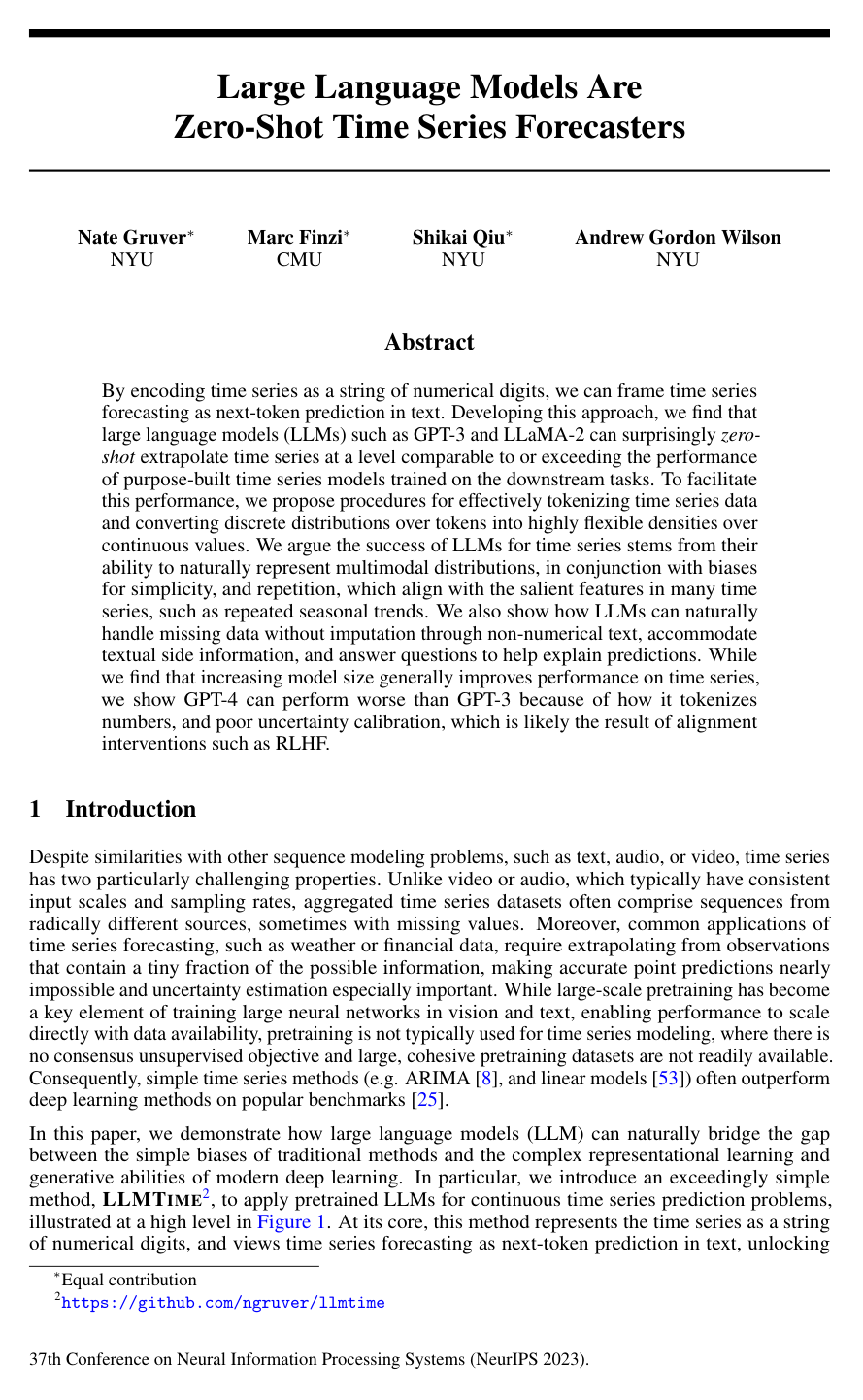
Large Language Models Are Zero-Shot Time Series Forecasters
Nate Gruver, Marc Finzi, Shikai Qiu, Andrew Gordon Wilson
Why you should read this
Demonstrates that off-the-shelf large language models can match or exceed specialized domain models at zero-shot time series forecasting simply by framing numerical sequences as next-token prediction tasks.
By encoding time series as a string of numerical digits, we can frame time series forecasting as next-token prediction in text. Developing this approach, we find that large language models (LLMs) such as GPT-3 and LLaMA-2 can surprisingly zero-shot extrapolate time series at a level comparable to or exceeding the performance of purpose-built time series models trained on the downstream tasks. To facilitate this performance, we propose procedures for effectively tokenizing time series data and converting discrete distributions over tokens into highly flexible densities over continuous values. We argue the success of LLMs for time series stems from their ability to naturally represent multimodal distributions, in conjunction with biases for simplicity, and repetition, which align with the salient features in many time series, such as repeated seasonal trends. We also show how LLMs can naturally handle missing data without imputation through non-numerical text, accommodate textual side information, and answer questions to help explain predictions. While we find that increasing model size generally improves performance on time series, we show GPT-4 can perform worse than GPT-3 because of how it tokenizes numbers, and poor uncertainty calibration, which is likely the result of alignment interventions such as RLHF.
Added
2026-10-05
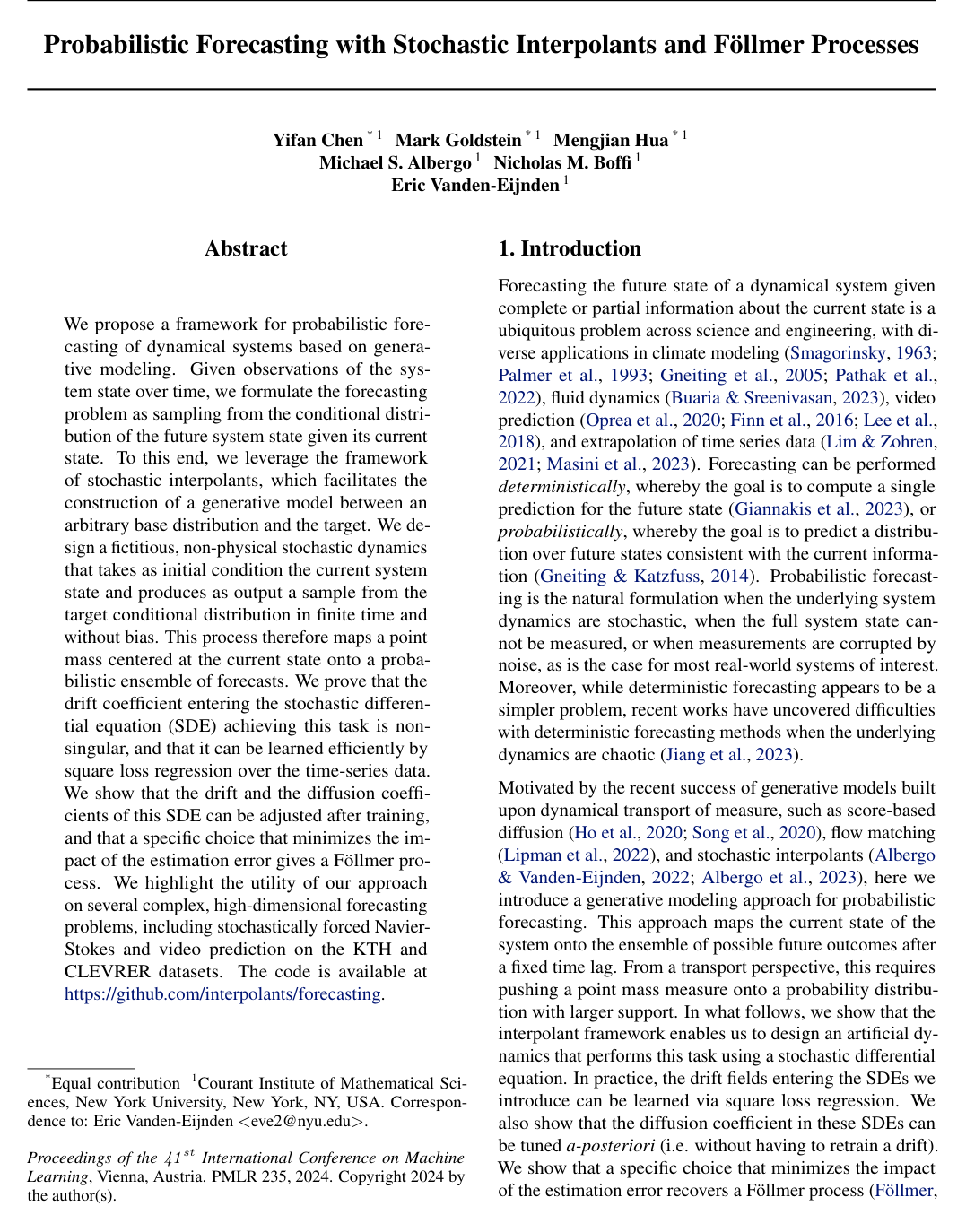
Probabilistic Forecasting with Stochastic Interpolants and Föllmer Processes
Yifan Chen, Mark Goldstein, Mengjian Hua, Michael S. Albergo, Nicholas Matthew Boffi, Eric Vanden-Eijnden
Why you should read this
Develops a generative framework using stochastic interpolants and Föllmer processes to construct stochastic differential equations that map point-mass state measurements directly to predictive distributions for high-dimensional dynamical systems and video forecasting.
We propose a framework for probabilistic forecasting of dynamical systems based on generative modeling. Given observations of the system state over time, we formulate the forecasting problem as sampling from the conditional distribution of the future system state given its current state. To this end, we leverage the framework of stochastic interpolants, which facilitates the construction of a generative model between an arbitrary base distribution and the target. We design a fictitious, non-physical stochastic dynamics that takes as initial condition the current system state and produces as output a sample from the target conditional distribution in finite time and without bias. This process therefore maps a point mass centered at the current state onto a probabilistic ensemble of forecasts. We prove that the drift coefficient entering the stochastic differential equation (SDE) achieving this task is non-singular, and that it can be learned efficiently by square loss regression over the time-series data. We show that the drift and the diffusion coefficients of this SDE can be adjusted after training, and that a specific choice that minimizes the impact of the estimation error gives a Föllmer process. We highlight the utility of our approach on several complex, high-dimensional forecasting problems, including stochastically forced Navier-Stokes and video prediction on the KTH and CLEVRER datasets. The code is available at https://github.com/interpolants/forecasting.
Added
2026-10-04
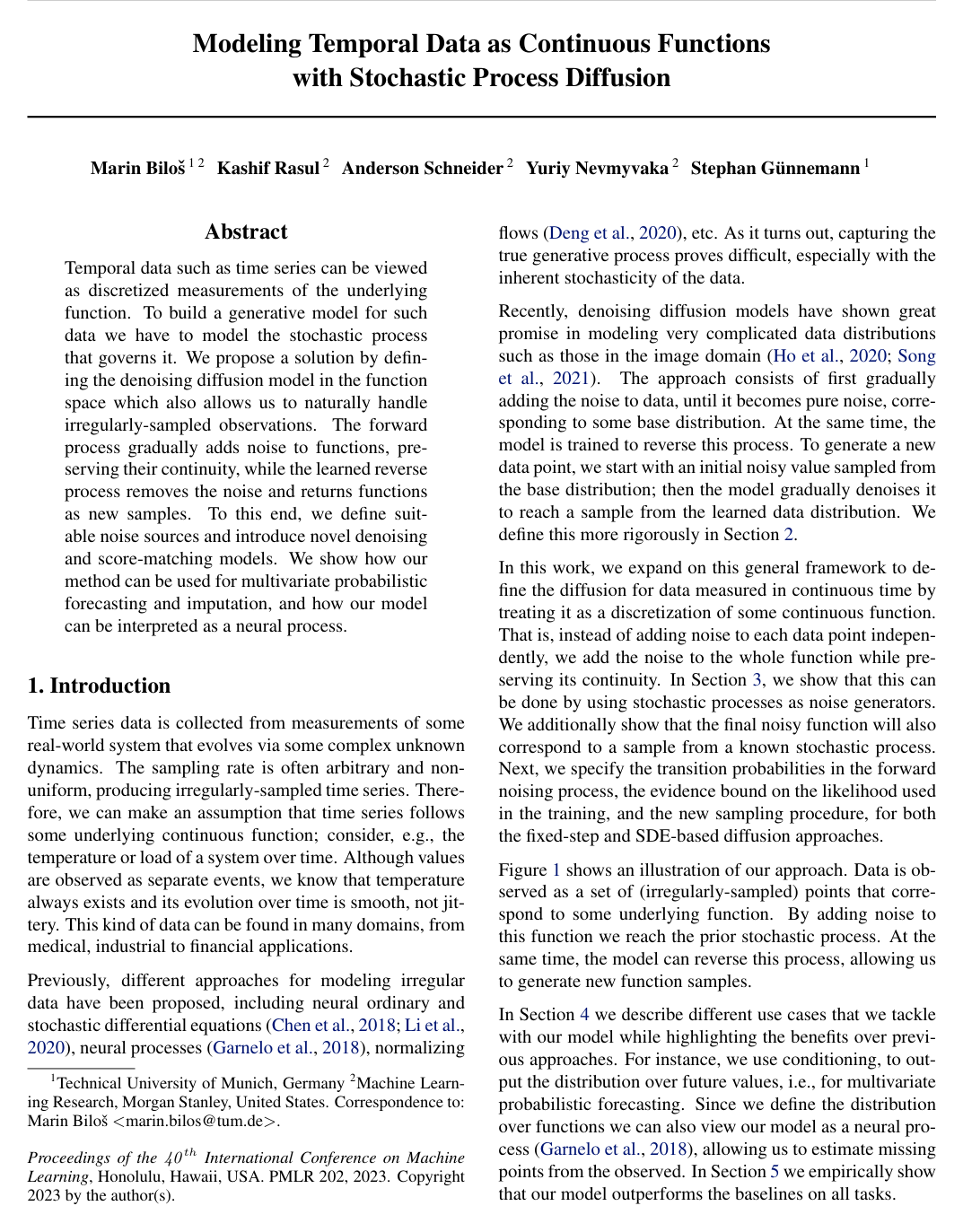
Modeling Temporal Data as Continuous Functions with Stochastic Process Diffusion
Marin Bilos, Kashif Rasul, Anderson Schneider, Yuriy Nevmyvaka, Stephan Günnemann
Why you should read this
Proposes a function-space denoising diffusion framework that preserves temporal continuity using stochastic process noise, enabling effective generative modeling, probabilistic forecasting, and imputation for irregularly sampled time series.
Temporal data such as time series can be viewed as discretized measurements of the underlying function. To build a generative model for such data we have to model the stochastic process that governs it. We propose a solution by defining the denoising diffusion model in the function space which also allows us to naturally handle irregularly-sampled observations. The forward process gradually adds noise to functions, preserving their continuity, while the learned reverse process removes the noise and returns functions as new samples. To this end, we define suitable noise sources and introduce novel denoising and score-matching models. We show how our method can be used for multivariate probabilistic forecasting and imputation, and how our model can be interpreted as a neural process.
Added
2026-10-03
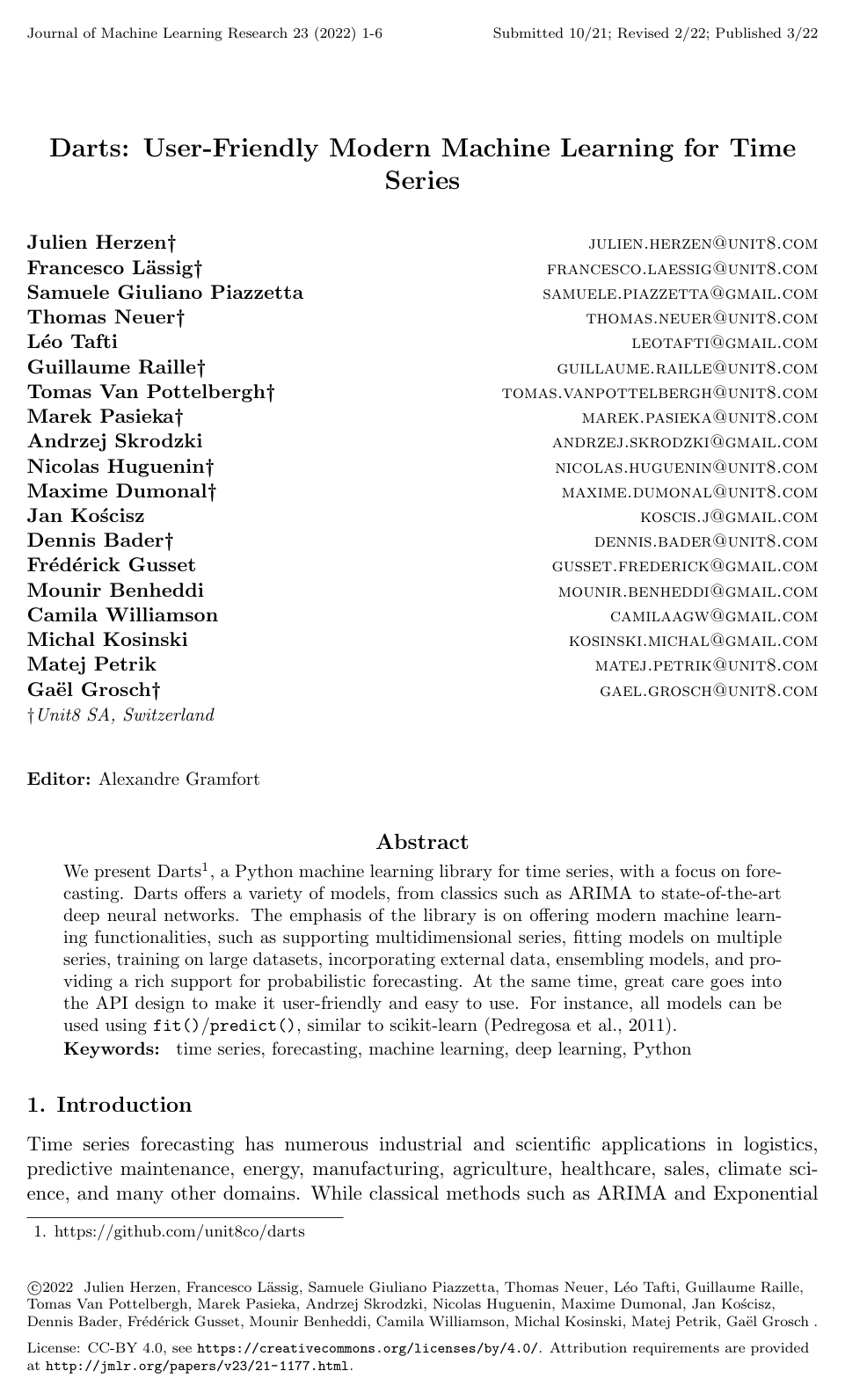
Darts: User-Friendly Modern Machine Learning for Time Series
Julien Herzen, Francesco Lässig, Samuele Giuliano Piazzetta, Thomas Neuer, Léo Tafti, Guillaume Raille, Tomas Van Pottelbergh, Marek Pasieka, Andrzej Skrodzki, Nicolas Huguenin, Maxime Dumonal, Jan Koscisz, Dennis Bader, Frédérick Gusset, Mounir Benheddi, Camila Williamson, Michal Kosinski, Matej Petrik, Gaël Grosch
Why you should read this
Presents Darts, an open-source Python library that unifies classical forecasting methods and modern deep learning architectures under a scikit-learn-like interface supporting multivariate series, multi-series training, and probabilistic forecasting.
We present Darts¹, a Python machine learning library for time series, with a focus on forecasting. Darts offers a variety of models, from classics such as ARIMA to state-of-the-art deep neural networks. The emphasis of the library is on offering modern machine learning functionalities, such as supporting multidimensional series, fitting models on multiple series, training on large datasets, incorporating external data, ensembling models, and providing a rich support for probabilistic forecasting. At the same time, great care goes into the API design to make it user-friendly and easy to use. For instance, all models can be used using fit()/predict(), similar to scikit-learn (Pedregosa et al., 2011).
Added
2026-09-28
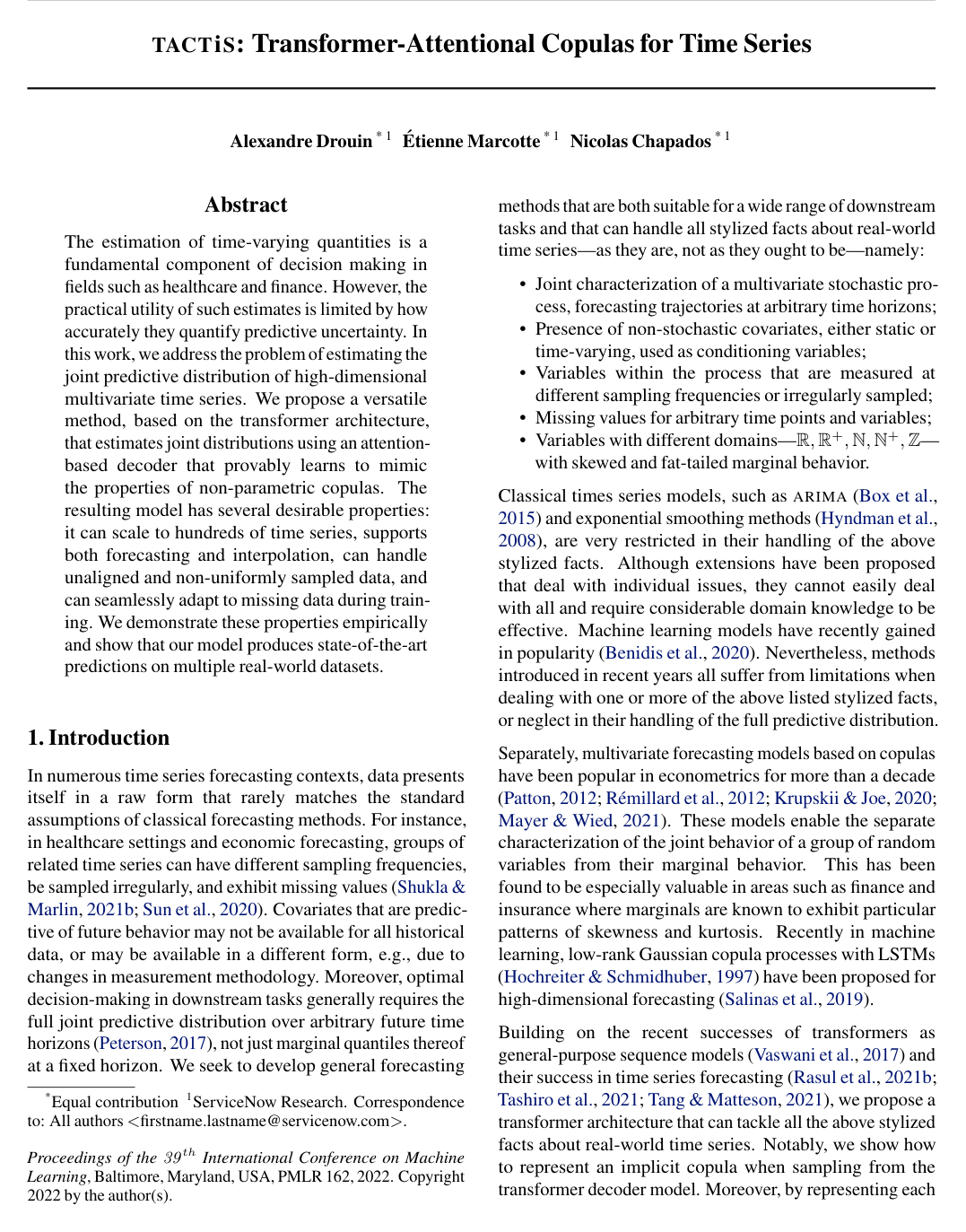
TACTiS: Transformer-Attentional Copulas for Time Series
Alexandre Drouin, Étienne Marcotte, Nicolas Chapados
Why you should read this
Introduces TACTiS, a transformer architecture that models non-parametric copulas through attention mechanisms to deliver state-of-the-art multivariate probabilistic forecasting and interpolation across irregular, unaligned, and missing time series data.
The estimation of time-varying quantities is a fundamental component of decision making in fields such as healthcare and finance. However, the practical utility of such estimates is limited by how accurately they quantify predictive uncertainty. In this work, we address the problem of estimating the joint predictive distribution of high-dimensional multivariate time series. We propose a versatile method, based on the transformer architecture, that estimates joint distributions using an attention-based decoder that provably learns to mimic the properties of non-parametric copulas. The resulting model has several desirable properties: it can scale to hundreds of time series, supports both forecasting and interpolation, can handle unaligned and non-uniformly sampled data, and can seamlessly adapt to missing data during training. We demonstrate these properties empirically and show that our model produces state-of-the-art predictions on multiple real-world datasets.
Added
2026-09-26
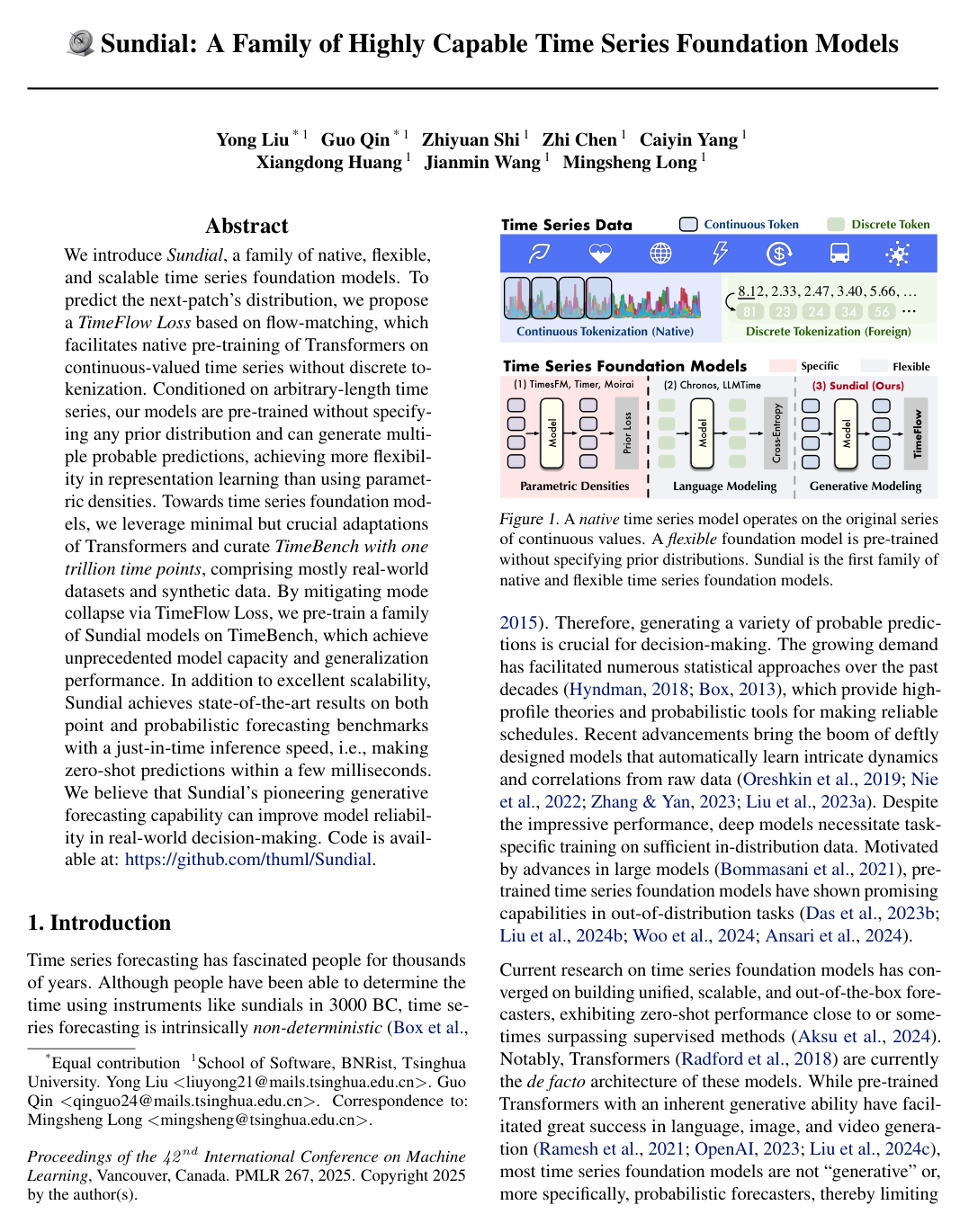
Sundial: A Family of Highly Capable Time Series Foundation Models
Yong Liu, Guo Qin, Zhiyuan Shi, Zhi Chen, Caiyin Yang, Xiangdong Huang, Jianmin Wang, Mingsheng Long
Why you should read this
Presents Sundial, a family of time series foundation models pre-trained on a one-trillion-point dataset using a flow-matching objective to enable fast, zero-shot probabilistic forecasting directly on continuous data without discrete tokenization.
We introduce Sundial, a family of native, flexible, and scalable time series foundation models. To predict the next-patch's distribution, we propose a TimeFlow Loss based on flow-matching, which facilitates native pre-training of Transformers on continuous-valued time series without discrete tokenization. Conditioned on arbitrary-length time series, our models are pre-trained without specifying any prior distribution and can generate multiple probable predictions, achieving more flexibility in representation learning than using parametric densities. Towards time series foundation models, we leverage minimal but crucial adaptations of Transformers and curate TimeBench with one trillion time points, comprising mostly real-world datasets and synthetic data. By mitigating mode collapse via TimeFlow Loss, we pre-train a family of Sundial models on TimeBench, which achieve unprecedented model capacity and generalization performance. In addition to excellent scalability, Sundial achieves state-of-the-art results on both point and probabilistic forecasting benchmarks with a just-in-time inference speed, i.e., making zero-shot predictions within a few milliseconds. We believe that Sundial's pioneering generative forecasting capability can improve model reliability in real-world decision-making. Code is available at: https://github.com/thuml/Sundial.
Added
2026-09-26
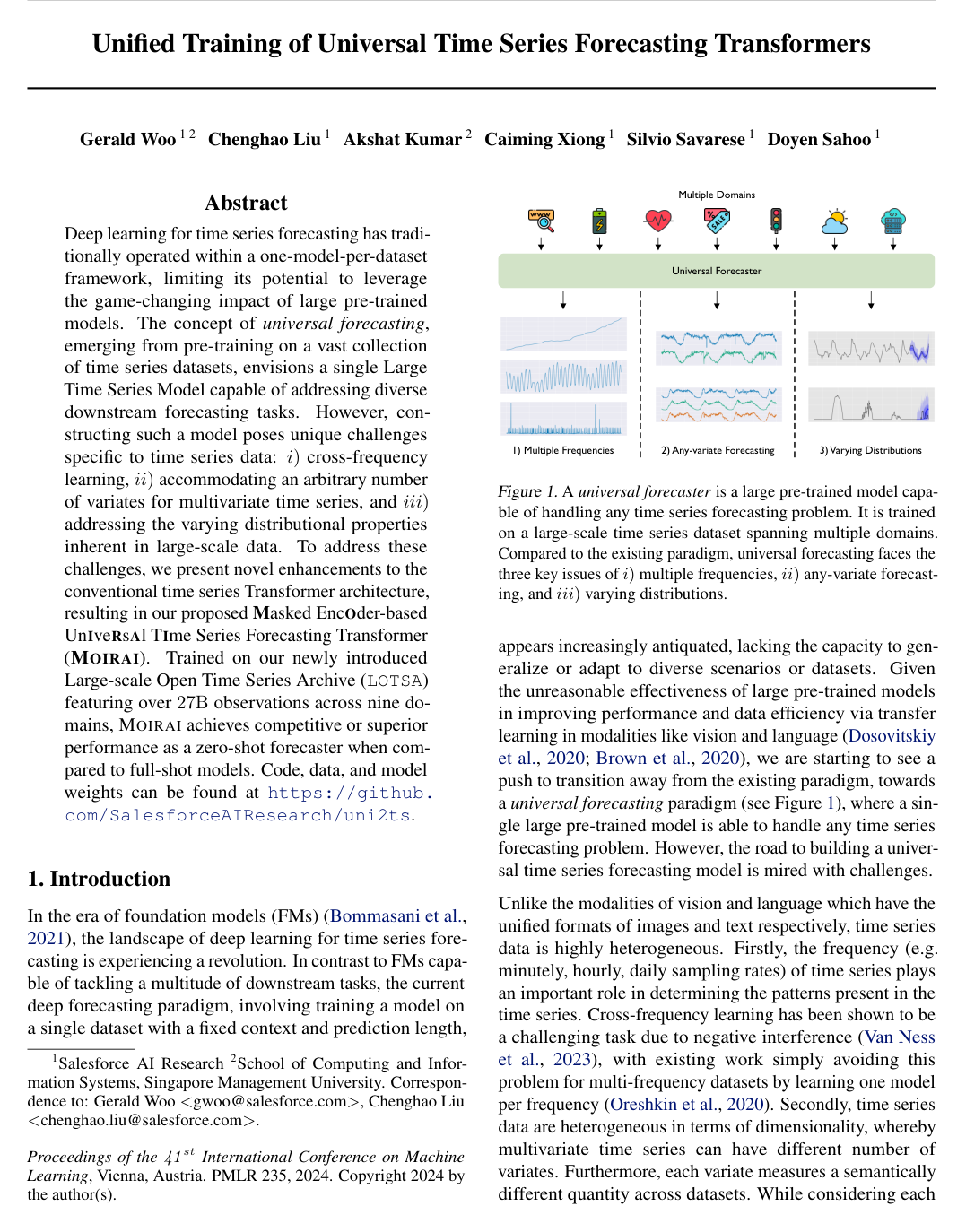
Unified Training of Universal Time Series Forecasting Transformers
Gerald Woo, Chenghao Liu, Akshat Kumar, Caiming Xiong, Silvio Savarese, Doyen Sahoo
Why you should read this
Presents Moirai, a universal time series transformer trained on the 27-billion-observation LOTSA archive, which handles arbitrary variate counts and frequencies to match or outperform dataset-specific models in zero-shot forecasting.
Deep learning for time series forecasting has traditionally operated within a one-model-per-dataset framework, limiting its potential to leverage the game-changing impact of large pre-trained models. The concept of universal forecasting, emerging from pre-training on a vast collection of time series datasets, envisions a single Large Time Series Model capable of addressing diverse downstream forecasting tasks. However, constructing such a model poses unique challenges specific to time series data: i) cross-frequency learning, ii) accommodating an arbitrary number of variates for multivariate time series, and iii) addressing the varying distributional properties inherent in large-scale data. To address these challenges, we present novel enhancements to the conventional time series Transformer architecture, resulting in our proposed Masked Encoder-based Universal Time Series Forecasting Transformer (Moirai). Trained on our newly introduced Large-scale Open Time Series Archive (LOTSA) featuring over 27B observations across nine domains, Moirai achieves competitive or superior performance as a zero-shot forecaster when compared to full-shot models. Code, data, and model weights can be found at this https URL.
Added
2026-09-26
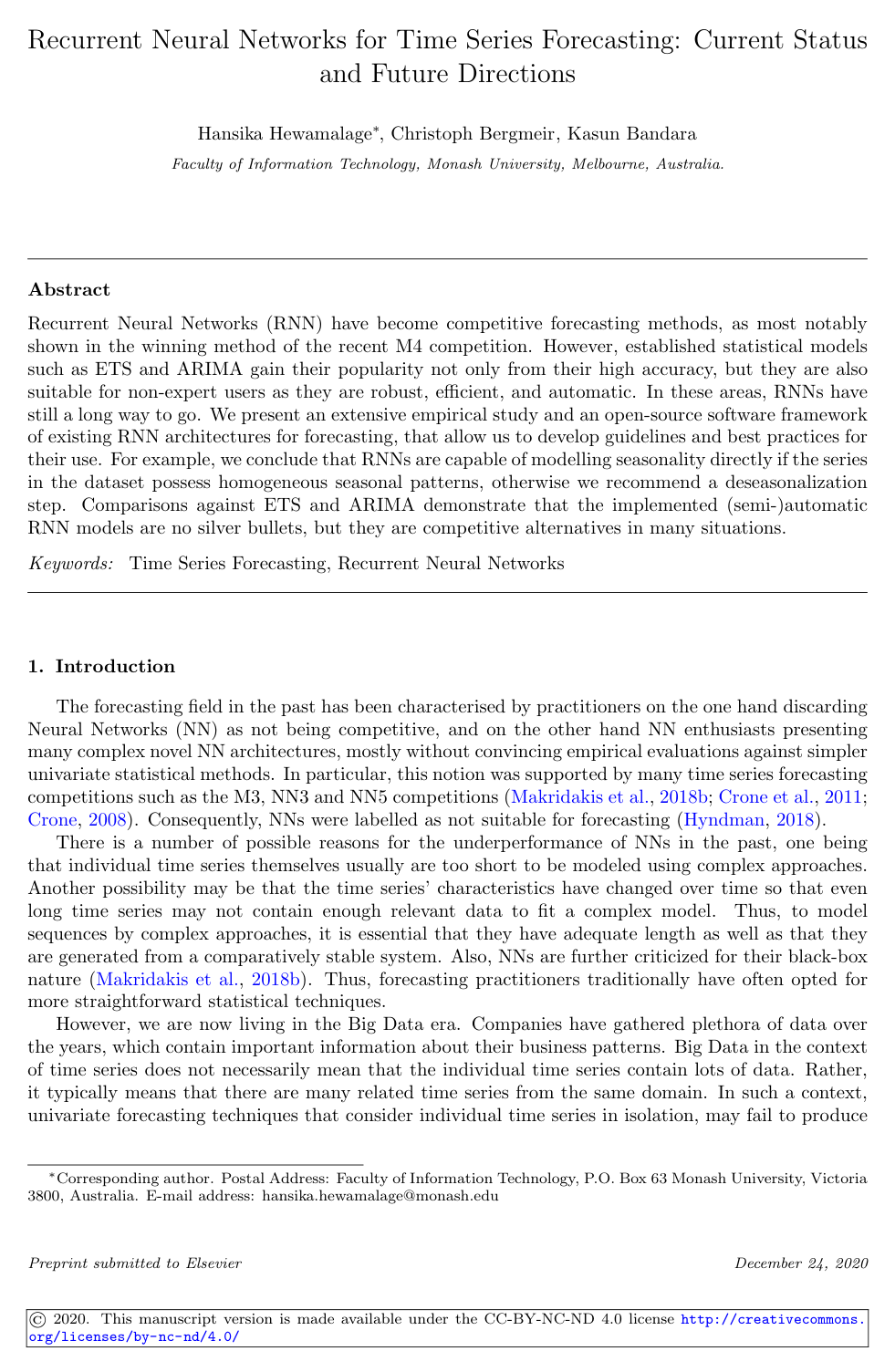
Recurrent Neural Networks for Time Series Forecasting: Current Status and Future Directions
Hansika Hewamalage, Christoph Bergmeir, Kasun Bandara
Why you should read this
Establishes practical guidelines and an open-source framework for time series forecasting with recurrent neural networks through extensive empirical comparisons against standard statistical baselines like ARIMA and ETS.
Recurrent Neural Networks (RNN) have become competitive forecasting methods, as most notably shown in the winning method of the recent M4 competition. However, established statistical models such as ETS and ARIMA gain their popularity not only from their high accuracy, but they are also suitable for non-expert users as they are robust, efficient, and automatic. In these areas, RNNs have still a long way to go. We present an extensive empirical study and an open-source software framework of existing RNN architectures for forecasting, that allow us to develop guidelines and best practices for their use. For example, we conclude that RNNs are capable of modelling seasonality directly if the series in the dataset possess homogeneous seasonal patterns, otherwise we recommend a deseasonalization step. Comparisons against ETS and ARIMA demonstrate that the implemented (semi-)automatic RNN models are no silver bullets, but they are competitive alternatives in many situations.
Added
2026-09-25
Time-series forecasting with deep learning: a survey
Bryan Lim, Stefan Zohren
Why you should read this
Categorizes modern deep learning and hybrid statistical architectures for multi-horizon time series forecasting, providing a clear guide on how different models encode temporal dynamics for operational decision support.
Numerous deep learning architectures have been developed to accommodate the diversity of time series datasets across different domains. In this article, we survey common encoder and decoder designs used in both one-step-ahead and multi-horizon time series forecasting -- describing how temporal information is incorporated into predictions by each model. Next, we highlight recent developments in hybrid deep learning models, which combine well-studied statistical models with neural network components to improve pure methods in either category. Lastly, we outline some ways in which deep learning can also facilitate decision support with time series data.
Added
2026-09-18
Enhancing the Locality and Breaking the Memory Bottleneck of Transformer on Time Series Forecasting
SHIYANG LI, Xiaoyong Jin, Yao Xuan, Xiyou Zhou, Wenhu Chen, Yu-Xiang Wang, Xifeng Yan
Why you should read this
Proposes convolutional self-attention and a LogSparse Transformer architecture that reduces memory complexity to O(L(log L)^2), solving the key challenges of local context insensitivity and quadratic memory bottlenecks in long-sequence time series forecasting.
Time series forecasting is an important problem across many domains, including predictions of solar plant energy output, electricity consumption, and traffic jam situation. In this paper, we propose to tackle such forecasting problem with Transformer [1]. Although impressed by its performance in our preliminary study, we found its two major weaknesses: (1) locality-agnostics: the point-wise dot-product self-attention in canonical Transformer architecture is insensitive to local context, which can make the model prone to anomalies in time series; (2) memory bottleneck: space complexity of canonical Transformer grows quadratically with sequence length , making directly modeling long time series infeasible. In order to solve these two issues, we first propose convolutional self-attention by producing queries and keys with causal convolution so that local context can be better incorporated into attention mechanism. Then, we propose LogSparse Transformer with only memory cost, improving forecasting accuracy for time series with fine granularity and strong long-term dependencies under constrained memory budget. Our experiments on both synthetic data and real-world datasets show that it compares favorably to the state-of-the-art.
Added
2026-09-17
DeepAR: Probabilistic Forecasting with Autoregressive Recurrent Networks
David Salinas, Valentin Flunkert, Jan Gasthaus, Tim Januschowski
Why you should read this
Details a globally-trained probabilistic approach leveraging autoregressive recurrent networks to actively learn shared behaviors across thousands of disparate related time series.
Probabilistic forecasting, i.e. estimating the probability distribution of a time series' future given its past, is a key enabler for optimizing business processes. In retail businesses, for example, forecasting demand is crucial for having the right inventory available at the right time at the right place. In this paper we propose DeepAR, a methodology for producing accurate probabilistic forecasts, based on training an auto regressive recurrent network model on a large number of related time series. We demonstrate how by applying deep learning techniques to forecasting, one can overcome many of the challenges faced by widely-used classical approaches to the problem. We show through extensive empirical evaluation on several real-world forecasting data sets accuracy improvements of around 15% compared to state-of-the-art methods.
Added
2026-06-28

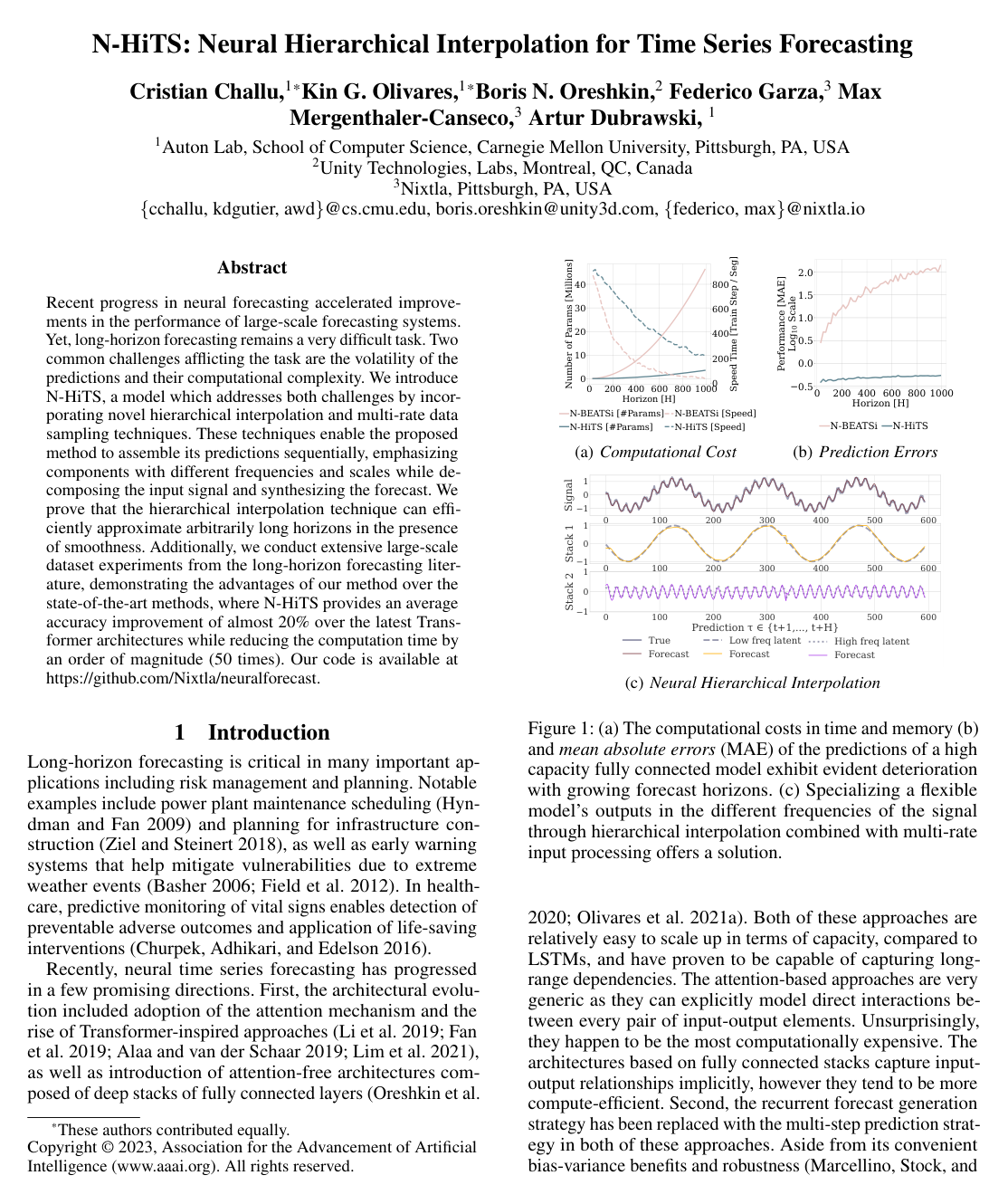
N-HiTS: Neural Hierarchical Interpolation for Time Series Forecasting
Cristian Challu, Kin G. Olivares, Boris N. Oreshkin, Federico Garza, Max Mergenthaler-Canseco, Artur Dubrawski
Why you should read this
Improves upon previous architectures by incorporating multi-rate signal sampling and hierarchical interpolation to computationally capture high-frequency patterns across massive temporal horizons.
Recent progress in neural forecasting accelerated improvements in the performance of large-scale forecasting systems. Yet, long-horizon forecasting remains a very difficult task. Two common challenges afflicting the task are the volatility of the predictions and their computational complexity. We introduce N-HiTS, a model which addresses both challenges by incorporating novel hierarchical interpolation and multi-rate data sampling techniques. These techniques enable the proposed method to assemble its predictions sequentially, emphasizing components with different frequencies and scales while decomposing the input signal and synthesizing the forecast. We prove that the hierarchical interpolation technique can efficiently approximate arbitrarily long horizons in the presence of smoothness. Additionally, we conduct extensive large-scale dataset experiments from the long-horizon forecasting literature, demonstrating the advantages of our method over the state-of-the-art methods, where N-HiTS provides an average accuracy improvement of almost 20% over the latest Transformer architectures while reducing the computation time by an order of magnitude (50 times). Our code is available at bit.ly/3VA5DoT
Added
2026-06-27
N-BEATS: Neural basis expansion analysis for interpretable time series forecasting
Boris N. Oreshkin, Dmitri Carpov, Nicolas Chapados, Yoshua Bengio
Why you should read this
Proposes a pure deep learning architecture comprised of backward and forward residual basis expansions that matches classical interpretability without requiring domain-specific feature engineering.
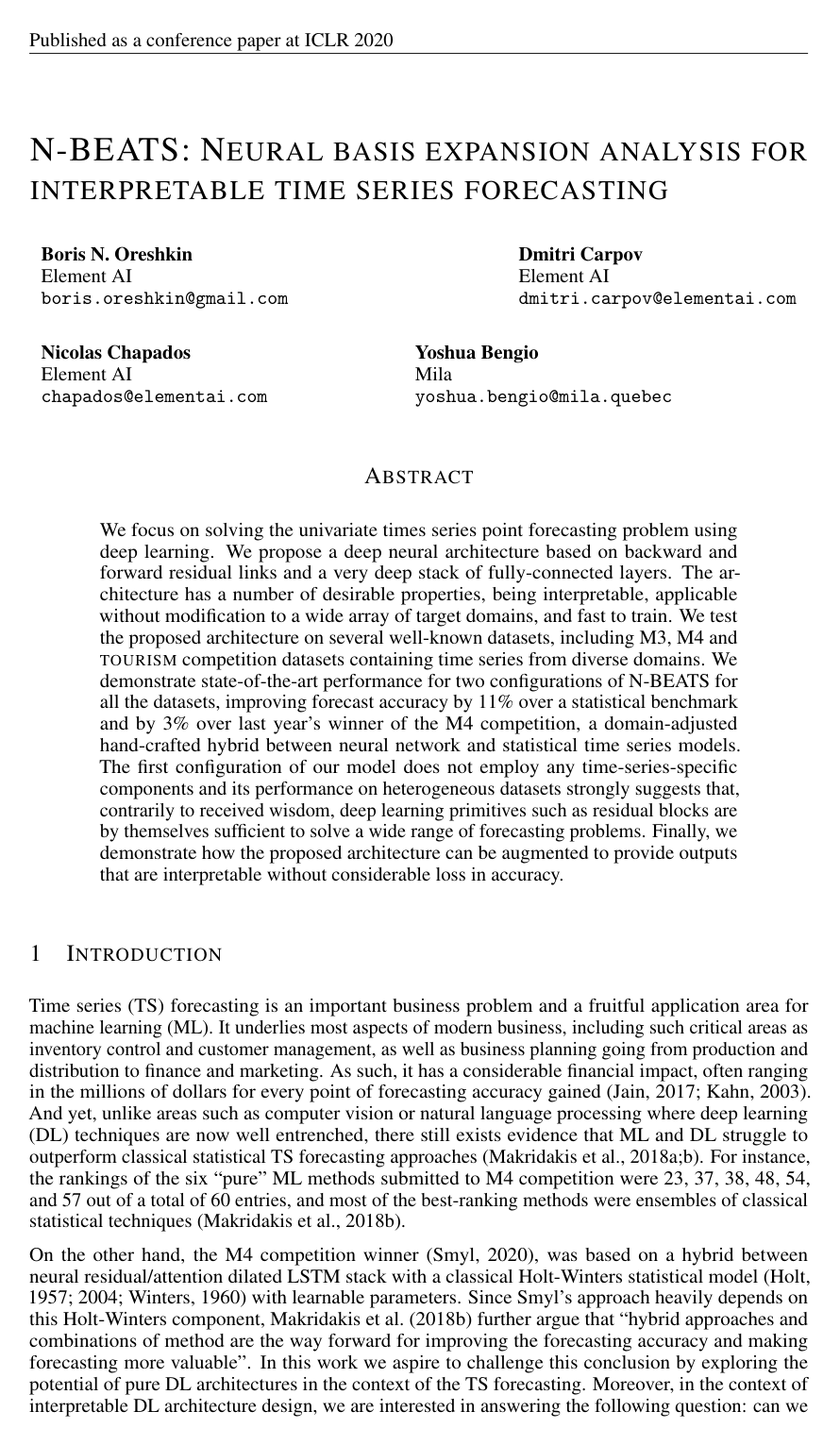
We focus on solving the univariate times series point forecasting problem using deep learning. We propose a deep neural architecture based on backward and forward residual links and a very deep stack of fully-connected layers. The architecture has a number of desirable properties, being interpretable, applicable without modification to a wide array of target domains, and fast to train. We test the proposed architecture on several well-known datasets, including M3, M4 and TOURISM competition datasets containing time series from diverse domains. We demonstrate state-of-the-art performance for two configurations of N-BEATS for all the datasets, improving forecast accuracy by 11% over a statistical benchmark and by 3% over last year's winner of the M4 competition, a domain-adjusted hand-crafted hybrid between neural network and statistical time series models. The first configuration of our model does not employ any time-series-specific components and its performance on heterogeneous datasets strongly suggests that, contrarily to received wisdom, deep learning primitives such as residual blocks are by themselves sufficient to solve a wide range of forecasting problems. Finally, we demonstrate how the proposed architecture can be augmented to provide outputs that are interpretable without considerable loss in accuracy.
Added
2026-06-27