
keyword
image reconstruction
Image reconstruction is the process of recovering or synthesizing a complete, high-quality image from indirect, incomplete, compressed, or degraded data representations. It functions by inverting a forward encoding, physical acquisition, or degradation process to transform information from intermediate forms—such as raw sensor measurements in medical scans, sub-sampled signals in compressive sensing, or compact latent tokens in computational models—back into a visually interpretable and spatially coherent image. Often formulated as an inverse problem, image reconstruction relies on analytical transforms, mathematical optimization techniques, or trained neural networks to suppress noise, resolve missing spatial information, and faithfully recover the underlying visual structure.
10 items
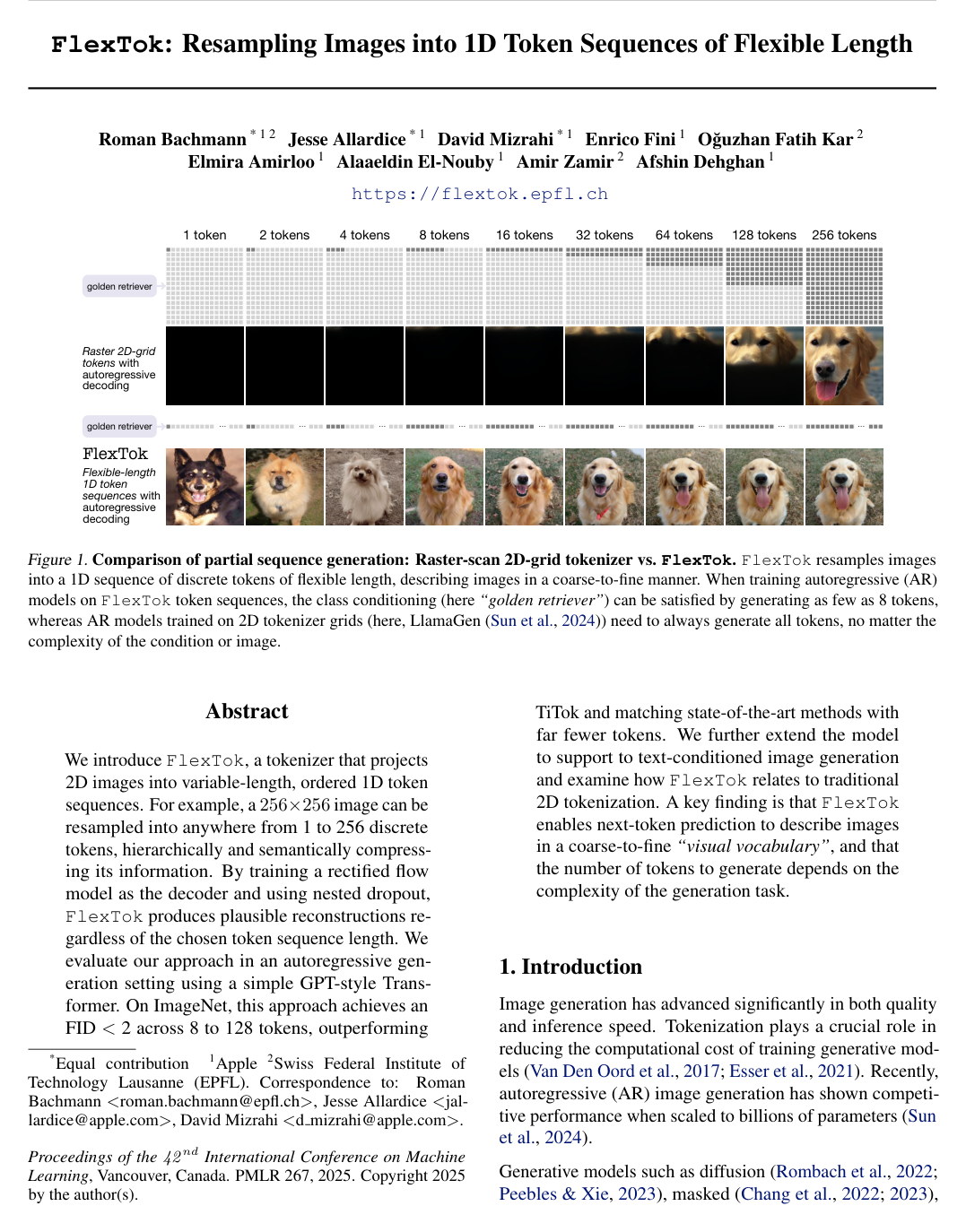
FlexTok: Resampling Images into 1D Token Sequences of Flexible Length
Roman Bachmann, Jesse Allardice, David Mizrahi, Enrico Fini, Oguzhan Fatih Kar, Elmira Amirloo, Alaaeldin El-Nouby, Amir Zamir, Afshin Dehghan
Why you should read this
Introduces an image tokenizer that encodes 2D visual content into ordered, variable-length 1D token sequences paired with a rectified flow decoder, enabling autoregressive models to generate high-quality images from coarse to fine details using as few as eight tokens.
We introduce FlexTok, a tokenizer that projects 2D images into variable-length, ordered 1D token sequences. For example, a 256×256 image can be resampled into anywhere from 1 to 256 discrete tokens, hierarchically and semantically compressing its information. By training a rectified flow model as the decoder and using nested dropout, FlexTok produces plausible reconstructions regardless of the chosen token sequence length. We evaluate our approach in an autoregressive generation setting using a simple GPT-style Transformer. On ImageNet, this approach achieves an FID < 2 across 8 to 128 tokens, outperforming TiTok and matching state-of-the-art methods with far fewer tokens. We further extend the model to support to text-conditioned image generation and examine how FlexTok relates to traditional 2D tokenization. A key finding is that FlexTok enables next-token prediction to describe images in a coarse-to-fine “visual vocabulary”, and that the number of tokens to generate depends on the complexity of the generation task.
Added
2026-10-02
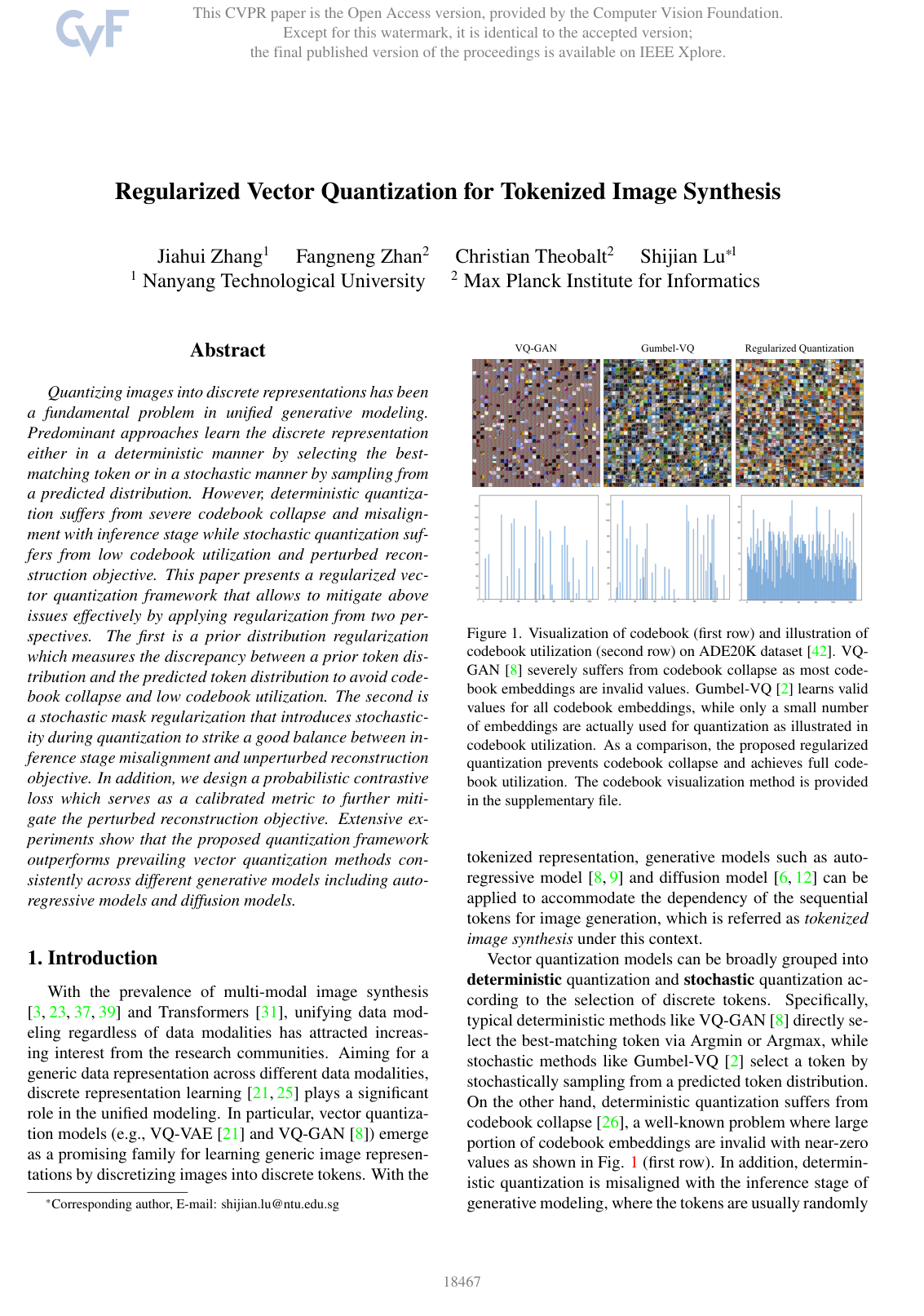
Regularized Vector Quantization for Tokenized Image Synthesis
Jiahui Zhang, Fangneng Zhan, Christian Theobalt, Shijian Lu
Why you should read this
Proposes a dual-regularized vector quantization framework with a probabilistic contrastive loss that prevents codebook collapse and aligns training with stochastic sampling for superior image synthesis in autoregressive and diffusion models.
Quantizing images into discrete representations has been a fundamental problem in unified generative modeling. Predominant approaches learn the discrete representation either in a deterministic manner by selecting the best-matching token or in a stochastic manner by sampling from a predicted distribution. However, deterministic quantization suffers from severe codebook collapse and misalignment with inference stage while stochastic quantization suffers from low codebook utilization and perturbed reconstruction objective. This paper presents a regularized vector quantization framework that allows to mitigate above issues effectively by applying regularization from two perspectives. The first is a prior distribution regularization which measures the discrepancy between a prior token distribution and the predicted token distribution to avoid codebook collapse and low codebook utilization. The second is a stochastic mask regularization that introduces stochasticity during quantization to strike a good balance between inference stage misalignment and unperturbed reconstruction objective. In addition, we design a probabilistic contrastive loss which serves as a calibrated metric to further mitigate the perturbed reconstruction objective. Extensive experiments show that the proposed quantization framework outperforms prevailing vector quantization methods consistently across different generative models including auto-regressive models and diffusion models.
Added
2026-09-26
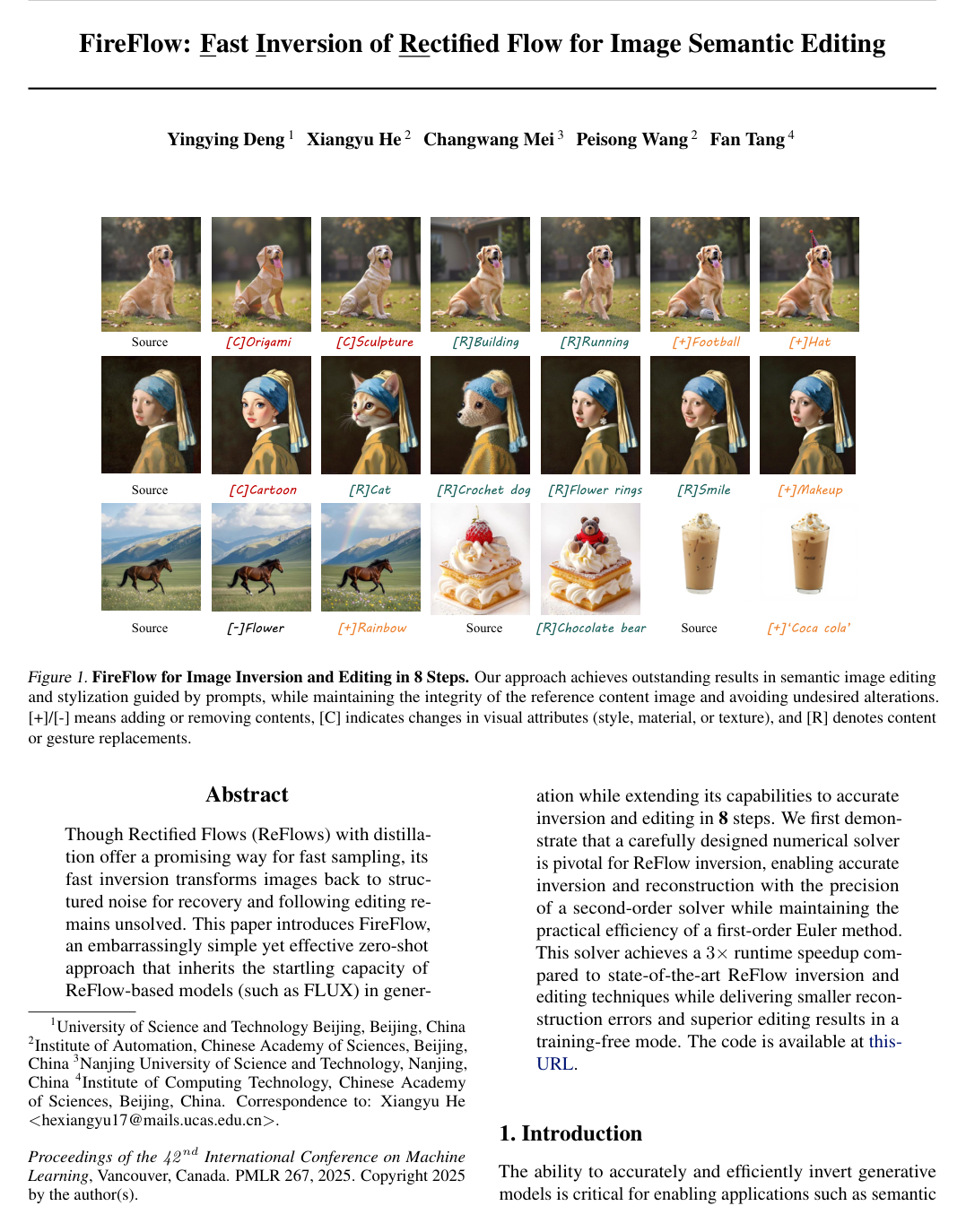
FireFlow: Fast Inversion of Rectified Flow for Image Semantic Editing
Yingying Deng, Xiangyu He, Changwang Mei, Peisong Wang, Fan Tang
Why you should read this
Introduces a training-free numerical solver for rectified flow models that achieves second-order inversion precision with first-order computational efficiency, enabling high-fidelity image semantic editing in only eight steps with a three-fold speedup.
Though Rectified Flows (ReFlows) with distillation offer a promising way for fast sampling, its fast inversion transforms images back to structured noise for recovery and following editing remains unsolved. This paper introduces FireFlow, an embarrassingly simple yet effective zero-shot approach that inherits the startling capacity of ReFlow-based models (such as FLUX) in generation while extending its capabilities to accurate inversion and editing in 8 steps. We first demonstrate that a carefully designed numerical solver is pivotal for ReFlow inversion, enabling accurate inversion and reconstruction with the precision of a second-order solver while maintaining the practical efficiency of a first-order Euler method. This solver achieves a 3× runtime speedup compared to state-of-the-art ReFlow inversion and editing techniques while delivering smaller reconstruction errors and superior editing results in a training-free mode. The code is available at this-URL.
Added
2026-09-26
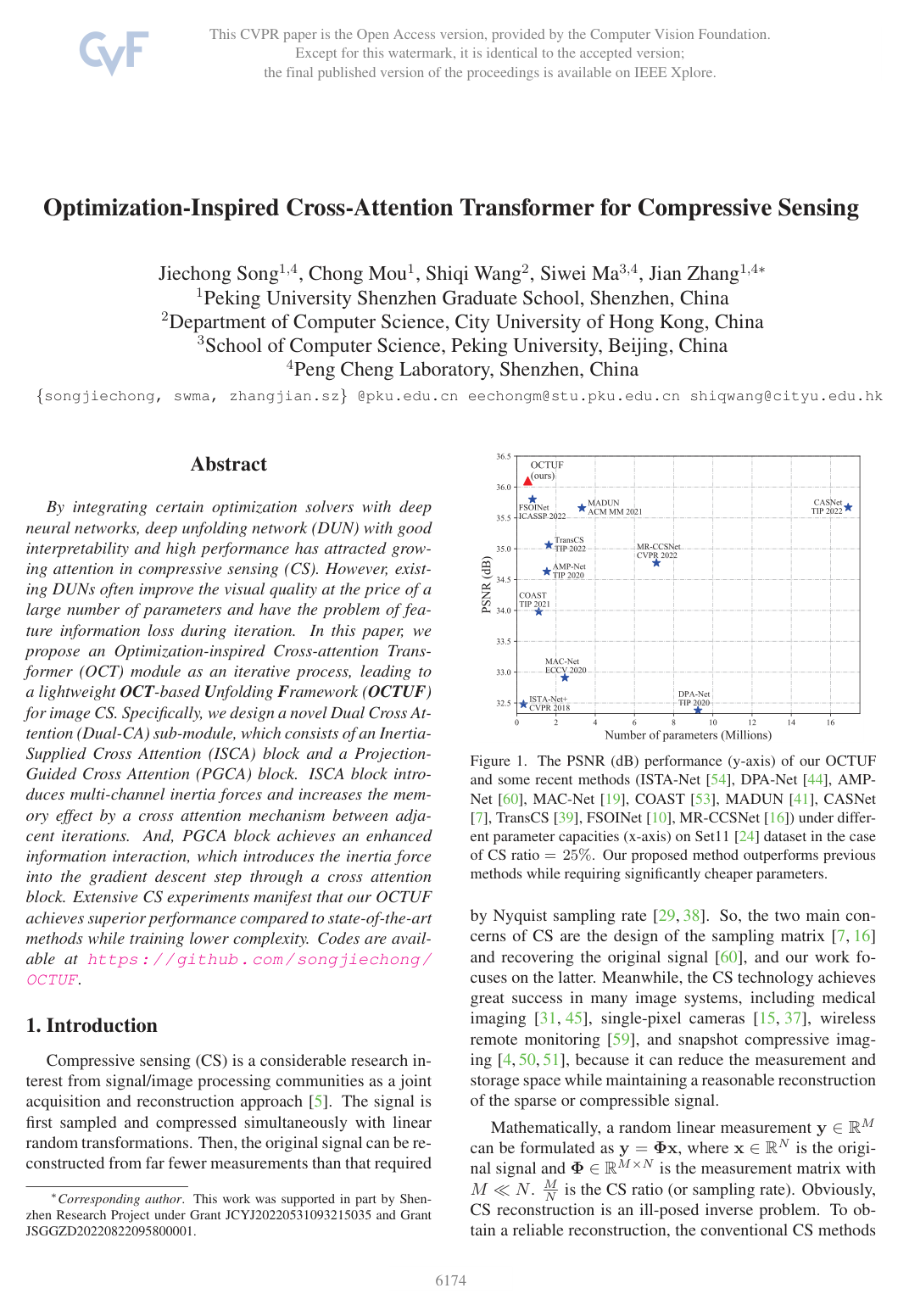
Optimization-Inspired Cross-Attention Transformer for Compressive Sensing
Jiechong Song, Chong Mou, Shiqi Wang, Siwei Ma, Jian Zhang
Why you should read this
Proposes a lightweight deep unfolding framework that integrates cross-attention mechanisms directly into the iterative optimization steps of compressive sensing, preserving inter-stage feature information to achieve state-of-the-art image reconstruction with substantially fewer parameters.
By integrating certain optimization solvers with deep neural networks, deep unfolding network (DUN) with good interpretability and high performance has attracted growing attention in compressive sensing (CS). However, existing DUNs often improve the visual quality at the price of a large number of parameters and have the problem of feature information loss during iteration. In this paper, we propose an Optimization-inspired Cross-attention Transformer (OCT) module as an iterative process, leading to a lightweight OCT-based Unfolding Framework (OCTUF) for image CS. Specifically, we design a novel Dual Cross Attention (Dual-CA) sub-module, which consists of an Inertia-Supplied Cross Attention (ISCA) block and a Projection-Guided Cross Attention (PGCA) block. ISCA block introduces multi-channel inertia forces and increases the memory effect by a cross attention mechanism between adjacent iterations. And, PGCA block achieves an enhanced information interaction, which introduces the inertia force into the gradient descent step through a cross attention block. Extensive CS experiments manifest that our OCTUF achieves superior performance compared to state-of-the-art methods while training lower complexity. Codes are available at https://github.com/songjiechong/OCTUF.
Added
2026-09-26
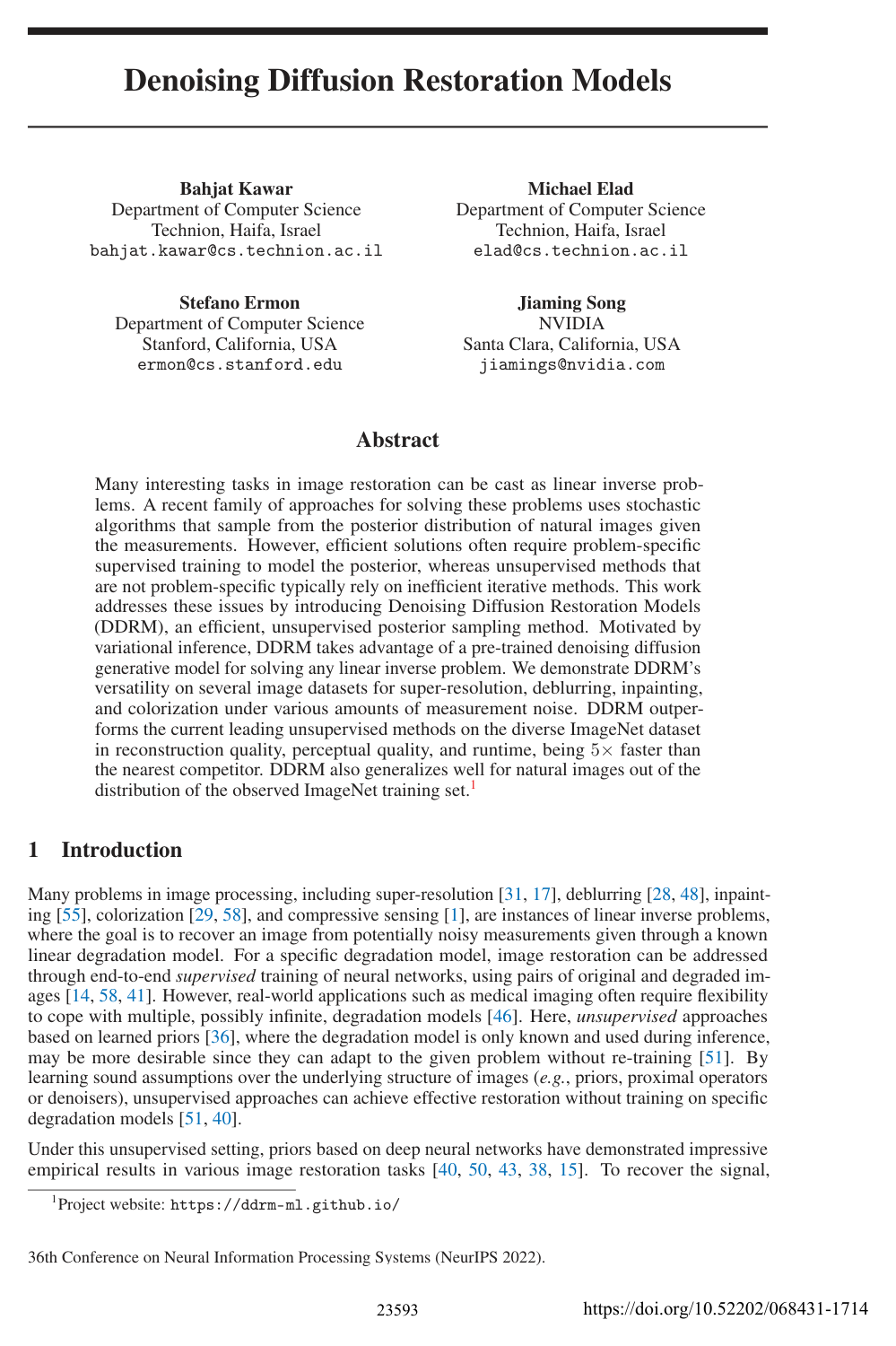
Denoising Diffusion Restoration Models
Bahjat Kawar, Michael Elad, S. Ermon, Jiaming Song
Why you should read this
Proposes Denoising Diffusion Restoration Models (DDRM), an unsupervised method that leverages pre-trained unconditional diffusion models to efficiently solve diverse linear inverse problems—such as super-resolution, deblurring, and inpainting—in as few as 20 steps without requiring task-specific training.
Many interesting tasks in image restoration can be cast as linear inverse problems. A recent family of approaches for solving these problems uses stochastic algorithms that sample from the posterior distribution of natural images given the measurements. However, efficient solutions often require problem-specific supervised training to model the posterior, whereas unsupervised methods that are not problem-specific typically rely on inefficient iterative methods. This work addresses these issues by introducing Denoising Diffusion Restoration Models (DDRM), an efficient, unsupervised posterior sampling method. Motivated by variational inference, DDRM takes advantage of a pre-trained denoising diffusion generative model for solving any linear inverse problem. We demonstrate DDRM’s versatility on several image datasets for super-resolution, deblurring, inpainting, and colorization under various amounts of measurement noise. DDRM outperforms the current leading unsupervised methods on the diverse ImageNet dataset in reconstruction quality, perceptual quality, and runtime, being 5× faster than the nearest competitor. DDRM also generalizes well for natural images out of the distribution of the observed ImageNet training set.
Added
2026-09-25
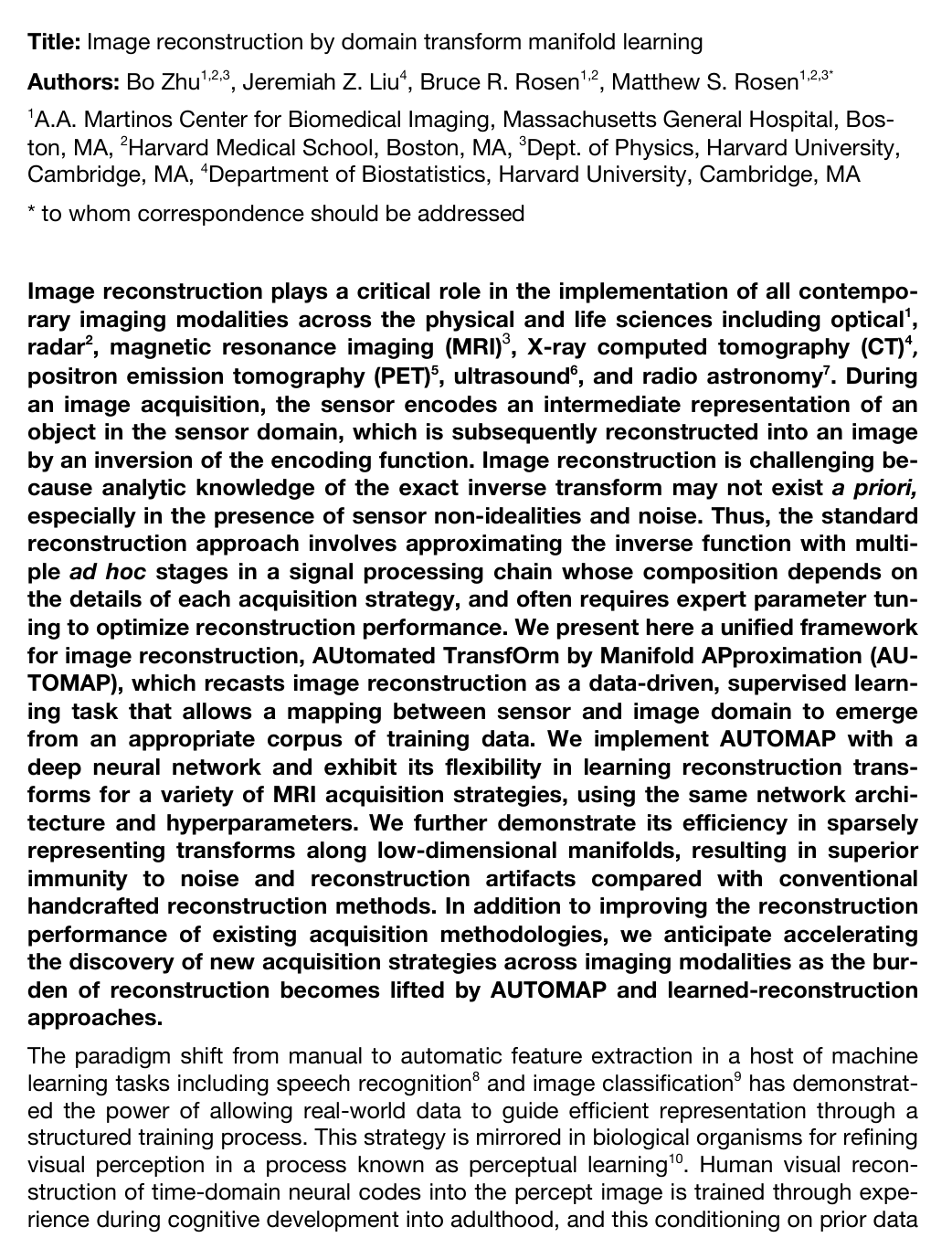
Image reconstruction by domain-transform manifold learning
Bo Zhu, Jeremiah Z. Liu, Bruce R. Rosen, Matthew S. Rosen
Why you should read this
Introduces AUTOMAP, a unified deep learning framework that learns direct transforms from raw sensor data to images across diverse acquisition strategies, eliminating ad hoc reconstruction pipelines while reducing noise and artifacts.
Image reconstruction plays a critical role in the implementation of all contemporary imaging modalities across the physical and life sciences including optical, MRI, CT, PET, and radio astronomy. During an image acquisition, the sensor encodes an intermediate representation of an object in the sensor domain, which is subsequently reconstructed into an image by an inversion of the encoding function. Image reconstruction is challenging because analytic knowledge of the inverse transform may not exist a priori, especially in the presence of sensor non-idealities and noise. Thus, the standard reconstruction approach involves approximating the inverse function with multiple ad hoc stages in a signal processing chain whose composition depends on the details of each acquisition strategy, and often requires expert parameter tuning to optimize reconstruction performance. We present here a unified framework for image reconstruction, AUtomated TransfOrm by Manifold APproximation (AUTOMAP), which recasts image reconstruction as a data-driven, supervised learning task that allows a mapping between sensor and image domain to emerge from an appropriate corpus of training data. We implement AUTOMAP with a deep neural network and exhibit its flexibility in learning reconstruction transforms for a variety of MRI acquisition strategies, using the same network architecture and hyperparameters. We further demonstrate its efficiency in sparsely representing transforms along low-dimensional manifolds, resulting in superior immunity to noise and reconstruction artifacts compared with conventional handcrafted reconstruction methods. In addition to improving the reconstruction performance of existing acquisition methodologies, we anticipate accelerating the discovery of new acquisition strategies across modalities as the burden of reconstruction becomes lifted by AUTOMAP and learned-reconstruction approaches.
Added
2026-09-24
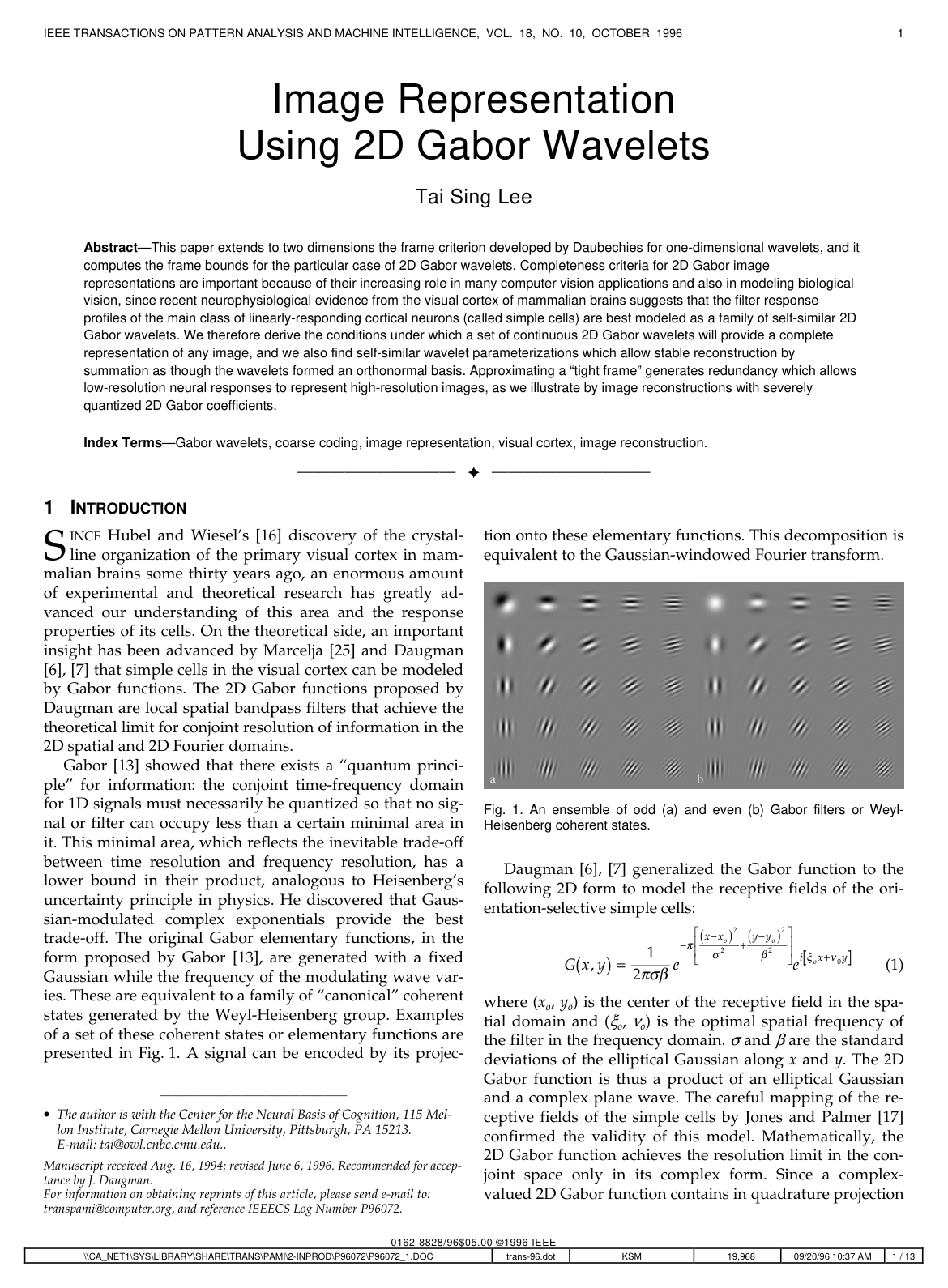
Image Representation Using 2D Gabor Wavelets
Tai-Sing Lee
Why you should read this
Establishes mathematical completeness conditions and tight frame bounds for 2D Gabor wavelets, demonstrating how biologically plausible visual cortex filters enable stable image reconstruction even from coarsely quantized neural responses.
This paper extends to two dimensions the frame criterion developed by Daubechies for one-dimensional wavelets, and it computes the frame bounds for the particular case of 2D Gabor wavelets. Completeness criteria for 2D Gabor image representations are important because of their increasing role in many computer vision applications and also in modeling biological vision, since recent neurophysiological evidence from the visual cortex of mammalian brains suggests that the filter response profiles of the main class of linearly-responding cortical neurons (called simple cells) are best modeled as a family of self-similar 2D Gabor wavelets. We therefore derive the conditions under which a set of continuous 2D Gabor wavelets will provide a complete representation of any image, and we also find self-similar wavelet parameterizations which allow stable reconstruction by summation as though the wavelets formed an orthonormal basis. Approximating a “tight frame” generates redundancy which allows low-resolution neural responses to represent high-resolution images, as we illustrate by image reconstructions with severely quantized 2D Gabor coefficients.
Added
2026-09-18
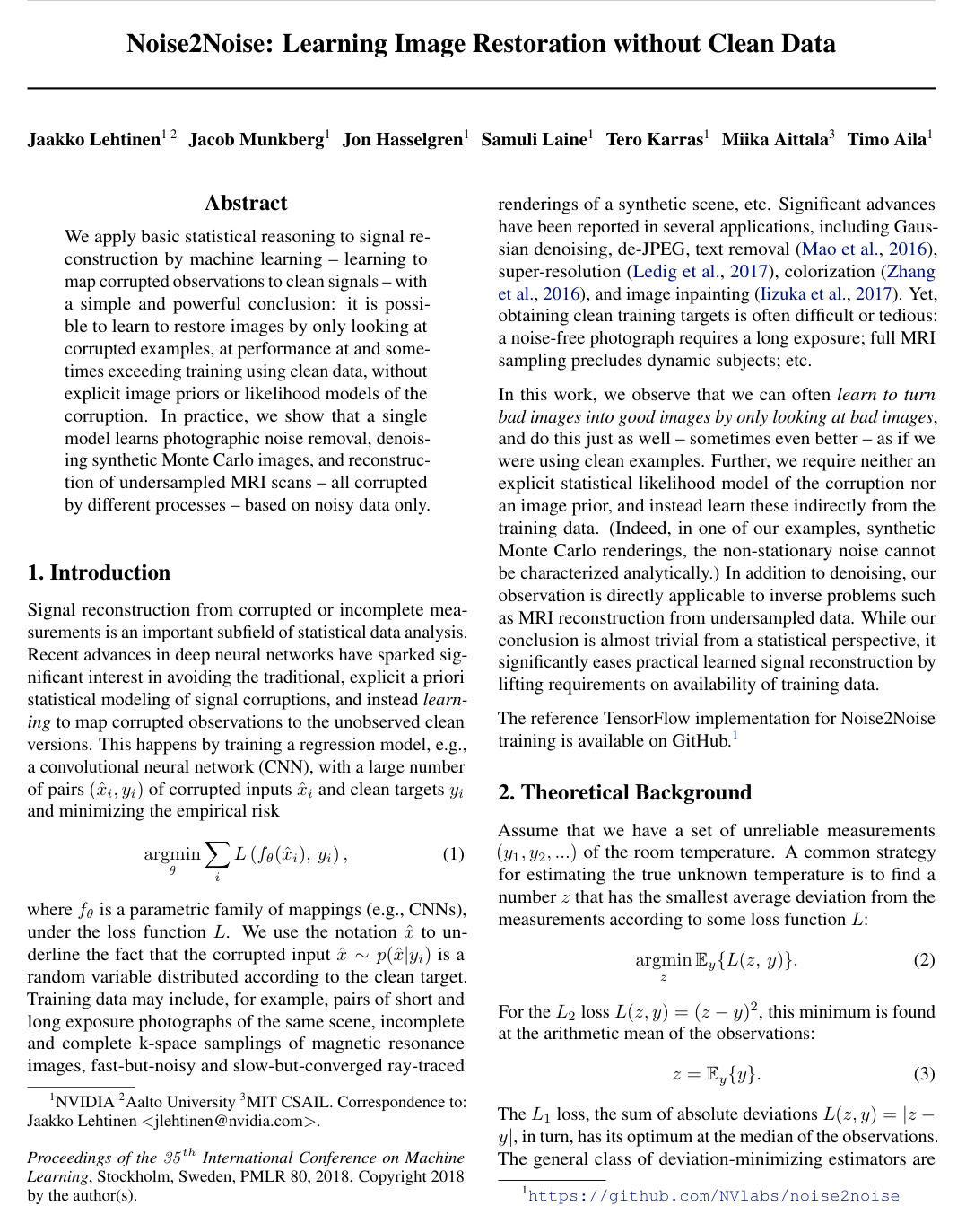
Noise2Noise: Learning Image Restoration without Clean Data
Jaakko Lehtinen, Jacob Munkberg, Jon Hasselgren, Samuli Laine, Tero Karras, Miika Aittala, Timo Aila
Why you should read this
Demonstrates that neural networks can learn to restore images across photographic denoising, Monte Carlo rendering, and MRI reconstruction by training entirely on pairs of corrupted inputs without ever seeing clean targets.
We apply basic statistical reasoning to signal reconstruction by machine learning -- learning to map corrupted observations to clean signals -- with a simple and powerful conclusion: it is possible to learn to restore images by only looking at corrupted examples, at performance at and sometimes exceeding training using clean data, without explicit image priors or likelihood models of the corruption. In practice, we show that a single model learns photographic noise removal, denoising synthetic Monte Carlo images, and reconstruction of undersampled MRI scans -- all corrupted by different processes -- based on noisy data only.
Added
2026-09-18
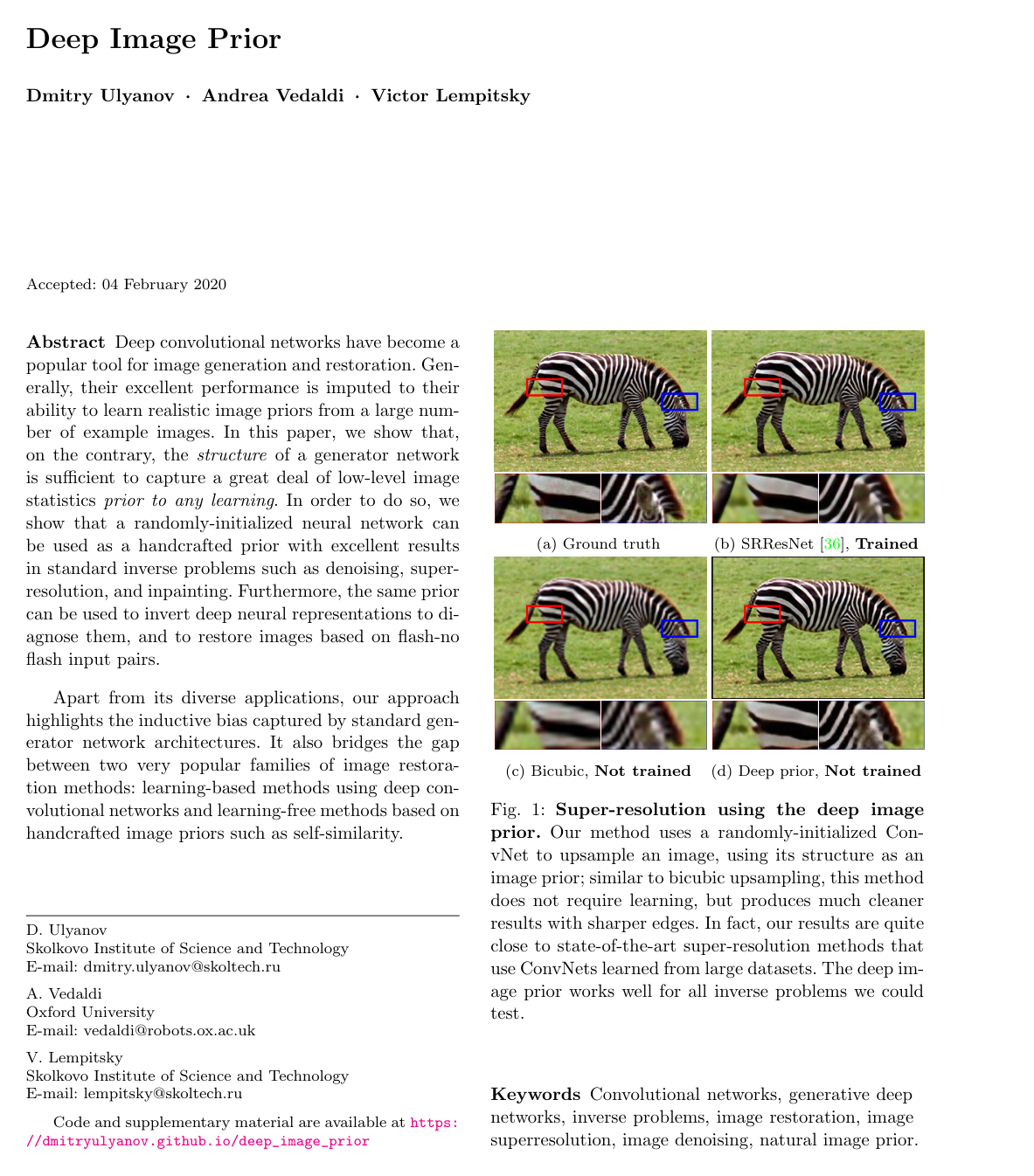
Deep Image Prior
Dmitry Ulyanov, Andrea Vedaldi, Victor Lempitsky
Why you should read this
Demonstrates that the structure of an untrained convolutional neural network inherently captures low-level image statistics, enabling tasks like denoising, inpainting, and super-resolution without any training data.
Deep convolutional networks have become a popular tool for image generation and restoration. Generally, their excellent performance is imputed to their ability to learn realistic image priors from a large number of example images. In this paper, we show that, on the contrary, the structure of a generator network is sufficient to capture a great deal of low-level image statistics prior to any learning. In order to do so, we show that a randomly-initialized neural network can be used as a handcrafted prior with excellent results in standard inverse problems such as denoising, super-resolution, and inpainting. Furthermore, the same prior can be used to invert deep neural representations to diagnose them, and to restore images based on flash-no flash input pairs. Apart from its diverse applications, our approach highlights the inductive bias captured by standard generator network architectures. It also bridges the gap between two very popular families of image restoration methods: learning-based methods using deep convolutional networks and learning-free methods based on handcrafted image priors such as self-similarity. Code and supplementary material are available at this https URL .
Added
2026-09-11
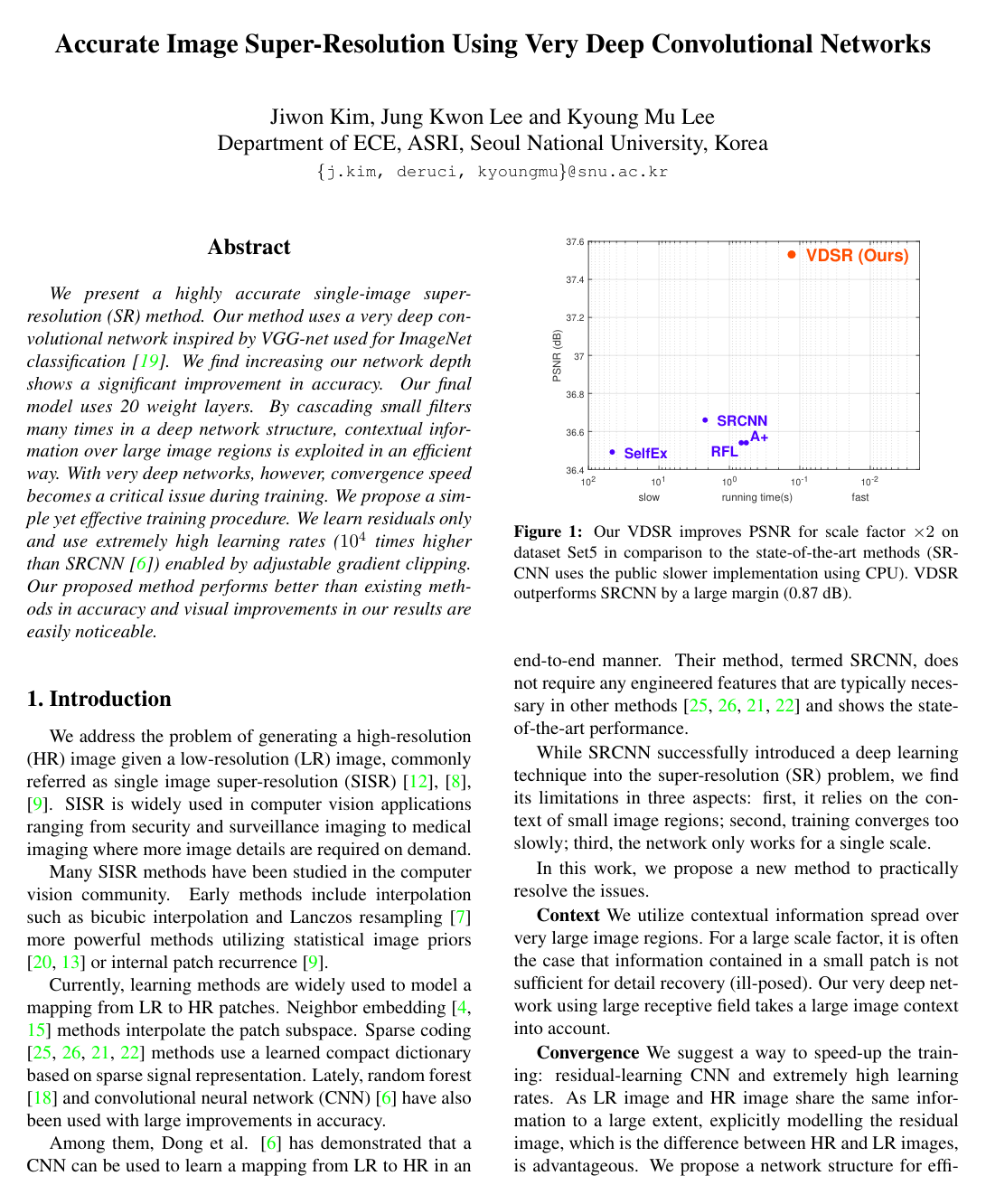
Accurate Image Super-Resolution Using Very Deep Convolutional Networks
Jiwon Kim, Jung Kwon Lee, Kyoung Mu Lee
Why you should read this
Proposes a 20-layer convolutional architecture for single-image super-resolution that incorporates residual learning and adaptive gradient clipping to accelerate training and achieve superior reconstruction accuracy over shallow models.
We present a highly accurate single-image super-resolution (SR) method. Our method uses a very deep convolutional network inspired by VGG-net used for ImageNet classification \cite{simonyan2015very}. We find increasing our network depth shows a significant improvement in accuracy. Our final model uses 20 weight layers. By cascading small filters many times in a deep network structure, contextual information over large image regions is exploited in an efficient way. With very deep networks, however, convergence speed becomes a critical issue during training. We propose a simple yet effective training procedure. We learn residuals only and use extremely high learning rates ( times higher than SRCNN \cite{dong2015image}) enabled by adjustable gradient clipping. Our proposed method performs better than existing methods in accuracy and visual improvements in our results are easily noticeable.
Added
2026-09-09