
keyword
domain shift
Domain shift refers to a change or mismatch in the underlying data distribution between the environment where a machine learning model is trained (the source domain) and the environment where it is tested or deployed (the target domain). Standard machine learning algorithms generally rely on the assumption that training and testing samples are independently and identically distributed from the same statistical distribution. When domain shift occurs—caused by variations in factors such as visual style, sensor equipment, environmental conditions, or demographic contexts—this assumption is violated, leading to significant degradation in model performance and predictive accuracy. To mitigate the adverse impact of domain shift, methodologies such as domain adaptation and domain generalization are designed to align cross-domain feature representations and learn invariant patterns capable of generalizing across diverse or unseen target distributions.
20 items
Domain Adaptation for Time Series Forecasting via Attention Sharing
Xiaoyong Jin, Youngsuk Park, Danielle C. Maddix, Hao Wang, Yuyang Wang
Why you should read this
Proposes an end-to-end domain adaptation framework for time series forecasting that aligns shared attention queries and keys across data-rich and data-scarce domains while preserving domain-specific values to improve multi-horizon predictions.
Recently, deep neural networks have gained increasing popularity in the field of time series forecasting. A primary reason for their success is their ability to effectively capture complex temporal dynamics across multiple related time series. The advantages of these deep forecasters only start to emerge in the presence of a sufficient amount of data. This poses a challenge for typical forecasting problems in practice, where there is a limited number of time series or observations per time series, or both. To cope with this data scarcity issue, we propose a novel domain adaptation framework, Domain Adaptation Forecaster (DAF). DAF leverages statistical strengths from a relevant domain with abundant data samples (source) to improve the performance on the domain of interest with limited data (target). In particular, we use an attention-based shared module with a domain discriminator across domains and private modules for individual domains. We induce domain-invariant latent features (queries and keys) and retrain domain-specific features (values) simultaneously to enable joint training of forecasters on source and target domains. A main insight is that our design of aligning keys allows the target domain to leverage source time series even with different characteristics. Extensive experiments on various domains demonstrate that our proposed method outperforms state-of-the-art baselines on synthetic and real-world datasets, and ablation studies verify the effectiveness of our design choices.
Added
2026-10-01
Cross-Domain Detection of GPT-2-Generated Technical Text
Juan Diego Rodriguez, Todd Hay, David Gros, Zain Shamsi, Ravi Srinivasan
Why you should read this
Demonstrates that machine-generated technical text detectors can successfully transfer across distinct scientific domains with only a few hundred labeled examples, enabling effective identification of synthetic content and paragraph tampering in full-length research papers.
Machine-generated text presents a potential threat not only to the public sphere, but also to the scientific enterprise, whereby genuine research is undermined by convincing, synthetic text. In this paper we examine the problem of detecting GPT-2-generated technical research text. We first consider the realistic scenario where the defender does not have full information about the adversary's text generation pipeline, but is able to label small amounts of in-domain genuine and synthetic text in order to adapt to the target distribution. Even in the extreme scenario of adapting a physics-domain detector to a biomedical detector, we find that only a few hundred labels are sufficient for good performance. Finally, we show that paragraph-level detectors can be used to detect the tampering of full-length documents under a variety of threat models.
Added
2026-09-26
Attracting and Dispersing: A Simple Approach for Source-free Domain Adaptation
Shiqi Yang, Yaxing Wang, Kai Wang, Shangling Jui, Joost van de Weijer
Why you should read this
Proposes a simple source-free domain adaptation method that adapts models without source data by optimizing an upper bound on prediction consistency to attract neighboring features and disperse distant ones, setting a new state of the art on benchmarks like VisDA.
We propose a simple but effective source-free domain adaptation (SFDA) method. Treating SFDA as an unsupervised clustering problem and following the intuition that local neighbors in feature space should have more similar predictions than other features, we propose to optimize an objective of prediction consistency. This objective encourages local neighborhood features in feature space to have similar predictions while features farther away in feature space have dissimilar predictions, leading to efficient feature clustering and cluster assignment simultaneously. For efficient training, we seek to optimize an upper-bound of the objective resulting in two simple terms. Furthermore, we relate popular existing methods in domain adaptation, source-free domain adaptation and contrastive learning via the perspective of discriminability and diversity. The experimental results prove the superiority of our method, and our method can be adopted as a simple but strong baseline for future research in SFDA. Our method can be also adapted to source-free open-set and partial-set DA which further shows the generalization ability of our method. Code is available in https://github.com/Albert0147/AaD_SFDA.
Added
2026-09-26
C-SFDA: A Curriculum Learning Aided Self-Training Framework for Efficient Source Free Domain Adaptation
Nazmul Karim, Niluthpol Chowdhury Mithun, Abhinav Rajvanshi, Han-Pang Chiu, Supun Samarasekera, Nazanin Rahnavard
Why you should read this
Proposes a curriculum-driven self-training framework for source-free domain adaptation that filters out noisy pseudo-labels to prevent early-stage memorization without needing memory banks or expensive feature clustering.
Unsupervised domain adaptation (UDA) approaches focus on adapting models trained on a labeled source domain to an unlabeled target domain. In contrast to UDA, source-free domain adaptation (SFDA) is a more practical setup as access to source data is no longer required during adaptation. Recent state-of-the-art (SOTA) methods on SFDA mostly focus on pseudo-label refinement based self-training which generally suffers from two issues: i) inevitable occurrence of noisy pseudo-labels that could lead to early training time memorization, ii) refinement process requires maintaining a memory bank which creates a significant burden in resource constraint scenarios. To address these concerns, we propose C-SFDA, a curriculum learning aided self-training framework for SFDA that adapts efficiently and reliably to changes across domains based on selective pseudo-labeling. Specifically, we employ a curriculum learning scheme to promote learning from a restricted amount of pseudo labels selected based on their reliabilities. This simple yet effective step successfully prevents label noise propagation during different stages of adaptation and eliminates the need for costly memory-bank based label refinement. Our extensive experimental evaluations on both image recognition and semantic segmentation tasks confirm the effectiveness of our method. C-SFDA is also applicable to online test-time domain adaptation and outperforms previous SOTA methods in this task.
Added
2026-09-26
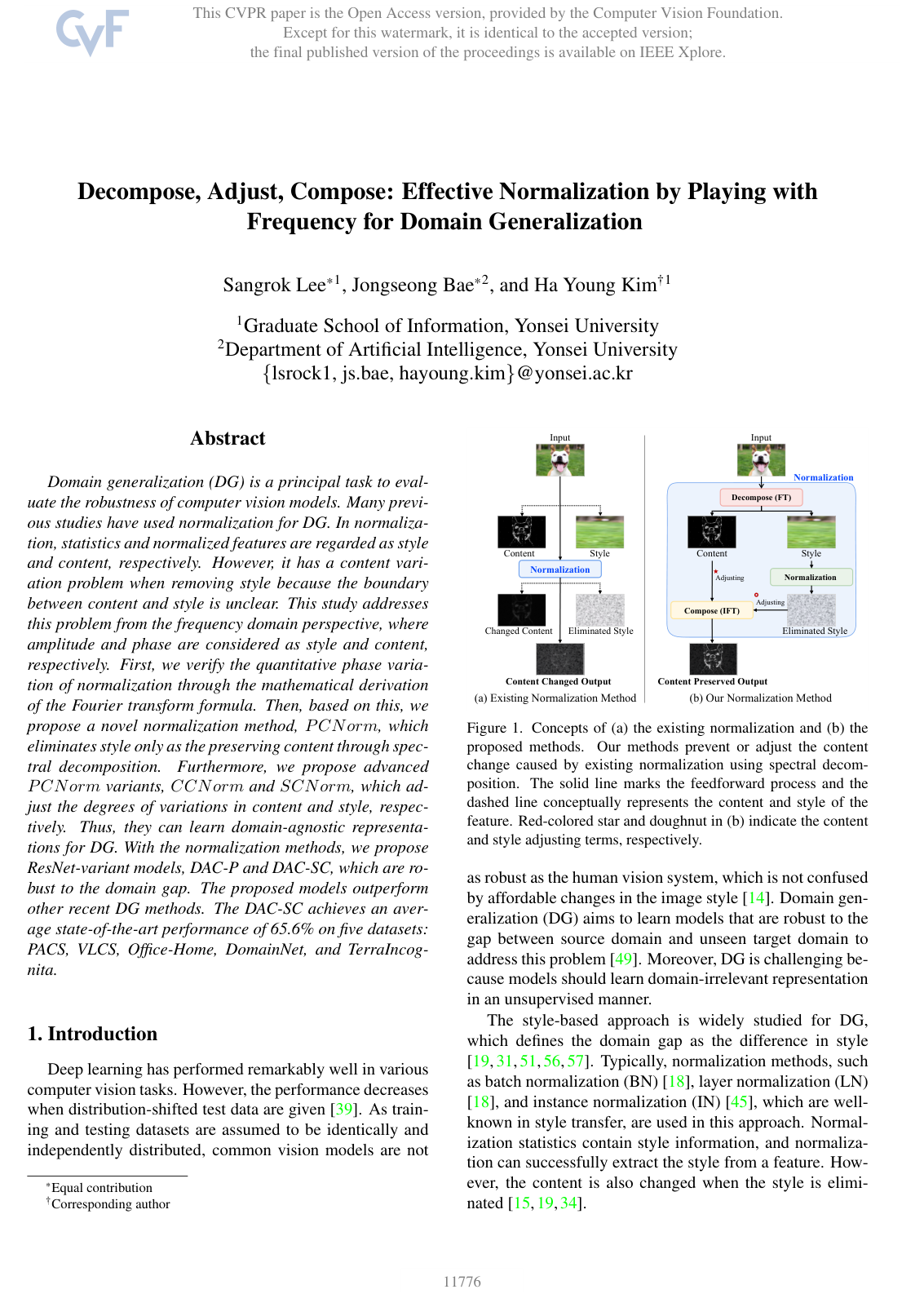
Decompose, Adjust, Compose: Effective Normalization by Playing with Frequency for Domain Generalization
Sangrok Lee, Jongseong Bae, Ha Young Kim
Why you should read this
Proposes a frequency-domain normalization framework that separates and regulates amplitude and phase variations to eliminate domain-specific styles while preserving essential semantic content for domain generalization.
Added
2026-09-26
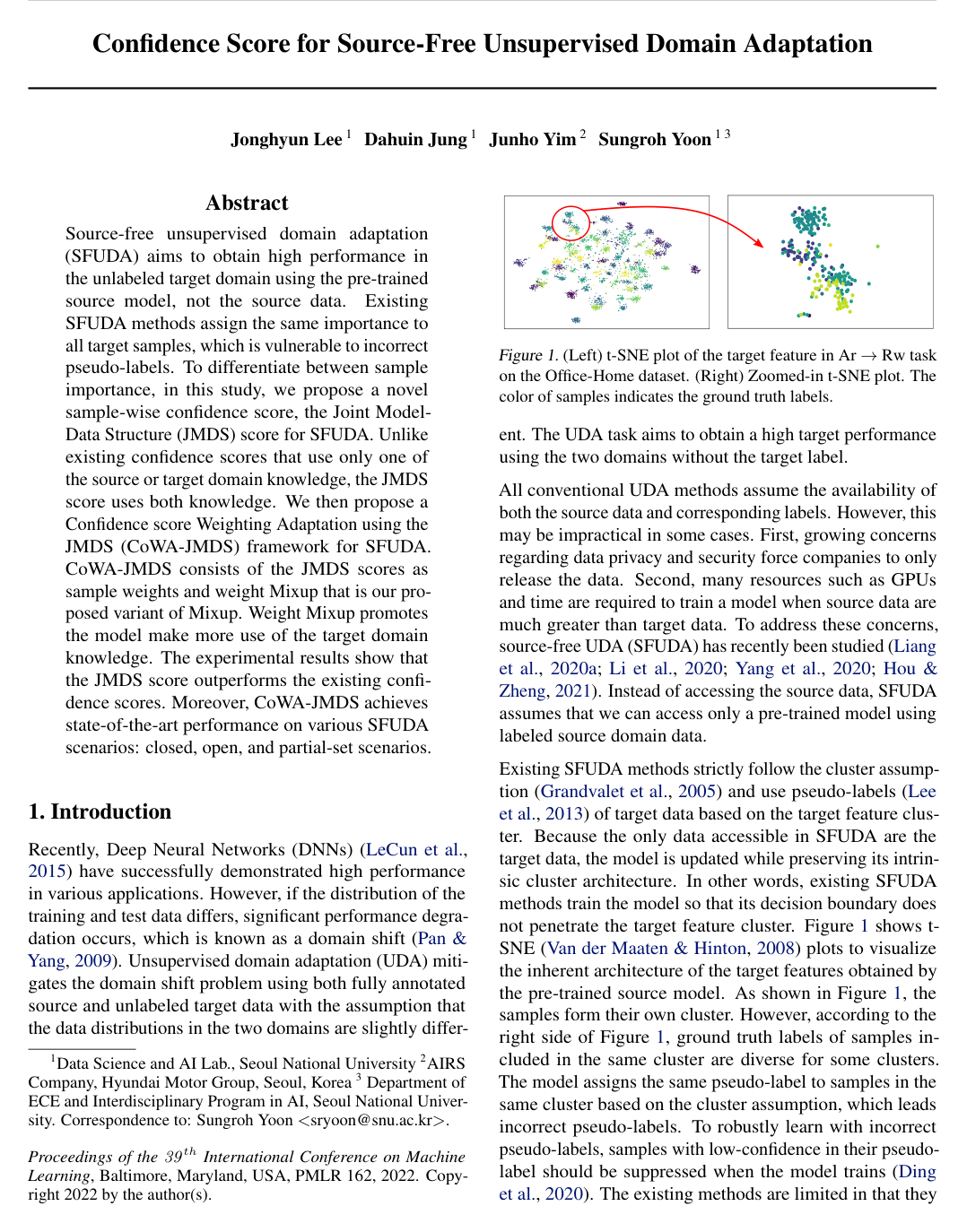
Confidence Score for Source-Free Unsupervised Domain Adaptation
Jonghyun Lee, Dahuin Jung, Junho Yim, Sungroh Yoon
Why you should read this
Proposes a joint model-data structure confidence score and sample-weighted adaptation framework that mitigates noisy pseudo-labeling in source-free unsupervised domain adaptation by combining source model probabilities with target feature cluster distributions.
Source-free unsupervised domain adaptation (SFUDA) aims to obtain high performance in the unlabeled target domain using the pre-trained source model, not the source data. Existing SFUDA methods assign the same importance to all target samples, which is vulnerable to incorrect pseudo-labels. To differentiate between sample importance, in this study, we propose a novel sample-wise confidence score, the Joint Model-Data Structure (JMDS) score for SFUDA. Unlike existing confidence scores that use only one of the source or target domain knowledge, the JMDS score uses both knowledge. We then propose a Confidence score Weighting Adaptation using the JMDS (CoWA-JMDS) framework for SFUDA. CoWA-JMDS consists of the JMDS scores as sample weights and weight Mixup that is our proposed variant of Mixup. Weight Mixup promotes the model make more use of the target domain knowledge. The experimental results show that the JMDS score outperforms the existing confidence scores. Moreover, CoWA-JMDS achieves state-of-the-art performance on various SFUDA scenarios: closed, open, and partial-set scenarios.
Added
2026-09-26
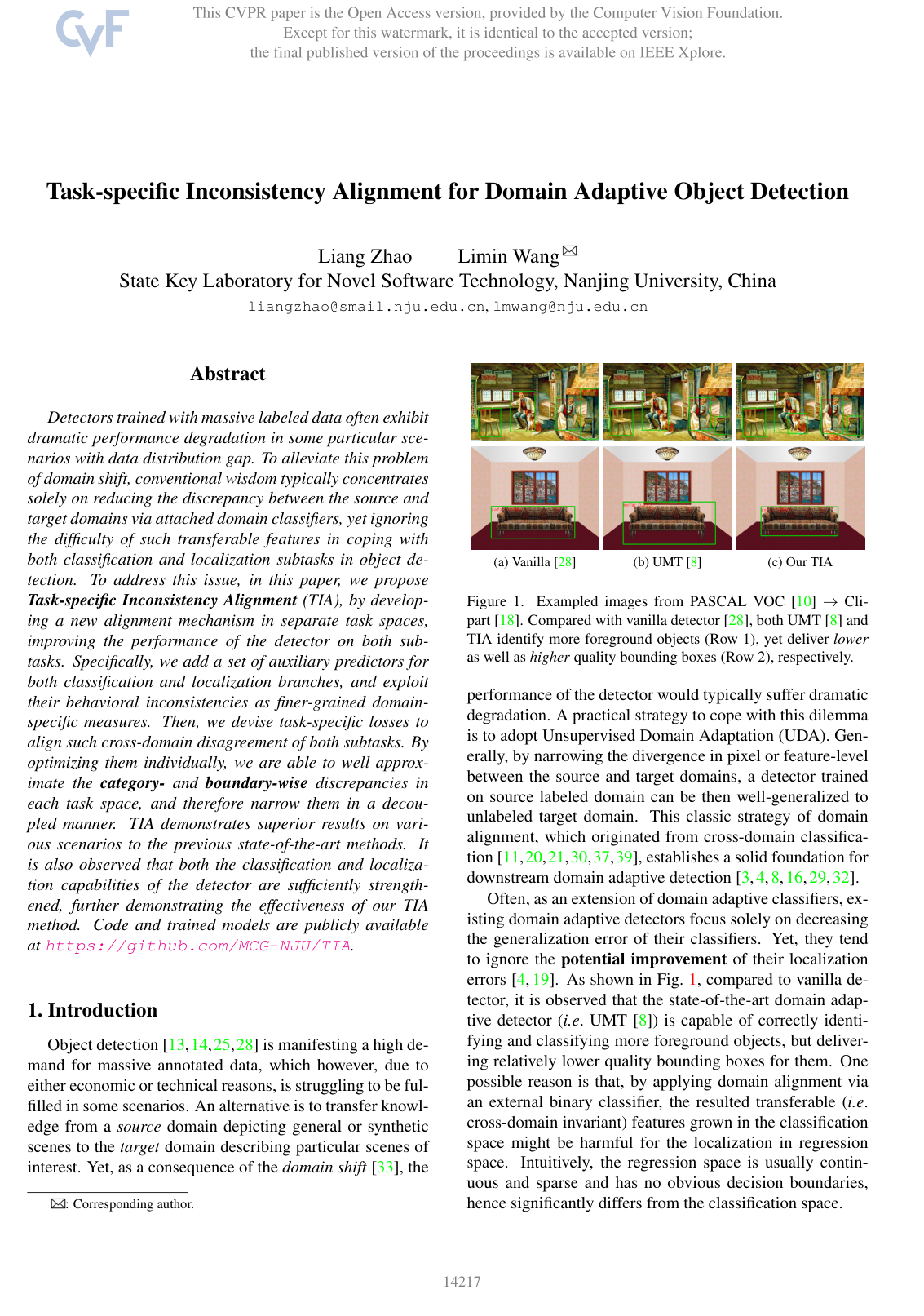
Task-specific Inconsistency Alignment for Domain Adaptive Object Detection
Liang Zhao, Limin Wang
Why you should read this
Proposes a domain adaptive object detection framework that uses auxiliary predictors to independently measure and minimize task-specific inconsistencies across domains, effectively decoupling feature alignment for classification and bounding box regression.
Detectors trained with massive labeled data often exhibit dramatic performance degradation in some particular scenarios with data distribution gap. To alleviate this problem of domain shift, conventional wisdom typically concentrates solely on reducing the discrepancy between the source and target domains via attached domain classifiers, yet ignoring the difficulty of such transferable features in coping with both classification and localization subtasks in object detection. To address this issue, in this paper, we propose Task-specific Inconsistency Alignment (TIA), by developing a new alignment mechanism in separate task spaces, improving the performance of the detector on both subtasks. Specifically, we add a set of auxiliary predictors for both classification and localization branches, and exploit their behavioral inconsistencies as finer-grained domain-specific measures. Then, we devise task-specific losses to align such cross-domain disagreement of both subtasks. By optimizing them individually, we are able to well approximate the category- and boundary-wise discrepancies in each task space, and therefore narrow them in a decoupled manner. TIA demonstrates superior results on various scenarios to the previous state-of-the-art methods. It is also observed that both the classification and localization capabilities of the detector are sufficiently strengthened, further demonstrating the effectiveness of our TIA method. Code and trained models are publicly available at https://github.com/MCG-NJU/TIA.
Added
2026-09-26
MADG: Margin-based Adversarial Learning for Domain Generalization
Aveen Dayal, Vimal K. B., Linga Reddy Cenkeramaddi, C. Krishna Mohan, Abhinav Kumar, Vineeth N. Balasubramanian
Why you should read this
Proposes a margin-based adversarial learning framework for domain generalization backed by Rademacher complexity bounds that achieves consistent state-of-the-art performance across standard DomainBed benchmarks.
Domain Generalization (DG) techniques have emerged as a popular approach to address the challenges of domain shift in Deep Learning (DL), with the goal of generalizing well to the target domain unseen during the training. In recent years, numerous methods have been proposed to address the DG setting, among which one popular approach is the adversarial learning-based methodology. The main idea behind adversarial DG methods is to learn domain-invariant features by minimizing a discrepancy metric. However, most adversarial DG methods use 0-1 loss based HΔH divergence metric. In contrast, the margin loss-based discrepancy metric has the following advantages: more informative, tighter, practical, and efficiently optimizable. To mitigate this gap, this work proposes a novel adversarial learning DG algorithm, MADG, motivated by a margin loss-based discrepancy metric. The proposed MADG model learns domain-invariant features across all source domains and uses adversarial training to generalize well to the unseen target domain. We also provide a theoretical analysis of the proposed MADG model based on the unseen target error bound. Specifically, we construct the link between the source and unseen domains in the real-valued hypothesis space and derive the generalization bound using margin loss and Rademacher complexity. We extensively experiment with the MADG model on popular real-world DG datasets, VLCS, PACS, OfficeHome, DomainNet, and TerraIncognita. We evaluate the proposed algorithm on DomainBed's benchmark and observe consistent performance across all the datasets.
Added
2026-09-26
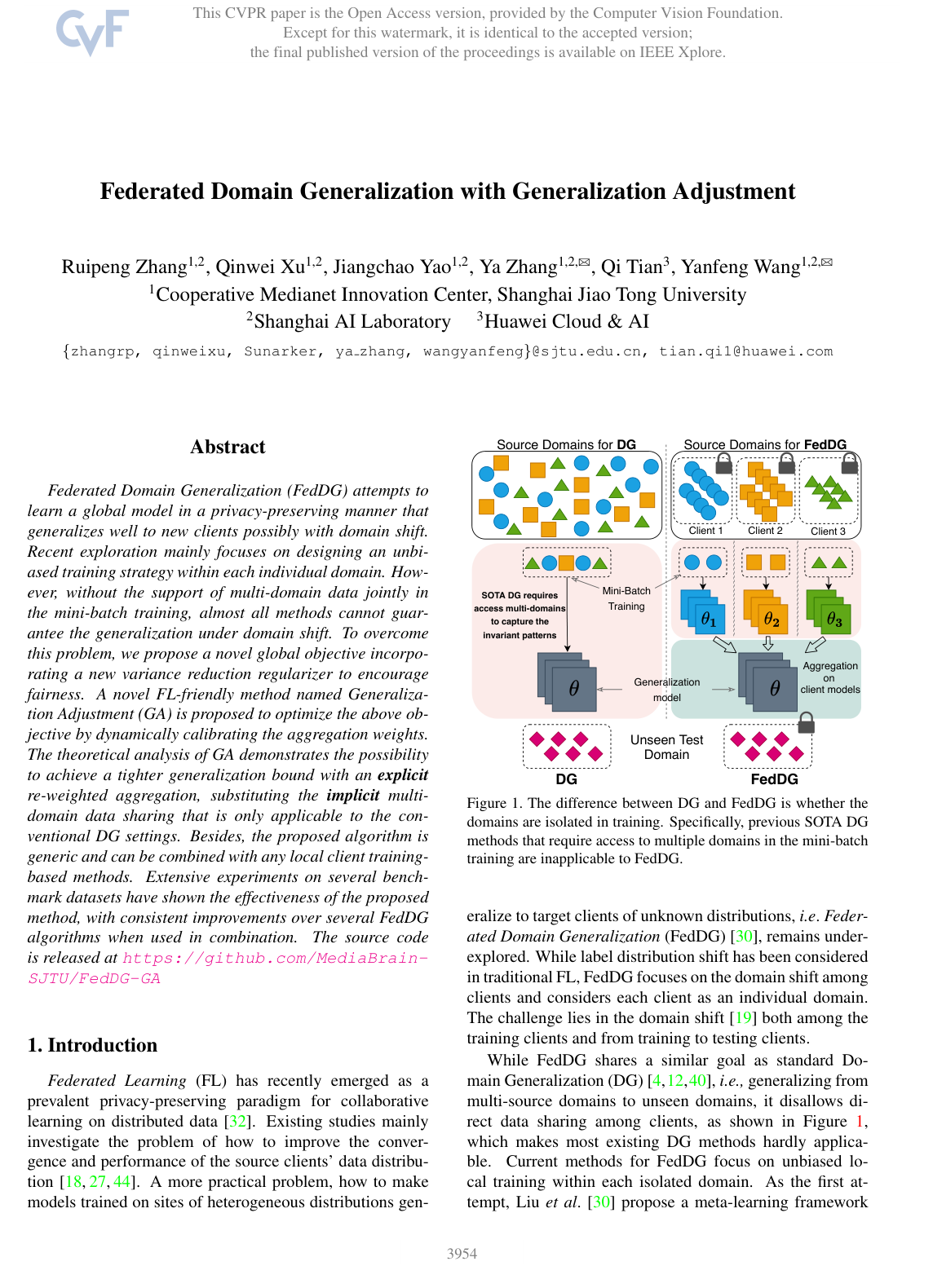
Federated Domain Generalization with Generalization Adjustment
Ruipeng Zhang, Qinwei Xu, Jiangchao Yao, Ya Zhang, Qi Tian, Yanfeng Wang
Why you should read this
Proposes Generalization Adjustment, a server-side aggregation strategy that dynamically recalibrates client weights using a variance-reduction regularizer on generalization gaps to improve model performance on unseen target domains without sharing private multi-domain data.
Federated Domain Generalization (FedDG) attempts to learn a global model in a privacy-preserving manner that generalizes well to new clients possibly with domain shift. Recent exploration mainly focuses on designing an unbiased training strategy within each individual domain. However, without the support of multi-domain data jointly in the mini-batch training, almost all methods cannot guarantee the generalization under domain shift. To overcome this problem, we propose a novel global objective incorporating a new variance reduction regularizer to encourage fairness. A novel FL-friendly method named Generalization Adjustment (GA) is proposed to optimize the above objective by dynamically calibrating the aggregation weights. The theoretical analysis of GA demonstrates the possibility to achieve a tighter generalization bound with an explicit re-weighted aggregation, substituting the implicit multi-domain data sharing that is only applicable to the conventional DG settings. Besides, the proposed algorithm is generic and can be combined with any local client training-based methods. Extensive experiments on several benchmark datasets have shown the effectiveness of the proposed method, with consistent improvements over several FedDG algorithms when used in combination. The source code is released at https://github.com/MediaBrain-SJTU/FedDG-GA
Added
2026-09-26
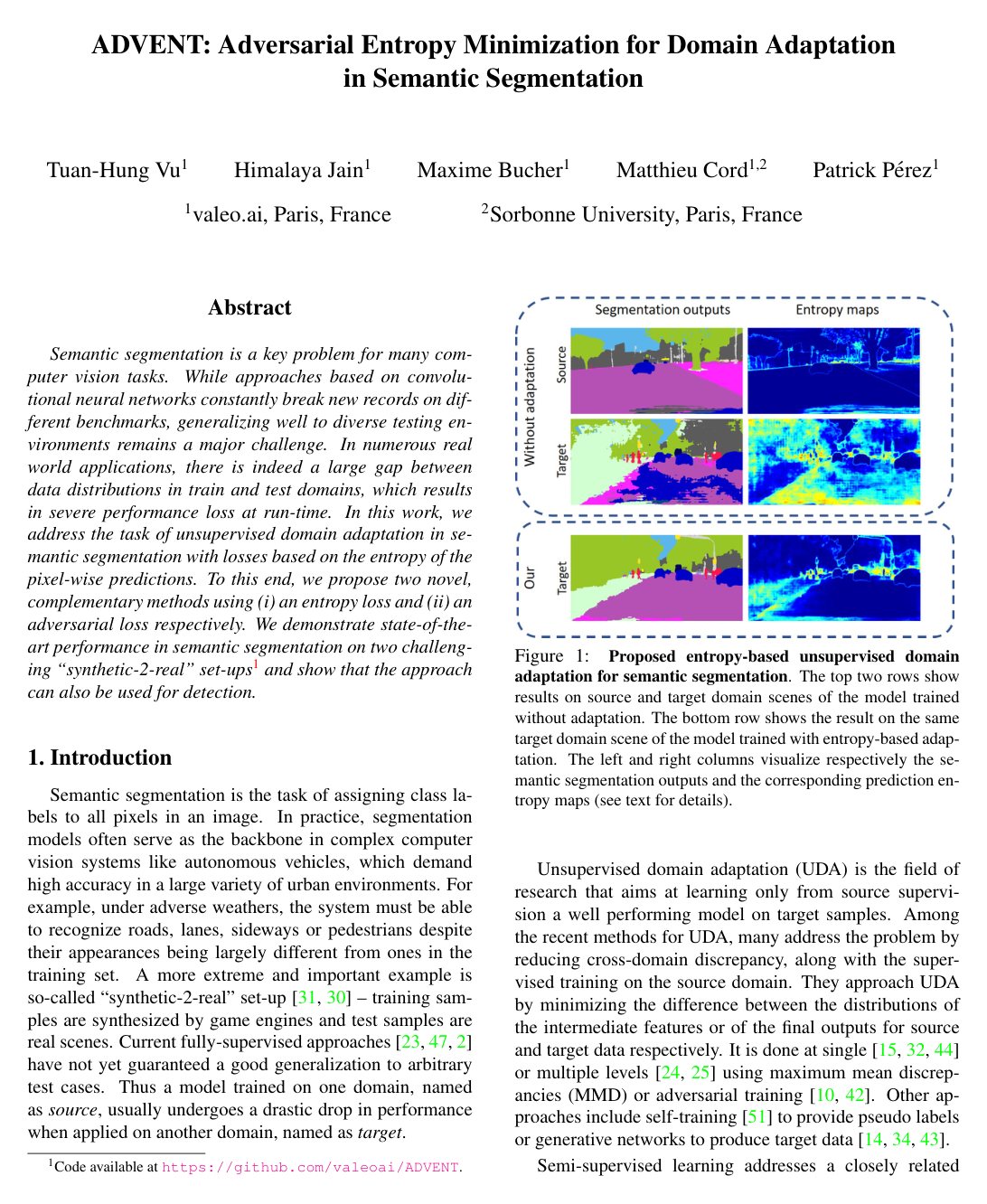
ADVENT: Adversarial Entropy Minimization for Domain Adaptation in Semantic Segmentation
Tuan-Hung Vu, Himalaya Jain, Maxime Bucher, Matthieu Cord, Patrick Pérez
Why you should read this
Introduces an adversarial entropy minimization framework that significantly narrows the synthetic-to-real performance gap in semantic segmentation by driving models to produce confident and structurally consistent predictions on unlabeled target data.
Semantic segmentation is a key problem for many computer vision tasks. While approaches based on convolutional neural networks constantly break new records on different benchmarks, generalizing well to diverse testing environments remains a major challenge. In numerous real world applications, there is indeed a large gap between data distributions in train and test domains, which results in severe performance loss at run-time. In this work, we address the task of unsupervised domain adaptation in semantic segmentation with losses based on the entropy of the pixel-wise predictions. To this end, we propose two novel, complementary methods using (i) entropy loss and (ii) adversarial loss respectively. We demonstrate state-of-the-art performance in semantic segmentation on two challenging "synthetic-2-real" set-ups and show that the approach can also be used for detection.
Added
2026-09-24
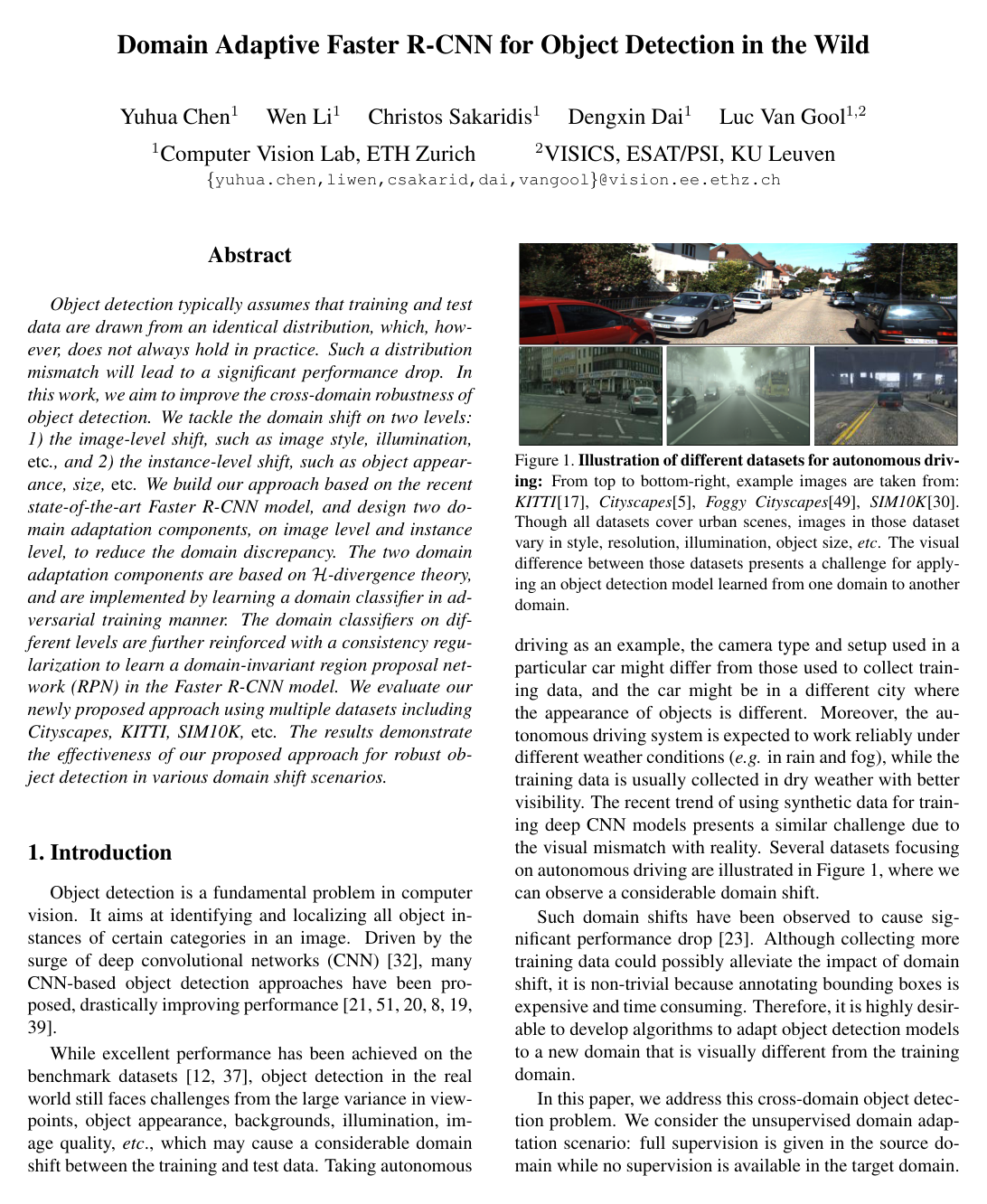
Domain Adaptive Faster R-CNN for Object Detection in the Wild
Yuhua Chen, Wen Li, Christos Sakaridis, Dengxin Dai, Luc Van Gool
Why you should read this
Proposes an adversarial domain adaptation framework for Faster R-CNN that aligns image- and instance-level features while enforcing consistency across representations, substantially improving cross-domain object detection performance across challenging shifts in style, illumination, and object scale.
Object detection typically assumes that training and test data are drawn from an identical distribution, which, however, does not always hold in practice. Such a distribution mismatch will lead to a significant performance drop. In this work, we aim to improve the cross-domain robustness of object detection. We tackle the domain shift on two levels: 1) the image-level shift, such as image style, illumination, etc, and 2) the instance-level shift, such as object appearance, size, etc. We build our approach based on the recent state-of-the-art Faster R-CNN model, and design two domain adaptation components, on image level and instance level, to reduce the domain discrepancy. The two domain adaptation components are based on H-divergence theory, and are implemented by learning a domain classifier in adversarial training manner. The domain classifiers on different levels are further reinforced with a consistency regularization to learn a domain-invariant region proposal network (RPN) in the Faster R-CNN model. We evaluate our newly proposed approach using multiple datasets including Cityscapes, KITTI, SIM10K, etc. The results demonstrate the effectiveness of our proposed approach for robust object detection in various domain shift scenarios.
Added
2026-09-24
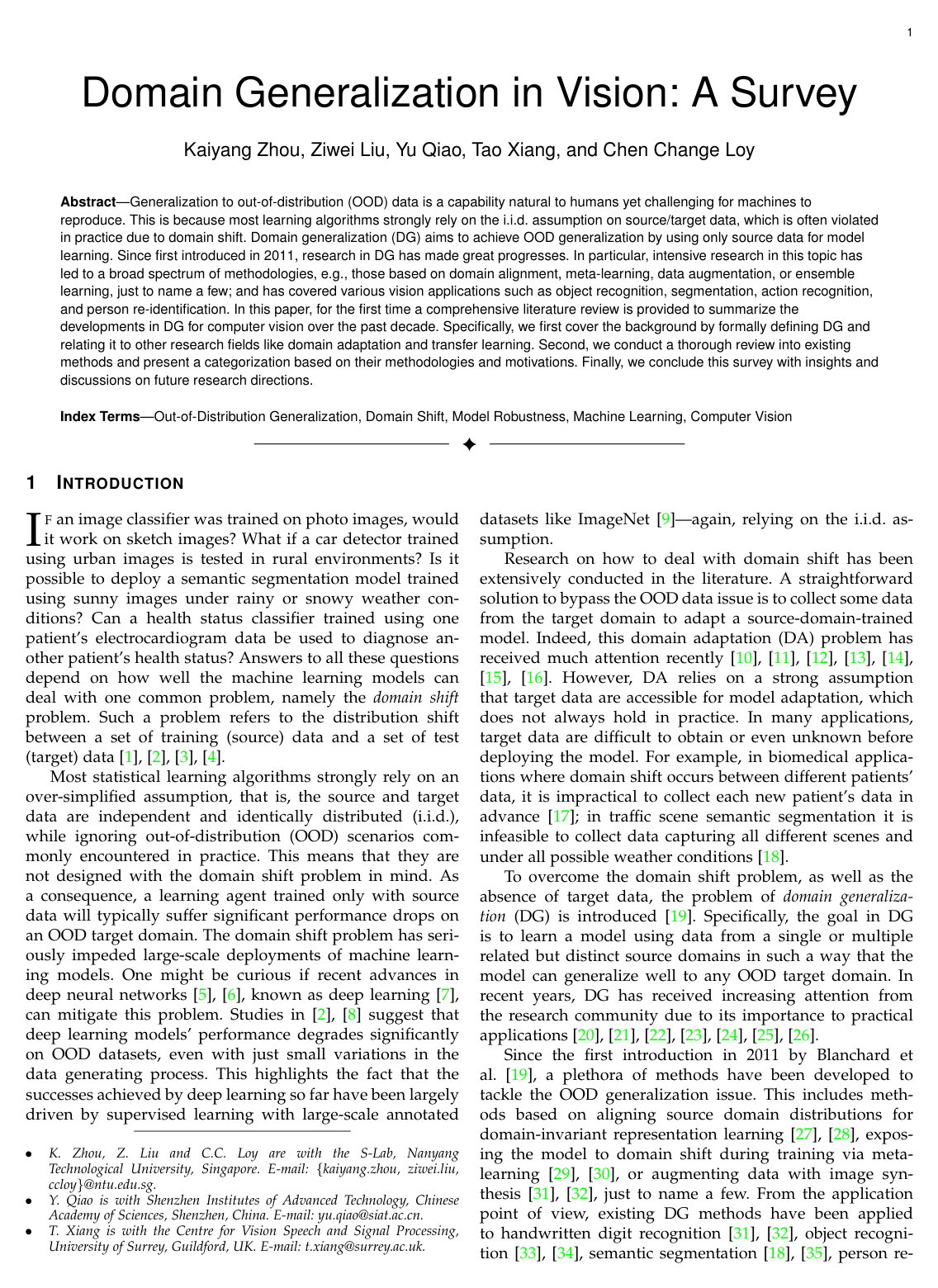
Domain Generalization: A Survey
Kaiyang Zhou, Ziwei Liu, Yu Qiao, Tao Xiang, Chen Change Loy
Why you should read this
Systematizes a decade of domain generalization research by establishing a formal framework, categorizing diverse methodologies from meta-learning to data augmentation, and identifying key open challenges for training models that generalize to unseen distributions.
Generalization to out-of-distribution (OOD) data is a capability natural to humans yet challenging for machines to reproduce. This is because most learning algorithms strongly rely on the i.i.d.~assumption on source/target data, which is often violated in practice due to domain shift. Domain generalization (DG) aims to achieve OOD generalization by using only source data for model learning. Over the last ten years, research in DG has made great progress, leading to a broad spectrum of methodologies, e.g., those based on domain alignment, meta-learning, data augmentation, or ensemble learning, to name a few; DG has also been studied in various application areas including computer vision, speech recognition, natural language processing, medical imaging, and reinforcement learning. In this paper, for the first time a comprehensive literature review in DG is provided to summarize the developments over the past decade. Specifically, we first cover the background by formally defining DG and relating it to other relevant fields like domain adaptation and transfer learning. Then, we conduct a thorough review into existing methods and theories. Finally, we conclude this survey with insights and discussions on future research directions.
Added
2026-09-24
Learning to Generalize: Meta-Learning for Domain Generalization
Da Li, Yongxin Yang, Yi-Zhe Song, Timothy M. Hospedales
Why you should read this
Proposes a model-agnostic meta-learning framework that trains neural networks to generalize to unseen domains by simulating train-test domain shifts within mini-batches, delivering state-of-the-art results across image classification and reinforcement learning benchmarks.
Domain shift refers to the well known problem that a model trained in one source domain performs poorly when applied to a target domain with different statistics. {Domain Generalization} (DG) techniques attempt to alleviate this issue by producing models which by design generalize well to novel testing domains. We propose a novel {meta-learning} method for domain generalization. Rather than designing a specific model that is robust to domain shift as in most previous DG work, we propose a model agnostic training procedure for DG. Our algorithm simulates train/test domain shift during training by synthesizing virtual testing domains within each mini-batch. The meta-optimization objective requires that steps to improve training domain performance should also improve testing domain performance. This meta-learning procedure trains models with good generalization ability to novel domains. We evaluate our method and achieve state of the art results on a recent cross-domain image classification benchmark, as well demonstrating its potential on two classic reinforcement learning tasks.
Added
2026-09-20
Do We Really Need to Access the Source Data? Source Hypothesis Transfer for Unsupervised Domain Adaptation
Jian Liang, Dapeng Hu, Jiashi Feng
Why you should read this
Proposes a source-free unsupervised domain adaptation method that adapts trained models to unlabeled target domains without requiring access to original source data, addressing critical privacy concerns while achieving top performance across multiple adaptation benchmarks.
Unsupervised domain adaptation (UDA) aims to leverage the knowledge learned from a labeled source dataset to solve similar tasks in a new unlabeled domain. Prior UDA methods typically require to access the source data when learning to adapt the model, making them risky and inefficient for decentralized private data. This work tackles a practical setting where only a trained source model is available and investigates how we can effectively utilize such a model without source data to solve UDA problems. We propose a simple yet generic representation learning framework, named \emph{Source HypOthesis Transfer} (SHOT). SHOT freezes the classifier module (hypothesis) of the source model and learns the target-specific feature extraction module by exploiting both information maximization and self-supervised pseudo-labeling to implicitly align representations from the target domains to the source hypothesis. To verify its versatility, we evaluate SHOT in a variety of adaptation cases including closed-set, partial-set, and open-set domain adaptation. Experiments indicate that SHOT yields state-of-the-art results among multiple domain adaptation benchmarks.
Added
2026-09-19
Generalizing to Unseen Domains: A Survey on Domain Generalization
Jindong Wang, Cuiling Lan, Chang Liu, Yidong Ouyang, Tao Qin
Why you should read this
Systematizes out-of-distribution machine learning by establishing theoretical foundations for domain generalization, classifying existing methods into a clear three-part taxonomy, and providing standardized benchmark datasets with an open-source codebase for fair evaluation.
Machine learning systems generally assume that the training and testing distributions are the same. To this end, a key requirement is to develop models that can generalize to unseen distributions. Domain generalization (DG), i.e., out-of-distribution generalization, has attracted increasing interests in recent years. Domain generalization deals with a challenging setting where one or several different but related domain(s) are given, and the goal is to learn a model that can generalize to an unseen test domain. Great progress has been made in the area of domain generalization for years. This paper presents the first review of recent advances in this area. First, we provide a formal definition of domain generalization and discuss several related fields. We then thoroughly review the theories related to domain generalization and carefully analyze the theory behind generalization. We categorize recent algorithms into three classes: data manipulation, representation learning, and learning strategy, and present several popular algorithms in detail for each category. Third, we introduce the commonly used datasets, applications, and our open-sourced codebase for fair evaluation. Finally, we summarize existing literature and present some potential research topics for the future.
Added
2026-09-18
Deep Visual Domain Adaptation: A Survey
Mei Wang, Weihong Deng
Why you should read this
Systematizes deep visual domain adaptation methods by divergence scenarios and loss formulations while examining their practical deployment across advanced computer vision tasks like semantic segmentation and object detection.
Deep domain adaption has emerged as a new learning technique to address the lack of massive amounts of labeled data. Compared to conventional methods, which learn shared feature subspaces or reuse important source instances with shallow representations, deep domain adaption methods leverage deep networks to learn more transferable representations by embedding domain adaptation in the pipeline of deep learning. There have been comprehensive surveys for shallow domain adaption, but few timely reviews the emerging deep learning based methods. In this paper, we provide a comprehensive survey of deep domain adaptation methods for computer vision applications with four major contributions. First, we present a taxonomy of different deep domain adaption scenarios according to the properties of data that define how two domains are diverged. Second, we summarize deep domain adaption approaches into several categories based on training loss, and analyze and compare briefly the state-of-the-art methods under these categories. Third, we overview the computer vision applications that go beyond image classification, such as face recognition, semantic segmentation and object detection. Fourth, some potential deficiencies of current methods and several future directions are highlighted.
Added
2026-09-15
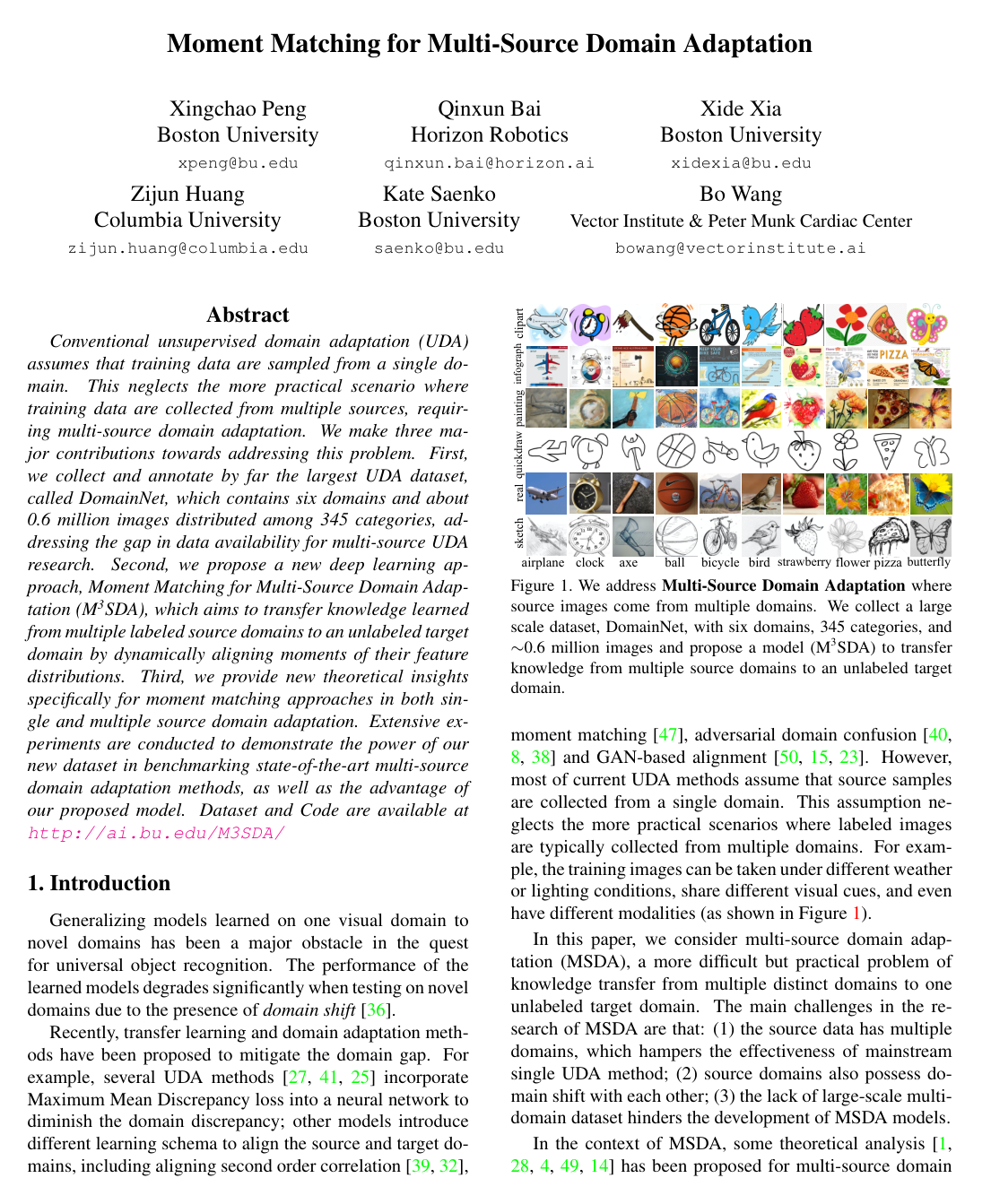
Moment Matching for Multi-Source Domain Adaptation
Xingchao Peng, Qinxun Bai, Xide Xia, Zijun Huang, Kate Saenko, Bo Wang
Why you should read this
Introduces the large-scale DomainNet benchmark alongside M3SDA, a moment-matching framework with theoretical grounding that transfers knowledge from multiple labeled source domains to an unlabeled target by dynamically aligning their feature distributions.
Conventional unsupervised domain adaptation (UDA) assumes that training data are sampled from a single domain. This neglects the more practical scenario where training data are collected from multiple sources, requiring multi-source domain adaptation. We make three major contributions towards addressing this problem. First, we collect and annotate by far the largest UDA dataset, called DomainNet, which contains six domains and about 0.6 million images distributed among 345 categories, addressing the gap in data availability for multi-source UDA research. Second, we propose a new deep learning approach, Moment Matching for Multi-Source Domain Adaptation M3SDA, which aims to transfer knowledge learned from multiple labeled source domains to an unlabeled target domain by dynamically aligning moments of their feature distributions. Third, we provide new theoretical insights specifically for moment matching approaches in both single and multiple source domain adaptation. Extensive experiments are conducted to demonstrate the power of our new dataset in benchmarking state-of-the-art multi-source domain adaptation methods, as well as the advantage of our proposed model. Dataset and Code are available at \url{this http URL}.
Added
2026-09-14
Deep CORAL: Correlation Alignment for Deep Domain Adaptation
Baochen Sun, Kate Saenko
Why you should read this
Presents an end-to-end unsupervised domain adaptation method that aligns the second-order statistics of deep feature activations to generalize neural networks across domain shifts without target labels.
Deep neural networks are able to learn powerful representations from large quantities of labeled input data, however they cannot always generalize well across changes in input distributions. Domain adaptation algorithms have been proposed to compensate for the degradation in performance due to domain shift. In this paper, we address the case when the target domain is unlabeled, requiring unsupervised adaptation. CORAL is a "frustratingly easy" unsupervised domain adaptation method that aligns the second-order statistics of the source and target distributions with a linear transformation. Here, we extend CORAL to learn a nonlinear transformation that aligns correlations of layer activations in deep neural networks (Deep CORAL). Experiments on standard benchmark datasets show state-of-the-art performance.
Added
2026-09-11
Unsupervised Domain Adaptation by Backpropagation
Yaroslav Ganin, Victor Lempitsky
Why you should read this
Introduces the gradient reversal layer, enabling deep neural networks to learn domain-invariant representations directly through standard backpropagation without requiring labeled target data.
Top-performing deep architectures are trained on massive amounts of labeled data. In the absence of labeled data for a certain task, domain adaptation often provides an attractive option given that labeled data of similar nature but from a different domain (e.g. synthetic images) are available. Here, we propose a new approach to domain adaptation in deep architectures that can be trained on large amount of labeled data from the source domain and large amount of unlabeled data from the target domain (no labeled target-domain data is necessary). As the training progresses, the approach promotes the emergence of "deep" features that are (i) discriminative for the main learning task on the source domain and (ii) invariant with respect to the shift between the domains. We show that this adaptation behaviour can be achieved in almost any feed-forward model by augmenting it with few standard layers and a simple new gradient reversal layer. The resulting augmented architecture can be trained using standard backpropagation. Overall, the approach can be implemented with little effort using any of the deep-learning packages. The method performs very well in a series of image classification experiments, achieving adaptation effect in the presence of big domain shifts and outperforming previous state-of-the-art on Office datasets.
Added
2026-09-10
License
Published with permission
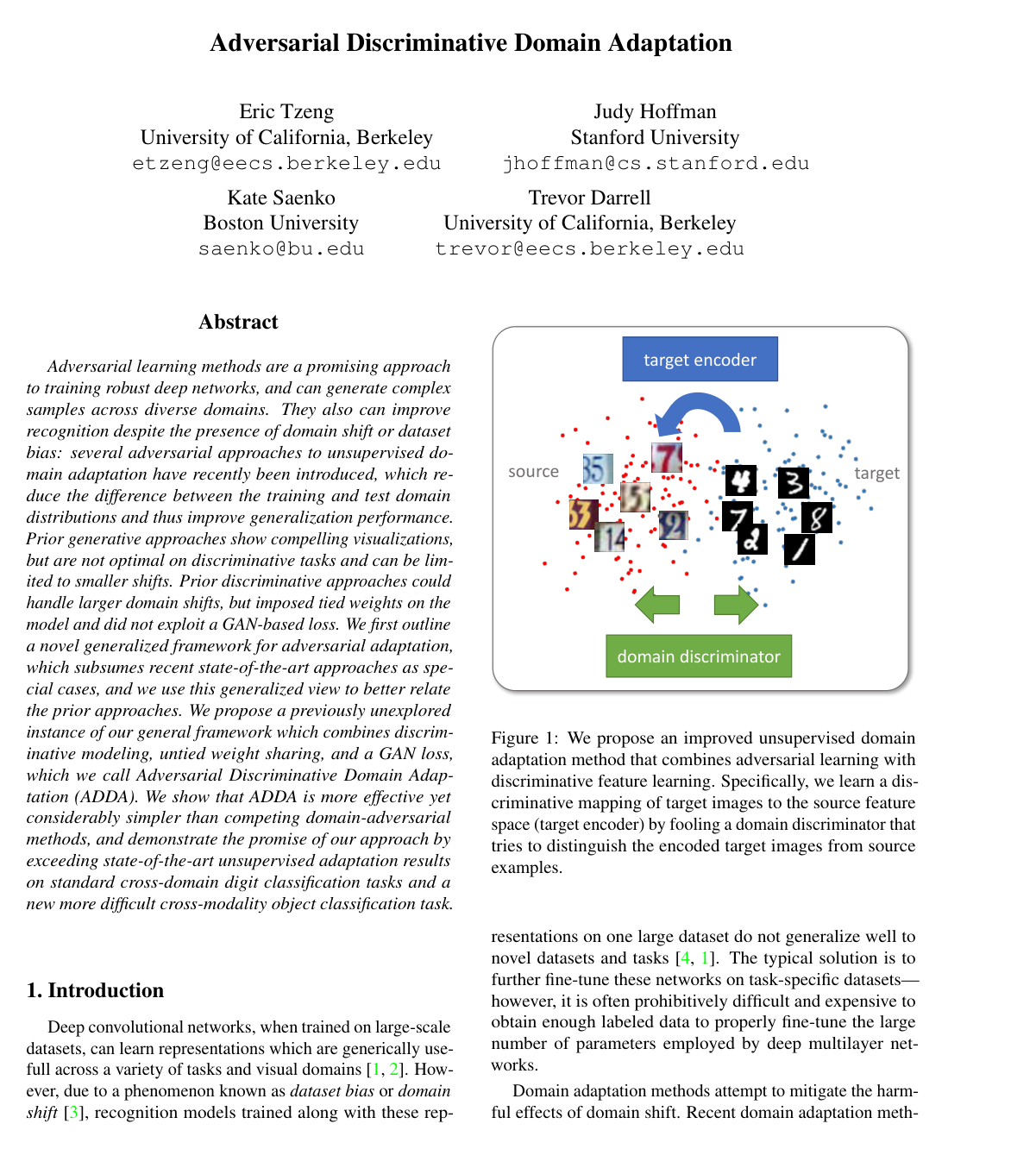
Adversarial Discriminative Domain Adaptation
Eric Tzeng, Judy Hoffman, Kate Saenko, Trevor Darrell
Why you should read this
Introduces a unified framework for adversarial domain adaptation alongside ADDA, an approach combining untied network weights with standard GAN losses to achieve superior performance on challenging cross-domain visual classification tasks.
Adversarial learning methods are a promising approach to training robust deep networks, and can generate complex samples across diverse domains. They also can improve recognition despite the presence of domain shift or dataset bias: several adversarial approaches to unsupervised domain adaptation have recently been introduced, which reduce the difference between the training and test domain distributions and thus improve generalization performance. Prior generative approaches show compelling visualizations, but are not optimal on discriminative tasks and can be limited to smaller shifts. Prior discriminative approaches could handle larger domain shifts, but imposed tied weights on the model and did not exploit a GAN-based loss. We first outline a novel generalized framework for adversarial adaptation, which subsumes recent state-of-the-art approaches as special cases, and we use this generalized view to better relate the prior approaches. We propose a previously unexplored instance of our general framework which combines discriminative modeling, untied weight sharing, and a GAN loss, which we call Adversarial Discriminative Domain Adaptation (ADDA). We show that ADDA is more effective yet considerably simpler than competing domain-adversarial methods, and demonstrate the promise of our approach by exceeding state-of-the-art unsupervised adaptation results on standard cross-domain digit classification tasks and a new more difficult cross-modality object classification task.
Added
2026-09-10