
keyword
dense prediction tasks
Dense prediction tasks are computer vision problems in which an artificial intelligence model generates fine-grained outputs for every pixel or local spatial location across an input image, rather than producing a single summary label for the entire scene. Unlike image-level classification, which assigns a single categorical prediction to a whole image, dense prediction requires preserving spatial resolution and precise localization alongside high-level semantic understanding. Common examples include semantic segmentation, instance segmentation, object detection, and per-pixel depth estimation. To perform these tasks effectively, deep learning models typically utilize multi-scale feature representations, high-resolution feature maps, and specialized attention or convolutional operations to capture broad contextual relationships while maintaining exact spatial fidelity.
20 items
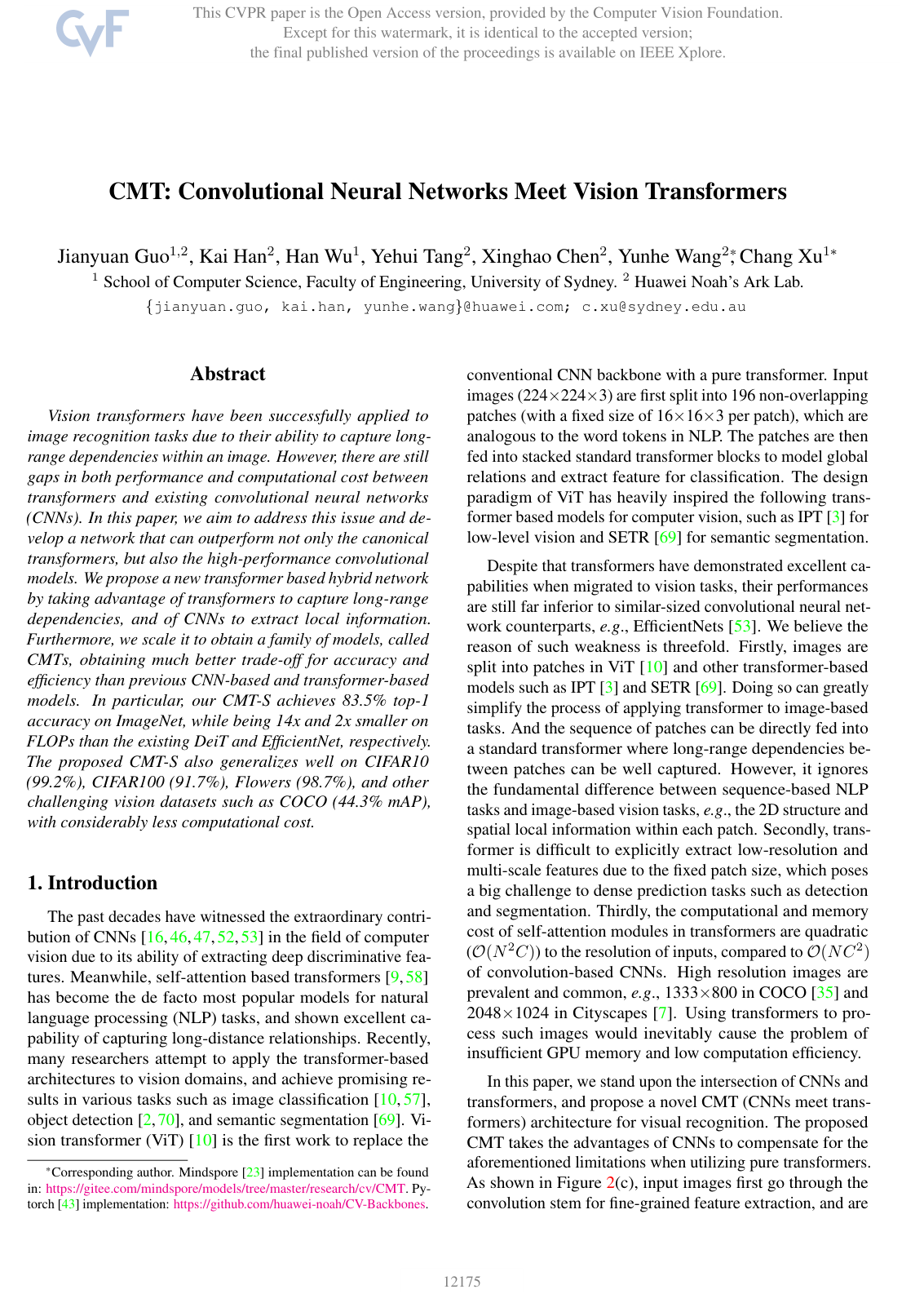
CMT: Convolutional Neural Networks Meet Vision Transformers
Jianyuan Guo, Kai Han, Han Wu, Yehui Tang, Xinghao Chen, Yunhe Wang, Chang Xu
Why you should read this
Presents a hybrid architecture family called CMT that combines convolutional operations with vision transformers to capture both local and global features, achieving superior accuracy and computational efficiency compared to standard CNNs and pure transformers on ImageNet and COCO.
Vision transformers have been successfully applied to image recognition tasks due to their ability to capture long-range dependencies within an image. However, there are still gaps in both performance and computational cost between transformers and existing convolutional neural networks (CNNs). In this paper, we aim to address this issue and develop a network that can outperform not only the canonical transformers, but also the high-performance convolutional models. We propose a new transformer based hybrid network by taking advantage of transformers to capture long-range dependencies, and of CNNs to extract local information. Furthermore, we scale it to obtain a family of models, called CMTs, obtaining much better trade-off for accuracy and efficiency than previous CNN-based and transformer-based models. In particular, our CMT-S achieves 83.5% top-1 accuracy on ImageNet, while being 14x and 2x smaller on FLOPs than the existing DeiT and EfficientNet, respectively. The proposed CMT-S also generalizes well on CIFAR10 (99.2%), CIFAR100 (91.7%), Flowers (98.7%), and other challenging vision datasets such as COCO (44.3% mAP), with considerably less computational cost.
Added
2026-10-05
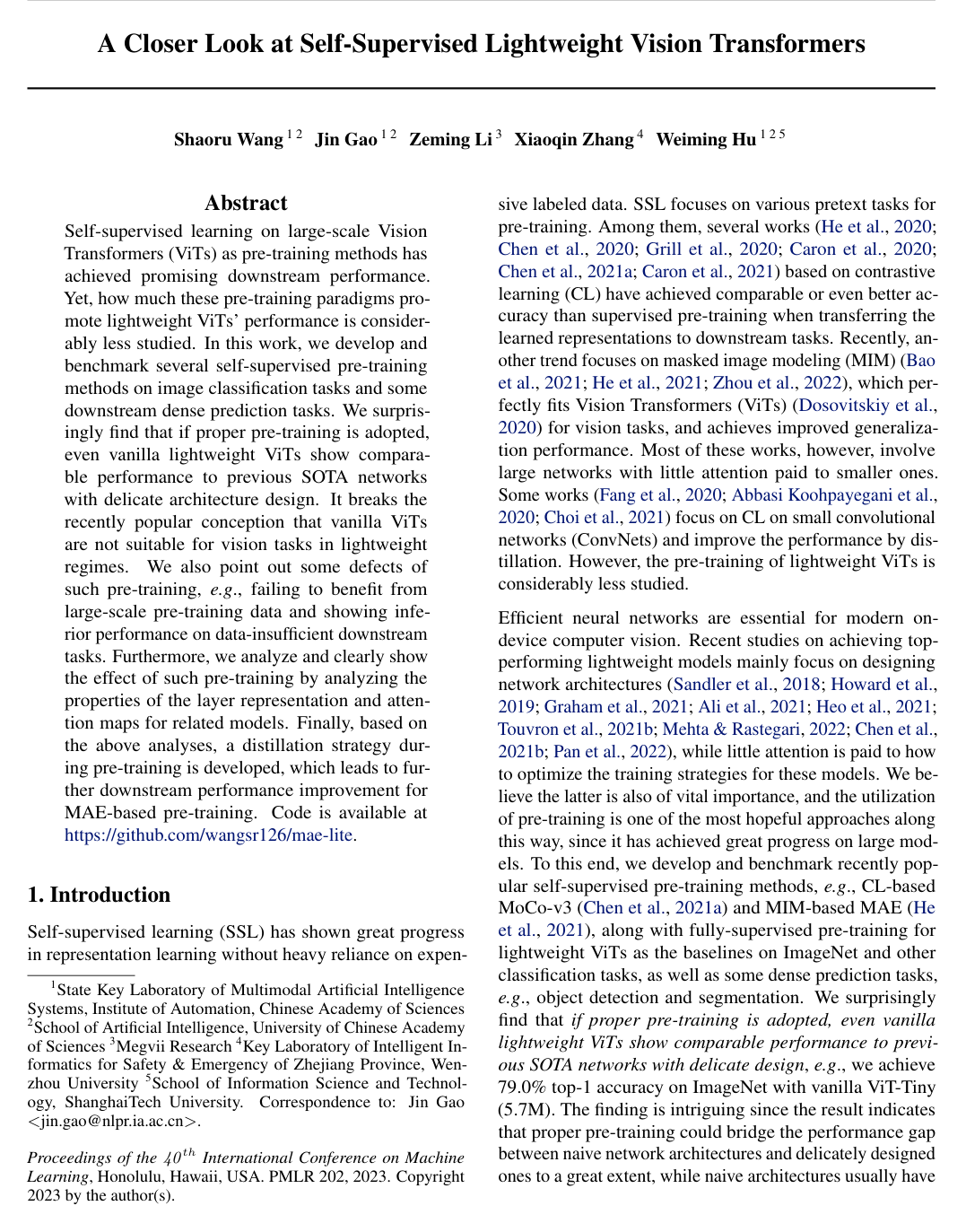
A Closer Look at Self-Supervised Lightweight Vision Transformers
Shaoru Wang, Jin Gao, Zeming Li, Xiaoqin Zhang, Weiming Hu
Why you should read this
Demonstrates that proper self-supervised pre-training enables vanilla lightweight Vision Transformers to match specialized architectures on visual benchmarks, while introducing a pre-training distillation strategy to overcome performance drops on data-limited downstream tasks.
Self-supervised learning on large-scale Vision Transformers (ViTs) as pre-training methods has achieved promising downstream performance. Yet, how much these pre-training paradigms promote lightweight ViTs' performance is considerably less studied. In this work, we develop and benchmark several self-supervised pre-training methods on image classification tasks and some downstream dense prediction tasks. We surprisingly find that if proper pre-training is adopted, even vanilla lightweight ViTs show comparable performance to previous SOTA networks with delicate architecture design. It breaks the recently popular conception that vanilla ViTs are not suitable for vision tasks in lightweight regimes. We also point out some defects of such pre-training, e.g., failing to benefit from large-scale pre-training data and showing inferior performance on data-insufficient downstream tasks. Furthermore, we analyze and clearly show the effect of such pre-training by analyzing the properties of the layer representation and attention maps for related models. Finally, based on the above analyses, a distillation strategy during pre-training is developed, which leads to further downstream performance improvement for MAE-based pre-training. Code is available at https://github.com/wangsr126/mae-lite.
Added
2026-10-03
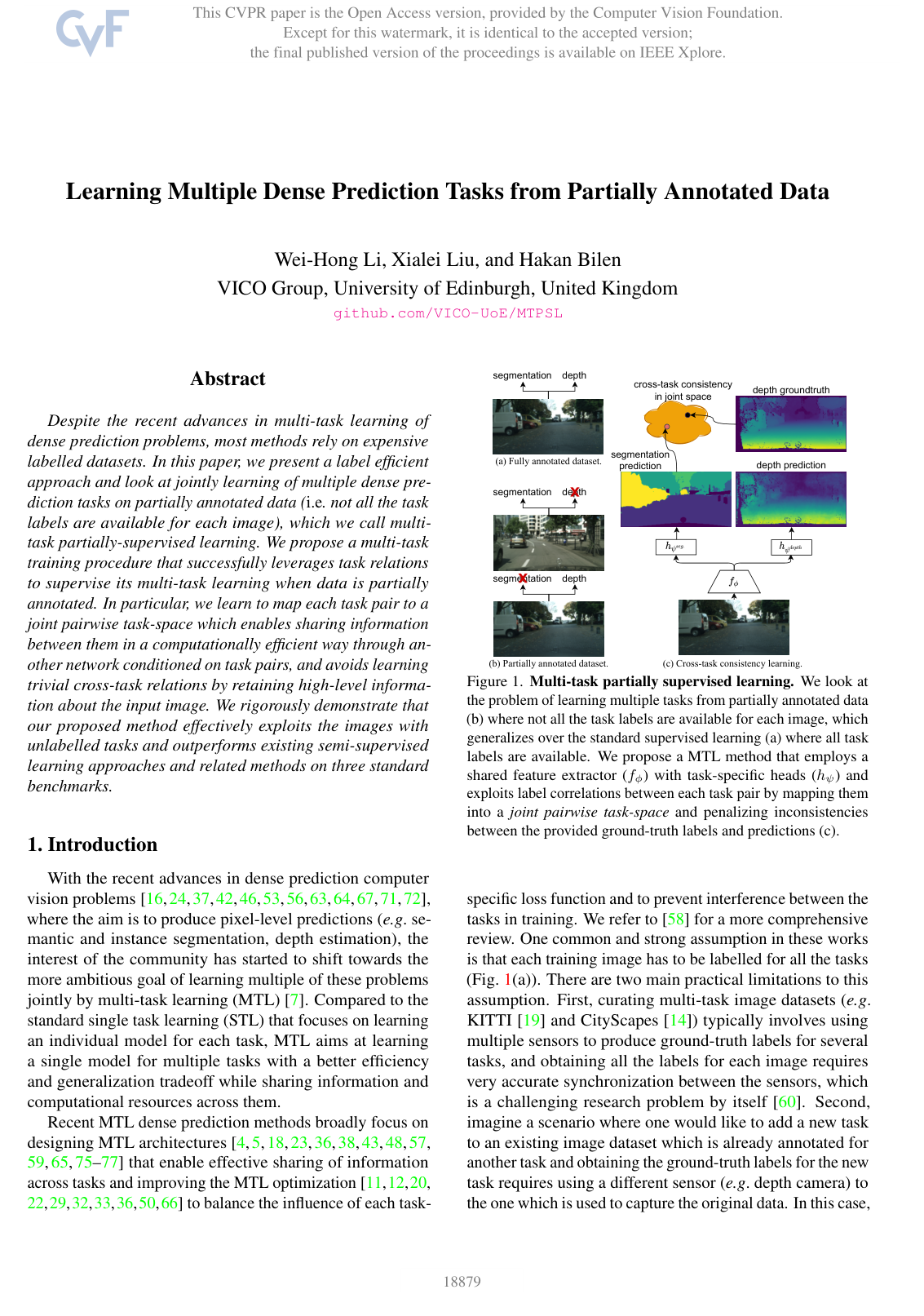
Learning Multiple Dense Prediction Tasks from Partially Annotated Data
Wei-Hong Li, Xialei Liu, Hakan Bilen
Why you should read this
Presents a label-efficient framework for multi-task dense prediction that learns joint pairwise task spaces to supervise missing annotations across images through cross-task consistency.
Despite the recent advances in multi-task learning of dense prediction problems, most methods rely on expensive labelled datasets. In this paper, we present a label efficient approach and look at jointly learning of multiple dense prediction tasks on partially annotated data (i.e. not all the task labels are available for each image), which we call multi-task partially-supervised learning. We propose a multi-task training procedure that successfully leverages task relations to supervise its multi-task learning when data is partially annotated. In particular, we learn to map each task pair to a joint pairwise task-space which enables sharing information between them in a computationally efficient way through another network conditioned on task pairs, and avoids learning trivial cross-task relations by retaining high-level information about the input image. We rigorously demonstrate that our proposed method effectively exploits the images with unlabelled tasks and outperforms existing semi-supervised learning approaches and related methods on three standard benchmarks.
Added
2026-09-26
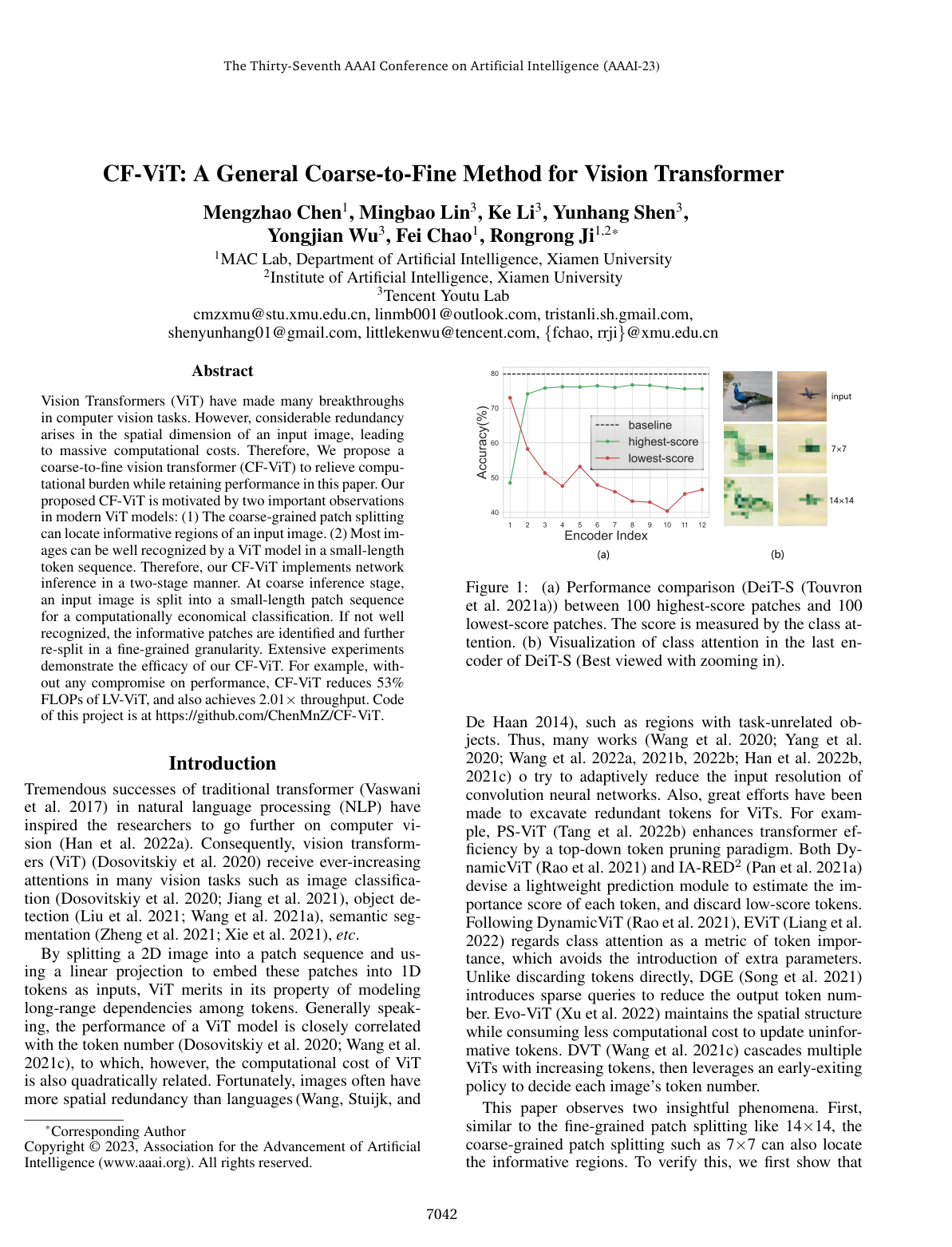
CF-ViT: A General Coarse-to-Fine Method for Vision Transformer
Mengzhao Chen, Mingbao Lin, Ke Li, Yunhang Shen, Yongjian Wu, Fei Chao, Rongrong Ji
Why you should read this
Proposes a two-stage vision transformer inference framework that processes easy images using coarse-grained patches and selectively re-splits only informative regions into fine-grained tokens for hard images, cutting computational cost by more than half while doubling throughput without sacrificing accuracy.
Vision Transformers (ViT) have made many breakthroughs in computer vision tasks. However, considerable redundancy arises in the spatial dimension of an input image, leading to massive computational costs. Therefore, We propose a coarse-to-fine vision transformer (CF-ViT) to relieve computational burden while retaining performance in this paper. Our proposed CF-ViT is motivated by two important observations in modern ViT models: (1) The coarse-grained patch splitting can locate informative regions of an input image. (2) Most images can be well recognized by a ViT model in a small-length token sequence. Therefore, our CF-ViT implements network inference in a two-stage manner. At coarse inference stage, an input image is split into a small-length patch sequence for a computationally economical classification. If not well recognized, the informative patches are identified and further re-split in a fine-grained granularity. Extensive experiments demonstrate the efficacy of our CF-ViT. For example, without any compromise on performance, CF-ViT reduces 53% FLOPs of LV-ViT, and also achieves 2.01× throughput. Code of this project is at https://github.com/ChenMnZ/CF-ViT.
Added
2026-09-26
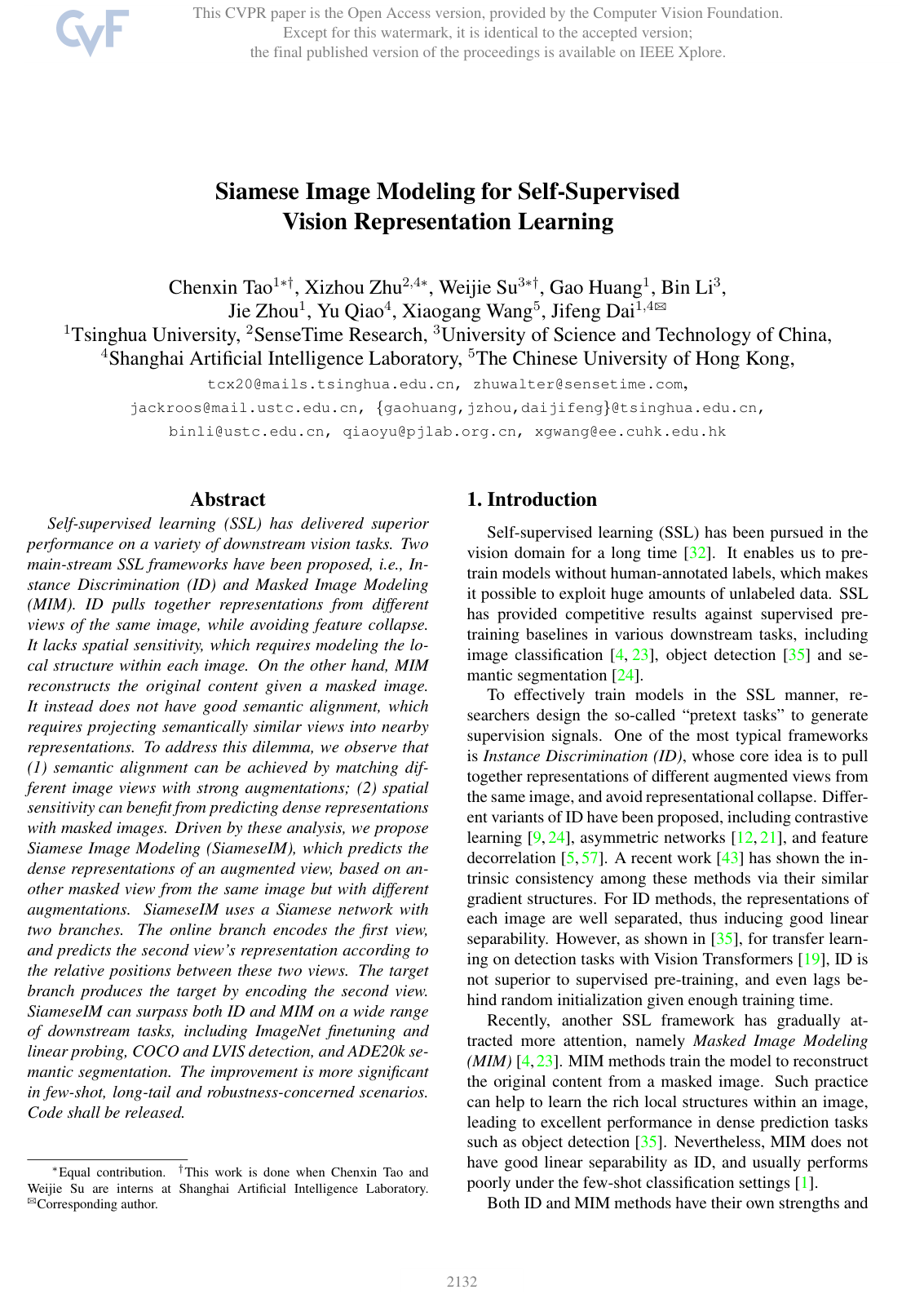
Siamese Image Modeling for Self-Supervised Vision Representation Learning
Chenxin Tao, Xizhou Zhu, Weijie Su, Gao Huang, Bin Li, Jie Zhou, Yu Qiao, Xiaogang Wang, Jifeng Dai
Why you should read this
Proposes Siamese Image Modeling, a self-supervised framework that bridges the gap between instance discrimination and masked image modeling by predicting dense representations across differently augmented views to achieve both semantic alignment and spatial sensitivity.
Self-supervised learning (SSL) has delivered superior performance on a variety of downstream vision tasks. Two main-stream SSL frameworks have been proposed, i.e., Instance Discrimination (ID) and Masked Image Modeling (MIM). ID pulls together representations from different views of the same image, while avoiding feature collapse. It lacks spatial sensitivity, which requires modeling the local structure within each image. On the other hand, MIM reconstructs the original content given a masked image. It instead does not have good semantic alignment, which requires projecting semantically similar views into nearby representations. To address this dilemma, we observe that (1) semantic alignment can be achieved by matching different image views with strong augmentations; (2) spatial sensitivity can benefit from predicting dense representations with masked images. Driven by these analysis, we propose Siamese Image Modeling (SiameseIM), which predicts the dense representations of an augmented view, based on another masked view from the same image but with different augmentations. SiameseIM uses a Siamese network with two branches. The online branch encodes the first view, and predicts the second view's representation according to the relative positions between these two views. The target branch produces the target by encoding the second view. SiameseIM can surpass both ID and MIM on a wide range of downstream tasks, including ImageNet finetuning and linear probing, COCO and LVIS detection, and ADE20k semantic segmentation. The improvement is more significant in few-shot, long-tail and robustness-concerned scenarios. Code shall be released.
Added
2026-09-26
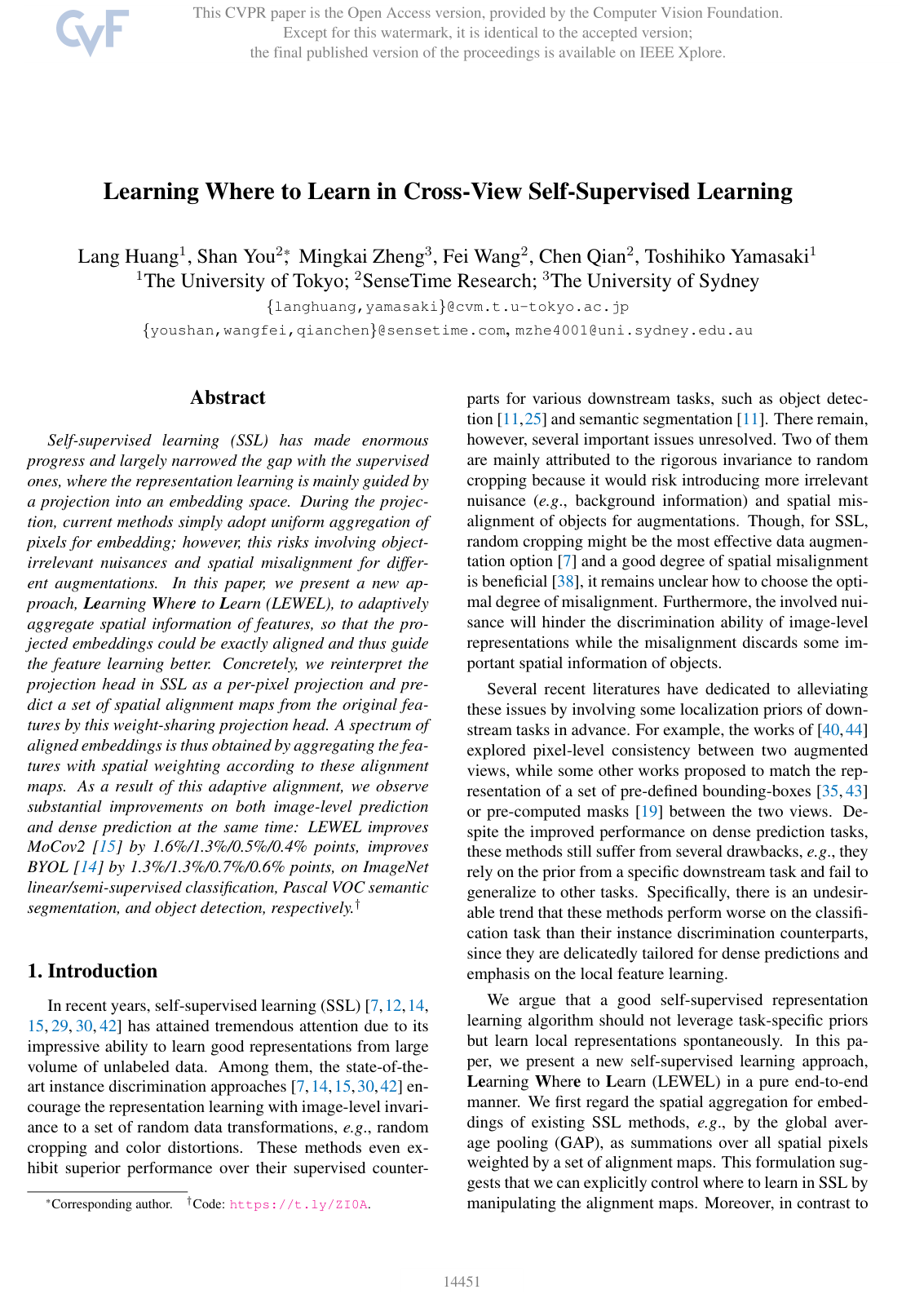
Learning Where to Learn in Cross-View Self-Supervised Learning
Lang Huang, Shan You, Mingkai Zheng, Fei Wang, Chen Qian, Toshihiko Yamasaki
Why you should read this
Proposes an adaptive self-supervised learning framework called LEWEL that reinterprets standard projection heads as per-pixel predictors to dynamically generate spatial alignment maps, correcting cross-view spatial misalignment and improving performance across image classification, object detection, and semantic segmentation.
Self-supervised learning (SSL) has made enormous progress and largely narrowed the gap with the supervised ones, where the representation learning is mainly guided by a projection into an embedding space. During the projection, current methods simply adopt uniform aggregation of pixels for embedding; however, this risks involving object-irrelevant nuisances and spatial misalignment for different augmentations. In this paper, we present a new approach, Learning Where to Learn (LEWEL), to adaptively aggregate spatial information of features, so that the projected embeddings could be exactly aligned and thus guide the feature learning better. Concretely, we reinterpret the projection head in SSL as a per-pixel projection and predict a set of spatial alignment maps from the original features by this weight-sharing projection head. A spectrum of aligned embeddings is thus obtained by aggregating the features with spatial weighting according to these alignment maps. As a result of this adaptive alignment, we observe substantial improvements on both image-level prediction and dense prediction at the same time: LEWEL improves MoCov2 [15] by 1.6%/1.3%/0.5%/0.4% points, improves BYOL [14] by 1.3%/1.3%/0.7%/0.6% points, on ImageNet linear/semi-supervised classification, Pascal VOC semantic segmentation, and object detection, respectively.†
Added
2026-09-26
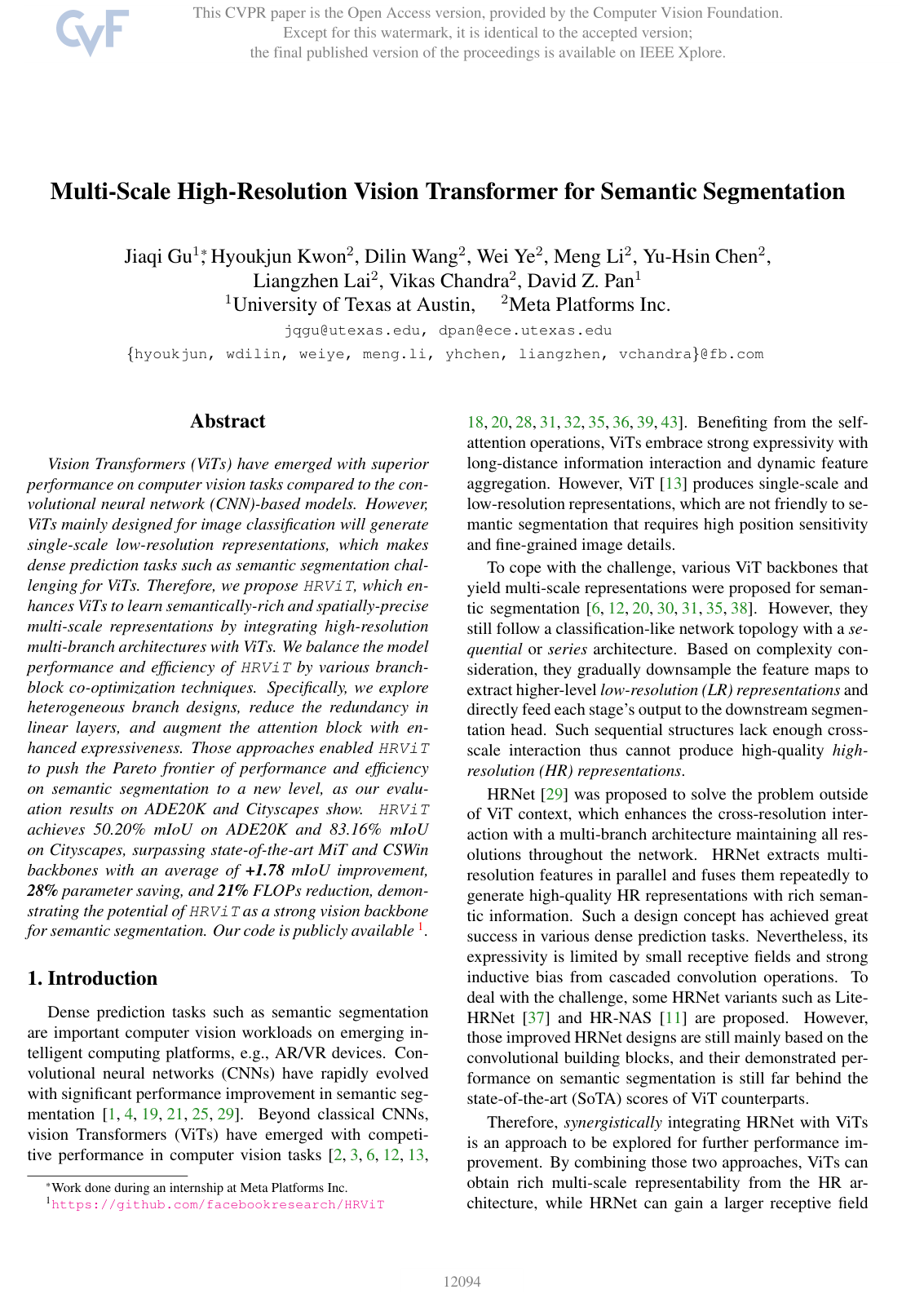
Multi-Scale High-Resolution Vision Transformer for Semantic Segmentation
Jiaqi Gu, Hyoukjun Kwon, Dilin Wang, Wei Ye, Meng Li, Yu-Hsin Chen, Liangzhen Lai, Vikas Chandra, David Z. Pan
Why you should read this
Presents HRViT, a multi-branch vision transformer backbone for semantic segmentation that combines high-resolution feature representations with efficient attention and heterogeneous branch designs to outperform state-of-the-art models on ADE20K and Cityscapes with fewer parameters and FLOPs.
Vision Transformers (ViTs) have emerged with superior performance on computer vision tasks compared to the convolutional neural network (CNN)-based models. However, ViTs mainly designed for image classification will generate single-scale low-resolution representations, which makes dense prediction tasks such as semantic segmentation challenging for ViTs. Therefore, we propose HRViT, which enhances ViTs to learn semantically-rich and spatially-precise multi-scale representations by integrating high-resolution multi-branch architectures with ViTs. We balance the model performance and efficiency of HRViT by various branch-block co-optimization techniques. Specifically, we explore heterogeneous branch designs, reduce the redundancy in linear layers, and augment the attention block with enhanced expressiveness. Those approaches enabled HRViT to push the Pareto frontier of performance and efficiency on semantic segmentation to a new level, as our evaluation results on ADE20K and Cityscapes show. HRViT achieves 50.20% mIoU on ADE20K and 83.16% mIoU on Cityscapes, surpassing state-of-the-art MiT and CSWin backbones with an average of +1.78 mIoU improvement, 28% parameter saving, and 21% FLOPs reduction, demonstrating the potential of HRViT as a strong vision backbone for semantic segmentation. Our code is publicly available 1.
Added
2026-09-26
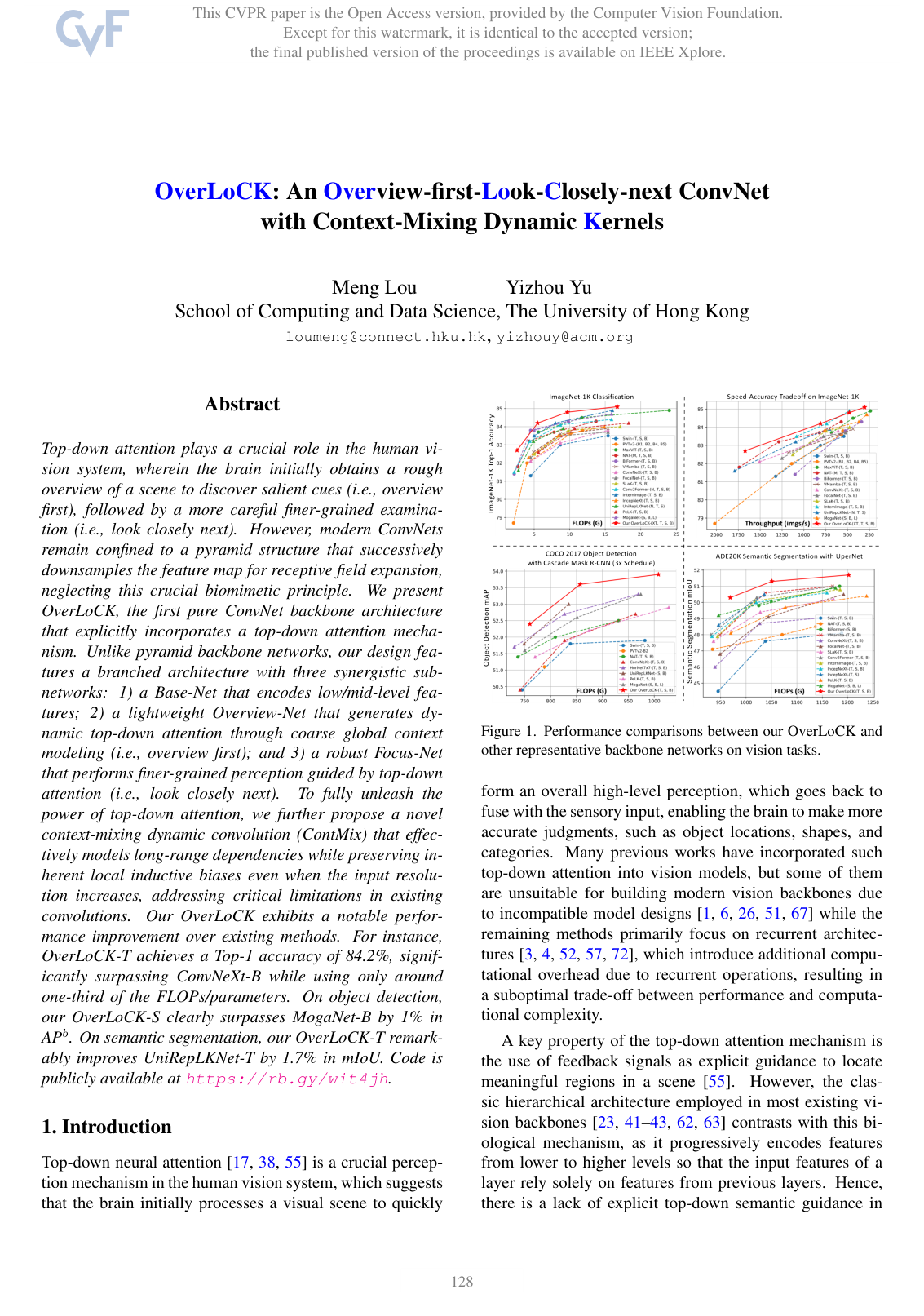
OverLoCK: An Overview-first-Look-Closely-next ConvNet with Context-Mixing Dynamic Kernels
Meng Lou, Yizhou Yu
Why you should read this
Proposes a pure convolutional backbone that mimics human top-down attention through a branched overview-and-focus architecture and context-mixing dynamic kernels, outperforming ConvNeXt-B on ImageNet while using only a third of the parameters and compute.
Top-down attention plays a crucial role in the human vision system, wherein the brain initially obtains a rough overview of a scene to discover salient cues (i.e., overview first), followed by a more careful finer-grained examination (i.e., look closely next). However, modern ConvNets remain confined to a pyramid structure that successively downsamples the feature map for receptive field expansion, neglecting this crucial biomimetic principle. We present OverLoCK, the first pure ConvNet backbone architecture that explicitly incorporates a top-down attention mechanism. Unlike pyramid backbone networks, our design features a branched architecture with three synergistic sub-networks: 1) a Base-Net that encodes low/mid-level features; 2) a lightweight Overview-Net that generates dynamic top-down attention through coarse global context modeling (i.e., overview first); and 3) a robust Focus-Net that performs finer-grained perception guided by top-down attention (i.e., look closely next). To fully unleash the power of top-down attention, we further propose a novel context-mixing dynamic convolution (ContMix) that effectively models long-range dependencies while preserving inherent local inductive biases even when the input resolution increases, addressing critical limitations in existing convolutions. Our OverLoCK exhibits a notable performance improvement over existing methods. For instance, OverLoCK-T achieves a Top-1 accuracy of 84.2%, significantly surpassing ConvNeXt-B while using only around one-third of the FLOPs/parameters. On object detection, our OverLoCK-S clearly surpasses MogANet-B by 1% in AP^b. On semantic segmentation, our OverLoCK-T remarkably improves UniRepLKNet-T by 1.7% in mIoU. Code is publicly available at https://rb.gy/wit4jh.
Added
2026-09-26
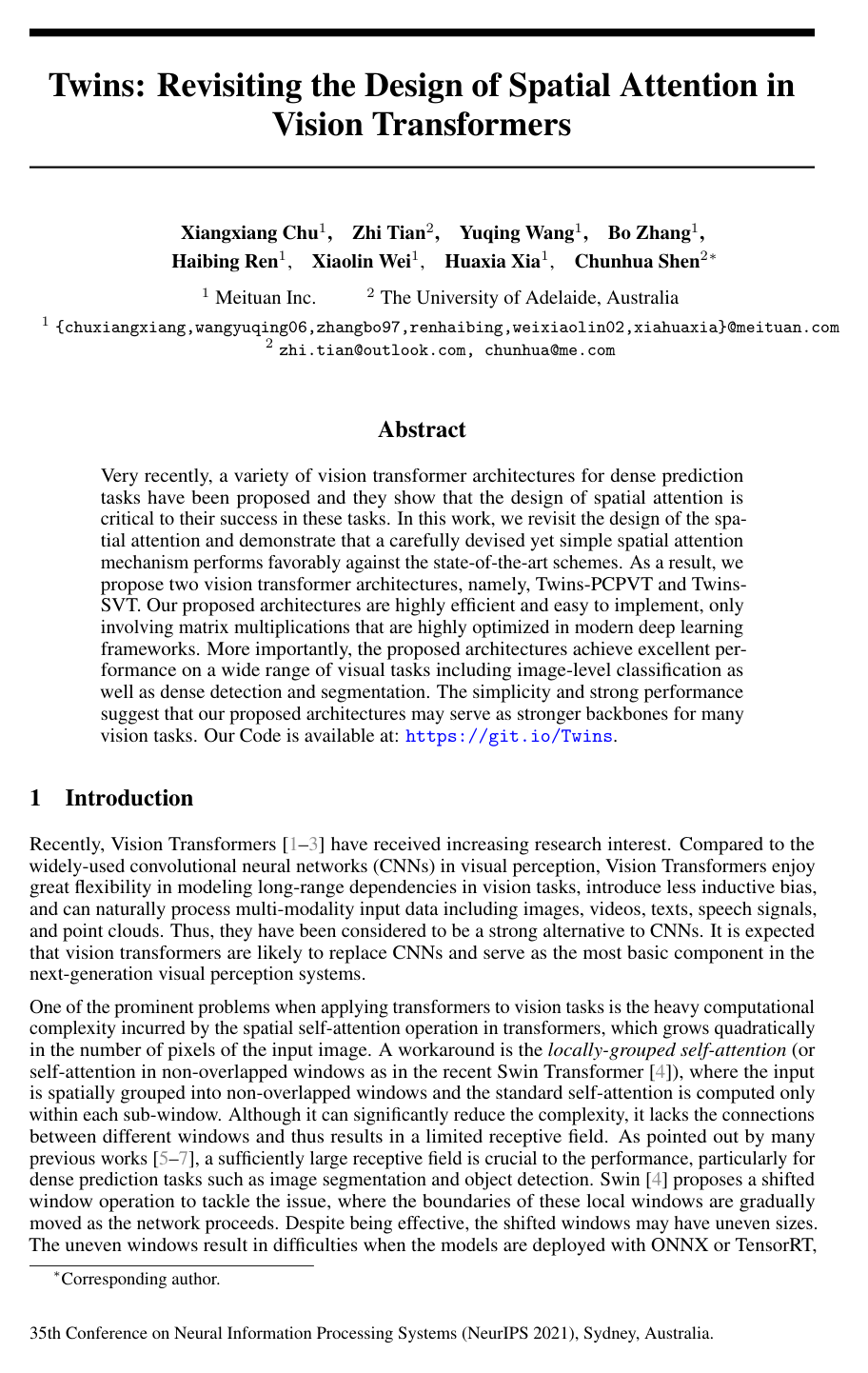
Twins: Revisiting the Design of Spatial Attention in Vision Transformers
Xiangxiang Chu, Zhi Tian, Yuqing Wang, Bo Zhang, Haibing Ren, Xiaolin Wei, Huaxia Xia, Chunhua Shen
Why you should read this
Proposes two efficient vision transformer architectures that simplify spatial attention using standard matrix operations to deliver competitive performance across classification, detection, and segmentation tasks.
Very recently, a variety of vision transformer architectures for dense prediction tasks have been proposed and they show that the design of spatial attention is critical to their success in these tasks. In this work, we revisit the design of the spatial attention and demonstrate that a carefully-devised yet simple spatial attention mechanism performs favourably against the state-of-the-art schemes. As a result, we propose two vision transformer architectures, namely, Twins-PCPVT and Twins-SVT. Our proposed architectures are highly-efficient and easy to implement, only involving matrix multiplications that are highly optimized in modern deep learning frameworks. More importantly, the proposed architectures achieve excellent performance on a wide range of visual tasks, including image level classification as well as dense detection and segmentation. The simplicity and strong performance suggest that our proposed architectures may serve as stronger backbones for many vision tasks. Our code is released at this https URL .
Added
2026-09-25
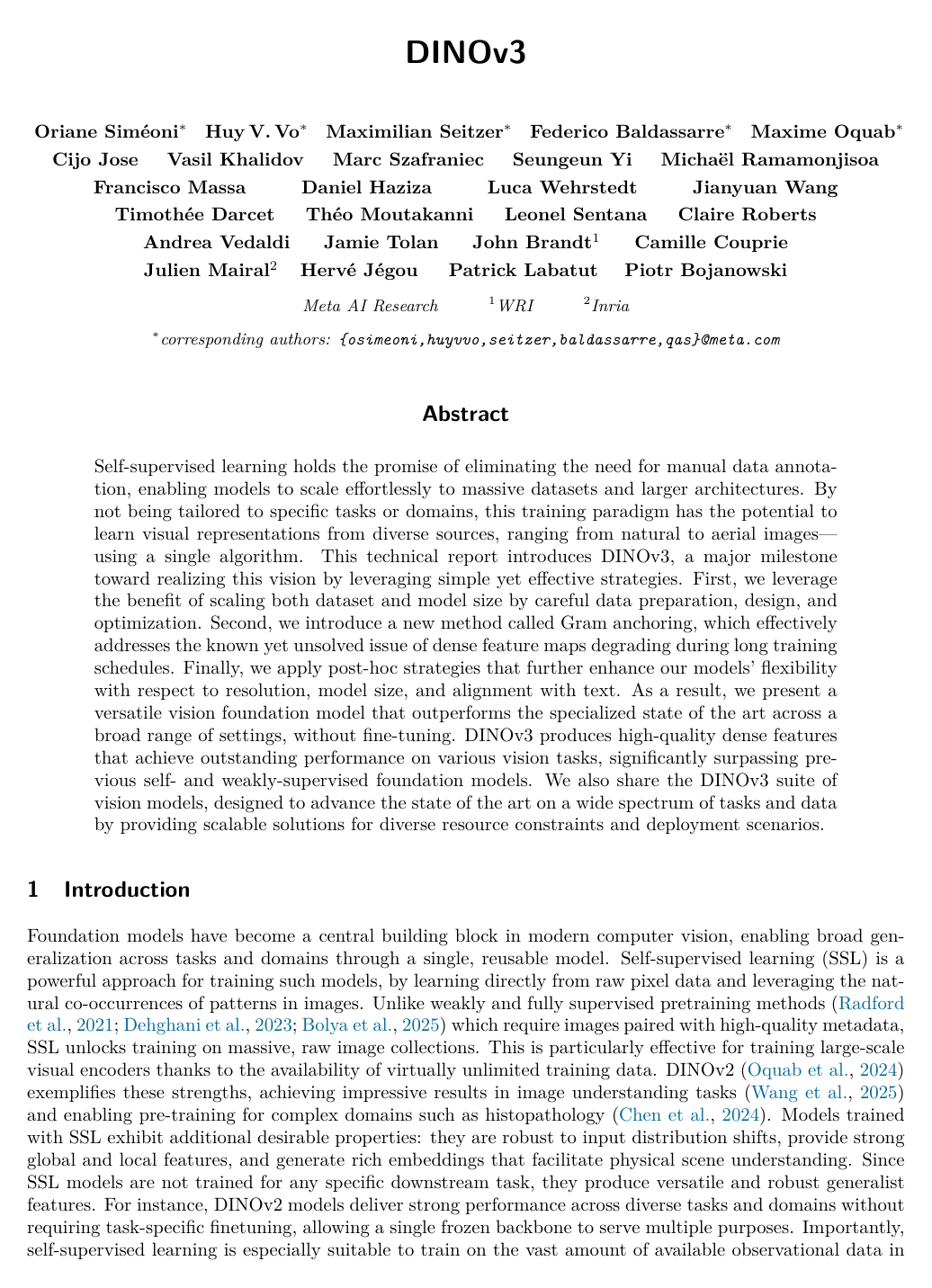
DINOv3
Oriane Siméoni, Huy V. Vo, Maximilian Seitzer, Federico Baldassarre, Maxime Oquab, Cijo Jose, Vasil Khalidov, Marc Szafraniec, Seungeun Yi, Michaël Ramamonjisoa, Francisco Massa, Daniel Haziza, Luca Wehrstedt, Jianyuan Wang, Timothée Darcet, Théo Moutakanni, Leonel Sentana, Claire Roberts, Andrea Vedaldi, Jamie Tolan, John Brandt, Camille Couprie, Julien Mairal, Hervé Jégou, Patrick Labatut, Piotr Bojanowski
Why you should read this
Introduces DINOv3, a self-supervised vision foundation model that incorporates Gram anchoring to prevent feature degradation during extended training and achieves state-of-the-art dense representation performance across diverse visual tasks without fine-tuning.
Self-supervised learning holds the promise of eliminating the need for manual data annotation, enabling models to scale effortlessly to massive datasets and larger architectures. By not being tailored to specific tasks or domains, this training paradigm has the potential to learn visual representations from diverse sources, ranging from natural to aerial images -- using a single algorithm. This technical report introduces DINOv3, a major milestone toward realizing this vision by leveraging simple yet effective strategies. First, we leverage the benefit of scaling both dataset and model size by careful data preparation, design, and optimization. Second, we introduce a new method called Gram anchoring, which effectively addresses the known yet unsolved issue of dense feature maps degrading during long training schedules. Finally, we apply post-hoc strategies that further enhance our models' flexibility with respect to resolution, model size, and alignment with text. As a result, we present a versatile vision foundation model that outperforms the specialized state of the art across a broad range of settings, without fine-tuning. DINOv3 produces high-quality dense features that achieve outstanding performance on various vision tasks, significantly surpassing previous self- and weakly-supervised foundation models. We also share the DINOv3 suite of vision models, designed to advance the state of the art on a wide spectrum of tasks and data by providing scalable solutions for diverse resource constraints and deployment scenarios.
Added
2026-09-25
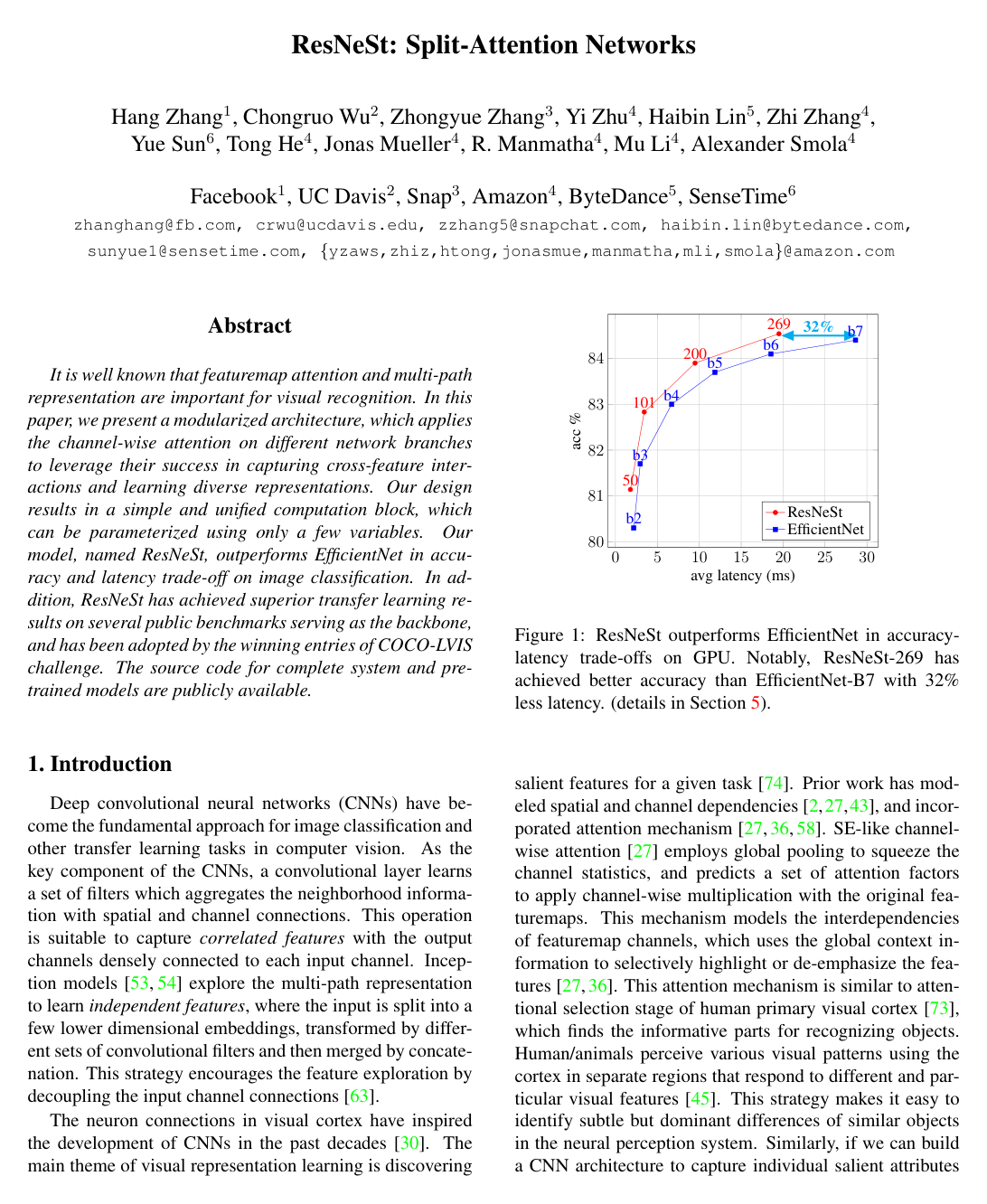
ResNeSt: Split-Attention Networks
Hang Zhang, Chongruo Wu, Zhongyue Zhang, Yi Zhu, Haibin Lin, Zhi Zhang, Yue Sun, Tong He, Jonas Mueller, R. Manmatha, Mu Li, Alexander Smola
Why you should read this
Introduces ResNeSt, a modular split-attention architecture that combines multi-path representations with cross-branch channel attention to outperform EfficientNet in accuracy-latency trade-offs and transfer learning benchmarks.
It is well known that featuremap attention and multi-path representation are important for visual recognition. In this paper, we present a modularized architecture, which applies the channel-wise attention on different network branches to leverage their success in capturing cross-feature interactions and learning diverse representations. Our design results in a simple and unified computation block, which can be parameterized using only a few variables. Our model, named ResNeSt, outperforms EfficientNet in accuracy and latency trade-off on image classification. In addition, ResNeSt has achieved superior transfer learning results on several public benchmarks serving as the backbone, and has been adopted by the winning entries of COCO-LVIS challenge. The source code for complete system and pretrained models are publicly available.
Added
2026-09-24
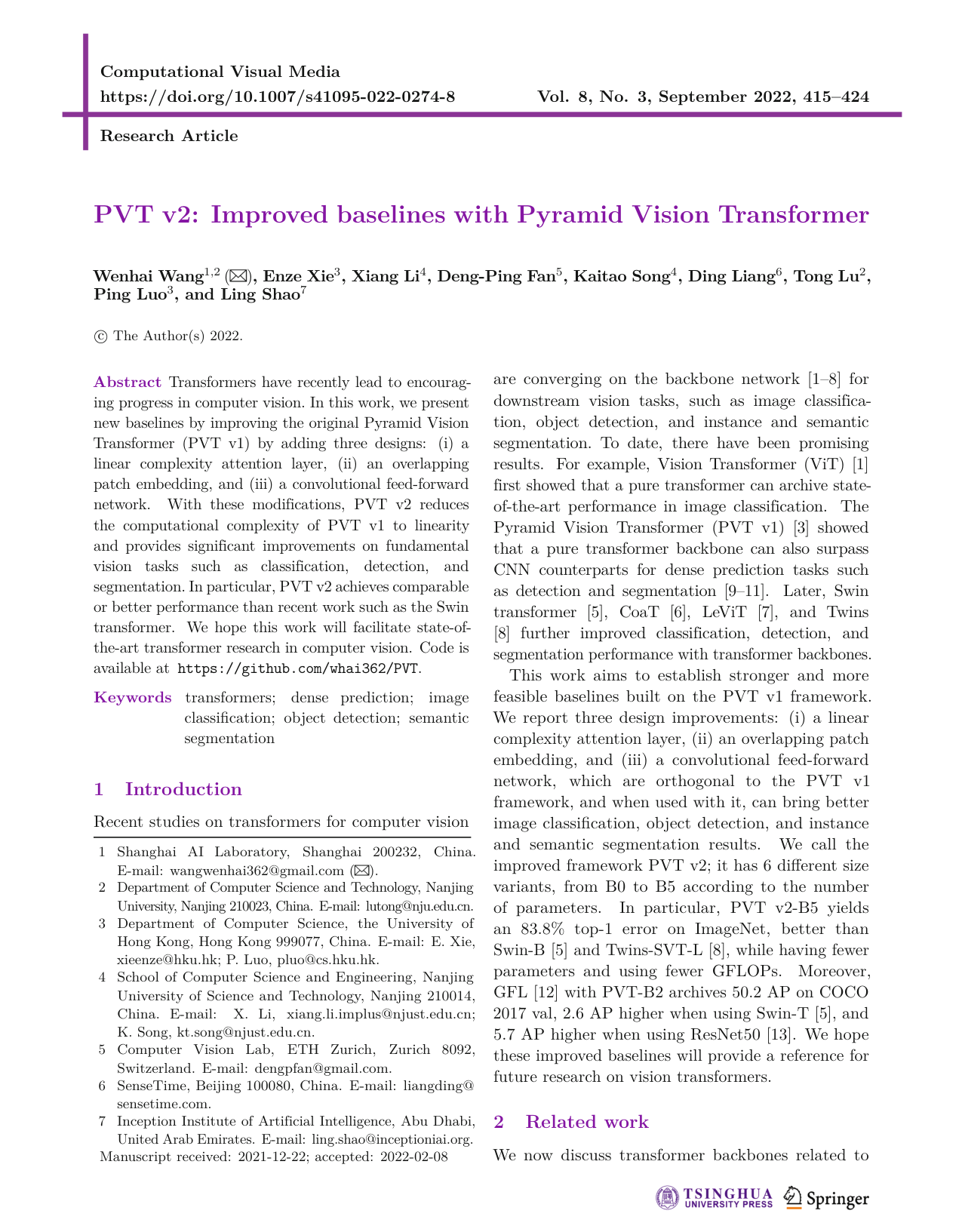
PVT v2: Improved baselines with Pyramid Vision Transformer
Wenhai Wang, Enze Xie, Xiang Li, Deng-Ping Fan, Kaitao Song, Ding Liang, Tong Lu, Ping Luo, Ling Shao
Why you should read this
Introduces PVT v2, an upgraded vision transformer that achieves linear computational complexity through overlapping patch embeddings and convolutional feed-forward networks, rivaling Swin Transformer on dense prediction tasks.
Transformer recently has presented encouraging progress in computer vision. In this work, we present new baselines by improving the original Pyramid Vision Transformer (PVT v1) by adding three designs, including (1) linear complexity attention layer, (2) overlapping patch embedding, and (3) convolutional feed-forward network. With these modifications, PVT v2 reduces the computational complexity of PVT v1 to linear and achieves significant improvements on fundamental vision tasks such as classification, detection, and segmentation. Notably, the proposed PVT v2 achieves comparable or better performances than recent works such as Swin Transformer. We hope this work will facilitate state-of-the-art Transformer researches in computer vision. Code is available at this https URL.
Added
2026-09-18
Dilated Residual Networks
Fisher Yu, Vladlen Koltun, Thomas Funkhouser
Why you should read this
Proposes dilated residual networks that retain high spatial feature resolution without increasing model complexity, introducing a degridding technique that improves performance across image classification, object localization, and semantic segmentation.
Convolutional networks for image classification progressively reduce resolution until the image is represented by tiny feature maps in which the spatial structure of the scene is no longer discernible. Such loss of spatial acuity can limit image classification accuracy and complicate the transfer of the model to downstream applications that require detailed scene understanding. These problems can be alleviated by dilation, which increases the resolution of output feature maps without reducing the receptive field of individual neurons. We show that dilated residual networks (DRNs) outperform their non-dilated counterparts in image classification without increasing the model's depth or complexity. We then study gridding artifacts introduced by dilation, develop an approach to removing these artifacts (`degridding'), and show that this further increases the performance of DRNs. In addition, we show that the accuracy advantage of DRNs is further magnified in downstream applications such as object localization and semantic segmentation.
Added
2026-09-18
Vision Mamba: Efficient Visual Representation Learning with Bidirectional State Space Model
Lianghui Zhu, Bencheng Liao, Qian Zhang, Xinlong Wang, Wenyu Liu, Xinggang Wang
Why you should read this
Introduces Vision Mamba, a bidirectional state space backbone that replaces self-attention to achieve linear-time visual representation learning, outperforming standard vision transformers across core visual benchmarks while cutting GPU memory use by over 86% on high-resolution images.
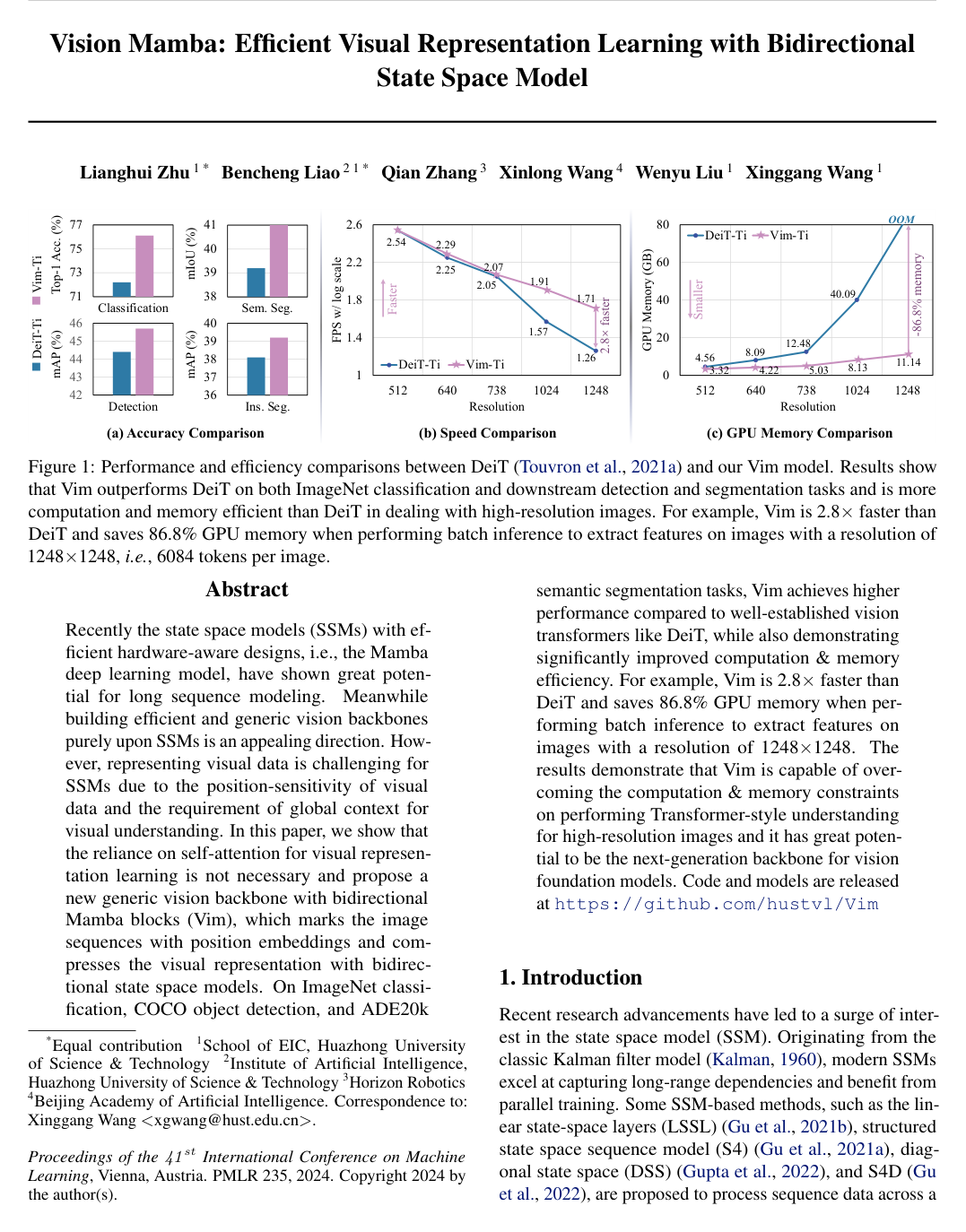
Recently the state space models (SSMs) with efficient hardware-aware designs, i.e., the Mamba deep learning model, have shown great potential for long sequence modeling. Meanwhile building efficient and generic vision backbones purely upon SSMs is an appealing direction. However, representing visual data is challenging for SSMs due to the position-sensitivity of visual data and the requirement of global context for visual understanding. In this paper, we show that the reliance on self-attention for visual representation learning is not necessary and propose a new generic vision backbone with bidirectional Mamba blocks (Vim), which marks the image sequences with position embeddings and compresses the visual representation with bidirectional state space models. On ImageNet classification, COCO object detection, and ADE20k semantic segmentation tasks, Vim achieves higher performance compared to well-established vision transformers like DeiT, while also demonstrating significantly improved computation & memory efficiency. For example, Vim is 2.8 faster than DeiT and saves 86.8% GPU memory when performing batch inference to extract features on images with a resolution of 12481248. The results demonstrate that Vim is capable of overcoming the computation & memory constraints on performing Transformer-style understanding for high-resolution images and it has great potential to be the next-generation backbone for vision foundation models. Code is available at this https URL.
Added
2026-09-18
CvT: Introducing Convolutions to Vision Transformers
Haiping Wu, Bin Xiao, Noel Codella, Mengchen Liu, Xiyang Dai, Lu Yuan, Lei Zhang
Why you should read this
Presents CvT, a hybrid architecture that incorporates convolutional token embeddings and projections into Vision Transformers to achieve superior ImageNet accuracy with fewer parameters and FLOPs while eliminating the need for positional encodings.
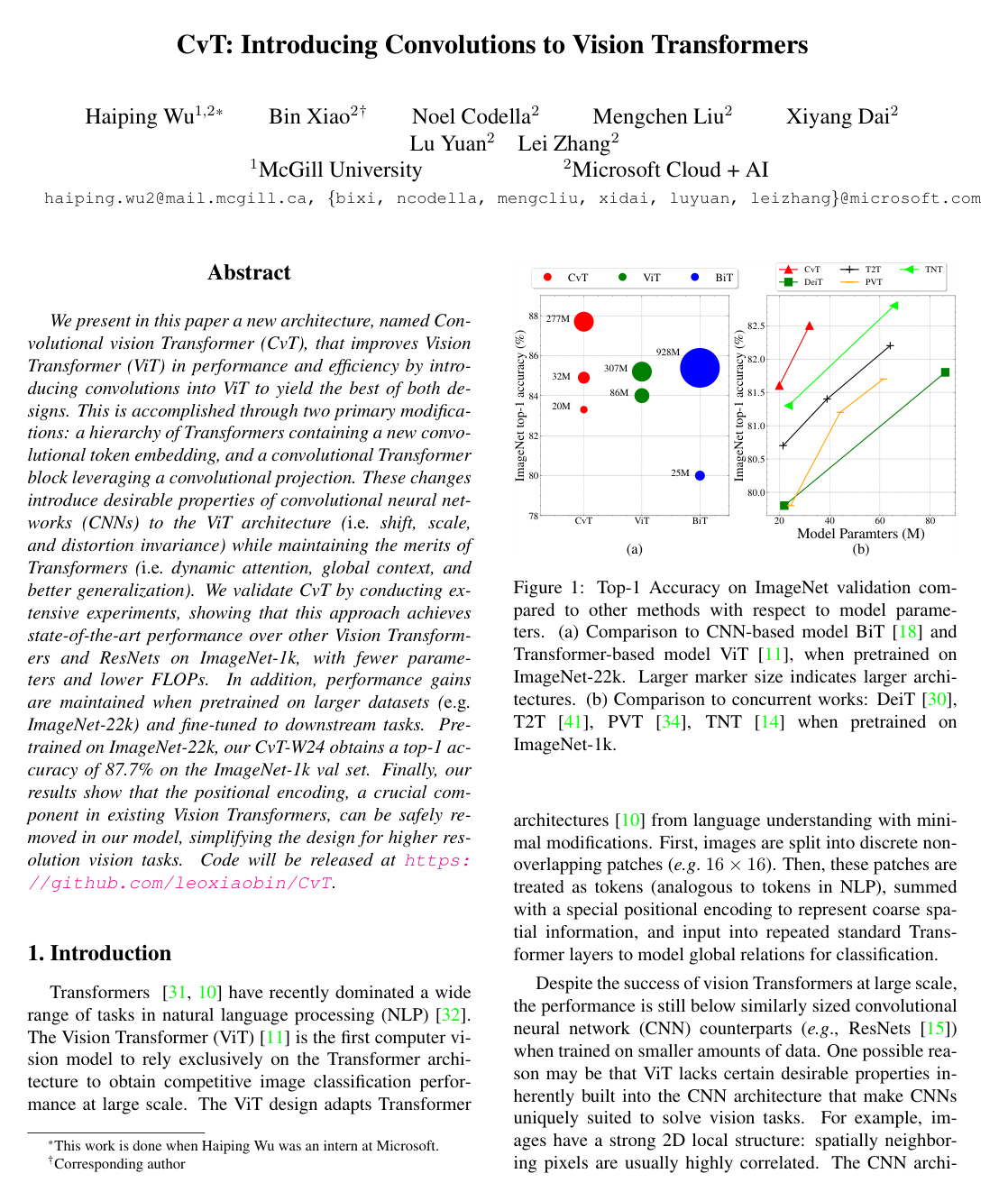
We present in this paper a new architecture, named Convolutional vision Transformer (CvT), that improves Vision Transformer (ViT) in performance and efficiency by introducing convolutions into ViT to yield the best of both designs. This is accomplished through two primary modifications: a hierarchy of Transformers containing a new convolutional token embedding, and a convolutional Transformer block leveraging a convolutional projection. These changes introduce desirable properties of convolutional neural networks (CNNs) to the ViT architecture (\ie shift, scale, and distortion invariance) while maintaining the merits of Transformers (\ie dynamic attention, global context, and better generalization). We validate CvT by conducting extensive experiments, showing that this approach achieves state-of-the-art performance over other Vision Transformers and ResNets on ImageNet-1k, with fewer parameters and lower FLOPs. In addition, performance gains are maintained when pretrained on larger datasets (\eg ImageNet-22k) and fine-tuned to downstream tasks. Pre-trained on ImageNet-22k, our CvT-W24 obtains a top-1 accuracy of 87.7\% on the ImageNet-1k val set. Finally, our results show that the positional encoding, a crucial component in existing Vision Transformers, can be safely removed in our model, simplifying the design for higher resolution vision tasks. Code will be released at \url{this https URL}.
Added
2026-09-14
CCNet: Criss-Cross Attention for Semantic Segmentation
Zilong Huang, Xinggang Wang, Lichao Huang, Chang Huang, Yunchao Wei, Humphrey Shi, Wenyu Liu
Why you should read this
Introduces CCNet, a criss-cross attention network that captures global visual context for semantic segmentation while reducing GPU memory usage by eleven times and computation by 85 percent compared to standard non-local blocks.
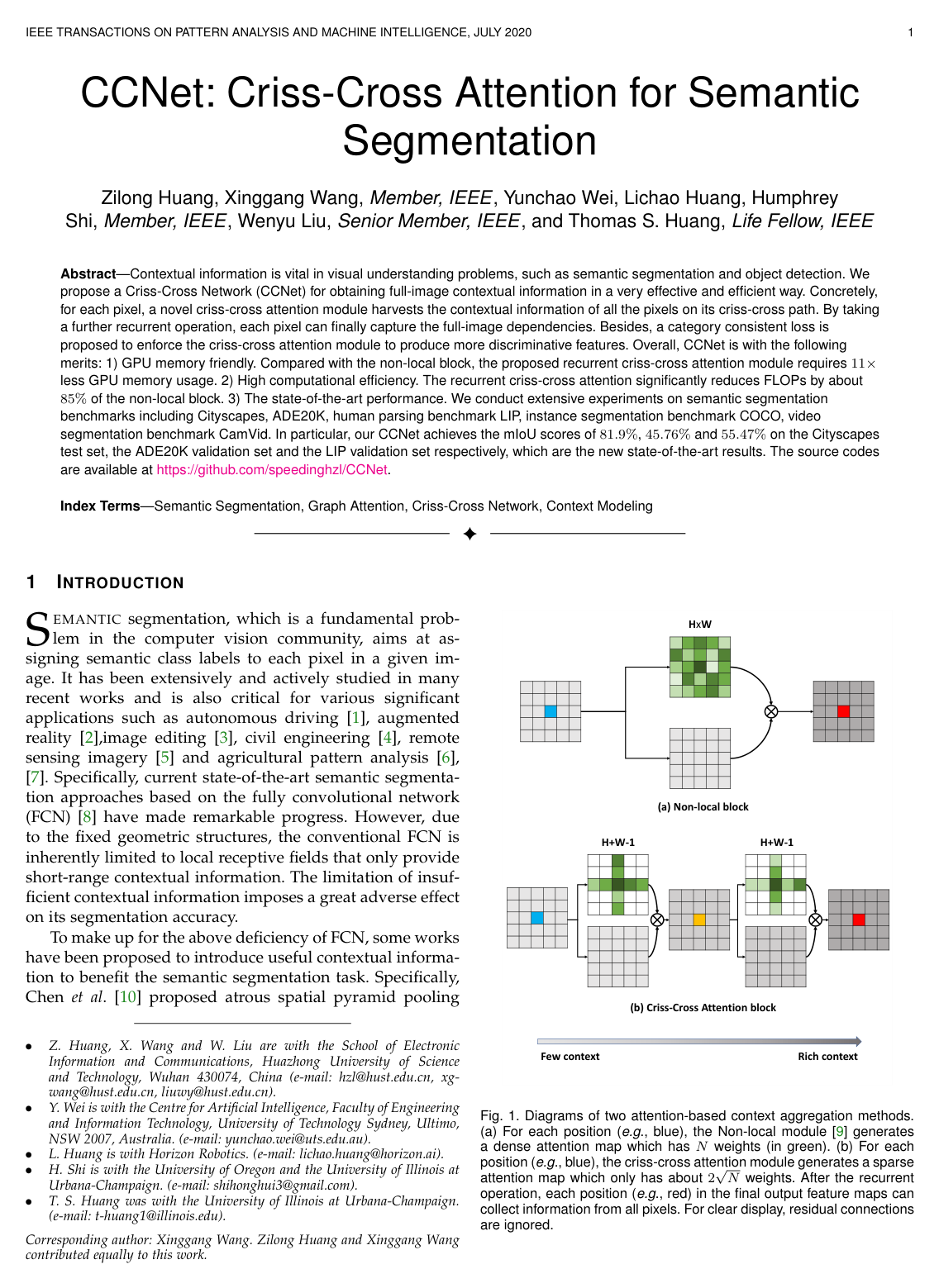
Contextual information is vital in visual understanding problems, such as semantic segmentation and object detection. We propose a Criss-Cross Network (CCNet) for obtaining full-image contextual information in a very effective and efficient way. Concretely, for each pixel, a novel criss-cross attention module harvests the contextual information of all the pixels on its criss-cross path. By taking a further recurrent operation, each pixel can finally capture the full-image dependencies. Besides, a category consistent loss is proposed to enforce the criss-cross attention module to produce more discriminative features. Overall, CCNet is with the following merits: 1) GPU memory friendly. Compared with the non-local block, the proposed recurrent criss-cross attention module requires 11x less GPU memory usage. 2) High computational efficiency. The recurrent criss-cross attention significantly reduces FLOPs by about 85% of the non-local block. 3) The state-of-the-art performance. We conduct extensive experiments on semantic segmentation benchmarks including Cityscapes, ADE20K, human parsing benchmark LIP, instance segmentation benchmark COCO, video segmentation benchmark CamVid. In particular, our CCNet achieves the mIoU scores of 81.9%, 45.76% and 55.47% on the Cityscapes test set, the ADE20K validation set and the LIP validation set respectively, which are the new state-of-the-art results. The source codes are available at \url{this https URL}.
Added
2026-09-12
DeepLab: Semantic Image Segmentation with Deep Convolutional Nets, Atrous Convolution, and Fully Connected CRFs
Liang-Chieh Chen, George Papandreou, Iasonas Kokkinos, Kevin Murphy, Alan L. Yuille
Why you should read this
Introduces the DeepLab framework, which combines atrous convolution, atrous spatial pyramid pooling, and fully connected conditional random fields to capture multi-scale context and achieve precise boundary localization in semantic image segmentation.
In this work we address the task of semantic image segmentation with Deep Learning and make three main contributions that are experimentally shown to have substantial practical merit. First, we highlight convolution with upsampled filters, or 'atrous convolution', as a powerful tool in dense prediction tasks. Atrous convolution allows us to explicitly control the resolution at which feature responses are computed within Deep Convolutional Neural Networks. It also allows us to effectively enlarge the field of view of filters to incorporate larger context without increasing the number of parameters or the amount of computation. Second, we propose atrous spatial pyramid pooling (ASPP) to robustly segment objects at multiple scales. ASPP probes an incoming convolutional feature layer with filters at multiple sampling rates and effective fields-of-views, thus capturing objects as well as image context at multiple scales. Third, we improve the localization of object boundaries by combining methods from DCNNs and probabilistic graphical models. The commonly deployed combination of max-pooling and downsampling in DCNNs achieves invariance but has a toll on localization accuracy. We overcome this by combining the responses at the final DCNN layer with a fully connected Conditional Random Field (CRF), which is shown both qualitatively and quantitatively to improve localization performance. Our proposed "DeepLab" system sets the new state-of-art at the PASCAL VOC-2012 semantic image segmentation task, reaching 79.7% mIOU in the test set, and advances the results on three other datasets: PASCAL-Context, PASCAL-Person-Part, and Cityscapes. All of our code is made publicly available online.
Added
2026-09-09
FCOS: Fully Convolutional One-Stage Object Detection
Zhi Tian, Chunhua Shen, Hao Chen, Tong He
Why you should read this
Introduces FCOS, a fully convolutional anchor-free object detector that reformulates bounding box detection as per-pixel prediction, eliminating complex anchor box tuning while outperforming standard one-stage detectors.
We propose a fully convolutional one-stage object detector (FCOS) to solve object detection in a per-pixel prediction fashion, analogue to semantic segmentation. Almost all state-of-the-art object detectors such as RetinaNet, SSD, YOLOv3, and Faster R-CNN rely on pre-defined anchor boxes. In contrast, our proposed detector FCOS is anchor box free, as well as proposal free. By eliminating the predefined set of anchor boxes, FCOS completely avoids the complicated computation related to anchor boxes such as calculating overlapping during training. More importantly, we also avoid all hyper-parameters related to anchor boxes, which are often very sensitive to the final detection performance. With the only post-processing non-maximum suppression (NMS), FCOS with ResNeXt-64x4d-101 achieves 44.7% in AP with single-model and single-scale testing, surpassing previous one-stage detectors with the advantage of being much simpler. For the first time, we demonstrate a much simpler and flexible detection framework achieving improved detection accuracy. We hope that the proposed FCOS framework can serve as a simple and strong alternative for many other instance-level tasks. Code is available at:Code is available at: this https URL
Added
2026-09-09
What Uncertainties Do We Need in Bayesian Deep Learning for Computer Vision?
Alex Kendall, Yarin Gal
Why you should read this
Develops a unified Bayesian deep learning framework that separates aleatoric and epistemic uncertainties to create noise-attenuating loss functions, improving accuracy and confidence estimation across core computer vision tasks like semantic segmentation and depth regression.
There are two major types of uncertainty one can model. Aleatoric uncertainty captures noise inherent in the observations. On the other hand, epistemic uncertainty accounts for uncertainty in the model -- uncertainty which can be explained away given enough data. Traditionally it has been difficult to model epistemic uncertainty in computer vision, but with new Bayesian deep learning tools this is now possible. We study the benefits of modeling epistemic vs. aleatoric uncertainty in Bayesian deep learning models for vision tasks. For this we present a Bayesian deep learning framework combining input-dependent aleatoric uncertainty together with epistemic uncertainty. We study models under the framework with per-pixel semantic segmentation and depth regression tasks. Further, our explicit uncertainty formulation leads to new loss functions for these tasks, which can be interpreted as learned attenuation. This makes the loss more robust to noisy data, also giving new state-of-the-art results on segmentation and depth regression benchmarks.
Added
2026-09-08
SegFormer: Simple and Efficient Design for Semantic Segmentation with Transformers
Enze Xie, Wenhai Wang, Zhiding Yu, Anima Anandkumar, Jose M. Alvarez, Ping Luo
Why you should read this
Proposes SegFormer, an efficient semantic segmentation framework that pairs a positional-encoding-free hierarchical Transformer with a lightweight MLP decoder to achieve state-of-the-art accuracy on ADE20K and Cityscapes with a fraction of the parameters of previous models.
We present SegFormer, a simple, efficient yet powerful semantic segmentation framework which unifies Transformers with lightweight multilayer perception (MLP) decoders. SegFormer has two appealing features: 1) SegFormer comprises a novel hierarchically structured Transformer encoder which outputs multiscale features. It does not need positional encoding, thereby avoiding the interpolation of positional codes which leads to decreased performance when the testing resolution differs from training. 2) SegFormer avoids complex decoders. The proposed MLP decoder aggregates information from different layers, and thus combining both local attention and global attention to render powerful representations. We show that this simple and lightweight design is the key to efficient segmentation on Transformers. We scale our approach up to obtain a series of models from SegFormer-B0 to SegFormer-B5, reaching significantly better performance and efficiency than previous counterparts. For example, SegFormer-B4 achieves 50.3% mIoU on ADE20K with 64M parameters, being 5x smaller and 2.2% better than the previous best method. Our best model, SegFormer-B5, achieves 84.0% mIoU on Cityscapes validation set and shows excellent zero-shot robustness on Cityscapes-C. Code will be released at: this http URL.
Added
2026-09-07