Vision Mamba: Efficient Visual Representation Learning with Bidirectional State Space Model
Lianghui ZhuBencheng LiaoQian ZhangXinlong WangWenyu LiuXinggang Wang
Introduces Vision Mamba, a bidirectional state space backbone that replaces self-attention to achieve linear-time visual representation learning, outperforming standard vision transformers across core visual benchmarks while cutting GPU memory use by over 86% on high-resolution images.
Modern computer vision heavily relies on vision transformers to achieve high accuracy across complex visual recognition tasks. However, these transformer models depend on self-attention mechanisms whose computational and memory costs grow quadratically with the length of the visual sequence. This creates a severe performance bottleneck when processing high-resolution images, limiting operational throughput and inflating hardware infrastructure costs.
To resolve this bottleneck, the article evaluated whether self-attention can be eliminated in generic visual backbones by introducing Vision Mamba (Vim). Vim adapts modern selective state space models—initially developed for linear-time language modeling—into a bidirectional architecture designed specifically for sequential visual representation without relying on conventional attention mechanisms or hand-crafted spatial biases.
The authors designed Vim by flattening images into patch sequences, marking them with position embeddings, and processing them using forward and backward state space pathways optimized for hardware memory bandwidth. The model was empirically evaluated across multiple standardized benchmarks, including supervised image classification on ImageNet-1K (1.28 million training images), semantic segmentation on ADE20K, and object detection and instance segmentation on COCO 2017. The evaluation benchmarked both task accuracy and hardware efficiency against established baseline models such as Data-efficient Image Transformers (DeiT).
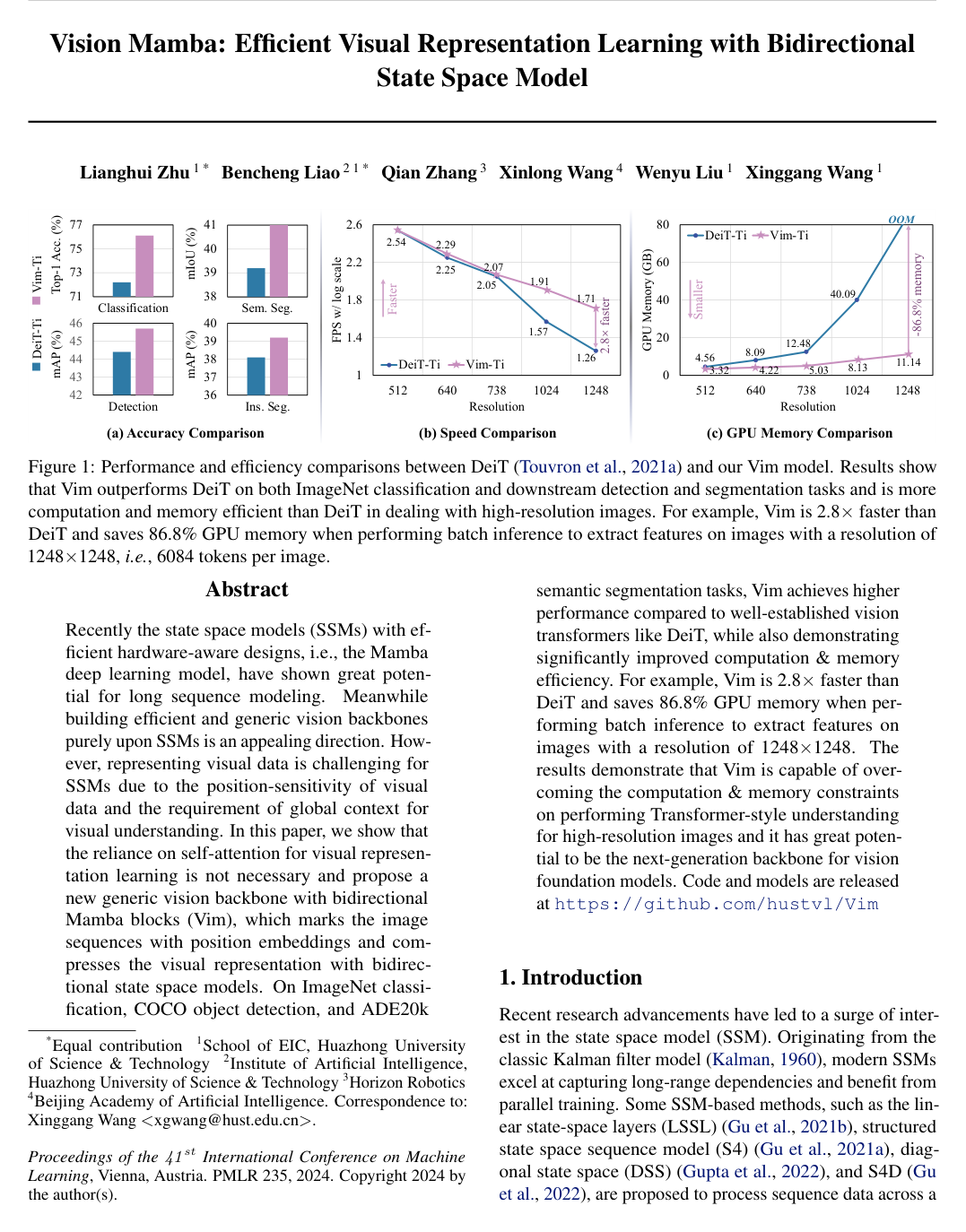
The evaluation produced four primary findings. First, Vim consistently surpassed DeiT across multiple model scales on ImageNet classification; for instance, the tiny variant achieved 76.1% top-1 accuracy compared to DeiT's 72.2%, rising to 78.3% after long-sequence fine-tuning. Second, Vim delivered major hardware efficiency gains at high resolutions: when processing 1248×1248 images, Vim operated 2.8 times faster than DeiT and reduced GPU memory consumption by 86.8%. Third, on dense downstream tasks, Vim-Tiny outperformed DeiT-Tiny on the COCO dataset by 1.3 box average precision points and 1.1 mask average precision points, showing particular strength on large objects due to improved long-range contextual modeling. Finally, in semantic segmentation on ADE20K, Vim achieved higher mean intersection over union than DeiT while matching traditional convolutional ResNet-101 performance with nearly half the parameter footprint.
These findings indicate that bidirectional state space models can match or exceed transformer-level visual understanding while maintaining subquadratic computational speed and linear memory scaling. For technical leadership and deployment teams, this translates into significantly lower memory footprint, reduced cloud computing costs, and the ability to process high-resolution visual inputs end-to-end without resorting to complex, performance-limiting windowing approximations.
Organizations handling high-resolution visual workflows—such as medical pathology, remote sensing, and long-form video—should consider piloting bidirectional state space architectures as drop-in alternatives to conventional vision transformers. Future technical development should prioritize exploring large-scale unsupervised pretraining (such as masked image modeling) and integrating Vim into multimodal vision-language architectures.
While empirical results on standard benchmarks show high confidence, current evaluations are primarily bounded by supervised training regimes and standard model sizes up to roughly 100 million parameters. Further validation is warranted at extreme foundation-model scales and across specialized industry domains before broad production replacement.
- Paper: An Image is Worth 16x16 Words: Transformers for Image Recognition at Scale, Alexey Dosovitskiy et al. (2021). Introduces the foundational Vision Transformer (ViT) architecture and patch-based visual tokenization that Vision Mamba adopts while replacing self-attention with state space models.
- Paper: Training data-efficient image transformers & distillation through attention, Hugo Touvron et al. (2021). Establishes data-efficient training strategies and baseline vision transformer benchmarks (DeiT) against which Vision Mamba directly compares its efficiency and representation learning performance.
- Paper: Swin Transformer: Hierarchical Vision Transformer using Shifted Windows, Ze Liu et al. (2021). Demonstrates the architectural challenges and computational limits of applying global self-attention to high-resolution dense vision tasks, which motivates Vision Mamba's linear-complexity alternative.
- Paper: MLP-Mixer: An all-MLP Architecture for Vision, I. Tolstikhin et al. (2021). Pioneers the exploration of alternative, non-attention sequence-mixing operations over image patches for visual representation learning.
- Paper: VMamba: Visual State Space Model, Yue Liu et al. (2024). Extends the visual state space model paradigm by introducing a 2D Selective Scan mechanism to further improve multi-directional context traversal in visual backbones.
- Paper: Qwen2-VL: Enhancing Vision-Language Model's Perception of the World at Any Resolution, Peng Wang et al. (2024). Builds upon efficient visual representation learning principles by scaling multimodal perception to arbitrary resolutions and multidimensional position tracking.
- Paper: LLaVA-OneVision: Easy Visual Task Transfer, Bo Li et al. (2024). Explores unified visual representations across single-image, multi-image, and video contexts, building on advances in scalable visual backbones.