
keyword
complex networks
A complex network is a graph representation of a real-world system composed of interconnected elements, characterized by non-trivial topological features and organizational patterns that do not appear in simple regular lattices or purely random graphs. In these networks, nodes represent individual components, such as people, proteins, or power stations, while edges represent interactions, relationships, or physical connections between them. Unlike basic graph models, complex networks typically exhibit structural properties such as scale-free degree distributions, high clustering, community structure, small-world effects, and modular organization. They frequently incorporate additional real-world complexities, including spatial constraints, time-varying interactions, multilayer dependencies, and higher-order group interactions among multiple entities. The framework of complex networks is widely used across physics, biology, sociology, neuroscience, and computer science to model and predict emergent dynamic behaviors, such as information diffusion, epidemic spreading, synchronization, and cascading failures.
12 items
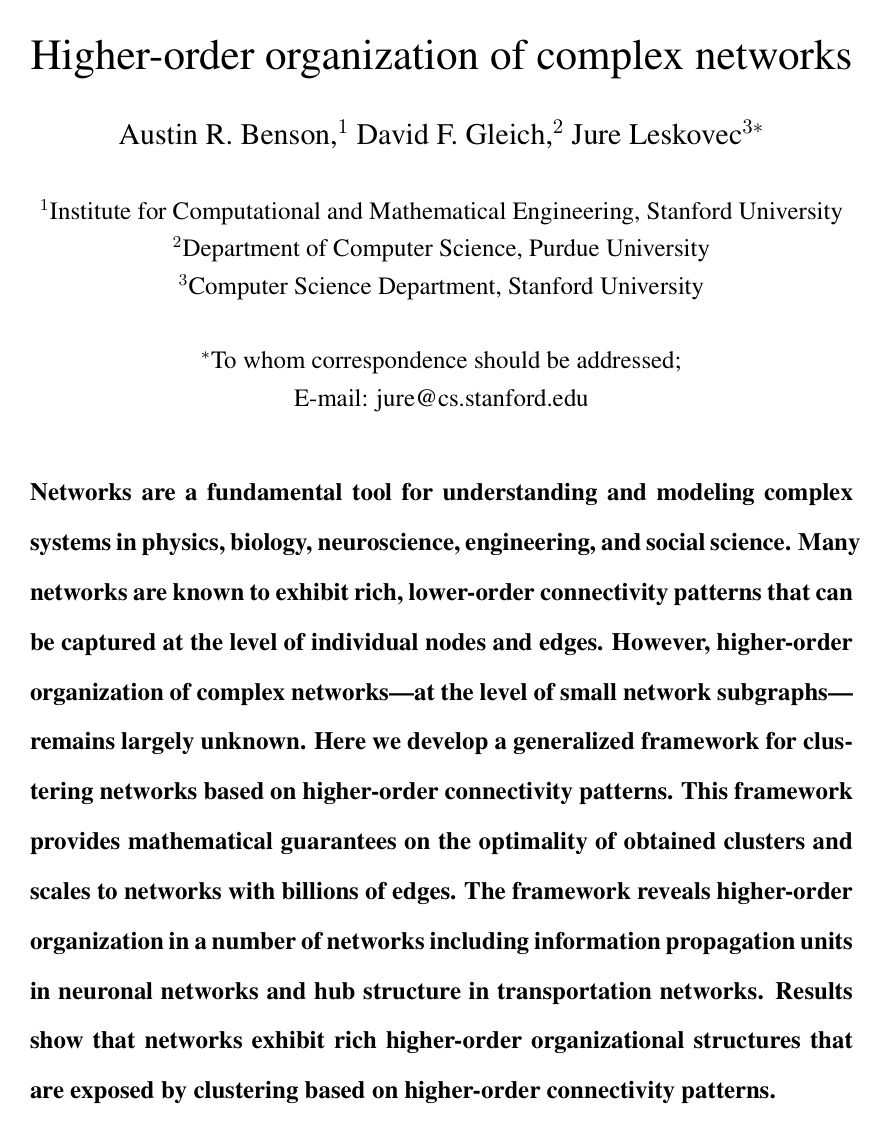
Higher-order organization of complex networks
Austin R. Benson, David F. Gleich, Jure Leskovec
Why you should read this
Develops a scalable, mathematically rigorous framework for clustering complex networks based on higher-order subgraph patterns rather than simple edges, exposing functional modular structures in massive biological, neural, and transportation systems.
Networks are a fundamental tool for understanding and modeling complex systems in physics, biology, neuroscience, engineering, and social science. Many networks are known to exhibit rich, lower-order connectivity patterns that can be captured at the level of individual nodes and edges. However, higher-order organization of complex networks---at the level of small network subgraphs---remains largely unknown. Here we develop a generalized framework for clustering networks based on higher-order connectivity patterns. This framework provides mathematical guarantees on the optimality of obtained clusters and scales to networks with billions of edges. The framework reveals higher-order organization in a number of networks including information propagation units in neuronal networks and hub structure in transportation networks. Results show that networks exhibit rich higher-order organizational structures that are exposed by clustering based on higher-order connectivity patterns.
Added
2026-09-25
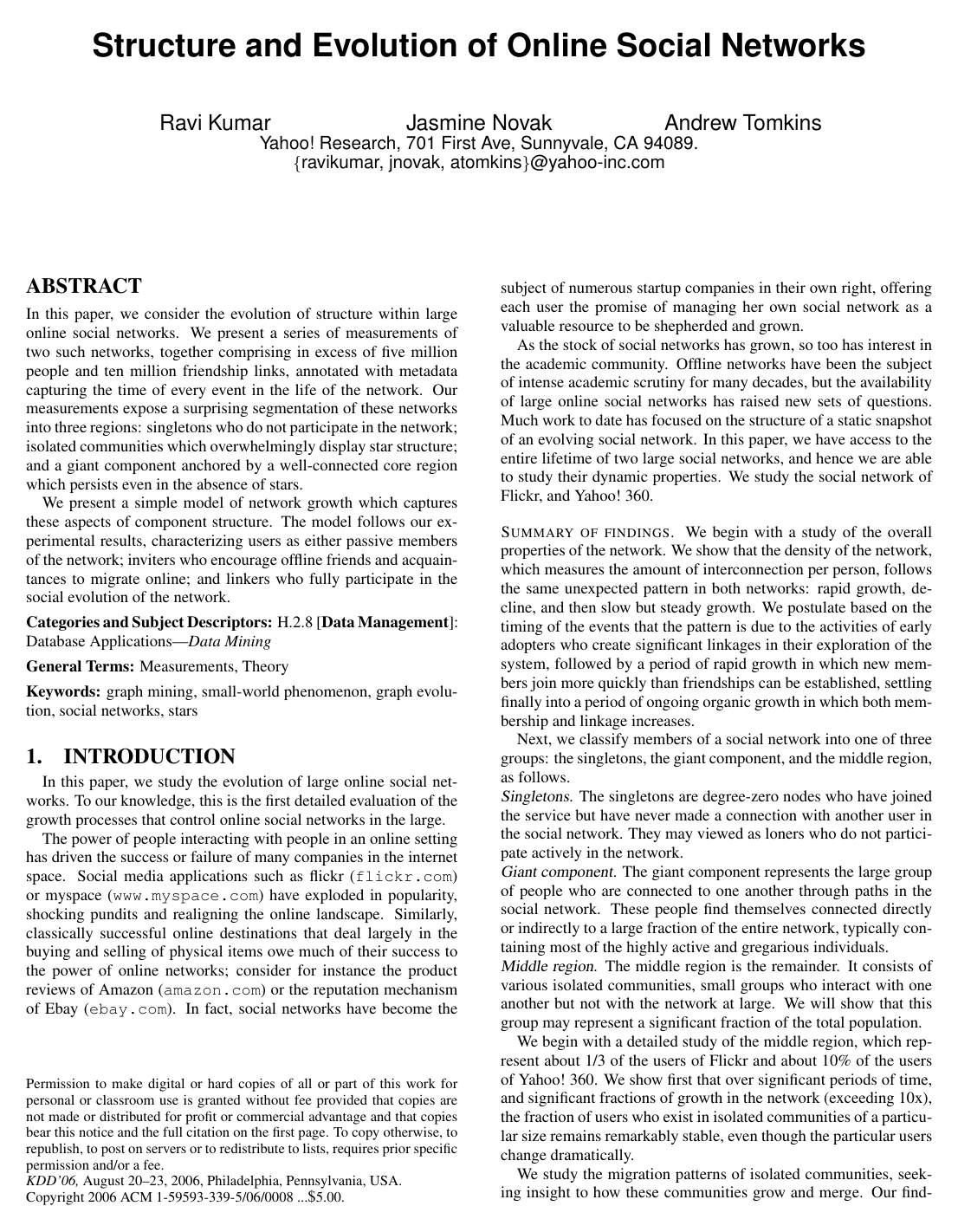
Structure and evolution of online social networks
Ravi Kumar, Jasmine Novak, A. Tomkins
Why you should read this
Reveals how large-scale online social networks evolve from star-like isolated communities into a tightly connected giant core, introducing a biased preferential attachment model that accurately reproduces empirical network growth and density shifts over time.
In this paper, we consider the evolution of structure within large online social networks. We present a series of measurements of two such networks, together comprising in excess of five million people and ten million friendship links, annotated with metadata capturing the time of every event in the life of the network. Our measurements expose a surprising segmentation of these networks into three regions: singletons who do not participate in the network; isolated communities which overwhelmingly display star structure; and a giant component anchored by a well-connected core region which persists even in the absence of stars. We present a simple model of network growth which captures these aspects of component structure. The model follows our experimental results, characterizing users as either passive members of the network; inviters who encourage offline friends and acquaintances to migrate online; and linkers who fully participate in the social evolution of the network.
Added
2026-09-24
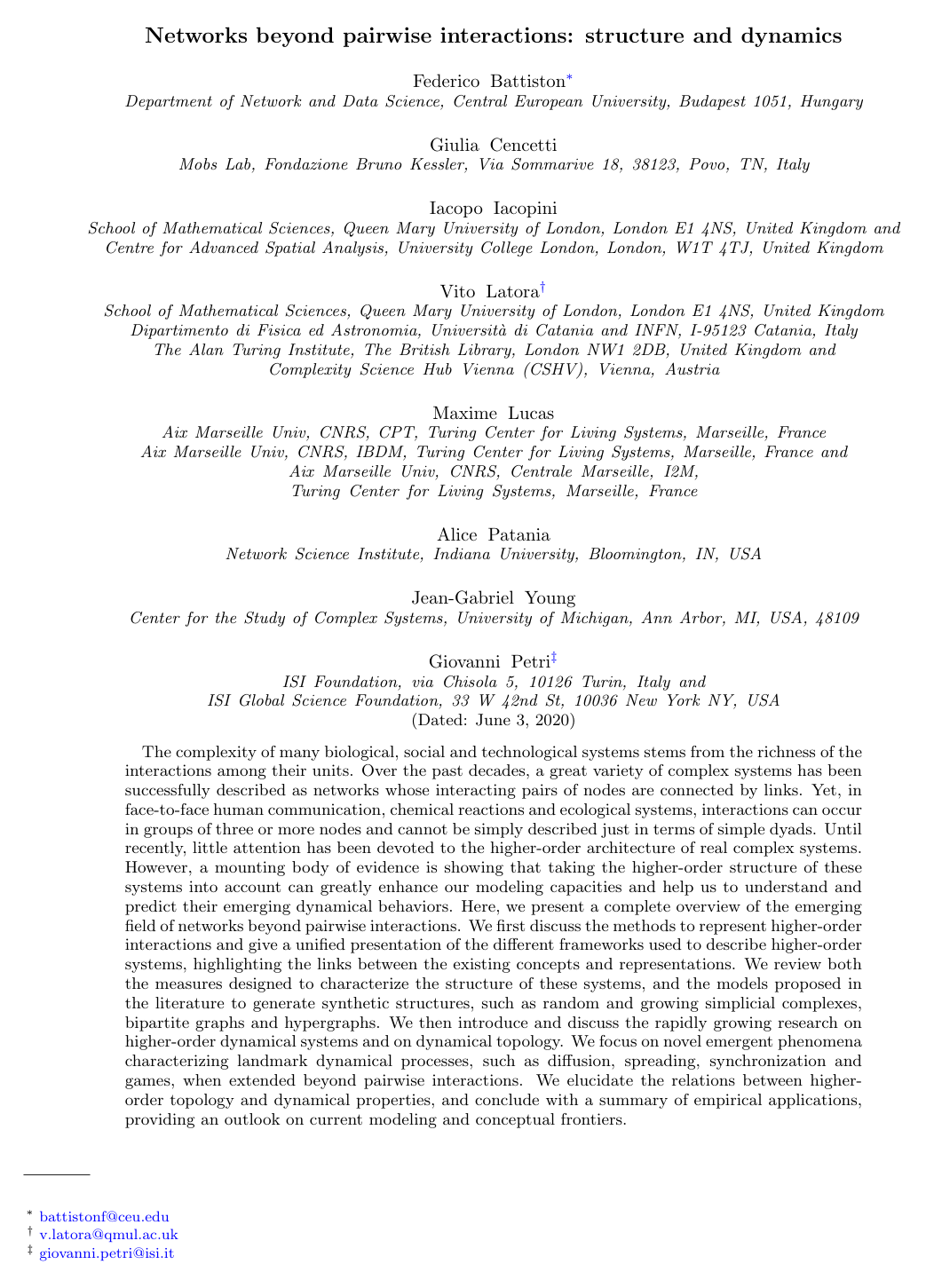
Networks beyond pairwise interactions: structure and dynamics
Federico Battiston, Giulia Cencetti, Iacopo Iacopini, Vito Latora, Maxime Lucas, Alice Patania, Jean-Gabriel Young, Giovanni Petri
Why you should read this
Unifies the mathematical frameworks, structural metrics, and dynamical models of higher-order networks to demonstrate how group interactions across hypergraphs and simplicial complexes fundamentally change processes such as diffusion, contagion, and synchronization.
The complexity of many biological, social and technological systems stems from the richness of the interactions among their units. Over the past decades, a great variety of complex systems has been successfully described as networks whose interacting pairs of nodes are connected by links. Yet, in face-to-face human communication, chemical reactions and ecological systems, interactions can occur in groups of three or more nodes and cannot be simply described just in terms of simple dyads. Until recently, little attention has been devoted to the higher-order architecture of real complex systems. However, a mounting body of evidence is showing that taking the higher-order structure of these systems into account can greatly enhance our modeling capacities and help us to understand and predict their emerging dynamical behaviors. Here, we present a complete overview of the emerging field of networks beyond pairwise interactions. We first discuss the methods to represent higher-order interactions and give a unified presentation of the different frameworks used to describe higher-order systems, highlighting the links between the existing concepts and representations. We review the measures designed to characterize the structure of these systems and the models proposed in the literature to generate synthetic structures, such as random and growing simplicial complexes, bipartite graphs and hypergraphs. We introduce and discuss the rapidly growing research on higher-order dynamical systems and on dynamical topology. We focus on novel emergent phenomena characterizing landmark dynamical processes, such as diffusion, spreading, synchronization and games, when extended beyond pairwise interactions. We elucidate the relations between higher-order topology and dynamical properties, and conclude with a summary of empirical applications, providing an outlook on current modeling and conceptual frontiers.
Added
2026-09-24
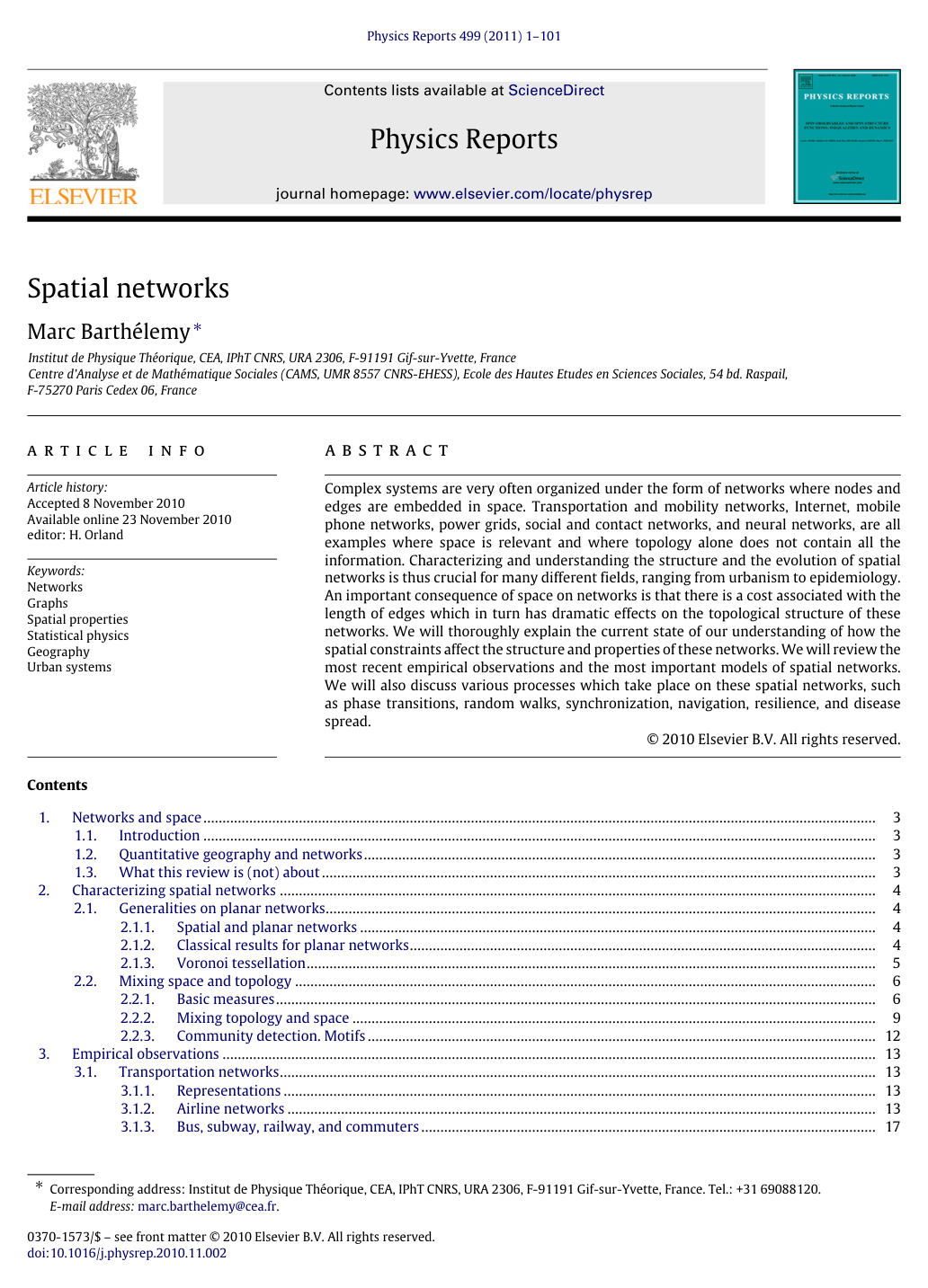
Spatial Networks
Marc Barthelemy
Why you should read this
Establishes a foundational framework for analyzing spatially embedded networks by demonstrating how geometric constraints and distance costs govern the topology, evolution, and dynamical processes of systems from infrastructure grids to epidemic spread.
Complex systems are very often organized under the form of networks where nodes and edges are embedded in space. Transportation and mobility networks, Internet, mobile phone networks, power grids, social and contact networks, neural networks, are all examples where space is relevant and where topology alone does not contain all the information. Characterizing and understanding the structure and the evolution of spatial networks is thus crucial for many different fields ranging from urbanism to epidemiology. An important consequence of space on networks is that there is a cost associated to the length of edges which in turn has dramatic effects on the topological structure of these networks. We will expose thoroughly the current state of our understanding of how the spatial constraints affect the structure and properties of these networks. We will review the most recent empirical observations and the most important models of spatial networks. We will also discuss various processes which take place on these spatial networks, such as phase transitions, random walks, synchronization, navigation, resilience, and disease spread.
Added
2026-09-14
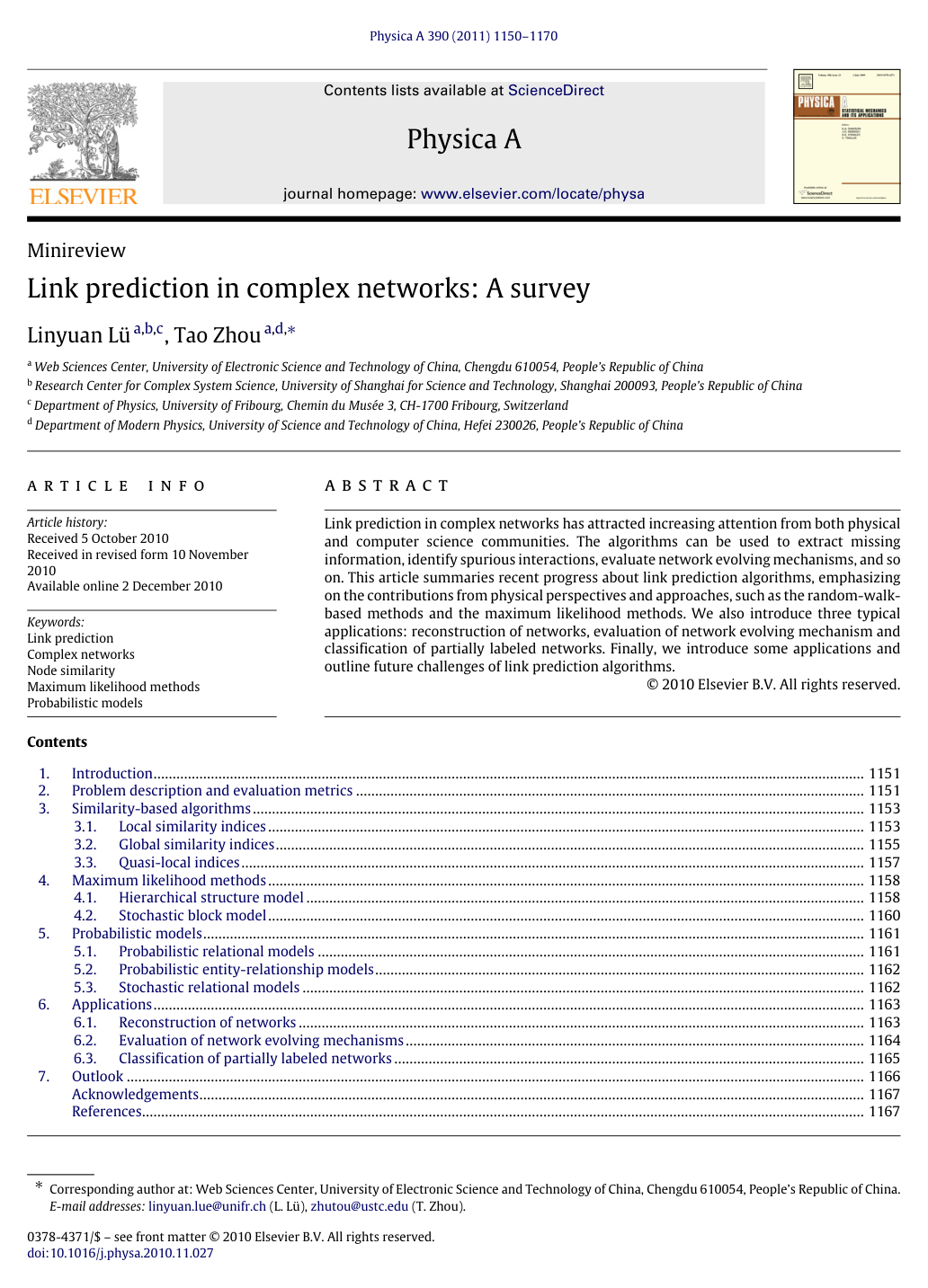
Link Prediction in Complex Networks: A Survey
Linyuan Lu, Tao Zhou
Why you should read this
Systematizes link prediction methods across statistical physics and computer science, providing actionable algorithms for reconstructing missing connections and testing network evolution models.
Link prediction in complex networks has attracted increasing attention from both physical and computer science communities. The algorithms can be used to extract missing information, identify spurious interactions, evaluate network evolving mechanisms, and so on. This article summaries recent progress about link prediction algorithms, emphasizing on the contributions from physical perspectives and approaches, such as the random-walk-based methods and the maximum likelihood methods. We also introduce three typical applications: reconstruction of networks, evaluation of network evolving mechanism and classification of partially labelled networks. Finally, we introduce some applications and outline future challenges of link prediction algorithms.
Added
2026-09-14
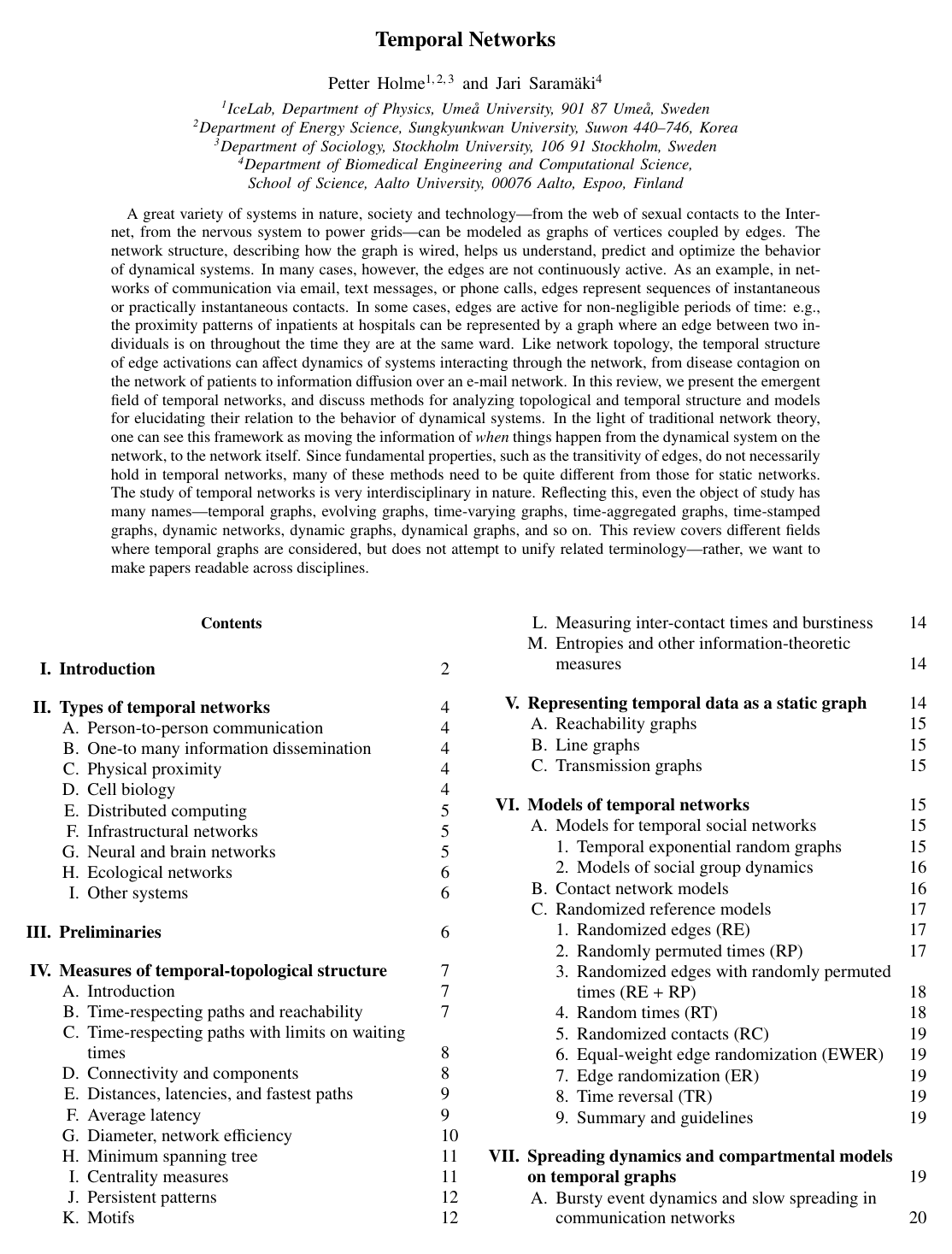
Temporal Networks
Petter Holme, Jari Saramäki
Why you should read this
Presents the core concepts and analytical methods for temporal networks, demonstrating how time-varying connectivity alters dynamical processes like epidemic contagion and information diffusion compared to traditional static graphs.
A great variety of systems in nature, society and technology -- from the web of sexual contacts to the Internet, from the nervous system to power grids -- can be modeled as graphs of vertices coupled by edges. The network structure, describing how the graph is wired, helps us understand, predict and optimize the behavior of dynamical systems. In many cases, however, the edges are not continuously active. As an example, in networks of communication via email, text messages, or phone calls, edges represent sequences of instantaneous or practically instantaneous contacts. In some cases, edges are active for non-negligible periods of time: e.g., the proximity patterns of inpatients at hospitals can be represented by a graph where an edge between two individuals is on throughout the time they are at the same ward. Like network topology, the temporal structure of edge activations can affect dynamics of systems interacting through the network, from disease contagion on the network of patients to information diffusion over an e-mail network. In this review, we present the emergent field of temporal networks, and discuss methods for analyzing topological and temporal structure and models for elucidating their relation to the behavior of dynamical systems. In the light of traditional network theory, one can see this framework as moving the information of when things happen from the dynamical system on the network, to the network itself. Since fundamental properties, such as the transitivity of edges, do not necessarily hold in temporal networks, many of these methods need to be quite different from those for static networks.
Added
2026-09-13
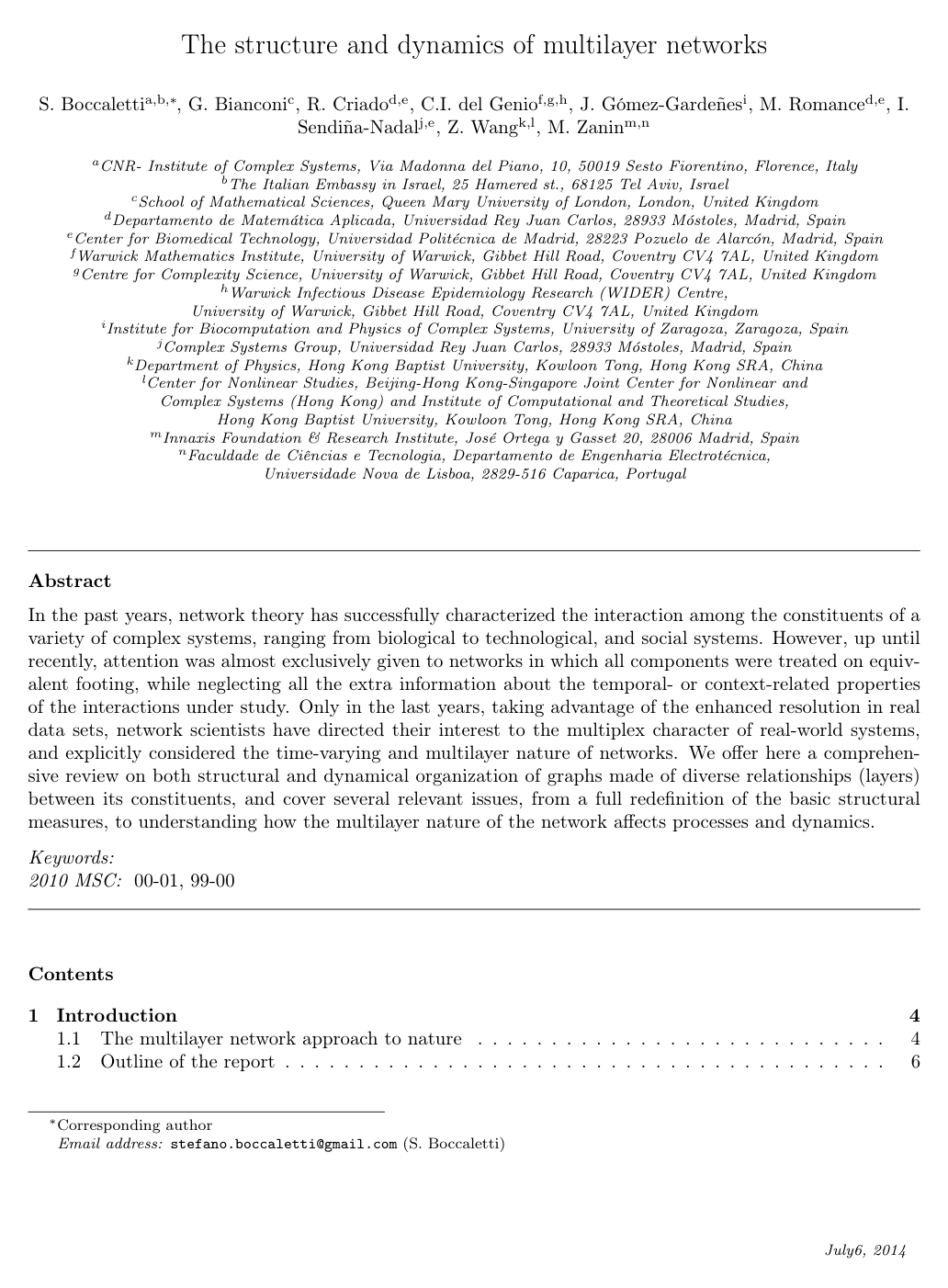
The structure and dynamics of multilayer networks
S. Boccaletti, G. Bianconi, R. Criado, C. I. del Genio, J. Gómez-Gardeñes, M. Romance, I. Sendiña-Nadal, Z. Wang, M. Zanin
Why you should read this
Establishes a unified mathematical framework for multilayer and multiplex networks by systematically examining their structural measures, generative models, percolation resilience, and dynamical phenomena such as spreading and synchronization.
In the past years, network theory has successfully characterized the interaction among the constituents of a variety of complex systems, ranging from biological to technological, and social systems. However, up until recently, attention was almost exclusively given to networks in which all components were treated on equivalent footing, while neglecting all the extra information about the temporal- or context-related properties of the interactions under study. Only in the last years, taking advantage of the enhanced resolution in real data sets, network scientists have directed their interest to the multiplex character of real-world systems, and explicitly considered the time-varying and multilayer nature of networks. We offer here a comprehensive review on both structural and dynamical organization of graphs made of diverse relationships (layers) between its constituents, and cover several relevant issues, from a full redefinition of the basic structural measures, to understanding how the multilayer nature of the network affects processes and dynamics.
Added
2026-09-12
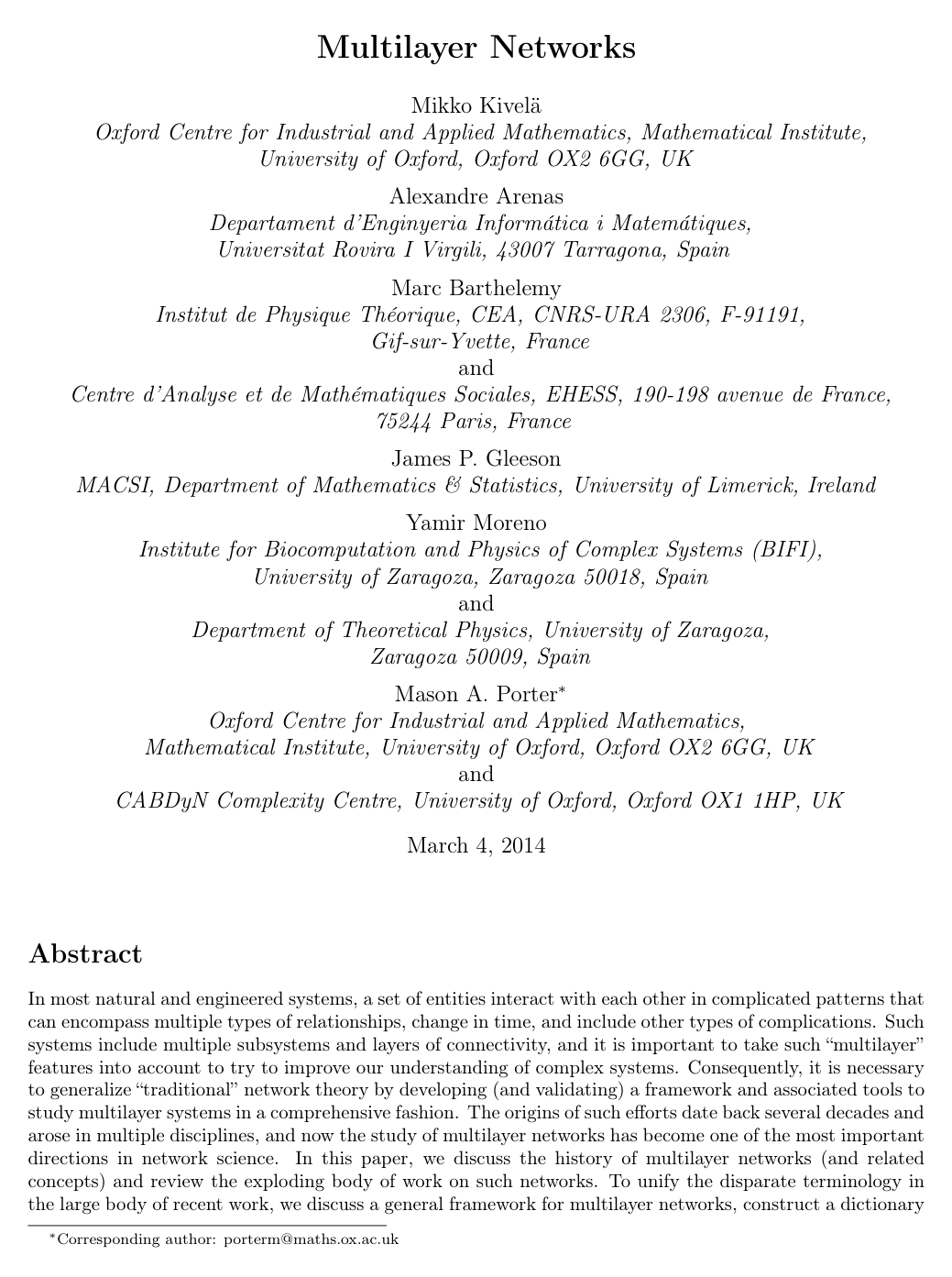
Multilayer networks
Mikko Kivelä, Alexandre Arenas, Marc Barthelemy, James P. Gleeson, Yamir Moreno, Mason A. Porter
Why you should read this
Establishes a unified mathematical framework and standardized terminology for studying complex systems with multiple layers of connectivity, resolving conflicting definitions across multiplex, interdependent, and interconnected network models.
In most natural and engineered systems, a set of entities interact with each other in complicated patterns that can encompass multiple types of relationships, change in time, and include other types of complications. Such systems include multiple subsystems and layers of connectivity, and it is important to take such "multilayer" features into account to try to improve our understanding of complex systems. Consequently, it is necessary to generalize "traditional" network theory by developing (and validating) a framework and associated tools to study multilayer systems in a comprehensive fashion. The origins of such efforts date back several decades and arose in multiple disciplines, and now the study of multilayer networks has become one of the most important directions in network science. In this paper, we discuss the history of multilayer networks (and related concepts) and review the exploding body of work on such networks. To unify the disparate terminology in the large body of recent work, we discuss a general framework for multilayer networks, construct a dictionary of terminology to relate the numerous existing concepts to each other, and provide a thorough discussion that compares, contrasts, and translates between related notions such as multilayer networks, multiplex networks, interdependent networks, networks of networks, and many others. We also survey and discuss existing data sets that can be represented as multilayer networks. We review attempts to generalize single-layer-network diagnostics to multilayer networks. We also discuss the rapidly expanding research on multilayer-network models and notions like community structure, connected components, tensor decompositions, and various types of dynamical processes on multilayer networks. We conclude with a summary and an outlook.
Added
2026-09-11
Epidemic processes in complex networks
Romualdo Pastor-Satorras, Claudio Castellano, Piet Van Mieghem, Alessandro Vespignani
Why you should read this
Synthesizes the mathematical foundations of biological and social contagion across heterogeneous and time-varying networks, providing researchers with a unified theoretical framework for predicting how network structure governs spreading phenomena.
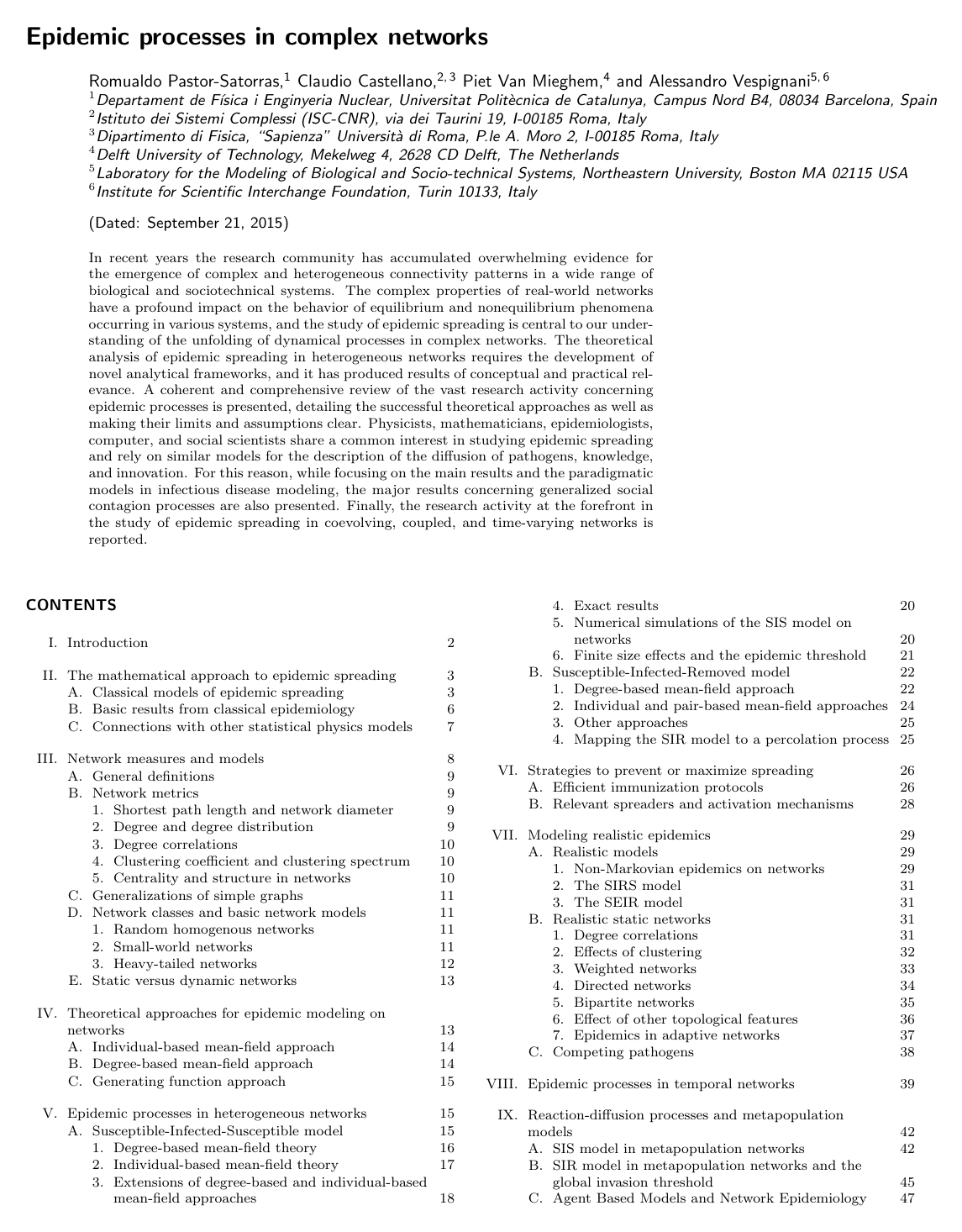
In recent years the research community has accumulated overwhelming evidence for the emergence of complex and heterogeneous connectivity patterns in a wide range of biological and sociotechnical systems. The complex properties of real-world networks have a profound impact on the behavior of equilibrium and nonequilibrium phenomena occurring in various systems, and the study of epidemic spreading is central to our understanding of the unfolding of dynamical processes in complex networks. The theoretical analysis of epidemic spreading in heterogeneous networks requires the development of novel analytical frameworks, and it has produced results of conceptual and practical relevance. A coherent and comprehensive review of the vast research activity concerning epidemic processes is presented, detailing the successful theoretical approaches as well as making their limits and assumptions clear. Physicists, mathematicians, epidemiologists, computer, and social scientists share a common interest in studying epidemic spreading and rely on similar models for the description of the diffusion of pathogens, knowledge, and innovation. For this reason, while focusing on the main results and the paradigmatic models in infectious disease modeling, the major results concerning generalized social contagion processes are also presented. Finally, the research activity at the forefront in the study of epidemic spreading in coevolving, coupled, and time-varying networks is reported.
Added
2026-09-11
Catastrophic cascade of failures in interdependent networks
Shlomo Havlin, N. A. M. Araujo, Sergey V. Buldyrev, C. S. Dias, Roni Parshani, Gerald Paul, H. E. Stanley
Why you should read this
Demonstrates how coupling between infrastructure networks makes them exceptionally fragile to sudden, system-wide collapse through cascading failures triggered by minor initial disruptions.
Modern network-like systems are usually coupled in such a way that failures in one network can affect the entire system. In infrastructures, biology, sociology, and economy, systems are interconnected and events taking place in one system can propagate to any other coupled system. Recent studies on such coupled systems show that the coupling increases their vulnerability to random failure. Properties for interdependent networks differ significantly from those of single-network systems. In this article, these results are reviewed and the main properties discussed.
Added
2026-09-11
From Louvain to Leiden: guaranteeing well-connected communities
Vincent Traag, Ludo Waltman, Nees Jan van Eck
Why you should read this
Introduces the Leiden algorithm for network community detection to resolve a critical flaw in the popular Louvain method, providing mathematical guarantees of well-connected communities alongside faster runtimes and higher-quality partitions.
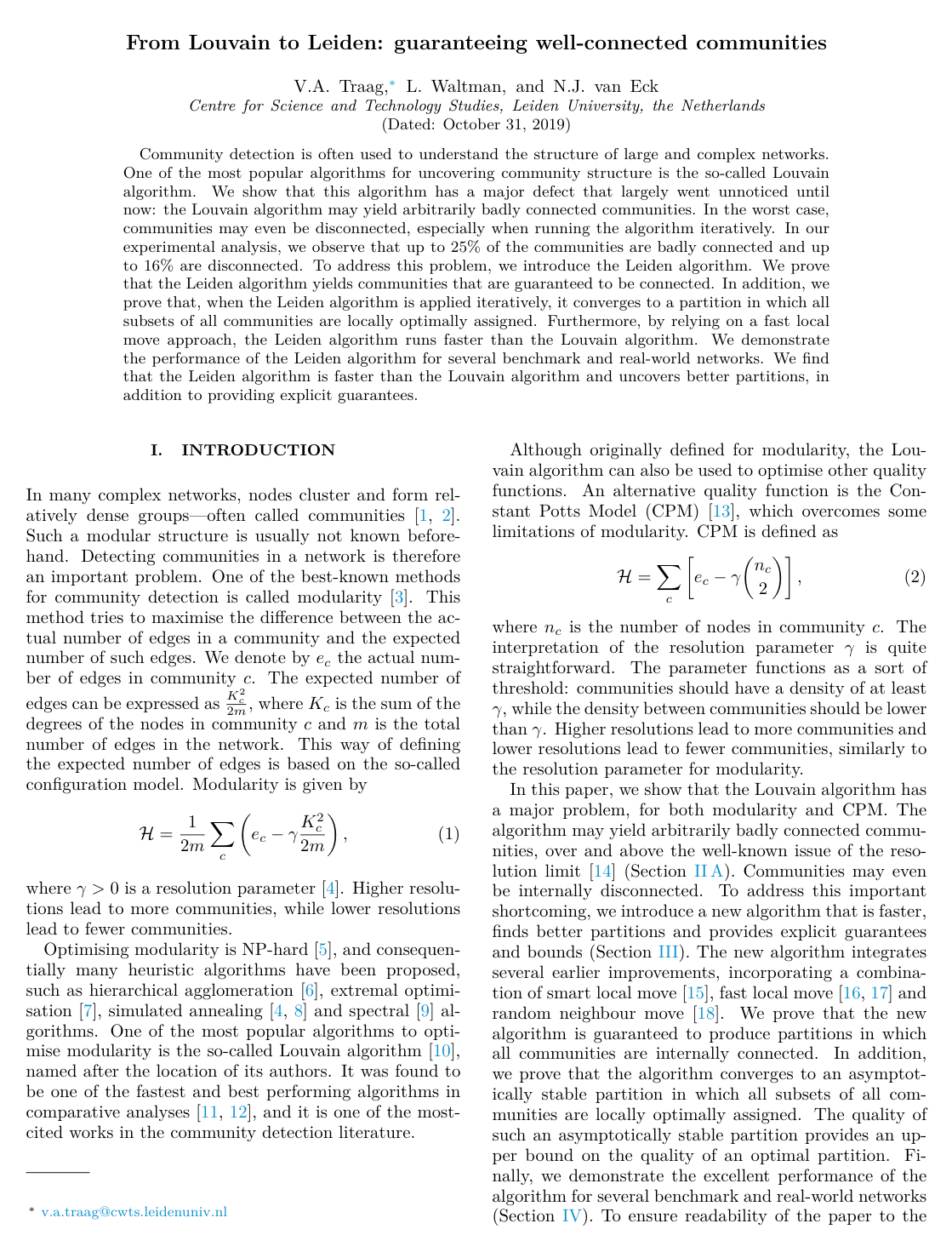
Community detection is often used to understand the structure of large and complex networks. One of the most popular algorithms for uncovering community structure is the so-called Louvain algorithm. We show that this algorithm has a major defect that largely went unnoticed until now: the Louvain algorithm may yield arbitrarily badly connected communities. In the worst case, communities may even be disconnected, especially when running the algorithm iteratively. In our experimental analysis, we observe that up to 25% of the communities are badly connected and up to 16% are disconnected. To address this problem, we introduce the Leiden algorithm. We prove that the Leiden algorithm yields communities that are guaranteed to be connected. In addition, we prove that, when the Leiden algorithm is applied iteratively, it converges to a partition in which all subsets of all communities are locally optimally assigned. Furthermore, by relying on a fast local move approach, the Leiden algorithm runs faster than the Louvain algorithm. We demonstrate the performance of the Leiden algorithm for several benchmark and real-world networks. We find that the Leiden algorithm is faster than the Louvain algorithm and uncovers better partitions, in addition to providing explicit guarantees.
Added
2026-09-10
Community detection in graphs
Santo Fortunato
Why you should read this
Surveys fundamental algorithms, statistical physics approaches, and evaluation benchmarks for community detection, providing a definitive guide to identifying cluster structures across complex biological, social, and technological networks.
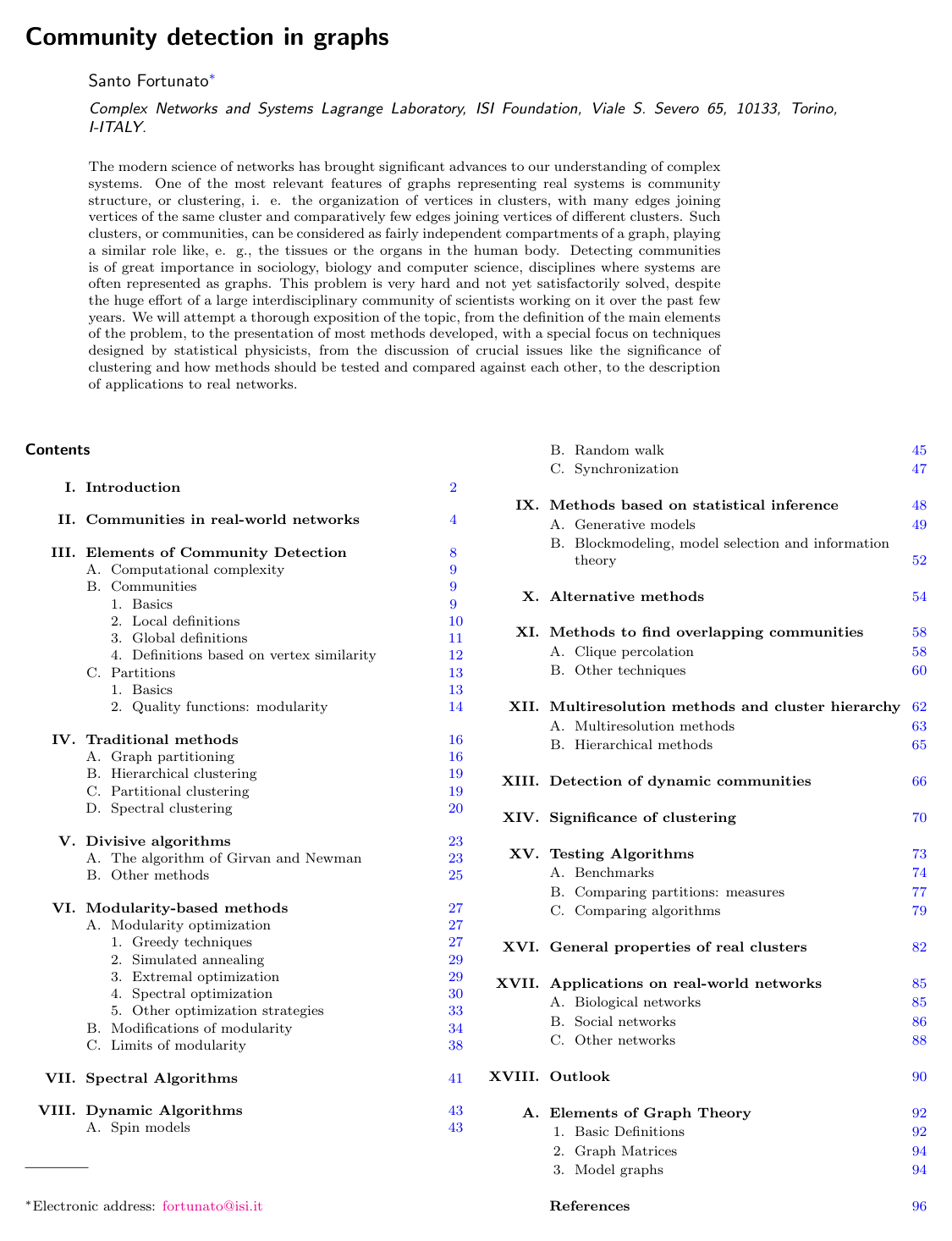
The modern science of networks has brought significant advances to our understanding of complex systems. One of the most relevant features of graphs representing real systems is community structure, or clustering, i. e. the organization of vertices in clusters, with many edges joining vertices of the same cluster and comparatively few edges joining vertices of different clusters. Such clusters, or communities, can be considered as fairly independent compartments of a graph, playing a similar role like, e. g., the tissues or the organs in the human body. Detecting communities is of great importance in sociology, biology and computer science, disciplines where systems are often represented as graphs. This problem is very hard and not yet satisfactorily solved, despite the huge effort of a large interdisciplinary community of scientists working on it over the past few years. We will attempt a thorough exposition of the topic, from the definition of the main elements of the problem, to the presentation of most methods developed, with a special focus on techniques designed by statistical physicists, from the discussion of crucial issues like the significance of clustering and how methods should be tested and compared against each other, to the description of applications to real networks.
Added
2026-09-06