Temporal Networks
Petter HolmeJari Saramäki
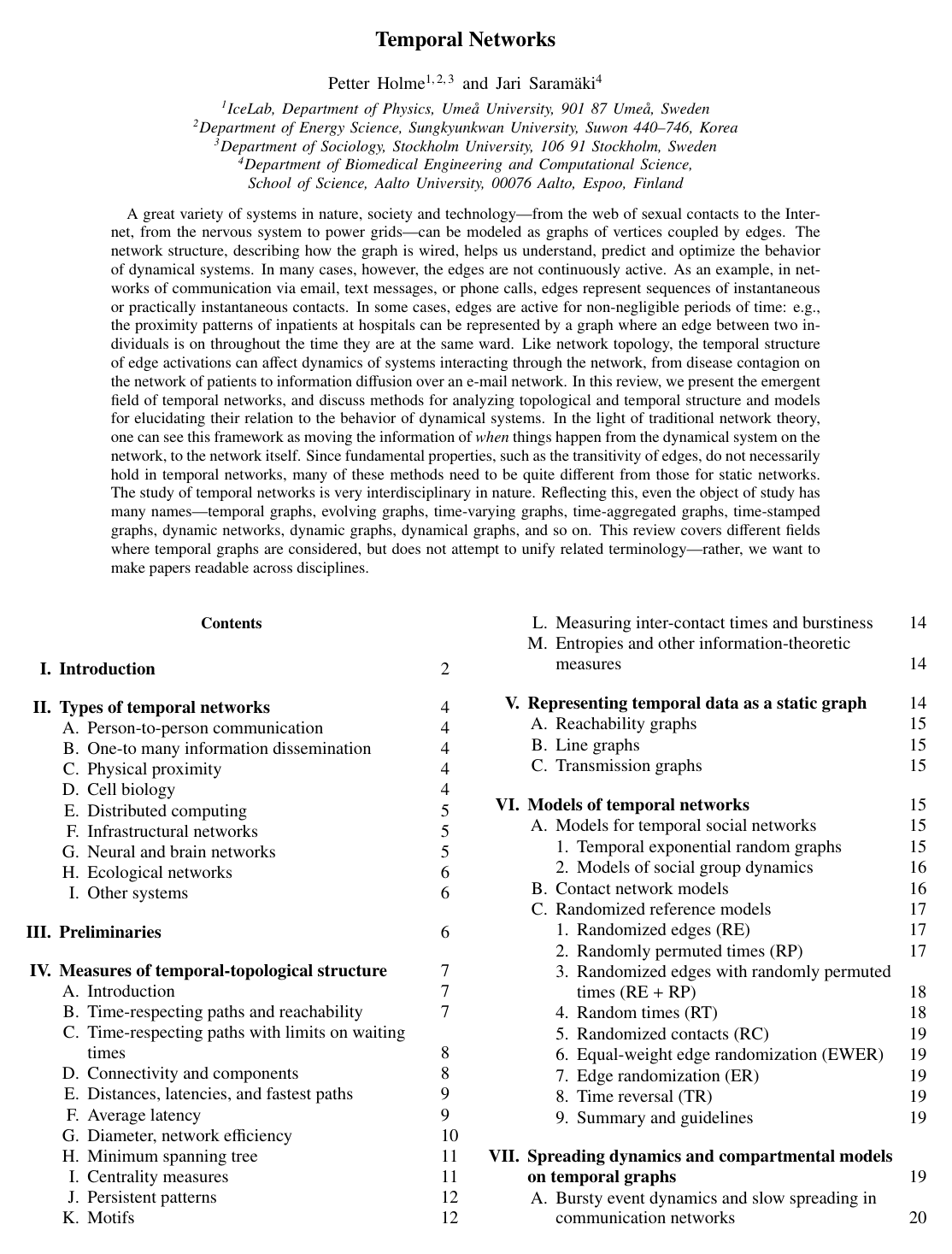
Presents the core concepts and analytical methods for temporal networks, demonstrating how time-varying connectivity alters dynamical processes like epidemic contagion and information diffusion compared to traditional static graphs.
Many real-world systems—from email exchanges and mobile phone calls to hospital patient proximity and gene regulation—feature interactions that occur only at specific instants or intervals rather than continuously. Traditional static network models aggregate these contacts into fixed edges and therefore lose information about when contacts happen. Because the order and timing of contacts determine whether a path exists and how quickly something can travel along it, static models can produce misleading predictions about processes such as disease spread or information diffusion. The review synthesizes research across physics, computer science, biology, and the social sciences to establish temporal networks as a distinct framework in which edge activation times are treated as an explicit part of the network itself.
The authors set out to define the core concepts, survey existing analytic methods, and illustrate how temporal structure influences dynamical processes. They draw on empirical contact sequences from communication records, proximity sensors, and biological systems, and they compare these data against families of randomized reference models that selectively destroy different classes of temporal or topological correlation.
The central finding is that time ordering and bursty contact patterns materially change reachability and spreading speed. In several large communication datasets, the time-respecting paths that actually exist are far fewer and slower than those implied by the corresponding aggregated static graph; burstiness alone can slow epidemic-style spreading by orders of magnitude relative to a Poisson null model. Temporal centrality measures, latency distributions, and motif counts reveal persistent patterns and bottlenecks that static metrics miss. Randomized reference models show that different correlations—edge burstiness, inter-edge triggering, and overall daily rhythms—dominate different regimes of spreading dynamics. The same structure can also be exploited: simple rules that use recent or frequent contacts to select vaccination targets outperform random or static-neighborhood strategies in several real contact datasets.
These results matter because many practical decisions—setting quarantine thresholds, designing communication protocols, or interpreting functional brain networks—rest on assumptions about how fast and how far something can propagate. When those assumptions ignore timing, the resulting cost, risk, or policy estimates can be substantially wrong. At the same time, the field remains young. Terminology is still fragmented across disciplines, generative models that reproduce observed temporal patterns are scarce, and visualization and inference tools lag behind those available for static networks. Further progress therefore requires tighter integration of temporal data collection with modeling, systematic comparison of spreading outcomes across reference ensembles, and targeted empirical studies that test whether temporal-network predictions improve real-world interventions.
- Book: An introduction to graph theory, Darij Grinberg (2023). Mastering the foundational definitions and counting formulas of classical graph theory is an essential prerequisite for analyzing the structural and dynamical properties of temporal networks.
- Paper: The structure and dynamics of multilayer networks, S. Boccaletti et al. (2014). This paper extends the single-layer temporal perspective of the source into a comprehensive framework for multilayer networks where multiple types of interactions and interlayer links occur simultaneously.
- Paper: Epidemic processes in complex networks, Romualdo Pastor-Satorras et al. (2015). Building directly on the temporal contact structures reviewed in the source, this paper advances epidemic and contagion modeling by rigorously incorporating time-varying contact sequences into spreading dynamics.
- Paper: Multilayer networks, Mikko Kivelä et al. (2013). This review unifies the diverse terminologies of complex systems, explicitly building upon temporal network representations to construct a general tensor-based framework for multilayer and time-evolving structures.