Epidemic processes in complex networks

Romualdo Pastor-SatorrasClaudio CastellanoPiet Van MieghemAlessandro Vespignani

article2015Rev. Mod. Phys.3,452 citations

Synthesizes the mathematical foundations of biological and social contagion across heterogeneous and time-varying networks, providing researchers with a unified theoretical framework for predicting how network structure governs spreading phenomena.

Listen

This review synthesizes theoretical and computational advances on epidemic spreading in networks that exhibit heterogeneous connectivity, heavy-tailed degree distributions, and other hallmarks of complex systems. The work addresses the need for accurate models of contagion processes in real contact patterns, where classical homogeneous-mixing assumptions fail to capture observed dynamics of disease, information, and innovation diffusion. Its central objective is to unify the growing body of analytic frameworks, exact results, and numerical findings that relate network topology to the threshold, size, and time course of outbreaks.

The authors organize the material through a progression of increasing realism. They first recall classical compartmental models and their mean-field treatment, then introduce the principal network metrics and generative models. They derive and compare degree-based and individual-based mean-field closures, generating-function methods, and exact Markov formulations for the SIS and SIR processes. Extensions incorporate non-Markovian timing, weighted and directed edges, community structure, adaptive rewiring, temporal contact sequences, and metapopulation mobility. Numerical benchmarks and rigorous bounds on thresholds and prevalence are presented throughout.

The analysis shows that heavy-tailed networks can support vanishing epidemic thresholds and rapid initial growth once activity reaches high-degree nodes or dense cores. Degree-based mean-field theory recovers the threshold scaling (\langle k\rangle/\langle k^2\rangle) for uncorrelated static graphs, while individual-based closures tie the threshold to the largest adjacency eigenvalue and reveal localization effects for exponents above 5/2. The SIR process maps exactly onto bond percolation on locally tree-like graphs, yielding the same threshold and critical exponents. Targeted immunization of hubs or high-K-core nodes raises the threshold far more efficiently than random removal; acquaintance and random-walk sampling achieve comparable gains with only local information. Non-Markovian recovery and temporal fluctuations further modulate thresholds and outbreak sizes, often in ways not anticipated by Poisson approximations.

These results matter because contact networks in human and animal populations routinely display the heterogeneity that drives the reported behaviors. Accurate threshold predictions directly inform vaccination priorities, surveillance design, and containment policies. The same frameworks also govern the reach of beneficial information and the risk of cascading failures in infrastructure.

Future work should integrate high-resolution temporal and multilayer data, develop scalable inference methods for hidden parameters, and test the robustness of control strategies under behavioral adaptation and stochastic fluctuations. Systematic comparison of competing approximations against large-scale empirical outbreaks remains essential before the models can serve as reliable real-time decision tools.

arXiv: 1408.2701
  • Paper: Community detection in graphs, Santo Fortunato (2009). Reading foundational work on community detection is essential because network modularity and mesoscale cluster organization directly govern how epidemics unfold across heterogeneous populations.
  • Paper: Catastrophic cascade of failures in interdependent networks, S. Havlin et al. (2009). Understanding cascading failures in interdependent networks provides vital mathematical groundwork for analyzing how pathogens or information propagate across coupled systems.
  • Paper: Maximizing the spread of influence through a social network, David Kempe et al. (2003). Influence maximization models offer fundamental mathematical tools for identifying key spreaders and optimal seed sets in network contagion processes.
  • Paper: Geometric Deep Learning: Going beyond Euclidean data, Michael M. Bronstein et al. (2016). Geometric deep learning naturally extends network diffusion concepts into modern neural network architectures capable of operating directly on irregular topological domains.
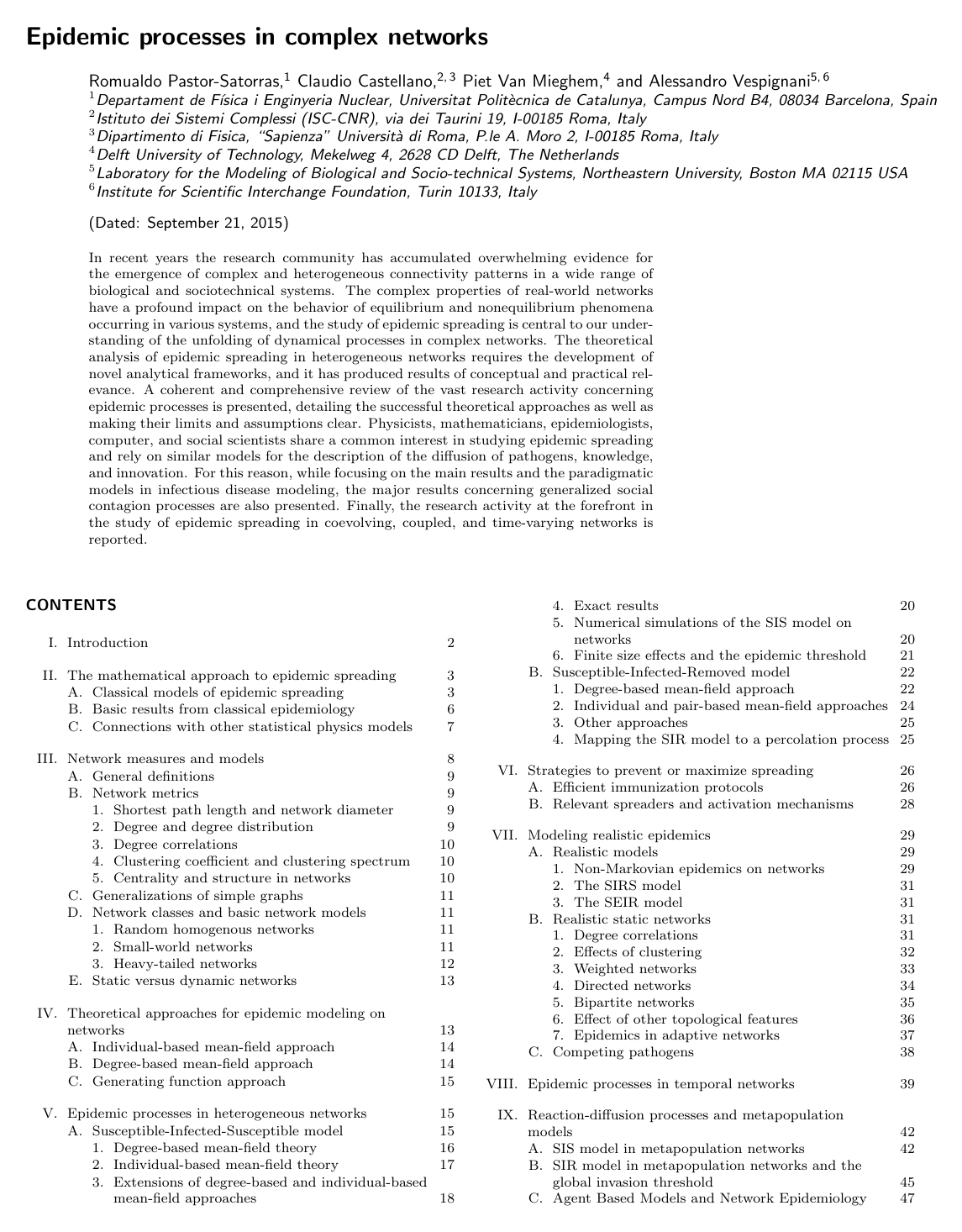
Cover for Epidemic processes in complex networks

Abstract

In recent years the research community has accumulated overwhelming evidence for the emergence of complex and heterogeneous connectivity patterns in a wide range of biological and sociotechnical systems. The complex properties of real-world networks have a profound impact on the behavior of equilibrium and nonequilibrium phenomena occurring in various systems, and the study of epidemic spreading is central to our understanding of the unfolding of dynamical processes in complex networks. The theoretical analysis of epidemic spreading in heterogeneous networks requires the development of novel analytical frameworks, and it has produced results of conceptual and practical relevance. A coherent and comprehensive review of the vast research activity concerning epidemic processes is presented, detailing the successful theoretical approaches as well as making their limits and assumptions clear. Physicists, mathematicians, epidemiologists, computer, and social scientists share a common interest in studying epidemic spreading and rely on similar models for the description of the diffusion of pathogens, knowledge, and innovation. For this reason, while focusing on the main results and the paradigmatic models in infectious disease modeling, the major results concerning generalized social contagion processes are also presented. Finally, the research activity at the forefront in the study of epidemic spreading in coevolving, coupled, and time-varying networks is reported.

Table of Contents

  • I. INTRODUCTION
  • II. THE MATHEMATICAL APPROACH TO EPIDEMIC SPREADING
  • A. Classical models of epidemic spreading
  • B. Basic results from classical epidemiology
  • C. Connections with other statistical physics models
  • III. NETWORK MEASURES AND MODELS
  • A. General definitions
  • B. Network metrics
  • 1. Shortest path length and network diameter
  • 2. Degree and degree distribution
  • 3. Degree correlations
  • 4. Clustering coefficient and clustering spectrum
  • 5. Centrality and structure in networks
  • C. Generalizations of simple graphs
  • D. Network classes and basic network models
  • 1. Random homogenous networks
  • 2. Small-world networks
  • 3. Heavy-tailed networks
  • E. Static versus dynamic networks
  • A. Individual-based mean-field approach
  • B. Degree-based mean-field approach
  • C. Generating function approach
  • V. EPIDEMIC PROCESSES IN HETEROGENEOUS NETWORKS
  • A. Susceptible-Infected-Susceptible model
  • 1. Degree-based mean-field theory
  • 2. Individual-based mean-field theory
  • 3. Extensions of degree-based and individual-based mean-field approaches
  • 4. Exact results
  • 5. Numerical simulations of the SIS model on networks
  • 6. Finite size effects and the epidemic threshold
  • B. Susceptible-Infected-Removed model
  • 1. Degree-based mean-field approach
  • 2. Individual and pair-based mean-field approaches
  • 3. Other approaches
  • 4. Mapping the SIR model to a percolation process
  • VI. STRATEGIES TO PREVENT OR MAXIMIZE SPREADING
  • A. Efficient immunization protocols
  • B. Relevant spreaders and activation mechanisms
  • VII. MODELING REALISTIC EPIDEMICS
  • A. Realistic models
  • 1. Non-Markovian epidemics on networks
  • 2. The SIRS model
  • 3. The SEIR model
  • B. Realistic static networks
  • 1. Degree correlations
  • 2. Effects of clustering
  • 3. Weighted networks
  • 4. Directed networks
  • 5. Bipartite networks
  • 6. Effect of other topological features
  • 7. Epidemics in adaptive networks
  • C. Competing pathogens
  • VIII. EPIDEMIC PROCESSES IN TEMPORAL NETWORKS
  • IX. REACTION-DIFFUSION PROCESSES AND METAPOPULATION MODELS
  • A. SIS model in metapopulation networks
  • B. SIR model in metapopulation networks and the global invasion threshold
  • C. Agent Based Models and Network Epidemiology
  • X. GENERALIZING EPIDEMIC MODELS AS SOCIAL CONTAGION PROCESSES
  • A. Threshold models
  • B. Rumor spreading
  • C. Empirical studies
  • XI. OUTLOOK

Knowls

  1. Knowl 1 — Degree-Based Mean-Field Theory and SIS Epidemic Threshold on Complex Networks

    theoretical result

    Degree-Based Mean-Field (DBMF) theory (also known as the heterogeneous mean-field approach) assumes that all vertices of a network with the same degree kk are statistically equivalent. In a continuous-time Susceptible-Infected-Susceptible (SIS) epidemic model with infection rate β\beta per contact and recovery rate μ\mu (defining the effective spreading rate λ=β/μ\lambda = \beta / \mu, or setting μ=1\mu = 1 without loss of generality), the fraction of infected nodes of degree kk, denoted by ρkI(t)\rho_k^I(t), evolves according to:

    dρkI(t)dt=ρkI(t)+λk[1ρkI(t)]kP(kk)ρkI(t)\frac{d\rho_k^I(t)}{dt} = -\rho_k^I(t) + \lambda k [1 - \rho_k^I(t)] \sum_{k'} P(k'|k) \rho_{k'}^I(t)

    where P(kk)P(k'|k) is the conditional probability that an edge departing from a vertex of degree kk connects to a vertex of degree kk'.

    A linear stability analysis of the disease-free state ({ρkI=0}\{\rho_k^I = 0\}) shows that the endemic state ({ρkI>0}\{\rho_k^I > 0\}) emerges above an epidemic threshold:

    λ>λcDBMF=1ΛM\lambda > \lambda_c^{\text{DBMF}} = \frac{1}{\Lambda_M}

    where ΛM\Lambda_M is the largest eigenvalue of the connectivity matrix Ckk=kP(kk)C_{kk'} = k P(k'|k).

    For degree-uncorrelated networks, where P(kk)=kP(k)/kP(k'|k) = k' P(k') / \langle k \rangle, the threshold becomes:

    λcDBMF,unc=kk2\lambda_c^{\text{DBMF,unc}} = \frac{\langle k \rangle}{\langle k^2 \rangle}

    where k=kkP(k)\langle k \rangle = \sum_k k P(k) and k2=kk2P(k)\langle k^2 \rangle = \sum_k k^2 P(k). For scale-free networks with power-law degree distribution P(k)kγP(k) \sim k^{-\gamma} and exponent 2<γ32 < \gamma \le 3, the second moment k2\langle k^2 \rangle diverges in the thermodynamic limit (NN \to \infty), causing the DBMF epidemic threshold to vanish asymptotically (λc0\lambda_c \to 0).

  2. Knowl 2 — Individual-Based Mean-Field Theory and Spectral Radius Epidemic Threshold

    theoretical result

    Individual-Based Mean-Field (IBMF) theory (also called Quenched Mean-Field theory or NN-Intertwined Mean-Field Approximation, NIMFA) formulates the continuous-time Susceptible-Infected-Susceptible (SIS) dynamics at the single-node level using the static adjacency matrix A=(aij)N×NA = (a_{ij})_{N \times N} of the network. Under the assumption that the states of neighboring nodes are statistically independent, E[Xi(t)Xj(t)]=ρiI(t)ρjI(t)E[X_i(t) X_j(t)] = \rho_i^I(t) \rho_j^I(t), where Xi(t){0,1}X_i(t) \in \{0, 1\} is the Bernoulli state of node ii, the infection probability ρiI(t)=E[Xi(t)]\rho_i^I(t) = E[X_i(t)] satisfies:

    dρiI(t)dt=μρiI(t)+β[1ρiI(t)]j=1NaijρjI(t)\frac{d\rho_i^I(t)}{dt} = -\mu \rho_i^I(t) + \beta [1 - \rho_i^I(t)] \sum_{j=1}^N a_{ij} \rho_j^I(t)

    where β\beta is the per-link infection rate and μ\mu is the recovery rate.

    Linear stability analysis of the disease-free state ({ρiI=0}\{\rho_i^I = 0\}) yields the IBMF epidemic threshold for the effective infection rate λ=β/μ\lambda = \beta / \mu:

    λcIBMF=1Λ1\lambda_c^{\text{IBMF}} = \frac{1}{\Lambda_1}

    where Λ1\Lambda_1 is the largest eigenvalue (spectral radius) of the adjacency matrix AA.

    In uncorrelated power-law networks with degree distribution P(k)kγP(k) \sim k^{-\gamma} and maximum degree kmaxk_{\max}, the leading eigenvalue scales as Λ1max{kmax,k2/k}\Lambda_1 \sim \max\{\sqrt{k_{\max}}, \langle k^2 \rangle / \langle k \rangle\}, yielding the threshold scaling:

    λcIBMF{1kmaxfor γ>5/2kk2for 2<γ<5/2\lambda_c^{\text{IBMF}} \sim \begin{cases} \frac{1}{\sqrt{k_{\max}}} & \text{for } \gamma > 5/2 \\ \frac{\langle k \rangle}{\langle k^2 \rangle} & \text{for } 2 < \gamma < 5/2 \end{cases}

    This establishes a vanishing epidemic threshold in the infinite-size limit for any random network whose maximum degree grows with network size NN.

  3. Knowl 3 — Exact Bond Percolation Mapping and Epidemic Threshold for the SIR Model

    theoretical result

    The asymptotic final state of the Susceptible-Infected-Removed (SIR) epidemic model on static networks maps exactly to a bond percolation problem. If an infected node transmits the disease across an edge at rate β\beta and remains infectious for a fixed time τ\tau, the transmissibility TT (the probability of transmission across an edge before recovery) is:

    T=1eβτT = 1 - e^{-\beta \tau}

    When infectious periods are exponentially distributed with recovery rate μ\mu (mean duration τ=1/μ\langle \tau \rangle = 1/\mu), the average transmissibility is T=λ1+λ\langle T \rangle = \frac{\lambda}{1 + \lambda}, with λ=β/μ\lambda = \beta / \mu.

    On uncorrelated, locally tree-like random networks with degree distribution P(k)P(k), the epidemic threshold for the emergence of a macroscopic giant outbreak corresponds to the bond percolation threshold:

    Tc=kk2kT_c = \frac{\langle k \rangle}{\langle k^2 \rangle - \langle k \rangle}

    For constant infectious time τ\tau, the critical transmission rate βc\beta_c is:

    βc=1τln(k2kk22k)\beta_c = \frac{1}{\tau} \ln\left( \frac{\langle k^2 \rangle - \langle k \rangle}{\langle k^2 \rangle - 2\langle k \rangle} \right)

    For exponentially distributed infectious periods, the critical spreading rate λc=βc/μ\lambda_c = \beta_c / \mu is:

    λc=kk22k\lambda_c = \frac{\langle k \rangle}{\langle k^2 \rangle - 2\langle k \rangle}

    For scale-free networks with 2<γ32 < \gamma \le 3, where k2\langle k^2 \rangle \to \infty, the threshold vanishes (Tc0,λc0T_c \to 0, \lambda_c \to 0). For γ>3\gamma > 3, the SIR threshold remains strictly positive and finite.

  4. Knowl 4 — Exact Lower Bound and Absorption Times for Markovian SIS Dynamics on Networks

    theoretical result

    In the exact 2N2^N-state continuous-time Markov chain formulation of the Susceptible-Infected-Susceptible (SIS) model on an arbitrary graph of NN nodes with adjacency matrix AA, infection rate β\beta, and recovery rate μ\mu, the expected infection probability of node ii, ρiI(t)=E[Xi(t)]\rho_i^I(t) = E[X_i(t)], satisfies the exact differential inequality:

    dρiI(t)dtμρiI(t)+βj=1NaijρjI(t)\frac{d \rho_i^I(t)}{dt} \le -\mu \rho_i^I(t) + \beta \sum_{j=1}^N a_{ij} \rho_j^I(t)

    This leads to a rigorous lower bound for the exact epidemic threshold λc\lambda_c (where λ=β/μ\lambda = \beta / \mu):

    λc1Λ1\lambda_c \ge \frac{1}{\Lambda_1}

    where Λ1\Lambda_1 is the largest eigenvalue of the adjacency matrix AA.

    Below the threshold (λ<1/Λ1\lambda < 1/\Lambda_1), the expected time E[T]E[T] for the process to reach the absorbing absorbing-state (all nodes healthy) is bounded logarithmically with the network size NN:

    E[T]logN+11λΛ1E[T] \le \frac{\log N + 1}{1 - \lambda \Lambda_1}

    Above the threshold on power-law networks, the expected time to absorption grows exponentially with NN (E[T]=O(ecN)E[T] = O(e^{c N}) for c>0c > 0), proving that true endemic activity persists for any λ>0\lambda > 0 in the infinite-size limit.

  5. Knowl 5 — Global Invasion Threshold for Metapopulation Reaction-Diffusion Networks

    theoretical result

    In a metapopulation network where individuals diffuse across subpopulations connected by a mobility graph, each subpopulation experiences local epidemic dynamics (such as an SIR process with within-population reproduction number R0>1R_0 > 1 and recovery rate μ\mu). Assuming individuals diffuse with probability pp and distribute uniformly among the kk neighbors of a subpopulation of degree kk, the metapopulation reproductive number RR_* (the average number of subpopulations seeded by a single infected subpopulation) on an uncorrelated network with degree distribution P(k)P(k) is:

    R=(R01)k2kk2pNˉαˉμR_* = (R_0 - 1) \frac{\langle k^2 \rangle - \langle k \rangle}{\langle k \rangle^2} \frac{p \bar{N} \bar{\alpha}}{\mu}

    where Nˉ\bar{N} is the average population size per node, and αˉ\bar{\alpha} is the attack rate (fraction of individuals infected during a local outbreak in an isolated subpopulation, where αˉ2(R01)/R02\bar{\alpha} \approx 2(R_0 - 1)/R_0^2 near the local threshold R01R_0 \to 1).

    A global outbreak invading a macroscopic fraction of subpopulations occurs if and only if R>1R_* > 1. This defines the critical mobility threshold pcp_c:

    pcNˉ=k2k2kμR022(R01)2p_c \bar{N} = \frac{\langle k \rangle^2}{\langle k^2 \rangle - \langle k \rangle} \frac{\mu R_0^2}{2 (R_0 - 1)^2}

    In scale-free metapopulation networks with k2\langle k^2 \rangle \to \infty, the global invasion threshold vanishes (pc0p_c \to 0), enabling global disease propagation even under arbitrarily low mobility rates.

  6. Knowl 6 — Targeted and Acquaintance Immunization Protocols on Heterogeneous Networks

    model/method

    Immunization protocols protect a network by making a fraction gg of nodes immune (effectively removing them and their incident edges), increasing the effective threshold λc(g)\lambda_c(g) to exceed the infection rate λ\lambda.

    1. Random Immunization: Under Degree-Based Mean-Field theory for the SIS model, uniformly random vaccination yields an immunization threshold:

    gc(λ)=1kλk2g_c(\lambda) = 1 - \frac{\langle k \rangle}{\lambda \langle k^2 \rangle}

    For scale-free networks with divergent k2\langle k^2 \rangle \to \infty, gc(λ)1g_c(\lambda) \to 1, requiring almost 100% population coverage to eradicate the disease.

    1. Targeted Immunization (Hub Vaccination): Immunizing the fraction gg of nodes with the highest degrees reduces the moments of the remaining degree distribution kg\langle k \rangle_g and k2g\langle k^2 \rangle_g. The threshold condition k2gc/kgc=1/λ\langle k^2 \rangle_{g_c} / \langle k \rangle_{g_c} = 1/\lambda gives, for scale-free networks with P(k)k3P(k) \sim k^{-3} and minimum degree mm, an exponentially small critical fraction:

    gc(λ)exp(2mλ)g_c(\lambda) \approx \exp\left(-\frac{2}{m \lambda}\right)

    1. Acquaintance Immunization: When global network topology is unknown, selecting random nodes and immunizing a random neighbor of each exploits the property that a randomly chosen neighbor has degree distributed as kP(k)/kk P(k) / \langle k \rangle. This achieves preferential hub targeting using purely local information.
  7. Knowl 7 — Epidemic Threshold on Activity-Driven Temporal Networks

    theoretical result

    Activity-driven network models describe time-varying contact graphs where each node ii is assigned an activity potential ai[0,1]a_i \in [0, 1] drawn from a distribution F(a)F(a). At each discrete time step, node ii becomes active with probability aia_i and generates mm connections to randomly chosen nodes; all connections are dissolved at the end of the time step.

    For both SIS and SIR epidemic processes unfolding on this temporal substrate with per-contact transmission probability λ\lambda and recovery probability μ=1\mu = 1, the exact epidemic threshold obtained via dynamical mean-field stability analysis is:

    λc=1m(a+a2)\lambda_c = \frac{1}{m (\langle a \rangle + \sqrt{\langle a^2 \rangle})}

    where a=aF(a)da\langle a \rangle = \int a F(a) da and a2=a2F(a)da\langle a^2 \rangle = \int a^2 F(a) da.

    This threshold is invariant to the time window TT used to aggregate contacts. While a static network aggregated over a long window TT exhibits a scale-free degree distribution that incorrectly predicts a vanishing threshold as TT \to \infty, the epidemic threshold on the real temporal network remains strictly positive and finite whenever a2\langle a^2 \rangle is finite.

  8. Knowl 8 — Generating Function Formalism and Critical Exponents for Network Percolation

    theoretical result

    In bond percolation on loopless uncorrelated graphs where edges are occupied with probability pp, the degree distribution generating function G0(z)=kP(k)zkG_0(z) = \sum_k P(k) z^k and the excess degree generating function G1(z)=k(k+1)P(k+1)kzk=G0(z)kG_1(z) = \sum_k \frac{(k+1)P(k+1)}{\langle k \rangle} z^k = \frac{G_0'(z)}{\langle k \rangle} determine the existence and size of the giant connected component (or SIR final outbreak size).

    The probability uu that a randomly chosen edge does not lead to the giant component satisfies the self-consistent condition:

    u=1p+pG1(u)=1p+kkP(k)k(1p+pu)k1u = 1 - p + p G_1(u) = 1 - p + \sum_k \frac{k P(k)}{\langle k \rangle} (1 - p + p u)^{k-1}

    The fraction of nodes in the giant component PG(p)P_G(p) is:

    PG(p)=1G0(1p+pu)P_G(p) = 1 - G_0(1 - p + p u)

    The percolation threshold occurs at pc=G0(1)G0(1)=kk2kp_c = \frac{G_0'(1)}{G_0''(1)} = \frac{\langle k \rangle}{\langle k^2 \rangle - \langle k \rangle}. Near pcp_c, the order parameter scales as PG(p)(ppc)βpercP_G(p) \sim (p - p_c)^{\beta_{\text{perc}}}, with exponents:

    βperc={13γfor 2<γ<31γ3for 3<γ41for γ4\beta_{\text{perc}} = \begin{cases} \frac{1}{3 - \gamma} & \text{for } 2 < \gamma < 3 \\ \frac{1}{\gamma - 3} & \text{for } 3 < \gamma \le 4 \\ 1 & \text{for } \gamma \ge 4 \end{cases}

    For γ=3\gamma = 3, PG(p)P_G(p) exhibits an essential singularity scaling as PG(p)e1/pP_G(p) \sim e^{-1/p}.

  9. Knowl 9 — Pair-Based Moment Closure and Threshold for SIS Dynamics

    model/method

    To account for dynamical correlations between adjacent nodes, pair-approximation frameworks extend individual-based mean-field models by tracking pair expectations E[XiXj]E[X_i X_j]. In a continuous-time SIS process with infection rate β\beta and recovery rate μ\mu, the exact equation for the joint expectation of connected nodes iji \ne j is:

    dE[XiXj]dt=2μE[XiXj]+βk=1NaikE[XjXk]+βk=1NajkE[XiXk]βk=1N(aik+ajk)E[XiXjXk]\frac{d E[X_i X_j]}{dt} = -2\mu E[X_i X_j] + \beta \sum_{k=1}^N a_{ik} E[X_j X_k] + \beta \sum_{k=1}^N a_{jk} E[X_i X_k] - \beta \sum_{k=1}^N (a_{ik} + a_{jk}) E[X_i X_j X_k]

    To close the system at the pair level, the triplet expectation is factorized using the standard statistical physics closure:

    E[XiXjXk]=E[XiXj]E[XjXk]E[Xj]E[X_i X_j X_k] = \frac{E[X_i X_j] E[X_j X_k]}{E[X_j]}

    Linear stability analysis of the closed pair equations around the disease-free state yields an explicit Jacobian matrix JJ with elements:

    Jij=(1+λ2ki2λ+2)δij+λ(2+λ)2λ+2aijJ_{ij} = -\left(1 + \frac{\lambda^2 k_i}{2\lambda + 2}\right)\delta_{ij} + \frac{\lambda(2 + \lambda)}{2\lambda + 2} a_{ij}

    where λ=β/μ\lambda = \beta / \mu, kik_i is the degree of node ii, and aija_{ij} are adjacency matrix entries. The critical spreading threshold occurs when the leading eigenvalue of JJ equals zero, which is exact for tree topologies.

  10. Knowl 10 — Watts Threshold Model and Global Cascade Conditions

    theoretical result

    In the Watts threshold model for social contagion, agents transition irreversibly from susceptible (SS) to active (II). Each node ii has a quenched threshold ϕi[0,1]\phi_i \in [0, 1] drawn from a distribution g(ϕ)g(\phi). A node in state SS with degree kik_i switches to state II if at least a fraction ϕi\phi_i of its neighbors are active (at least ϕiki\lceil \phi_i k_i \rceil active neighbors).

    A node is termed vulnerable if a single active neighbor suffices to activate it, requiring ϕi1/ki\phi_i \le 1/k_i. For an infinitesimal initial seed of active nodes, global cascades affecting a macroscopic fraction of the network occur if and only if the subgraph of vulnerable nodes percolates.

    On uniform random graphs with constant threshold ϕ\phi and average degree k\langle k \rangle:

    1. For k<1\langle k \rangle < 1, cascades are strictly local because the network lacks a giant component.
    2. For k>1/ϕ\langle k \rangle > 1/\phi, global cascades are blocked because high node degrees dilute the fractional influence of individual active contacts (local stability).
    3. Global cascades occur exclusively in the intermediate connectivity window 1<k<1/ϕ1 < \langle k \rangle < 1/\phi.

    At the critical upper boundary ϕc=1/k\phi_c = 1/\langle k \rangle, increasing network connectivity prevents cascades, leading to a discontinuous (first-order) phase transition in cascade size.

  11. Knowl 11 — Rumor Spreading Dynamics and Impact of Network Topology

    model/method

    Rumor spreading models adapt the SIR epidemic framework by replacing spontaneous recovery with contact-induced cessation of spreading among three classes: Ignorants (SS), Spreaders (II), and Stiflers (RR).

    1. Daley-Kendall (DK) Model: Contacts between agents induce transitions at rates β\beta (spreading) and α\alpha (stifling):

    S+Iβ2I,R+Iα2R,2Iα2RS + I \xrightarrow{\beta} 2I, \quad R + I \xrightarrow{\alpha} 2R, \quad 2I \xrightarrow{\alpha} 2R

    1. Maki-Thompson (MT) Model: When two spreaders interact, only the initiating spreader becomes a stifler:

    S+Iβ2I,R+Iα2R,2IαR+IS + I \xrightarrow{\beta} 2I, \quad R + I \xrightarrow{\alpha} 2R, \quad 2I \xrightarrow{\alpha} R + I

    On fully mixed homogeneous networks, the asymptotic fraction of stiflers rr_\infty satisfies r=1e(1+β/α)rr_\infty = 1 - e^{-(1 + \beta/\alpha)r_\infty}, which yields r>0r_\infty > 0 for all β/α>0\beta/\alpha > 0, showing the absence of an epidemic threshold.

    On scale-free networks (P(k)kγP(k) \sim k^{-\gamma}), degree heterogeneity hinders rumor spread: high-degree hubs are reached quickly, rapidly contact other informed nodes, and turn into stiflers, thereby terminating transmission to their remaining neighbors. If spontaneous forgetting (IμRI \xrightarrow{\mu} R) is added, a linear recovery term is restored and the model exhibits a standard SIR-like threshold λck/k2\lambda_c \propto \langle k \rangle / \langle k^2 \rangle.

  12. Knowl 12 — Bistability and Hysteresis in Adaptive Coevolving Epidemic Networks

    model/method

    Adaptive (coevolving) epidemic models couple disease transmission with topological link dynamics. In an adaptive Susceptible-Infected-Susceptible (SIS) model, infected individuals transmit the infection to susceptible neighbors with probability pp and recover with probability rr. Concurrently, susceptible individuals sever links with infected neighbors at rewiring rate ww and reconnect them to randomly chosen susceptible individuals.

    This topological coevolution induces structural and dynamical changes:

    1. Epidemic Threshold Elevation: Rewiring removes active transmission channels, shifting the critical infection probability pc(w)p_c(w) to higher values compared to static graphs (w=0w = 0).
    2. Bistability and Hysteresis: For w>0w > 0, the continuous absorbing-state transition is replaced by a region of bistability between pcp_c and a higher value pdp_d. In this parameter regime, both the disease-free state and the endemic infected state are stable attractors, producing discontinuous transitions and hysteresis loops.
    3. Topological Segregation: The dynamics splits the contact network into two loosely connected clusters of susceptible and infected nodes, leading to increased degree assortativity and broader degree distributions.
  13. Knowl 13 — Epidemic Thresholds in Bipartite and Directed Networks

    theoretical result

    Asymmetric and bipartite network structures modify the critical conditions for epidemic outbreaks:

    1. Bipartite Networks: In a bipartite graph with two node partitions mm and ff (e.g., males and females, or vectors and hosts) with partial degree distributions Pm(k)P_m(k) and Pf(k)P_f(k), the SIR threshold condition for transmissibilities TmT_m and TfT_f forms a hyperbola:

    TmTf=kmkfk(k1)mk(k1)fT_m T_f = \frac{\langle k \rangle_m \langle k \rangle_f}{\langle k(k-1) \rangle_m \langle k(k-1) \rangle_f}

    For the SIS model under Degree-Based Mean-Field theory with spreading rates λm\lambda_m and λf\lambda_f:

    λmλf=kmkfk2mk2f\lambda_m \lambda_f = \frac{\langle k \rangle_m \langle k \rangle_f}{\langle k^2 \rangle_m \langle k^2 \rangle_f}

    1. Directed Networks: On a directed network with joint in- and out-degree distribution P(kin,kout)P(k_{\text{in}}, k_{\text{out}}) and no neighbor degree correlations, the critical transmissibility TcT_c for the SIR model on a tree-like network is:

    Tc=kinkinkoutT_c = \frac{\langle k_{\text{in}} \rangle}{\langle k_{\text{in}} k_{\text{out}} \rangle}

    Macroscopic outbreaks are seeded only by nodes in the Giant Strongly Connected Component (GSCC) or Giant In-Component (GIN), while the final outbreak size is determined by the GSCC and Giant Out-Component (GOUT).

Coverage note — Empirical case studies of specific external datasets (such as Twitter cascades, Digg dynamics, and email worms) and broad bibliographic survey sections were omitted in favor of the foundational mathematical theories, spectral bounds, generating function formalisms, and non-equilibrium phase transition results.

References

  1. 1.Abramson, G., and M. Kuperman (2001), Phys. Rev. Lett. 86, 2909.
  2. 2.Adar, E., and L. Adamic (2005), in Proceedings of the 2005 IEEE/WIC/ACM International Conference on Web Intelligence, WI '05 (IEEE Computer Society, Washington, DC, USA) pp. 207–214.
  3. 3.Ahn, Y.-Y., H. Jeong, N. Masuda, and J. D. Noh (2006), Phys. Rev. E 74, 066113.
  4. 4.Ahnert, S. E., D. Garlaschelli, T. M. A. Fink, and G. Caldarelli (2007), Phys. Rev. E 76, 016101.
  5. 5.Albert, R., and A.-L. Barabási (2002), Rev. Mod. Phys. 74, 47.
  6. 6.Altarelli, F., A. Braunstein, L. Dall’Asta, A. Lage-Castellanos, and R. Zecchina (2014), Phys. Rev. Lett. 112, 118701.
  7. 7.Ancel, L. W., M. E. Newman, M. Martin, and S. Schrag (2003), Emerging Infectious Diseases 9, 204.
  8. 8.Anderson, R. M., and R. M. May (1992), Infectious diseases in humans (Oxford University Press, Oxford).
  9. 9.Andersson, H., and T. Britton (2000), Stochastic epidemic models and their statistical analysis, Lecture Notes in Statistics, Vol. 151 (Springer US, New York).
  10. 10.Apolloni, A., C. Poletto, and V. Colizza (2013), BMC Infectious Diseases 13, 176.
  11. 11.Bagnoli, F., P. Liò, and L. Sguanci (2007), Phys. Rev. E 76, 061904.
  12. 12.Bailey, N. T. J. (1975), The Mathematical Theory of Infectious Diseases and its Applications, 2nd ed. (Charlin Griffin & Company, London).
  13. 13.Bajardi, P., C. Poletto, J. Ramasco, M. Tizzoni, V. Colizza, and A. Vespignani (2011), PLoS One 6, e16591.
  14. 14.Balcan, D., V. Colizza, B. Goncalves, H. Hu, J. Ramasco, and A. Vespignani (2009a), Proceedings of the National Academy of Sciences 106, 21484.
  15. 15.Balcan, D., H. Hu, B. Goncalves, P. Bajardi, C. Poletto, J. Ramasco, D. Paolotti, N. Perra, M. Tizzoni, W. Van Den Broeck, V. Colizza, and A. Vespignani (2009b), BMC Med 7, 45.
  16. 16.Balcan, D., and A. Vespignani (2011), Nat Phys 7, 581.
  17. 17.Balcan, D., and A. Vespignani (2012), Journal of Theoretical Biology 293, 87 .
  18. 18.Ball, F., D. Mollison, and G. Scalia-Tomba (1997), Ann Appl Probab 7, 46.
  19. 19.Bancal, J.-D., and R. Pastor-Satorras (2010), Eur. Phys. J. B 76, 109.
  20. 20.Barabási, A.-L., and R. Albert (1999), Science 286, 509.
  21. 21.BarabasiLab, (2014), “Network science book,” http://barabasilab.neu.edu/networksciencebook/.
  22. 22.Baronchelli, A., M. Catanzaro, and R. Pastor-Satorras (2008), Phys. Rev. E 78, 016111.
  23. 23.Baronchelli, A., R. Ferrer-i-Cancho, R. Pastor-Satorras, N. Chater, and M. H. Christiansen (2013), Trends in Cognitive Sciences 17, 348.
  24. 24.Baronchelli, A., and R. Pastor-Satorras (2010), Phys. Rev. E 82, 011111.
  25. 25.Baroyan, O. V., L. A. Genchikov, L. A. Rvachev, and V. A. Shashkov (1969), Bull. Int. Epidemiol. Assoc. 18, 22.
  26. 26.Barrat, A., M. Barthélemy, R. Pastor-Satorras, and A. Vespignani (2004a), Proc. Natl. Acad. Sci. USA 101, 3747.
  27. 27.Barrat, A., M. Barthélemy, and A. Vespignani (2004b), Phys. Rev. Lett. 92, 228701.
  28. 28.Barrat, A., M. Barthélemy, and A. Vespignani (2008), Dynamical Processes on Complex Networks (Cambridge University Press, Cambridge).
  29. 29.Barthélemy, M., A. Barrat, R. Pastor-Satorras, and A. Vespignani (2004), Phys. Rev. Lett. 92, 178701.
  30. 30.Barthelemy, M., A. Barrat, R. Pastor-Satorras, and A. Vespignani (2005), Journal of Theoretical Biology 235, 275.
  31. 31.Bass, F. M. (1969), Management Science 15, 215.
  32. 32.Bauch, C. T., and A. P. Galvani (2013), Science 342, 47.
  33. 33.Bauer, F., and J. T. Lizier (2012), Europhysics Letters 99, 68007.
  34. 34.Belik, V., T. Geisel, and D. Brockmann (2011), Phys Rev X 1, 011001.
  35. 35.ben-Avraham, D., and S. Havlin (2005), Diffusion and Reactions in Fractals and Disordered Systems (Cambridge University Press, Cambridge, U.K.).
  36. 36.ben-Avraham, D., and J. Köhler (1992), Phys. Rev. A 45, 8358.
  37. 37.Ben-Zion, Y., Y. Cohen, and N. M. Shnerb (2010), Journal of Theoretical Biology 264, 197 .
  38. 38.Bender, E. A., and E. R. Canfield (1978), Journal of Combinatorial Theory A 24, 296.
  39. 39.Bernoulli, D. (1760), Mem. Math. Phys. Acad. Roy. Sci., Paris.
  40. 40.Bettencourt, L. M., A. Cintrón-Arias, D. a. I. Kaiser, and C. Castillo-Chávez (2006), Physica A , 513.
  41. 41.Bikhchandani, S., D. Hirshleifer, and I. Welch (1992), Journal of Political Economy , 992.
  42. 42.Binder, K., and D. W. Heermann (2010), Monte Carlo Simulation in Statistical Physics, 5th ed. (Springer-Verlag, Berlin).
  43. 43.Bisanzio, D., L. Bertolotti, L. Tomassone, G. Amore, C. Ragagli, A. Mannelli, M. Giacobini, and P. Provero (2010), PLoS ONE 5, e13796.
  44. 44.Blythe, S. P., and R. M. Anderson (1988), Mathematical Medicine and Biology 5, 181.
  45. 45.Boccaletti, S., G. Bianconi, R. Criado, C. del Genio, J. Gomez-Gardenes, M. Romance, I. Sendina-Nadal, Z. Wang, and M. Zanin (2014), Physics Reports 544, 1.
  46. 46.Boccaletti, S., V. Latora, Y. Moreno, M. Chavez, and D. Hwang (2006), Phys. Rep. 424, 175.
  47. 47.Boguñá, M., C. Castellano, and R. Pastor-Satorras (2013), Phys. Rev. Lett. 111, 068701.
  48. 48.Boguñá, M., L. F. Lafuerza, R. Toral, and M. A. Serrano (2014), Phys. Rev. E 90, 042108.
  49. 49.Boguñá, M., and R. Pastor-Satorras (2002), Phys. Rev. E 66, 047104.
  50. 50.Boguñá, M., and M. A. Serrano (2005), Phys. Rev. E 72, 016106.
  51. 51.Boguñá, M., C. Castellano, and R. Pastor-Satorras (2009), Phys. Rev. E 79, 036110.
  52. 52.Boguñá, M., R. Pastor-Satorras, and A. Vespignani (2003a), Phys. Rev. Lett. 90, 028701.
  53. 53.Boguñá, M., R. Pastor-Satorras, and A. Vespignani (2003b), in Statistical Mechanics of Complex Networks, Lecture Notes in Physics, Vol. 625, edited by R. Pastor-Satorras, J. M. Rubí, and A. Díaz-Guilera (Springer Verlag, Berlin) pp. 127–147.
  54. 54.Boguñá, M., R. Pastor-Satorras, and A. Vespignani (2004), Euro. Phys. J. B 38, 205.
  55. 55.Bonaccorsi, S., S. Ottaviano, F. De Pellegrini, A. Socievole, and P. Van Mieghem (2014), Physical Review E 90, 012810.
  56. 56.Borge-Holthoefer, J., S. Meloni, B. Gonçalves, and Y. Moreno (2012a), Journal of Statistical Physics 151, 383.
  57. 57.Borge-Holthoefer, J., and Y. Moreno (2012), Physical Review E 85.
  58. 58.Borge-Holthoefer, J., A. Rivero, and Y. Moreno (2012b), Physical Review E 85, 066123.
  59. 59.van de Bovenkamp, R., F. Kuipers, and P. Van Mieghem (2014), Physical Review E 89, 042818.
  60. 60.Brauer, F., and C. Castillo-Chavez (2010), Mathematical Models in Population Biology and Epidemiology, 2nd ed., Textsin Applied Mathematics, Vol. 40 (Springer US, New York).
  61. 61.Braunstein, L. A., S. V. Buldyrev, R. Cohen, S. Havlin, and H. E. Stanley (2003), Phys. Rev. Lett. 91, 168701.
  62. 62.Britton, T., M. Deijfen, and F. Liljeros (2011), Journal of Statistical Physics 145, 1368.
  63. 63.Brockmann, D., and D. Helbing (2013), Science 342, 1337.
  64. 64.Broeck, W., C. Gioannini, B. Goncalves, M. Quaggiotto, V. Colizza, and A. Vespignani (2011), BMC Infectious Diseases 11, 37.
  65. 65.Brummitt, C. D., K.-M. Lee, and K.-I. Goh (2012), Physical Review E 85, 045102.
  66. 66.Buono, C., L. G. Alvarez-Zuzek, P. A. Macri, and L. A. Braunstein (2014), PLoS ONE 9, e92200.
  67. 67.Buono, C., F. Vazquez, P. A. Macri, and L. A. Braunstein (2013), Phys. Rev. E 88, 022813.
  68. 68.Butts, C. T. (2009), Science 325, 414.
  69. 69.Caldarelli, G. (2007), Scale-Free Networks: Complex Webs in Nature and Technology (Oxford University Press, Oxford).
  70. 70.Callaway, D. S., M. E. Newman, S. H. Strogatz, and D. J. Watts (2000), Phys. Rev. Lett. 85, 5468.
  71. 71.Castellano, C., and R. Pastor-Satorras (2006), Phys. Rev. Lett. 96, 038701.
  72. 72.Castellano, C., and R. Pastor-Satorras (2010), Phys. Rev. Lett. 105, 218701.
  73. 73.Castellano, C., and R. Pastor-Satorras (2012), Scientific Reports 2, 10.1038/srep00371.
  74. 74.Catanzaro, M., M. Boguñá, and R. Pastor-Satorras (2005), Phys. Rev. E 71, 027103.
  75. 75.Cator, E., R. van de Bovenkamp, and P. Van Mieghem (2013), Physical Review E 87, 062816.
  76. 76.Cator, E., and P. Van Mieghem (2012), Physical Review E 85, 056111.
  77. 77.Cator, E., and P. Van Mieghem (2013), Physical Review E 87, 012811.
  78. 78.Cattuto, C., W. Van den Broeck, A. Barrat, V. Colizza, J.-F. Pinton, and A. Vespignani (2010), PLoS ONE 5, e11596.
  79. 79.Centola, D. (2010), Science 329, 1194.
  80. 80.Centola, D., V. M. Eguíluz, and M. W. Macy (2007), Physica A 374, 449.
  81. 81.Centola, D., and M. Macy (2007), American Journal of Sociology 113, 702.
  82. 82.Chakrabarti, D., Y. Wang, C. Wang, J. Leskovec, and C. Faloutsos (2008), ACM Transactions on Information and System Security (TISSEC) 10, 1.
  83. 83.Chao, D. L., M. E. Halloran, V. J. Obenchain, and I. M. Longini, Jr (2010), PLoS Comput Biol 6, e1000656.
  84. 84.Chatterjee, S., and R. Durrett (2009), Annals of Probability 37, 2332.
  85. 85.Chen, D., L. Lü, M.-S. Shang, Y.-C. Zhang, and T. Zhou (2012), Physica A 391, 1777.
  86. 86.Chen, D.-B., R. Xiao, A. Zeng, and Y.-C. Zhang (2013), Europhysics Letters 104, 68006.
  87. 87.Chen, Y., G. Paul, S. Havlin, F. Liljeros, and H. E. Stanley (2008), Phys. Rev. Lett. 101, 058701.
  88. 88.Christakis, N. A., and J. H. Fowler (2007), New England Journal of Medicine 357, 370.
  89. 89.Christakis, N. A., and J. H. Fowler (2008), New England Journal of Medicine 358, 2249.
  90. 90.Christakis, N. a., and J. H. Fowler (2010), PLoS ONE 5, e12948.
  91. 91.Chu, X., Z. Zhang, J. Guan, and S. Zhou (2011), Physica A 390, 471 .
  92. 92.Chung, F., L. Lu, and V. Vu (2003), Proc. Natl. Acad. Sci. USA 100, 6313.
  93. 93.Chung, N. N., L. Y. Chew, J. Zhou, and C. H. Lai (2012), Europhysics Letters 98, 58004.
  94. 94.Cohen, R., D. ben-Avraham, and S. Havlin (2002), Phys. Rev. E 66, 036113.
  95. 95.Cohen, R., K. Erez, D. ben-Avraham, and S. Havlin (2000), Phys. Rev. Lett. 85, 4626.
  96. 96.Cohen, R., K. Erez, D. ben-Avraham, and S. Havlin (2001), Phys. Rev. Lett. 86, 3682.
  97. 97.Cohen, R., and S. Havlin (2010), Complex Networks: Structure, Robustness and Function (Cambridge University Press, Cambridge).
  98. 98.Cohen, R., S. Havlin, and D. ben-Avraham (2003), Physical Review Letters 91, 247901.
  99. 99.Colizza, V., A.Barrat, M. Barthelemy, and A. Vespignani (2006), Proc. Natl. Acad. Sci. USA 103, 2015.
  100. 100.Colizza, V., A. Barrat, M. Barthelemy, A.-J. Valleron, and A. Vespignani (2007a), PLoS Med 4, e13.
  101. 101.Colizza, V., R. Pastor-Satorras, and A. Vespignani (2007b), Nature Physics 3, 276.
  102. 102.Colizza, V., and A. Vespignani (2007), Phys. Rev. Lett. 99, 148701.
  103. 103.Colizza, V., and A. Vespignani (2008), J. Theor. Biol. 251, 450.
  104. 104.Comin, C. H., and L. da Fontoura Costa (2011), Physical Review E 84, 056105.
  105. 105.Cooper, B., R. Pitman, W. Edmunds, and N. Gay (2006), PLoS Med 3, 845.
  106. 106.Costa, L. d. F., F. A. Rodrigues, G. Travieso, and P. R. Villas Boas (2007), Advances in Physics 56, 167.
  107. 107.Cox, D. R. (1967), Renewal Theory (Methuen, London).
  108. 108.Cozzo, E., R. A. Banos, S. Meloni, and Y. Moreno (2013), Physical Review E 88, 050801.
  109. 109.Cross, P., P. Johnson, J. Lloyd-Smith, and M. Wayne (2007), J R Soc Interface 4, 315.
  110. 110.Cross, P., J. Lloyd-Smith, P. Johnson, and M. Wayne (2005), Ecol Lett 8, 587.
  111. 111.Daley, D. J., and D. G. Kendall (1964), Nature 2004, 1118.
  112. 112.Daley, D. J., and D. G. Kendall (1965), IMA Journal of Applied Mathematics 1 (1), 42.
  113. 113.Danon, L., A. P. Ford, T. House, C. P. Jewell, M. J. Keeling, G. O. Roberts, J. V. Ross, and M. C. Vernon (2011), Interdisciplinary Perspectives on Infectious Diseases 2011, 284909.
  114. 114.Darabi Sahneh, F., C. Scoglio, and P. Van Mieghem (2013), IEEE/ACM Transaction on Networking 21 (5), 1609.
  115. 115.Decreusefond, L., J.-S. Dhersin, P. Moyal, and V. C. Tran (2012), The Annals of Applied Probability 22 (2), 541.
  116. 116.Deijfen, M. (2011), Mathematical Biosciences 232 (1), 57 .
  117. 117.Dezsö, Z., and A.-L. Barabási (2002), Phys. Rev. E 65, 055103.
  118. 118.Dickison, M., S. Havlin, and H. E. Stanley (2012), Physical Review E 85 (6), 066109.
  119. 119.Diekmann, O., H. Heesterbeek, and T. Britton (2012), Mathematical Tools for Understanding Infectious Disease Dynamics (Princeton University Press, Princeton, USA).
  120. 120.Diekmann, O., and J. Heesterbeek (2000), Mathematical epidemiology of infectious diseases: model building, analysis and interpretation (John Wiley & Sons, New York).
  121. 121.Dodds, P., and J. Payne (2009), Physical Review E 79 (6), 066115.
  122. 122.Dodds, P., and D. J. Watts (2004), Physical Review Letters 92 (21), 218701.
  123. 123.Dodds, P. S., K. D. Harris, and J. L. Payne (2011), Phys. Rev. E 83, 056122.
  124. 124.Doerr, C., N. Blenn, S. Tang, and P. Van Mieghem (2012), Computer Communications 35 (7), 796.
  125. 125.Doerr, C., N. Blenn, and P. Van Mieghem (2013), PLoS ONE 8 (5), e64349.
  126. 126.Domingos, P., and M. Richardson (2001), in Proceedings of the seventh ACM SIGKDD international conference on Knowledge discovery and data mining, KDD '01 (ACM, New York, NY, USA) pp. 57–66.
  127. 127.Dorogovtsev, S. N. (2010), Lectures on complex networks, Oxford Master Series in Physics (Oxford University Press, Oxford).
  128. 128.Dorogovtsev, S. N., A. V. Goltsev, and J. F. F. Mendes (2008), Rev. Mod. Phys. 80, 1275.
  129. 129.Dorogovtsev, S. N., and J. F. F. Mendes (2002), Advances in Physics 51, 1079.
  130. 130.Dorogovtsev, S. N., and J. F. F. Mendes (2003), Evolution of networks: From biological nets to the Internet and WWW (Oxford University Press, Oxford).
  131. 131.Dorogovtsev, S. N., J. F. F. Mendes, and A. N. Samukhin (2000), Phys. Rev. Lett. 85, 4633.
  132. 132.Dorogovtsev, S. N., J. F. F. Mendes, and A. N. Samukhin (2001), Phys. Rev. E 64, 025101.
  133. 133.Dunbar, R. I. (1998), Evolutionary Anthropology 9, 178.
  134. 134.Durrett, R. (2010), Proc. Natl. Acad. Sci. USA 107, 4491.
  135. 135.Eames, K. T., J. M. Read, and W. J. Edmunds (2009), Epidemics 1 (1), 70.
  136. 136.Eames, K. T. D., and M. J. Keeling (2002), Proc. Natl. Acad. Sci. USA 99, 13330.
  137. 137.Easley, D., and J. Kleinberg (2010), Networks, crowds, and markets (Cambridge University Press, Cambridge, U.K.).
  138. 138.Eguíluz, V. M., and K. Klemm (2002), Phys. Rev. Lett. 89, 108701.
  139. 139.Erdős, P., and P. Rényi (1959), Publicationes Mathematicae 6, 290.
  140. 140.Eubank, S., H. Guclu, V. Kumar, M. Marathe, A. Srinivasan, Z. Toroczkai, and N. Wang (2004), Nature 429, 180.
  141. 141.Ferguson, N. M., D. A. Cummings, S. Cauchemez, C. Fraser, S. Riley, A. Meeyai, S. Iamsirithaworn, and D. S. Burke (2005), Nature 437, 209.
  142. 142.Ferreira, S. C., C. Castellano, and R. Pastor-Satorras (2012), Phys. Rev. E 86, 041125.
  143. 143.Ferreira, S. C., R. S. Ferreira, C. Castellano, and R. Pastor-Satorras (2011), Phys. Rev. E 84, 066102.
  144. 144.Flahault, A., and A.-J. Valleron (1991), Math Popul Stud 3, 1.
  145. 145.Fortunato, S. (2010), Physics Reports 486 (3–5), 75 .
  146. 146.Fowler, J. H., and N. A. Christakis (2008), BMJ: British Medical Journal 337, a2338.
  147. 147.Freeman, L. C. (1977), Sociometry 40, 35.
  148. 148.Fujiwara, N., J. Kurths, and A. Díaz-Guilera (2011), Physical Review E 83 (2), 025101.
  149. 149.Fumanelli, L., M. Ajelli, P. Manfredi, A. Vespignani, and S. Merler (2012), PLoS Comput Biol 8 (9), e1002673.
  150. 150.Funk, S., E. Gilad, C. Watkins, and V. A. A. Jansen (2009), Proceedings of the National Academy of Sciences 106 (16), 6872.
  151. 151.Funk, S., and V. A. A. Jansen (2010), Phys. Rev. E 81, 036118.
  152. 152.Funk, S., M. Salathé, and V. a. a. Jansen (2010), Journal of the Royal Society, Interface 7, 1247.
  153. 153.Gallos, L. K., and P. Argyrakis (2004), Physical Review Letters 92 (13), 138301.
  154. 154.Galstyan, A., and P. Cohen (2007), Phys. Rev. E 75, 036109.
  155. 155.Ganesh, A., L. Massoulie, and D. Towsley (2005), in INFOCOM 2005. 24th Annual Joint Conference of the IEEE Computer and Communications Societies. Proceedings IEEE, Vol. 2, pp. 1455–1466.
  156. 156.Gang, Y., Z. Tao, W. Jie, F. Zhong-Qian, and W. Bing-Hong (2005), Chinese Physics Letters 22 (2), 510.
  157. 157.Gantmacher, F. R. (1974), The theory of matrices, Vol. II (Chelsea Publishing Company, New York).
  158. 158.Garas, A., F. Schweitzer, and S. Havlin (2012), New Journal of Physics 14 (8), 083030.
  159. 159.Garcia-Herranz, M., E. Moro, M. Cebrian, N. A. Christakis, and J. H. Fowler (2014), PLoS ONE 9 (4), e92413.
  160. 160.Gautreau, A., A. Barrat, and M. Barthélemy (2008), Journal of Theoretical Biology 251, 509.
  161. 161.Gil, S., and D. Zanette (2005), Eur. Phys. J. B 47, 265.
  162. 162.Gilbert, E. N. (1959), Annals of Mathematical Statistics 30, 1141.
  163. 163.Gillespie, D. T. (1977), The Journal of Physical Chemistry 81, 2340.
  164. 164.Givan, O., N. Schwartz, A. Cygelberg, and L. Stone (2011), Journal of Theoretical Biology 288, 21.
  165. 165.Gleeson, J., and D. Cahalane (2007), Physical Review E 75 (5), 056103.
  166. 166.Gleeson, J. P. (2008), Physical Review E 77 (4), 046117.
  167. 167.Gleeson, J. P. (2011), Phys. Rev. Lett. 107, 068701.
  168. 168.Gleeson, J. P. (2013), Phys. Rev. X 3, 021004.
  169. 169.Goffman, W. (1966), Nature 212 (5061), 449.
  170. 170.Goffman, W., and V. A. Newill (1964), Nature 204, 225.
  171. 171.Goltsev, A. V., S. N. Dorogovtsev, and J. F. F. Mendes (2008), Phys. Rev. E 78, 051105.
  172. 172.Goltsev, A. V., S. N. Dorogovtsev, J. G. Oliveira, and J. F. F. Mendes (2012), Phys. Rev. Lett 109, 128702.
  173. 173.Gómez, S., A. Arenas, J. Borge-Holthoefer, S. Meloni, and Y. Moreno (2010), Europhys. Lett. 89 (3), 38009.
  174. 174.Gomez-Gardenes, J., P. Echenique, and Y. Moreno (2006), The European Physical Journal B - Condensed Matter and Complex Systems 49 (2), 259.
  175. 175.Gomez-Gardenes, J., V. Latora, Y. Moreno, and E. Profumo (2008), Proc. Natl. Acad. Sci. USA 105, 1399.
  176. 176.Gonçalves, B., N. Perra, and A. Vespignani (2011), PloS one 6 (8), e22656.
  177. 177.Gourdin, E., J. Omic, and P. V. Mieghem (2011), 8th International Workshop on Design of Reliable Communication Networks (DRCN 2011), Krakow, Poland.
  178. 178.Grais, R., J. Eliis, A. Kress, and G. Glass (2004), Health Care Manag Sci 7, 127.
  179. 179.Granell, C., S. Gómez, and A. Arenas (2013), Phys. Rev. Lett. 111, 128701.
  180. 180.Granovetter, M. (1978), American Journal of Sociology 83, 1420.
  181. 181.Granovetter, M. S. (1973), American Journal of Sociology 78, 1360.
  182. 182.Grassberger, P. (1983), Mathematical Biosciences 63 (2), 157.
  183. 183.Grenfell, B., and J. Harwood (1997), Trends in ecology & evolution 12 (10), 395.
  184. 184.Gross, T., and B. Blasius (2008), Journal of the Royal Society Interface 5 (20), 259.
  185. 185.Gross, T., C. D’Lima, and B. Blasius (2006), Physical Review Letters 96 (20), 208701.
  186. 186.Gruhl, D., R. Guha, D. Liben-Nowell, and A. Tomkins (2004), in Proceedings of the 13th conference on World Wide Web - WWW '04 (ACM Press, New York, New York, USA) p. 491.
  187. 187.Guo, D., S. Trajanovski, R. van de Bovenkamp, H. Wang, and P. Van Mieghem (2013), Physical Review E 88 (4), 042802.
  188. 188.Hackett, A., S. Melnik, and J. Gleeson (2011), Physical Review E 83 (5), 35.
  189. 189.Halloran, M. E., N. M. Ferguson, S. Eubank, I. M. Longini, D. A. T. Cummings, B. Lewis, S. Xu, C. Fraser, A. Vullikanti, T. C. Germann, D. Wagener, R. Beckman, K. Kadau, C. Barrett, C. A. Macken, D. S. Burke, and P. Cooley (2008), Proc. Natl. Acad. Sci. USA 105, 4639.
  190. 190.Hamilton, K. E., and L. P. Pryadko (2014), Phys. Rev. Lett. 113, 208701.
  191. 191.Hammersley, J. M., and D. Welsh (1965), in Bernoulli 1713, Bayes 1763, Laplace 1813 (Springer) pp. 61–110.
  192. 192.Hanski, I., and O. Gaggiotti (2004), Ecology, Genetics and Evolution of Metapopulations (Elsevier Science, Princeton).
  193. 193.Harris, T. E. (1974), Ann. Prob. 2, 969.
  194. 194.Hébert-Dufresne, L., A. Allard, J.-g. Young, and L. J. Dubé (2013), Scientific Reports 3, 2171.
  195. 195.Henkel, M., H. Hinrichsen, and S. Lübeck (2008), Non-equilibrium phase transition: Absorbing Phase Transitions (Springer Verlag, Netherlands).
  196. 196.Hernández, D. G., and S. Risau-Gusman (2013), Phys. Rev. E 88, 052801.
  197. 197.Hethcote, H., and J. Yorke (1984), Gonorrhea Transmission Dynamics and Control, Lecture Notes in Biomathematics (Springer-Verlag).
  198. 198.Hethcote, H. W. (2000), SIAM Review 42, 599.
  199. 199.Hoffmann, T., M. A. Porter, and R. Lambiotte (2012), Physical Review E 86 (4), 046102.
  200. 200.Hollingsworth, T., N. Ferguson, and R. Anderson (2006), Nat Med 12, 497.
  201. 201.Holme, P. (2004), Europhysics Letters 68 (6), 908.
  202. 202.Holme, P. (2005), Phys. Rev. E 71, 046119.
  203. 203.Holme, P., B. J. Kim, C. N. Yoon, and S. K. Han (2002), Phys. Rev. E 65, 056109.
  204. 204.Holme, P., and J. Saramäki (2012), Physics Reports 519, 97.
  205. 205.Holme, P., and J. Saramäki, Eds. (2013), Temporal networks (Springer, Berlin).
  206. 206.Hou, B., Y. Yao, and D. Liao (2012), Physica A 391 (15), 4012.
  207. 207.House, T., and M. J. Keeling (2011), Journal of The Royal Society Interface 8 (54), 67.
  208. 208.Huang, W., and C. Li (2007), Journal of Statistical Mechanics: Theory and Experiment 2007 (01), P01014.
  209. 209.Hufnagel, L., D. Brockmann, and T. Geisel (2004), Proc Natl Acad Sci USA 101, 15124.
  210. 210.Hui, P., A. Chaintreau, J. Scott, R. Gass, J. Crowcroft, and C. Diot (2005), in WDTN '05: Proceedings of the 2005 ACM SIGCOMM workshop on Delay-tolerant networking (ACM, New York, NY, USA) pp. 244–251.
  211. 211.Iribarren, J., and E. Moro (2009), Physical Review Letters 103 (3), 038702.
  212. 212.Jackson, M. (2010), Social and Economic Networks (Princeton University Press, Princeton).
  213. 213.Janson, S., M. Luczak, and P. Windridge (2014), Random Struct. Algorithms 45, 724.
  214. 214.Jo, H.-H., J. I. Perotti, K. Kaski, and J. Kertész (2014), Phys. Rev. X 4, 011041.
  215. 215.Joh, R. I., H. Wang, H. Weiss, and J. S. Weitz (2009), Bulletin of Mathematical Biology 71, 845.
  216. 216.Joo, J., and J. L. Lebowitz (2004), Phys. Rev. E 69, 066105.
  217. 217.Juhász, R., G. Ódor, C. Castellano, and M. A. Muñoz (2012), Phys. Rev. E 85, 066125.
  218. 218.Karimi, F., and P. Holme (2013), Physica A 392 (16), 3476.
  219. 219.Karrer, B., and M. E. J. Newman (2010), Phys. Rev. E 82 (1), 016101.
  220. 220.Karrer, B., and M. E. J. Newman (2011), Phys. Rev. E 84, 036106.
  221. 221.Karrer, B., M. E. J. Newman, and L. Zdeborová (2014), Phys. Rev. Lett. 113, 208702.
  222. 222.Karsai, M., R. Juhász, and F. Iglói (2006), Phys. Rev. E 73, 036116.
  223. 223.Karsai, M., M. Kivelä, R. K. Pan, K. Kaski, J. Kertész, A.-L. Barabási, and J. Saramäki (2011), Phys. Rev. E 83, 025102.
  224. 224.Ke, H., and T. Yi (2006), Chinese Phys. 15 (12), 2782.
  225. 225.Keeling, M., and P. Rohani (2007), Modeling Infectious Diseases in Humans and Animals (Princeton University Press, Princeton).
  226. 226.Keeling, M. J. (1999), Proc. R. Soc. Lond. B 266, 859.
  227. 227.Keeling, M. J., and K. T. D. Eames (2005), J. R. Soc. Interface 2, 295.
  228. 228.Keeling, M. J., and B. T. Grenfell (1997), Science 275 (5296), 65.
  229. 229.Keeling, M. J., and P. Rohani (2002), Ecology Letters 5 (1), 20.
  230. 230.Kempe, D., J. Kleinberg, and E. Tardos (2003), in Proceedings of the ninth ACM SIGKDD international conference on Knowledge discovery and data mining, edited by ACM, pp. 137–146.
  231. 231.Kenah, E., and J. C. Miller (2011), Interdisciplinary Perspectives on Infectious Diseases 2011, 543520.
  232. 232.Kenah, E., and J. M. Robins (2007), Phys. Rev. E 76, 036113.
  233. 233.Kermack, W. O., and A. G. McKendrick (1927), Proc. R. Soc. Lond. A 115, 700.
  234. 234.Kesten, H. (2003), in From classical to modern probability (Springer) pp. 93–143.
  235. 235.Kimura, M., K. Saito, R. Nakano, and H. Motoda (2009), Data Mining and Knowledge Discovery 20 (1), 70.
  236. 236.Kiss, I. Z., C. G. Morris, F. Sélley, P. L. Simon, and R. R. Wilkinson (2015), Journal of Mathematical Biology 70, 437.
  237. 237.Kitsak, M., L. K. Gallos, S. Havlin, F. Liljeros, L. Muchnik, H. E. Stanley, and H. A. Makse (2010), Nature Physics 6, 888.
  238. 238.Kivelä, M., A. Arenas, M. Barthelemy, J. P. Gleeson, Y. Moreno, and M. A. Porter (2014), J. Complex Networks 2, 203.
  239. 239.Kivelä, M., R. K. Pan, K. Kaski, J. Kertész, J. ari Saramäki, and M. Karsai (2012), Journal of Statistical Mechanics: Theory and Experiment 2012 (03), P03005.
  240. 240.Klemm, K., M. A. Serrano, V. M. Eguíluz, and M. San Miguel (2012), Scientific reports 2.
  241. 241.Kooij, R., P. Schumm, C. Scoglio, and M. Youssef (2009), Networking 2009, LNCS 5550 , 562.
  242. 242.Krone, S. M. (1999), The Annals of Applied Probability 9 (2), pp. 331.
  243. 243.Lagorio, C., M. Dickison, F. Vazquez, L. A. Braunstein, P. A. Macri, M. V. Migueles, S. Havlin, and H. E. Stanley (2011), Phys. Rev. E 83, 026102.
  244. 244.Lagorio, C., M. Migueles, L. Braunstein, E. López, and P. Macri (2009), Physica A: Statistical Mechanics and its Applications 388 (5), 755 .
  245. 245.Lambiotte, R., L. Tabourier, and J.-C. Delvenne (2013), Eur. Phys. J. B 86, 320.
  246. 246.Lee, H. K., P.-S. Shim, and J. D. Noh (2013), Phys. Rev. E 87, 062812.
  247. 247.Lee, S., L. E. C. Rocha, F. Liljeros, and P. Holme (2012), PLoS ONE 7 (5), e36439.
  248. 248.Lerman, K., and R. Ghosh (2010), in Proceedings of 4th International Conference on Weblogs and Social Media (ICWSM) (The AAAI Press, Menlo Park, California) p. 90.
  249. 249.Leskovec, J., L. Adamic, and B. Huberman (2007a), ACM Transactions on the Web 1, 5.
  250. 250.Leskovec, J., M. Mcglohon, C. Faloutsos, N. Glance, and M. Hurst (2007b), “Patterns of cascading behavior in large blog graphs,” in Proceedings of the 2007 SIAM International Conference on Data Mining, Chap. 60 (SIAM) pp. 551–556.
  251. 251.Levins, R. (1970), Lecture Notes in Mathematics 2, 75.
  252. 252.Li, C., R. van de Bovenkamp, and P. Van Mieghem (2012a), Physical Review E 86, 026116.
  253. 253.Li, C., H. Wang, and P. Van Mieghem (2013), Phys. Rev. E 88, 062802.
  254. 254.Li, P., J. Zhang, X.-K. Xu, and M. Small (2012b), Chinese Physics Letters 29 (4), 048903.
  255. 255.Liben-Nowell, D., and J. Kleinberg (2008), Proc. Natl. Acad. Sci. USA 105, 4633.
  256. 256.Liljeros, F., C. R. Edling, L. A. N. Amaral, H. E. Stanley, and Y. Åberg (2001), Nature 411 (6840), 907.
  257. 257.Lindquist, J., J. Ma, P. Driessche, and F. Willeboordse (2011), Journal of Mathematical Biology 62 (2), 143.
  258. 258.Liu, J., Y. Tang, and Z. Yang (2004), J. Stat. Mech. , P08008.
  259. 259.Liu, J.-G., Z.-M. Ren, and Q. Guo (2013), Physica A: Statistical Mechanics and its Applications 392 (18), 4154 .
  260. 260.Liu, S., N. Perra, M. Karsai, and A. Vespignani (2014), Phys. Rev. Lett. 112, 118702.
  261. 261.Liu, Z., and B. Hu (2005), Europhys. Lett. 72, 315.
  262. 262.Liu, Z., Y.-C. Lai, and N. Ye (2003), Physical Review E 67 (3), 031911.
  263. 263.Lloyd, A. L. (2001a), Proceedings of the Royal Society of London. Series B: Biological Sciences 268 (1470), 985.
  264. 264.Lloyd, A. L. (2001b), Theoretical Population Biology 60 (1), 59 .
  265. 265.Lloyd, A. L., and R. M. May (2001), Science 292, 1316.
  266. 266.Lofgren, E. T., M. E. Halloran, C. M. Rivers, J. M. Drake, T. C. Porco, B. Lewis, W. Yang, A. Vespignani, J. Shaman, J. N. S. Eisenberg, M. C. Eisenberg, M. Marathe, S. V. Scarpino, K. A. Alexander, R. Meza, M. J. Ferrari, J. M. Hyman, L. A. Meyers, and S. Eubank (2014), Proc. Natl. Acad. Sci. USA 111, 18095.
  267. 267.Lokhov, A. Y., M. Mézard, H. Ohta, and L. Zdeborová (2014), Phys. Rev. E 90, 012801.
  268. 268.Longini, I. M., A. Nizam, S. Xu, K. Ungchusak, W. Hanshaoworakul, D. A. T. Cummings, and M. E. Halloran (2005), Science 309, 1083.
  269. 269.Lorenz, J., S. Battiston, and F. Schweitzer (2009), The European Physical Journal B 71 (4), 441.
  270. 270.Ludwig, D. (1975), Mathematical Biosciences 23, 33.
  271. 271.Maki, D. P., and M. Thompson (1973), Mathematical models and applications: with emphasis on the social, life, and management sciences (Prentice-Hall Englewood Cliffs).
  272. 272.Marathe, M., and A. K. S. Vullikanti (2013), Commun. ACM 56 (7), 88.
  273. 273.Marceau, V., P.-A. Noèl, L. Hébert-Dufresne, A. Allard, and L. J. Dubé (2010), Phys. Rev. E 82, 036116.
  274. 274.Marceau, V., P.-A. Noèl, L. Hébert-Dufresne, A. Allard, and L. J. Dubé (2011), Phys. Rev. E 84, 026105.
  275. 275.Marder, M. (2007), Physical Review E 75 (6), 066103.
  276. 276.Marro, J., and R. Dickman (1999), Nonequilibrium phase transitions in lattice models (Cambridge University Press, Cambridge).
  277. 277.Martin, T., X. Zhang, and M. E. J. Newman (2014), Phys. Rev. E 90, 052808.
  278. 278.Maslov, S., and K. Sneppen (2002), Science 296, 910.
  279. 279.Maslov, S., K. Sneppen, and A. Zaliznyak (2004), Physica A 333, 529.
  280. 280.Masuda, N., and N. Konno (2006), Journal of Theoretical Biology 243 (1), 64 .
  281. 281.Mata, A. S., and S. C. Ferreira (2013), Europhysics Letters 103 (4), 48003.
  282. 282.May, R. M., and A. L. Lloyd (2001), Physical Review E 64 (6), 066112.
  283. 283.Meloni, S., N. Perra, A. Arenas, S. Gomes, Y. Moreno, and A. Vespignani (2011), Sci Rep 1, 62.
  284. 284.Merler, S., M. Ajelli, A. Pugliese, and N. M. Ferguson (2011), PLoS Comput Biol 7 (9), e1002205.
  285. 285.Meyers, L. A., M. Newman, and B. Pourbohloul (2006), Journal of Theoretical Biology 240 (3), 400 .
  286. 286.Miller, J. (2007), Physical Review E 76 (1), 010101.
  287. 287.Miller, J. (2009a), Physical Review E 80 (2), 020901.
  288. 288.Miller, J. (2011), Journal of Mathematical Biology 62 (3), 349.
  289. 289.Miller, J. C. (2009b), Journal of The Royal Society Interface 6 (41), 1121.
  290. 290.Miller, J. C. (2013), Phys. Rev. E 87, 060801.
  291. 291.Miller, J. C., A. C. Slim, and E. M. Volz (2012), Journal of The Royal Society Interface 9, 890.
  292. 292.Miller, J. C., and E. M. Volz (2013), PLoS ONE 8 (8), e69162.
  293. 293.Min, B., K.-I. Goh, and I.-M. Kim (2013), Europhys. Lett. 103, 50002.
  294. 294.Min, B., K.-I. Goh, and A. Vazquez (2011), Physical Review E 83 (3), 036102.
  295. 295.Miritello, G., E. Moro, R. Lara, R. Martínez-López, J. Belchamber, S. G. Roberts, and R. I. Dunbar (2013), Social Networks 35 (1), 89.
  296. 296.Molloy, M., and B. Reed (1995), Random Struct. Algorithms 6, 161.
  297. 297.Monasson, R. (1999), European Physical Journal B 12, 555.
  298. 298.Moore, C., and M. E. J. Newman (2000), Phys. Rev. E 61, 5678.
  299. 299.Moreno, Y., J. B. Gómez, and A. F. Pacheco (2003), Phys. Rev. E 68, 035103.
  300. 300.Moreno, Y., M. Nekovee, and A. F. Pacheco (2004a), Physical Review E 69 (6), 066130.
  301. 301.Moreno, Y., M. Nekovee, and A. Vespignani (2004b), Physical Review E 69 (5), 055101.
  302. 302.Moreno, Y., R. Pastor-Satorras, and A. Vespignani (2002), Eur. Phys. J. B 26 (4), 521.
  303. 303.Morris, S. (2000), Review of Economic Studies 67 (1), 57.
  304. 304.Motter, A., and Y.-C. Lai (2002), Physical Review E 66 (6), 065102.
  305. 305.Mountford, T., J.-C. Mourrat, D. Valesin, and Q. Yao (2013), arXiv:1203.2972v1.
  306. 306.Muñoz, M. A., R. Juhász, C. Castellano, and G. Ódor (2010), Phys. Rev. Lett. 105, 128701.
  307. 307.Nardini, C., B. Kozma, and A. Barrat (2008), Phys. Rev. Lett. 100, 158701.
  308. 308.Nekovee, M., Y. Moreno, G. Bianconi, and M. Marsili (2007), Physica A 374 (1), 457.
  309. 309.Newman, M. (2010), Networks: An Introduction (Oxford University Press, New York, NY).
  310. 310.Newman, M. E. J. (2002a), Phys. Rev. Lett. 89, 208701.
  311. 311.Newman, M. E. J. (2002b), Phys. Rev. E 66, 016128.
  312. 312.Newman, M. E. J. (2003a), Phys. Rev. E 68, 026121.
  313. 313.Newman, M. E. J. (2003b), SIAM Review 45, 167.
  314. 314.Newman, M. E. J. (2005), Phys. Rev. Lett. 95, 108701.
  315. 315.Newman, M. E. J., and C. R. Ferrario (2013), PLoS ONE 8 (8), e71321.
  316. 316.Newman, M. E. J., S. H. Strogatz, and D. J. Watts (2001), Physical Review E 64 (2), 026118.
  317. 317.Ni, S., and W. Weng (2009), Phys. Rev. E 79, 016111.
  318. 318.Nian, F., and X. Wang (2010), J. Theor. Biol. 264, 77.
  319. 319.Nicolaides, C., L. Cueto-Felgueroso, and R. Juanes (2013), Journal of The Royal Society Interface 10 (87).
  320. 320.Nishiura, N. (2011), Eur J Epidemiol 26, 583.
  321. 321.Noèl, P.-A., A. Allard, L. u. Hébert-Dufresne, V. Marceau, and L. J. Dubé (2012), Phys. Rev. E 85, 031118.
  322. 322.Noèl, P.-A., B. Davoudi, R. C. Brunham, L. J. Dubé, and B. Pourbohloul (2009), Physical Review E 79 (2), 026101.
  323. 323.Noh, J. D., and H. Rieger (2004), Phys. Rev. Lett. 92 (11), 118701.
  324. 324.Nsoesie, E. O., J. S. Brownstein, N. Ramakrishnan, and M. V. Marathe (2013), Influenza and Other Respiratory Viruses 8, 309.
  325. 325.Ódor, G. (2013a), Phys. Rev. E 87, 042132.
  326. 326.Ódor, G. (2013b), Phys. Rev. E 88, 032109.
  327. 327.Ódor, G., and R. Pastor-Satorras (2012), Phys. Rev. E 86, 026117.
  328. 328.Olinky, R., and L. Stone (2004), Phys. Rev. E 70, 030902.
  329. 329.Oliveira, J. G., and A.-L. Barabasi (2005), Nature 437 (7063), 1251.
  330. 330.de Oliveira, M. M., and R. Dickman (2005), Phys. Rev. E 71, 016129.
  331. 331.Omic, J., A. Orda, and P. Van Mieghem (2009), in INFOCOM 2009, IEEE, pp. 1485–1493.
  332. 332.Onnela, J., J. Saramäki, J. Kertész, and K. Kaski (2005), Phys. Rev. E 71, 065103.
  333. 333.Onnela, J.-P., J. Saramäki, Jari, J. Hyvönen, G. Szabó, D. Lazer, K. Kaski, J. Kertész, and A.-L. Barabási (2007), Proceedings of the National Academy of Sciences 104 (18), 7332.
  334. 334.Park, J., and M. E. J. Newman (2003), Phys. Rev. E 68 (2), 026112.
  335. 335.Parshani, R., S. Carmi, and S. Havlin (2010), Phys. Rev. Lett. 104, 258701.
  336. 336.Pastor-Satorras, R., A. Vázquez, and A. Vespignani (2001), Phys. Rev. Lett. 87, 258701.
  337. 337.Pastor-Satorras, R., and A. Vespignani (2001a), Phys. Rev. E 63, 066117.
  338. 338.Pastor-Satorras, R., and A. Vespignani (2001b), Phys. Rev. Lett. 86, 3200.
  339. 339.Pastor-Satorras, R., and A. Vespignani (2002a), Physical Review E 65 (3), 035108.
  340. 340.Pastor-Satorras, R., and A. Vespignani (2002b), Phys. Rev. E 65 (3), 036104.
  341. 341.Pastor-Satorras, R., and A. Vespignani (2004), Evolution and structure of the Internet: A statistical physics approach (Cambridge University Press, Cambridge).
  342. 342.Payne, J. L., K. D. Harris, and P. S. Dodds (2011), Phys. Rev. E 84, 016110.
  343. 343.Peng, C., X. Jin, and M. Shi (2010), Physica A 389 (3), 549.
  344. 344.Peng, S., and C. Li (2009), in Computational Intelligence and Software Engineering, 2009. CiSE 2009. International Conference on, pp. 1–4.
  345. 345.Perra, N., D. Balcan, B. Gonçalves, and A. Vespignani (2011), PLoS ONE 6 (8), e23084.
  346. 346.Perra, N., A. Baronchelli, D. Mocanu, B. Gonçalves, R. Pastor-Satorras, and A. Vespignani (2012a), Physical Review Letters 109 (23), 238701.
  347. 347.Perra, N., B. Gonçalves, R. Pastor-Satorras, and A. Vespignani (2012b), Scientific reports 2.
  348. 348.Pinto, P. C., P. Thiran, and M. Vetterli (2012), Phys. Rev. Lett. 109, 068702.
  349. 349.Poletto, C., S. Meloni, V. Colizza, Y. Moreno, and A. Vespignani (2013), PLoS Comput Biol 9 (8), e1003169.
  350. 350.Poletto, C., M. Tizzoni, and V. Colizza (2012), Sci Rep 2, 476.
  351. 351.Prakash, B., D. Chakrabarti, N. Valler, M. Faloutsos, and C. Faloutsos (2012), Knowledge and Information Systems 33 (3), 549.
  352. 352.Rattana, P., K. B. Blyuss, K. T. D. Eames, and I. Z. Kiss (2013), Bulletin of Mathematical Biology 75, 466.
  353. 353.Ravasz, E., and A.-L. Barabási (2003), Physical Review E 67 (2), 026112.
  354. 354.Riley, S. (2007), Science 316, 1298.
  355. 355.Risau-Gusman, S., and D. H. Zanette (2009), Journal of Theoretical Biology 257, 52.
  356. 356.Rocha, L. E. C., and V. D. Blondel (2013), PLoS Comput Biol 9 (3), e1002974.
  357. 357.Rocha, L. E. C., F. Liljeros, and P. Holme (2011), PLoS Comput Biol 7 (3), e1001109.
  358. 358.Rogers, E. M. (2010), Diffusion of innovations (Simon and Schuster, New York).
  359. 359.Ross, S. M. (1996), Stochastic Processes (John Wiley & Sons, New York).
  360. 360.Rvachev, L., and I. Longini (1985), Math Biosci 75, 3.
  361. 361.Sahneh, F. D., C. Scoglio, and F. N. Chowdhury (2013), in American Control Conference (ACC), 2013, pp. 2307–2312.
  362. 362.Salathé, M., and S. Bonhoeffer (2008), Journal of The Royal Society Interface (29), 1505.
  363. 363.Salathé, M., and J. H. Jones (2010), PLoS Computational Biology 6 (4), e1000736.
  364. 364.Saldaña, J. (2008), Phys. Rev. E 78, 012902.
  365. 365.Santos, A., J. M. F. Moura, and J. Xavier (2013), ArXiv e-prints arXiv:1306.6812.
  366. 366.Sattenspiel, L., and K. Dietz (1995), Math Biosci 128, 71.
  367. 367.Saumell-Mendiola, A., M. A. Serrano, and M. Boguñá (2012), Physical Review E 86 (2), 026106.
  368. 368.Schneider, C. M., T. Mihaljev, S. Havlin, and H. J. Herrmann (2011), Phys. Rev. E 84, 061911.
  369. 369.Schumm, P., C. Scoglio, D. Gruenbacher, and T. Easton (2007), in Bio-Inspired Models of Network, Information and Computing Systems, 2007. Bionetics 2007. 2nd, pp. 201–208.
  370. 370.Schwartz, N., R. Cohen, D. ben-Avraham, A.-L. Barabási, and S. Havlin (2002), Phys. Rev. E 66, 015104.
  371. 371.Schwartz, N., and L. Stone (2013), Phys. Rev. E 87, 042815.
  372. 372.Seidman, S. B. (1983), Social Networks 5, 269 .
  373. 373.Serrano, M. A., and M. Boguñá (2006), Phys. Rev. Lett. 97, 088701.
  374. 374.Serrano, M. A., M. Boguñá, and R. Pastor-Satorras (2006), Phys. Rev. E 74, 055101.
  375. 375.Serrano, M. A., and M. Boguñá (2005), Phys. Rev. E 72, 036133.
  376. 376.Shalizi, C. R., and A. C. Thomas (2011), Sociological Methods & Research 40, 211.
  377. 377.Sharkey, K. (2008), Journal of Mathematical Biology 57 (3), 311.
  378. 378.Sharkey, K., I. Kiss, R. Wilkinson, and P. Simon (2013), Bulletin of Mathematical Biology , 1.
  379. 379.Sharkey, K. J. (2011), Theoretical Population Biology 79, 115.
  380. 380.Shaw, L. B. (2008), Physical Review E 77 (6), 066101.
  381. 381.Shaw, L. B., and I. B. Schwartz (2010), Physical Review E 81 (4), 046120.
  382. 382.da Silva, R. A. P., M. P. Viana, and L. da Fontoura Costa (2012), Journal of Statistical Mechanics: Theory and Experiment 2012 (07), P07005.
  383. 383.Simon, P., M. Taylor, and I. Kiss (2011), Journal of Mathematical Biology 62, 479.
  384. 384.Singh, P., S. Sreenivasan, B. K. Szymanski, and G. Korniss (2013), Scientific Reports 3, 2330.
  385. 385.Small, M., and C. K. Tse (2005), International Journal of Bifurcation and Chaos 15 (05), 1745.
  386. 386.Solomonoff, R., and A. Rapoport (1951), Bulletin of Mathematical Biophysics 14, 153.
  387. 387.Son, S.-W., G. Bizhani, C. Christensen, P. Grassberger, and M. Paczuski (2012), Europhysics Letters 97 (1), 16006.
  388. 388.Stanley, H. E. (1971), Introduction to phase transitions and critical phenomena (Oxford University Press, Oxford).
  389. 389.Starnini, M., A. Baronchelli, A. Barrat, and R. Pastor-Satorras (2012), Phys. Rev. E 85, 056115.
  390. 390.Starnini, M., A. Machens, C. Cattuto, A. Barrat, and R. Pastor-Satorras (2013), Journal of Theoretical Biology 337, 89 .
  391. 391.Starnini, M., and R. Pastor-Satorras (2013), Phys. Rev. E 87, 062807.
  392. 392.Starnini, M., and R. Pastor Satorras (2014), Phys. Rev. E 89, 032807.
  393. 393.Stauffer, A. O., and V. C. Barbosa (2006), Phys. Rev. E 74, 056105.
  394. 394.Stauffer, D., and A. Aharony (1994), Introduction to Percolation Theory, 2nd ed. (Taylor & Francis, London).
  395. 395.Stauffer, D., and M. Sahimi (2005), Phys. Rev. E 72, 46128.
  396. 396.Stehle, J., N. Voirin, A. Barrat, C. Cattuto, V. Colizza, L. Isella, C. Regis, J.-F. Pinton, N. Khanafer, W. Van den Broeck, and P. Vanhems (2011), BMC Medicine 9 (87).
  397. 397.Sudbury, A. (1985), Journal of applied probability , 443.
  398. 398.Takaguchi, T., N. Masuda, and P. Holme (2013), PLoS One 8, e68629.
  399. 399.Tang, J., S. Scellato, M. Musolesi, C. Mascolo, and V. Latora (2010), Phys. Rev. E 81, 055101.
  400. 400.Tanimoto, S. (2011), arXiv preprint arXiv:1103.1680.
  401. 401.Tijms, H. (2003), A First Course in Stochastic Models (Wiley, Chichester).
  402. 402.Tizzoni, M., P. Bajardi, C. Poletto, J. Ramasco, D. Balcan, B. Goncalves, N. Perra, V. Colizza, and A. Vespignani (2012), BMC Medicine 10, 165.
  403. 403.Trapman, P. (2007), Theoretical Population Biology 71 (2), 160 .
  404. 404.Trpevski, D., W. K. S. Tang, and L. Kocarev (2010), Phys. Rev. E 81, 056102.
  405. 405.Tunc, I., M. S. Shkarayev, and L. B. Shaw (2013), Journal of Statistical Physics 151 (1-2), 355.
  406. 406.Valdez, L., P. A. Macri, and L. A. Braunstein (2012a), Physical Review E 85 (3), 036108.
  407. 407.Valdez, L. D., P. A. Macri, and L. A. Braunstein (2012b), PLoS ONE 7 (9), e44188.
  408. 408.van Kampen, N. G. (1981), Stochastic processes in chemistry and physics (North Holland, Amsterdam).
  409. 409.Van Mieghem, P. (2011), Graph Spectra for Complex Networks (Cambridge University Press, Cambridge).
  410. 410.Van Mieghem, P. (2012a), Europhysics Letters 97, 48004.
  411. 411.Van Mieghem, P. (2012b), Computer Communications 35 (12), 1494.
  412. 412.Van Mieghem, P. (2013), arXiv:1310.3980.
  413. 413.Van Mieghem, P. (2014a), arXiv:1402.1731.
  414. 414.Van Mieghem, P. (2014b), Performance Analysis of Complex Networks and Systems (Cambridge University Press, Cambridge).
  415. 415.Van Mieghem, P., N. Blenn, and C. Doerr (2011), European Physical Journal B 83 (2), 252.
  416. 416.Van Mieghem, P., and R. van de Bovenkamp (2013), Physical Review Letters 110 (10), 10.1103/PhysRevLett.110.108701.
  417. 417.Van Mieghem, P., and E. Cator (2012), Physical Review E 86, 016116.
  418. 418.Van Mieghem, P., and J. Omic (2008), arXiv:1306.2588.
  419. 419.Van Mieghem, P., J. Omic, and R. E. Kooij (2009), IEEE/ACM Transactions on Networking 17 (1), 1.
  420. 420.Van Mieghem, P., F. D. Sahneh, and C. Scoglio (2014), in Proceedings of the 53rd IEEE Conference on Decision and Control, CDC'14 (Los Angeles, CA).
  421. 421.Van Mieghem, P., H. Wang, X. Ge, S. Tang, and F. A. Kuipers (2010), The European Physical Journal B 76 (4), 643.
  422. 422.Van Segbroeck, S., F. C. Santos, and J. M. Pacheco (2010), PLoS computational biology 6 (8), e1000895.
  423. 423.Vazquez, A. (2007), Journal of Theoretical Biology 245 (1), 125 .
  424. 424.Vázquez, A., M. Boguñá, Y. Moreno, R. Pastor-Satorras, and A. Vespignani (2003), Phys. Rev. E 67, 046111.
  425. 425.Vázquez, A., and Y. Moreno (2003), Phys. Rev. E 67, 015101.
  426. 426.Vázquez, A., R. Pastor-Satorras, and A. Vespignani (2002), Phys. Rev. E 65, 066130.
  427. 427.Vazquez, A., B. Rácz, A. Lukács, and A.-L. Barabási (2007), Phys. Rev. Lett. 98, 158702.
  428. 428.Ver Steeg, G., R. Ghosh, and K. Lerman (2011), in Proceedings of the Fifth International AAAI Conference on Weblogs and Social Media, pp. 377–384.
  429. 429.Vespignani, A. (2009), Science 325, 425.
  430. 430.Vespignani, A. (2012), Nature Physics 8, 32.
  431. 431.Viboud, C., O. Bjornstad, D. Smith, L. Simonsen, M. Miller, and B. Grenfell (2006), Science 312, 447.
  432. 432.Vojta, T. (2006), Journal of Physics A: Mathematical and General 39 (22), R143.
  433. 433.Volz, E. (2008), Journal of Mathematical Biology 56 (3), 293.
  434. 434.Volz, E., and L. A. Meyers (2009), Journal of The Royal Society Interface 6 (32), 233.
  435. 435.Wang, Y., D. Chakrabarti, C. Wang, and C. Faloutsos (2003), in 22nd International Symposium on Reliable Distributed Systems (SRDS’03) (IEEE Computer Society, Los Alamitos, CA) pp. 25–34.
  436. 436.Warren, C. P., L. M. Sander, and I. M. Sokolov (2002), Phys. Rev. E 66, 056105.
  437. 437.Wasserman, S., and K. Faust (1994), Social Network Analysis: Methods and Applications (Cambridge University Press, Cambridge).
  438. 438.Watts, D. J. (2002), Proceedings of the National Academy of Sciences of the United States of America 99 (9), 5766.
  439. 439.Watts, D. J., R. Muhamad, D. C. Medina, and P. S. Dodds (2005), Proceedings of the National Academy of Sciences of the United States of America 102 (32), 11157.
  440. 440.Watts, D. J., and S. H. Strogatz (1998), Nature 393, 440.
  441. 441.Webb, J. N. (2007), Game Theory: Decisions, Interaction and Evolution, edited by Springer, Springer Undergraduate Mathematics Series (Springer-Verlag, London).
  442. 442.Weber, S., and M. Porto (2007), Phys. Rev. E 76, 046111.
  443. 443.Wen, L., and J. Zhong (2012), Nonlinear Analysis: Real World Applications 13 (2), 967 .
  444. 444.Weng, L., J. Ratkiewicz, N. Perra, B. Gonçalves, C. Castillo, F. Bonchi, R. Schifanella, F. Menczer, and A. Flammini (2013), in Proceedings of the 19th ACM SIGKDD International Conference on Knowledge Discovery and Data Mining, KDD '13 (ACM, New York) pp. 356–364.
  445. 445.Wilf, H. S. (2006), Generatingfunctionology (A. K. Peters, Ltd., Natick, MA, USA).
  446. 446.Wilkinson, R. R., and K. J. Sharkey (2014), Phys. Rev. E 89, 022808.
  447. 447.Wu, X., and Z. Liu (2008), Physica A 387, 623.
  448. 448.Yagan, O., D. Qian, J. Zhang, and D. Cochran (2013), Selected Areas in Communications, IEEE Journal on 31 (6), 1038.
  449. 449.Yan, G., Z.-Q. Fu, J. Ren, and W.-X. Wang (2007), Physical Review E 75 (1), 016108.
  450. 450.Yang, Z., and T. Zhou (2012), Phys. Rev. E 85, 056106.
  451. 451.Yeomans, J. M. (1992), Statistical mechanics of phase transitions (Oxford University Press, Oxford).
  452. 452.Youssef, M., R. E. Kooij, and C. Scoglio (2011), Journal of Computational Science 2, 286.
  453. 453.Youssef, M., and C. Scoglio (2011), Journal of Theoretical Biology 283, 136 .
  454. 454.Zanette, D. (2001), Physical Review E 64 (5), 050901.
  455. 455.Zanette, D. H., and S. Risau-Gusmán (2008), Journal of Biological Physics 34, 135.
  456. 456.Zeng, A., and C.-J. Zhang (2013), Physics Letters A 377 (14), 1031.
  457. 457.Zhao, H., and Z. Gao (2007), Europhys. Lett. 79, 38002.
  458. 458.Zhou, J., Z. Liu, and B. Li (2007), Physics Letters A 368 (6), 458.

Citation

MLA
Pastor-Satorras, R., et al. “Epidemic Processes in Complex Networks”. Reviews of Modern Physics, vol. 87, no. 3, 2015, pp. 925–79, https://doi.org/10.1103/RevModPhys.87.925.
APA
Pastor-Satorras, R., Castellano, C., Van Mieghem, P., & Vespignani, A. (2015). Epidemic processes in complex networks. Reviews of Modern Physics, 87(3), 925–979. https://doi.org/10.1103/RevModPhys.87.925
Chicago
Pastor-Satorras, R., C. Castellano, P. Van Mieghem, and A. Vespignani. 2015. “Epidemic Processes in Complex Networks”. Reviews of Modern Physics 87 (3): 925–79. https://doi.org/10.1103/RevModPhys.87.925.
Harvard
Pastor-Satorras, R. et al. (2015) “Epidemic processes in complex networks”, Reviews of Modern Physics, 87(3), pp. 925–979. Available at: https://doi.org/10.1103/RevModPhys.87.925.
Vancouver
1. Pastor-Satorras R, Castellano C, Van Mieghem P, Vespignani A (2015) Epidemic processes in complex networks. Reviews of Modern Physics 87:925–979

BibTeX

@article{Pastor_Satorras_2015, title={Epidemic processes in complex networks}, volume={87}, ISSN={1539-0756}, url={http://dx.doi.org/10.1103/RevModPhys.87.925}, DOI={10.1103/revmodphys.87.925}, number={3}, journal={Reviews of Modern Physics}, publisher={American Physical Society (APS)}, author={Pastor-Satorras, Romualdo and Castellano, Claudio and Van Mieghem, Piet and Vespignani, Alessandro}, year={2015}, month=Aug, pages={925–979} }
Metadata:Crossref

Access the Paper

This paper is available from its original source. Click below to access the PDF.

Open PDF

License: Authors