
keyword
commonsense knowledge
Commonsense knowledge is the foundational set of implicit facts, shared assumptions, and practical understanding about the everyday world, physical reality, human behavior, and social conventions that most people possess and take for granted without formal instruction. In artificial intelligence and natural language processing, it encompasses intuitive physics, spatial and temporal awareness, causality, basic object properties, and interpersonal dynamics necessary for understanding human communication. Unlike specialized or encyclopedic factual knowledge, commonsense knowledge is rarely stated explicitly in text because it is assumed to be universally obvious, making it a distinct and essential component for computational systems to acquire when performing multi-hop reasoning, disambiguation, and general question answering.
9 items
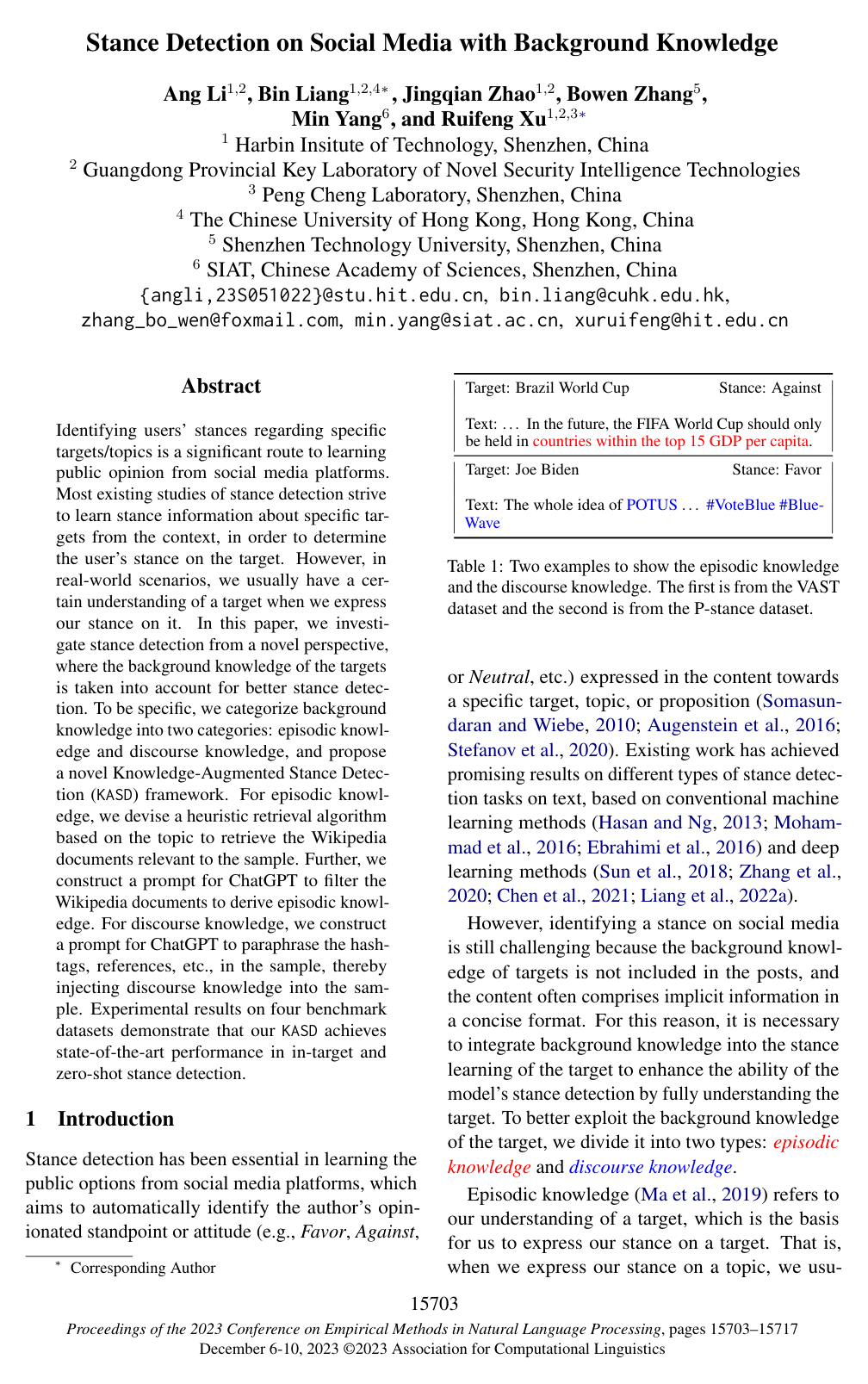
Stance Detection on Social Media with Background Knowledge
Ang Li, Bin Liang, Jingqian Zhao, Bowen Zhang, Min Yang, Ruifeng Xu
Why you should read this
Proposes a knowledge-augmented stance detection framework that integrates Wikipedia-derived episodic context and language-model-interpreted social discourse to achieve state-of-the-art accuracy in both in-target and zero-shot settings.
Identifying users’ stances regarding specific targets/topics is a significant route to learning public opinion from social media platforms. Most existing studies of stance detection strive to learn stance information about specific targets from the context, in order to determine the user’s stance on the target. However, in real-world scenarios, we usually have a certain understanding of a target when we express our stance on it. In this paper, we investigate stance detection from a novel perspective, where the background knowledge of the targets is taken into account for better stance detection. To be specific, we categorize background knowledge into two categories: episodic knowledge and discourse knowledge, and propose a novel Knowledge-Augmented Stance Detection (KASD) framework. For episodic knowledge, we devise a heuristic retrieval algorithm based on the topic to retrieve the Wikipedia documents relevant to the sample. Further, we construct a prompt for ChatGPT to filter the Wikipedia documents to derive episodic knowledge. For discourse knowledge, we construct a prompt for ChatGPT to paraphrase the hashtags, references, etc., in the sample, thereby injecting discourse knowledge into the sample. Experimental results on four benchmark datasets demonstrate that our KASD achieves state-of-the-art performance in in-target and zero-shot stance detection.
Added
2026-10-03
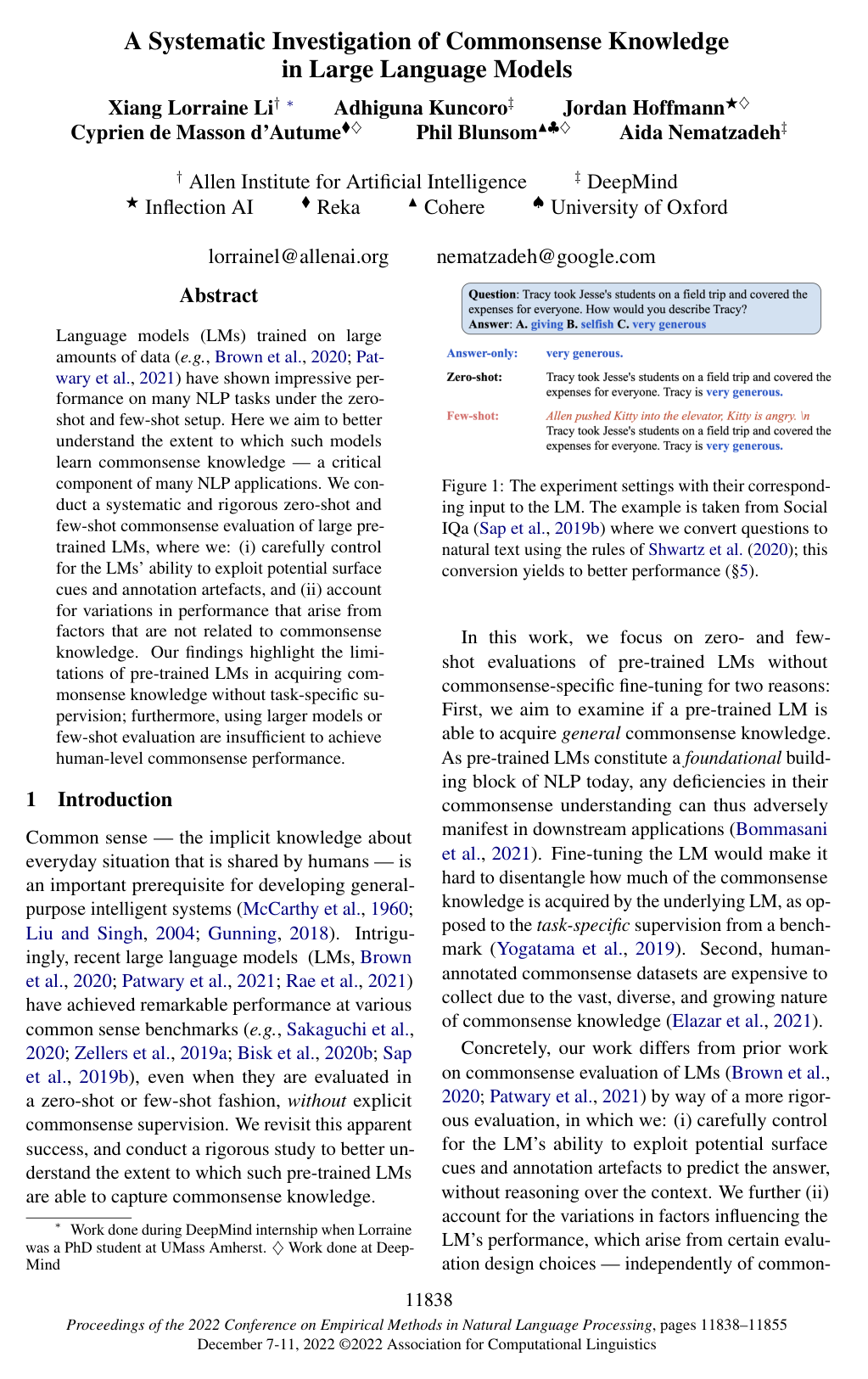
A Systematic Investigation of Commonsense Knowledge in Large Language Models
Xiang Lorraine Li, Adhiguna Kuncoro, Jordan Hoffmann, Cyprien de Masson d'Autume, Phil Blunsom, Aida Nematzadeh
Why you should read this
Reveals that scaling model parameters and few-shot prompting fail to close the gap to human-level commonsense reasoning in large language models once superficial cues and evaluation artifacts are strictly controlled.
Language models (LMs) trained on large amounts of data (e.g., Brown et al., 2020; Patwary et al., 2021) have shown impressive performance on many NLP tasks under the zero-shot and few-shot setup. Here we aim to better understand the extent to which such models learn commonsense knowledge — a critical component of many NLP applications. We conduct a systematic and rigorous zero-shot and few-shot commonsense evaluation of large pre-trained LMs, where we: (i) carefully control for the LMs’ ability to exploit potential surface cues and annotation artefacts, and (ii) account for variations in performance that arise from factors that are not related to commonsense knowledge. Our findings highlight the limitations of pre-trained LMs in acquiring commonsense knowledge without task-specific supervision; furthermore, using larger models or few-shot evaluation are insufficient to achieve human-level commonsense performance.
Added
2026-10-02
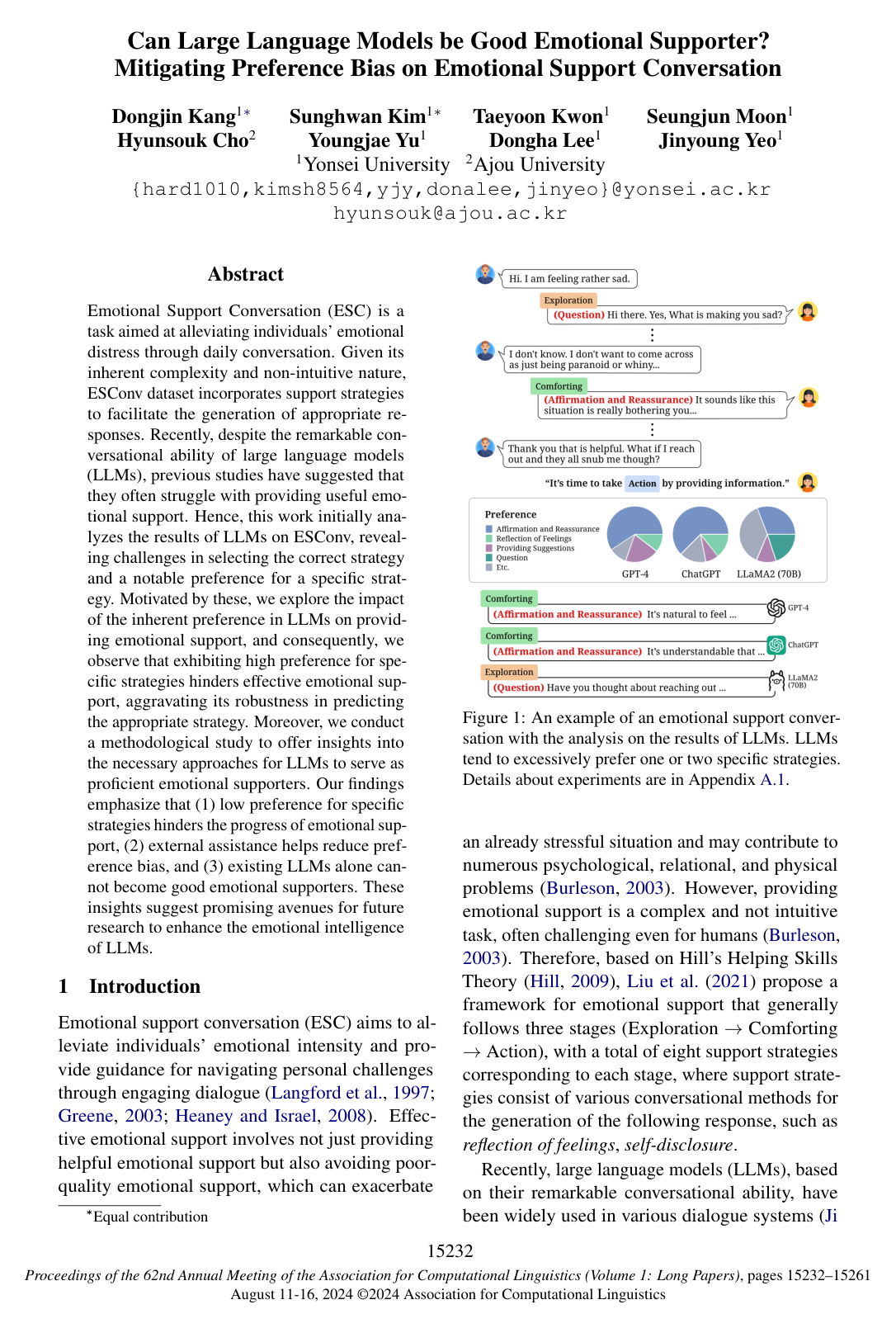
Can Large Language Models be Good Emotional Supporter? Mitigating Preference Bias on Emotional Support Conversation
Dongjin Kang, Sunghwan Kim, Taeyoon Kwon, Seungjun Moon, Hyunsouk Cho, Youngjae Yu, Dongha Lee, Jinyoung Yeo
Why you should read this
Reveals that large language models struggle in emotional support conversations due to an inherent bias toward specific conversational strategies and establishes methods to reduce this bias using external assistance.
Emotional Support Conversation (ESC) is a task aimed at alleviating individuals' emotional distress through daily conversation. Given its inherent complexity and non-intuitive nature, ESConv dataset incorporates support strategies to facilitate the generation of appropriate responses. Recently, despite the remarkable conversational ability of large language models (LLMs), previous studies have suggested that they often struggle with providing useful emotional support. Hence, this work initially analyzes the results of LLMs on ESConv, revealing challenges in selecting the correct strategy and a notable preference for a specific strategy. Motivated by these, we explore the impact of the inherent preference in LLMs on providing emotional support, and consequently, we observe that exhibiting high preference for specific strategies hinders effective emotional support, aggravating its robustness in predicting the appropriate strategy. Moreover, we conduct a methodological study to offer insights into the necessary approaches for LLMs to serve as proficient emotional supporters. Our findings emphasize that (1) low preference for specific strategies hinders the progress of emotional support, (2) external assistance helps reduce preference bias, and (3) existing LLMs alone cannot become good emotional supporters. These insights suggest promising avenues for future research to enhance the emotional intelligence of LLMs.
Added
2026-09-26
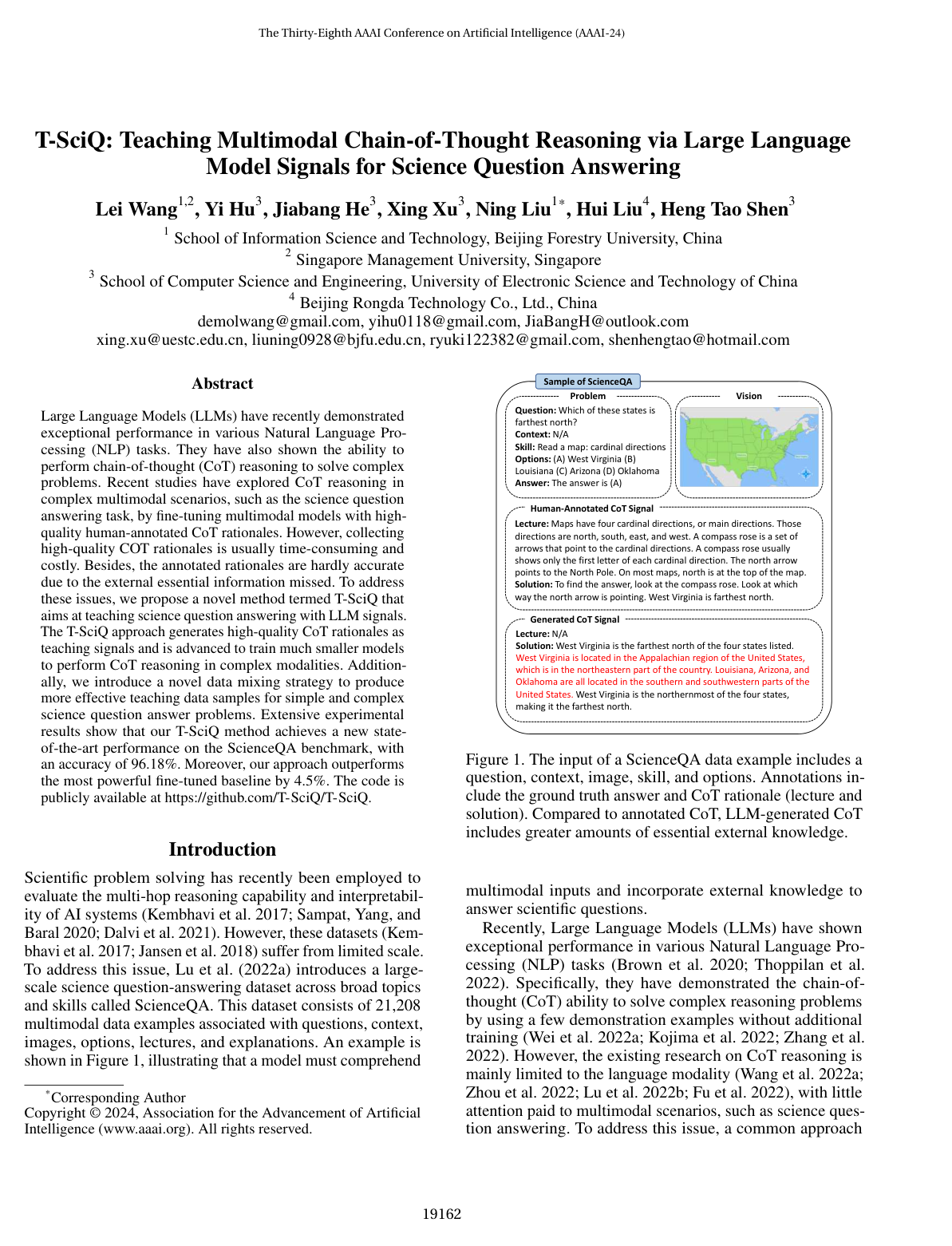
T-SciQ: Teaching Multimodal Chain-of-Thought Reasoning via Large Language Model Signals for Science Question Answering
Lei Wang, Yi Hu, Jiabang He, Xing Xu, Ning Liu, Hui Liu, Heng Tao Shen
Why you should read this
Proposes a data-generation and mixing framework that uses large language model reasoning signals to teach smaller multimodal models how to solve complex scientific questions, achieving a new state of the art on ScienceQA.
Large Language Models (LLMs) have recently demonstrated exceptional performance in various Natural Language Processing (NLP) tasks. They have also shown the ability to perform chain-of-thought (CoT) reasoning to solve complex problems. Recent studies have explored CoT reasoning in complex multimodal scenarios, such as the science question answering task, by fine-tuning multimodal models with high-quality human-annotated CoT rationales. However, collecting high-quality CoT rationales is usually time-consuming and costly. Besides, the annotated rationales are hardly accurate due to the external essential information missed. To address these issues, we propose a novel method termed T-SciQ that aims at teaching science question answering with LLM signals. The T-SciQ approach generates high-quality CoT rationales as teaching signals and is advanced to train much smaller models to perform CoT reasoning in complex modalities. Additionally, we introduce a novel data mixing strategy to produce more effective teaching data samples for simple and complex science question answer problems. Extensive experimental results show that our T-SciQ method achieves a new state-of-the-art performance on the ScienceQA benchmark, with an accuracy of 96.18%. Moreover, our approach outperforms the most powerful fine-tuned baseline by 4.5%. The code is publicly available at https://github.com/T-SciQ/T-SciQ.
Added
2026-09-26
Deep Bidirectional Language-Knowledge Graph Pretraining
Michihiro Yasunaga, Antoine Bosselut, Hongyu Ren, Xikun Zhang, Christopher D. Manning, Percy Liang, Jure Leskovec
Why you should read this
Presents DRAGON, a self-supervised framework that fuses text and knowledge graph subgraphs bidirectionally through joint masked language modeling and link prediction, significantly boosting accuracy on multi-step reasoning and biomedical question answering.
Pretraining a language model (LM) on text has been shown to help various downstream NLP tasks. Recent works show that a knowledge graph (KG) can complement text data, offering structured background knowledge that provides a useful scaffold for reasoning. However, these works are not pretrained to learn a deep fusion of the two modalities at scale, limiting the potential to acquire fully joint representations of text and KG. Here we propose DRAGON (Deep Bidirectional Language-Knowledge Graph Pretraining), a self-supervised method to pretrain a deeply joint language-knowledge foundation model from text and KG at scale. Specifically, our model takes pairs of text segments and relevant KG subgraphs as input and bidirectionally fuses information from both modalities. We pretrain this model by unifying two self-supervised reasoning tasks, masked language modeling and KG link prediction. DRAGON outperforms existing LM and LM+KG models on diverse downstream tasks including question answering across general and biomedical domains, with +5% absolute gain on average. In particular, DRAGON achieves strong performance on complex reasoning about language and knowledge (+10% on questions involving long contexts or multi-step reasoning) and low-resource QA (+8% on OBQA and RiddleSense), and new state-of-the-art results on various BioNLP tasks. Our code and trained models are available at https://github.com/michiyasunaga/dragon.
Added
2026-09-26
KAT: A Knowledge Augmented Transformer for Vision-and-Language
Liangke Gui, Borui Wang, Qiuyuan Huang, Alexander Hauptmann, Yonatan Bisk, Jianfeng Gao
Why you should read this
Proposes an encoder-decoder framework that jointly reasons over explicit knowledge retrieved from Wikidata and implicit knowledge extracted from GPT-3, setting a new state of the art on open-domain visual question answering while improving prediction interpretability.
The primary focus of recent work with large-scale transformers has been on optimizing the amount of information packed into the model's parameters. In this work, we ask a complementary question: Can multimodal transformers leverage explicit knowledge in their reasoning? Existing, primarily unimodal, methods have explored approaches under the paradigm of knowledge retrieval followed by answer prediction, but leave open questions about the quality and relevance of the retrieved knowledge used, and how the reasoning processes over implicit and explicit knowledge should be integrated. To address these challenges, we propose a - Knowledge Augmented Transformer (KAT) - which achieves a strong state-of-the-art result (+6% absolute) on the open-domain multimodal task of OK-VQA. Our approach integrates implicit and explicit knowledge in an encoder-decoder architecture, while still jointly reasoning over both knowledge sources during answer generation. Additionally, explicit knowledge integration improves interpretability of model predictions in our analysis. Code and pre-trained models are released at https://github.com/guilk/KAT.
Added
2026-09-26
CommonsenseQA: A Question Answering Challenge Targeting Commonsense Knowledge
Alon Talmor, Jonathan Herzig, Nicholas Lourie, Jonathan Berant
Why you should read this
Introduces CommonsenseQA, a 12,247-question multiple-choice benchmark derived from ConceptNet semantic relations that tests language models on background world knowledge and exposes a wide performance gap with human reasoning.
When answering a question, people often draw upon their rich world knowledge in addition to the particular context. Recent work has focused primarily on answering questions given some relevant document or context, and required very little general background. To investigate question answering with prior knowledge, we present CommonsenseQA: a challenging new dataset for commonsense question answering. To capture common sense beyond associations, we extract from ConceptNet (Speer et al., 2017) multiple target concepts that have the same semantic relation to a single source concept. Crowd-workers are asked to author multiple-choice questions that mention the source concept and discriminate in turn between each of the target concepts. This encourages workers to create questions with complex semantics that often require prior knowledge. We create 12,247 questions through this procedure and demonstrate the difficulty of our task with a large number of strong baselines. Our best baseline is based on BERT-large (Devlin et al., 2018) and obtains 56% accuracy, well below human performance, which is 89%.
Added
2026-09-14
Can a Suit of Armor Conduct Electricity? A New Dataset for Open Book Question Answering
Todor Mihaylov, Peter Clark, Tushar Khot, Ashish Sabharwal
Why you should read this
Introduces OpenBookQA, a benchmark that challenges question-answering systems to perform multi-hop reasoning by combining explicit science facts with broad commonsense knowledge, exposing a substantial gap between machine and human performance.
We present a new kind of question answering dataset, OpenBookQA, modeled after open book exams for assessing human understanding of a subject. The open book that comes with our questions is a set of 1329 elementary level science facts. Roughly 6000 questions probe an understanding of these facts and their application to novel situations. This requires combining an open book fact (e.g., metals conduct electricity) with broad common knowledge (e.g., a suit of armor is made of metal) obtained from other sources. While existing QA datasets over documents or knowledge bases, being generally self-contained, focus on linguistic understanding, OpenBookQA probes a deeper understanding of both the topic---in the context of common knowledge---and the language it is expressed in. Human performance on OpenBookQA is close to 92%, but many state-of-the-art pre-trained QA methods perform surprisingly poorly, worse than several simple neural baselines we develop. Our oracle experiments designed to circumvent the knowledge retrieval bottleneck demonstrate the value of both the open book and additional facts. We leave it as a challenge to solve the retrieval problem in this multi-hop setting and to close the large gap to human performance.
Added
2026-09-14
Language Models as Knowledge Bases?
Fabio Petroni, Tim Rocktäschel, Patrick Lewis, Anton Bakhtin, Yuxiang Wu, Alexander H. Miller, Sebastian Riedel
Why you should read this
Demonstrates that pretrained language models store substantial relational facts, enabling them to function as queryable knowledge bases for open-domain question answering without fine-tuning or schema engineering.
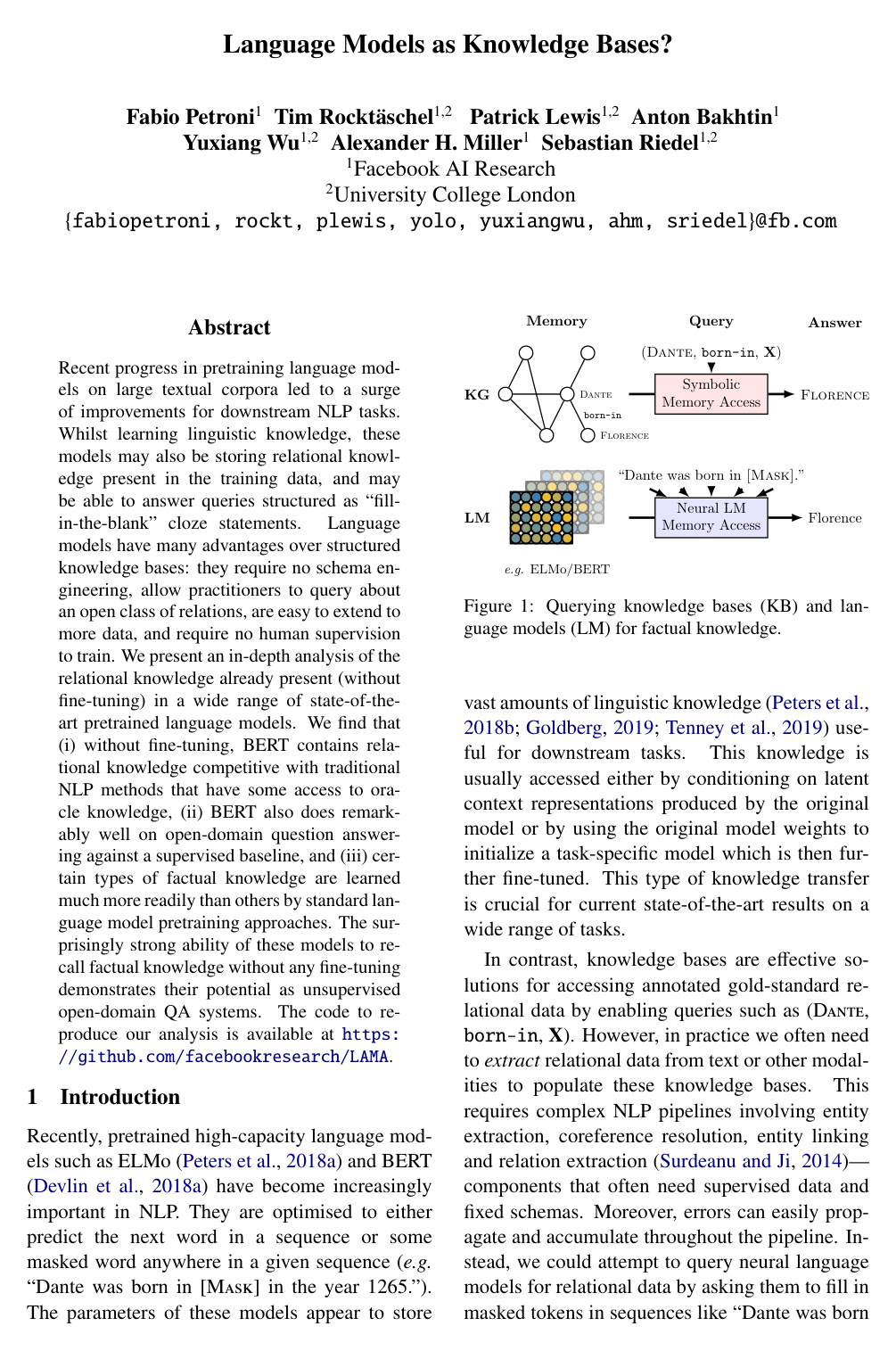
Recent progress in pretraining language models on large textual corpora led to a surge of improvements for downstream NLP tasks. Whilst learning linguistic knowledge, these models may also be storing relational knowledge present in the training data, and may be able to answer queries structured as "fill-in-the-blank" cloze statements. Language models have many advantages over structured knowledge bases: they require no schema engineering, allow practitioners to query about an open class of relations, are easy to extend to more data, and require no human supervision to train. We present an in-depth analysis of the relational knowledge already present (without fine-tuning) in a wide range of state-of-the-art pretrained language models. We find that (i) without fine-tuning, BERT contains relational knowledge competitive with traditional NLP methods that have some access to oracle knowledge, (ii) BERT also does remarkably well on open-domain question answering against a supervised baseline, and (iii) certain types of factual knowledge are learned much more readily than others by standard language model pretraining approaches. The surprisingly strong ability of these models to recall factual knowledge without any fine-tuning demonstrates their potential as unsupervised open-domain QA systems. The code to reproduce our analysis is available at this https URL.
Added
2026-09-11