
keyword
autoregressive models
An autoregressive model is a statistical or machine learning model that predicts future or subsequent values in a sequence based on its own previously observed or generated values. In probabilistic modeling and deep learning, these models decompose the joint probability distribution of a sequence of elements into a product of conditional probabilities using the probability chain rule, allowing each token, pixel, or data point to be generated step by step conditioned on preceding elements. While traditionally formulated as linear models for time series forecasting, modern autoregressive models often utilize deep neural network architectures such as Transformers, recurrent networks, or masked convolutions, making them foundational to generative artificial intelligence applications across text generation, speech synthesis, image generation, and multidimensional sequence analysis.
13 items
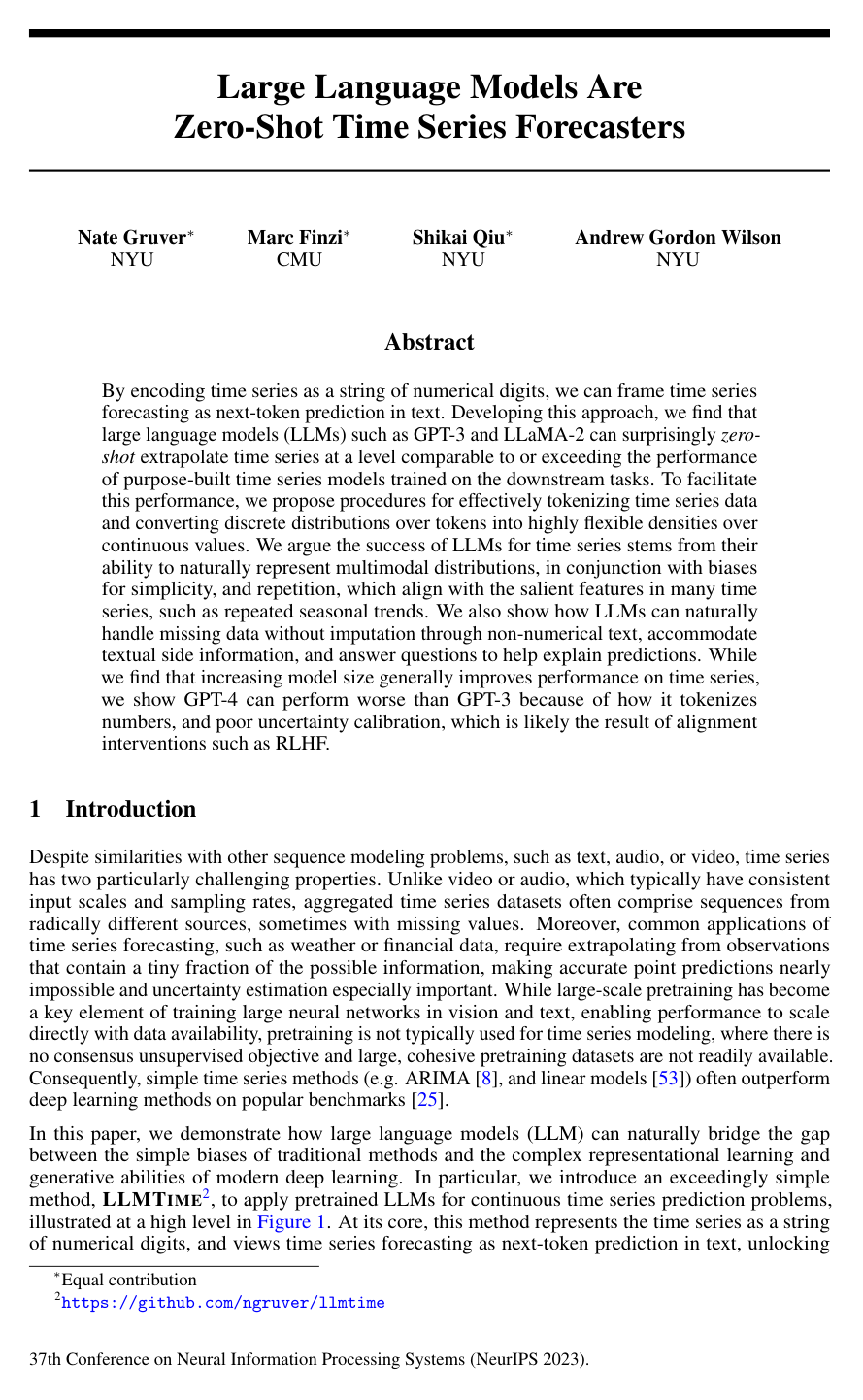
Large Language Models Are Zero-Shot Time Series Forecasters
Nate Gruver, Marc Finzi, Shikai Qiu, Andrew Gordon Wilson
Why you should read this
Demonstrates that off-the-shelf large language models can match or exceed specialized domain models at zero-shot time series forecasting simply by framing numerical sequences as next-token prediction tasks.
By encoding time series as a string of numerical digits, we can frame time series forecasting as next-token prediction in text. Developing this approach, we find that large language models (LLMs) such as GPT-3 and LLaMA-2 can surprisingly zero-shot extrapolate time series at a level comparable to or exceeding the performance of purpose-built time series models trained on the downstream tasks. To facilitate this performance, we propose procedures for effectively tokenizing time series data and converting discrete distributions over tokens into highly flexible densities over continuous values. We argue the success of LLMs for time series stems from their ability to naturally represent multimodal distributions, in conjunction with biases for simplicity, and repetition, which align with the salient features in many time series, such as repeated seasonal trends. We also show how LLMs can naturally handle missing data without imputation through non-numerical text, accommodate textual side information, and answer questions to help explain predictions. While we find that increasing model size generally improves performance on time series, we show GPT-4 can perform worse than GPT-3 because of how it tokenizes numbers, and poor uncertainty calibration, which is likely the result of alignment interventions such as RLHF.
Added
2026-10-05
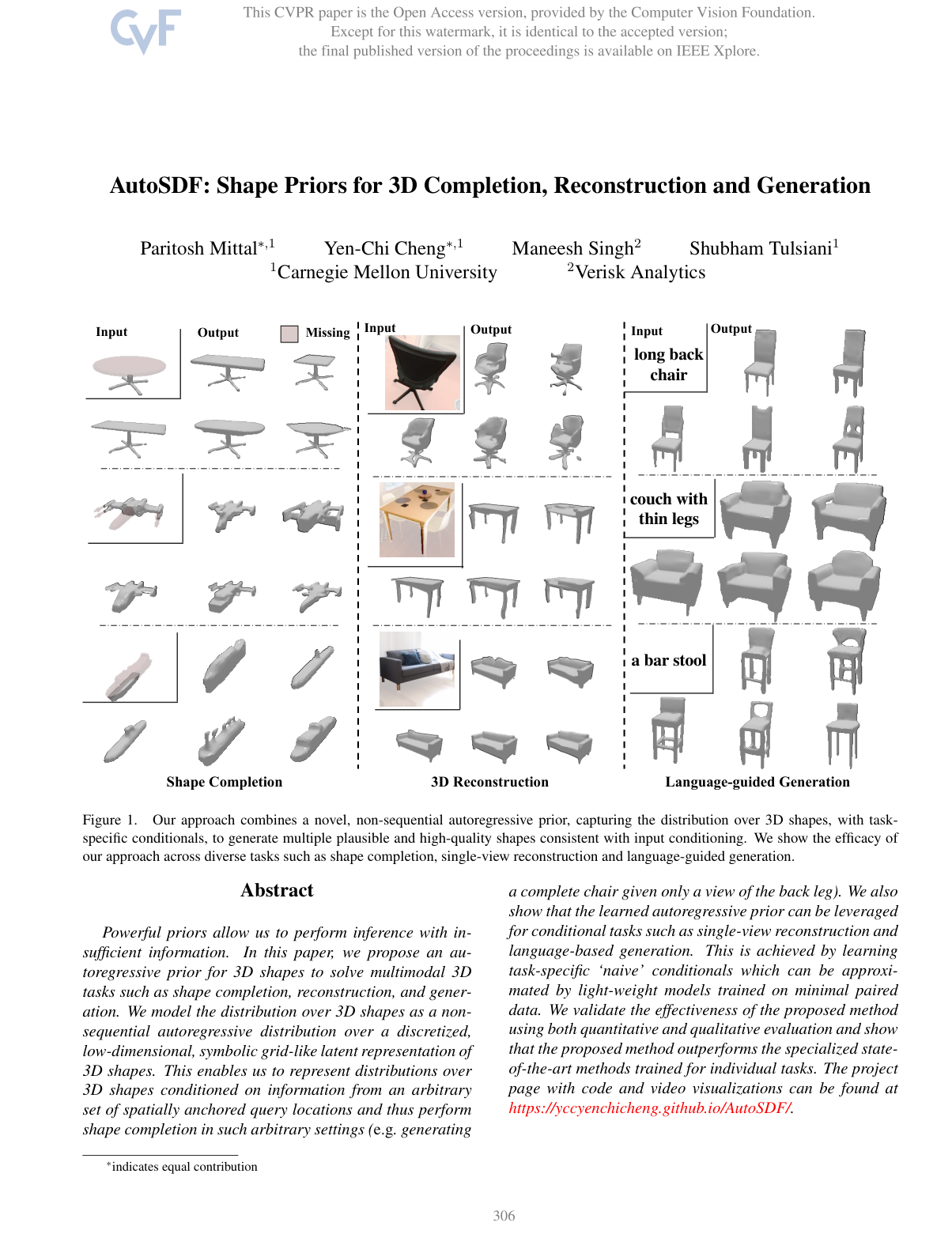
AutoSDF: Shape Priors for 3D Completion, Reconstruction and Generation
Paritosh Mittal, Yen-Chi Cheng, Maneesh Singh, Shubham Tulsiani
Why you should read this
Introduces an autoregressive 3D shape prior over discretized latent grids that unifies multimodal shape completion from arbitrary spatial observations, single-view reconstruction, and language-guided generation while outperforming specialized task-specific models.
Powerful priors allow us to perform inference with insufficient information. In this paper, we propose an autoregressive prior for 3D shapes to solve multimodal 3D tasks such as shape completion, reconstruction, and generation. We model the distribution over 3D shapes as a non-sequential autoregressive distribution over a discretized, low-dimensional, symbolic grid-like latent representation of 3D shapes. This enables us to represent distributions over 3D shapes conditioned on information from an arbitrary set of spatially anchored query locations and thus perform shape completion in such arbitrary settings (e.g., generating a complete chair given only a view of the back leg). We also show that the learned autoregressive prior can be leveraged for conditional tasks such as single-view reconstruction and language-based generation. This is achieved by learning task-specific naive conditionals which can be approximated by light-weight models trained on minimal paired data. We validate the effectiveness of the proposed method using both quantitative and qualitative evaluation and show that the proposed method outperforms the specialized state-of-the-art methods trained for individual tasks. The project page with code and video visualizations can be found at this https URL.
Added
2026-09-26
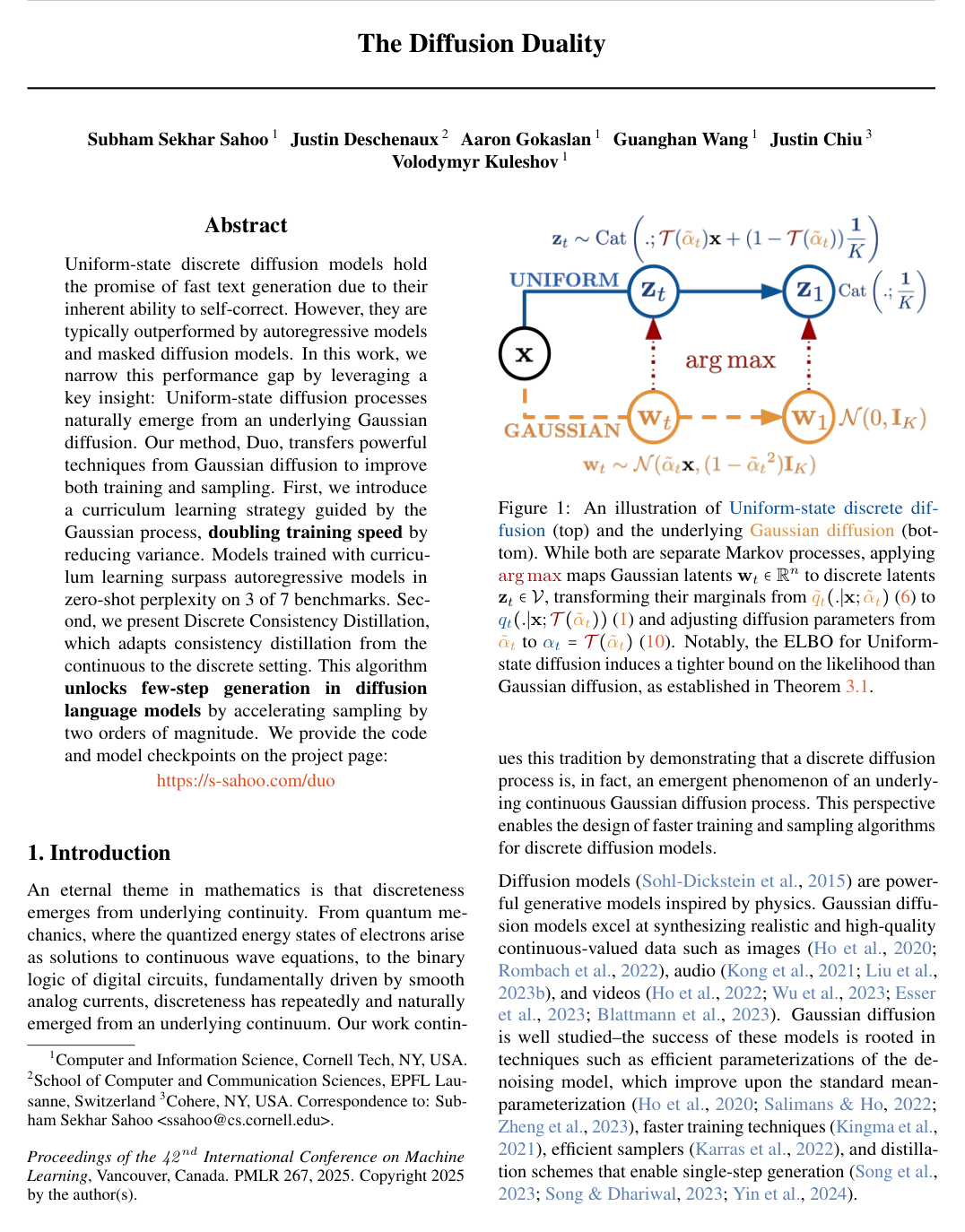
The Diffusion Duality
Subham Sekhar Sahoo, Justin Deschenaux, Aaron Gokaslan, Guanghan Wang, Justin T. Chiu, Volodymyr Kuleshov
Why you should read this
Establishes a theoretical link proving uniform-state discrete diffusion emerges from continuous Gaussian processes, enabling curriculum training and discrete consistency distillation that doubles training speed and accelerates text generation by two orders of magnitude.
Uniform-state discrete diffusion models hold the promise of fast text generation due to their inherent ability to self-correct. However, they are typically outperformed by autoregressive models and masked diffusion models. In this work, we narrow this performance gap by leveraging a key insight: Uniform-state diffusion processes naturally emerge from an underlying Gaussian diffusion. Our method, Duo, transfers powerful techniques from Gaussian diffusion to improve both training and sampling. First, we introduce a curriculum learning strategy guided by the Gaussian process, doubling training speed by reducing variance. Models trained with curriculum learning surpass autoregressive models in zero-shot perplexity on 3 of 7 benchmarks. Second, we present Discrete Consistency Distillation, which adapts consistency distillation from the continuous to the discrete setting. This algorithm unlocks few-step generation in diffusion language models by accelerating sampling by two orders of magnitude. We provide the code and model checkpoints on the project page: https://s-sahoo.com/duo
Added
2026-09-26
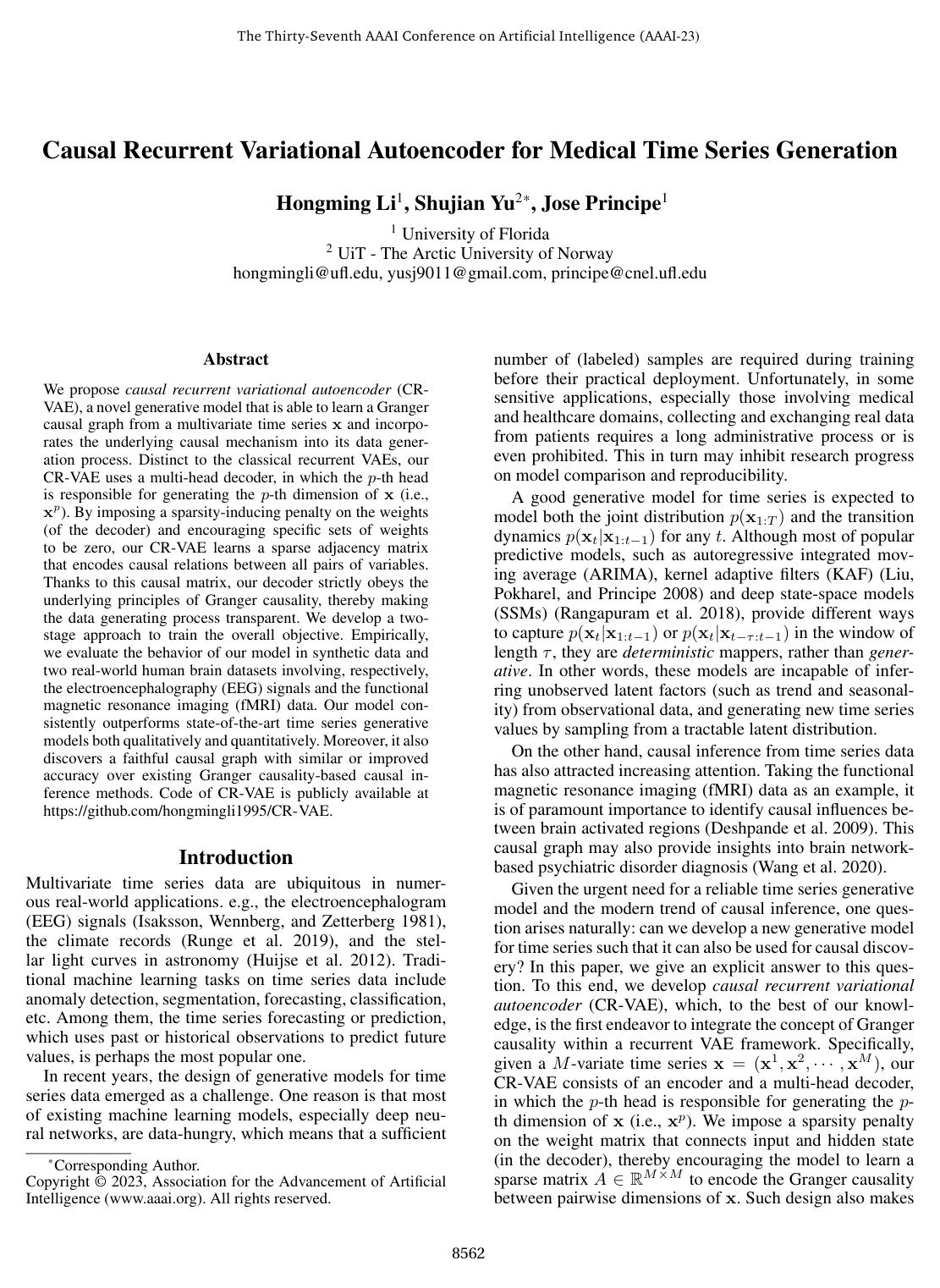
Causal Recurrent Variational Autoencoder for Medical Time Series Generation
Hongming Li, Shujian Yu, José C. Príncipe
Why you should read this
Proposes a causal recurrent variational autoencoder that embeds Granger causality into a multi-head decoder to simultaneously generate realistic medical time series and discover transparent inter-variable causal graphs.
We propose causal recurrent variational autoencoder (CR-VAE), a novel generative model that is able to learn a Granger causal graph from a multivariate time series x and incorporates the underlying causal mechanism into its data generation process. Distinct to the classical recurrent VAEs, our CR-VAE uses a multi-head decoder, in which the p-th head is responsible for generating the p-th dimension of x (i.e., x^p). By imposing a sparsity-inducing penalty on the weights (of the decoder) and encouraging specific sets of weights to be zero, our CR-VAE learns a sparse adjacency matrix that encodes causal relations between all pairs of variables. Thanks to this causal matrix, our decoder strictly obeys the underlying principles of Granger causality, thereby making the data generating process transparent. We develop a two-stage approach to train the overall objective. Empirically, we evaluate the behavior of our model in synthetic data and two real-world human brain datasets involving, respectively, the electroencephalography (EEG) signals and the functional magnetic resonance imaging (fMRI) data. Our model consistently outperforms state-of-the-art time series generative models both qualitatively and quantitatively. Moreover, it also discovers a faithful causal graph with similar or improved accuracy over existing Granger causality-based causal inference methods. Code of CR-VAE is publicly available at https://github.com/hongmingli1995/CR-VAE.
Added
2026-09-26
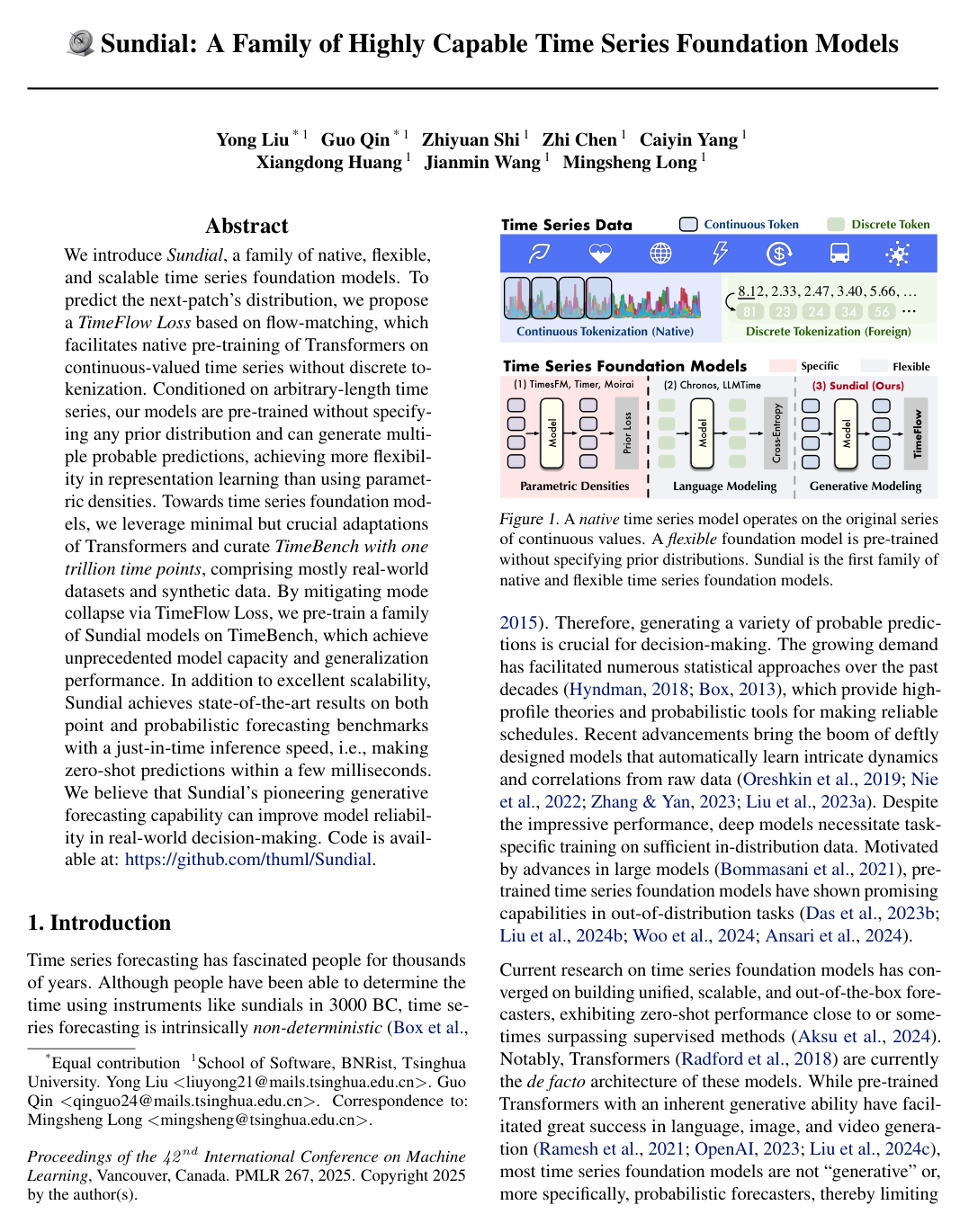
Sundial: A Family of Highly Capable Time Series Foundation Models
Yong Liu, Guo Qin, Zhiyuan Shi, Zhi Chen, Caiyin Yang, Xiangdong Huang, Jianmin Wang, Mingsheng Long
Why you should read this
Presents Sundial, a family of time series foundation models pre-trained on a one-trillion-point dataset using a flow-matching objective to enable fast, zero-shot probabilistic forecasting directly on continuous data without discrete tokenization.
We introduce Sundial, a family of native, flexible, and scalable time series foundation models. To predict the next-patch's distribution, we propose a TimeFlow Loss based on flow-matching, which facilitates native pre-training of Transformers on continuous-valued time series without discrete tokenization. Conditioned on arbitrary-length time series, our models are pre-trained without specifying any prior distribution and can generate multiple probable predictions, achieving more flexibility in representation learning than using parametric densities. Towards time series foundation models, we leverage minimal but crucial adaptations of Transformers and curate TimeBench with one trillion time points, comprising mostly real-world datasets and synthetic data. By mitigating mode collapse via TimeFlow Loss, we pre-train a family of Sundial models on TimeBench, which achieve unprecedented model capacity and generalization performance. In addition to excellent scalability, Sundial achieves state-of-the-art results on both point and probabilistic forecasting benchmarks with a just-in-time inference speed, i.e., making zero-shot predictions within a few milliseconds. We believe that Sundial's pioneering generative forecasting capability can improve model reliability in real-world decision-making. Code is available at: https://github.com/thuml/Sundial.
Added
2026-09-26
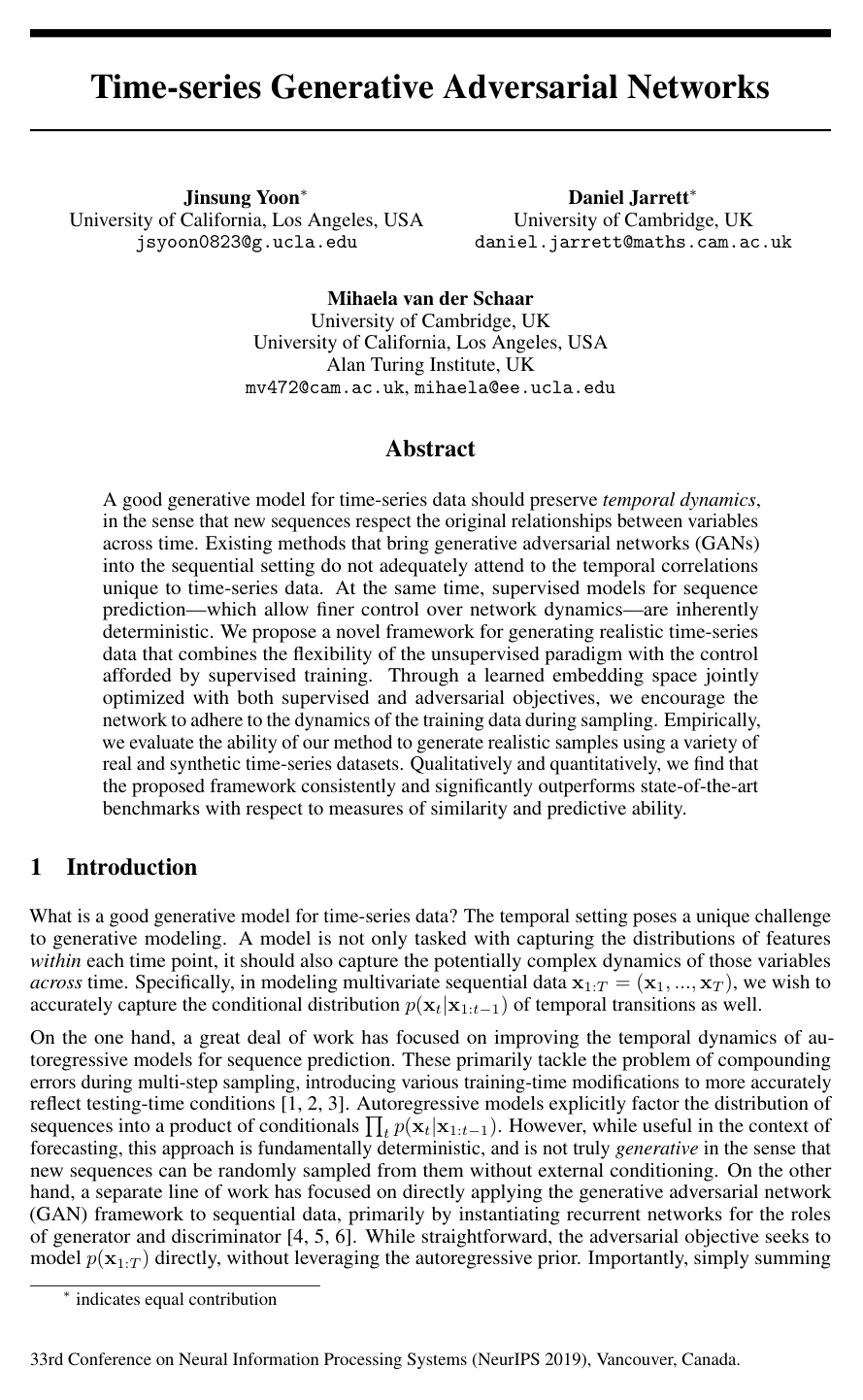
Time-series Generative Adversarial Networks
Jinsung Yoon, Daniel Jarrett, M. Vanderschaar
Why you should read this
Proposes TimeGAN, a generative adversarial network framework that jointly optimizes embedding, supervised, and adversarial objectives to capture complex temporal dynamics and produce high-fidelity synthetic time-series data.
A good generative model for time-series data should preserve temporal dynamics, in the sense that new sequences respect the original relationships between variables across time. Existing methods that bring generative adversarial networks (GANs) into the sequential setting do not adequately attend to the temporal correlations unique to time-series data. At the same time, supervised models for sequence prediction—which allow finer control over network dynamics—are inherently deterministic. We propose a novel framework for generating realistic time-series data that combines the flexibility of the unsupervised paradigm with the control afforded by supervised training. Through a learned embedding space jointly optimized with both supervised and adversarial objectives, we encourage the network to adhere to the dynamics of the training data during sampling. Empirically, we evaluate the ability of our method to generate realistic samples using a variety of real and synthetic time-series datasets. Qualitatively and quantitatively, we find that the proposed framework consistently and significantly outperforms state-of-the-art benchmarks with respect to measures of similarity and predictive ability.
Added
2026-09-24
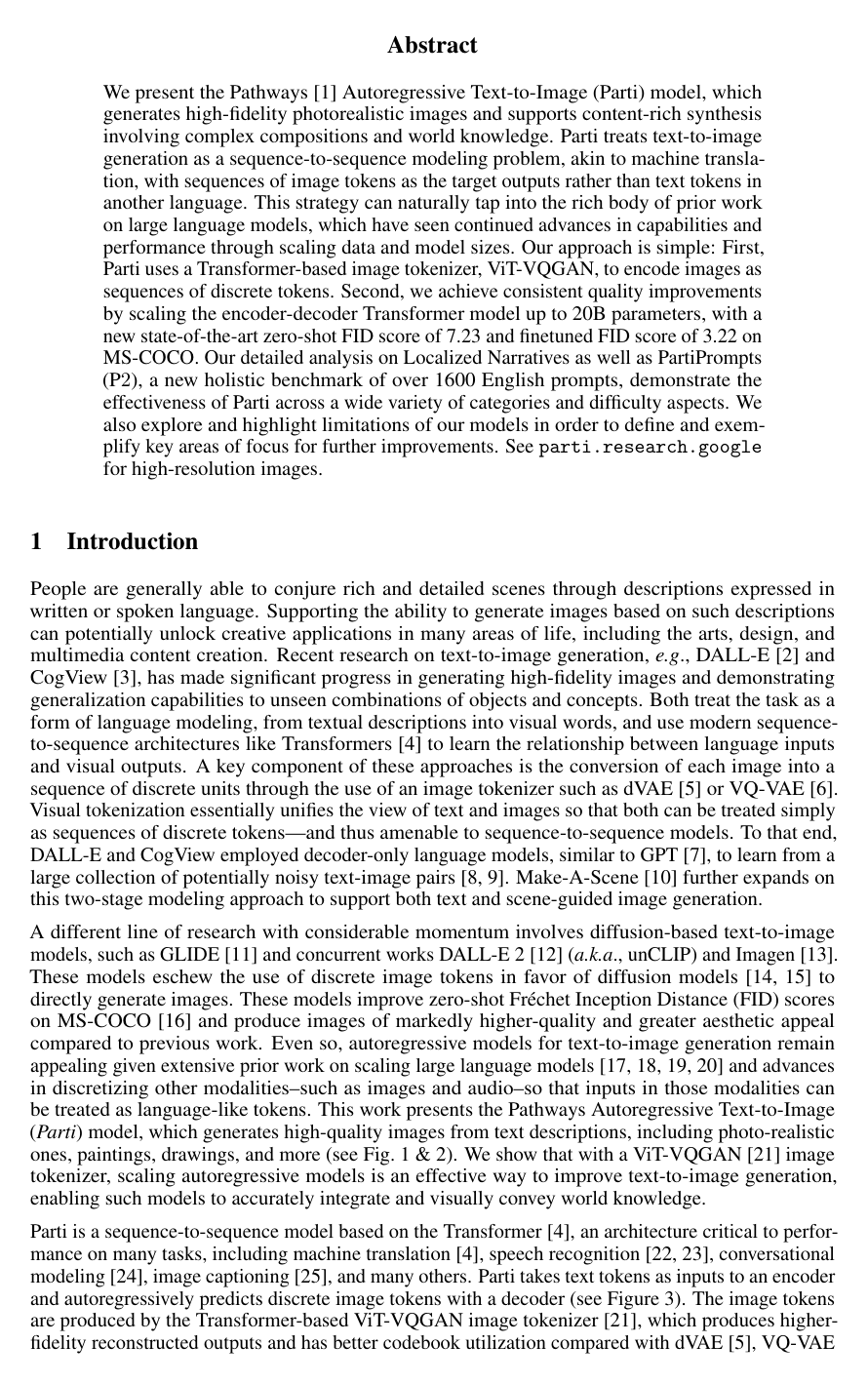
Scaling Autoregressive Models for Content-Rich Text-to-Image Generation
Jiahui Yu, Yuanzhong Xu, Jing Yu Koh, Thang Luong, Gunjan Baid, Zirui Wang, Vijay Vasudevan, Alexander Ku, Yinfei Yang, Burcu Karagol Ayan, Ben Hutchinson, Wei Han, Zarana Parekh, Xin Li, Han Zhang, Jason Baldridge, Yonghui Wu
Why you should read this
Demonstrates that scaling an autoregressive sequence-to-sequence model up to 20 billion parameters achieves state-of-the-art text-to-image synthesis quality and effectively handles complex, compositionally rich prompts.
We present the Pathways Autoregressive Text-to-Image (Parti) model, which generates high-fidelity photorealistic images and supports content-rich synthesis involving complex compositions and world knowledge. Parti treats text-to-image generation as a sequence-to-sequence modeling problem, akin to machine translation, with sequences of image tokens as the target outputs rather than text tokens in another language. This strategy can naturally tap into the rich body of prior work on large language models, which have seen continued advances in capabilities and performance through scaling data and model sizes. Our approach is simple: First, Parti uses a Transformer-based image tokenizer, ViT-VQGAN, to encode images as sequences of discrete tokens. Second, we achieve consistent quality improvements by scaling the encoder-decoder Transformer model up to 20B parameters, with a new state-of-the-art zero-shot FID score of 7.23 and finetuned FID score of 3.22 on MS-COCO. Our detailed analysis on Localized Narratives as well as PartiPrompts (P2), a new holistic benchmark of over 1600 English prompts, demonstrate the effectiveness of Parti across a wide variety of categories and difficulty aspects. We also explore and highlight limitations of our models in order to define and exemplify key areas of focus for further improvements. See this https URL for high-resolution images.
Added
2026-09-24
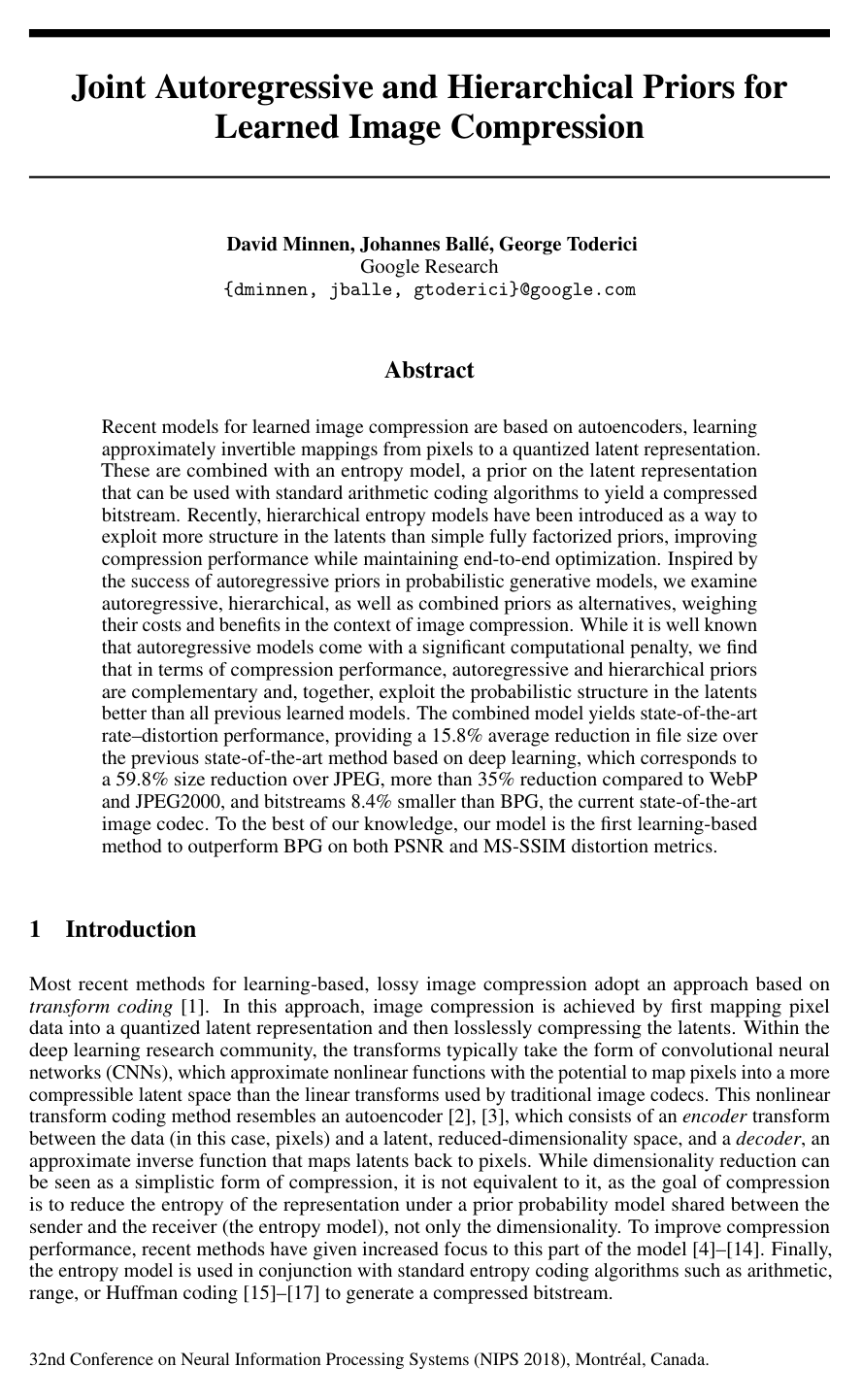
Joint Autoregressive and Hierarchical Priors for Learned Image Compression
David Minnen, Johannes Ballé, George Toderici
Why you should read this
Presents a learned image compression architecture that couples autoregressive and hierarchical priors in the entropy model, establishing the first deep learning approach to outperform traditional BPG codecs across both PSNR and MS-SSIM rate-distortion metrics.
Recent models for learned image compression are based on autoencoders, learning approximately invertible mappings from pixels to a quantized latent representation. These are combined with an entropy model, a prior on the latent representation that can be used with standard arithmetic coding algorithms to yield a compressed bitstream. Recently, hierarchical entropy models have been introduced as a way to exploit more structure in the latents than simple fully factorized priors, improving compression performance while maintaining end-to-end optimization. Inspired by the success of autoregressive priors in probabilistic generative models, we examine autoregressive, hierarchical, as well as combined priors as alternatives, weighing their costs and benefits in the context of image compression. While it is well known that autoregressive models come with a significant computational penalty, we find that in terms of compression performance, autoregressive and hierarchical priors are complementary and, together, exploit the probabilistic structure in the latents better than all previous learned models. The combined model yields state-of-the-art rate--distortion performance, providing a 15.8% average reduction in file size over the previous state-of-the-art method based on deep learning, which corresponds to a 59.8% size reduction over JPEG, more than 35% reduction compared to WebP and JPEG2000, and bitstreams 8.4% smaller than BPG, the current state-of-the-art image codec. To the best of our knowledge, our model is the first learning-based method to outperform BPG on both PSNR and MS-SSIM distortion metrics.
Added
2026-09-24
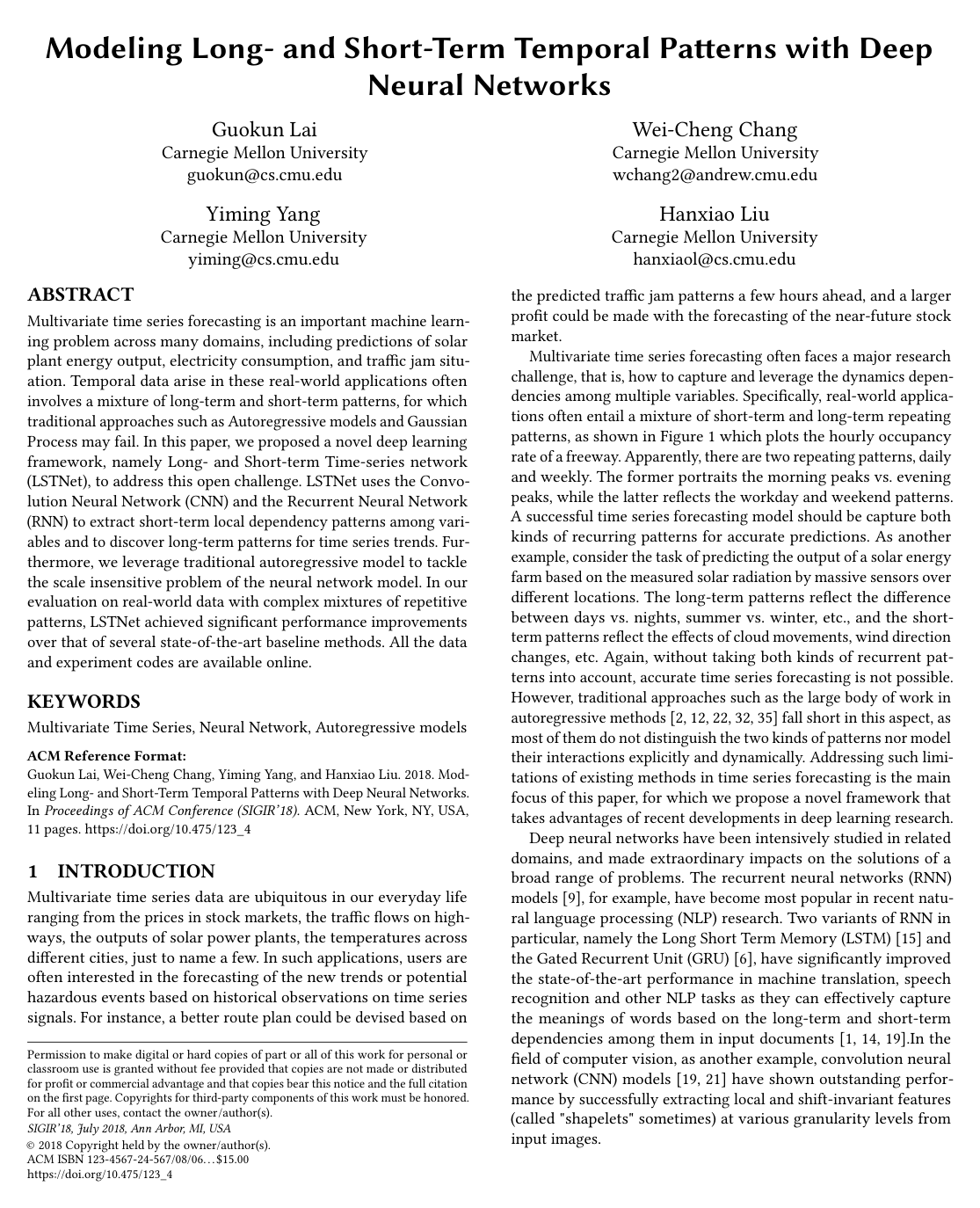
Modeling Long- and Short-Term Temporal Patterns with Deep Neural Networks
Guokun Lai, Wei-Cheng Chang, Yiming Yang, Hanxiao Liu
Why you should read this
Introduces LSTNet, a deep learning architecture that integrates convolutional and recurrent neural networks with an autoregressive model to capture both short-term local dependencies and long-term trends while addressing scale insensitivity in multivariate time series forecasting.
Multivariate time series forecasting is an important machine learning problem across many domains, including predictions of solar plant energy output, electricity consumption, and traffic jam situation. Temporal data arise in these real-world applications often involves a mixture of long-term and short-term patterns, for which traditional approaches such as Autoregressive models and Gaussian Process may fail. In this paper, we proposed a novel deep learning framework, namely Long- and Short-term Time-series network (LSTNet), to address this open challenge. LSTNet uses the Convolution Neural Network (CNN) and the Recurrent Neural Network (RNN) to extract short-term local dependency patterns among variables and to discover long-term patterns for time series trends. Furthermore, we leverage traditional autoregressive model to tackle the scale insensitive problem of the neural network model. In our evaluation on real-world data with complex mixtures of repetitive patterns, LSTNet achieved significant performance improvements over that of several state-of-the-art baseline methods. All the data and experiment codes are available online.
Added
2026-09-14
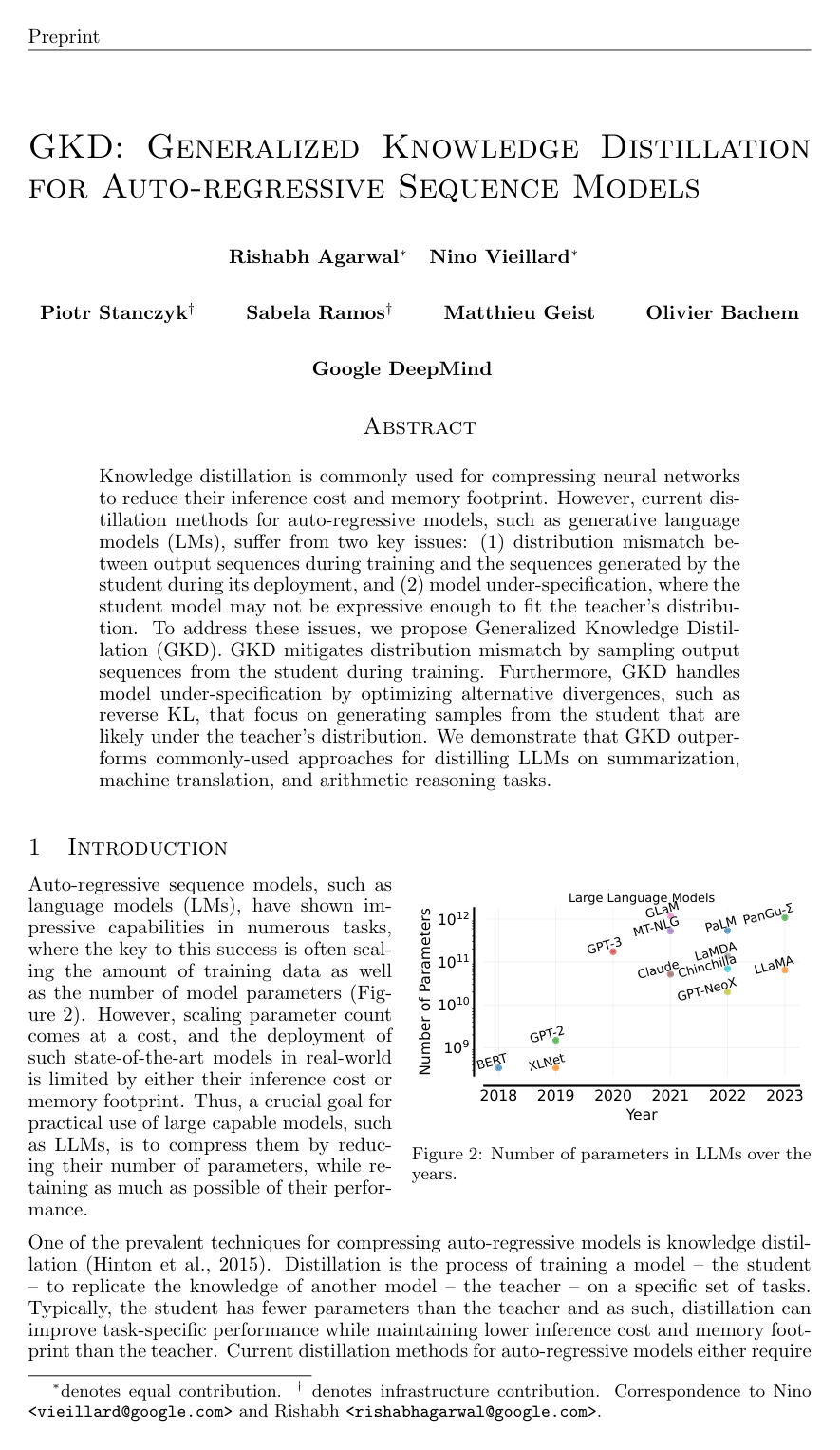
GKD: Generalized Knowledge Distillation for Auto-regressive Models
Rishabh Agarwal, Nino Vieillard, Piotr Stanczyk, Sabela Ramos, Matthieu Geist, Olivier Bachem
Why you should read this
Proposes Generalized Knowledge Distillation to enhance the compression of auto-regressive language models by leveraging on-policy sampling and mode-seeking divergences to resolve critical issues of distribution mismatch and model under-specification.
Knowledge distillation is commonly used for compressing neural networks to reduce their inference cost and memory footprint. However, current distillation methods for auto-regressive models, such as generative language models (LMs), suffer from two key issues: (1) distribution mismatch between output sequences during training and the sequences generated by the student during its deployment, and (2) model under-specification, where the student model may not be expressive enough to fit the teacher's distribution. To address these issues, we propose Generalized Knowledge Distillation (GKD). GKD mitigates distribution mismatch by sampling output sequences from the student during training. Furthermore, GKD handles model under-specification by optimizing alternative divergences, such as reverse KL, that focus on generating samples from the student that are likely under the teacher's distribution. We demonstrate that GKD outperforms commonly-used approaches for distilling LLMs on summarization, machine translation, and arithmetic reasoning tasks.
Added
2026-06-19
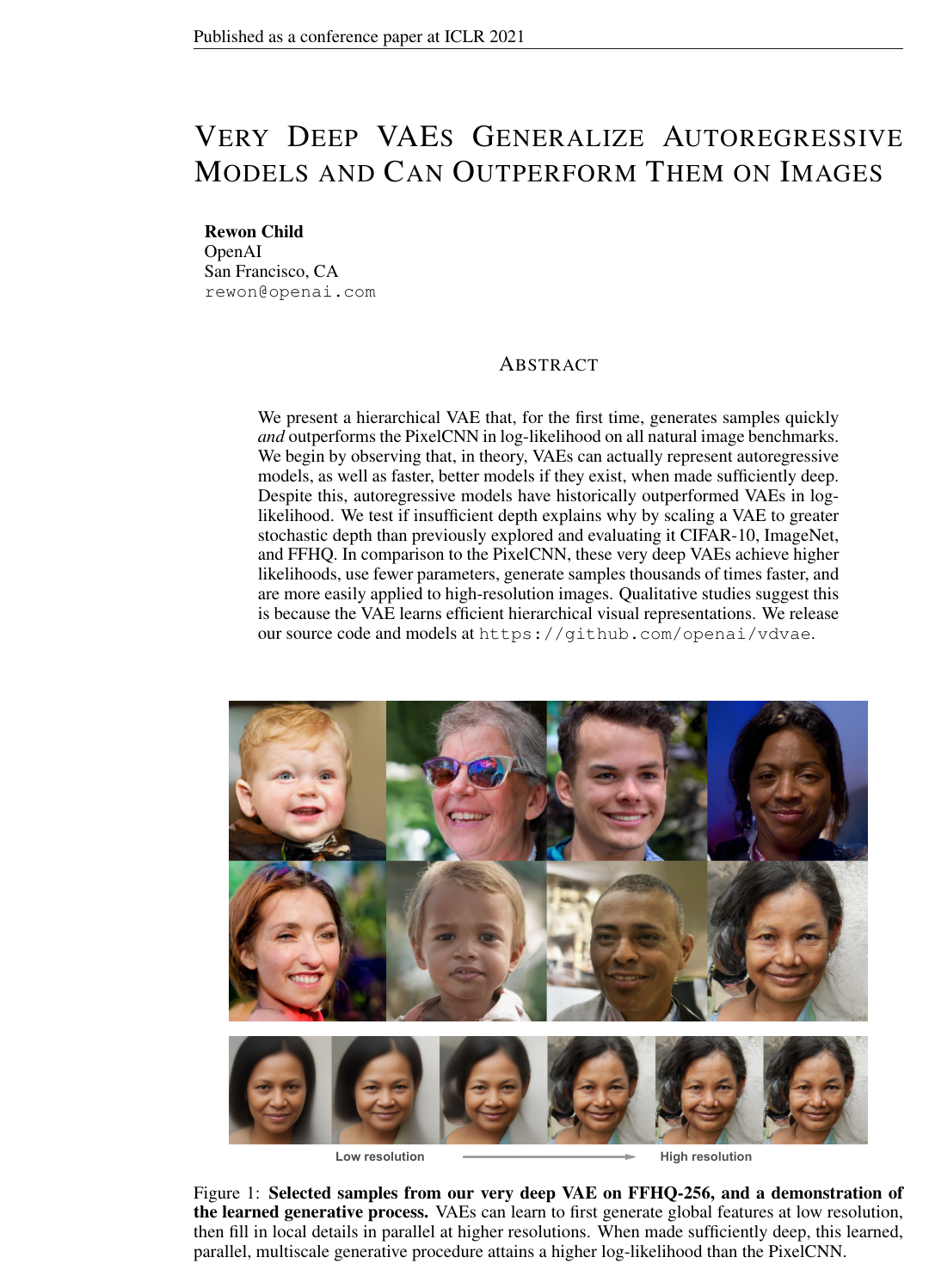
Very Deep VAEs Generalize Autoregressive Models and Can Outperform Them on Images
Rewon Child
Why you should read this
Shows that scaling VAEs to extreme depths allows them to outperform autoregressive models in density estimation (compression).
We present a hierarchical VAE that, for the first time, generates samples quickly while outperforming the PixelCNN in log-likelihood on all natural image benchmarks. We begin by observing that, in theory, VAEs can actually represent autoregressive models, as well as faster, better models if they exist, when made sufficiently deep. Despite this, autoregressive models have historically outperformed VAEs in log-likelihood. We test if insufficient depth explains why by scaling a VAE to greater stochastic depth than previously explored and evaluating it CIFAR-10, ImageNet, and FFHQ. In comparison to the PixelCNN, these very deep VAEs achieve higher likelihoods, use fewer parameters, generate samples thousands of times faster, and are more easily applied to high-resolution images. Qualitative studies suggest this is because the VAE learns efficient hierarchical visual representations. We release our source code and models at https://github.com/openai/vdvae.
Added
2026-03-09
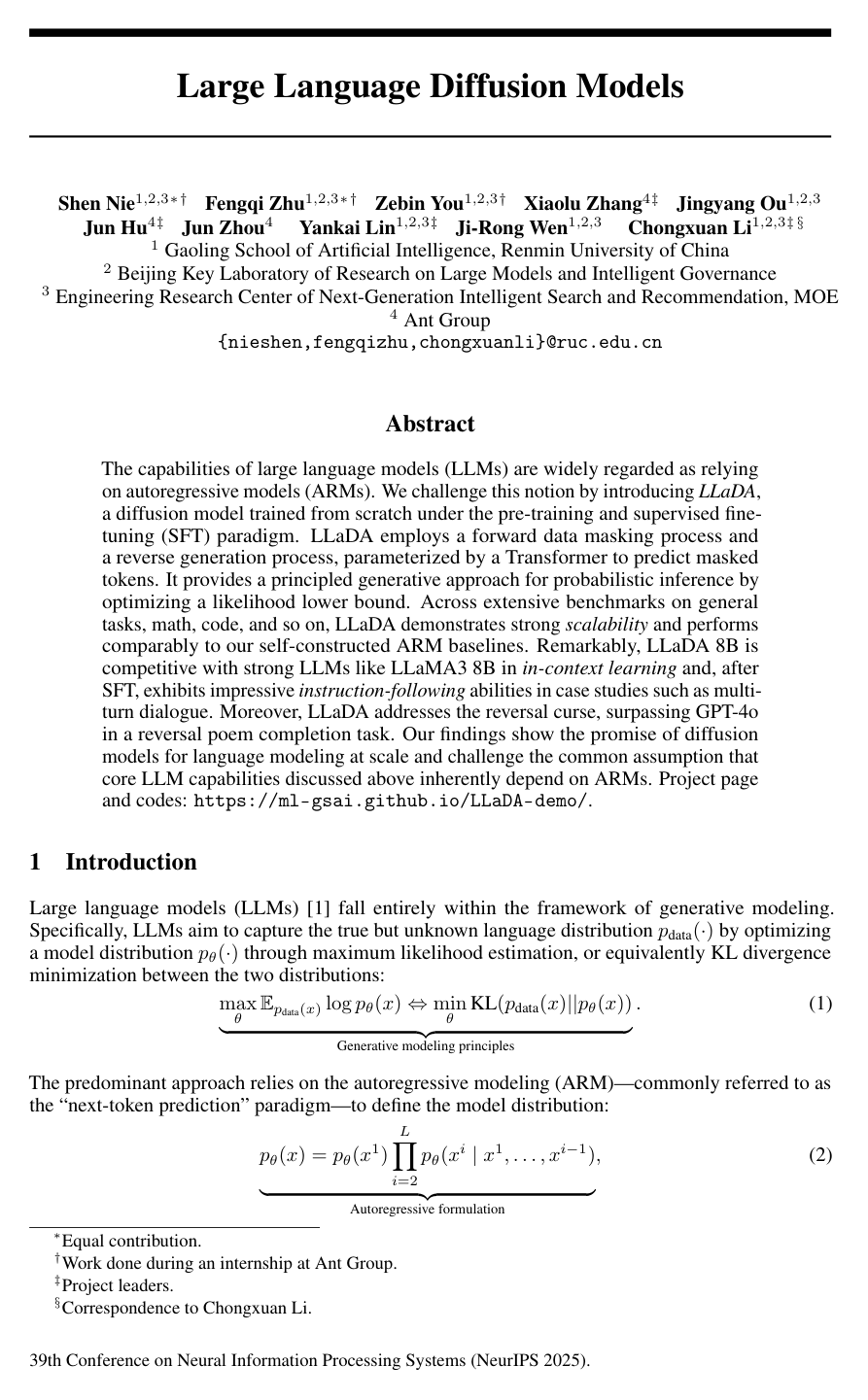
Large Language Diffusion Models
Shen Nie, Fengqi Zhu, Zebin You, Xiaolu Zhang, Jingyang Ou, Jun Hu, Jun Zhou, Yankai Lin, Ji-Rong Wen, Chongxuan Li
Why you should read this
Introduces LLaDA, a novel diffusion model that fundamentally challenges the prevalent reliance on autoregressive models for Large Language Model capabilities by demonstrating comparable performance and even surpassing them in specific tasks, thus opening new avenues for LLM development.
The capabilities of large language models (LLMs) are widely regarded as relying on autoregressive models (ARMs). We challenge this notion by introducing LLaDA, a diffusion model trained from scratch under the pre-training and supervised fine-tuning (SFT) paradigm. LLaDA employs a forward data masking process and a reverse generation process, parameterized by a Transformer to predict masked tokens. It provides a principled generative approach for probabilistic inference by optimizing a likelihood lower bound. Across extensive benchmarks on general tasks, math, code, and so on, LLaDA demonstrates strong scalability and performs comparably to our self-constructed ARM baselines. Remarkably, LLaDA 8B is competitive with strong LLMs like LLaMA3 8B in in-context learning and, after SFT, exhibits impressive instruction-following abilities in case studies such as multi-turn dialogue. Moreover, LLaDA addresses the reversal curse, surpassing GPT-4o in a reversal poem completion task. Our findings show the promise of diffusion models for language modeling at scale and challenge the common assumption that core LLM capabilities discussed above inherently depend on ARMs. Project page and codes: this https URL.
Added
2026-01-10

Block Diffusion: Interpolating Between Autoregressive and Diffusion Language Models
Marianne Arriola, Aaron Gokaslan, Justin T. Chiu, Zhihan Yang, Zhixuan Qi, Jiaqi Han, Subham Sekhar Sahoo, Volodymyr Kuleshov
Why you should read this
Introduces Block Diffusion, a novel approach that overcomes the limitations of both autoregressive and diffusion language models by enabling flexible-length, parallelized generation with state-of-the-art performance on language modeling benchmarks.
Diffusion language models offer unique benefits over autoregressive models due to their potential for parallelized generation and controllability, yet they lag in likelihood modeling and are limited to fixed-length generation. In this work, we introduce a class of block diffusion language models that interpolate between discrete denoising diffusion and autoregressive models. Block diffusion overcomes key limitations of both approaches by supporting flexible-length generation and improving inference efficiency with KV caching and parallel token sampling. We propose a recipe for building effective block diffusion models that includes an efficient training algorithm, estimators of gradient variance, and data-driven noise schedules to minimize the variance. Block diffusion sets a new state-of-the-art performance among diffusion models on language modeling benchmarks and enables generation of arbitrary-length sequences. We provide the code, along with the model weights and blog post on the project page: this https URL
Added
2026-01-06