The Diffusion Duality
Subham Sekhar SahooJustin DeschenauxAaron GokaslanGuanghan WangJustin T. ChiuVolodymyr Kuleshov
Establishes a theoretical link proving uniform-state discrete diffusion emerges from continuous Gaussian processes, enabling curriculum training and discrete consistency distillation that doubles training speed and accelerates text generation by two orders of magnitude.
Modern generative language models typically generate text sequentially from left to right, which limits processing speed and prevents models from revising earlier errors. Discrete diffusion models provide an alternative approach that can update and refine entire text sequences in parallel, offering inherent self-correction capabilities. However, discrete diffusion models have historically lagged behind standard sequential models and masked diffusion models in terms of output quality and training efficiency, while also requiring hundreds of iterative steps during inference.
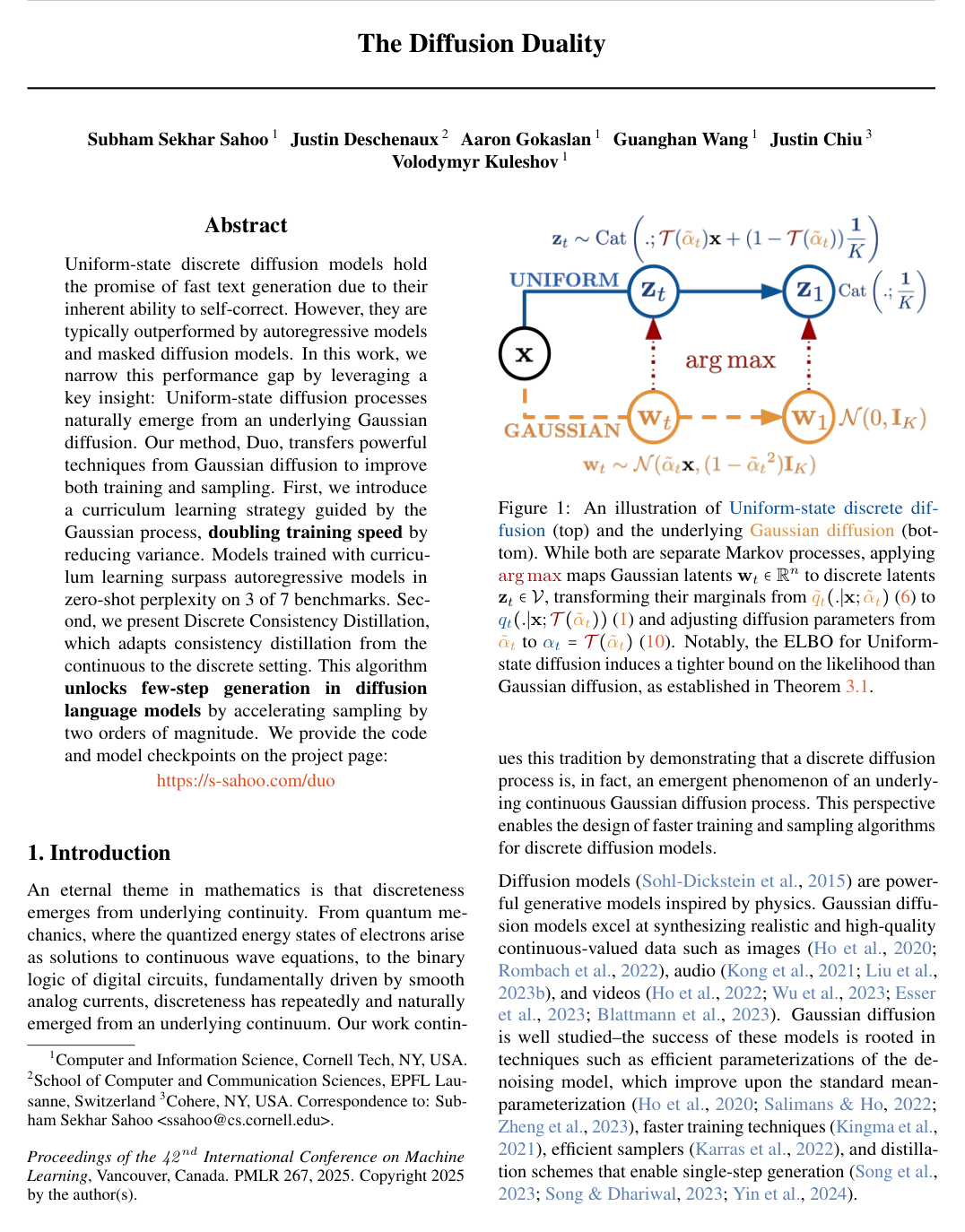
The article demonstrates that discrete diffusion processes naturally emerge from continuous Gaussian diffusion processes through mathematical mapping. Building on this theoretical insight, the authors introduce Duo, a framework designed to transfer proven continuous diffusion techniques to discrete text generation to significantly accelerate both model training and text generation.
To evaluate this framework, the authors conducted extensive experiments using 170-million-parameter transformer architectures trained on major standard benchmarks, including the One Billion Word Benchmark and OpenWebText. The approach incorporates two main technical innovations: a curriculum learning strategy that gradually transitions training inputs from smooth continuous approximations to hard discrete tokens, and a discrete consistency distillation algorithm that creates deterministic trajectories to compress multi-step generation into very few steps.
The experimental findings show significant improvements across training, quality, and generation speed. First, the curriculum learning strategy halved the training time needed to reach target performance by substantially reducing gradient variance. Second, the resulting models outperformed standard autoregressive models on zero-shot perplexity across 3 out of 7 standard benchmark datasets. Third, the consistency distillation technique, combined with a greedy sampling refinement, reduced the required generation steps from 1,024 down to just 8 to 16 steps—an acceleration of up to two orders of magnitude—while outperforming competing distilled diffusion models in the few-step regime.
These results demonstrate that bridging continuous and discrete diffusion principles removes major computational and quality barriers that previously hindered non-autoregressive text models. In practical terms, accelerating inference by up to two orders of magnitude dramatically lowers computing costs, reduces latency, and unlocks viable deployment for high-throughput language generation applications where real-time speed and error correction are paramount.
Organizations developing or deploying high-speed language generation systems should consider piloting discrete diffusion frameworks with consistency distillation as a high-throughput alternative to traditional sequential models. For broader adoption, practitioners should evaluate the trade-off between sampling steps and generation diversity depending on whether the downstream task prioritizes peak speed or rich creative variation.
The study has certain limitations, as evaluations were focused on 170-million-parameter models and established text benchmarks rather than modern web-scale foundation models with tens of billions of parameters. Nonetheless, the mathematical proofs and empirical gains provide high confidence that continuous diffusion techniques can reliably enhance discrete sequence generation.
- Paper: Discrete Diffusion Modeling by Estimating the Ratios of the Data Distribution, Aaron Lou et al. (2024). Establishes score entropy discrete diffusion on categorical language data, providing the foundational uniform-state discrete diffusion principles and likelihood baselines that The Diffusion Duality seeks to accelerate and improve.
- Paper: Structured Denoising Diffusion Models in Discrete State-Spaces, Jacob Austin et al. (2021). Introduces discrete denoising diffusion probabilistic models with structured forward transition matrices, laying the groundwork for uniform and absorbing discrete diffusion processes.
- Paper: A Continuous Time Framework for Discrete Denoising Models, Andrew Campbell et al. (2022). Develops the continuous-time Markov chain framework for discrete diffusion models upon which modern discrete diffusion duality and score-matching methods rely.
- Paper: Consistency Models, Yang Song et al. (2023). Formulates consistency models and consistency distillation in continuous Gaussian diffusion, which The Diffusion Duality directly adapts to the discrete setting for few-step text generation.
- Paper: Denoising Diffusion Probabilistic Models, Jonathan Ho et al. (2020). Presents the foundational continuous Gaussian denoising diffusion probabilistic framework from which Duo draws key training and variance-reduction techniques.
- Paper: Progressive Distillation for Fast Sampling of Diffusion Models, Tim Salimans et al. (2022). Introduces distillation techniques for reducing sampling steps in diffusion models, inspiring fast discrete distillation formulations.
- Paper: Argmax Flows and Multinomial Diffusion: Learning Categorical Distributions, Emiel Hoogeboom et al. (2021). Provides early mathematical treatments of multinomial diffusion and categorical generative modeling that motivate discrete state-space formulation.
- Paper: Unlocking Lossless Speedups in LLMs via Discrete Diffusion, Subham Sekhar Sahoo et al. (2026). Extends discrete diffusion language modeling by distilling diffusion draft proposals to achieve lossless speculative decoding speedups on top of autoregressive language models.
- Paper: Discrete State Diffusion Models: A Sample Complexity Perspective, Aadithya Srikanth et al. (2026). Establishes formal sample complexity and score estimation error bounds for continuous-time discrete-state diffusion models.
- Paper: Context-weighted Discrete Flow Matching, Daniil Cherniavskii et al. (2026). Builds on discrete generative trajectories by introducing context-weighted token updates to enhance training and sampling efficiency in non-autoregressive discrete generation.
- Paper: Looped Diffusion Language Models, Sanghyun Lee et al. (2026). Investigates structural layer-looping mechanisms in masked diffusion language models to improve compute efficiency and downstream generative reasoning.
- Paper: ELF: Embedded Language Flows, Keya Hu et al. (2026). Explores an alternative continuous-to-discrete bridge for language generation by operating in continuous embedding spaces via flow matching.
- Paper: Diffusion as a Training Curriculum for Timestep-Free Iterative Reasoning, Mariia Drozdova et al. (2026). Generalizes diffusion curricula into persistent-state iterative reasoning architectures for flexible inference-time scaling.