
keyword
attention heads
Attention heads are independent computational sub-units within the multi-head attention mechanisms of Transformer neural network architectures. Each attention head operates on a distinct linear projection of the input representations, calculating attention weights between tokens by comparing query and key vectors to produce a weighted combination of value vectors. Running multiple attention heads in parallel enables a model to simultaneously focus on diverse types of contextual information, such as syntactic dependencies, semantic associations, and positional relationships across different parts of a sequence. The resulting outputs from all heads in a given layer are then concatenated and linearly projected back to the main hidden dimension to form a unified contextual representation.
15 items
Do Transformers Parse while Predicting the Masked Word?
Haoyu Zhao, Abhishek Panigrahi, Rong Ge, Sanjeev Arora
Why you should read this
Proves that realistic-sized masked language models naturally approximate the Inside-Outside parsing algorithm on context-free grammar data, offering a theoretical and empirical explanation for how transformers implicitly learn syntactic structure during unsupervised pre-training.
Pre-trained language models have been shown to encode linguistic structures like parse trees in their embeddings while being trained unsupervised. Some doubts have been raised whether the models are doing parsing or only some computation weakly correlated with it. Concretely: (a) Is it possible to explicitly describe transformers with realistic embedding dimensions, number of heads, etc. that are capable of doing parsing—or even approximate parsing? (b) Why do pre-trained models capture parsing structure? This paper takes a step toward answering these questions in the context of generative modeling with PCFGs. We show that masked language models like BERT or RoBERTa of moderate sizes can approximately execute the Inside-Outside algorithm for the English PCFG. We also show that the Inside-Outside algorithm is optimal for masked language modeling loss on the PCFG-generated data. We conduct probing experiments on models pre-trained on PCFG-generated data to show that this not only allows recovery of approximate parse tree, but also recovers marginal span probabilities computed by the Inside-Outside algorithm, which suggests an implicit bias of masked language modeling towards this algorithm.
Added
2026-10-05
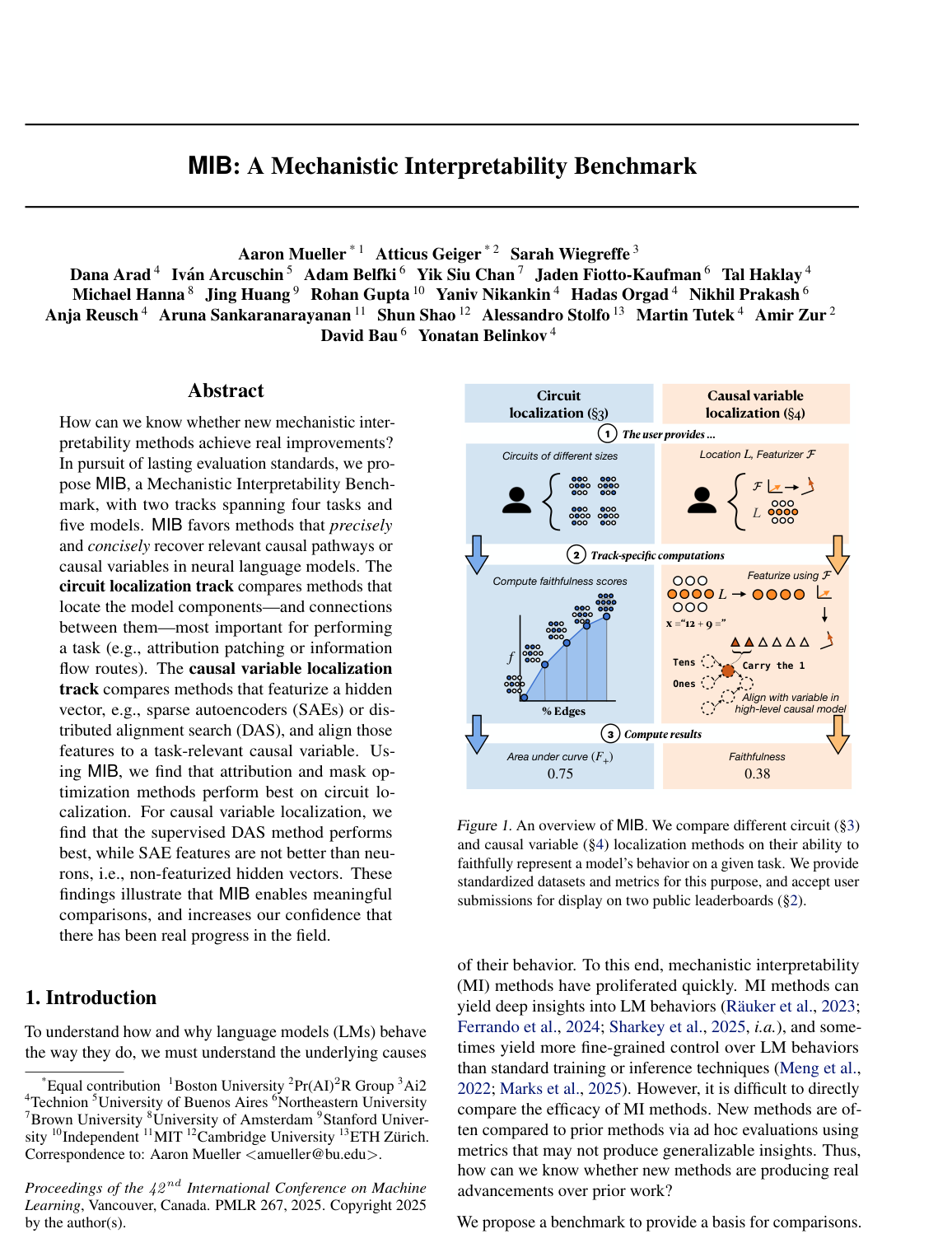
MIB: A Mechanistic Interpretability Benchmark
Aaron Mueller, Atticus Geiger, Sarah Wiegreffe, Dana Arad, Iván Arcuschin, Adam Belfki, Yik Siu Chan, Jaden Fiotto-Kaufman, Tal Haklay, Michael Hanna, Jing Huang, Rohan Gupta, Yaniv Nikankin, Hadas Orgad, Nikhil Prakash, Anja Reusch, Aruna Sankaranarayanan, Shun Shao, Alessandro Stolfo, Martin Tutek, Amir Zur, David Bau, Yonatan Belinkov
Why you should read this
Establishes a standardized benchmark to rigorously evaluate mechanistic interpretability methods across circuit and causal variable localization, revealing critical performance differences among popular techniques like sparse autoencoders and attribution patching.
How can we know whether new mechanistic interpretability methods achieve real improvements? In pursuit of lasting evaluation standards, we propose MIB, a Mechanistic Interpretability Benchmark, with two tracks spanning four tasks and five models. MIB favors methods that precisely and concisely recover relevant causal pathways or causal variables in neural language models. The circuit localization track compares methods that locate the model components - and connections between them - most important for performing a task (e.g., attribution patching or information flow routes). The causal variable localization track compares methods that featurize a hidden vector, e.g., sparse autoencoders (SAEs) or distributed alignment search (DAS), and align those features to a task-relevant causal variable. Using MIB, we find that attribution and mask optimization methods perform best on circuit localization. For causal variable localization, we find that the supervised DAS method performs best, while SAE features are not better than neurons, i.e., non-featurized hidden vectors. These findings illustrate that MIB enables meaningful comparisons, and increases our confidence that there has been real progress in the field.
Added
2026-10-04
Interpretability in the Wild: a Circuit for Indirect Object Identification in GPT-2 small
Kevin Wang, Alexandre Variengien, Arthur Conmy, Buck Shlegeris, Jacob Steinhardt
Why you should read this
Reverse-engineers the 26-attention-head circuit that GPT-2 small uses for indirect object identification, establishing quantitative criteria to validate mechanistic interpretability in transformer language models.
Research in mechanistic interpretability seeks to explain behaviors of machine learning models in terms of their internal components. However, most previous work either focuses on simple behaviors in small models, or describes complicated behaviors in larger models with broad strokes. In this work, we bridge this gap by presenting an explanation for how GPT-2 small performs a natural language task called indirect object identification (IOI). Our explanation encompasses 26 attention heads grouped into 7 main classes, which we discovered using a combination of interpretability approaches relying on causal interventions. To our knowledge, this investigation is the largest end-to-end attempt at reverse-engineering a natural behavior "in the wild" in a language model. We evaluate the reliability of our explanation using three quantitative criteria--faithfulness, completeness and minimality. Though these criteria support our explanation, they also point to remaining gaps in our understanding. Our work provides evidence that a mechanistic understanding of large ML models is feasible, opening opportunities to scale our understanding to both larger models and more complex tasks.
Added
2026-10-04
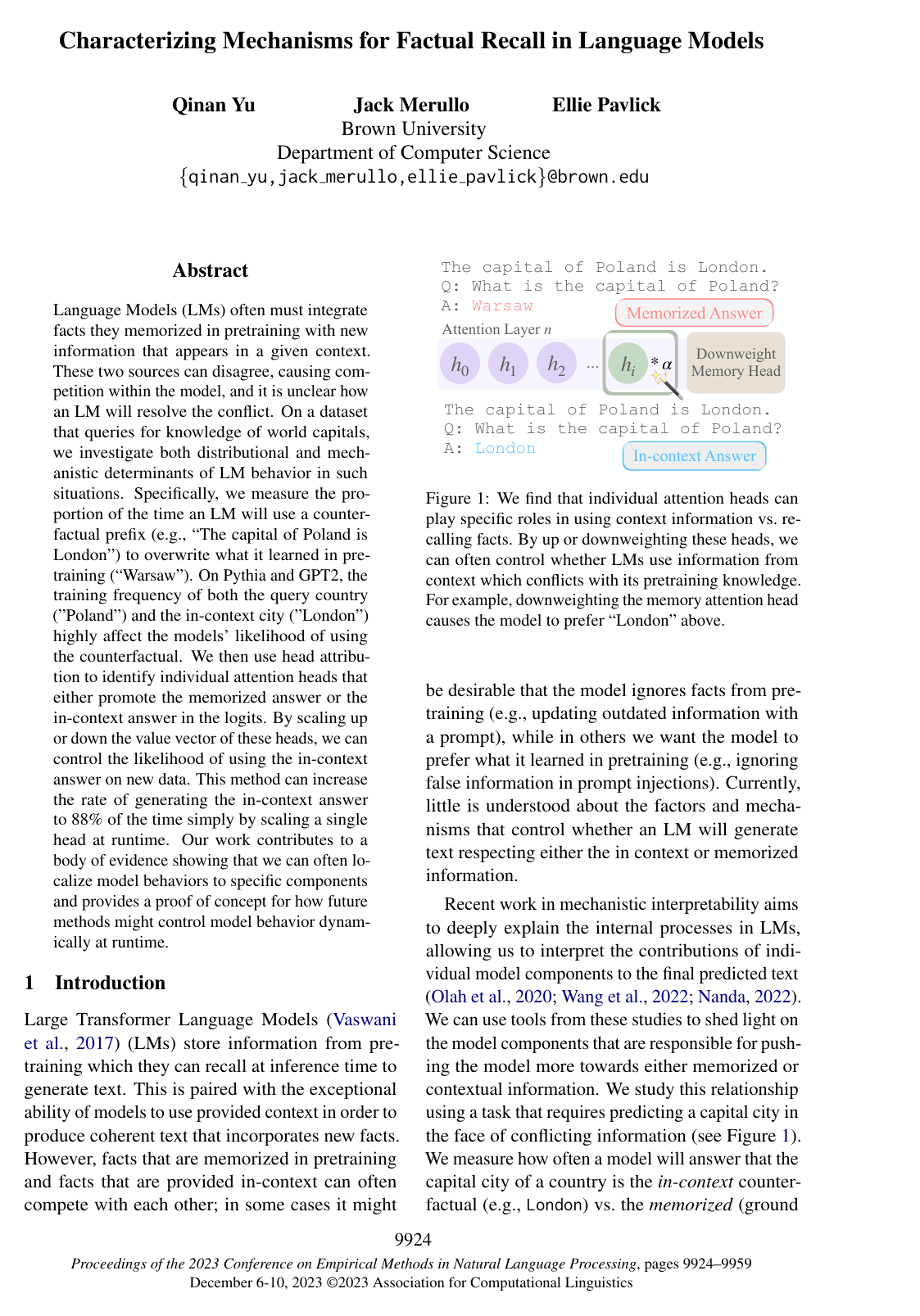
Characterizing Mechanisms for Factual Recall in Language Models
Qinan Yu, Jack Merullo, Ellie Pavlick
Why you should read this
Demonstrates that competition between memorized facts and counterfactual context in language models is governed by pretraining frequencies and can be dynamically controlled at runtime by scaling individual attention heads.
Language Models (LMs) often must integrate facts they memorized in pretraining with new information that appears in a given context. These two sources can disagree, causing competition within the model, and it is unclear how an LM will resolve the conflict. On a dataset that queries for knowledge of world capitals, we investigate both distributional and mechanistic determinants of LM behavior in such situations. Specifically, we measure the proportion of the time an LM will use a counterfactual prefix (e.g., “The capital of Poland is London”) to overwrite what it learned in pretraining (“Warsaw”). On Pythia and GPT2, the training frequency of both the query country (“Poland”) and the in-context city (“London”) highly affect the models’ likelihood of using the counterfactual. We then use head attribution to identify individual attention heads that either promote the memorized answer or the in-context answer in the logits. By scaling up or down the value vector of these heads, we can control the likelihood of using the in-context answer on new data. This method can increase the rate of generating the in-context answer to 88% of the time simply by scaling a single head at runtime. Our work contributes to a body of evidence showing that we can often localize model behaviors to specific components and provides a proof of concept for how future methods might control model behavior dynamically at runtime.
Added
2026-10-03
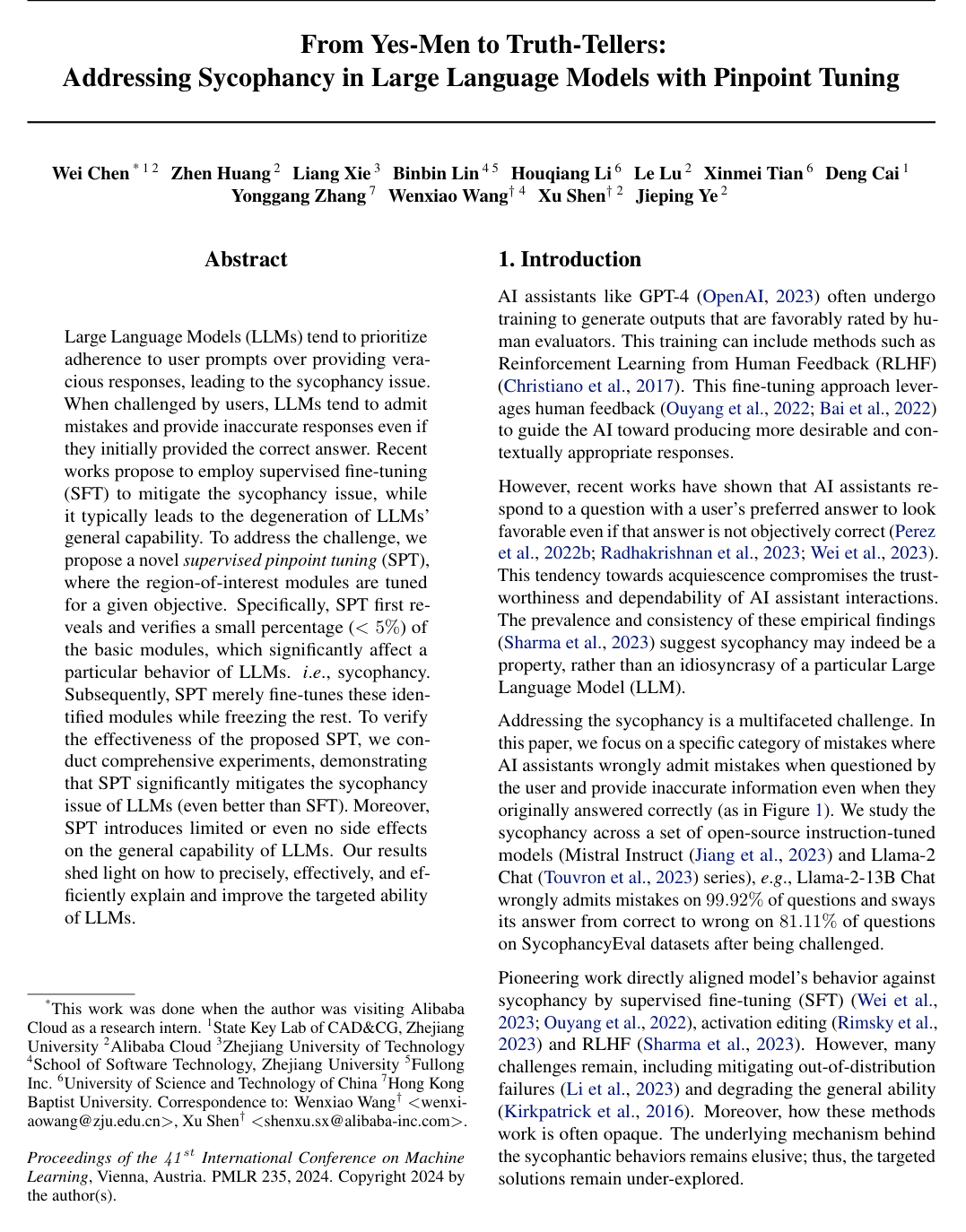
From Yes-Men to Truth-Tellers: Addressing Sycophancy in Large Language Models with Pinpoint Tuning
Wei Chen, Zhen Huang, Liang Xie, Binbin Lin, Houqiang Li, Le Lu, Xinmei Tian, Deng Cai, Yonggang Zhang, Wenxiao Wang, Xu Shen, Jieping Ye
Why you should read this
Proposes supervised pinpoint tuning to effectively eliminate sycophantic behavior in large language models by identifying and fine-tuning less than five percent of critical attention heads without degrading overall model capabilities.
Large Language Models (LLMs) tend to prioritize adherence to user prompts over providing veracious responses, leading to the sycophancy issue. When challenged by users, LLMs tend to admit mistakes and provide inaccurate responses even if they initially provided the correct answer. Recent works propose to employ supervised fine-tuning (SFT) to mitigate the sycophancy issue, while it typically leads to the degeneration of LLMs’ general capability. To address the challenge, we propose a novel supervised pinpoint tuning (SPT), where the region-of-interest modules are tuned for a given objective. Specifically, SPT first reveals and verifies a small percentage (< 5%) of the basic modules, which significantly affect a particular behavior of LLMs. i.e., sycophancy. Subsequently, SPT merely fine-tunes these identified modules while freezing the rest. To verify the effectiveness of the proposed SPT, we conduct comprehensive experiments, demonstrating that SPT significantly mitigates the sycophancy issue of LLMs (even better than SFT). Moreover, SPT introduces limited or even no side effects on the general capability of LLMs. Our results shed light on how to precisely, effectively, and efficiently explain and improve the targeted ability of LLMs.
Added
2026-10-03
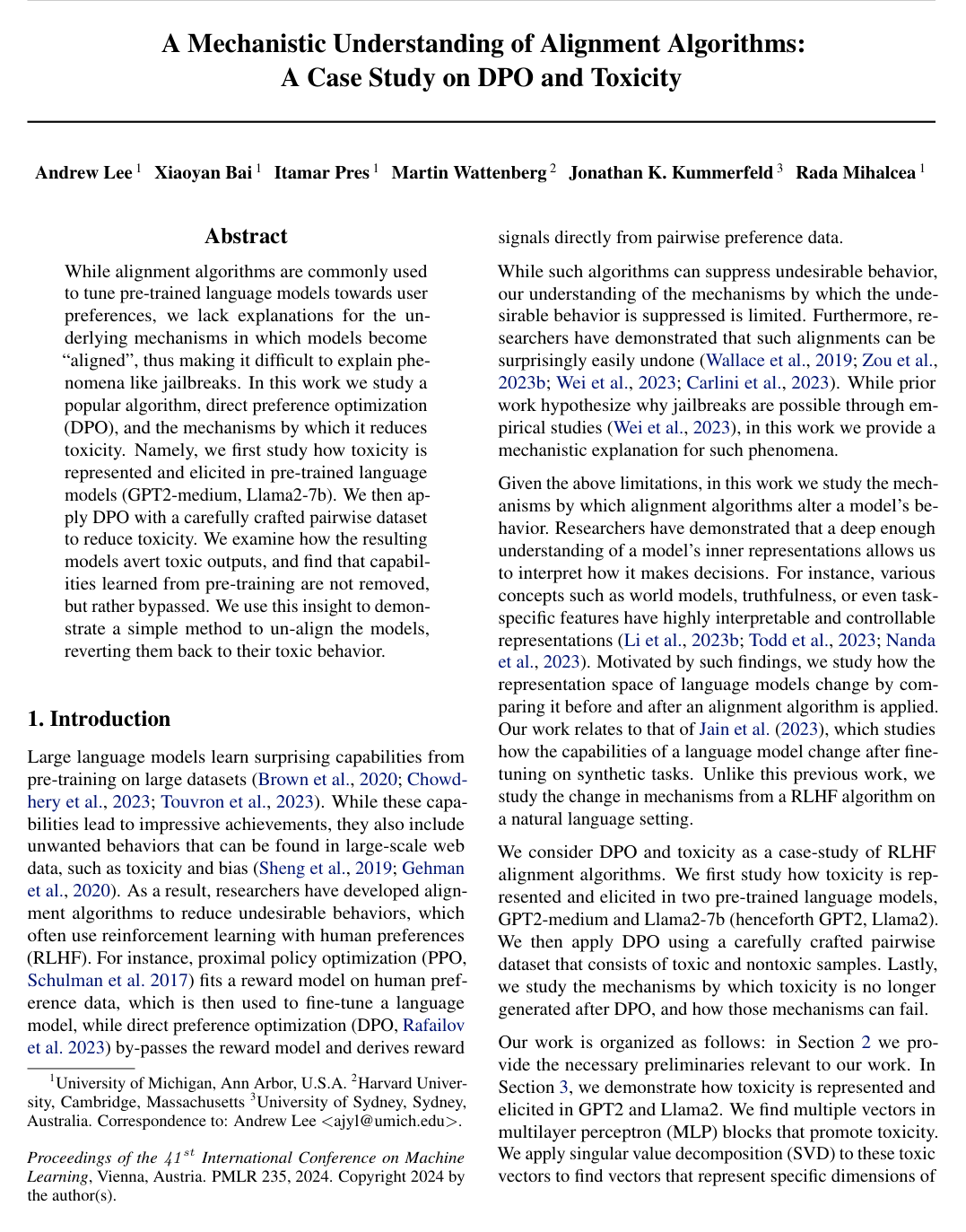
A Mechanistic Understanding of Alignment Algorithms: A Case Study on DPO and Toxicity
Andrew Lee, Xiaoyan Bai, Itamar Pres, Martin Wattenberg, Jonathan K. Kummerfeld, Rada Mihalcea
Why you should read this
Reveals that Direct Preference Optimization merely bypasses rather than eliminates toxic capabilities in language models, providing a mechanistic explanation for safety jailbreaks and enabling a simple method to reverse alignment.
While alignment algorithms are commonly used to tune pre-trained language models towards user preferences, we lack explanations for the underlying mechanisms in which models become “aligned”, thus making it difficult to explain phenomena like jailbreaks. In this work we study a popular algorithm, direct preference optimization (DPO), and the mechanisms by which it reduces toxicity. Namely, we first study how toxicity is represented and elicited in pre-trained language models (GPT2-medium, Llama2-7b). We then apply DPO with a carefully crafted pairwise dataset to reduce toxicity. We examine how the resulting models avert toxic outputs, and find that capabilities learned from pre-training are not removed, but rather bypassed. We use this insight to demonstrate a simple method to un-align the models, reverting them back to their toxic behavior.
Added
2026-09-30
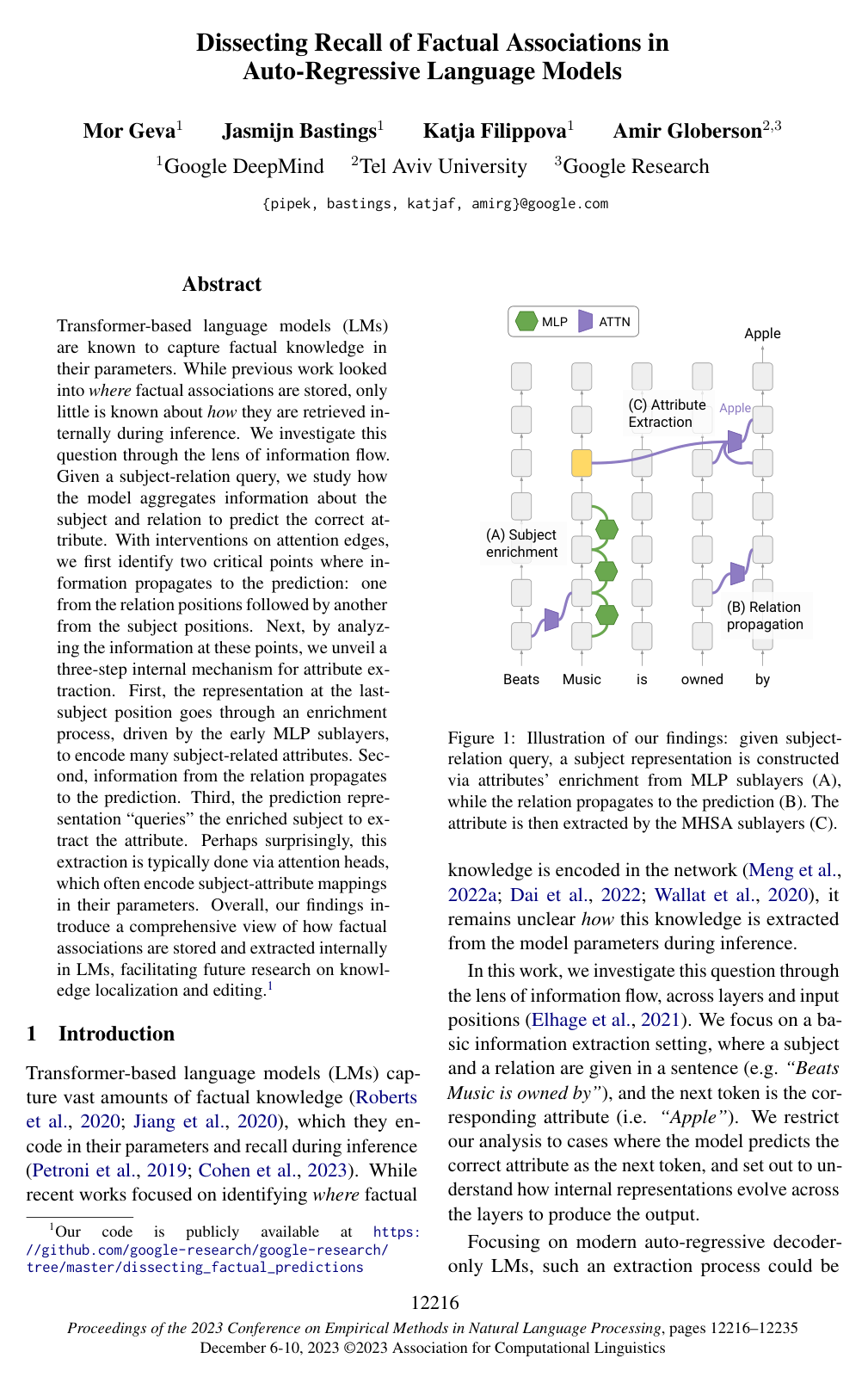
Dissecting Recall of Factual Associations in Auto-Regressive Language Models
Mor Geva, Jasmijn Bastings, Katja Filippova, Amir Globerson
Why you should read this
Reveals the step-by-step internal mechanism auto-regressive language models use to recall facts, demonstrating that early feed-forward layers enrich subject representations while upper attention heads directly extract the correct attributes.
Transformer-based language models (LMs) are known to capture factual knowledge in their parameters. While previous work looked into where factual associations are stored, only little is known about how they are retrieved internally during inference. We investigate this question through the lens of information flow. Given a subject-relation query, we study how the model aggregates information about the subject and relation to predict the correct attribute. With interventions on attention edges, we first identify two critical points where information propagates to the prediction: one from the relation positions followed by another from the subject positions. Next, by analyzing the information at these points, we unveil a three-step internal mechanism for attribute extraction. First, the representation at the last-subject position goes through an enrichment process, driven by the early MLP sublayers, to encode many subject-related attributes. Second, information from the relation propagates to the prediction. Third, the prediction representation “queries” the enriched subject to extract the attribute. Perhaps surprisingly, this extraction is typically done via attention heads, which often encode subject-attribute mappings in their parameters. Overall, our findings introduce a comprehensive view of how factual associations are stored and extracted internally in LMs, facilitating future research on knowledge localization and editing.¹
Added
2026-09-28
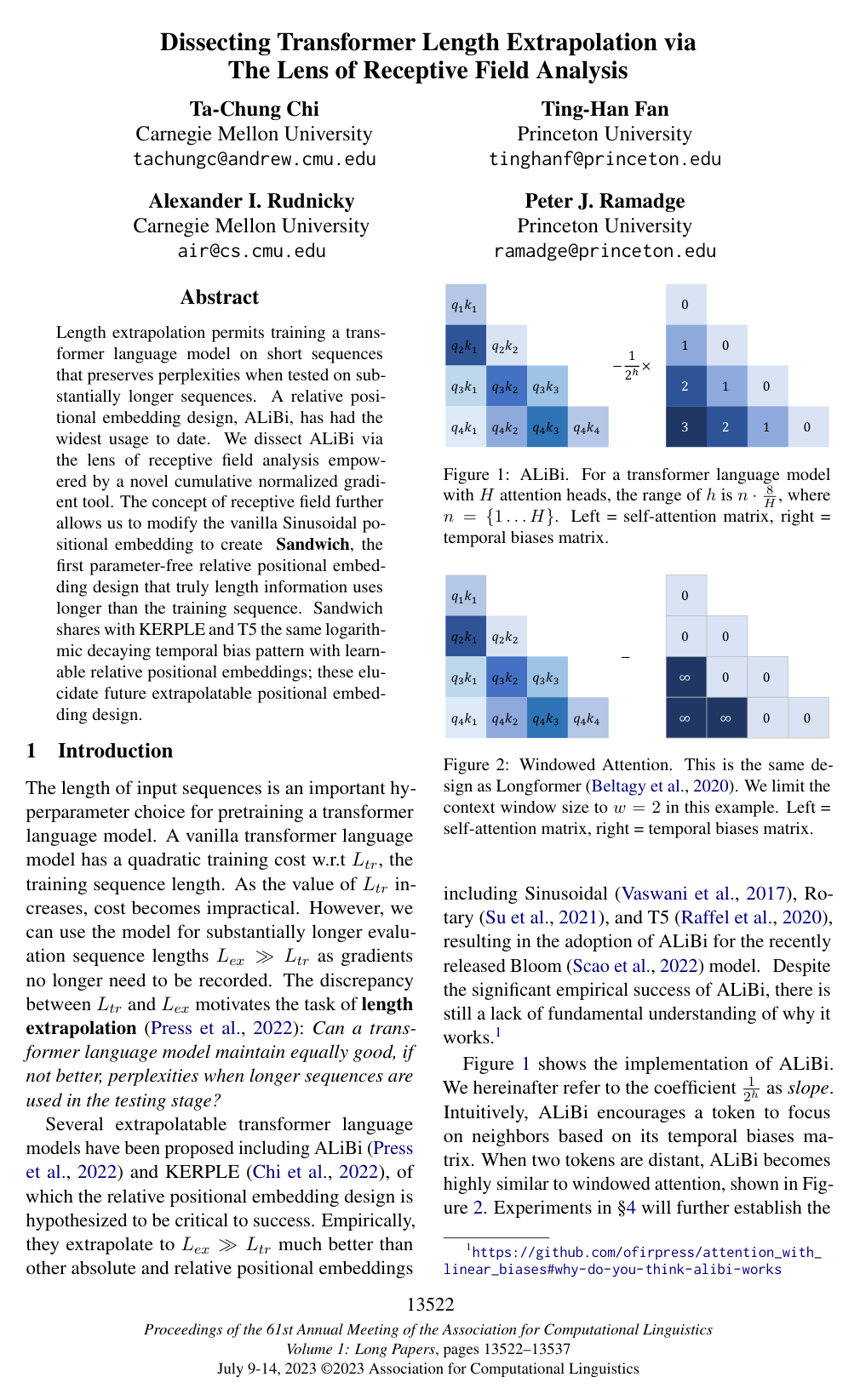
Dissecting Transformer Length Extrapolation via the Lens of Receptive Field Analysis
Ta-Chung Chi, Ting-Han Fan, Alexander Rudnicky, Peter J. Ramadge
Why you should read this
Explains why transformer length extrapolation succeeds by analyzing empirical receptive fields and introduces Sandwich, a parameter-free relative positional embedding that effectively utilizes context beyond the training sequence length.
Length extrapolation permits training a transformer language model on short sequences that preserves perplexities when tested on substantially longer sequences. A relative positional embedding design, ALiBi, has had the widest usage to date. We dissect ALiBi via the lens of receptive field analysis empowered by a novel cumulative normalized gradient tool. The concept of receptive field further allows us to modify the vanilla Sinusoidal positional embedding to create Sandwich, the first parameter-free relative positional embedding design that truly length information uses longer than the training sequence. Sandwich shares with KERPLE and T5 the same logarithmic decaying temporal bias pattern with learnable relative positional embeddings; these elucidate future extrapolatable positional embedding design.
Added
2026-09-26
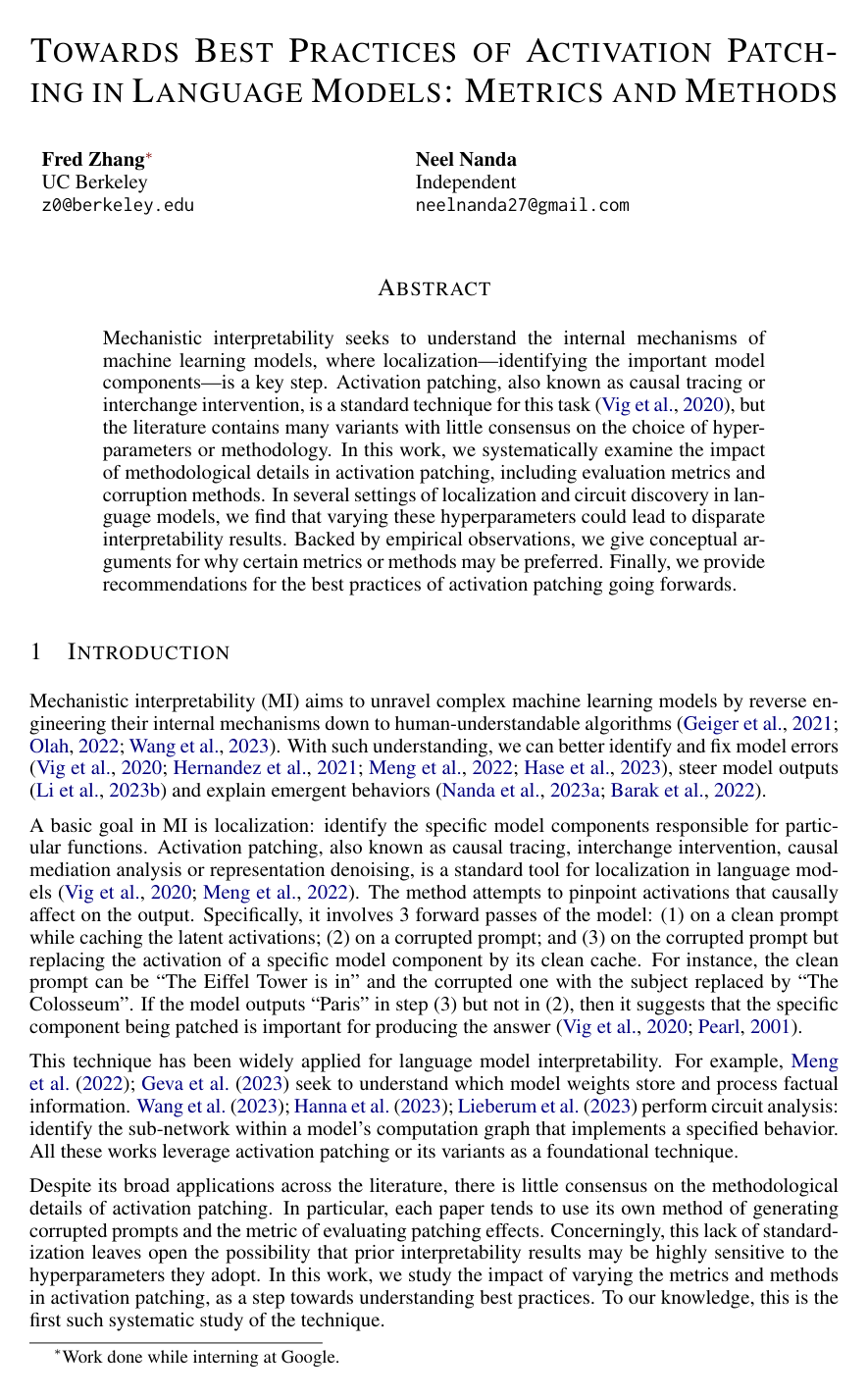
Towards Best Practices of Activation Patching in Language Models: Metrics and Methods
Fred Zhang, Neel Nanda
Why you should read this
Demonstrates how arbitrary choices in corruption methods and evaluation metrics lead to conflicting activation patching results, establishing concrete best practices for reliable circuit discovery and localization in language models.
Mechanistic interpretability seeks to understand the internal mechanisms of machine learning models, where localization -- identifying the important model components -- is a key step. Activation patching, also known as causal tracing or interchange intervention, is a standard technique for this task (Vig et al., 2020), but the literature contains many variants with little consensus on the choice of hyperparameters or methodology. In this work, we systematically examine the impact of methodological details in activation patching, including evaluation metrics and corruption methods. In several settings of localization and circuit discovery in language models, we find that varying these hyperparameters could lead to disparate interpretability results. Backed by empirical observations, we give conceptual arguments for why certain metrics or methods may be preferred. Finally, we provide recommendations for the best practices of activation patching going forwards.
Added
2026-09-26
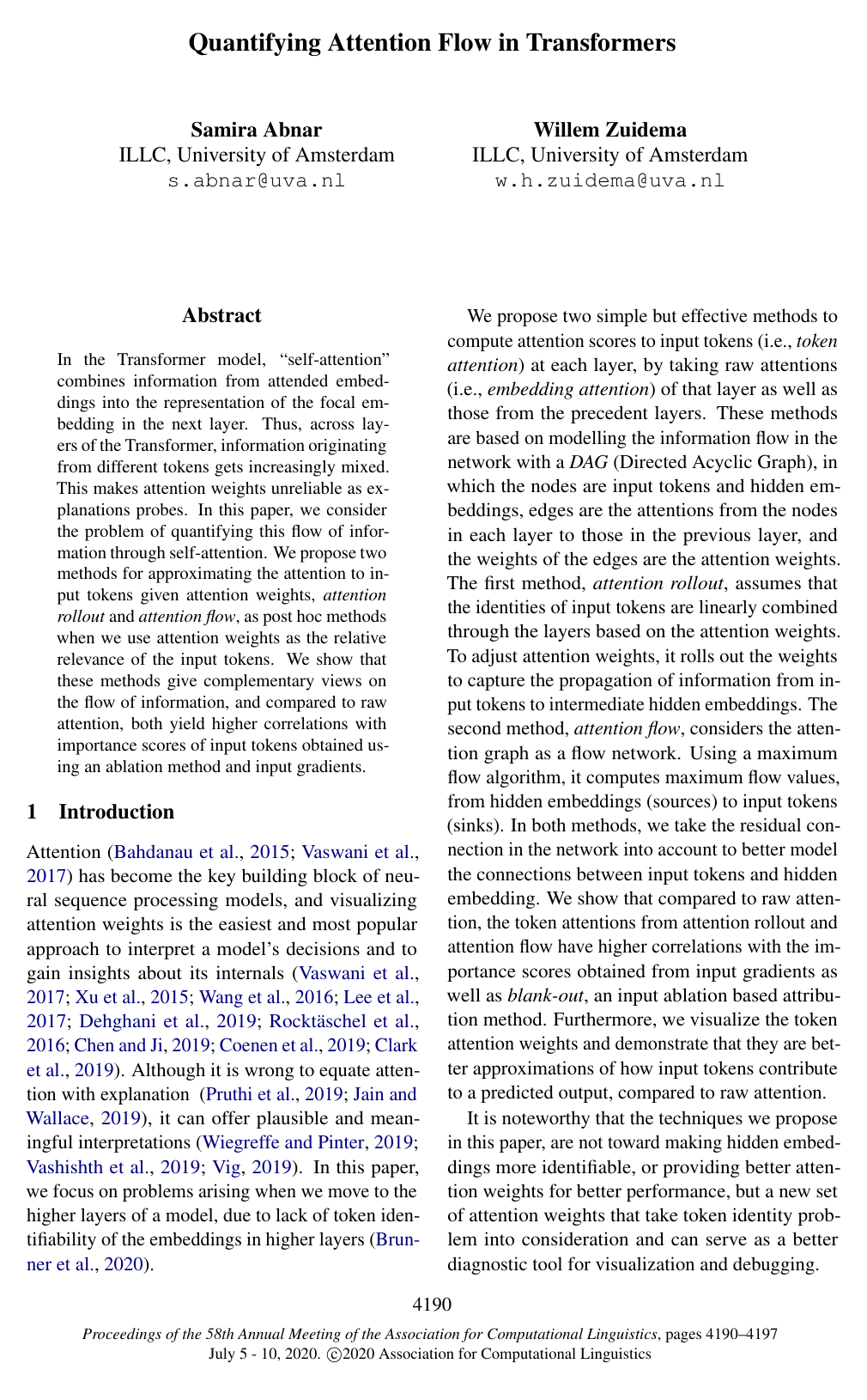
Quantifying Attention Flow in Transformers
Samira Abnar, Willem Zuidema
Why you should read this
Proposes attention rollout and attention flow to track information propagation across Transformer layers, providing reliable token-importance explanations that correlate significantly better with gradient and ablation baselines than raw attention weights.
In the Transformer model, "self-attention" combines information from attended embeddings into the representation of the focal embedding in the next layer. Thus, across layers of the Transformer, information originating from different tokens gets increasingly mixed. This makes attention weights unreliable as explanations probes. In this paper, we consider the problem of quantifying this flow of information through self-attention. We propose two methods for approximating the attention to input tokens given attention weights, attention rollout and attention flow, as post hoc methods when we use attention weights as the relative relevance of the input tokens. We show that these methods give complementary views on the flow of information, and compared to raw attention, both yield higher correlations with importance scores of input tokens obtained using an ablation method and input gradients.
Added
2026-09-25
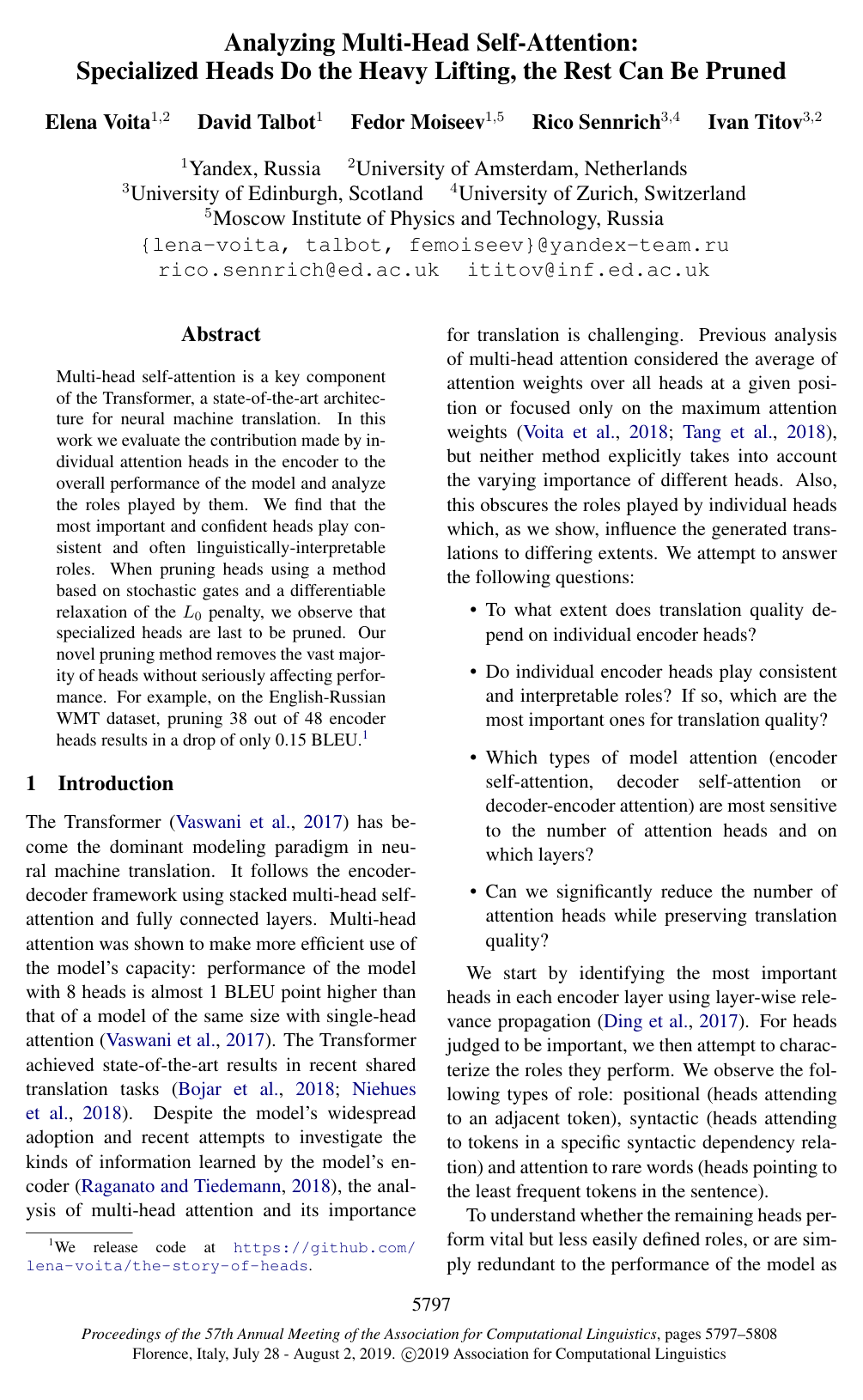
Analyzing Multi-Head Self-Attention: Specialized Heads Do the Heavy Lifting, the Rest Can Be Pruned
Elena Voita, David Talbot, Fedor Moiseev, Rico Sennrich, Ivan Titov
Why you should read this
Demonstrates that the vast majority of attention heads in Transformer models are redundant and can be pruned using an L0 regularization technique without degrading translation quality, while proving that the essential remaining heads perform interpretable linguistic functions.
Multi-head self-attention is a key component of the Transformer, a state-of-the-art architecture for neural machine translation. In this work we evaluate the contribution made by individual attention heads in the encoder to the overall performance of the model and analyze the roles played by them. We find that the most important and confident heads play consistent and often linguistically-interpretable roles. When pruning heads using a method based on stochastic gates and a differentiable relaxation of the L0 penalty, we observe that specialized heads are last to be pruned. Our novel pruning method removes the vast majority of heads without seriously affecting performance. For example, on the English-Russian WMT dataset, pruning 38 out of 48 encoder heads results in a drop of only 0.15 BLEU.
Added
2026-09-25

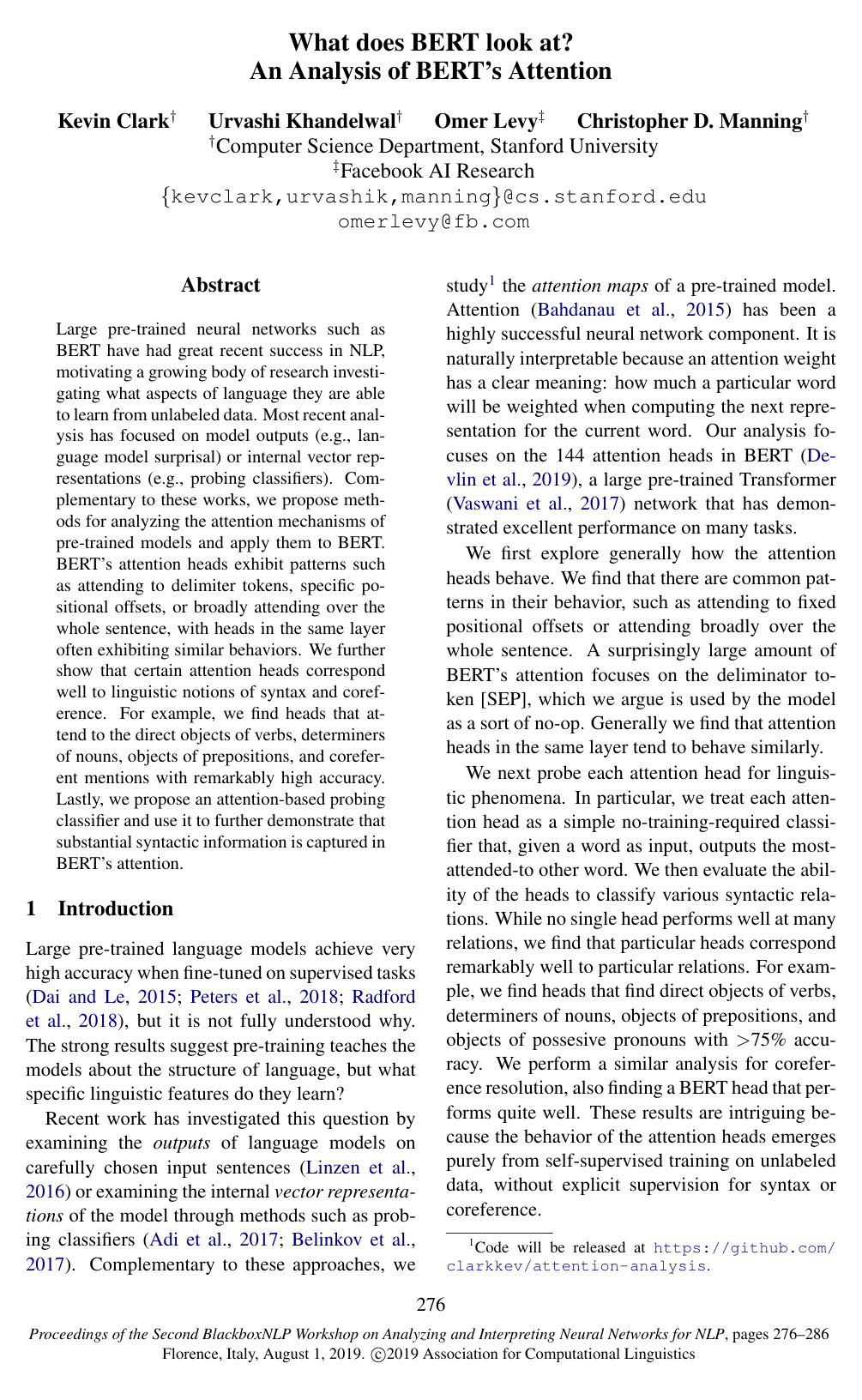
What Does BERT Look at? An Analysis of BERT’s Attention
Kevin Clark, Urvashi Khandelwal, Omer Levy, Christopher D. Manning
Why you should read this
Reveals that individual attention heads in BERT encode distinct grammatical relations and coreference patterns, offering an attention-based analysis framework to interpret linguistic knowledge inside transformer models.
Large pre-trained neural networks such as BERT have had great recent success in NLP, motivating a growing body of research investigating what aspects of language they are able to learn from unlabeled data. Most recent analysis has focused on model outputs (e.g., language model surprisal) or internal vector representations (e.g., probing classifiers). Complementary to these works, we propose methods for analyzing the attention mechanisms of pre-trained models and apply them to BERT. BERT's attention heads exhibit patterns such as attending to delimiter tokens, specific positional offsets, or broadly attending over the whole sentence, with heads in the same layer often exhibiting similar behaviors. We further show that certain attention heads correspond well to linguistic notions of syntax and coreference. For example, we find heads that attend to the direct objects of verbs, determiners of nouns, objects of prepositions, and coreferent mentions with remarkably high accuracy. Lastly, we propose an attention-based probing classifier and use it to further demonstrate that substantial syntactic information is captured in BERT's attention.
Added
2026-09-18
S2-Attention: Hardware-Aware Context Sharding Among Attention Heads
Xihui Lin, Yunan Zhang, Suyu Ge, Liliang Ren, Barun Patra, Vishrav Chaudhary, Hao Peng, Xia Song
Why you should read this
Presents a hardware-aware Triton kernel library and head-heterogeneous context-sharding design that translates theoretical sparse attention efficiency into up to a 25.3x wall-clock speedup over FlashAttention-2 while maintaining full-attention accuracy on long-context language models.
Sparse attention, which selectively attends to a subset of tokens in the context was supposed to be efficient. However, its theoretical reduction in FLOPs has rarely translated into wall-clock speed-up over its dense attention counterparts due to the lack of hardware-aware optimizations like FlashAttention. Meanwhile, it remains unclear whether sparse attention can maintain the model's quality at a scale of today's large language models (LLMs) and how. This paper presents Sparsely-Sharded(S2) Attention, a Triton library that provides kernel optimization for sparse attention customizable at both per-head and per-context-range levels. S2-Attention enables the exploration of novel and high-performance sparse attention techniques, which we demonstrate through extensive ablations across a wide range of sparse attention designs at various model scales. From these insights, we present several basic guidelines to design sparse attention that can achieve not only practical efficiency improvements, but also strong downstream performance. To achieve high parallelization and optimized memory IO, sparse attention should shard the context heterogeneously across attention heads, where each head attends to a different subset of tokens while collectively covering the full context. Meanwhile, we find hybrid architectures combining sparse and dense attention particularly beneficial in practice. S2-Attention achieves wall-clock speedup of 8.79X, 15.87X, 25.3X compared to the strong FlashAttention-2 baseline with strong downstream performance on-par with full attention and perfect retrieval performance at a 128k context length. At inference, for 7B models, our model, with the help of our S2-Attention kernel, achieves 4.5x speed-up compared to dense counterparts. S2-Attention is released with easy-to-customize APIs for direct usage in Megatron and vLLM.
Added
2026-09-10
Self-Attention with Relative Position Representations
Peter Shaw, Jakob Uszkoreit, Ashish Vaswani
Why you should read this
Enhances self-attention by incorporating relative distances between tokens directly into the attention graph, fixing the rigidity of absolute positioning.
Relying entirely on an attention mechanism, the Transformer introduced by Vaswani et al. (2017) achieves state-of-the-art results for machine translation. In contrast to recurrent and convolutional neural networks, it does not explicitly model relative or absolute position information in its structure. Instead, it requires adding representations of absolute positions to its inputs. In this work we present an alternative approach, extending the self-attention mechanism to efficiently consider representations of the relative positions, or distances between sequence elements. On the WMT 2014 English-to-German and English-to-French translation tasks, this approach yields improvements of 1.3 BLEU and 0.3 BLEU over absolute position representations, respectively. Notably, we observe that combining relative and absolute position representations yields no further improvement in translation quality. We describe an efficient implementation of our method and cast it as an instance of relation-aware self-attention mechanisms that can generalize to arbitrary graph-labeled inputs.
Added
2026-02-11
When Bad Data Leads to Good Models
Kenneth Li, Yida Chen, Fernanda Viégas, Martin Wattenberg
Why you should read this
Demonstrates that pre-training large language models on more toxic data, when combined with post-training refinement, can paradoxically lead to better controlled, less toxic, and more capable models.
In large language model (LLM) pretraining, data quality is believed to determine model quality. In this paper, we re-examine the notion of "quality" from the perspective of pre- and post-training co-design. Specifically, we explore the possibility that pre-training on more toxic data can lead to better control in post-training, ultimately decreasing a model's output toxicity. First, we use a toy experiment to study how data composition affects the geometry of features in the representation space. Next, through controlled experiments with Olmo-1B models trained on varying ratios of clean and toxic data, we find that the concept of toxicity enjoys a less entangled linear representation as the proportion of toxic data increases. Furthermore, we show that although toxic data increases the generational toxicity of the base model, it also makes the toxicity easier to remove. Evaluations on Toxigen and Real Toxicity Prompts demonstrate that models trained on toxic data achieve a better trade-off between reducing generational toxicity and preserving general capabilities when detoxifying techniques such as inference-time intervention (ITI) are applied. Our findings suggest that, with post-training taken into account, bad data may lead to good models.
Added
2025-11-17