
topic
formal semantics
Formal semantics is the mathematically rigorous study and precise definition of the meaning of constructs in formal languages, such as programming languages, logical systems, and data models. By providing an unambiguous mathematical description of how expressions evaluate and how systems behave, it establishes a reliable foundation for reasoning about software and hardware correctness. The field is traditionally divided into three primary approaches: operational semantics, which describes computation through step-by-step state transitions; denotational semantics, which maps program constructs directly to abstract mathematical objects; and axiomatic semantics, which defines meaning using logical assertions about program states before and after execution. These mathematical foundations are essential for programming language design, compiler implementation, formal verification, model checking, and computational linguistics.
3 items
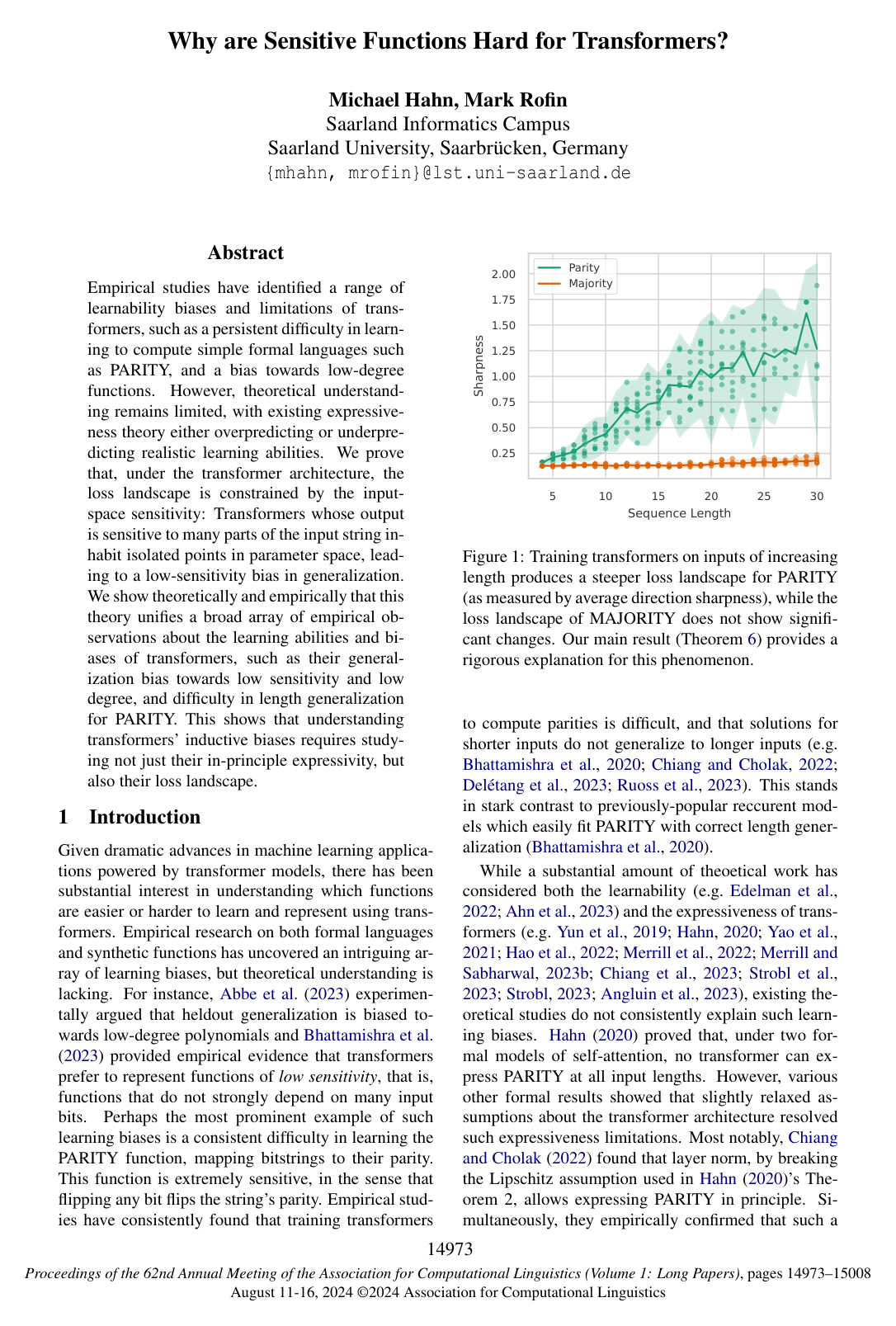
Why are Sensitive Functions Hard for Transformers?
Michael Hahn, Mark Rofin
Why you should read this
Proves that transformers computing highly sensitive functions occupy extremely sharp, isolated parameter regions, mathematically explaining why these models inherently struggle to learn and generalize functions like PARITY despite having the expressive capacity to represent them.
Empirical studies have identified a range of learnability biases and limitations of transformers, such as a persistent difficulty in learning to compute simple formal languages such as PARITY, and a bias towards low-degree functions. However, theoretical understanding remains limited, with existing expressiveness theory either overpredicting or underpredicting realistic learning abilities. We prove that, under the transformer architecture, the loss landscape is constrained by the input-space sensitivity: Transformers whose output is sensitive to many parts of the input string inhabit isolated points in parameter space, leading to a low-sensitivity bias in generalization. We show theoretically and empirically that this theory unifies a broad array of empirical observations about the learning abilities and biases of transformers, such as their generalization bias towards low sensitivity and low degree, and difficulty in length generalization for PARITY. This shows that understanding transformers' inductive biases requires studying not just their in-principle expressivity, but also their loss landscape.
Added
2026-10-03
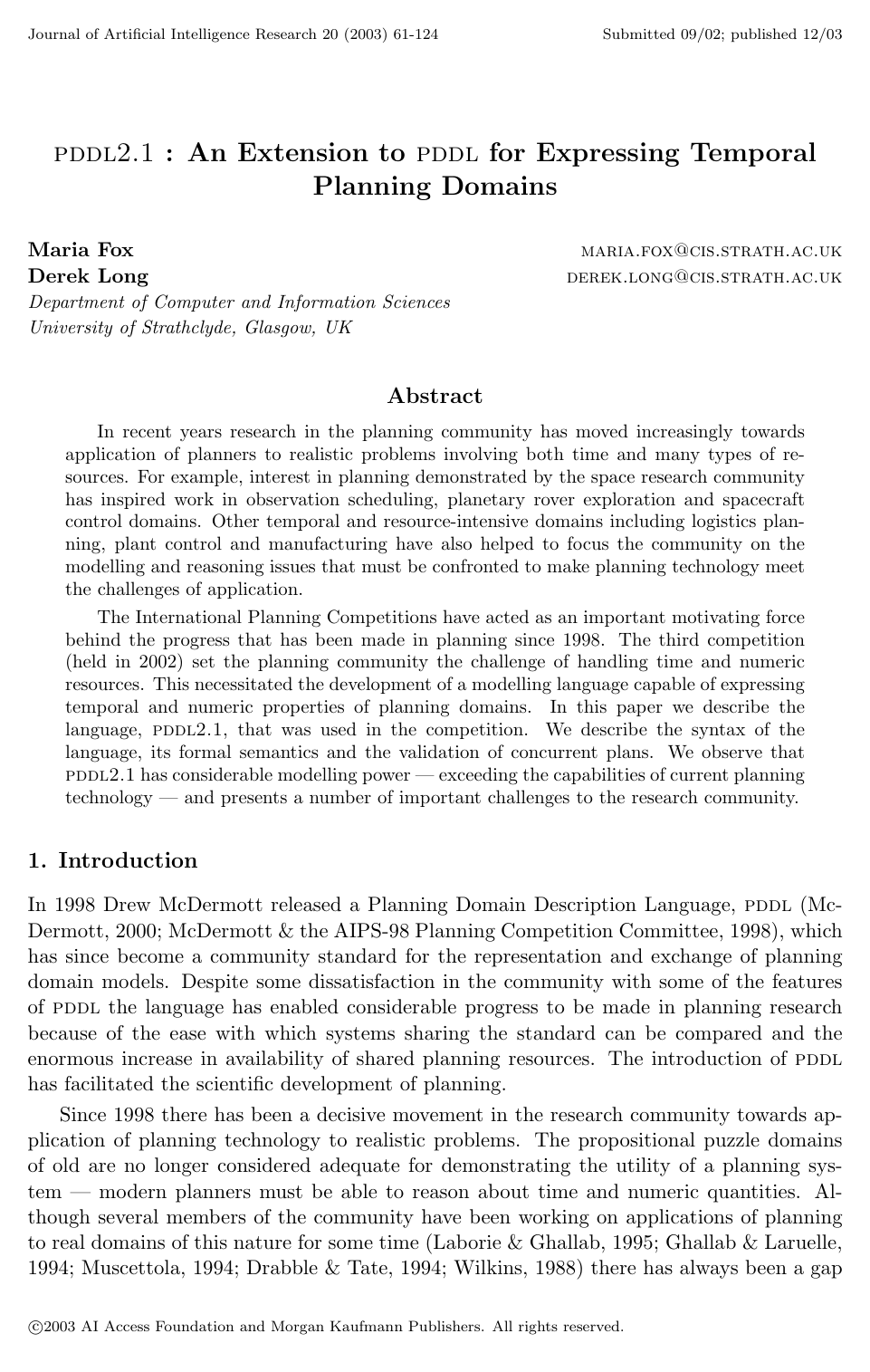
PDDL2.1: An Extension to PDDL for Expressing Temporal Planning Domains
Maria Fox, Derek Long
Why you should read this
Introduces PDDL2.1, a backward-compatible extension to the standard Planning Domain Description Language that formalizes numeric resources, durative actions, and plan validation criteria to enable automated planners to tackle complex, real-world temporal problems.
In recent years research in the planning community has moved increasingly towards application of planners to realistic problems involving both time and many types of resources. For example, interest in planning demonstrated by the space research community has inspired work in observation scheduling, planetary rover exploration and spacecraft control domains. Other temporal and resource-intensive domains including logistics planning, plant control and manufacturing have also helped to focus the community on the modelling and reasoning issues that must be confronted to make planning technology meet the challenges of application. The International Planning Competitions have acted as an important motivating force behind the progress that has been made in planning since 1998. The third competition (held in 2002) set the planning community the challenge of handling time and numeric resources. This necessitated the development of a modelling language capable of expressing temporal and numeric properties of planning domains. In this paper we describe the language, PDDL2.1, that was used in the competition. We describe the syntax of the language, its formal semantics and the validation of concurrent plans. We observe that PDDL2.1 has considerable modelling power — exceeding the capabilities of current planning technology — and presents a number of important challenges to the research community.
Added
2026-09-15
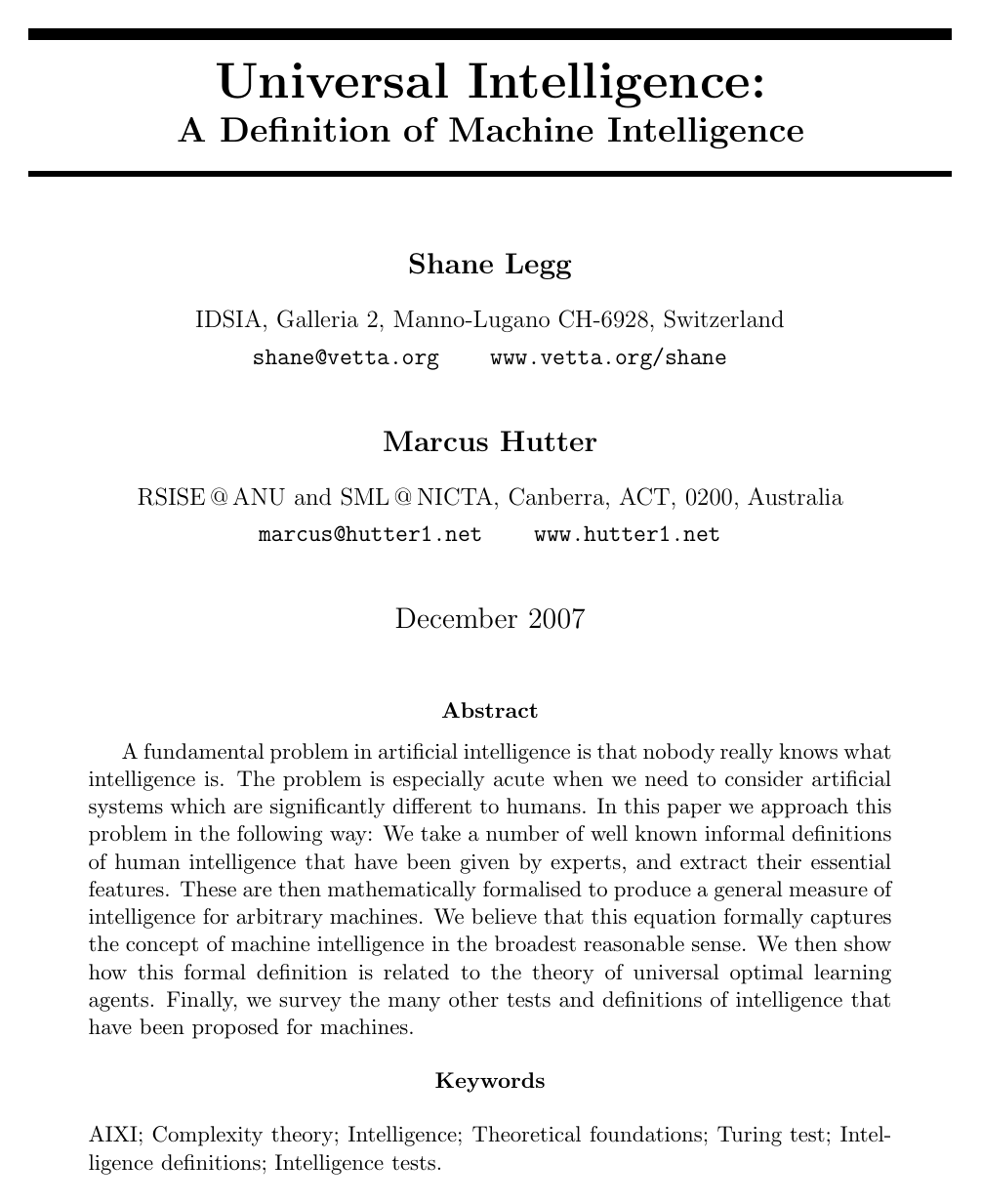
Universal Intelligence: A Definition of Machine Intelligence
Shane Legg, Marcus Hutter
Why you should read this
Develops a mathematically rigorous definition of intelligence that applies to any agent—biological or artificial—by formalizing the intuition that intelligence means succeeding at a wide variety of tasks weighted by their complexity.
A fundamental problem in artificial intelligence is that nobody really knows what intelligence is. The problem is especially acute when we need to consider artificial systems which are significantly different to humans. In this paper we approach this problem in the following way: We take a number of well known informal definitions of human intelligence that have been given by experts, and extract their essential features. These are then mathematically formalised to produce a general measure of intelligence for arbitrary machines. We believe that this equation formally captures the concept of machine intelligence in the broadest reasonable sense. We then show how this formal definition is related to the theory of universal optimal learning agents. Finally, we survey the many other tests and definitions of intelligence that have been proposed for machines.
Added
2026-02-21