Why are Sensitive Functions Hard for Transformers?
Michael HahnMark Rofin
Proves that transformers computing highly sensitive functions occupy extremely sharp, isolated parameter regions, mathematically explaining why these models inherently struggle to learn and generalize functions like PARITY despite having the expressive capacity to represent them.
Modern artificial intelligence heavily relies on the transformer architecture, yet these models consistently struggle to learn certain simple logical tasks, such as determining the parity of a bit string. While classical recurrent models solve parity easily, transformers fail to learn it reliably or generalize it to longer sequences. Previous theoretical research has produced a confusing contradiction: purely expressive models suggest transformers can easily represent parity in principle, whereas alternative mathematical bounds underpredict their ability to learn simple sparse patterns. Consequently, technical leaders and researchers lack a rigorous explanation for the fundamental learning biases and failure modes of transformer models.
The article establishes a unified theoretical framework explaining why sensitive functions—where changing a single input bit alters the overall output—are fundamentally difficult for transformers to learn. The authors evaluate the mathematical properties of transformer architectures with layer normalization and validate their findings through empirical experiments measuring loss landscape geometry, model parameter sensitivity, and training behavior across various boolean functions.
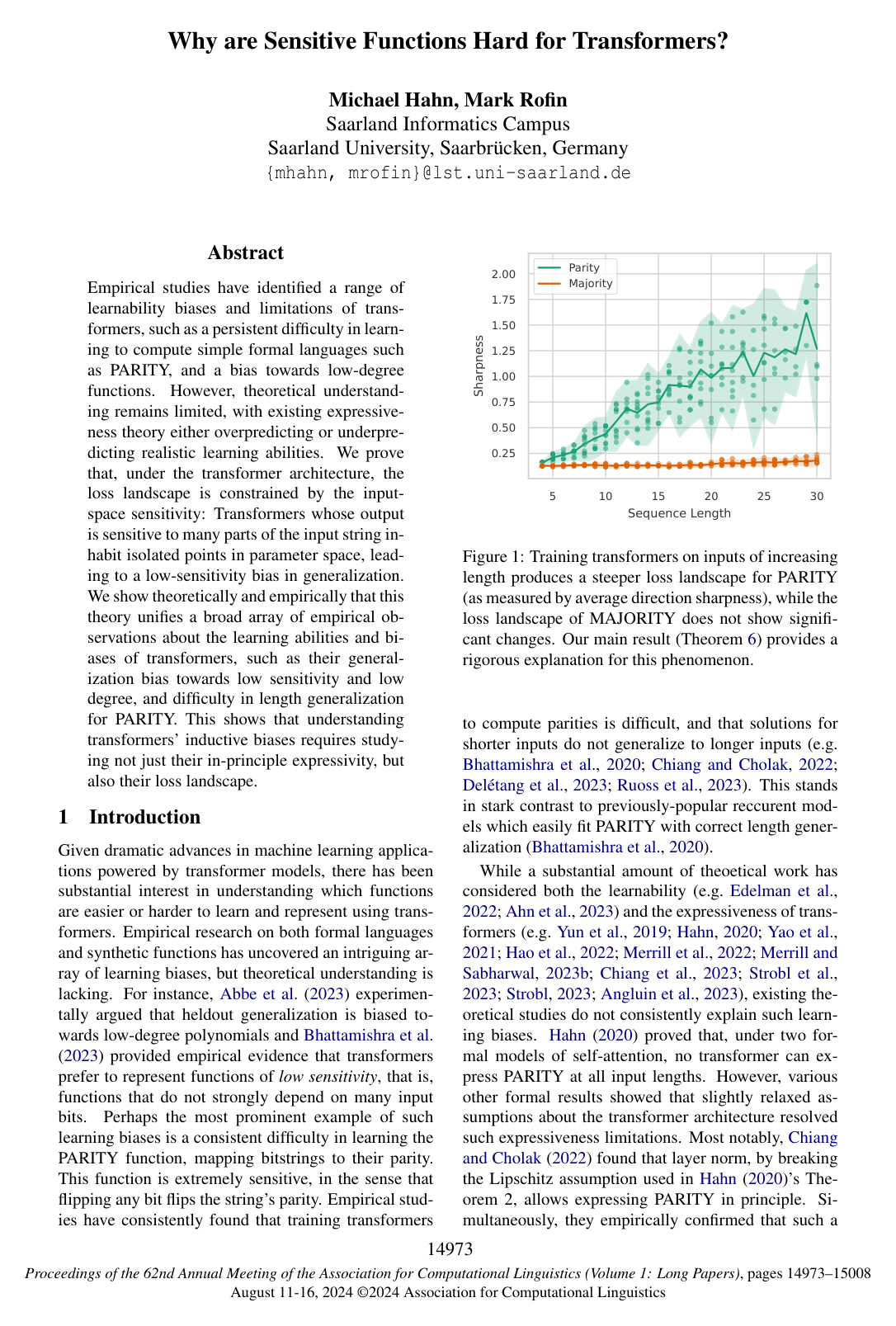
The investigation proves mathematically and confirms experimentally that fitting a highly sensitive function forces a transformer to occupy extremely sharp, brittle minima in its loss landscape. First, representing high-sensitivity functions requires an unavoidable mathematical trade-off between growing parameter norms and exploding layer normalization factors as input sequence lengths increase. Second, the authors prove that any transformer achieving high input sensitivity becomes excessively sensitive to tiny parameter perturbations; moving even slightly away from an optimal configuration causes severe performance collapse on long inputs. Empirically, training transformers on the parity function demonstrated a dramatic increase in loss sharpness as sequence length grew, exhibiting a regression slope roughly two orders of magnitude steeper than less sensitive functions like majority or sparse selection. Finally, breaking sensitive tasks into multi-step autoregressive scratchpad generation reduces step-level sensitivity to a small constant, completely eliminating this sharpness penalty.
These findings provide clear strategic implications for deploying transformers in complex reasoning domains. The core bottleneck is not representational capacity, but optimization geometry: standard gradient descent inherently prefers broad, flat minima, creating a natural architectural bias toward low-sensitivity and low-degree solutions. This explains why transformers struggle with length generalization on brittle, sensitive tasks when forced to answer in a single forward pass. Expecting a standard transformer encoder to solve highly sensitive global logic in one step introduces severe reliability risks and training failure.
Organizations developing machine learning systems should avoid relying on single-pass transformer architectures for high-sensitivity logical reasoning. Instead, teams should implement chain-of-thought prompting, scratchpads, or recurrent autoregressive generation to decompose sensitive tasks into low-sensitivity intermediate steps. Future technical efforts should prioritize developing quantitative finite-length bounds, investigating sequence-to-sequence transductions, and analyzing causal decoder architectures under this geometric framework.
While the theoretical proofs are asymptotic and focus on single-output boolean tasks within bounded-depth transformer encoders, the conclusions remain highly robust. The theoretical bounds closely match empirical observations across synthetic benchmark tasks, giving high confidence that optimization landscape sharpness is the primary driver of transformers' sensitivity limitations.
- Paper: Overcoming a Theoretical Limitation of Self-Attention, David Chiang et al. (2022). This parity-focused analysis establishes the prior expressivity and layer-normalization results that the source reconciles with its account of optimization difficulty.
- Paper: Exploring Length Generalization in Large Language Models, Cem Anil et al. (2022). Its experiments on parity length generalization and scratchpad methods provide the empirical context for the source’s explanation of brittle single-pass learning.
No sufficiently relevant recommendations were found.