
keyword
sensitivity bounds
Sensitivity bounds are mathematical limits that quantify the maximum or minimum degree to which the output, internal state, or performance of a function, algorithm, or model changes in response to variations or perturbations in its input data. In machine learning and theoretical computer science, these bounds characterize the stability, complexity, and inductive biases of learning architectures by measuring how sensitive predictions or loss landscapes are to alterations across input features. In privacy-preserving computation, such as differential privacy, sensitivity bounds establish the worst-case impact that adding, modifying, or removing an individual data record can have on algorithmic iterates and statistical estimates, thereby determining the precise amount of noise required to ensure privacy without excessively degrading model utility. Establishing rigorous sensitivity bounds is fundamental for analyzing algorithmic robustness, proving generalization limits, and optimizing the trade-offs between computational efficiency, privacy, and accuracy.
2 items
Why are Sensitive Functions Hard for Transformers?
Michael Hahn, Mark Rofin
Why you should read this
Proves that transformers computing highly sensitive functions occupy extremely sharp, isolated parameter regions, mathematically explaining why these models inherently struggle to learn and generalize functions like PARITY despite having the expressive capacity to represent them.
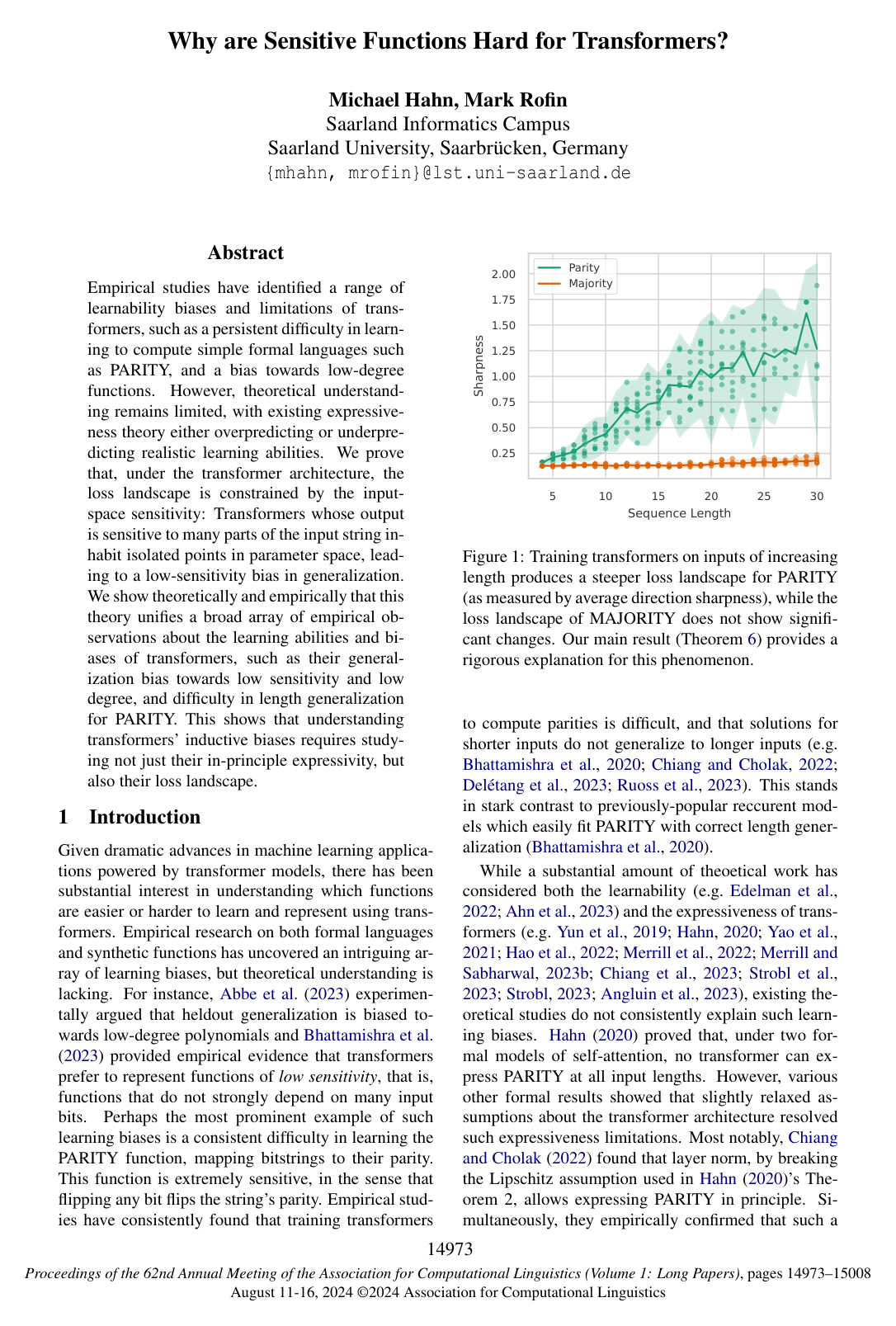
Empirical studies have identified a range of learnability biases and limitations of transformers, such as a persistent difficulty in learning to compute simple formal languages such as PARITY, and a bias towards low-degree functions. However, theoretical understanding remains limited, with existing expressiveness theory either overpredicting or underpredicting realistic learning abilities. We prove that, under the transformer architecture, the loss landscape is constrained by the input-space sensitivity: Transformers whose output is sensitive to many parts of the input string inhabit isolated points in parameter space, leading to a low-sensitivity bias in generalization. We show theoretically and empirically that this theory unifies a broad array of empirical observations about the learning abilities and biases of transformers, such as their generalization bias towards low sensitivity and low degree, and difficulty in length generalization for PARITY. This shows that understanding transformers' inductive biases requires studying not just their in-principle expressivity, but also their loss landscape.
Added
2026-10-03
Linear-Time User-Level DP SCO via Robust Statistics
Pasin Manurangsi, Badih Ghazi, Daogao Liu, Ravi Kumar
Why you should read this
Introduces a linear-time algorithm for user-level differentially private stochastic convex optimization that employs median and trimmed-mean gradient estimators to eliminate per-step noise accumulation and achieve near-optimal privacy-utility trade-offs.
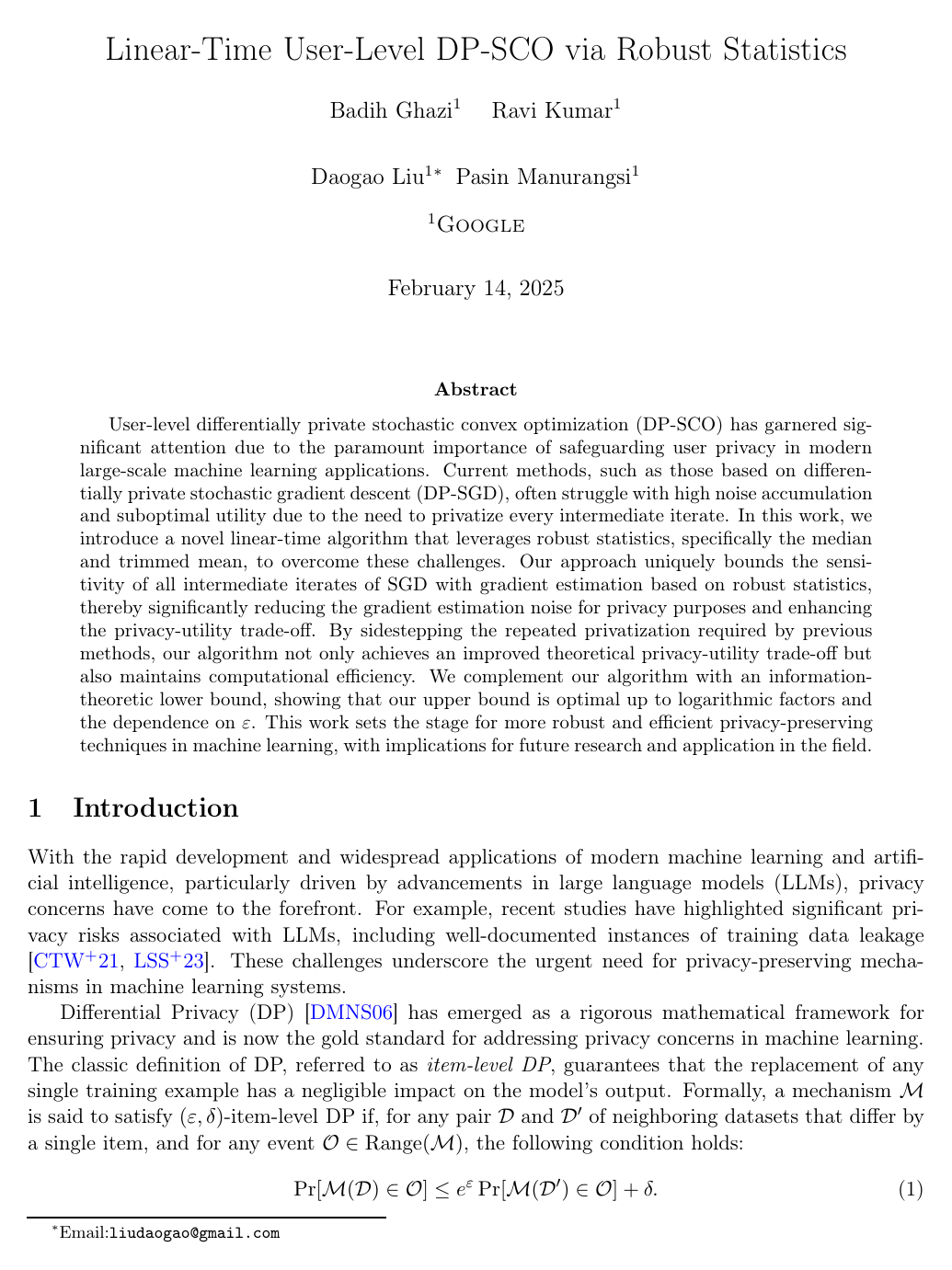
User-level differentially private stochastic convex optimization (DP-SCO) has garnered significant attention due to the paramount importance of safeguarding user privacy in modern large-scale machine learning applications. Current methods, such as those based on differentially private stochastic gradient descent (DP-SGD), often struggle with high noise accumulation and suboptimal utility due to the need to privatize every intermediate iterate. In this work, we introduce a novel linear-time algorithm that leverages robust statistics, specifically the median and trimmed mean, to overcome these challenges. Our approach uniquely bounds the sensitivity of all intermediate iterates of SGD with gradient estimation based on robust statistics, thereby significantly reducing the gradient estimation noise for privacy purposes and enhancing the privacy-utility trade-off. By sidestepping the repeated privatization required by previous methods, our algorithm not only achieves an improved theoretical privacy-utility trade-off but also maintains computational efficiency. We complement our algorithm with an information-theoretic lower bound, showing that our upper bound is optimal up to logarithmic factors and the dependence on . This work sets the stage for more robust and efficient privacy-preserving techniques in machine learning, with implications for future research and application in the field.
Added
2026-10-01