Negative-Aware Attention Framework for Image-Text Matching
Kun ZhangZhendong MaoQuan WangYongdong Zhang
Proposes a negative-aware attention framework that explicitly mines mismatched word-region fragments alongside matched clues to prevent false-positive alignments and achieve state-of-the-art image-text matching accuracy.
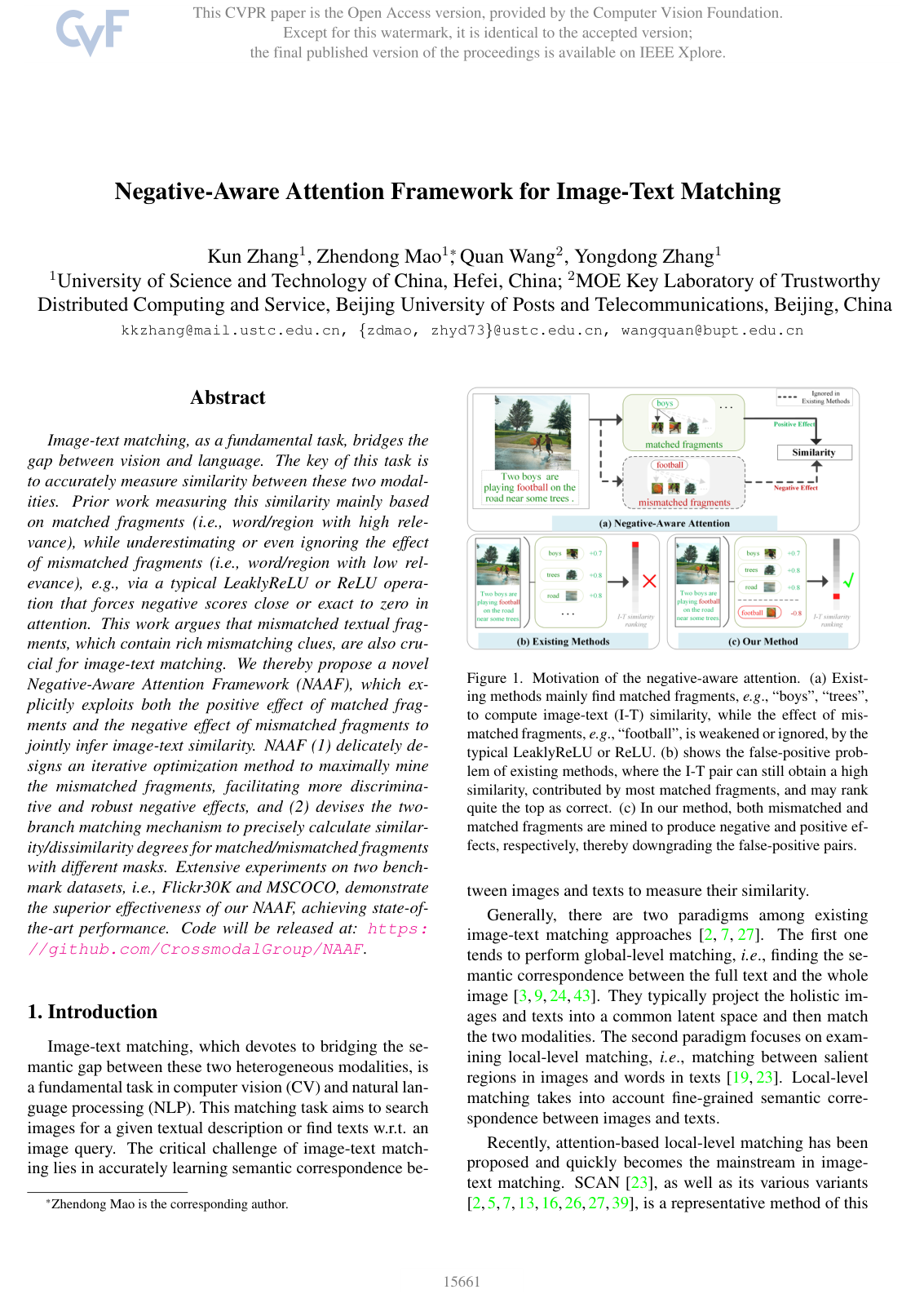
Cross-modal search between images and text is a foundational capability for multimodal artificial intelligence, enabling systems to retrieve relevant visual content given a textual query and vice versa. Existing matching approaches predominantly rely on positive alignment between words and image regions while suppressing or ignoring mismatched elements. This unilateral focus frequently causes false-positive errors, as an image and text pair containing multiple matching items can achieve a top retrieval rank despite containing critical descriptive words that do not exist in the visual scene.
The article demonstrates and evaluates a novel Negative-Aware Attention Framework (NAAF). The primary objective is to improve image-text matching accuracy by jointly factoring in both the positive contribution of matched elements and the negative penalty of mismatched textual elements.
To achieve this, the approach introduces a two-branch matching architecture alongside an iterative optimization mechanism. The model calculates positive alignment through standard attention while isolating mismatched words to compute explicit dissimilarity penalties that downgrade false positives. Because no manual word-level annotations exist to distinguish matches from mismatches, the method adaptively learns a dynamic decision boundary from sampled similarity distributions. The framework was evaluated on two widely used benchmark datasets, Flickr30K and MS-COCO, across standard top-rank recall metrics.
Key findings show that NAAF significantly improves cross-modal retrieval performance over existing state-of-the-art models. On the Flickr30K benchmark, the framework achieved an overall recall sum of 513.2, representing an absolute improvement of 13.6 points over previous top methods and a 48.2% relative gain compared to baseline cross-attention models. On the larger MS-COCO dataset, NAAF outperformed comparable techniques across both the 1,000-image and 5,000-image test splits, yielding near-term top-1 recall improvements of roughly 1% to 4% across directions. Ablation analyses confirmed that removing the negative attention branch caused a substantial drop in performance, proving that dissimilarity penalties are critical for cross-modal precision.
These results indicate that penalizing mismatched semantic concepts is essential for building reliable cross-modal retrieval and search systems. By explicitly downgrading high-similarity false positives, organizations can reduce search error rates and deliver more accurate multimodal applications. For future implementations, engineering teams should adopt two-branch attention architectures and dynamically tuned decision boundaries when developing text-to-image retrieval pipelines.
Confidence in these findings is high given the consistent gains across multiple benchmark splits and clear ablation studies. However, the framework focuses primarily on mismatched textual fragments rather than image-to-text mismatches, because visual scenes naturally contain unrelated background objects. Operational deployments will require evaluating performance across specialized, domain-specific vocabularies and broader enterprise datasets.
- Paper: Stacked Cross Attention for Image-Text Matching, Kuang-Huei Lee et al. (2018). Lee et al. introduce Stacked Cross Attention (SCAN) for region-word alignment in image-text matching, establishing the latent cross-attention baseline that NAAF specifically critiques and improves by incorporating negative mismatched clues.
- Paper: Bottom-Up and Top-Down Attention for Image Captioning and Visual Question Answering, Peter Anderson et al. (2018). Anderson et al. establish the standard bottom-up region-feature extraction pipeline widely utilized for fine-grained image-text fragment matching.
- Paper: AttnGAN: Fine-Grained Text to Image Generation with Attentional Generative Adversarial Networks, Tao Xu et al. (2017). Xu et al. propose the Deep Attentional Multimodal Similarity Model (DAMSM) to measure fine-grained visual-word relevance, laying key foundational principles for cross-modal fragment attention.
- Paper: Show, Attend and Tell: Neural Image Caption Generation with Visual Attention, Kelvin Xu et al. (2015). Xu et al. formulate the foundational visual attention mechanisms that dynamically weight and align spatial image regions with linguistic tokens.
- Paper: Noisy Correspondence Learning with Meta Similarity Correction, Haochen Han et al. (2023). Han et al. advance cross-modal retrieval robustness under mismatched data by explicitly modeling and correcting noisy correspondence through meta similarity learning.
- Paper: SoftCLIP: Softer Cross-Modal Alignment Makes CLIP Stronger, Yuting Gao et al. (2024). Gao et al. extend cross-modal alignment paradigms by relaxing strict matching constraints and introducing softened target alignments derived from intra-modal relationships.
- Paper: Robust Cross-Modal Representation Learning with Progressive Self-Distillation, Alex Andonian et al. (2022). Andonian et al. generalize cross-modal representation learning to noisy correspondence settings by dynamically generating soft alignment targets through self-distillation.
- Paper: ViSTA: Vision and Scene Text Aggregation for Cross-Modal Retrieval, Mengjun Cheng et al. (2022). Cheng et al. expand cross-modal retrieval frameworks by aggregating fine-grained scene text alongside visual appearances into unified matching architectures.