Robust Cross-Modal Representation Learning with Progressive Self-Distillation
Alex AndonianShixing ChenRaffay Hamid
Proposes a progressive self-distillation framework that replaces rigid one-to-one pairings in vision-language pretraining with dynamic soft-alignment targets, consistently outperforming CLIP across zero-shot, transfer, and retrieval benchmarks without extra computational overhead.
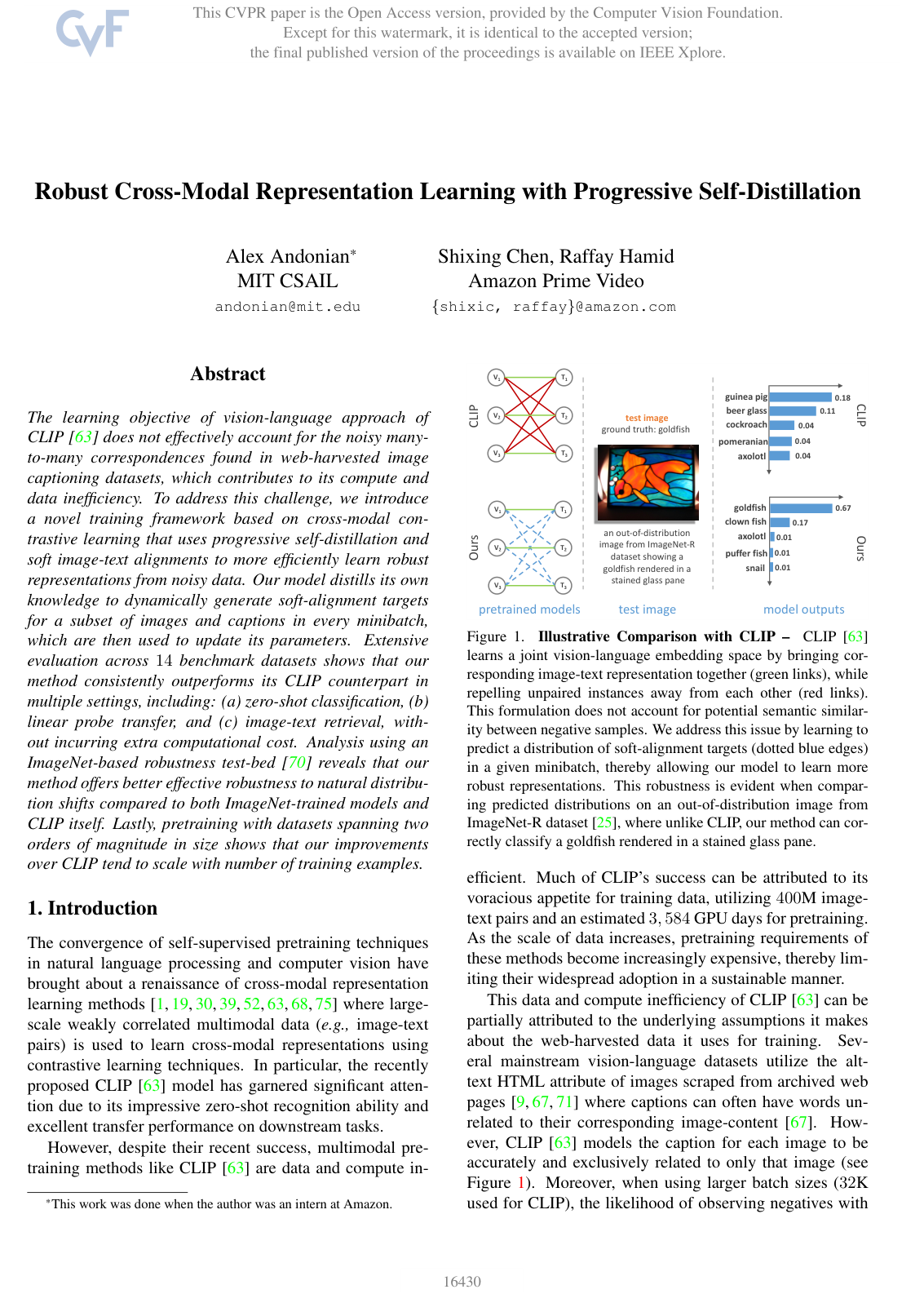
Modern vision-language artificial intelligence models, such as Contrastive Language-Image Pretraining (CLIP), achieve impressive capabilities by training on hundreds of millions of web-scraped image-caption pairs. However, web data is inherently noisy and loosely descriptive. Traditional training frameworks strictly enforce one-to-one pairings, wrongly penalizing images that match multiple captions or captions that relate to multiple images. This rigid assumption causes high data and compute inefficiency, requiring thousands of processor days to learn effectively.
The article demonstrates a novel training framework that uses progressive self-distillation and soft alignment targets to learn robust multimodal representations directly from noisy data. The primary objective is to evaluate whether allowing flexible, many-to-many probability alignments improves model accuracy, robustness, and efficiency compared to standard contrastive methods without adding computational overhead.
The researchers evaluated their approach across three pretraining datasets of varying scale and noise, ranging from roughly 118,000 to 10 million image-text pairs. Rather than pruning or hand-filtering noisy data, the model acts as its own teacher. During each training batch, it dynamically splits samples into an aligned subset trained with standard objectives and an unaligned subset where the model predicts softened alignment targets. Over the course of training, the model progressively increases its reliance on these self-generated soft targets while utilizing cross-modal swapped predictions to avoid reinforcing its own errors. The resulting models were benchmarked across 14 standard test datasets across zero-shot classification, linear probe transfer, and cross-modal retrieval tasks.
The findings demonstrate substantial, consistent performance advantages over baseline CLIP models. Across zero-shot classification benchmarks, the proposed framework achieved an absolute average accuracy gain of 2.22% on smaller data, 6.19% on intermediate data, and 5.23% on large-scale data. On out-of-distribution robustness tests designed to measure how well models handle real-world variations and distribution shifts, the method surpassed baseline accuracy by up to 8.5%. Linear probe and image-text retrieval benchmarks similarly showed consistent improvements across all test domains. In addition, data efficiency sweeps revealed that the relative performance advantage over CLIP persisted and widened across data sizes spanning two orders of magnitude.
These results indicate that accounting for natural semantic overlap and noisy annotations significantly improves representation learning without requiring larger infrastructure budgets. For organizations deploying computer vision and multimodal search systems, this approach reduces computational costs, improves data utilization, and enhances operational reliability against real-world visual shifts. Because it avoids maintaining complex secondary teacher networks or separate data-filtering pipelines, the method can be integrated directly into existing training workflows.
Organizations training multimodal models should adopt dynamic soft alignments and progressive self-distillation in place of rigid contrastive objectives. Future development should explore applying these self-distillation techniques to larger foundation models, specialized architectures, and redundant dataset optimizations to further minimize hardware resource requirements.
While confidence in the comparative empirical improvements across the 14 benchmarks is high, the largest dataset evaluated in the article contained approximately 10 million pairs, which is smaller than private industry datasets containing hundreds of millions of samples. Stakeholders should conduct pilot evaluations when scaling up to multi-billion-parameter models or domain-specific enterprise datasets to verify that hyperparameter decay schedules transfer seamlessly.
- Paper: Learning Transferable Visual Models From Natural Language Supervision, Alec Radford et al.. It introduces the foundational CLIP contrastive framework whose rigid one-to-one alignment objective and web-scale training setup the source directly seeks to improve.
- Paper: Align before Fuse: Vision and Language Representation Learning with Momentum Distillation, Junnan Li et al. (2021). It establishes momentum distillation and soft targets for cross-modal contrastive learning to handle noisy web data, providing the conceptual foundation for progressive self-distillation.
- Paper: Scaling Up Visual and Vision-Language Representation Learning With Noisy Text Supervision, Chao Jia et al. (2021). It demonstrates how dual-encoder contrastive learning scales on noisy web alt-text pairs, framing the exact noisy-correspondence challenge addressed in the source.
- Paper: Conceptual 12M: Pushing Web-Scale Image-Text Pre-Training To Recognize Long-Tail Visual Concepts, Soravit Changpinyo et al. (2021). It introduces the Conceptual 12M dataset of noisy, weakly-supervised image-text pairs used directly as a core pretraining benchmark in the source.
- Paper: A Simple Framework for Contrastive Learning of Visual Representations, Ting Chen et al. (2020). It formalizes normalized temperature-scaled contrastive loss and visual projection head design that underpin modern contrastive representation learning.
- Paper: SoftCLIP: Softer Cross-Modal Alignment Makes CLIP Stronger, Yuting Gao et al. (2024). It extends the concept of relaxed one-to-one cross-modal alignment by using fine-grained object detectors to compute intra-modal soft similarity targets.
- Paper: Noisy Correspondence Learning with Meta Similarity Correction, Haochen Han et al. (2023). It builds upon noisy correspondence mitigation in cross-modal learning by employing meta-learning on clean reference data to correct mismatched pairs.
- Paper: Improving CLIP Training with Language Rewrites, Lijie Fan et al. (2023). It complements soft representation alignment by expanding text caption diversity through automated language model rewrites during CLIP pretraining.
- Paper: HiCLIP: Contrastive Language-Image Pretraining with Hierarchy-aware Attention, Shijie Geng et al. (2023). It further enhances CLIP pretraining by incorporating hierarchy-aware attention mechanisms to capture multi-level structural alignments in images and text.
- Paper: MAP: Multimodal Uncertainty-Aware Vision-Language Pre-training Model, Yatai Ji et al. (2023). It advances beyond point-based deterministic representations by modeling visual and textual features as probability distributions to capture multimodal uncertainty.