
keyword
cross-modal retrieval
Cross-modal retrieval is an information retrieval task in machine learning where a query given in one data modality, such as text, is used to search for and retrieve semantically corresponding content in a different data modality, such as images, video, or audio. Because distinct media formats have disparate structural representations, cross-modal retrieval systems bridge this heterogeneity gap by mapping data from different modalities into a shared or aligned representation space where semantic similarity can be directly measured. This allows algorithms to evaluate relevance across disparate data types, enabling applications such as text-to-image search, image-based text retrieval, and text-to-video discovery without requiring the query and the target database to share the same medium.
16 items
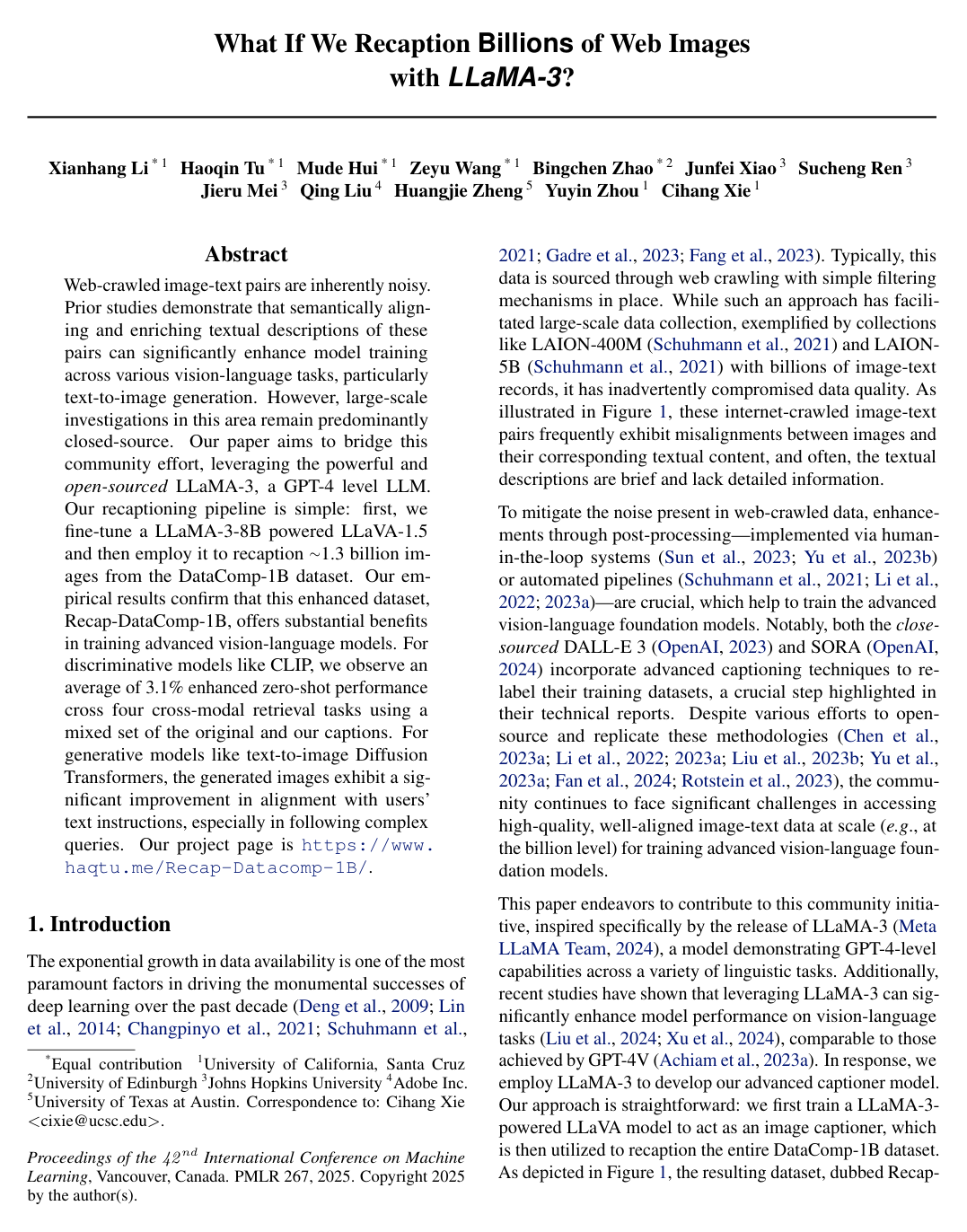
What If We Recaption Billions of Web Images with LLaMA-3?
Xianhang Li, Haoqin Tu, Mude Hui, Zeyu Wang, Bingchen Zhao, Junfei Xiao, Sucheng Ren, Jieru Mei, Qing Liu, Huangjie Zheng, Yuyin Zhou, Cihang Xie
Why you should read this
Presents an open-source pipeline using a LLaMA-3-powered LLaVA model to recaption 1.3 billion web images in DataComp-1B, substantially improving downstream performance for both CLIP retrieval and text-to-image generation.
Large multimodal models trained at scale have demonstrated remarkable performance across diverse visual tasks.
Added
2026-10-02
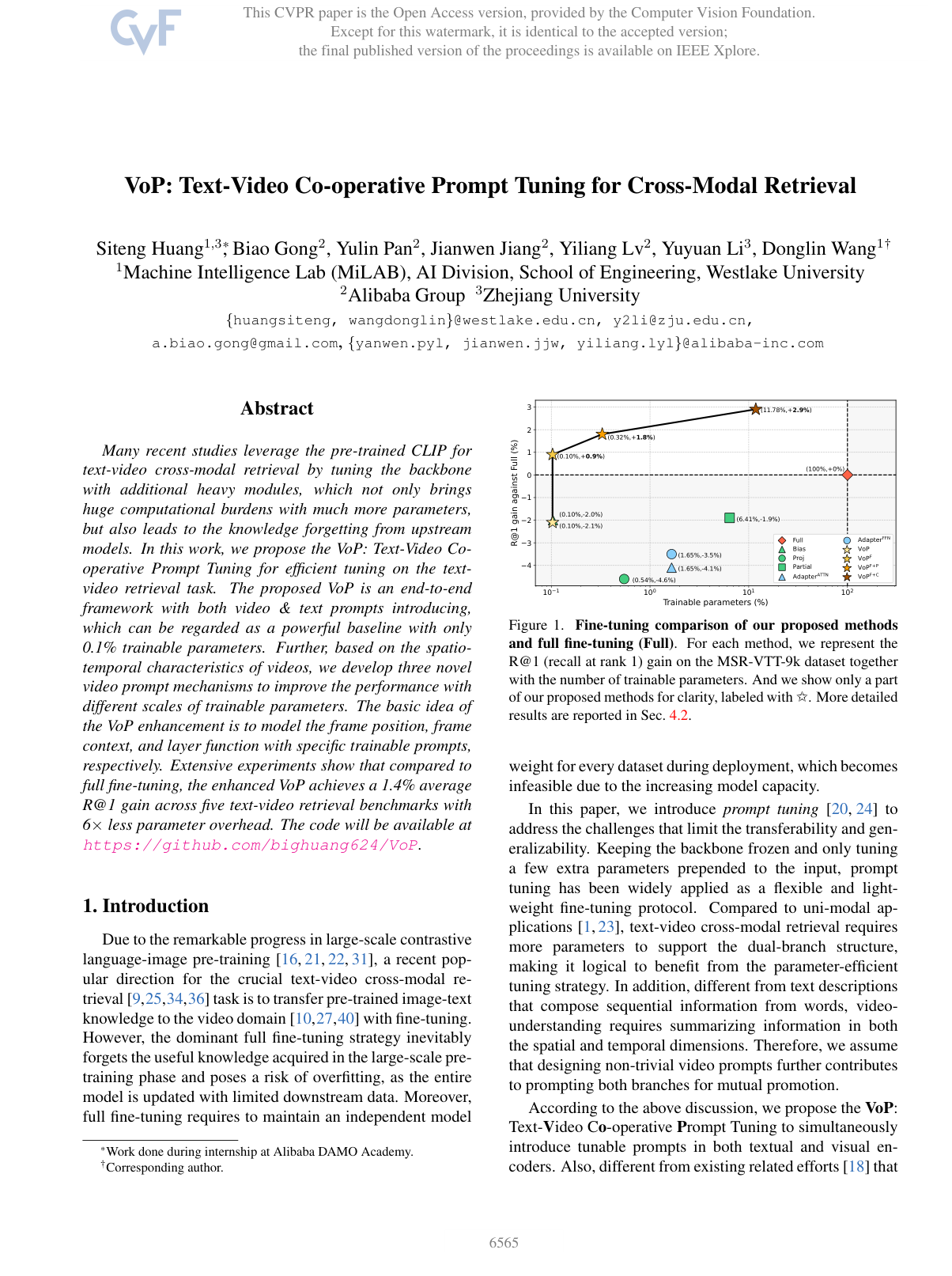
VoP: Text-Video Co-Operative Prompt Tuning for Cross-Modal Retrieval
Siteng Huang, Biao Gong, Yulin Pan, Jianwen Jiang, Yiliang Lv, Yuyuan Li, Donglin Wang
Why you should read this
Proposes an efficient text-video co-operative prompt tuning framework that incorporates spatio-temporal video prompts into CLIP to outperform full fine-tuning on text-video retrieval benchmarks with six times fewer parameters.
Many recent studies leverage the pre-trained CLIP for text-video cross-modal retrieval by tuning the backbone with additional heavy modules, which not only brings huge computational burdens with much more parameters, but also leads to the knowledge forgetting from upstream models. In this work, we propose the VoP: Text-Video Co-operative Prompt Tuning for efficient tuning on the text-video retrieval task. The proposed VoP is an end-to-end framework with both video & text prompts introducing, which can be regarded as a powerful baseline with only 0.1% trainable parameters. Further, based on the spatio-temporal characteristics of videos, we develop three novel video prompt mechanisms to improve the performance with different scales of trainable parameters. The basic idea of the VoP enhancement is to model the frame position, frame context, and layer function with specific trainable prompts, respectively. Extensive experiments show that compared to full fine-tuning, the enhanced VoP achieves a 1.4% average R@1 gain across five text-video retrieval benchmarks with 6× less parameter overhead. The code will be available at https://github.com/bighuang624/VoP.
Added
2026-09-26
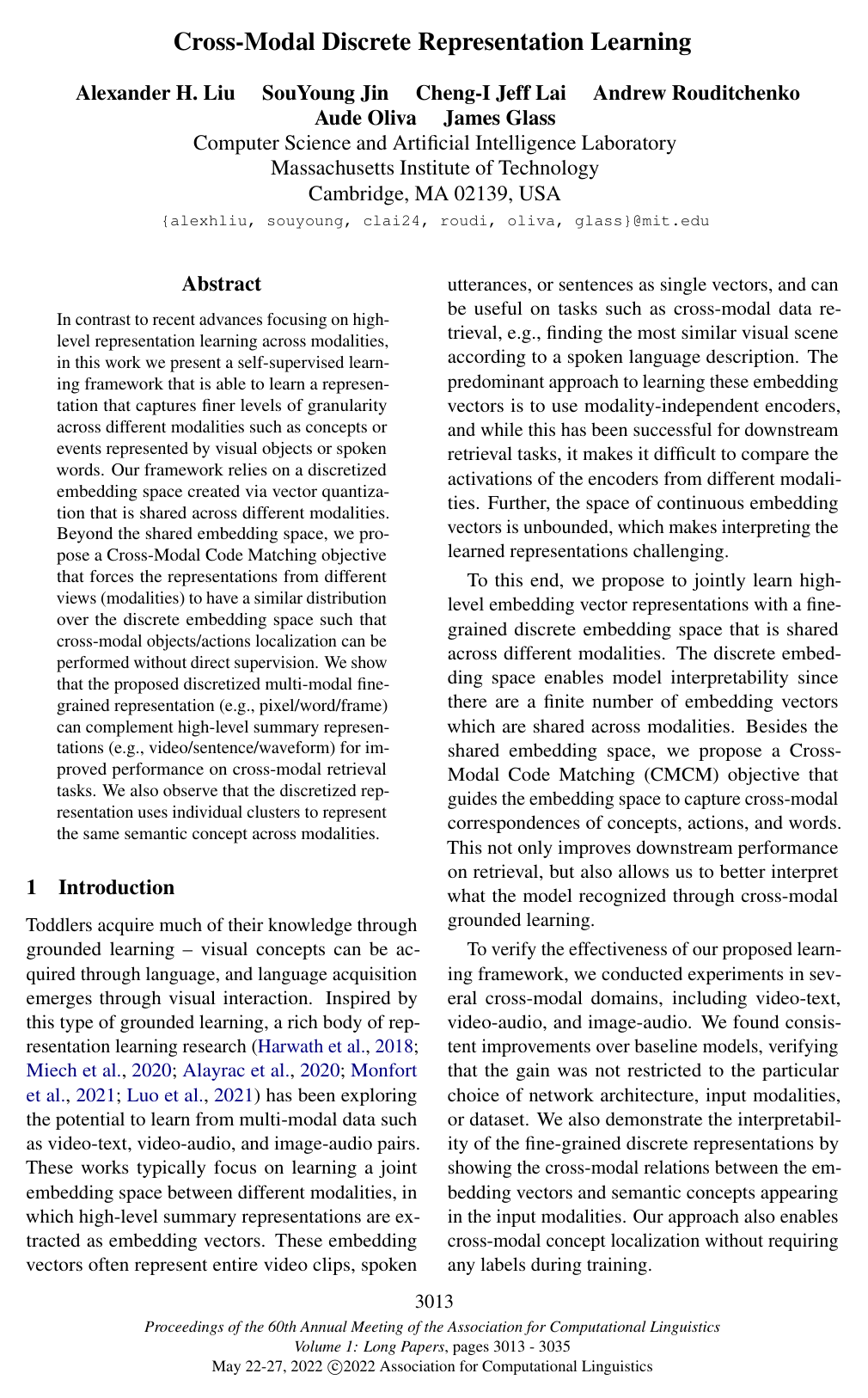
Cross-Modal Discrete Representation Learning
Alexander H. Liu, SouYoung Jin, Cheng-I Lai, Andrew Rouditchenko, Aude Oliva, James R. Glass
Why you should read this
Presents a self-supervised framework that uses vector quantization and code matching across modalities to learn fine-grained discrete representations, enabling unsupervised concept localization and boosting retrieval performance.
In contrast to recent advances focusing on high-level representation learning across modalities, in this work we present a self-supervised learning framework that is able to learn a representation that captures finer levels of granularity across different modalities such as concepts or events represented by visual objects or spoken words. Our framework relies on a discretized embedding space created via vector quantization that is shared across different modalities. Beyond the shared embedding space, we propose a Cross-Modal Code Matching objective that forces the representations from different views (modalities) to have a similar distribution over the discrete embedding space such that cross-modal objects/actions localization can be performed without direct supervision. We show that the proposed discretized multi-modal fine-grained representation (e.g., pixel/word/frame) can complement high-level summary representations (e.g., video/sentence/waveform) for improved performance on cross-modal retrieval tasks. We also observe that the discretized representation uses individual clusters to represent the same semantic concept across modalities.
Added
2026-09-26
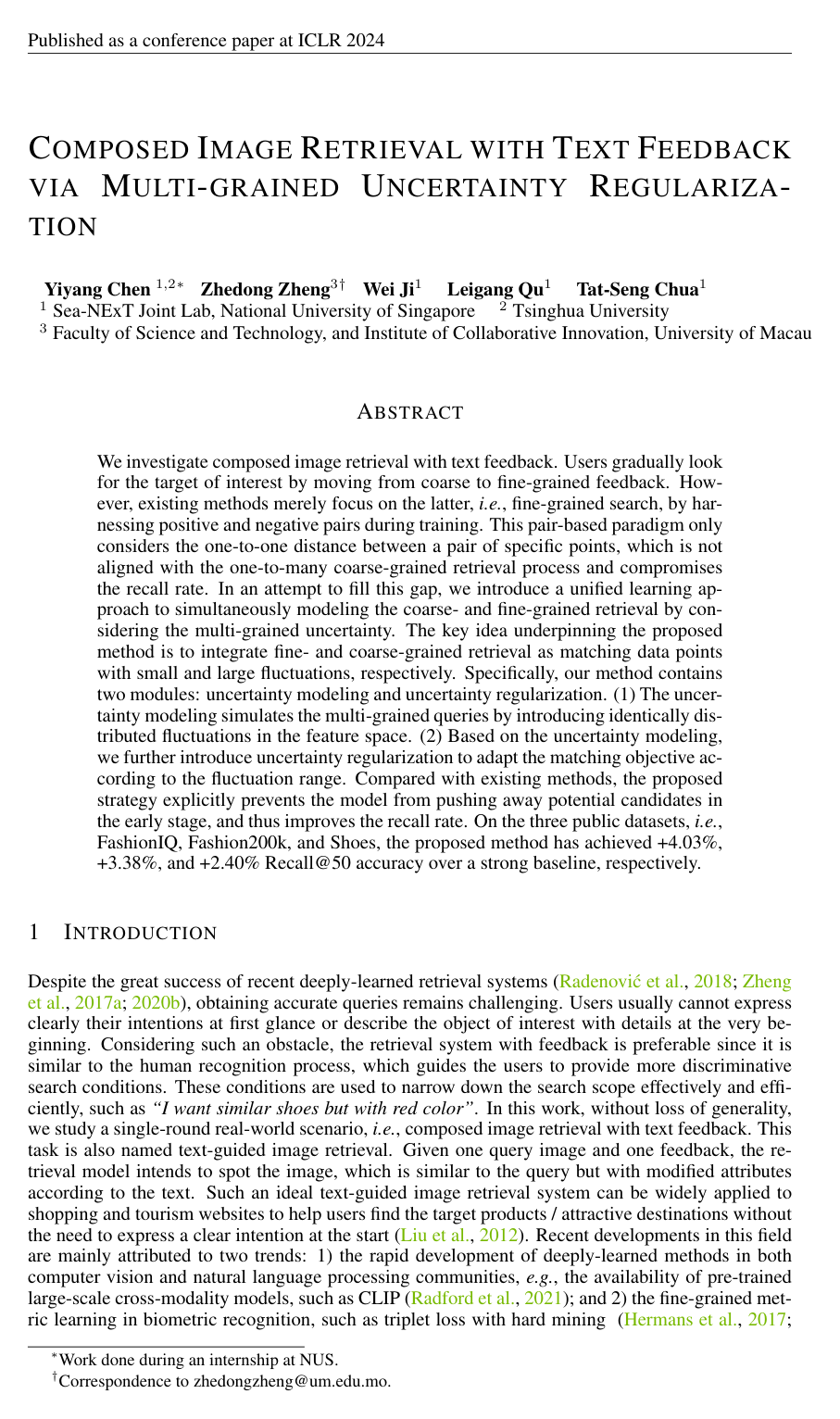
Composed Image Retrieval with Text Feedback via Multi-grained Uncertainty Regularization
Yiyang Chen, Zhedong Zheng, Wei Ji, Leigang Qu, Tat-Seng Chua
Why you should read this
Proposes a multi-grained uncertainty regularization framework for composed image retrieval that unifies coarse-to-fine text feedback by modeling feature fluctuations, preventing premature candidate exclusion and significantly increasing recall across standard benchmarks.
We investigate composed image retrieval with text feedback. Users gradually look for the target of interest by moving from coarse to fine-grained feedback. However, existing methods merely focus on the latter, i.e., fine-grained search, by harnessing positive and negative pairs during training. This pair-based paradigm only considers the one-to-one distance between a pair of specific points, which is not aligned with the one-to-many coarse-grained retrieval process and compromises the recall rate. In an attempt to fill this gap, we introduce a unified learning approach to simultaneously modeling the coarse- and fine-grained retrieval by considering the multi-grained uncertainty. The key idea underpinning the proposed method is to integrate fine- and coarse-grained retrieval as matching data points with small and large fluctuations, respectively. Specifically, our method contains two modules: uncertainty modeling and uncertainty regularization. (1) The uncertainty modeling simulates the multi-grained queries by introducing identically distributed fluctuations in the feature space. (2) Based on the uncertainty modeling, we further introduce uncertainty regularization to adapt the matching objective according to the fluctuation range. Compared with existing methods, the proposed strategy explicitly prevents the model from pushing away potential candidates in the early stage, and thus improves the recall rate. On the three public datasets, i.e., FashionIQ, Fashion200k, and Shoes, the proposed method has achieved +4.03%, +3.38%, and +2.40% Recall@50 accuracy over a strong baseline, respectively.
Added
2026-09-26
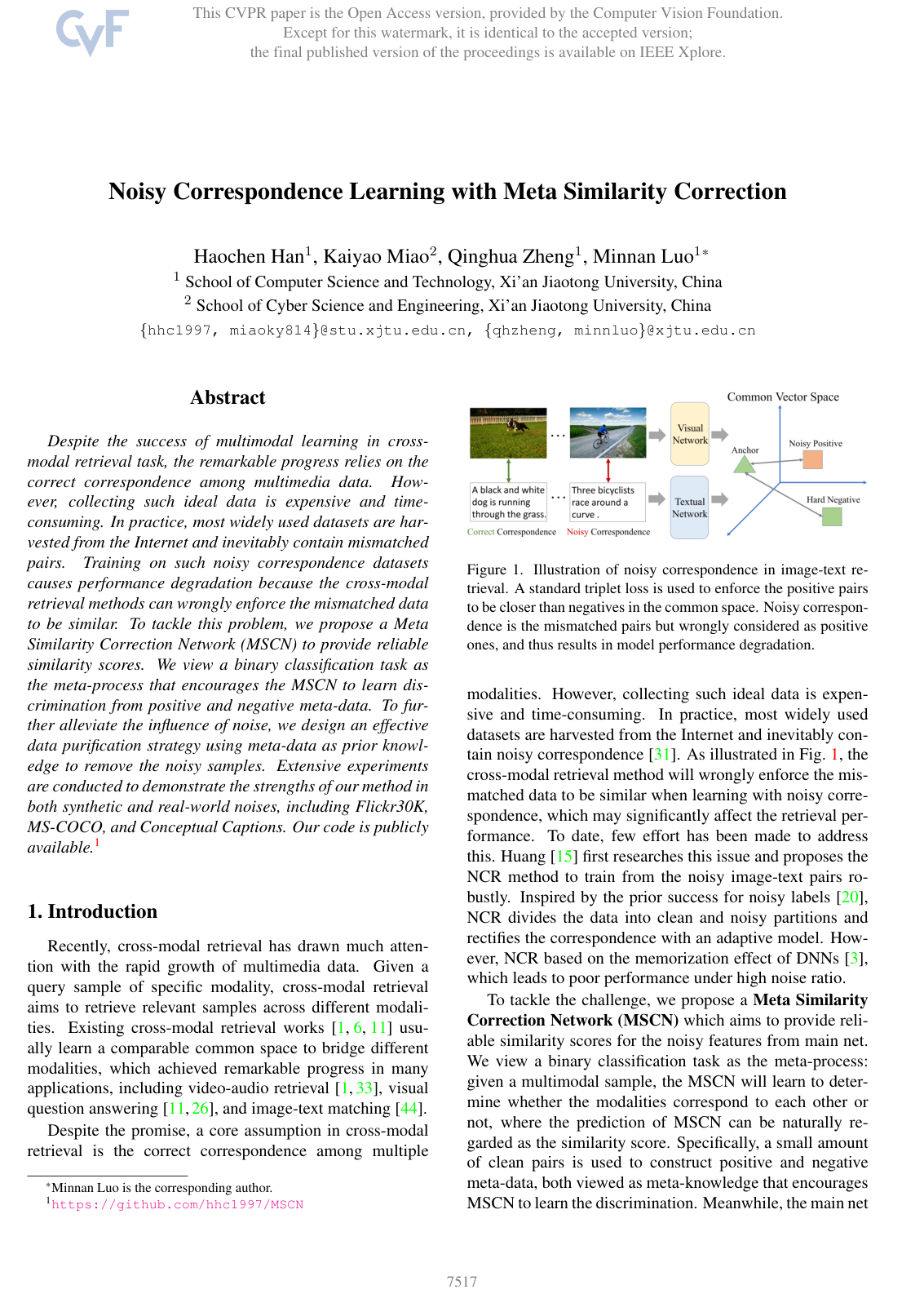
Noisy Correspondence Learning with Meta Similarity Correction
Haochen Han, Kaiyao Miao, Qinghua Zheng, Minnan Luo
Why you should read this
Proposes a meta-learning framework that trains a correction network on clean and mismatched meta-data to rectify similarity scores and filter out mismatched cross-modal pairs during retrieval training.
Despite the success of multimodal learning in cross-modal retrieval task, the remarkable progress relies on the correct correspondence among multimedia data. However, collecting such ideal data is expensive and time-consuming. In practice, most widely used datasets are harvested from the Internet and inevitably contain mismatched pairs. Training on such noisy correspondence datasets causes performance degradation because the cross-modal retrieval methods can wrongly enforce the mismatched data to be similar. To tackle this problem, we propose a Meta Similarity Correction Network (MSCN) to provide reliable similarity scores. We view a binary classification task as the meta-process that encourages the MSCN to learn discrimination from positive and negative meta-data. To further alleviate the influence of noise, we design an effective data purification strategy using meta-data as prior knowledge to remove the noisy samples. Extensive experiments are conducted to demonstrate the strengths of our method in both synthetic and real-world noises, including Flickr30K, MS-COCO, and Conceptual Captions. Our code is publicly available.
Added
2026-09-26
COTS: Collaborative Two-Stream Vision-Language Pre-Training Model for Cross-Modal Retrieval
Haoyu Lu, Nanyi Fei, Yuqi Huo, Yizhao Gao, Zhiwu Lu, Ji-Rong Wen
Why you should read this
Proposes a collaborative two-stream vision-language pre-training framework that integrates instance, token, and task-level interactions with an adaptive momentum filter, achieving single-stream retrieval accuracy while maintaining over 10,000 times faster inference speed.
Large-scale single-stream pre-training has shown dramatic performance in image-text retrieval. Regrettably, it faces low inference efficiency due to heavy attention layers. Recently, two-stream methods like CLIP and ALIGN with high inference efficiency have also shown promising performance, however, they only consider instance-level alignment between the two streams (thus there is still room for improvement). To overcome these limitations, we propose a novel COllaborative Two-Stream vision-language pre-training model termed COTS for image-text retrieval by enhancing cross-modal interaction. In addition to instance-level alignment via momentum contrastive learning, we leverage two extra levels of cross-modal interactions in our COTS: (1) Token-level interaction - a masked vision-language modeling (MVLM) learning objective is devised without using a cross-stream network module, where variational autoencoder is imposed on the visual encoder to generate visual tokens for each image. (2) Task-level interaction - a KL-alignment learning objective is devised between text-to-image and image-to-text retrieval tasks, where the probability distribution per task is computed with the negative queues in momentum contrastive learning. Under a fair comparison setting, our COTS achieves the highest performance among all two-stream methods and comparable performance (but with 10,800× faster in inference) w.r.t. the latest single-stream methods. Importantly, our COTS is also applicable to text-to-video retrieval, yielding new state-of-the-art on the widely-used MSR-VTT dataset.
Added
2026-09-26
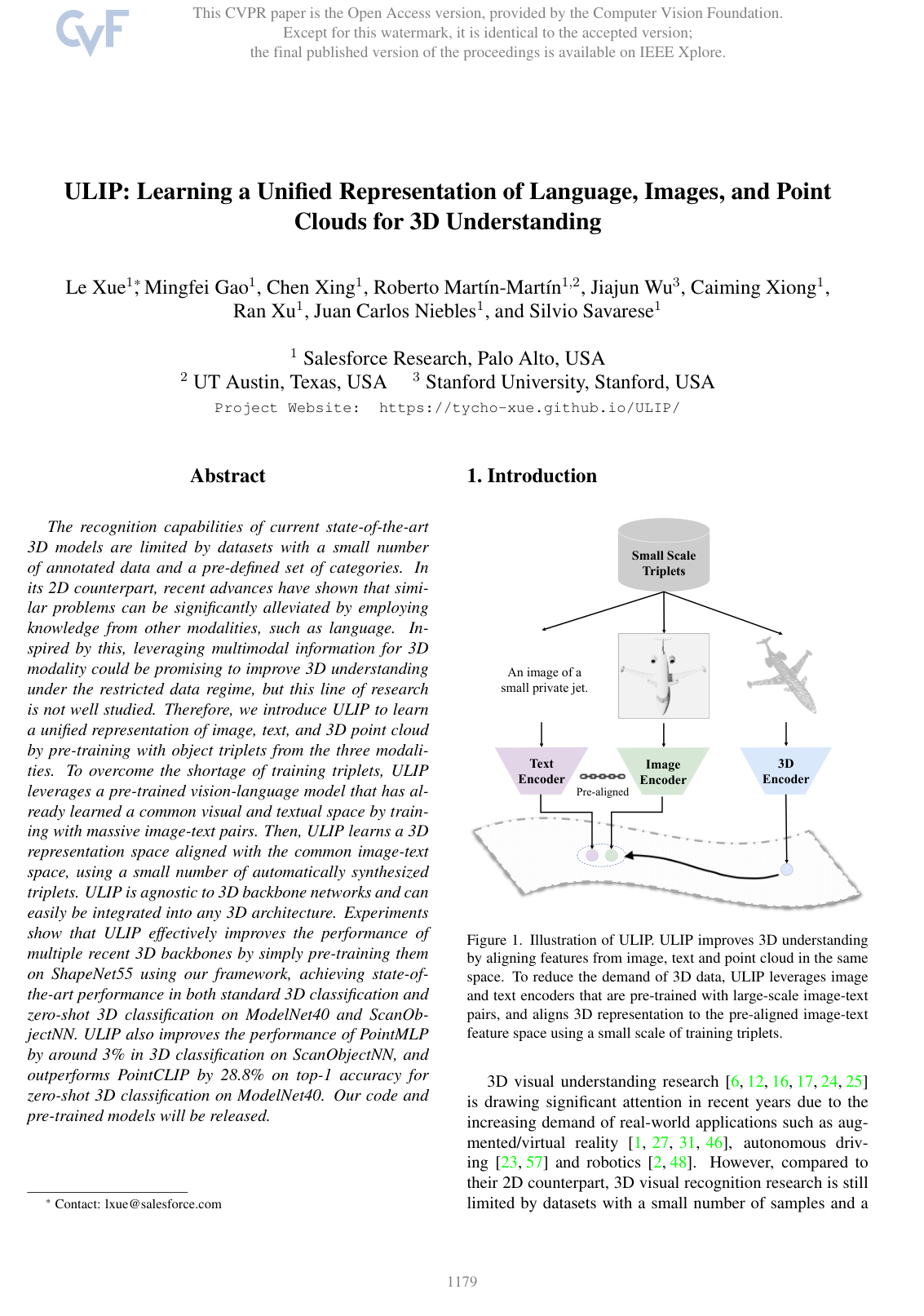
ULIP: Learning a Unified Representation of Language, Images, and Point Clouds for 3D Understanding
Le Xue, Mingfei Gao, Chen Xing, Roberto Martín-Martín, Jiajun Wu, Caiming Xiong, Ran Xu, Juan Carlos Niebles, Silvio Savarese
Why you should read this
Introduces a model-agnostic pre-training framework that aligns 3D point cloud encoders with frozen vision-language models using synthesized multimodal triplets, substantially boosting zero-shot and standard 3D recognition performance across various architectures.
The recognition capabilities of current state-of-the-art 3D models are limited by datasets with a small number of annotated data and a pre-defined set of categories. In its 2D counterpart, recent advances have shown that similar problems can be significantly alleviated by employing knowledge from other modalities, such as language. Inspired by this, leveraging multimodal information for 3D modality could be promising to improve 3D understanding under the restricted data regime, but this line of research is not well studied. Therefore, we introduce ULIP to learn a unified representation of image, text, and 3D point cloud by pre-training with object triplets from the three modalities. To overcome the shortage of training triplets, ULIP leverages a pre-trained vision-language model that has already learned a common visual and textual space by training with massive image-text pairs. Then, ULIP learns a 3D representation space aligned with the common image-text space, using a small number of automatically synthesized triplets. ULIP is agnostic to 3D backbone networks and can easily be integrated into any 3D architecture. Experiments show that ULIP effectively improves the performance of multiple recent 3D backbones by simply pre-training them on ShapeNet55 using our framework, achieving state-of-the-art performance in both standard 3D classification and zero-shot 3D classification on ModelNet40 and ScanObjectNN. ULIP also improves the performance of PointMLP by around 3% in 3D classification on ScanObjectNN, and outperforms PointCLIP by 28.8% on top-1 accuracy for zero-shot 3D classification on ModelNet40. Our code and pre-trained models will be released.
Added
2026-09-26
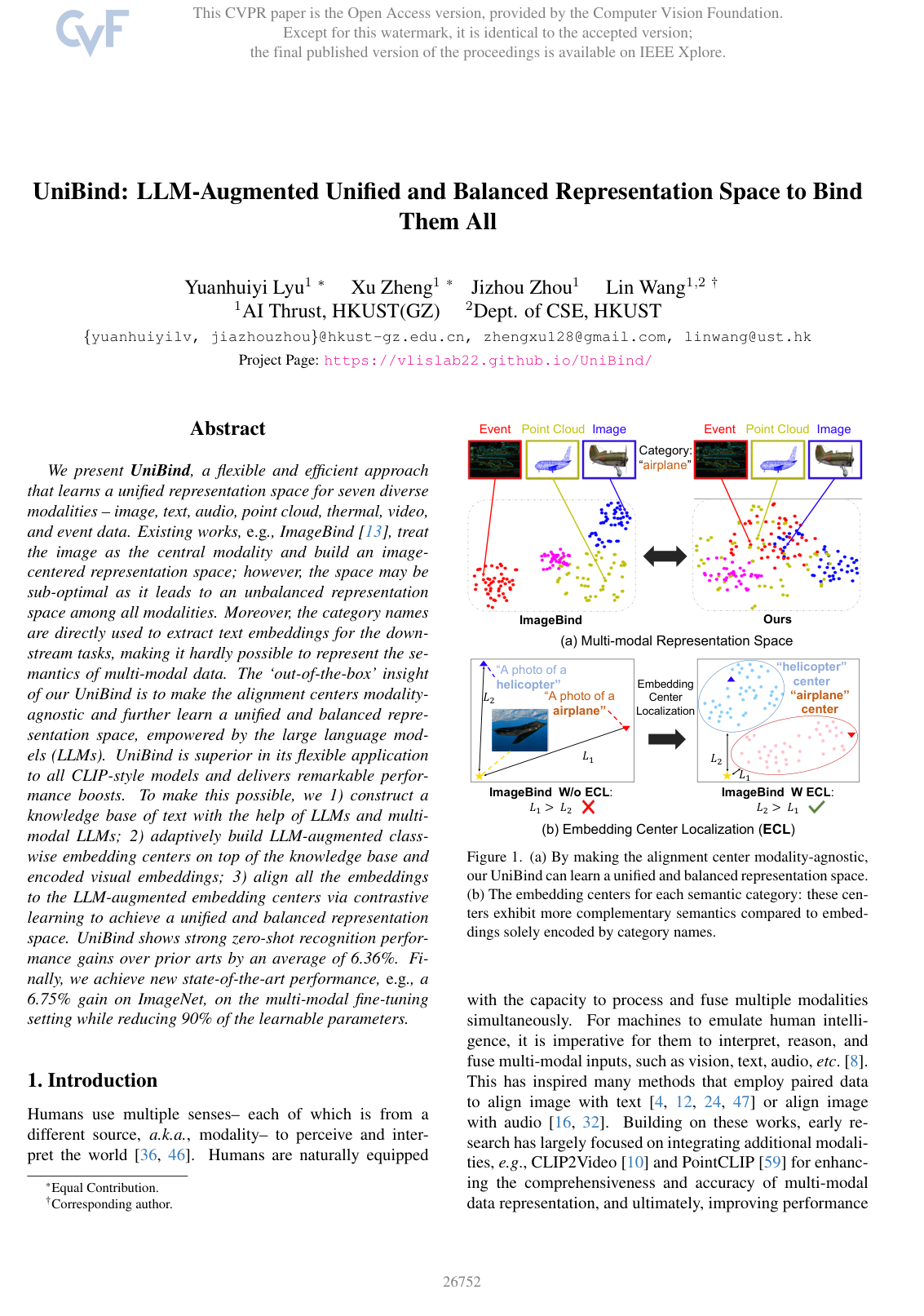
UniBind: LLM-Augmented Unified and Balanced Representation Space to Bind Them All
Yuanhuiyi Lyu, Xu Zheng, Jiazhou Zhou, Lin Wang
Why you should read this
Presents UniBind, a framework that uses large language models and multi-modal LLMs to construct modality-agnostic text embedding centers, overcoming single-modality bias to unify seven distinct sensory modalities while reducing learnable fine-tuning parameters by 90%.
We present UniBind, a flexible and efficient approach that learns a unified representation space for seven diverse modalities – image, text, audio, point cloud, thermal, video, and event data. Existing works, e.g., ImageBind [13], treat the image as the central modality and build an image-centered representation space; however, the space may be sub-optimal as it leads to an unbalanced representation space among all modalities. Moreover, the category names are directly used to extract text embeddings for the downstream tasks, making it hardly possible to represent the semantics of multi-modal data. The ‘out-of-the-box’ insight of our UniBind is to make the alignment centers modality-agnostic and further learn a unified and balanced representation space, empowered by the large language models (LLMs). UniBind is superior in its flexible application to all CLIP-style models and delivers remarkable performance boosts. To make this possible, we 1) construct a knowledge base of text with the help of LLMs and multi-modal LLMs; 2) adaptively build LLM-augmented class-wise embedding centers on top of the knowledge base and encoded visual embeddings; 3) align all the embeddings to the LLM-augmented embedding centers via contrastive learning to achieve a unified and balanced representation space. UniBind shows strong zero-shot recognition performance gains over prior arts by an average of 6.36%. Finally, we achieve new state-of-the-art performance, e.g., a 6.75% gain on ImageNet, on the multi-modal fine-tuning setting while reducing 90% of the learnable parameters.
Added
2026-09-26
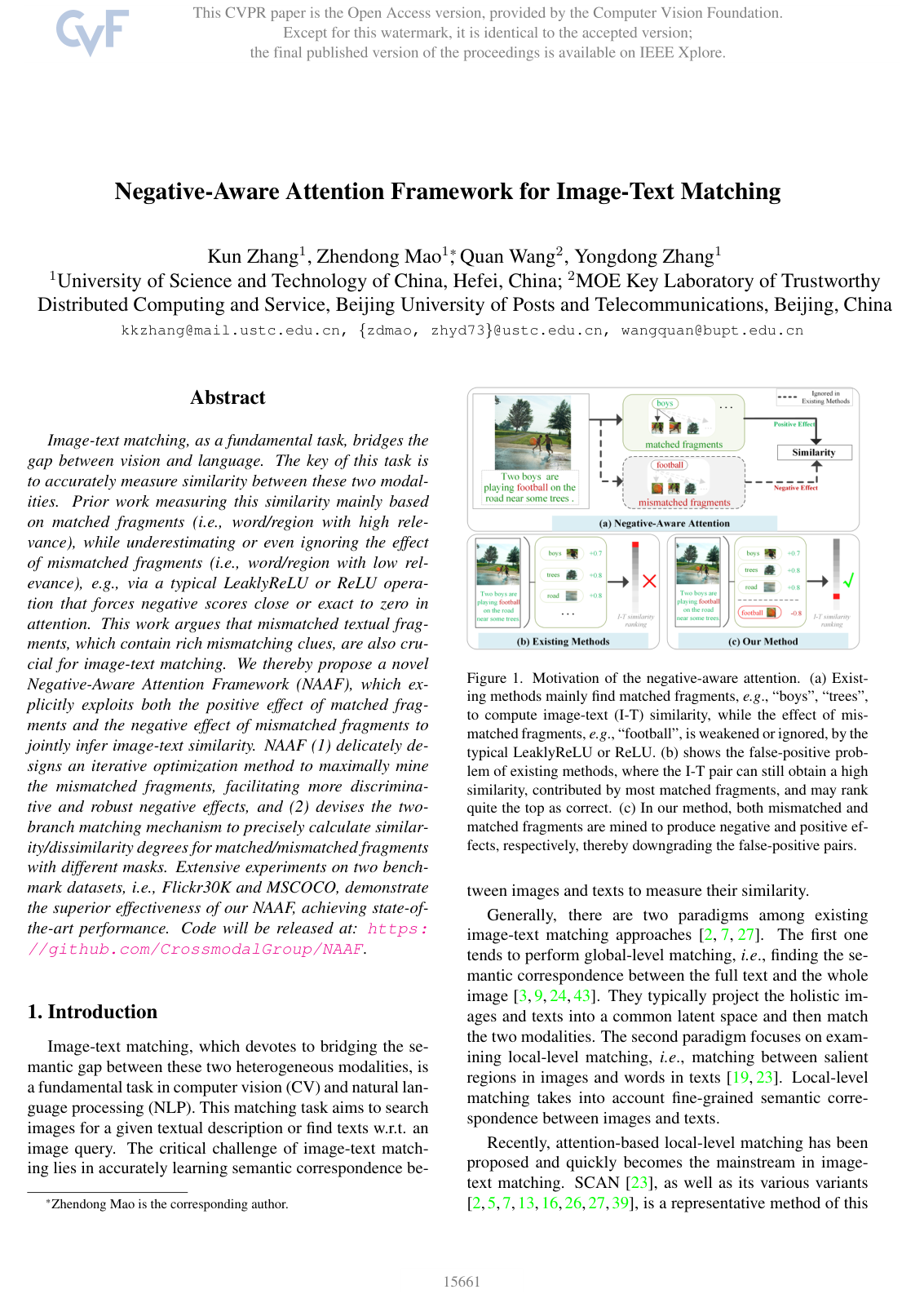
Negative-Aware Attention Framework for Image-Text Matching
Kun Zhang, Zhendong Mao, Quan Wang, Yongdong Zhang
Why you should read this
Proposes a negative-aware attention framework that explicitly mines mismatched word-region fragments alongside matched clues to prevent false-positive alignments and achieve state-of-the-art image-text matching accuracy.
Image-text matching, as a fundamental task, bridges the gap between vision and language. The key of this task is to accurately measure similarity between these two modalities. Prior work measuring this similarity mainly based on matched fragments (i.e., word/region with high relevance), while underestimating or even ignoring the effect of mismatched fragments (i.e., word/region with low relevance), e.g., via a typical LeakyReLU or ReLU operation that forces negative scores close or exact to zero in attention. This work argues that mismatched textual fragments, which contain rich mismatching clues, are also crucial for image-text matching. We thereby propose a novel Negative-Aware Attention Framework (NAAF), which explicitly exploits both the positive effect of matched fragments and the negative effect of mismatched fragments to jointly infer image-text similarity. NAAF (1) delicately designs an iterative optimization method to maximally mine the mismatched fragments, facilitating more discriminative and robust negative effects, and (2) devises the two-branch matching mechanism to precisely calculate similarity/dissimilarity degrees for matched/mismatched fragments with different masks. Extensive experiments on two benchmark datasets, i.e., Flickr30K and MSCOCO, demonstrate the superior effectiveness of our NAAF, achieving state-of-the-art performance. Code will be released at: https://github.com/CrossmodalGroup/NAAF.
Added
2026-09-26
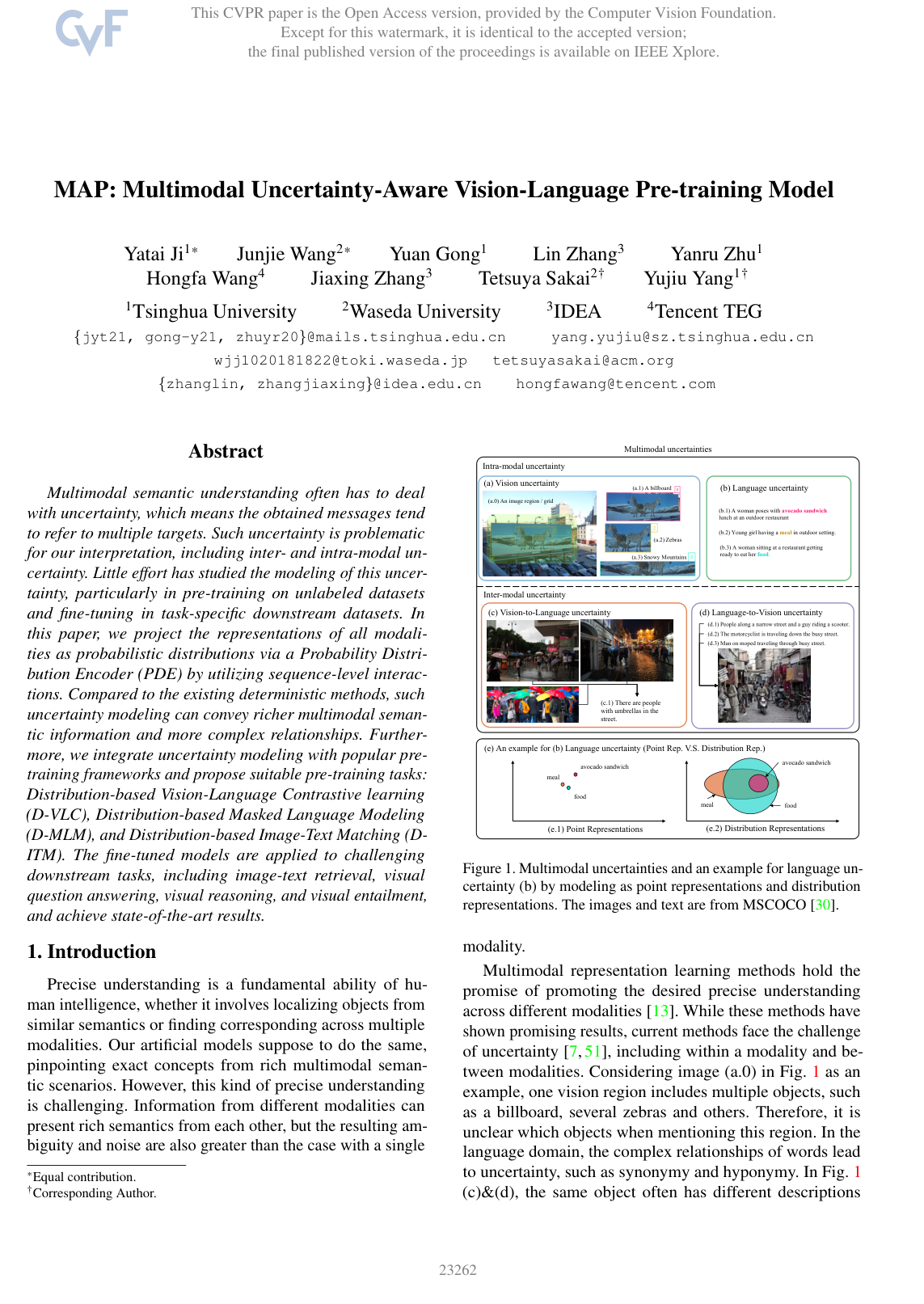
MAP: Multimodal Uncertainty-Aware Vision-Language Pre-training Model
Yatai Ji, Junjie Wang, Yuan Gong, Lin Zhang, Yanru Zhu, Hongfa Wang, Jiaxing Zhang, Tetsuya Sakai, Yujiu Yang
Why you should read this
Proposes a vision-language pre-training framework that models multimodal features as Gaussian distributions instead of deterministic points to capture inter- and intra-modal semantic uncertainty across downstream tasks like visual reasoning and image-text retrieval.
Multimodal semantic understanding often has to deal with uncertainty, which means the obtained messages tend to refer to multiple targets. Such uncertainty is problematic for our interpretation, including inter- and intra-modal uncertainty. Little effort has studied the modeling of this uncertainty, particularly in pre-training on unlabeled datasets and fine-tuning in task-specific downstream datasets. In this paper, we project the representations of all modalities as probabilistic distributions via a Probability Distribution Encoder (PDE) by utilizing sequence-level interactions. Compared to the existing deterministic methods, such uncertainty modeling can convey richer multimodal semantic information and more complex relationships. Furthermore, we integrate uncertainty modeling with popular pre-training frameworks and propose suitable pre-training tasks: Distribution-based Vision-Language Contrastive learning (D-VLC), Distribution-based Masked Language Modeling (D-MLM), and Distribution-based Image-Text Matching (D-ITM). The fine-tuned models are applied to challenging downstream tasks, including image-text retrieval, visual question answering, visual reasoning, and visual entailment, and achieve state-of-the-art results.
Added
2026-09-26
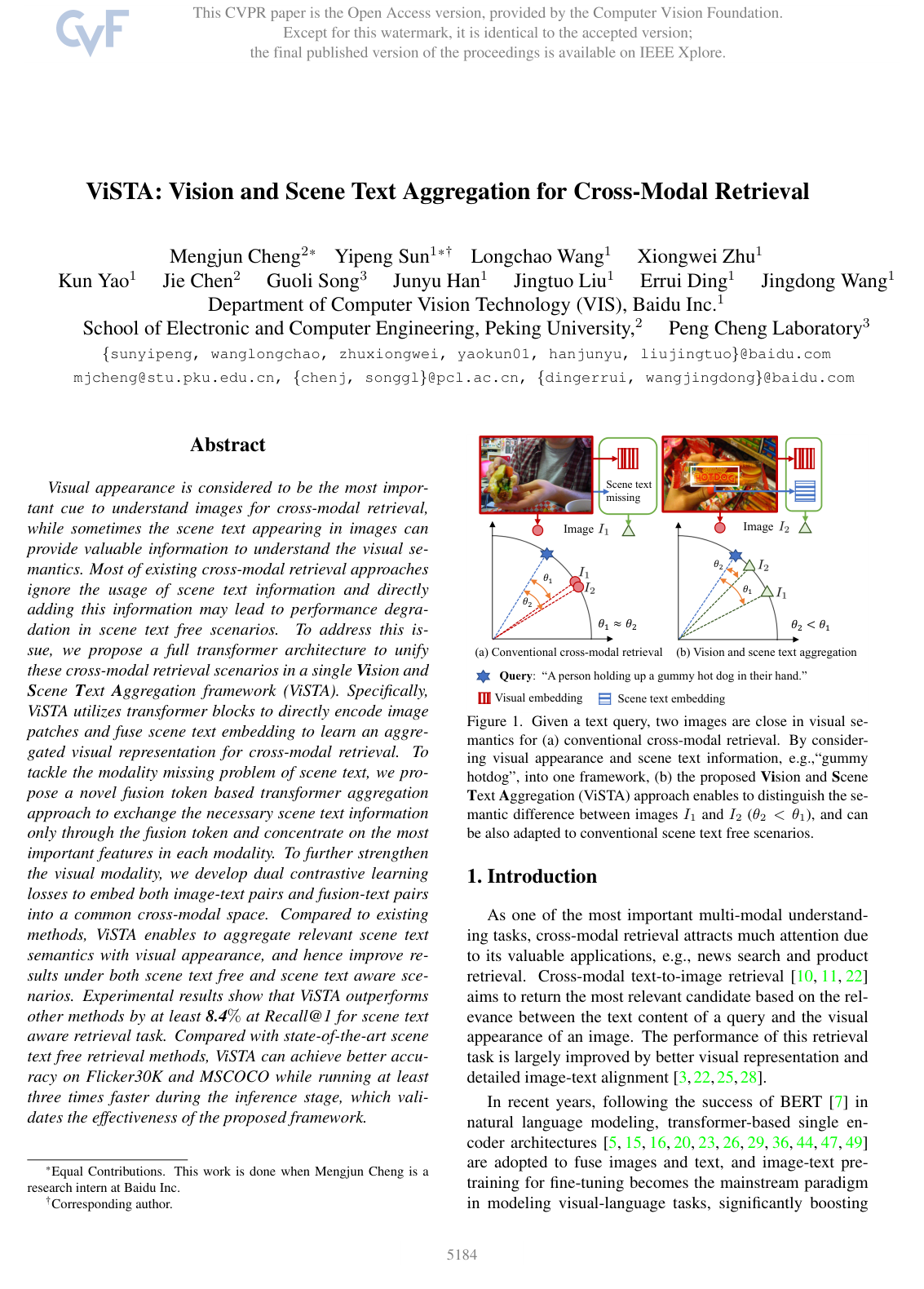
ViSTA: Vision and Scene Text Aggregation for Cross-Modal Retrieval
Mengjun Cheng, Yipeng Sun, Longchao Wang, Xiongwei Zhu, Kun Yao, Jie Chen, Guoli Song, Junyu Han, Jingtuo Liu, Errui Ding, Jingdong Wang
Why you should read this
Proposes a dual-encoder transformer architecture that fuses visual appearance with detected scene text via a shared fusion token and dual contrastive objectives, enabling unified cross-modal retrieval across both text-rich and text-free images while achieving faster inference.
Added
2026-09-26
Cobra: Extending Mamba to Multi-Modal Large Language Model for Efficient Inference
Han Zhao, Min Zhang, Wei Zhao, Pengxiang Ding, Siteng Huang, Donglin Wang
Why you should read this
Introduces Cobra, a linear-complexity multimodal large language model that integrates the Mamba architecture with visual inputs to achieve faster inference speeds and comparable accuracy to LLaVA using 43% of the parameters.
In recent years, the application of multimodal large language models (MLLM) in various fields has achieved remarkable success. However, as the foundation model for many downstream tasks, current MLLMs are composed of the well-known Transformer network, which has a less efficient quadratic computation complexity. To improve the efficiency of such basic models, we propose Cobra, a linear computational complexity MLLM. Specifically, Cobra integrates the efficient Mamba language model into the visual modality. Moreover, we explore and study various modal fusion schemes to create an effective multi-modal Mamba. Extensive experiments demonstrate that (1) Cobra achieves extremely competitive performance with current computationally efficient state-of-the-art methods, e.g., LLaVA-Phi, TinyLLaVA, and MobileVLM v2, and has faster speed due to Cobra's linear sequential modeling. (2) Interestingly, the results of closed-set challenging prediction benchmarks show that Cobra performs well in overcoming visual illusions and spatial relationship judgments. (3) Notably, Cobra even achieves comparable performance to LLaVA with about 43% of the number of parameters. We will make all codes of Cobra open-source and hope that the proposed method can facilitate future research on complexity problems in MLLM. Our project page is available at: this https URL.
Added
2026-09-26
Stacked Cross Attention for Image-Text Matching
Kuang-Huei Lee, Xi Chen, Gang Hua, Houdong Hu, Xiaodong He
Why you should read this
Proposes a stacked cross-attention network that aligns visual regions with corresponding sentence words, achieving significant gains in bidirectional image-text retrieval accuracy on MS-COCO and Flickr30K.
In this paper, we study the problem of image-text matching. Inferring the latent semantic alignment between objects or other salient stuff (e.g. snow, sky, lawn) and the corresponding words in sentences allows to capture fine-grained interplay between vision and language, and makes image-text matching more interpretable. Prior work either simply aggregates the similarity of all possible pairs of regions and words without attending differentially to more and less important words or regions, or uses a multi-step attentional process to capture limited number of semantic alignments which is less interpretable. In this paper, we present Stacked Cross Attention to discover the full latent alignments using both image regions and words in a sentence as context and infer image-text similarity. Our approach achieves the state-of-the-art results on the MS-COCO and Flickr30K datasets. On Flickr30K, our approach outperforms the current best methods by 22.1% relatively in text retrieval from image query, and 18.2% relatively in image retrieval with text query (based on Recall@1). On MS-COCO, our approach improves sentence retrieval by 17.8% relatively and image retrieval by 16.6% relatively (based on Recall@1 using the 5K test set). Code has been made available at: this https URL.
Added
2026-09-25
Multimodal Machine Learning: A Survey and Taxonomy
Tadas Baltrušaitis, Chaitanya Ahuja, Louis-Philippe Morency
Why you should read this
Establishes a comprehensive taxonomy for multimodal machine learning by structuring the field around five fundamental technical challenges: representation, translation, alignment, fusion, and co-learning.
Our experience of the world is multimodal - we see objects, hear sounds, feel texture, smell odors, and taste flavors. Modality refers to the way in which something happens or is experienced and a research problem is characterized as multimodal when it includes multiple such modalities. In order for Artificial Intelligence to make progress in understanding the world around us, it needs to be able to interpret such multimodal signals together. Multimodal machine learning aims to build models that can process and relate information from multiple modalities. It is a vibrant multi-disciplinary field of increasing importance and with extraordinary potential. Instead of focusing on specific multimodal applications, this paper surveys the recent advances in multimodal machine learning itself and presents them in a common taxonomy. We go beyond the typical early and late fusion categorization and identify broader challenges that are faced by multimodal machine learning, namely: representation, translation, alignment, fusion, and co-learning. This new taxonomy will enable researchers to better understand the state of the field and identify directions for future research.
Added
2026-09-10
Gemini Embedding 2: A Native Multimodal Embedding Model from Gemini
Madhuri Shanbhogue, Zhe Li, Shanfeng Zhang, Gustavo Hernández Ábrego, Shih-Cheng Huang, Aashi Jain, Daniel Salz, Sonam Goenka, Chaitra Hegde, Ji Ma, Feiyang Chen, Jiaxing Wu, Tanmaya Dabral, Babak Samari, Kevin Poulet, Daniel Cer, Kaifeng Chen, Paul Suganathan, Hui Hui, Jovan Andonov, Philippe Schlattner, Jay Han, Iftekhar Naim, Wing Lowe, Vladimir Pchelin, Albert Yang, Yi-Ting Chen, Zhongli Ding, Grace Zhang, Georg Heigold, Yichang Chen, Antoine Reveillon, Brendan Mccloskey, Wenlei Zhou, Dahun Kim, Rui Meng, Emma Wang, Jack Zheng, Halley Fede, Zhen Yang, Keegan Mosley, Brian Potetz, Sahil Dua, Henrique Schechter Vera, Shen Gao, Hesen Zhang, Andreas Hess, Hengxuan Ying, Alberto Montes, Karan Gill, Min Choi, Sebastian Russo, Anja Hauth, Jinhyuk Lee, Michael Boratko, Megan Barnes, Vikram Rao, Claudiu Musat, Cyril Allauzen, Ehsan Variani, Shankar Kumar, Tom Bagby, Junyi Jiao, Yang Gu, Tengxin Li, Ayush Agrawal, Roberto Santana, Dev Nath, Stephen Karukas, Shuoxuan Han, Lucia Loher, Alice Twu, Nidhi Vyas, Siddharth Bhai, Frank Palma Gomez, Wangyuan Zhang, Chaoren Liu, Jizheng Yang, Steve Qiu, Shijie Zhang, Sujay Kulkarni, Sascha Rothe, Sean Nakamoto, Raphael Hoffmann, Zach Gleicher, Yunhsuan Sung, Qin Yin, Tom Duerig, Mojtaba Seyedhosseini
Why you should read this
Introduces Gemini Embedding 2, a multimodal embedding model that achieves state-of-the-art performance across unimodal, cross-modal, and multimodal retrieval tasks by leveraging Gemini's capabilities for unified representation and robust zero-shot generalization across diverse domains.
We introduce Gemini Embedding 2, a native multimodal embedding model that allows embedding video, audio, image, and text modalities in a unified representation space. We leverage the multimodal capabilities of Gemini to produce embeddings for arbitrary combinations of interleaved inputs across all these modalities that generalize well across a wide variety of tasks. Applying large-scale contrastive learning in a multi-task multi-stage training setup, we achieve state-of-the-art performance on key embedding benchmarks including unimodal, cross-modal, and multimodal retrieval spanning a diverse set of tasks. We show that our embedding model demonstrates strong performance (with a score of 62.9 R@1 on MSCOCO, 68.8 NDCG@10 on Vatex, 69.9 on MTEB multilingual and 84.0 on MTEB Code) across a variety of tasks surpassing the performance of specialized models. These unified capabilities make Gemini Embedding 2 a promising candidate for downstream use cases such as RAG, recommendation and search. Furthermore, its robust zero-shot performance across distinct fields - from astronomy and bioscience to fine arts and the culinary arts - establishes it as a highly reliable, out-of-the-box representation even for specialized domains.
Added
2026-05-29

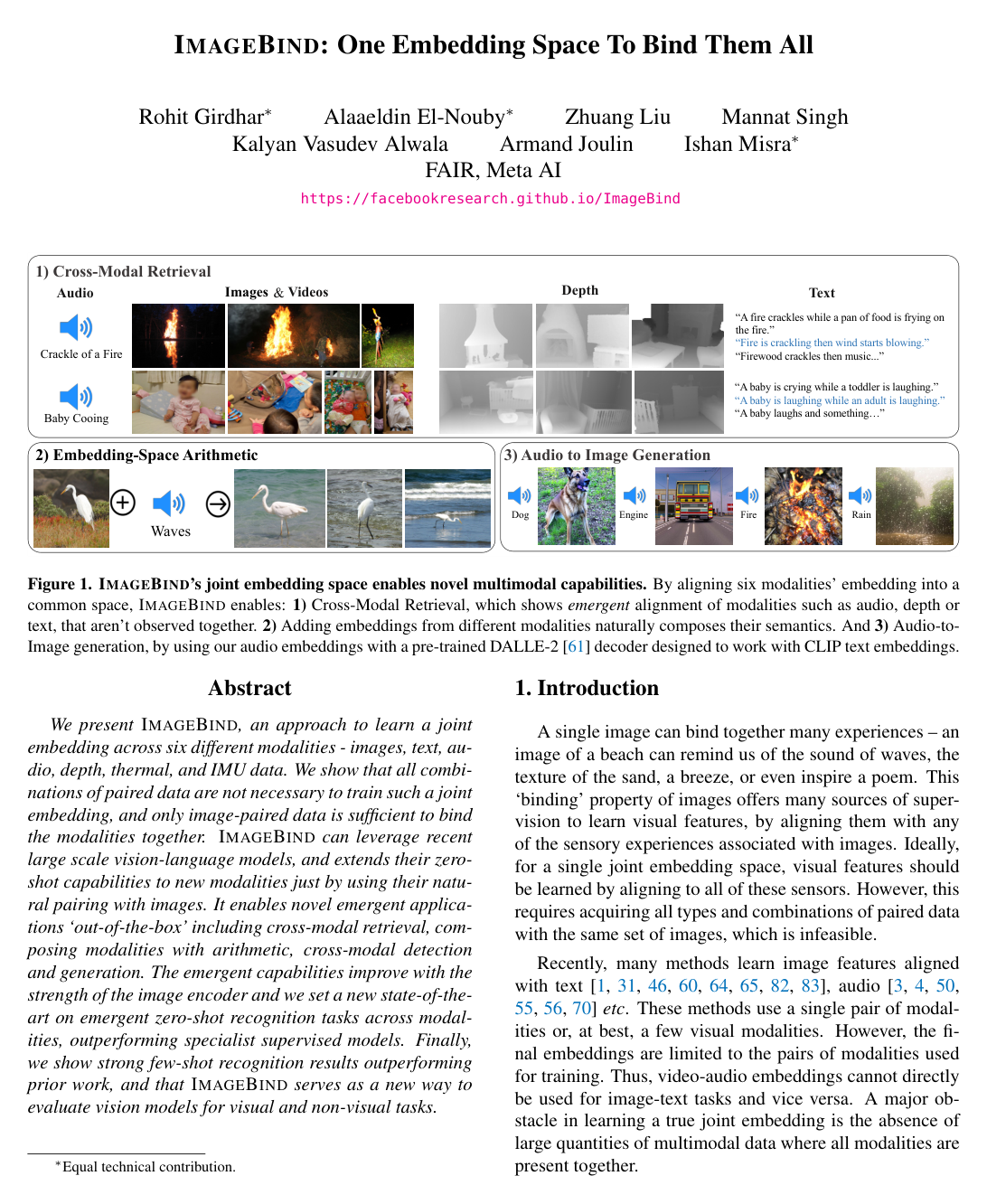
ImageBind One Embedding Space to Bind Them All
Rohit Girdhar, Alaaeldin El-Nouby, Zhuang Liu, Mannat Singh, Kalyan Vasudev Alwala, Armand Joulin, Ishan Misra
Why you should read this
Demonstrates that aligning various modalities (audio, depth, thermal) to images automatically aligns them to each other, creating a universal embedding space.
We present ImageBind, an approach to learn a joint embedding across six different modalities - images, text, audio, depth, thermal, and IMU data. We show that all combinations of paired data are not necessary to train such a joint embedding, and only image-paired data is sufficient to bind the modalities together. ImageBind can leverage recent large scale vision-language models, and extends their zero-shot capabilities to new modalities just by using their natural pairing with images. It enables novel emergent applications 'out-of-the-box' including cross-modal retrieval, composing modalities with arithmetic, cross-modal detection and generation. The emergent capabilities improve with the strength of the image encoder and we set a new state-of-the-art on emergent zero-shot recognition tasks across modalities, outperforming specialist supervised models. Finally, we show strong few-shot recognition results outperforming prior work, and that ImageBind serves as a new way to evaluate vision models for visual and non-visual tasks.
Added
2026-01-28