Geometric Multimodal Contrastive Representation Learning
Petra PoklukarMiguel VascoHang YinFrancisco S. MeloAna PaivaDanica Kragic
Proposes a geometric multimodal contrastive learning framework that aligns modality-specific encoders with complete observations in a shared latent space, maintaining high task performance even when individual modalities are missing during evaluation.
Modern artificial intelligence systems frequently rely on multiple data sources, such as video, audio, text, and physical sensors, to make decisions and control automated tasks. However, in practical deployment, systems often experience sensor failures, communication dropouts, or missing data streams. Existing machine learning models often struggle under these conditions because the internal representations derived from a single data source become geometrically misaligned with the representations learned when all data streams are present simultaneously.
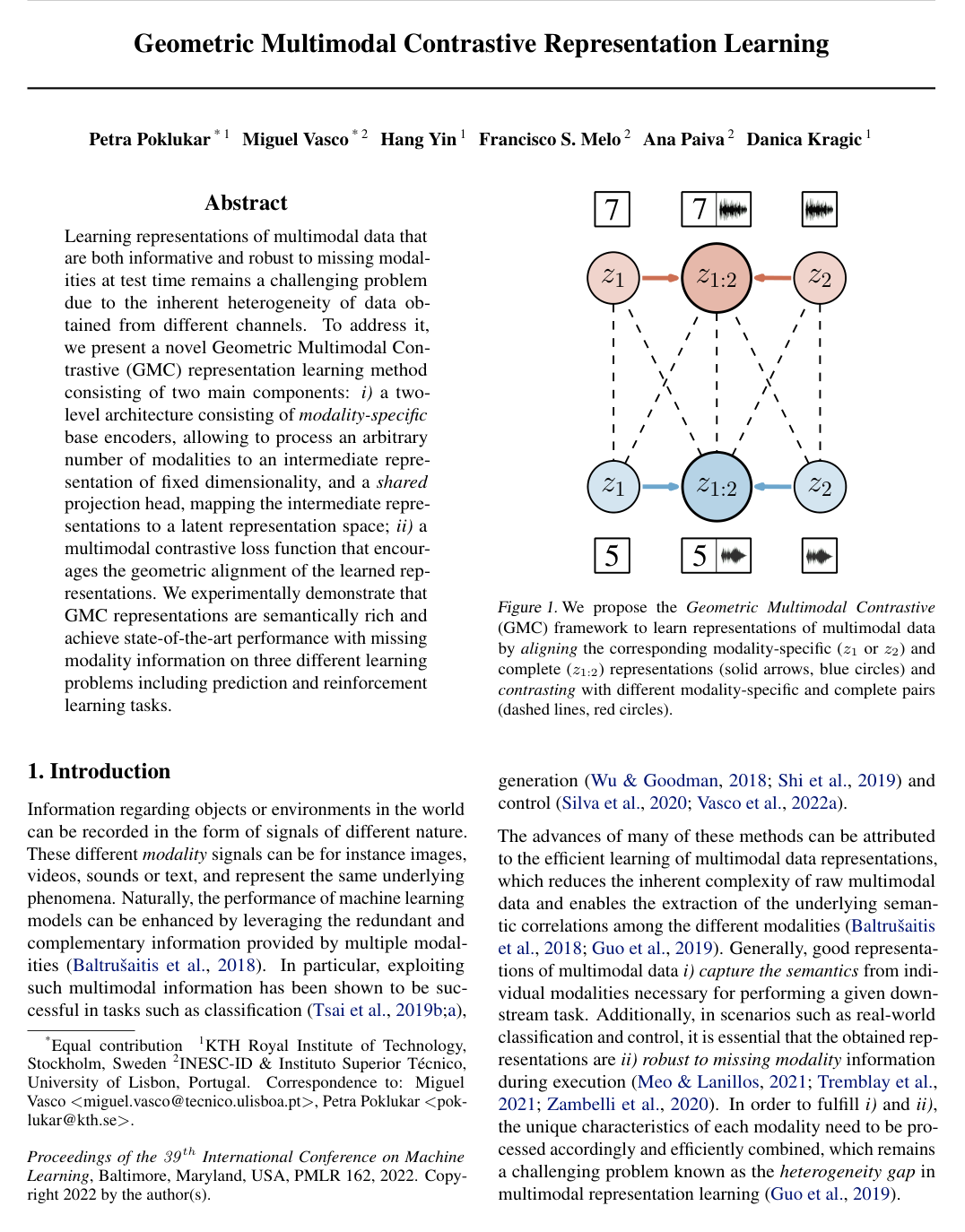
The article introduces the Geometric Multimodal Contrastive (GMC) framework to solve this vulnerability. The primary objective is to demonstrate that GMC can create semantically rich, geometrically aligned data representations that maintain state-of-the-art performance across classification and control tasks, even when one or more data streams are entirely absent during testing.
To evaluate this capability, the authors conducted experiments across three distinct learning environments: unsupervised classification using handwriting digits across four channels (images, sound, motion trajectories, and labels), supervised sentiment classification on video datasets (CMU-MOSEI and CMU-MOSI), and reinforcement learning control on a simulated multimodal inverted pendulum. The approach uses a two-level neural network architecture combining modality-specific base encoders with a shared projection head. It applies a contrastive learning objective that directly aligns single-source representations with full multimodal representations in a shared space, scaling linearly with the number of input sources.
Across all benchmarks, GMC demonstrated significant performance and efficiency advantages. In unsupervised digit classification with incomplete input data, GMC achieved between 93.04% and 99.96% accuracy across individual modalities where competing baselines dropped as low as 10% to 79%. In supervised video sentiment analysis missing visual or audio streams, GMC raised binary accuracy to roughly 65% compared to baseline drops below 54%. In reinforcement learning control with missing image or sound data, agents using GMC experienced virtually zero performance degradation, maintaining an average return of approximately -0.94 to -0.96 compared to sharp declines to -6.64 in baseline methods. In addition, GMC achieved these results with high computational efficiency, requiring 50% to 68% fewer parameters than alternative multimodal baseline models.
These findings indicate that explicit geometric alignment prevents downstream task failure caused by sudden data source loss, directly improving system reliability, safety, and resilience in autonomous operations. By operating with significantly fewer parameters and offering straightforward integration with existing network architectures, the method reduces computing costs and deployment overhead without sacrificing baseline accuracy.
Organizations deploying multimodal models in real-world environments should consider adopting contrastive alignment methods to mitigate sensor failure risks. Next steps should include exploring modality-specific data augmentations and conducting pilot tests in real-world physical and industrial environments. Decision-makers should note that GMC's performance gains are slightly moderated when trained on smaller datasets, as demonstrated by the smaller CMU-MOSI evaluation, though confidence in the framework remains high given consistent improvements across diverse test domains.
- Paper: Contrastive Multiview Coding, Yonglong Tian et al. (2019). Its contrastive multiview framework establishes how paired sensory views can be aligned in a shared representation space, the key setup GMC adapts to handle missing modalities.
- Paper: Understanding Contrastive Representation Learning through Alignment and Uniformity on the Hypersphere, Tongzhou Wang et al. (2020). Its alignment-and-uniformity account of contrastive objectives clarifies the geometric properties that GMC explicitly measures and seeks to preserve.
- Paper: Multimodal Machine Learning: A Survey and Taxonomy, Tadas Baltrušaitis et al. (2017). Its taxonomy of multimodal representation, alignment, fusion, and co-learning gives the conceptual framework for locating GMC’s missing-modality alignment problem.
- Paper: MMANet: Margin-Aware Distillation and Modality-Aware Regularization for Incomplete Multimodal Learning, Shicai Wei et al. (2023). It extends GMC’s missing-input robustness problem with margin-aware distillation and modality-aware regularization for handling arbitrary incomplete modality combinations.
- Paper: Factorized Contrastive Learning: Going Beyond Multi-view Redundancy, Paul Pu Liang et al. (2023). It carries multimodal contrastive representation learning beyond alignment by factorizing shared and modality-specific task-relevant information.
- Paper: FOCAL: Contrastive Learning for Multimodal Time-Series Sensing Signals in Factorized Orthogonal Latent Space, Shengzhong Liu et al. (2023). It extends contrastive multimodal sensing to factorized shared and private features, addressing modality-unique signals that geometric alignment alone may not retain.
- Paper: Provable Dynamic Fusion for Low-Quality Multimodal Data, Qingyang Zhang et al. (2023). It develops a complementary robustness strategy that dynamically weights degraded or unreliable modalities, building on the practical challenge of sensory failure.
- Paper: Multimodal Prompting with Missing Modalities for Visual Recognition, Yi-Lun Lee et al. (2023). It applies missing-modality robustness to pretrained multimodal transformers through lightweight prompts conditioned on which input stream is absent.