CONTaiNER: Few-Shot Named Entity Recognition via Contrastive Learning
Sarkar Snigdha Sarathi DasArzoo KatiyarRebecca J. PassonneauRui Zhang
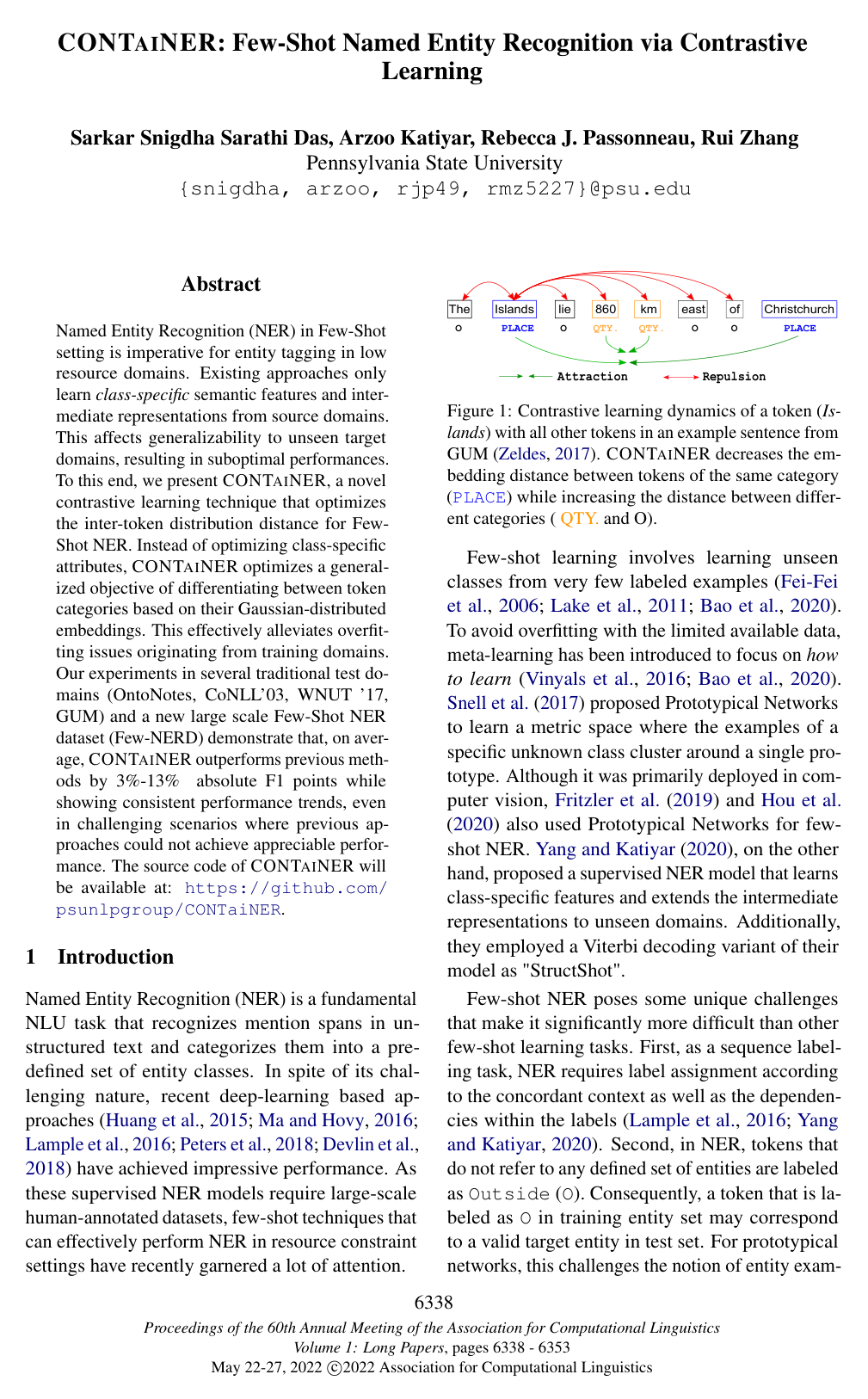
Proposes a contrastive learning framework that models token representations as Gaussian distributions to optimize distributional divergence between entity types, achieving substantial gains over existing few-shot named entity recognition methods across multiple benchmarks.
Extracting structured information from unstructured text through named entity recognition is a core capability across modern automated workflows. However, standard systems rely heavily on massive, human-annotated datasets, making deployment slow and costly when expanding into specialized domains where labeled data is scarce. While few-shot learning methods attempt to train systems using only a handful of examples, current approaches frequently struggle because they overfit to specific source categories and misclassify non-entity words that later become valid target entities.
The article evaluates a new framework named CONTAINER, which demonstrates how contrastive learning over Gaussian distributions can improve few-shot entity recognition across unseen text domains. The main objective is to establish a generalized, class-agnostic representation of language tokens that avoids overfitting and easily adapts to new entity types with minimal target-domain data.
The researchers assessed this approach by pretraining language model representations to separate distinct word categories while pulling identical categories together using probability distributions rather than traditional point embeddings. They evaluated the framework across standard benchmark datasets spanning general text, news, biomedical records, social media, and mixed genres, as well as a large-scale specialized few-shot benchmark. These tests covered both tag-set expansion within the same domain and transfer across entirely different text domains, primarily testing performance under 1-shot and 5-shot data constraints.
The evaluation revealed several key findings. First, CONTAINER outperformed existing state-of-the-art methods by an average of 3% to 13% in absolute F1 score across multiple domains. Second, the system showed its largest advantages in difficult scenarios where previous models struggled, such as cross-domain transfers and datasets with entirely disjoint coarse entity types. Third, fine-tuning on multiple target examples (such as 5-shot setups) yielded substantial performance gains, proving the framework effectively utilizes small support datasets to model class distributions. Fourth, the model learned natural label dependencies directly from contrastive training, rendering additional sequence decoding steps largely unnecessary unless transferring across extreme domain shifts.
These findings indicate that adopting distribution-based contrastive learning significantly reduces the time and cost required to deploy language processing systems in new, data-poor areas. By learning how to differentiate words rather than memorizing domain-specific labels, organizations can reliably adapt existing language models without complex, brittle prompt-engineering or extensive hyperparameter tuning.
For practical implementation, technical teams should consider adopting Gaussian contrastive objectives when developing low-resource entity extraction pipelines. While the approach delivers benchmark-leading few-shot performance, the article cautions that absolute accuracy still trails fully supervised systems trained on extensive manual annotations. Consequently, stakeholders should avoid fully autonomous deployment in high-stakes environments—such as clinical medical record extraction—without human review, and should conduct targeted pilot studies before broad operational rollout.
- Paper: A Survey on Deep Learning for Named Entity Recognition, Jing Li et al. (2018). Provides a comprehensive architectural foundation of deep learning methods and sequence representation paradigms for named entity recognition.
- Paper: SimCSE: Simple Contrastive Learning of Sentence Embeddings, Tianyu Gao et al. (2021). Introduces fundamental contrastive learning formulations for NLP text embeddings that CONTaiNER adapts to Gaussian distributional representations.
- Paper: Supervised Contrastive Learning, Prannay Khosla et al. (2020). Formulates supervised contrastive learning objectives that pull matching class representations together and push non-matching classes apart.
- Paper: Meta-Learning for Semi-Supervised Few-Shot Classification, Mengye Ren et al. (2018). Establishes prototype and metric-learning mechanics for low-resource episodic classification in few-shot settings.
- Paper: DeBERTaV3: Improving DeBERTa using ELECTRA-Style Pre-Training with Gradient-Disentangled Embedding Sharing, Pengcheng He et al. (2021). Details the pre-trained transformer architecture and representation mechanisms widely leveraged for token-level embedding extraction.
- Paper: A Simple Framework for Contrastive Learning of Visual Representations, Ting Chen et al. (2020). Introduces key contrastive framework principles, including projection heads and batch negative formulations that underpin modern contrastive representation learning.
- Paper: GLiNER: Generalist Model for Named Entity Recognition using Bidirectional Transformer, Urchade Zaratiana et al. (2024). Advances beyond few-shot distributional contrastive learning by introducing an arbitrary-type zero-shot transformer model that matches entity type representations directly against text spans.
- Paper: Good Examples Make A Faster Learner: Simple Demonstration-based Learning for Low-resource NER, Dong-Ho Lee et al. (2022). Presents an alternative demonstration-retrieval paradigm for low-resource named entity recognition without requiring distributional contrastive pretraining.
- Paper: MELM: Data Augmentation with Masked Entity Language Modeling for Low-Resource NER, Ran Zhou et al. (2022). Explores label-conditioned text augmentation to address low-resource entity recognition data scarcity complementary to contrastive representation tuning.
- Paper: Making Text Embedders Few-Shot Learners, Chaofan Li et al. (2025). Extends contrastive pre-training to make text embeddings general few-shot learners via in-context learning.
- Paper: Generalized Category Discovery with Decoupled Prototypical Network, Wenbin An et al. (2023). Extends prototypical representation learning to discover novel semantic categories alongside known classes in low-supervision scenarios.