
keyword
sequence labeling
Sequence labeling is a machine learning and natural language processing task that involves assigning a categorical tag or label to each individual item in an input sequence, such as words or characters within a text. Unlike whole-sequence classification, sequence labeling generates an output sequence corresponding to the input tokens by evaluating both the features of individual elements and the contextual dependencies between neighboring elements. This approach is widely used for structured prediction tasks such as named entity recognition, part-of-speech tagging, and syntactic chunking, typically implemented using probabilistic frameworks like hidden Markov models and conditional random fields or deep learning architectures such as recurrent neural networks and transformer-based models.
13 items
Do Transformers Parse while Predicting the Masked Word?
Haoyu Zhao, Abhishek Panigrahi, Rong Ge, Sanjeev Arora
Why you should read this
Proves that realistic-sized masked language models naturally approximate the Inside-Outside parsing algorithm on context-free grammar data, offering a theoretical and empirical explanation for how transformers implicitly learn syntactic structure during unsupervised pre-training.
Pre-trained language models have been shown to encode linguistic structures like parse trees in their embeddings while being trained unsupervised. Some doubts have been raised whether the models are doing parsing or only some computation weakly correlated with it. Concretely: (a) Is it possible to explicitly describe transformers with realistic embedding dimensions, number of heads, etc. that are capable of doing parsing—or even approximate parsing? (b) Why do pre-trained models capture parsing structure? This paper takes a step toward answering these questions in the context of generative modeling with PCFGs. We show that masked language models like BERT or RoBERTa of moderate sizes can approximately execute the Inside-Outside algorithm for the English PCFG. We also show that the Inside-Outside algorithm is optimal for masked language modeling loss on the PCFG-generated data. We conduct probing experiments on models pre-trained on PCFG-generated data to show that this not only allows recovery of approximate parse tree, but also recovers marginal span probabilities computed by the Inside-Outside algorithm, which suggests an implicit bias of masked language modeling towards this algorithm.
Added
2026-10-05
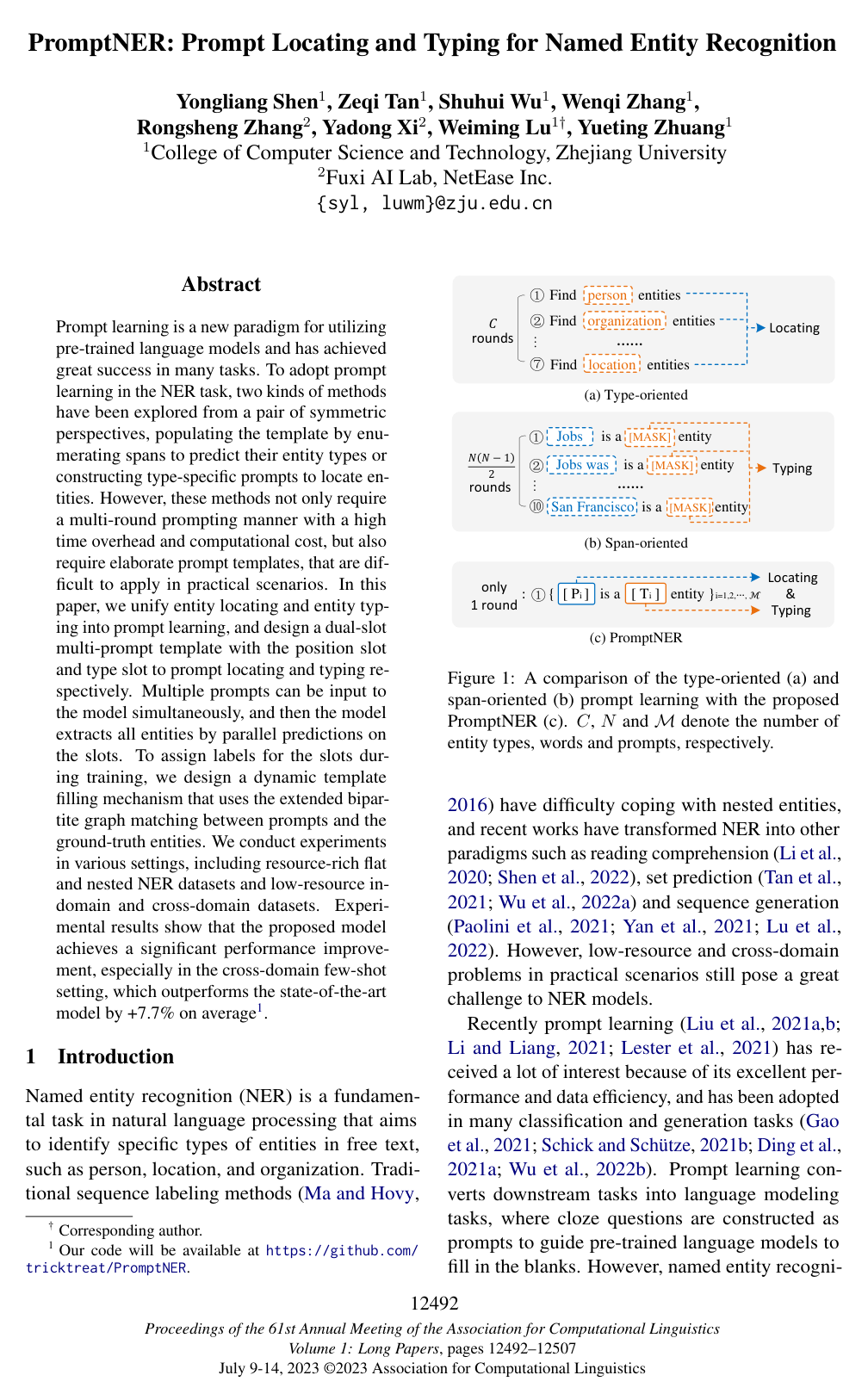
PromptNER: Prompt Locating and Typing for Named Entity Recognition
Yongliang Shen, Zeqi Tan, Shuhui Wu, Wenqi Zhang, Rongsheng Zhang, Yadong Xi, Weiming Lu, Yueting Zhuang
Why you should read this
Proposes a single-round prompt learning framework for named entity recognition that unifies entity locating and typing via dual-slot templates and bipartite graph matching, avoiding span enumeration while boosting cross-domain few-shot performance by 7.7%.
Prompt learning is a new paradigm for utilizing pre-trained language models and has achieved great success in many tasks. To adopt prompt learning in the NER task, two kinds of methods have been explored from a pair of symmetric perspectives, populating the template by enumerating spans to predict their entity types or constructing type-specific prompts to locate entities. However, these methods not only require a multi-round prompting manner with a high time overhead and computational cost, but also require elaborate prompt templates, that are difficult to apply in practical scenarios. In this paper, we unify entity locating and entity typing into prompt learning, and design a dual-slot multi-prompt template with the position slot and type slot to prompt locating and typing respectively. Multiple prompts can be input to the model simultaneously, and then the model extracts all entities by parallel predictions on the slots. To assign labels for the slots during training, we design a dynamic template filling mechanism that uses the extended bipartite graph matching between prompts and the ground-truth entities. We conduct experiments in various settings, including resource-rich flat and nested NER datasets and low-resource in-domain and cross-domain datasets. Experimental results show that the proposed model achieves a significant performance improvement, especially in the cross-domain few-shot setting, which outperforms the state-of-the-art model by +7.7% on average¹.
Added
2026-10-03
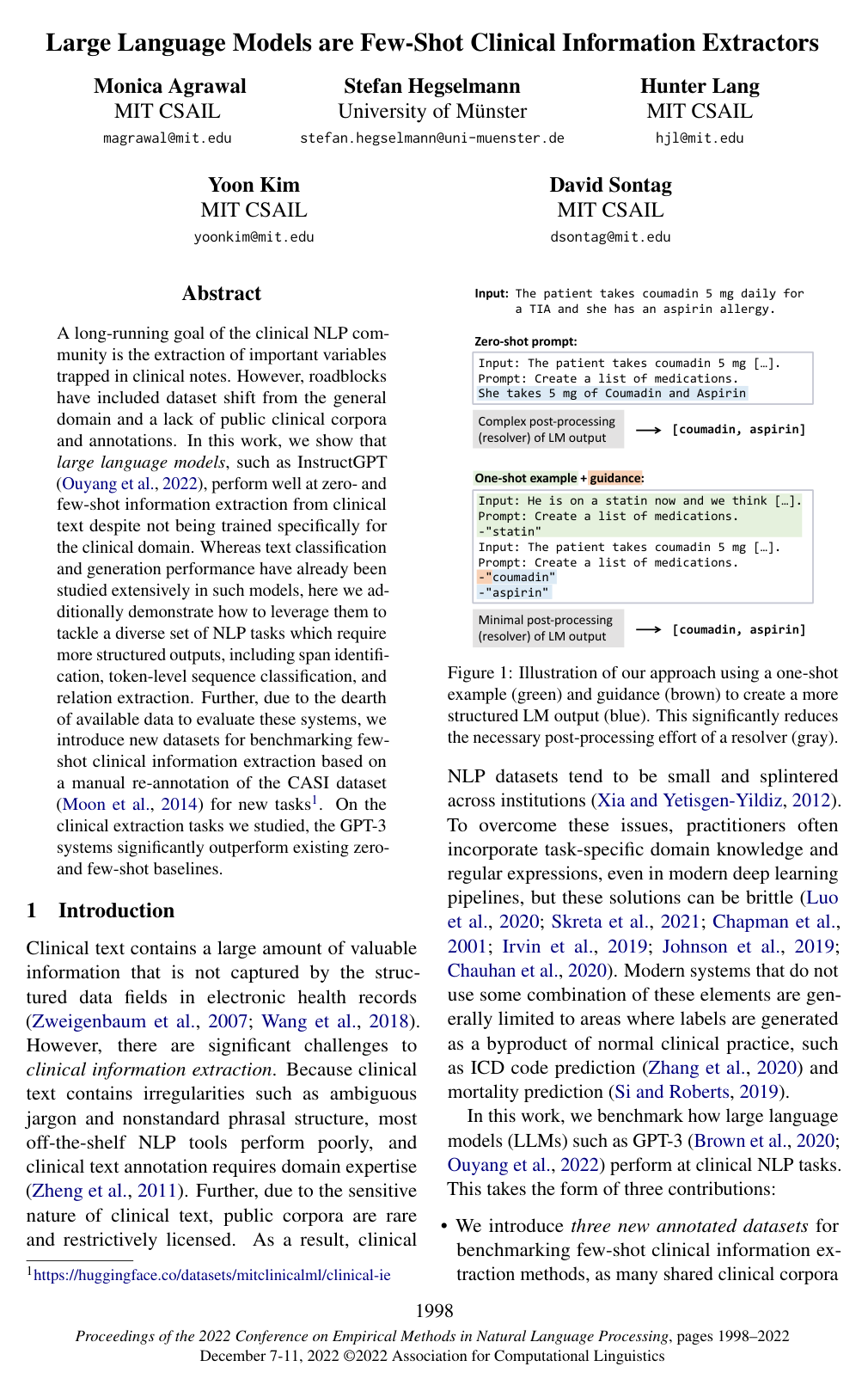
Large language models are few-shot clinical information extractors
Monica Agrawal, Stefan Hegselmann, Hunter Lang, Yoon Kim, David A. Sontag
Why you should read this
Demonstrates that general-domain large language models can perform complex few-shot clinical information extraction tasks, such as span identification and relation extraction, significantly outperforming existing baselines without domain-specific training.
A long-running goal of the clinical NLP community is the extraction of important variables trapped in clinical notes. However, roadblocks have included dataset shift from the general domain and a lack of public clinical corpora and annotations. In this work, we show that large language models, such as InstructGPT, perform well at zero- and few-shot information extraction from clinical text despite not being trained specifically for the clinical domain. Whereas text classification and generation performance have already been studied extensively in such models, here we additionally demonstrate how to leverage them to tackle a diverse set of NLP tasks which require more structured outputs, including span identification, token-level sequence classification, and relation extraction. Further, due to the dearth of available data to evaluate these systems, we introduce new datasets for benchmarking few-shot clinical information extraction based on a manual re-annotation of the CASI dataset for new tasks. On the clinical extraction tasks we studied, the GPT-3 systems significantly outperform existing zero- and few-shot baselines.
Added
2026-09-28
Contextual String Embeddings for Sequence Labeling
A. Akbik, Duncan A. J. Blythe, Roland Vollgraf
Why you should read this
Proposes extracting contextualized word representations from bidirectional character-level language models to effectively handle polysemy and subword structures, achieving state-of-the-art results in sequence labeling tasks like named entity recognition.
Recent advances in language modeling using recurrent neural networks have made it viable to model language as distributions over characters. By learning to predict the next character on the basis of previous characters, such models have been shown to automatically internalize linguistic concepts such as words, sentences, subclauses and even sentiment. In this paper, we propose to leverage the internal states of a trained character language model to produce a novel type of word embedding which we refer to as contextual string embeddings. Our proposed embeddings have the distinct properties that they (a) are trained without any explicit notion of words and thus fundamentally model words as sequences of characters, and (b) are contextualized by their surrounding text, meaning that the same word will have different embeddings depending on its contextual use. We conduct a comparative evaluation against previous embeddings and find that our embeddings are highly useful for downstream tasks: across four classic sequence labeling tasks we consistently outperform the previous state-of-the-art. In particular, we significantly outperform previous work on English and German named entity recognition (NER), allowing us to report new state-of-the-art F1-scores on the CoNLL03 shared task. We release all code and pre-trained language models in a simple-to-use framework to the re-search community, to enable reproduction of these experiments and application of our proposed embeddings to other tasks: https://github.com/zalandoresearch/flair
Added
2026-09-27

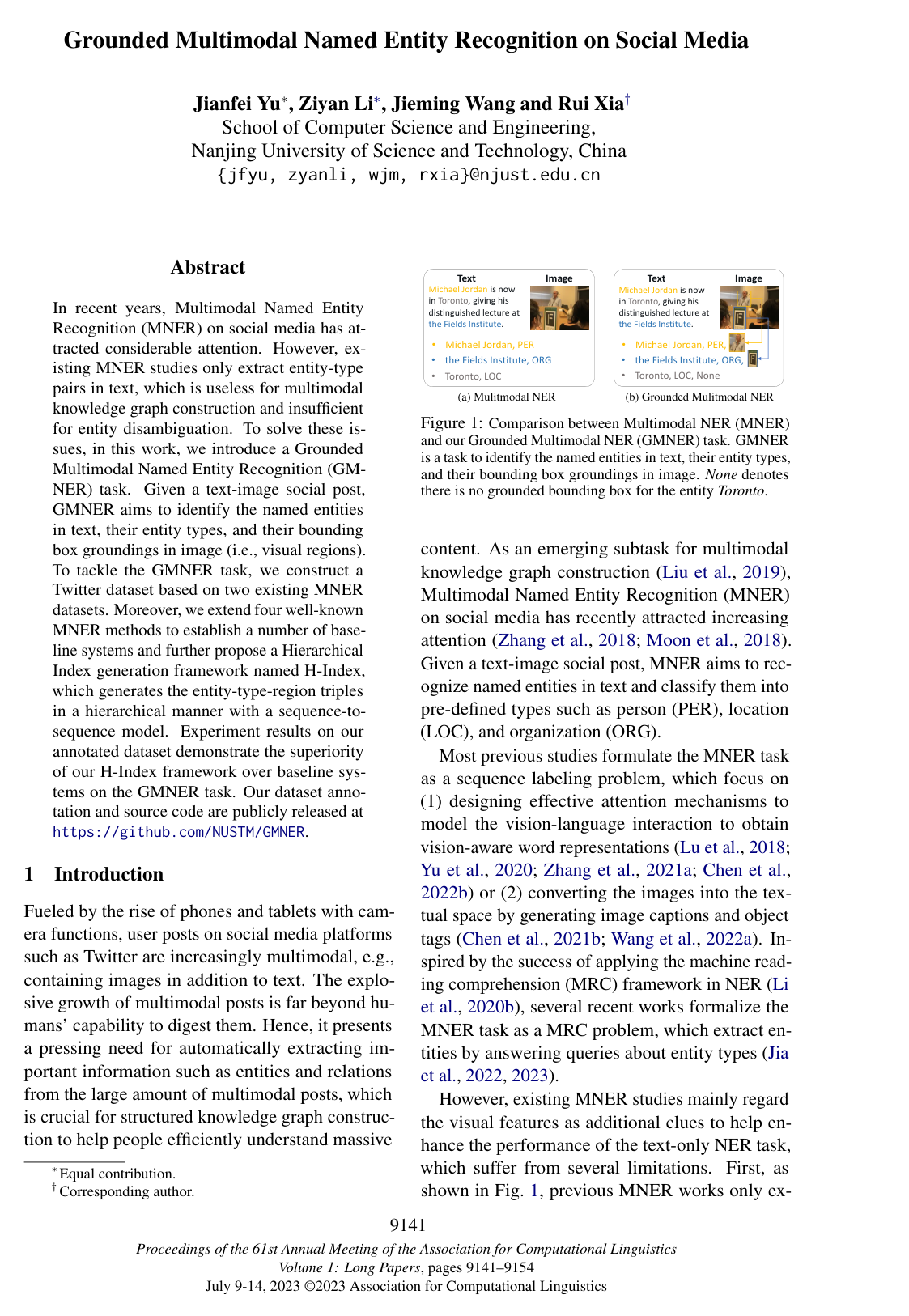
Grounded Multimodal Named Entity Recognition on Social Media
Jianfei Yu, Ziyan Li, Jieming Wang, Rui Xia
Why you should read this
Introduces the task of Grounded Multimodal Named Entity Recognition along with a benchmark Twitter dataset and a hierarchical index generation framework that jointly extracts text entities and locates their corresponding image regions to resolve visual ambiguity in social media posts.
In recent years, Multimodal Named Entity Recognition (MNER) on social media has attracted considerable attention. However, existing MNER studies only extract entity-type pairs in text, which is useless for multimodal knowledge graph construction and insufficient for entity disambiguation. To solve these issues, in this work, we introduce a Grounded Multimodal Named Entity Recognition (GMNER) task. Given a text-image social post, GMNER aims to identify the named entities in text, their entity types, and their bounding box groundings in image (i.e., visual regions). To tackle the GMNER task, we construct a Twitter dataset based on two existing MNER datasets. Moreover, we extend four well-known MNER methods to establish a number of baseline systems and further propose a Hierarchical Index generation framework named H-Index, which generates the entity-type-region triples in a hierarchical manner with a sequence-to-sequence model. Experiment results on our annotated dataset demonstrate the superiority of our H-Index framework over baseline systems on the GMNER task. Our dataset annotation and source code are publicly released at https://github.com/NUSTM/GMNER.
Added
2026-09-26
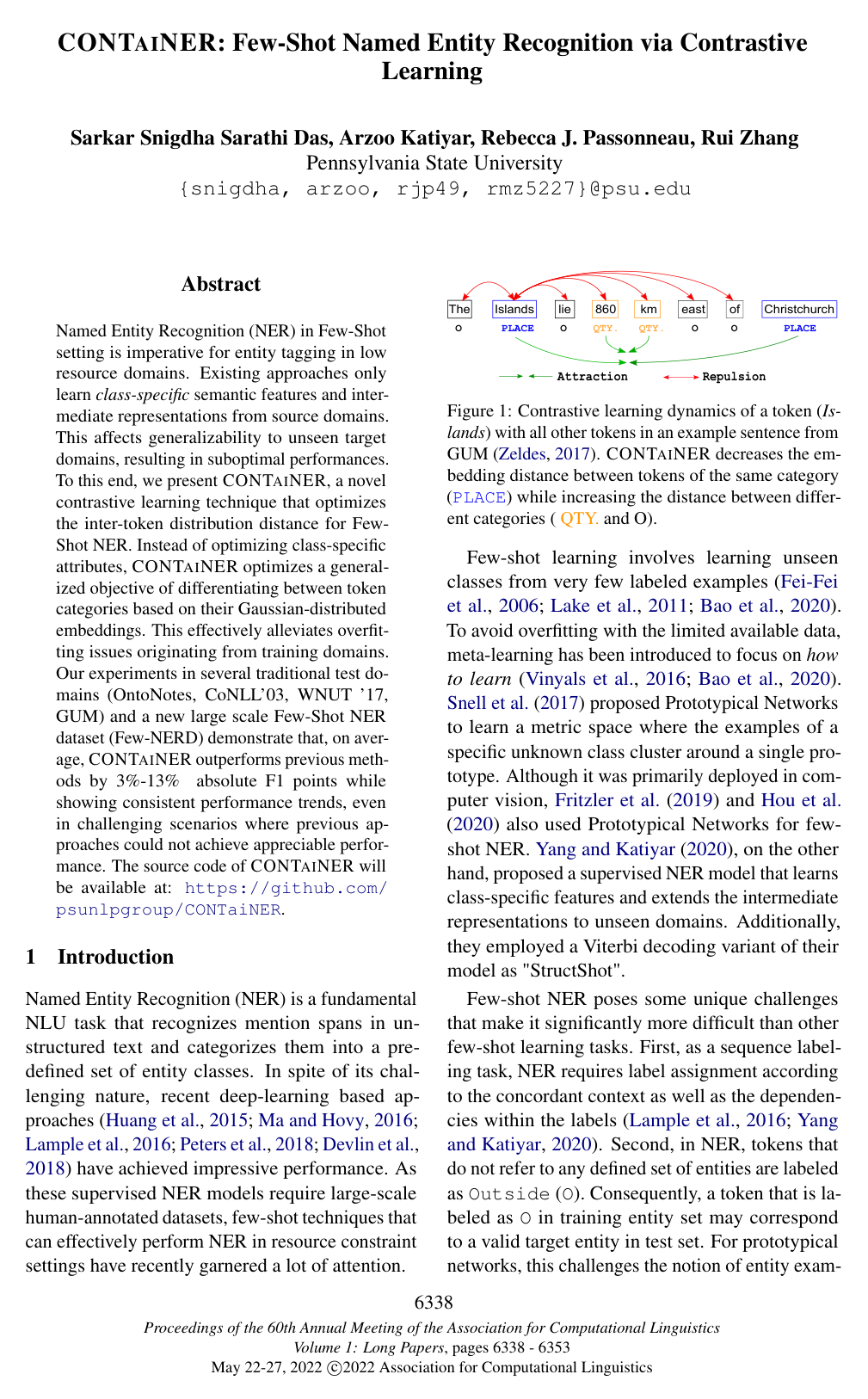
CONTaiNER: Few-Shot Named Entity Recognition via Contrastive Learning
Sarkar Snigdha Sarathi Das, Arzoo Katiyar, Rebecca J. Passonneau, Rui Zhang
Why you should read this
Proposes a contrastive learning framework that models token representations as Gaussian distributions to optimize distributional divergence between entity types, achieving substantial gains over existing few-shot named entity recognition methods across multiple benchmarks.
Named Entity Recognition (NER) in Few-Shot setting is imperative for entity tagging in low resource domains. Existing approaches only learn class-specific semantic features and intermediate representations from source domains. This affects generalizability to unseen target domains, resulting in suboptimal performances. To this end, we present CONTaiNER, a novel contrastive learning technique that optimizes the inter-token distribution distance for Few-Shot NER. Instead of optimizing class-specific attributes, CONTaiNER optimizes a generalized objective of differentiating between token categories based on their Gaussian-distributed embeddings. This effectively alleviates overfitting issues originating from training domains. Our experiments in several traditional test domains (OntoNotes, CoNLL’03, WNUT ’17, GUM) and a new large scale Few-Shot NER dataset (Few-NERD) demonstrate that, on average, CONTaiNER outperforms previous methods by 3%-13% absolute F1 points while showing consistent performance trends, even in challenging scenarios where previous approaches could not achieve appreciable performance. The source code of CONTaiNER will be available at: https://github.com/psunlpgroup/CONTaiNER.
Added
2026-09-26
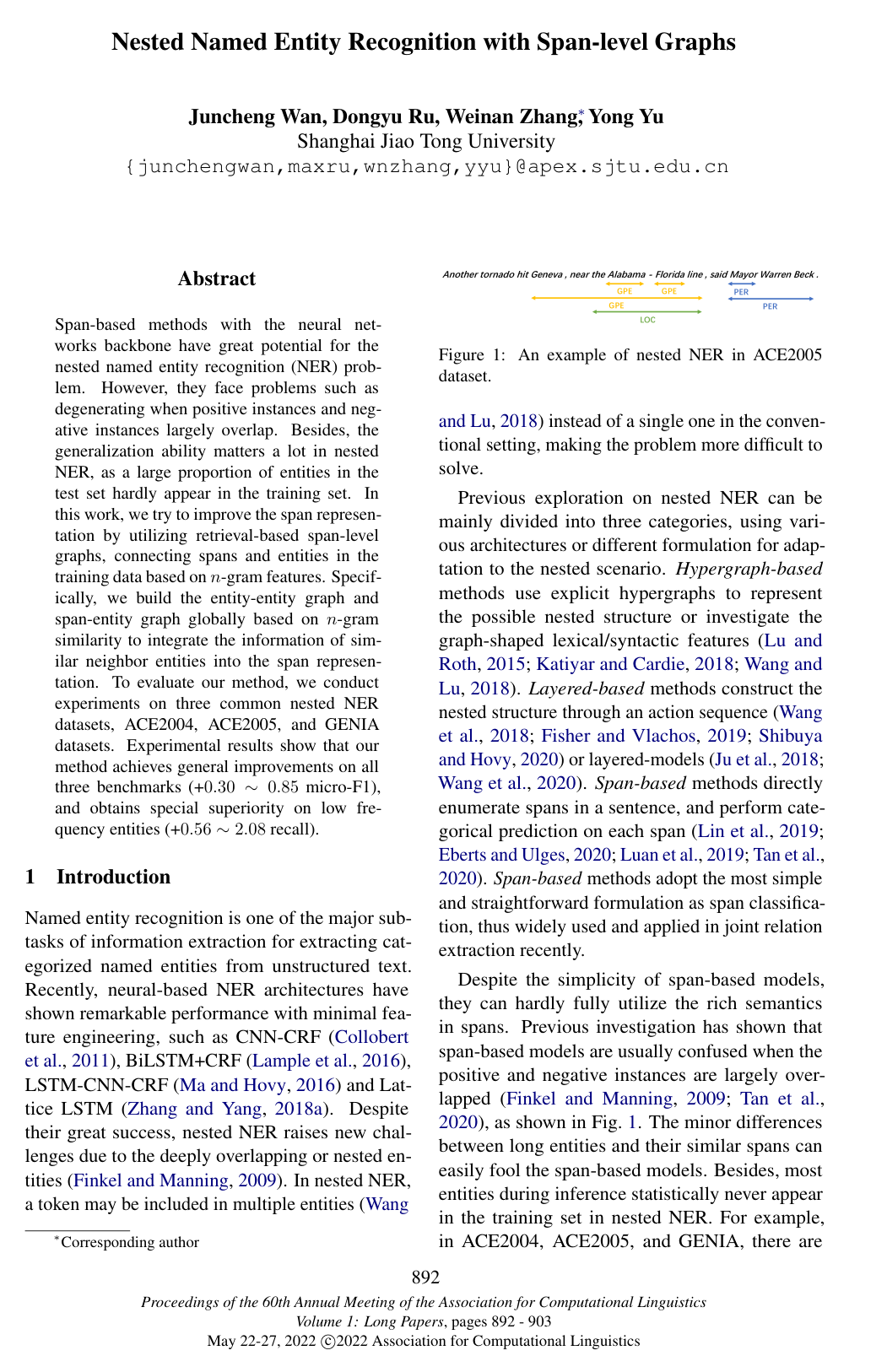
Nested Named Entity Recognition with Span-level Graphs
Juncheng Wan, Dongyu Ru, Weinan Zhang, Yong Yu
Why you should read this
Proposes a retrieval-based span-level graph approach that connects candidate spans to training entities via n-gram similarity and applies graph convolutional networks to significantly boost nested named entity recognition performance, especially for low-frequency and long spans.
Span-based methods with the neural networks backbone have great potential for the nested named entity recognition (NER) problem. However, they face problems such as degenerating when positive instances and negative instances largely overlap. Besides, the generalization ability matters a lot in nested NER, as a large proportion of entities in the test set hardly appear in the training set. In this work, we try to improve the span representation by utilizing retrieval-based span-level graphs, connecting spans and entities in the training data based on n-gram features. Specifically, we build the entity-entity graph and span-entity graph globally based on n-gram similarity to integrate the information of similar neighbor entities into the span representation. To evaluate our method, we conduct experiments on three common nested NER datasets, ACE2004, ACE2005, and GENIA datasets. Experimental results show that our method achieves general improvements on all three benchmarks (+0.30 ∼ 0.85 micro-F1), and obtains special superiority on low frequency entities (+0.56 ∼ 2.08 recall).
Added
2026-09-26
Shallow Parsing with Conditional Random Fields
Fei Sha, Fernando C Pereira
Why you should read this
Demonstrates how applying conditional random fields with modern numerical optimization techniques like L-BFGS achieves state-of-the-art shallow parsing performance while significantly outperforming previous single models and scaling efficiently to millions of features.
Conditional random fields for sequence labeling offer advantages over both generative models like HMMs and classifiers applied at each sequence position. Among sequence labeling tasks in language processing, shallow parsing has received much attention, with the development of standard evaluation datasets and extensive comparison among methods. We show here how to train a conditional random field to achieve performance as good as any reported base noun-phrase chunking method on the CoNLL task, and better than any reported single model. Improved training methods based on modern optimization algorithms were critical in achieving these results. We present extensive comparisons between models and training methods that confirm and strengthen previous results on shallow parsing and training methods for maximum-entropy models.
Added
2026-09-24
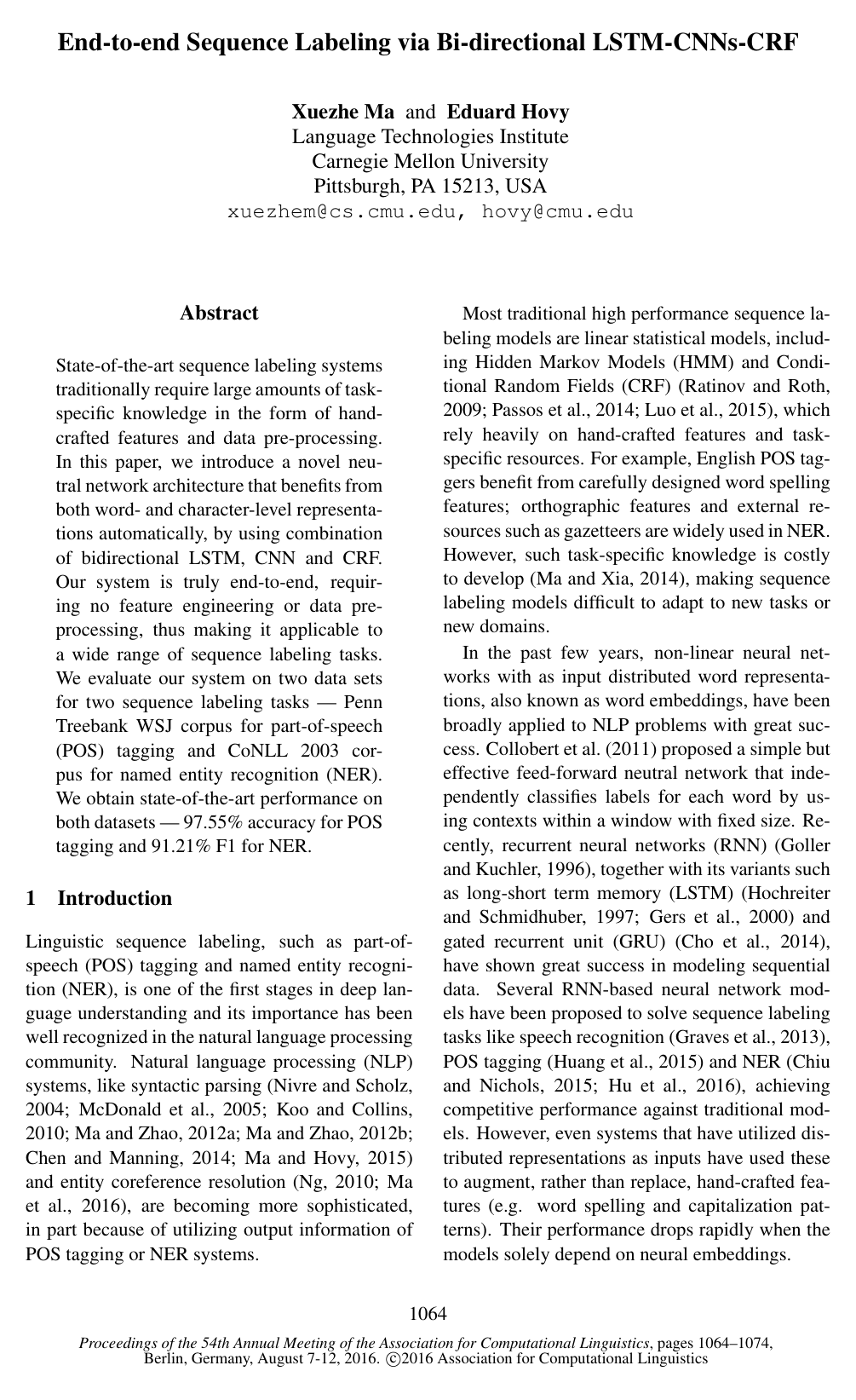
End-to-end Sequence Labeling via Bi-directional LSTM-CNNs-CRF
Xuezhe Ma, Eduard Hovy
Why you should read this
Proposes an end-to-end neural architecture combining CNNs, bidirectional LSTMs, and CRFs that eliminates manual feature engineering while achieving state-of-the-art performance in part-of-speech tagging and named entity recognition.
State-of-the-art sequence labeling systems traditionally require large amounts of task-specific knowledge in the form of hand-crafted features and data pre-processing. In this paper, we introduce a novel neutral network architecture that benefits from both word- and character-level representations automatically, by using combination of bidirectional LSTM, CNN and CRF. Our system is truly end-to-end, requiring no feature engineering or data pre-processing, thus making it applicable to a wide range of sequence labeling tasks. We evaluate our system on two data sets for two sequence labeling tasks --- Penn Treebank WSJ corpus for part-of-speech (POS) tagging and CoNLL 2003 corpus for named entity recognition (NER). We obtain state-of-the-art performance on both the two data --- 97.55\% accuracy for POS tagging and 91.21\% F1 for NER.
Added
2026-09-14
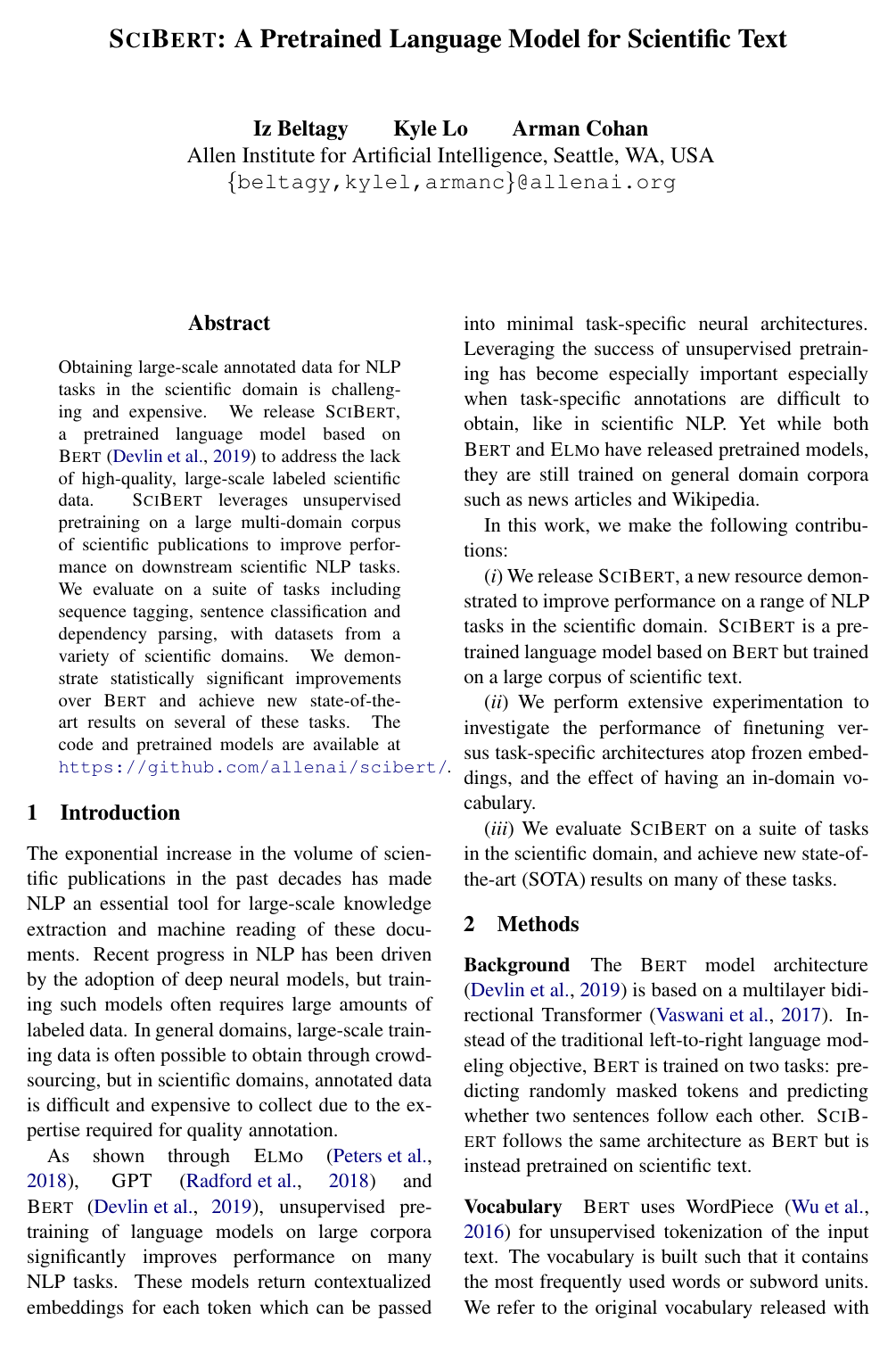
SciBERT: A Pretrained Language Model for Scientific Text
Iz Beltagy, Kyle Lo, Arman Cohan
Why you should read this
Introduces SciBERT, a domain-specific language model pretrained on large-scale scientific literature that consistently outperforms standard BERT across diverse scientific natural language processing benchmarks.
Obtaining large-scale annotated data for NLP tasks in the scientific domain is challenging and expensive. We release SciBERT, a pretrained language model based on BERT (Devlin et al., 2018) to address the lack of high-quality, large-scale labeled scientific data. SciBERT leverages unsupervised pretraining on a large multi-domain corpus of scientific publications to improve performance on downstream scientific NLP tasks. We evaluate on a suite of tasks including sequence tagging, sentence classification and dependency parsing, with datasets from a variety of scientific domains. We demonstrate statistically significant improvements over BERT and achieve new state-of-the-art results on several of these tasks. The code and pretrained models are available at this https URL.
Added
2026-09-12
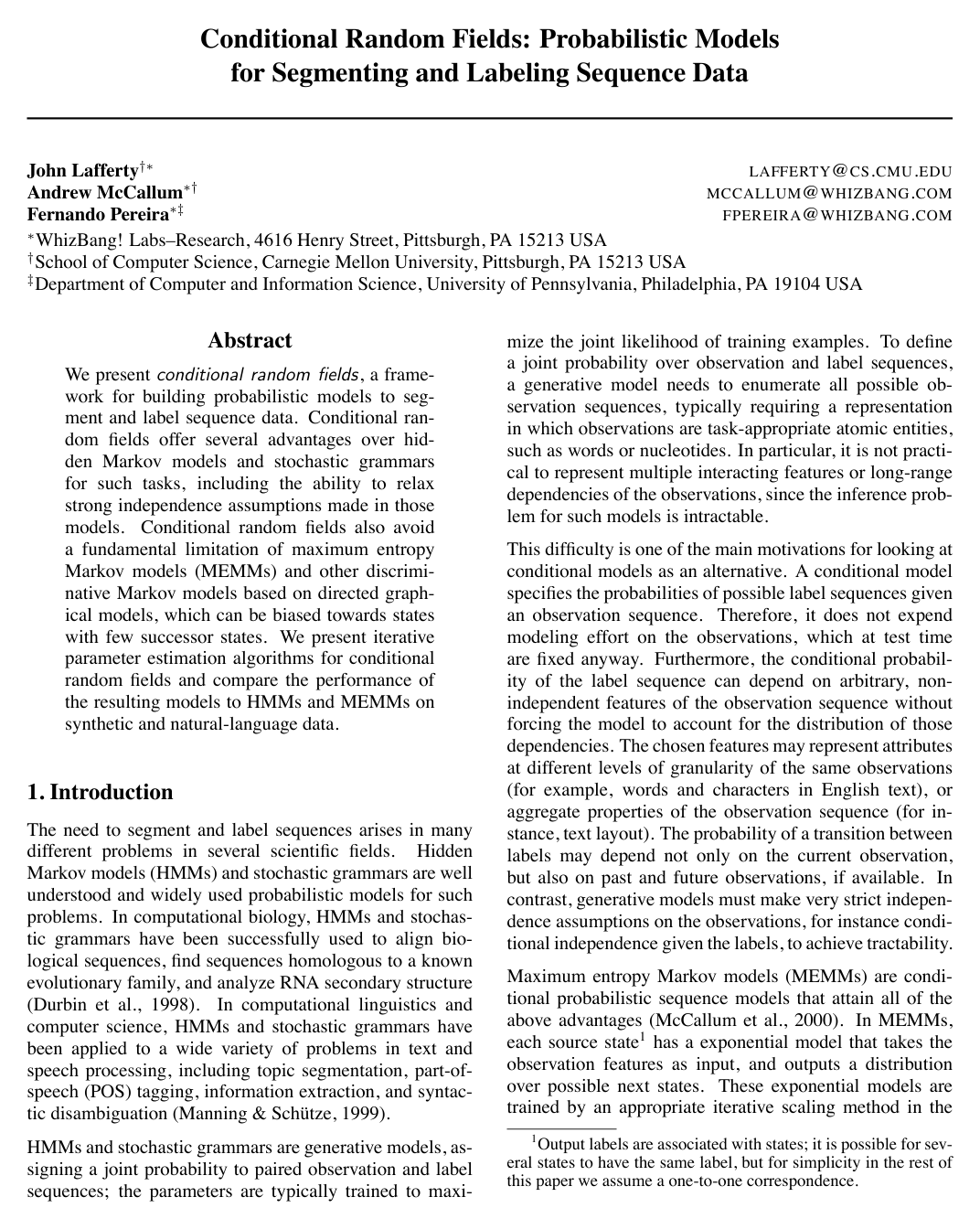
Conditional Random Fields: Probabilistic Models for Segmenting and Labeling Sequence Data
John D. Lafferty, Andrew McCallum, Fernando C. N. Pereira
Why you should read this
Introduces conditional random fields, a discriminative framework for sequence labeling that overcomes the label bias problem inherent in maximum entropy Markov models while relaxing the strict independence assumptions of hidden Markov models.
We present conditional random fields, a frame-work for building probabilistic models to segment and label sequence data. Conditional random fields offer several advantages over hidden Markov models and stochastic grammars for such tasks, including the ability to relax strong independence assumptions made in those models. Conditional random fields also avoid a fundamental limitation of maximum entropy Markov models (MEMMs) and other discriminative Markov models based on directed graphical models, which can be biased towards states with few successor states. We present iterative parameter estimation algorithms for conditional random fields and compare the performance of the resulting models to HMMs and MEMMs on synthetic and natural-language data.
Added
2026-09-06
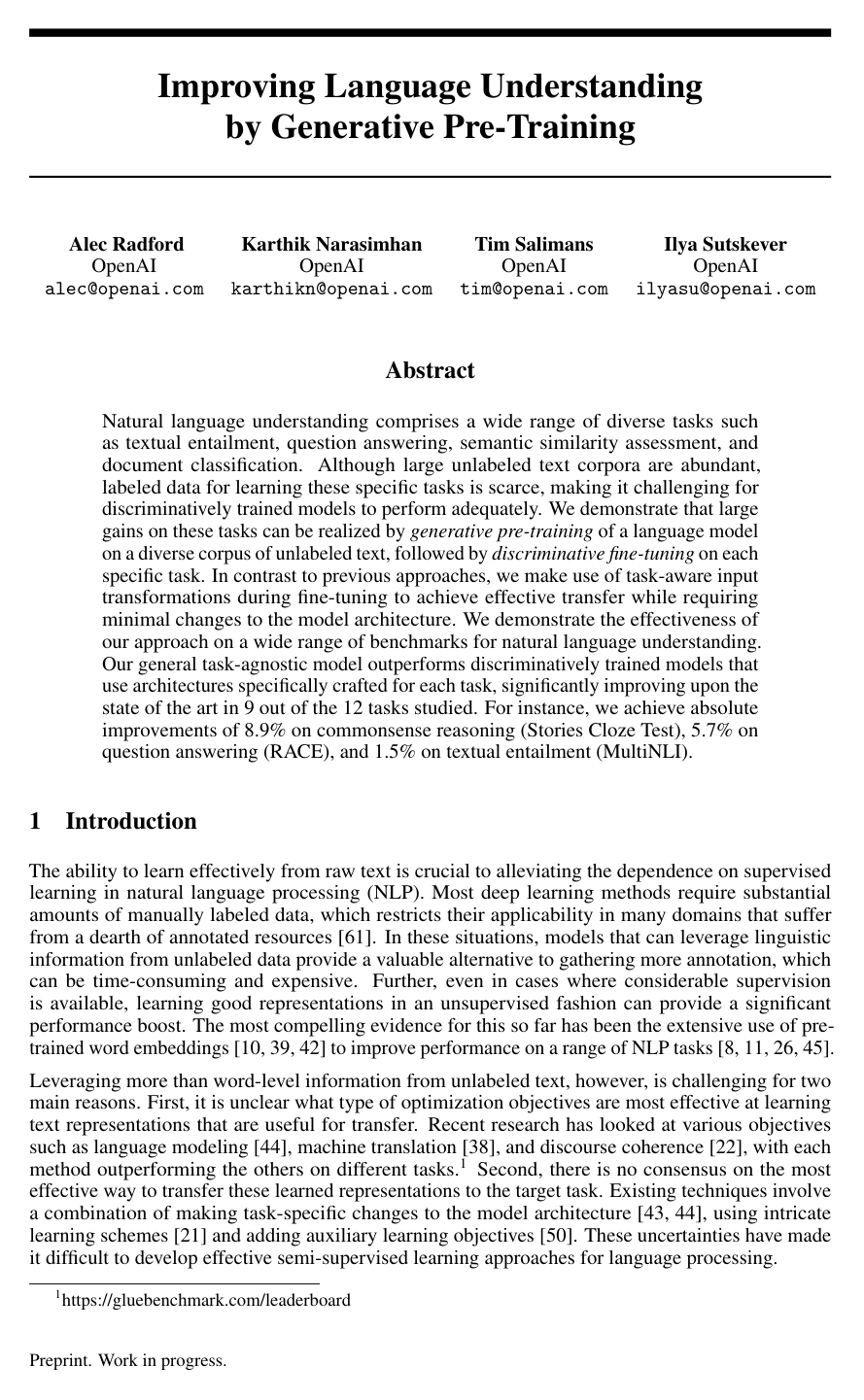
Improving Language Understanding by Generative Pre-Training
Alec Radford, Karthik Narasimhan, Tim Salimans, Ilya Sutskever
Why you should read this
Proposes a semi-supervised training framework that combines unsupervised generative pre-training of a Transformer language model with task-specific discriminative fine-tuning, achieving state-of-the-art results across a diverse range of natural language understanding benchmarks.
Natural language understanding comprises a wide range of diverse tasks such as textual entailment, question answering, semantic similarity assessment, and document classification. Although large unlabeled text corpora are abundant, labeled data for learning these specific tasks is scarce, making it challenging for discriminatively trained models to perform adequately. We demonstrate that large gains on these tasks can be realized by generative pre-training of a language model on a diverse corpus of unlabeled text, followed by discriminative fine-tuning on each specific task. In contrast to previous approaches, we make use of task-aware input transformations during fine-tuning to achieve effective transfer while requiring minimal changes to the model architecture. We demonstrate the effectiveness of our approach on a wide range of benchmarks for natural language understanding. Our general task-agnostic model outperforms discriminatively trained models that use architectures specifically crafted for each task, significantly improving upon the state of the art in 9 out of the 12 tasks studied. For instance, we achieve absolute improvements of 8.9% on commonsense reasoning (Stories Cloze Test), 5.7% on question answering (RACE), and 1.5% on textual entailment (MultiNLI).
Added
2026-06-11
License
Published with permission
Word Representations: A Simple and General Method for Semi-Supervised Learning.
Joseph Turian, Lev-Arie Ratinov, Yoshua Bengio
Why you should read this
Demonstrates that augmenting supervised NLP systems with unsupervised word representations—such as Brown clusters and neural embeddings—offers a simple, model-agnostic method to significantly improve accuracy on sequence labeling tasks by effectively mitigating data sparsity.
If we take an existing supervised NLP system, a simple and general way to improve accuracy is to use unsupervised word representations as extra word features. We evaluate Brown clusters, Collobert and Weston (2008) embeddings, and HLBL (Mnih & Hinton, 2009) embeddings of words on both NER and chunking. We use near state-of-the-art supervised baselines, and find that each of the three word representations improves the accuracy of these baselines. We find further improvements by combining different word representations. You can download our word features, for off-the-shelf use in existing NLP systems, as well as our code, here: http://metaoptimize.com/projects/wordreprs/
Added
2026-02-21