PromptNER: Prompt Locating and Typing for Named Entity Recognition

Yongliang ShenZeqi TanShuhui WuWenqi ZhangRongsheng ZhangYadong XiWeiming LuYueting Zhuang

article2023ACL60 citations

Proposes a single-round prompt learning framework for named entity recognition that unifies entity locating and typing via dual-slot templates and bipartite graph matching, avoiding span enumeration while boosting cross-domain few-shot performance by 7.7%.

Listen

Named entity recognition is a critical natural language processing capability used to identify and categorize key information, such as people, places, and organizations, within unstructured text. While modern prompt-based learning methods have improved data efficiency, existing solutions suffer from significant practical drawbacks. Current approaches either evaluate candidate text spans or search across specific entity types, requiring multiple computational passes and rigid prompt engineering. These multi-round processes result in high latency, substantial computational costs, and severe performance degradation when applied to low-resource or cross-domain settings.

The article evaluates a unified framework called PromptNER, which aims to execute both entity locating and entity typing in a single, parallel inference pass without enumerating spans or types. The approach introduces a dual-slot multi-prompt template featuring dedicated position and type slots. To train the system without predefined prompt assignments, the authors implement an extended bipartite matching mechanism that dynamically pairs prompts to target entities in a one-to-many relationship. The framework was evaluated across standard flat and nested datasets (CoNLL03, ACE04, ACE05) and low-resource domain transfer benchmarks (MIT Movie, MIT Restaurant, ATIS) using pre-trained language model backbones and warm-up training on Wikipedia anchor text.

The experimental findings show substantial improvements in both efficiency and accuracy. In cross-domain few-shot evaluations, PromptNER outperformed previous state-of-the-art models by an average of 7.7% in F1-score, with performance gains reaching 13% to 14% in extreme 10-shot target scenarios. On standard nested entity benchmarks, the model established new state-of-the-art results (88.72% on ACE04 and 88.26% on ACE05) while remaining highly competitive on standard flat text benchmarks. Furthermore, the single-round parallel architecture achieved dramatic operational efficiency gains, running over 48 times faster than previous span-based template methods and roughly two times faster than generative and reading-comprehension architectures.

These results demonstrate that entity boundaries and categories can be decoupled and resolved simultaneously, allowing models to transfer structural knowledge across disparate domains effectively. For decision-makers and technical leaders, this approach significantly reduces inference latency and cloud computing expenses while lowering the cost and data requirements needed to deploy information extraction tools in specialized domains.

Organizations seeking to deploy high-throughput or low-data entity extraction should consider adopting unified single-pass prompt architectures and utilizing weakly supervised warm-up strategies. However, stakeholders must account for key technical boundaries: the current architecture cannot extract discontinuous entity fragments, requires Wikipedia-based warm-up steps to learn structural boundary detection, and enforces a fixed upper bound on the maximum number of entities detectable per input text sentence.

  • Paper: Template-free Prompt Tuning for Few-shot NER, Ruotian Ma et al. (2022). This few-shot NER approach exposes the span-by-span computational bottleneck in earlier prompt methods that PromptNER’s unified, parallel locating-and-typing design addresses.
Cover for PromptNER: Prompt Locating and Typing for Named Entity Recognition

Abstract

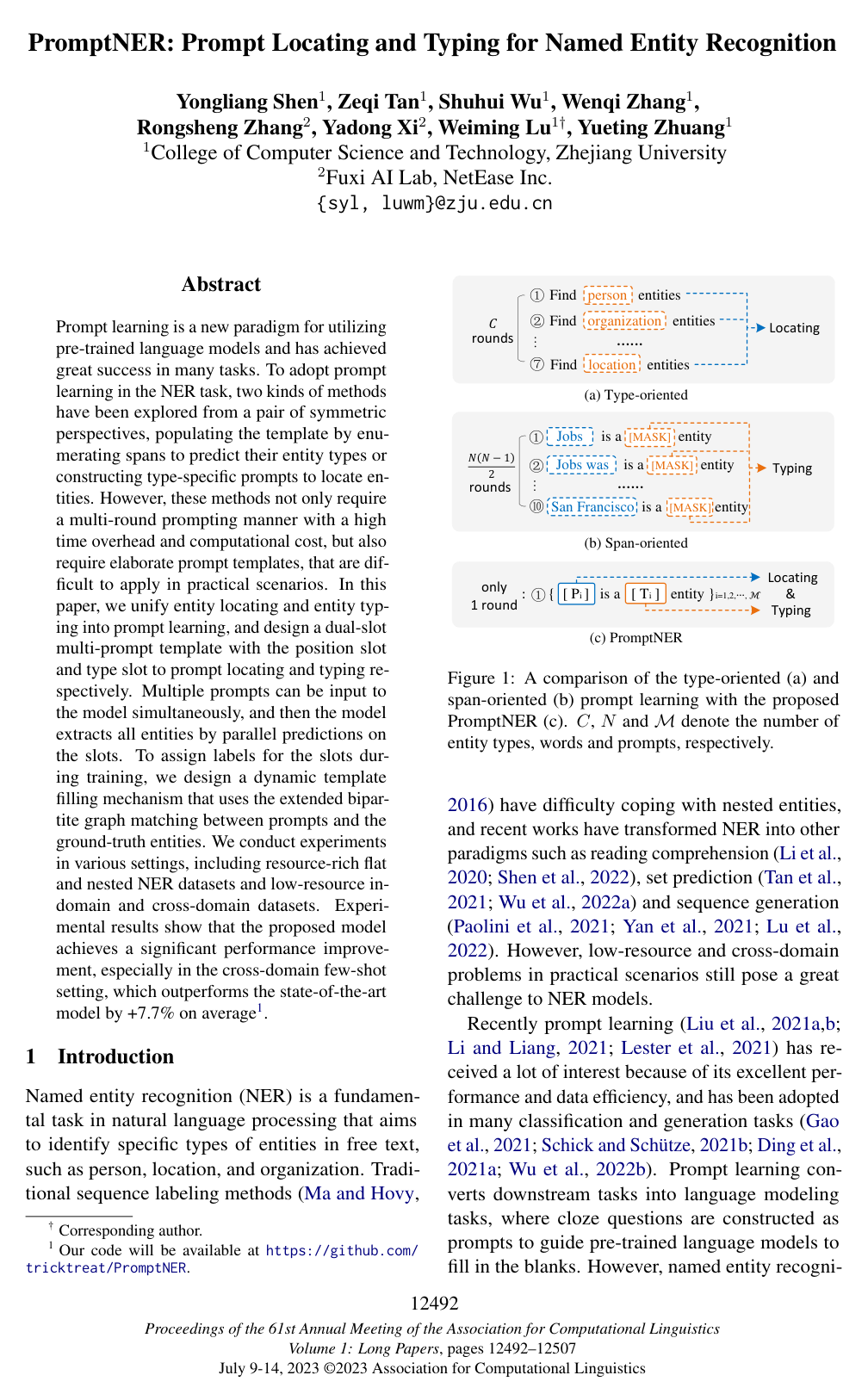
Prompt learning is a new paradigm for utilizing pre-trained language models and has achieved great success in many tasks. To adopt prompt learning in the NER task, two kinds of methods have been explored from a pair of symmetric perspectives, populating the template by enumerating spans to predict their entity types or constructing type-specific prompts to locate entities. However, these methods not only require a multi-round prompting manner with a high time overhead and computational cost, but also require elaborate prompt templates, that are difficult to apply in practical scenarios. In this paper, we unify entity locating and entity typing into prompt learning, and design a dual-slot multi-prompt template with the position slot and type slot to prompt locating and typing respectively. Multiple prompts can be input to the model simultaneously, and then the model extracts all entities by parallel predictions on the slots. To assign labels for the slots during training, we design a dynamic template filling mechanism that uses the extended bipartite graph matching between prompts and the ground-truth entities. We conduct experiments in various settings, including resource-rich flat and nested NER datasets and low-resource in-domain and cross-domain datasets. Experimental results show that the proposed model achieves a significant performance improvement, especially in the cross-domain few-shot setting, which outperforms the state-of-the-art model by +7.7% on average¹.

Table of Contents

  • 1 Introduction
  • 2 Related Work
  • 2.1 Named Entity Recognition
  • 2.2 Prompt Learning
  • 3 Method
  • 3.1 Task Formulation
  • 3.2 Prompt Construction
  • 3.3 Prompt Locating and Typing
  • 3.4 Dynamic Template Filling
  • 4 Experiments
  • 4.1 Implementation Details
  • 4.2 Warmup Training
  • 4.3 Standard Flat and Nested NER Setting
  • 4.4 In-Domain Few-Shot NER Setting
  • 4.5 Cross-Domain Few-Shot NER Setting
  • 5 Analysis
  • 5.1 Ablation Study
  • 5.2 Analysis of M and I
  • 5.3 Analysis of Prompt Templates
  • 5.4 Inference Efficiency
  • 6 Conclusion
  • Limitations
  • Acknowledgments
  • References
  • A Appendix
  • A.1 Statistics of the nested NER datasets
  • A.2 Analysis of Entity Locating and Typing

Knowls

  1. Knowl 1 — Dual-slot multi-prompt formulation for joint entity locating and typing

    model/method

    PromptNER represents named entity recognition (NER) using a fixed set of MM prompts, each with a position slot [Pi][P_i] and a type slot [Ti][T_i], alongside the input sentence. A prompt’s position slot predicts an entity’s boundaries, while its type slot predicts the entity class. The model predicts the slots for all prompts in parallel in one model pass, rather than enumerating the sentence’s possible spans or querying each entity type separately. The separate prompts can represent nested entities, and the fixed number of prompts also limits how many entities can be output for one sentence. The default template uses the paired slots without additional contextual tokens.

  2. Knowl 2 — Prompt encoding, slot prediction, and inference

    model/method

    For a sentence of NN words and MM prompts, PromptNER encodes the prompt-and-sentence input with BERT. A prompt-agnostic attention mask makes sentence representations independent of the prompt prefix. Prompt-interaction layers then apply self-attention among slots of the same kind and cross-attention from prompt slots to sentence representations; learnable prompt identity embeddings associate the position and type slots belonging to each prompt. Each type slot is classified over entity types (including a no-entity class), and each position slot predicts start- and end-boundary probabilities for every word. For each prompt, inference independently takes the most probable start, end, and type. Duplicate entity predictions are collapsed; if predictions have the same boundaries but inconsistent types, only the candidate with the highest probability is retained. The default implementation uses BERT-large, hidden size h=1024h=1024, M=50M=50 prompts, and I=3I=3 interaction layers.

  3. Knowl 3 — One-to-many dynamic template filling

    algorithm

    Because a gold entity is not associated with a particular prompt in advance, PromptNER assigns training labels by matching gold entities to prompt predictions. Let the gold entities be boundary-and-type triples (li,ri,ti)(l_i,r_i,t_i), where lil_i and rir_i are word indices and tit_i is an entity type; let pjl(q)p_j^l(q), pjr(q)p_j^r(q), and pjt(c)p_j^t(c) be prompt jj’s predicted probabilities for a start at word qq, an end at word qq, and class cc. Gold entities are repeated to allow one entity to supervise multiple prompts, up to an expansion limit UU, and the resulting list is padded with empty targets to length MM. The assignment is the permutation of these targets across the MM prompts minimizing total pairwise cost. For a nonempty gold entity and prompt jj, the match cost is −[pjt(ti)+pjl(li)+pjr(ri)]-[p_j^t(t_i)+p_j^l(l_i)+p_j^r(r_i)]; an empty target has cost zero. The Hungarian algorithm finds the minimum-cost assignment.

    The typing loss is the summed negative log-probability of each assigned type, including the empty-target class. The locating loss sums negative log-probabilities for assigned start and end boundaries, only for nonempty targets. The total loss is L=λ1L1+λ2L2L=\lambda_1L_1+\lambda_2L_2, with default weights λ1=1\lambda_1=1 and λ2=2\lambda_2=2. The default expansion limit is U=0.9MU=0.9M (45 when M=50M=50).

  4. Knowl 4 — Cross-domain few-shot NER results

    empirical result

    The cross-domain experiment transfers from resource-rich CoNLL03 to MIT Movie, MIT Restaurant, and ATIS, where the entity types differ from the source domain. Training uses a fixed number of sampled instances per target entity type: 10, 20, 50, 100, 200, or 500 for the two MIT datasets, and 10, 20, or 50 for ATIS; when a type has fewer available instances, all are used. PromptNER has the highest reported performance across these support settings. Its F1 scores (%) at the support counts above are: MIT Movie, 55.6, 68.2, 76.5, 80.4, 82.9, 84.5; MIT Restaurant, 56.1, 62.6, 69.3, 71.3, 74.4, 77.4; ATIS, 91.5, 94.3, 95.5. For comparison, TemplateNER scores 42.4, 54.2, 59.6, 65.3, 69.6, 80.3 on Movie; 53.1, 60.3, 64.1, 67.3, 72.2, 75.7 on Restaurant; and 77.3, 88.9, 93.5 on ATIS. The reported average across all settings is 76.0 for PromptNER and 68.3 for TemplateNER, a 7.7-point difference. At 10 instances per type, PromptNER exceeds TemplateNER by 13.2 points on Movie, 3.0 on Restaurant, and 14.2 on ATIS.

  5. Knowl 5 — Flat and nested benchmark performance

    empirical result

    On the flat CoNLL03 benchmark and nested ACE04 and ACE05 benchmarks, PromptNER was evaluated with BERT-large and RoBERTa-large. Precision/recall/F1 (%) for PromptNER with BERT-large were: ACE04 87.58/88.76/88.16, ACE05 86.07/88.38/87.21, and CoNLL03 92.48/92.33/92.41. With RoBERTa-large they were: ACE04 88.64/88.79/88.72, ACE05 88.15/88.38/88.26, and CoNLL03 92.96/93.18/93.08. The paper reports that the RoBERTa results improve on the prior best nested-dataset F1 scores by 0.20 points on ACE04 (88.52 to 88.72) and 0.12 points on ACE05 (88.14 to 88.26). On CoNLL03, PromptNER’s RoBERTa F1 of 93.08 is below the cited 93.77 baseline, so the result is comparable rather than a new best.

  6. Knowl 6 — Wikipedia-anchor warm-up for low-resource use

    experimental setup

    Before few-shot training, PromptNER is warm-started on entity-related hyperlinks in Wikipedia, called wiki anchors. These examples provide noisy entity-position annotations but no entity types, so warm-up trains the entity-locating component only. The BERT weights are frozen; the model is trained for three epochs with a learning rate of 1×10−51\times10^{-5} using the locating loss. The resulting weights initialize PromptNER in the in-domain and cross-domain few-shot experiments. The paper motivates this step by noting that pretrained language models do not necessarily learn the structural entity-localization ability needed by the prompt slots during pretraining.

  7. Knowl 7 — In-domain few-shot NER results

    empirical result

    The in-domain few-shot evaluation downsamples CoNLL03 to 4,001 training samples, with 100 MISC entities, 100 LOC entities, 2,496 PER entities, and 3,763 ORG entities. LOC and MISC are designated low-resource types; PER and ORG are resource-rich. Reported F1 scores (%) in ORG/PER/LOC/MISC/overall order are: BERTTagger 75.32/76.25/61.55/59.35/68.12; TemplateNER 72.61/84.49/71.98/73.37/75.59; PromptNER 76.96/88.11/82.69/62.89/79.75. Relative to BERTTagger, PromptNER improves the average F1 across the two low-resource types by 12.34 points. Relative to TemplateNER, it improves LOC and overall F1 but has lower MISC F1 (62.89 versus 73.37).

  8. Knowl 8 — Ablations on ACE04

    empirical result

    On ACE04, the full PromptNER model obtains precision/recall/F1 of 87.58/88.76/88.16. Removing dynamic template filling and assigning prompts by entity occurrence order gives 86.19/83.32/84.73; removing label expansion and using one-to-one matching gives 84.46/83.65/84.05; removing the prompt-agnostic attention mask gives 87.59/87.90/87.74. Thus the F1 decreases by 3.43, 4.11, and 0.42 points, respectively. These ablations support the importance of adaptive assignment and repeating gold labels so multiple prompts can learn to predict an entity; they also show a smaller benefit from keeping sentence representations prompt-independent.

  9. Knowl 9 — Parallel inference efficiency

    empirical result

    PromptNER predicts entities through one parallel pass over its prompts, avoiding repeated predictions over spans or types and autoregressive entity generation. The paper characterizes the number of prediction rounds as O(1)O(1) for PromptNER, compared with O(N2)O(N^2) for span-enumerating TemplateNER, O(C)O(C) for type-oriented MRC, and O(T)O(T) for autoregressive BARTNER, where NN is sentence length, CC is the number of entity types, and TT is the generated entity-sequence length. On the CoNLL03 test set using one NVIDIA GeForce RTX 3090, the paper reports PromptNER as 48.23× faster than TemplateNER, 1.86× faster than MRC, and 2.39× faster than BARTNER. These complexity claims concern the number of prediction rounds, not the full cost of processing the input.

  10. Knowl 10 — Stated limitations of PromptNER

    limitation

    PromptNER cannot directly recognize discontinuous entities: each position slot predicts one start and one end, whereas a discontinuous entity consists of multiple fragments. The paper suggests expanding the position slots as a possible alternative. PromptNER also has a fixed number of prompts set during training, limiting the number of entities it can recognize; performance can be poor if a test sentence contains more entities than the configured prompt count. Finally, the paper states that low-resource use requires Wikipedia warm-up for localization, because pretrained language models may encode semantic information more strongly than entity structure.

Coverage note — The prompt-template comparison, prompt-count and interaction-layer sensitivity analysis, and separate locating-versus-typing benchmark breakdown are omitted as supporting diagnostics; the core method, principal evaluations, ablation findings, efficiency claim, and stated limitations are included.

References

  1. 1.Beatrice Alex, Barry Haddow, and Claire Grover. 2007. Recognising nested named entities in biomedical text. In Biological, translational, and clinical language processing, pages 65–72, Prague, Czech Republic. Association for Computational Linguistics.
  2. 2.Nicolas Carion, Francisco Massa, Gabriel Synnaeve, Nicolas Usunier, Alexander Kirillov, and Sergey Zagoruyko. 2020. End-to-end object detection with transformers. In Computer Vision – ECCV 2020, pages 213–229, Cham. Springer International Publishing.
  3. 3.Shuguang Chen, Gustavo Aguilar, Leonardo Neves, and Thamar Solorio. 2021. Data augmentation for cross-domain named entity recognition. In Proceedings of the 2021 Conference on Empirical Methods in Natural Language Processing, pages 5346–5356, Online and Punta Cana, Dominican Republic. Association for Computational Linguistics.
  4. 4.Leyang Cui, Yu Wu, Jian Liu, Sen Yang, and Yue Zhang. 2021. Template-based named entity recognition using BART. In Findings of the Association for Computational Linguistics: ACL-IJCNLP 2021, pages 1835–1845, Online. Association for Computational Linguistics.
  5. 5.Jacob Devlin, Ming-Wei Chang, Kenton Lee, and Kristina Toutanova. 2019. BERT: Pre-training of deep bidirectional transformers for language understanding. In Proceedings of the 2019 Conference of the North American Chapter of the Association for Computational Linguistics: Human Language Technologies, Volume 1 (Long and Short Papers), pages 4171–4186, Minneapolis, Minnesota. Association for Computational Linguistics.
  6. 6.Ning Ding, Yulin Chen, Xu Han, Guangwei Xu, Pengjun Xie, Hai-Tao Zheng, Zhiyuan Liu, Juanzi Li, and Hong-Gee Kim. 2021a. Prompt-learning for fine-grained entity typing. arXiv preprint arXiv:2108.10604.
  7. 7.Ning Ding, Guangwei Xu, Yulin Chen, Xiaobin Wang, Xu Han, Pengjun Xie, Haitao Zheng, and Zhiyuan Liu. 2021b. Few-NERD: A few-shot named entity recognition dataset. In Proceedings of the 59th Annual Meeting of the Association for Computational Linguistics and the 11th International Joint Conference on Natural Language Processing (Volume 1: Long Papers), pages 3198–3213, Online. Association for Computational Linguistics.
  8. 8.George Doddington, Alexis Mitchell, Mark Przybocki, Lance Ramshaw, Stephanie Strassel, and Ralph Weischedel. 2004. The automatic content extraction (ACE) program – tasks, data, and evaluation. In Proceedings of the Fourth International Conference on Language Resources and Evaluation (LREC’04), Lisbon, Portugal. European Language Resources Association (ELRA).
  9. 9.Tianyu Gao, Adam Fisch, and Danqi Chen. 2021. Making pre-trained language models better few-shot learners. In Proceedings of the 59th Annual Meeting of the Association for Computational Linguistics and the 11th International Joint Conference on Natural Language Processing (Volume 1: Long Papers), pages 3816–3830, Online. Association for Computational Linguistics.
  10. 10.Jiaxin Huang, Chunyuan Li, Krishan Subudhi, Damien Jose, Shobana Balakrishnan, Weizhu Chen, Baolin Peng, Jianfeng Gao, and Jiawei Han. 2021. Few-shot named entity recognition: An empirical baseline study. In Proceedings of the 2021 Conference on Empirical Methods in Natural Language Processing, pages 10408–10423, Online and Punta Cana, Dominican Republic. Association for Computational Linguistics.
  11. 11.Weiqiang Jin, Biao Zhao, and Chenxing Liu. 2023. Fintech key-phrase: A new chinese financial high-tech dataset accelerating expression-level information retrieval. In Database Systems for Advanced Applications, pages 425–440, Cham. Springer Nature Switzerland.
  12. 12.Weiqiang Jin, Biao Zhao, Hang Yu, Xi Tao, Ruiping Yin, and Guizhong Liu. 2022. Improving embedded knowledge graph multi-hop question answering by introducing relational chain reasoning. Data Mining and Knowledge Discovery.
  13. 13.Meizhi Ju, Makoto Miwa, and Sophia Ananiadou. 2018. A neural layered model for nested named entity recognition. In Proceedings of the 2018 Conference of the North American Chapter of the Association for Computational Linguistics: Human Language Technologies, Volume 1 (Long Papers), pages 1446–1459, New Orleans, Louisiana. Association for Computational Linguistics.
  14. 14.Diederik P. Kingma and Jimmy Ba. 2015. Adam: A method for stochastic optimization. In 3th International Conference on Learning Representations, ICLR 2021.
  15. 15.Harold W Kuhn. 1955. The hungarian method for the assignment problem. Naval research logistics quarterly, 2(1-2):83–97.
  16. 16.Guillaume Lample, Miguel Ballesteros, Sandeep Subramanian, Kazuya Kawakami, and Chris Dyer. 2016. Neural architectures for named entity recognition. In Proceedings of the 2016 Conference of the North American Chapter of the Association for Computational Linguistics: Human Language Technologies, pages 260–270, San Diego, California. Association for Computational Linguistics.
  17. 17.Dong-Ho Lee, Akshen Kadakia, Kangmin Tan, Mahak Agarwal, Xinyu Feng, Takashi Shibuya, Ryosuke Mitani, Toshiyuki Sekiya, Jay Pujara, and Xiang Ren. 2022. Good examples make a faster learner: Simple demonstration-based learning for low-resource NER. In Proceedings of the 60th Annual Meeting of the Association for Computational Linguistics (Volume 1: Long Papers), pages 2687–2700, Dublin, Ireland. Association for Computational Linguistics.
  18. 18.Brian Lester, Rami Al-Rfou, and Noah Constant. 2021. The power of scale for parameter-efficient prompt tuning. In Proceedings of the 2021 Conference on Empirical Methods in Natural Language Processing, pages 3045–3059, Online and Punta Cana, Dominican Republic. Association for Computational Linguistics.
  19. 19.Jingye Li, Hao Fei, Jiang Liu, Shengqiong Wu, Meishan Zhang, Chong Teng, Donghong Ji, and Fei Li. 2022. Unified named entity recognition as word-word relation classification. In Proceedings of the AAAI Conference on Artificial Intelligence, volume 36, pages 10965–10973.
  20. 20.Xiang Lisa Li and Percy Liang. 2021. Prefix-tuning: Optimizing continuous prompts for generation. In Proceedings of the 59th Annual Meeting of the Association for Computational Linguistics and the 11th International Joint Conference on Natural Language Processing (Volume 1: Long Papers), pages 4582–4597, Online. Association for Computational Linguistics.
  21. 21.Xiaoya Li, Jingrong Feng, Yuxian Meng, Qinghong Han, Fei Wu, and Jiwei Li. 2020. A unified MRC framework for named entity recognition. In Proceedings of the 58th Annual Meeting of the Association for Computational Linguistics, pages 5849–5859, Online. Association for Computational Linguistics.
  22. 22.Andy T. Liu, Wei Xiao, Henghui Zhu, Dejiao Zhang, Shang-Wen Li, and Andrew Arnold. 2022. Qaner: Prompting question answering models for few-shot named entity recognition.
  23. 23.Pengfei Liu, Weizhe Yuan, Jinlan Fu, Zhengbao Jiang, Hiroaki Hayashi, and Graham Neubig. 2021a. Pre-train, prompt, and predict: A systematic survey of prompting methods in natural language processing.
  24. 24.Xiao Liu, Yanan Zheng, Zhengxiao Du, Ming Ding, Yujie Qian, Zhilin Yang, and Jie Tang. 2021b. Gpt understands, too.
  25. 25.Zihan Liu, Yan Xu, Tiezheng Yu, Wenliang Dai, Ziwei Ji, Samuel Cahyawijaya, Andrea Madotto, and Pascale Fung. 2021c. Crossner: Evaluating cross-domain named entity recognition. Proceedings of the AAAI Conference on Artificial Intelligence, 35(15):13452–13460.
  26. 26.Chao Lou, Songlin Yang, and Kewei Tu. 2022. Nested named entity recognition as latent lexicalized constituency parsing. In Proceedings of the 60th Annual Meeting of the Association for Computational Linguistics (Volume 1: Long Papers), pages 6183–6198, Dublin, Ireland. Association for Computational Linguistics.
  27. 27.Wei Lu and Dan Roth. 2015. Joint mention extraction and classification with mention hypergraphs. In Proceedings of the 2015 Conference on Empirical Methods in Natural Language Processing, pages 857–867, Lisbon, Portugal. Association for Computational Linguistics.
  28. 28.Yaojie Lu, Qing Liu, Dai Dai, Xinyan Xiao, Hongyu Lin, Xianpei Han, Le Sun, and Hua Wu. 2022. Unified structure generation for universal information extraction. In Proceedings of the 60th Annual Meeting of the Association for Computational Linguistics (Volume 1: Long Papers), pages 5755–5772, Dublin, Ireland. Association for Computational Linguistics.
  29. 29.Ruotian Ma, Xin Zhou, Tao Gui, Yiding Tan, Linyang Li, Qi Zhang, and Xuanjing Huang. 2022. Template-free prompt tuning for few-shot NER. In Proceedings of the 2022 Conference of the North American Chapter of the Association for Computational Linguistics: Human Language Technologies, pages 5721–5732, Seattle, United States. Association for Computational Linguistics.
  30. 30.Xuezhe Ma and Eduard Hovy. 2016. End-to-end sequence labeling via bi-directional LSTM-CNNs-CRF. In Proceedings of the 54th Annual Meeting of the Association for Computational Linguistics (Volume 1: Long Papers), pages 1064–1074, Berlin, Germany. Association for Computational Linguistics.
  31. 31.Xue Mengge, Bowen Yu, Zhenyu Zhang, Tingwen Liu, Yue Zhang, and Bin Wang. 2020. Coarse-to-Fine Pre-training for Named Entity Recognition. In Proceedings of the 2020 Conference on Empirical Methods in Natural Language Processing (EMNLP), pages 6345–6354, Online. Association for Computational Linguistics.
  32. 32.Aldrian Obaja Muis and Wei Lu. 2017. Labeling gaps between words: Recognizing overlapping mentions with mention separators. In Proceedings of the 2017 Conference on Empirical Methods in Natural Language Processing, pages 2608–2618, Copenhagen, Denmark. Association for Computational Linguistics.
  33. 33.Giovanni Paolini, Ben Athiwaratkun, Jason Krone, Jie Ma, Alessandro Achille, Rishita Anubhai, Cicero Nogueira dos Santos, Bing Xiang, and Stefano Soatto. 2021. Structured prediction as translation between augmented natural languages. In 9th International Conference on Learning Representations, ICLR 2021.
  34. 34.Timo Schick and Hinrich Schütze. 2021a. Exploiting cloze-questions for few-shot text classification and natural language inference. In Proceedings of the 16th Conference of the European Chapter of the Association for Computational Linguistics: Main Volume, pages 255–269, Online. Association for Computational Linguistics.
  35. 35.Timo Schick and Hinrich Schütze. 2021b. It’s not just size that matters: Small language models are also few-shot learners. In Proceedings of the 2021 Conference of the North American Chapter of the Association for Computational Linguistics: Human Language Technologies, pages 2339–2352, Online. Association for Computational Linguistics.
  36. 36.Yongliang Shen, Xinyin Ma, Zeqi Tan, Shuai Zhang, Wen Wang, and Weiming Lu. 2021a. Locate and label: A two-stage identifier for nested named entity recognition. In Proceedings of the 59th Annual Meeting of the Association for Computational Linguistics and the 11th International Joint Conference on Natural Language Processing (Volume 1: Long Papers), pages 2782–2794, Online. Association for Computational Linguistics.
  37. 37.Yongliang Shen, Xinyin Ma, Yechun Tang, and Weiming Lu. 2021b. A trigger-sense memory flow framework for joint entity and relation extraction. In Proceedings of the Web Conference 2021, WWW ’21, page 1704–1715, New York, NY, USA. ACM.
  38. 38.Yongliang Shen, Xiaobin Wang, Zeqi Tan, Guangwei Xu, Pengjun Xie, Fei Huang, Weiming Lu, and Yueting Zhuang. 2022. Parallel instance query network for named entity recognition. In Proceedings of the 60th Annual Meeting of the Association for Computational Linguistics (Volume 1: Long Papers), pages 947–961, Dublin, Ireland. Association for Computational Linguistics.
  39. 39.Takashi Shibuya and Eduard Hovy. 2020. Nested named entity recognition via second-best sequence learning and decoding. Transactions of the Association for Computational Linguistics, 8:605–620.
  40. 40.Taylor Shin, Yasaman Razeghi, Robert L. Logan IV, Eric Wallace, and Sameer Singh. 2020. AutoPrompt: Eliciting Knowledge from Language Models with Automatically Generated Prompts. In Proceedings of the 2020 Conference on Empirical Methods in Natural Language Processing (EMNLP), pages 4222–4235, Online. Association for Computational Linguistics.
  41. 41.Mohammad Golam Sohrab and Makoto Miwa. 2018. Deep exhaustive model for nested named entity recognition. In Proceedings of the 2018 Conference on Empirical Methods in Natural Language Processing, pages 2843–2849, Brussels, Belgium. Association for Computational Linguistics.
  42. 42.Zeqi Tan, Yongliang Shen, Xuming Hu, Wenqi Zhang, Xiaoxia Cheng, Weiming Lu, and Yueting Zhuang. 2022. Query-based instance discrimination network for relational triple extraction. In Proceedings of the 2022 Conference on Empirical Methods in Natural Language Processing, pages 7677–7690, Abu Dhabi, United Arab Emirates. Association for Computational Linguistics.
  43. 43.Zeqi Tan, Yongliang Shen, Shuai Zhang, Weiming Lu, and Yueting Zhuang. 2021. A sequence-to-set network for nested named entity recognition. In Proceedings of the Thirtieth International Joint Conference on Artificial Intelligence, IJCAI-21, pages 3936–3942. International Joint Conferences on Artificial Intelligence Organization. Main Track.
  44. 44.Erik F. Tjong Kim Sang and Fien De Meulder. 2003. Introduction to the CoNLL-2003 shared task: Language-independent named entity recognition. In Proceedings of the Seventh Conference on Natural Language Learning at HLT-NAACL 2003, pages 142–147.
  45. 45.David Wadden, Ulme Wennberg, Yi Luan, and Hannaneh Hajishirzi. 2019. Entity, relation, and event extraction with contextualized span representations. In Proceedings of the 2019 Conference on Empirical Methods in Natural Language Processing and the 9th International Joint Conference on Natural Language Processing (EMNLP-IJCNLP), pages 5784–5789, Hong Kong, China. Association for Computational Linguistics.
  46. 46.Christopher Walker, Stephanie Strassel, and Kazuaki Maeda. 2006. Ace 2005 multilingual training corpus. linguistic. In Linguistic Data Consortium, Philadelphia 57.
  47. 47.Jue Wang, Lidan Shou, Ke Chen, and Gang Chen. 2020. Pyramid: A layered model for nested named entity recognition. In Proceedings of the 58th Annual Meeting of the Association for Computational Linguistics, pages 5918–5928, Online. Association for Computational Linguistics.
  48. 48.Xinyu Wang, Yongliang Shen, Jiong Cai, Tao Wang, Xiaobin Wang, Pengjun Xie, Fei Huang, Weiming Lu, Yueting Zhuang, Kewei Tu, Wei Lu, and Yong Jiang. 2022. DAMO-NLP at SemEval-2022 task 11: A knowledge-based system for multilingual named entity recognition. In Proceedings of the 16th International Workshop on Semantic Evaluation (SemEval-2022), pages 1457–1468, Seattle, United States. Association for Computational Linguistics.
  49. 49.Sam Wiseman and Karl Stratos. 2019. Label-agnostic sequence labeling by copying nearest neighbors. In Proceedings of the 57th Annual Meeting of the Association for Computational Linguistics, pages 5363–5369, Florence, Italy. Association for Computational Linguistics.
  50. 50.Shuhui Wu, Yongliang Shen, Zeqi Tan, and Weiming Lu. 2022a. Propose-and-refine: A two-stage set prediction network for nested named entity recognition. In Proceedings of the Thirty-First International Joint Conference on Artificial Intelligence, IJCAI-22, pages 4418–4424. International Joint Conferences on Artificial Intelligence Organization. Main Track.
  51. 51.Yiquan Wu, Yifei Liu, Weiming Lu, Yating Zhang, Jun Feng, Changlong Sun, Fei Wu, and Kun Kuang. 2022b. Towards interactivity and interpretability: A rationale-based legal judgment prediction framework. In Proceedings of the 2022 Conference on Empirical Methods in Natural Language Processing, pages 4787–4799.
  52. 52.Ikuya Yamada, Akari Asai, Hiroyuki Shindo, Hideaki Takeda, and Yuji Matsumoto. 2020. LUKE: Deep contextualized entity representations with entity-aware self-attention. In Proceedings of the 2020 Conference on Empirical Methods in Natural Language Processing (EMNLP), pages 6442–6454, Online. Association for Computational Linguistics.
  53. 53.Hang Yan, Tao Gui, Junqi Dai, Qipeng Guo, Zheng Zhang, and Xipeng Qiu. 2021. A unified generative framework for various NER subtasks. In Proceedings of the 59th Annual Meeting of the Association for Computational Linguistics and the 11th International Joint Conference on Natural Language Processing (Volume 1: Long Papers), pages 5808–5822, Online. Association for Computational Linguistics.
  54. 54.Songlin Yang and Kewei Tu. 2022. Bottom-up constituency parsing and nested named entity recognition with pointer networks. In Proceedings of the 60th Annual Meeting of the Association for Computational Linguistics (Volume 1: Long Papers), pages 2403–2416, Dublin, Ireland. Association for Computational Linguistics.
  55. 55.Juntao Yu, Bernd Bohnet, and Massimo Poesio. 2020. Named entity recognition as dependency parsing. In Proceedings of the 58th Annual Meeting of the Association for Computational Linguistics, pages 6470–6476, Online. Association for Computational Linguistics.
  56. 56.Zheng Yuan, Chuanqi Tan, Songfang Huang, and Fei Huang. 2022. Fusing heterogeneous factors with triaffine mechanism for nested named entity recognition. In Findings of the Association for Computational Linguistics: ACL 2022, pages 3174–3186, Dublin, Ireland. Association for Computational Linguistics.
  57. 57.Shuai Zhang, Yongliang Shen, Zeqi Tan, Yiquan Wu, and Weiming Lu. 2022. De-bias for generative extraction in unified NER task. In Proceedings of the 60th Annual Meeting of the Association for Computational Linguistics (Volume 1: Long Papers), pages 808–818, Dublin, Ireland. Association for Computational Linguistics.
  58. 58.Changmeng Zheng, Yi Cai, Jingyun Xu, Ho-fung Leung, and Guandong Xu. 2019. A boundary-aware neural model for nested named entity recognition. In Proceedings of the 2019 Conference on Empirical Methods in Natural Language Processing and the 9th International Joint Conference on Natural Language Processing (EMNLP-IJCNLP), pages 357–366, Hong Kong, China. Association for Computational Linguistics.
  59. 59.Ran Zhou, Xin Li, Ruidan He, Lidong Bing, Erik Cambria, Luo Si, and Chunyan Miao. 2022. MELM: Data augmentation with masked entity language modeling for low-resource NER. In Proceedings of the 60th Annual Meeting of the Association for Computational Linguistics (Volume 1: Long Papers), pages 2251–2262, Dublin, Ireland. Association for Computational Linguistics.
  60. 60.Enwei Zhu and Jinpeng Li. 2022. Boundary smoothing for named entity recognition. In Proceedings of the 60th Annual Meeting of the Association for Computational Linguistics (Volume 1: Long Papers), pages 7096–7108, Dublin, Ireland. Association for Computational Linguistics.
  61. 61.Morteza Ziyadi, Yuting Sun, Abhishek Goswami, Jade Huang, and Weizhu Chen. 2020. Example-based named entity recognition. CoRR, abs/2008.10570.

Citation

MLA
Shen, Y., et al. “PromptNER: Prompt Locating and Typing for Named Entity Recognition”. Proceedings of the 61st Annual Meeting of the Association for Computational Linguistics (Volume 1: Long Papers), 2023, pp. 12492–507, https://doi.org/10.18653/v1/2023.acl-long.698.
APA
Shen, Y., Tan, Z., Wu, S., Zhang, W., Zhang, R., Xi, Y., Lu, W., & Zhuang, Y. (2023). PromptNER: Prompt Locating and Typing for Named Entity Recognition. Proceedings of the 61st Annual Meeting of the Association for Computational Linguistics (Volume 1: Long Papers), 12492–12507. https://doi.org/10.18653/v1/2023.acl-long.698
Chicago
Shen, Y., Z. Tan, S. Wu, et al. 2023. “PromptNER: Prompt Locating and Typing for Named Entity Recognition”. Proceedings of the 61st Annual Meeting of the Association for Computational Linguistics (Volume 1: Long Papers), 12492–507. https://doi.org/10.18653/v1/2023.acl-long.698.
Harvard
Shen, Y. et al. (2023) “PromptNER: Prompt Locating and Typing for Named Entity Recognition”, Proceedings of the 61st Annual Meeting of the Association for Computational Linguistics (Volume 1: Long Papers). Association for Computational Linguistics, pp. 12492–12507. Available at: https://doi.org/10.18653/v1/2023.acl-long.698.
Vancouver
1. Shen Y, Tan Z, Wu S, Zhang W, Zhang R, Xi Y, Lu W, Zhuang Y (2023) PromptNER: Prompt Locating and Typing for Named Entity Recognition. In: Proceedings of the 61st Annual Meeting of the Association for Computational Linguistics (Volume 1: Long Papers). Association for Computational Linguistics, pp 12492–12507

BibTeX

@inproceedings{shen-etal-2023-promptner,
    title = "{P}rompt{NER}: Prompt Locating and Typing for Named Entity Recognition",
    author = "Shen, Yongliang  and
      Tan, Zeqi  and
      Wu, Shuhui  and
      Zhang, Wenqi  and
      Zhang, Rongsheng  and
      Xi, Yadong  and
      Lu, Weiming  and
      Zhuang, Yueting",
    editor = "Rogers, Anna  and
      Boyd-Graber, Jordan  and
      Okazaki, Naoaki",
    booktitle = "Proceedings of the 61st Annual Meeting of the Association for Computational Linguistics (Volume 1: Long Papers)",
    month = jul,
    year = "2023",
    address = "Toronto, Canada",
    publisher = "Association for Computational Linguistics",
    url = "https://aclanthology.org/2023.acl-long.698/",
    doi = "10.18653/v1/2023.acl-long.698",
    pages = "12492--12507"
}
Metadata:ACL Anthology

Source Code

This paper has an official code repository available. Click below to access the source code.

View Repository

Access the Paper

This paper is available from its original source. Click below to access the PDF.

Open PDF
License: https://creativecommons.org/licenses/by/4.0/