Multi-View Transformer for 3D Visual Grounding
Shijia HuangYilun ChenJiaya JiaLiwei Wang
Proposes a Multi-View Transformer that projects 3D point cloud coordinates across rotated views to aggregate spatial information simultaneously, eliminating viewpoint bias and achieving state-of-the-art performance on 3D visual grounding benchmarks.
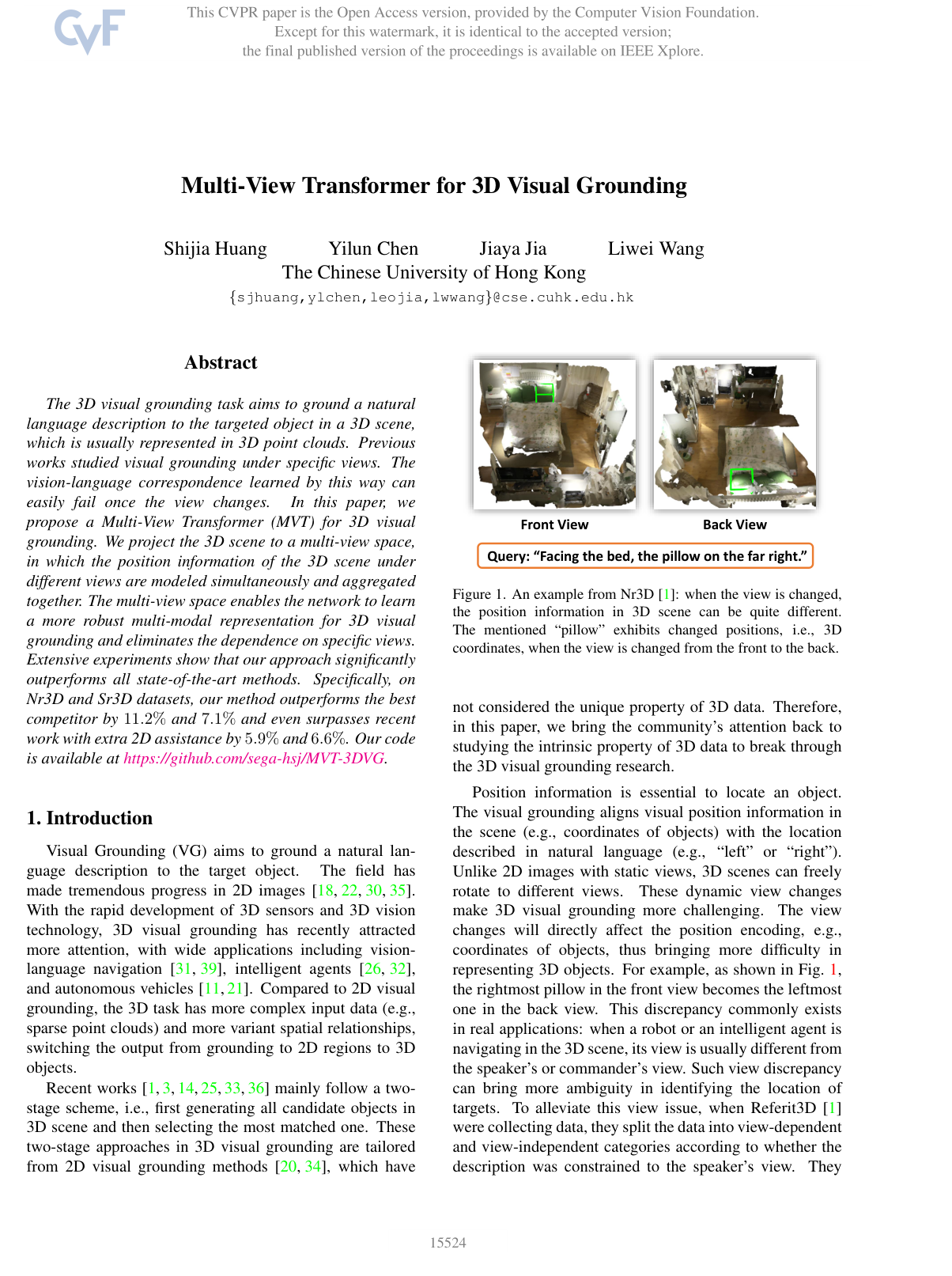
Visual grounding in three dimensions requires automated systems to interpret natural language descriptions and locate the corresponding target objects within complex 3D scenes. This capability is critical for emerging autonomous robotics, intelligent virtual agents, and spatial navigation. A core operational challenge is that spatial language, such as "on the left" or "facing the bed," frequently depends on an implicit human vantage point. When an autonomous system views a scene from an orientation different from the speaker's, traditional models often fail because their spatial position representations are tied to a single, static view.
The article demonstrates and evaluates the Multi-View Transformer, a novel framework designed to overcome vantage-point discrepancies by learning a view-robust multi-modal representation for 3D visual grounding.
The evaluated approach projects a 3D scene into a multi-view space through systematic equal-angle rotations around the vertical axis. To keep computational costs minimal, the architecture decouples processing by extracting point-cloud features once and sharing them across all views, updating only object position coordinates per perspective. Object representations and language queries are fused across views using a transformer decoder, integrated via average pooling, and further refined through an auxiliary language-guided classification task. The framework was evaluated across standard benchmark datasets, including Nr3D, Sr3D, and ScanRefer, using scenes and object descriptions derived from real-world indoor environments.
The experimental findings show substantial performance improvements across all benchmarks. On the Nr3D benchmark, the Multi-View Transformer achieved an overall accuracy of 55.1%, outperforming the best competing method by 11.2 percentage points and surpassing approaches that rely on additional 2D semantic data by 5.9 percentage points. On view-dependent queries within Nr3D, accuracy reached 54.3%, representing an improvement of 12.6 percentage points over the prior best single-view baseline. On the Sr3D benchmark, the framework attained 64.5% accuracy, exceeding previous methods by 7.1 percentage points without requiring 2D supervision. Furthermore, these accuracy gains required negligible computational overhead, increasing per-query inference latency by only 3 milliseconds—from 261 milliseconds under a single view to 264 milliseconds under a four-view configuration.
These results establish that modeling multi-view coordinate spaces directly within neural representations resolves view ambiguity more effectively than simply augmenting training data with random rotations or attempting explicit viewpoint prediction. By rendering systems invariant to starting orientations, this approach eliminates the need for speakers to provide explicit viewing cues, substantially improving reliability for real-world robotic and navigation tasks.
Organizations developing spatial artificial intelligence and embodied robotics should adopt multi-view spatial encoding strategies and incorporate multi-modal classification objectives into their visual grounding pipelines. A four-view configuration provides the optimal balance, capturing necessary spatial context without introducing the computational redundancy or training instability observed at higher view counts.
Confidence in these findings is high across standard indoor benchmark conditions. However, performance boundaries remain constrained in environments featuring highly intricate spatial references, heavy object clutter, or dense distractors where visual recognition errors can still occur. Future development should evaluate deployment in unstructured outdoor environments and test performance under dynamic, real-time viewpoint shifts.
- Paper: Language Conditioned Spatial Relation Reasoning for 3D Object Grounding, Shizhe Chen et al. (2022). This paper establishes the foundational 3D visual grounding formulation and transformer-based spatial relation reasoning on Nr3D and Sr3D benchmarks that Multi-View Transformer explicitly improves upon.
- Paper: Multi-view Convolutional Neural Networks for 3D Shape Recognition, Hang Su et al. (2015). This foundational work introduces multi-view projection for 3D representation learning, motivating the multi-view feature aggregation paradigm used in MVT.
- Paper: Volumetric and Multi-view CNNs for Object Classification on 3D Data, Charles R. Qi et al. (2016). This paper provides essential background on the advantages and design of multi-view representations compared to native volumetric 3D representations.
- Paper: PCT: Point cloud transformer, Meng-Hao Guo et al. (2020). This work introduces the Point Cloud Transformer architecture for learning representations on irregular 3D point cloud coordinates.
- Paper: VisualBERT: A Simple and Performant Baseline for Vision and Language, Liunian Harold Li et al. (2019). This seminal paper demonstrates transformer-based cross-modal alignment between visual representations and natural language queries.
- Paper: Context-aware Alignment and Mutual Masking for 3D-Language Pre-training, Zhao Jin et al. (2023). This work extends 3D visual-language grounding into generic 3D-language pre-training with context-aware alignment to resolve spatial relation ambiguities.
- Paper: Learning 3D Representations from 2D Pre-Trained Models via Image-to-Point Masked Autoencoders, Renrui Zhang et al. (2023). This paper advances 3D vision-language representations by transferring 2D pre-trained transformer features to 3D point clouds via projected 2D views.
- Paper: Symphonize 3D Semantic Scene Completion with Contextual Instance Queries, Haoyi Jiang et al. (2024). This work builds on cross-view and 2D-to-3D transformer projection mechanisms to tackle 3D semantic scene understanding and completion.