ThiNet: A Filter Level Pruning Method for Deep Neural Network Compression
Jian-Hao LuoJianxin WuWeiyao Lin
Proposes ThiNet, a filter-level pruning method that uses next-layer statistics to compress convolutional neural networks by up to sixteen times while maintaining high accuracy across standard vision benchmarks.
Deploying modern artificial intelligence models on resource-constrained devices often requires reducing model size and computational demands without significantly harming prediction accuracy. The article addresses this challenge by evaluating practical optimization techniques within ThiNet, a method designed to prune redundant components from deep neural networks.
The article set out to evaluate how different channel selection algorithms affect accuracy during model compression and to compare a fast greedy pruning approach against an optimization technique based on sparse coding.
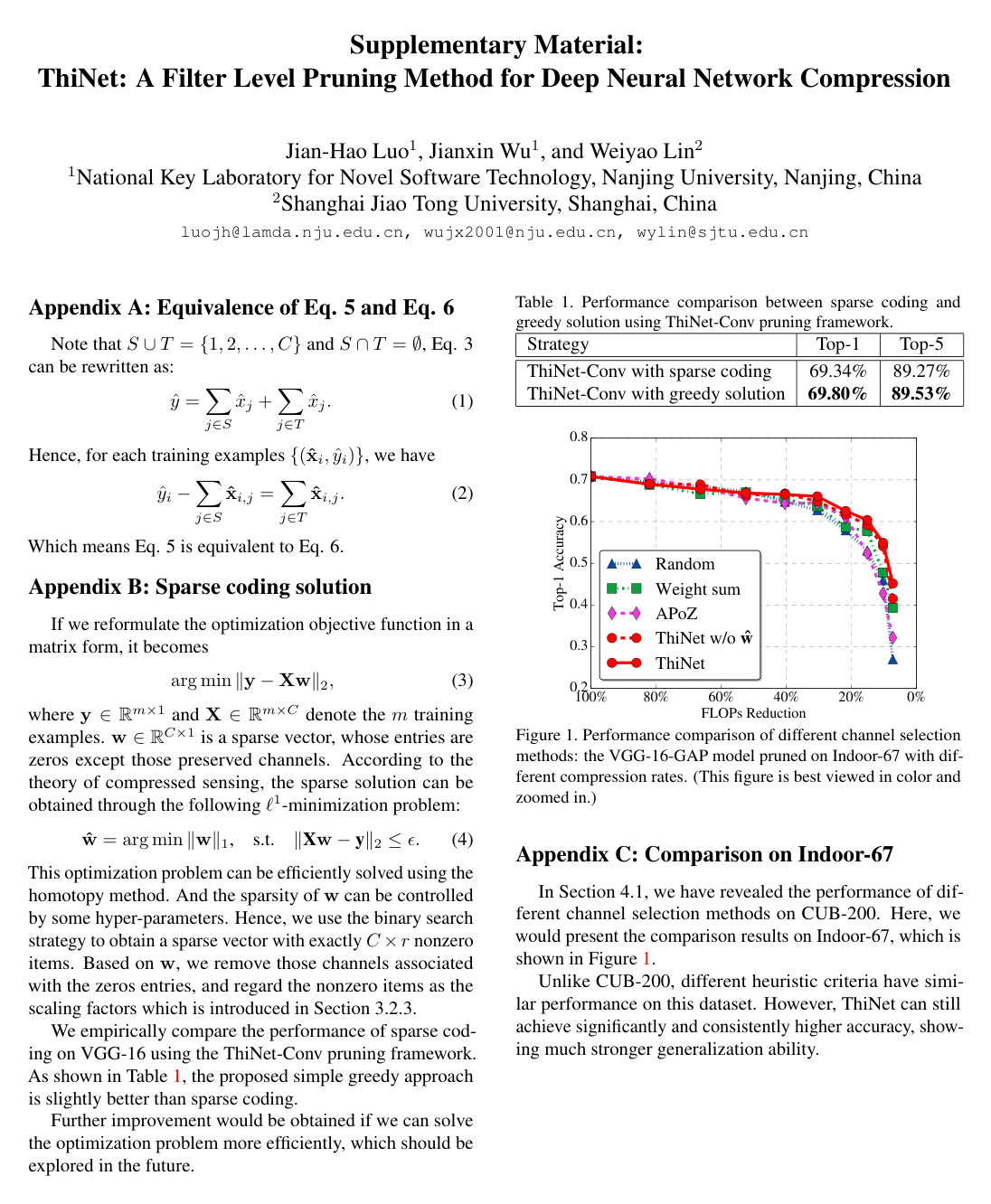
To conduct this evaluation, the researchers tested various pruning strategies on standardized deep learning models, specifically the VGG-16 architecture, across visual benchmark datasets including Indoor-67. They compared alternative channel selection heuristics against the proposed ThiNet framework across multiple levels of computational workload reduction.
The primary finding is that the ThiNet pruning framework consistently preserves higher classification accuracy across various compression rates compared to alternative heuristic methods, such as random selection, weight sums, and activity-based pruning. Additionally, when testing how to solve the underlying mathematical channel selection problem, the simpler greedy approach achieved slightly superior performance (69.80% top-1 accuracy) compared to the more complex sparse coding solution (69.34% top-1 accuracy). These results indicate strong generalization capabilities across diverse datasets.
These findings suggest that organizations aiming to deploy vision models on edge hardware can achieve substantial reductions in computational cost and energy usage without sacrificing operational performance. Furthermore, adopting the simpler greedy optimization strategy provides better accuracy while avoiding the algorithmic overhead and complexity associated with sparse coding solvers.
Technical leaders and engineering teams should prioritize the greedy channel selection strategy within the ThiNet framework when streamlining deep learning pipelines for production deployment. Future development should focus on exploring more efficient solvers for the optimization problem to determine if higher compression rates can be achieved without accuracy loss.
Confidence in these specific model comparisons is high, though readers should exercise caution when extrapolating results to entirely different network architectures or non-visual tasks, as the provided evidence focuses primarily on standard image classification benchmarks.
- Paper: Pruning Filters for Efficient ConvNets, Hao Li et al. (2016). Li et al. establish early filter-level pruning criteria using weight magnitude norms, which ThiNet directly addresses and seeks to improve upon by evaluating layer-to-layer statistical impact.
- Paper: Learning Structured Sparsity in Deep Neural Networks, Wei Wen et al. (2016). This paper establishes structured sparsity techniques via Group Lasso to remove structured network components like filters and channels, laying the groundwork for structured convolutional network pruning.
- Paper: Pruning Convolutional Neural Networks for Resource Efficient Inference, Pavlo Molchanov et al. (2016). Molchanov et al. introduce structured feature map pruning using Taylor expansion saliency criteria, providing a key foundation for subsequent data-driven structured pruning methods.
- Paper: Deep Compression: Compressing Deep Neural Network with Pruning, Trained Quantization and Huffman Coding, Song Han et al. (2015). This seminal work popularized multi-stage deep neural network compression and motivated the transition from unstructured weight pruning to structured filter-level pruning.
- Paper: Learning both Weights and Connections for Efficient Neural Networks, Song Han et al. (2015). Han et al. establish the standard iterative train-prune-finetune paradigm that ThiNet adapts to structured filter pruning.
- Paper: Optimal Brain Damage, Yann LeCun et al. (1989). This classic work foundationalizes saliency-based network pruning by establishing formal optimization and sensitivity criteria for connection removal.
- Paper: Channel Pruning for Accelerating Very Deep Neural Networks, Yihui He et al. (2017). He et al. build on output feature reconstruction for channel selection by using LASSO regression, presenting a closely related channel-pruning optimization framework.
- Paper: Learning Efficient Convolutional Networks through Network Slimming, Zhuang Liu et al. (2017). Liu et al. propose Network Slimming, which advances structured channel pruning by utilizing batch normalization scaling factors as sparsity indicators.
- Paper: Rethinking the Value of Network Pruning, Zhuang Liu et al. (2019). This study critically re-evaluates structured pruning methods like ThiNet, demonstrating that discovering efficient subnetwork architectures may be more valuable than inheriting pruned weights.
- Paper: Comparing Rewinding and Fine-tuning in Neural Network Pruning, Alex Renda et al. (2020). This work explores learning-rate and weight rewinding strategies as alternatives to standard fine-tuning pipelines after structured and unstructured network pruning.
- Paper: DepGraph: Towards Any Structural Pruning, Gongfan Fang et al. (2023). DepGraph generalizes structural pruning concepts across arbitrary modern architectures by automatically resolving layer dependencies that complicate filter removal.
- Paper: Dreaming to Distill: Data-Free Knowledge Transfer via DeepInversion, Hongxu Yin et al. (2020). DeepInversion extends downstream pruning and knowledge distillation pipelines by synthesizing realistic images directly from batch normalization statistics when training data is unavailable.