Rethinking Out-of-distribution (OOD) Detection: Masked Image Modeling is All You Need
Jingyao LiPengguang ChenZexin HeShaozuo YuShu LiuJiaya Jia
Demonstrates that pretraining vision transformers with masked image modeling enables models to capture intrinsic data distributions rather than classification shortcuts, outperforming existing out-of-distribution detection methods without requiring any outlier exposure.
Reliable automated visual recognition systems must not only classify known inputs correctly but also identify and flag unknown, out-of-distribution inputs for safe handling. This safety capability is critical in high-stakes domains such as autonomous driving, medical diagnostics, and fraud prevention. Traditional approaches often rely on classification-based training or exposure to outlier examples. However, classification networks frequently learn superficial shortcuts rather than the underlying distribution of the data, which leads to poor anomaly detection when unfamiliar samples share minor visual traits with known categories.
The article evaluates whether reconstruction-based pretext tasks can provide better foundational representations for out-of-distribution detection. Specifically, it demonstrates the performance of a proposed framework called Masked Image Modeling for Out-of-Distribution Detection (MOOD), which trains a vision model to reconstruct masked image patches without relying on outlier samples.
To conduct the evaluation, the authors pre-trained a standard Vision Transformer using masked image modeling on a large dataset (ImageNet-21k) and fine-tuned it on in-distribution data, integrating label smoothing for single-class tasks. They used the statistical Mahalanobis distance metric to score whether new test inputs were out-of-distribution. The method was benchmarked across four distinct scenarios—one-class detection, multi-class detection, near-distribution detection, and few-shot outlier exposure—against established state-of-the-art baselines on widely used image datasets including CIFAR-10, CIFAR-100, and ImageNet benchmarks.
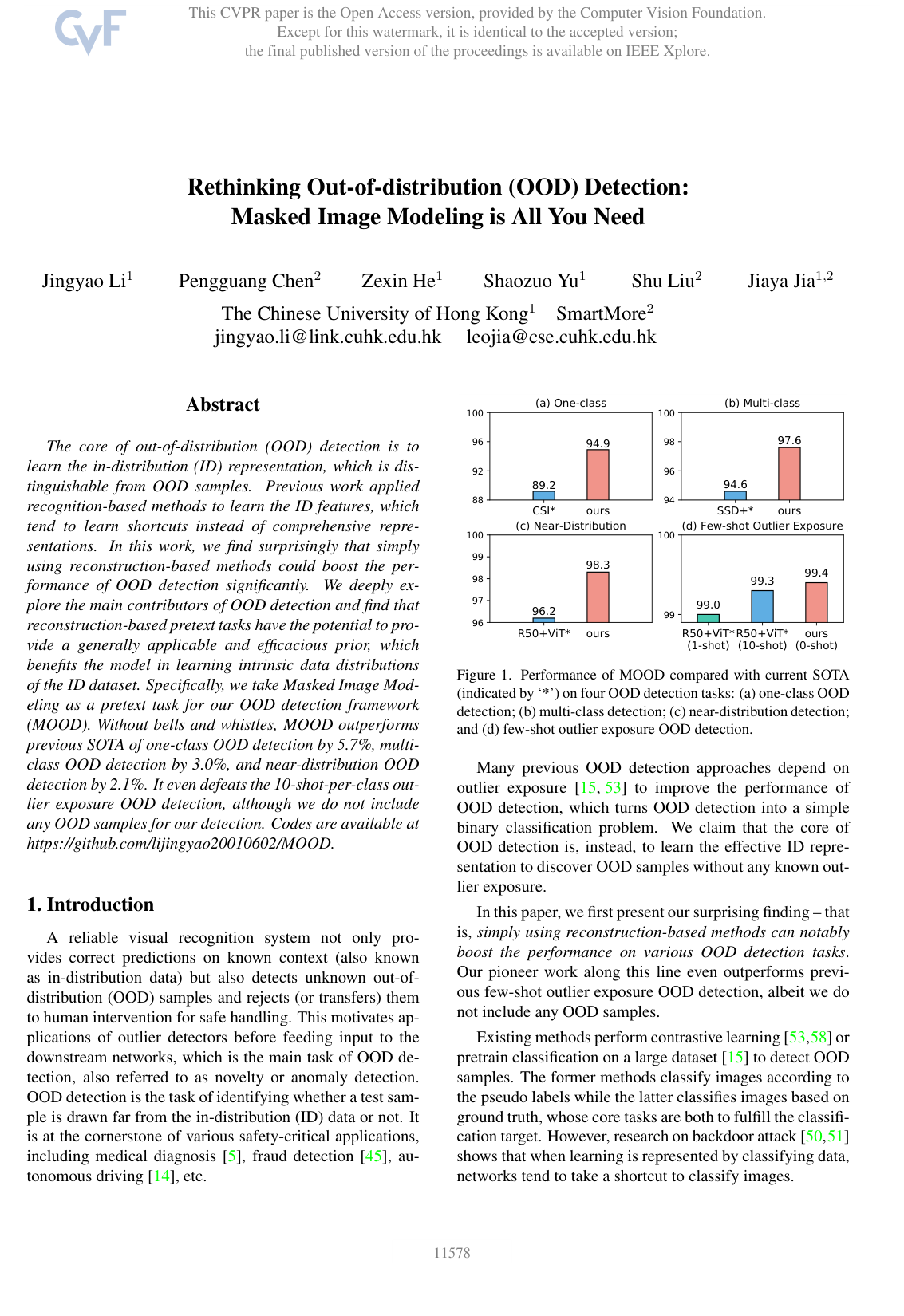
The experimental findings show that the proposed framework consistently establishes new performance records. In one-class detection, MOOD improved the average detection score by 5.7 percentage points over the previous leading baseline, reaching 94.9%. In multi-class detection, it outperformed the leading method by 3.0 percentage points, achieving 97.6%. On challenging near-distribution tasks where known and unknown classes share similar visual semantics, the framework reduced misclassified outlier samples by an average of 79% and raised accuracy across difficult class pairs from 78.7% to 93.9%. Furthermore, without using any outlier examples during training, the framework achieved a 99.41% score, outperforming complex baseline models that were explicitly trained with ten outlier examples per class.
These results indicate that forcing vision models to reconstruct masked inputs teaches them intrinsic, pixel-level data distributions rather than fragile classification shortcuts. This substantially reduces operational and safety risks in automated computer vision systems. Crucially, the findings show that developers do not need cumbersome ensemble models or synthetic outlier datasets to achieve robust safety filtering, which reduces engineering complexity and computational overhead.
Organizations developing or deploying safety-critical vision systems should consider adopting masked image modeling as a standard self-supervised pre-training strategy combined with distance-based anomaly metrics. Practitioners can streamline development pipelines by eliminating the need to collect and maintain outlier exposure datasets. Further evaluation in domain-specific, real-world deployment settings is recommended to assess performance alongside runtime latency constraints.
- Paper: Masked Autoencoders Are Scalable Vision Learners, Kaiming He et al. (2022). Introduces Masked Autoencoders (MAE) for masked image modeling, which serves as the foundational pretext reconstruction task leveraged by the MOOD framework.
- Paper: Generalized Out-of-Distribution Detection: A Survey, Jingkang Yang et al. (2021). Establishes a unified taxonomy and benchmarking protocol for generalized out-of-distribution detection, structuring the problem settings evaluated in the source paper.
- Paper: Deep Anomaly Detection with Outlier Exposure, Dan Hendrycks et al. (2019). Proposes outlier exposure for out-of-distribution detection, establishing the primary semi-supervised baseline that MOOD explicitly aims to outperform without outlier data.
- Paper: A Baseline for Detecting Misclassified and Out-of-Distribution Examples in Neural Networks, Dan Hendrycks et al. (2017). Introduces the standard maximum softmax probability baseline for out-of-distribution detection that standardizes performance comparisons in the field.
- Paper: Energy-based Out-of-distribution Detection, Weitang Liu et al. (2020). Provides a prominent classification-based out-of-distribution detection method using energy scores, representing the recognition-based paradigms re-evaluated by the source.
- Paper: A Simple Unified Framework for Detecting Out-of-Distribution Samples and Adversarial Attacks, Kimin Lee et al. (2018). Develops Mahalanobis distance-based feature modeling for out-of-distribution detection, serving as a key benchmark for ID feature representation quality.
- Paper: Out-of-Distribution Detection with Deep Nearest Neighbors, Yiyou Sun et al. (2022). Demonstrates distance-based OOD detection using deep nearest neighbors on normalized feature representations, contextualizing non-parametric approaches in representation space.
- Paper: Memorizing Normality to Detect Anomaly: Memory-Augmented Deep Autoencoder for Unsupervised Anomaly Detection, Dong Gong et al. (2019). Explores reconstruction-based representation learning and memory mechanisms to prevent shortcut generalization in anomaly and out-of-distribution detection.
- Paper: Scaling for Training Time and Post-hoc Out-of-distribution Detection Enhancement, Kai Xu et al. (2024). Investigates feature activation scaling and shaping to enhance post-hoc out-of-distribution detection performance across near-OOD and far-OOD regimes.