
keyword
novelty detection
Novelty detection is a machine learning task that involves identifying new, unobserved, or anomalous data points that differ significantly from the data distribution observed during training. Typically framed as an unsupervised, semi-supervised, or one-class learning problem, novelty detection models characterize the structure, boundaries, or statistical properties of normal in-distribution data without requiring prior examples of all possible anomalies. During evaluation or deployment, any test sample that deviates from this learned representation is flagged as novel or out-of-distribution. This capability is critical in domains such as industrial fault monitoring, medical image screening, cybersecurity, and open-set recognition, where unexpected variations or defects are rare, diverse, or impractical to collect and label beforehand.
18 items
Generative Cooperative Learning for Unsupervised Video Anomaly Detection
Muhammad Zaigham Zaheer, Arif Mahmood, Muhammad Haris Khan, Mattia Segù, Fisher Yu, Seung-Ik Lee
Why you should read this
Proposes a fully unsupervised video anomaly detection framework that trains a generator and a discriminator via iterative cross-supervision and negative learning on unlabelled data, eliminating the need for normal-only or frame-level annotations while outperforming existing one-class classification baselines on UCF-Crime and ShanghaiTech.
Video anomaly detection is well investigated in weakly-supervised and one-class classification (OCC) settings. However, unsupervised video anomaly detection methods are quite sparse, likely because anomalies are less frequent in occurrence and usually not well-defined, which when coupled with the absence of ground truth supervision, could adversely affect the performance of the learning algorithms. This problem is challenging yet rewarding as it can completely eradicate the costs of obtaining laborious annotations and enable such systems to be deployed without human intervention. To this end, we propose a novel unsupervised Generative Cooperative Learning (GCL) approach for video anomaly detection that exploits the low frequency of anomalies towards building a cross-supervision between a generator and a discriminator. In essence, both networks get trained in a cooperative fashion, thereby allowing unsupervised learning. We conduct extensive experiments on two large-scale video anomaly detection datasets, UCF crime and ShanghaiTech. Consistent improvement over the existing state-of-the-art unsupervised and OCC methods corroborate the effectiveness of our approach.
Added
2026-10-05
Anomaly Detection via Reverse Distillation from One-Class Embedding
Hanqiu Deng, Xingyu Li
Why you should read this
Introduces a reverse knowledge distillation paradigm that reconstructs multiscale teacher features from a one-class bottleneck embedding, preventing the student network from restoring anomalies and establishing new state-of-the-art accuracy in unsupervised anomaly detection.
Knowledge distillation (KD) achieves promising results on the challenging problem of unsupervised anomaly detection (AD).The representation discrepancy of anomalies in the teacher-student (T-S) model provides essential evidence for AD. However, using similar or identical architectures to build the teacher and student models in previous studies hinders the diversity of anomalous representations. To tackle this problem, we propose a novel T-S model consisting of a teacher encoder and a student decoder and introduce a simple yet effective "reverse distillation" paradigm accordingly. Instead of receiving raw images directly, the student network takes teacher model's one-class embedding as input and targets to restore the teacher's multiscale representations. Inherently, knowledge distillation in this study starts from abstract, high-level presentations to low-level features. In addition, we introduce a trainable one-class bottleneck embedding (OCBE) module in our T-S model. The obtained compact embedding effectively preserves essential information on normal patterns, but abandons anomaly perturbations. Extensive experimentation on AD and one-class novelty detection benchmarks shows that our method surpasses SOTA performance, demonstrating our proposed approach's effectiveness and generalizability.
Added
2026-10-05
Unsupervised Anomaly Detection Algorithms on Real-world Data: How Many Do We Need?
Roel Bouman, Zaharah Bukhsh, Tom Heskes
Why you should read this
Demonstrates through an evaluation of 33 algorithms across 52 real-world tabular datasets that practitioners only need Extended Isolation Forest and k-nearest neighbors to effectively detect both global and local anomalies.
In this study we evaluate 33 unsupervised anomaly detection algorithms on 52 real-world multivariate tabular data sets, performing the largest comparison of unsupervised anomaly detection algorithms to date. On this collection of data sets, the EIF (Extended Isolation Forest) algorithm significantly outperforms the most other algorithms. Visualizing and then clustering the relative performance of the considered algorithms on all data sets, we identify two clear clusters: one with “local” data sets, and another with “global” data sets. “Local” anomalies occupy a region with low density when compared to nearby samples, while “global” occupy an overall low density region in the feature space. On the local data sets the kNN (k-nearest neighbor) algorithm comes out on top. On the global data sets, the EIF (extended isolation forest) algorithm performs the best. Also taking into consideration the algorithms’ computational complexity, a toolbox with these two unsupervised anomaly detection algorithms suffices for finding anomalies in this representative collection of multivariate data sets. By providing access to code and data sets, our study can be easily reproduced and extended with more algorithms and/or data sets.
Added
2026-10-05
Explicit Boundary Guided Semi-Push-Pull Contrastive Learning for Supervised Anomaly Detection
Xincheng Yao, Ruoqi Li, Jing Zhang, Jun Sun, Chongyang Zhang
Why you should read this
Proposes a supervised anomaly detection framework that leverages normal feature distributions to establish explicit decision boundaries and applies a semi-push-pull contrastive loss, enabling models to exploit limited known anomalies without losing generalization to unseen defect types.
Most anomaly detection (AD) models are learned using only normal samples in an unsupervised way, which may result in ambiguous decision boundary and insufficient discriminability. In fact, a few anomaly samples are often available in real-world applications, the valuable knowledge of known anomalies should also be effectively exploited. However, utilizing a few known anomalies during training may cause another issue that the model may be biased by those known anomalies and fail to generalize to unseen anomalies. In this paper, we tackle supervised anomaly detection, i.e., we learn AD models using a few available anomalies with the objective to detect both the seen and unseen anomalies. We propose a novel explicit boundary guided semi-push-pull contrastive learning mechanism, which can enhance model’s discriminability while mitigating the bias issue. Our approach is based on two core designs: First, we find an explicit and compact separating boundary as the guidance for further feature learning. As the boundary only relies on the normal feature distribution, the bias problem caused by a few known anomalies can be alleviated. Second, a boundary guided semi-push-pull loss is developed to only pull the normal features together while pushing the abnormal features apart from the separating boundary beyond a certain margin region. In this way, our model can form a more explicit and discriminative decision boundary to distinguish known and also unseen anomalies from normal samples more effectively. Code will be available at https://github.com/xcyao00/BGAD.
Added
2026-09-26
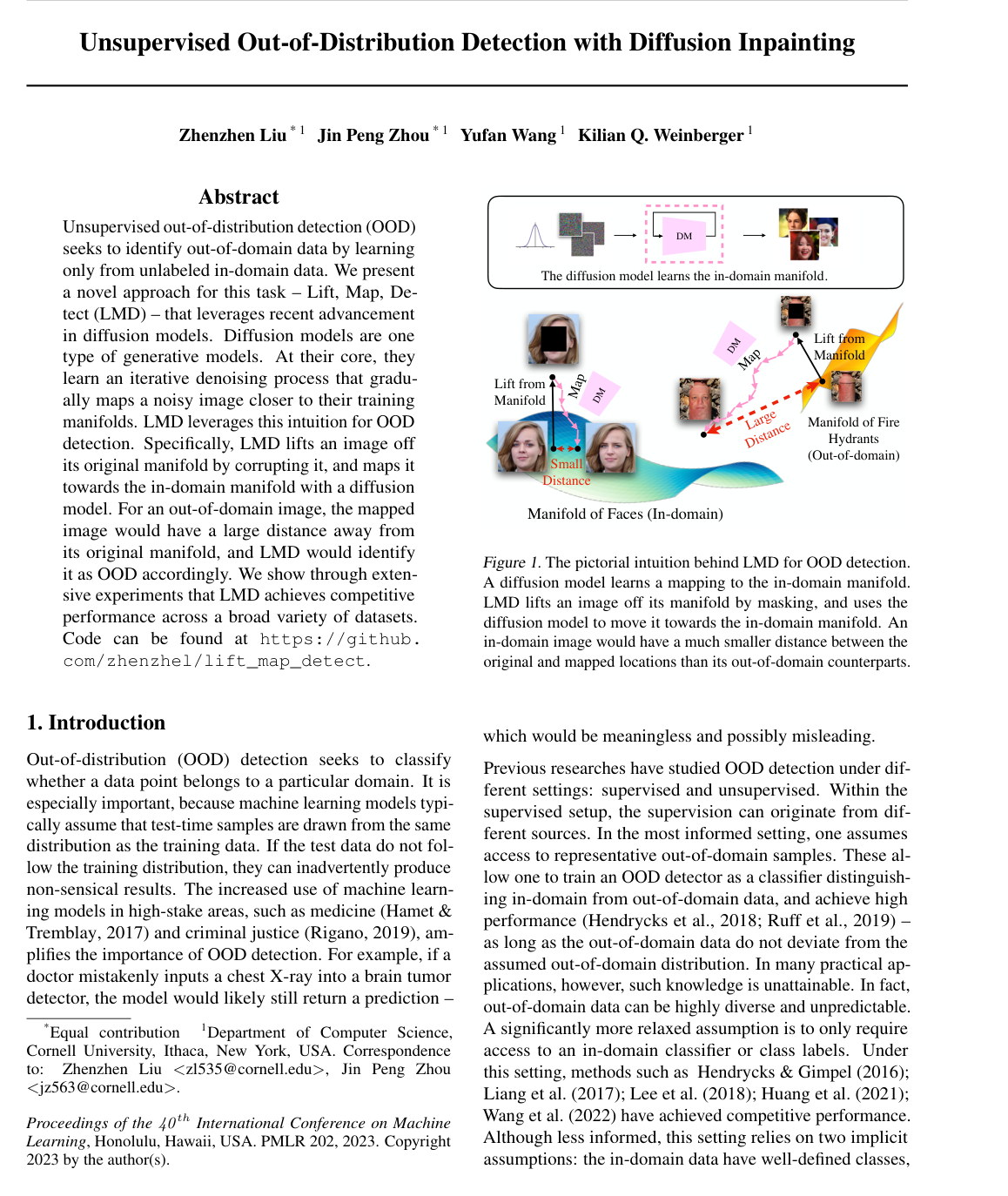
Unsupervised Out-of-Distribution Detection with Diffusion Inpainting
Zhenzhen Liu, Jin Peng Zhou, Yufan Wang, Kilian Q. Weinberger
Why you should read this
Introduces Lift, Map, Detect (LMD), an unsupervised out-of-distribution detection framework that identifies anomalous images by masking them and measuring reconstruction error after inpainting with a diffusion model trained only on in-domain data.
Unsupervised out-of-distribution detection (OOD) seeks to identify out-of-domain data by learning only from unlabeled in-domain data. We present a novel approach for this task – Lift, Map, Detect (LMD) – that leverages recent advancement in diffusion models. Diffusion models are one type of generative models. At their core, they learn an iterative denoising process that gradually maps a noisy image closer to their training manifolds. LMD leverages this intuition for OOD detection. Specifically, LMD lifts an image off its original manifold by corrupting it, and maps it towards the in-domain manifold with a diffusion model. For an out-of-domain image, the mapped image would have a large distance away from its original manifold, and LMD would identify it as OOD accordingly. We show through extensive experiments that LMD achieves competitive performance across a broad variety of datasets. Code can be found at https://github.com/zhenzhel/lift_map_detect.
Added
2026-09-26
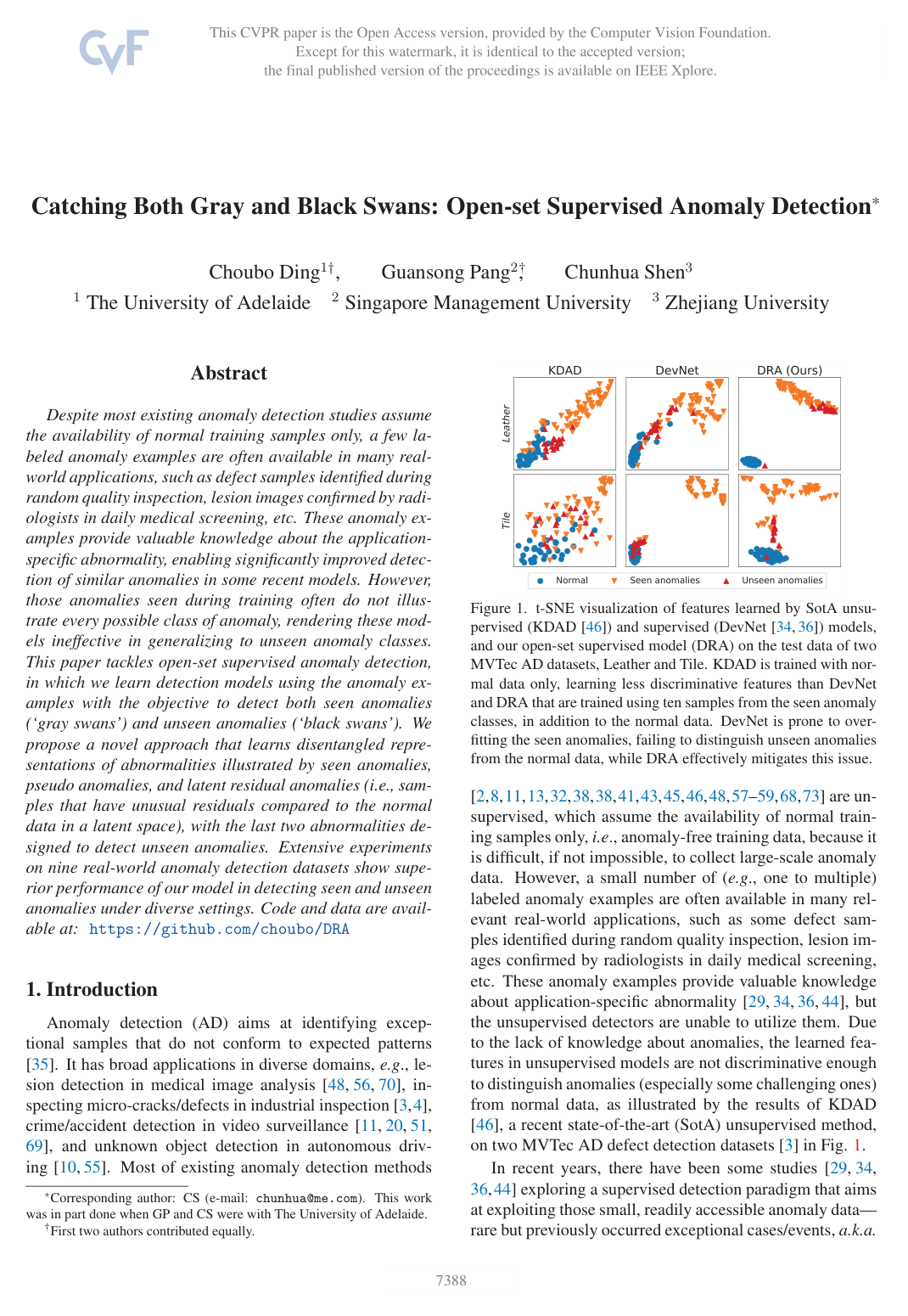
Catching Both Gray and Black Swans: Open-set Supervised Anomaly Detection
Choubo Ding, Guansong Pang, Chunhua Shen
Why you should read this
Proposes a multi-head framework that disentangles known, pseudo, and latent residual abnormalities to effectively detect both seen and novel anomaly classes using only a small set of labeled anomaly examples.
Despite most existing anomaly detection studies assume the availability of normal training samples only, a few labeled anomaly examples are often available in many real-world applications, such as defect samples identified during random quality inspection, lesion images confirmed by radiologists in daily medical screening, etc. These anomaly examples provide valuable knowledge about the application-specific abnormality, enabling significantly improved detection of similar anomalies in some recent models. However, those anomalies seen during training often do not illustrate every possible class of anomaly, rendering these models ineffective in generalizing to unseen anomaly classes. This paper tackles open-set supervised anomaly detection, in which we learn detection models using the anomaly examples with the objective to detect both seen anomalies ('gray swans') and unseen anomalies ('black swans'). We propose a novel approach that learns disentangled representations of abnormalities illustrated by seen anomalies, pseudo anomalies, and latent residual anomalies (i.e., samples that have unusual residuals compared to the normal data in a latent space), with the last two abnormalities designed to detect unseen anomalies. Extensive experiments on nine real-world anomaly detection datasets show superior performance of our model in detecting seen and unseen anomalies under diverse settings. Code and data are available at: https://github.com/choubo/DRA
Added
2026-09-26
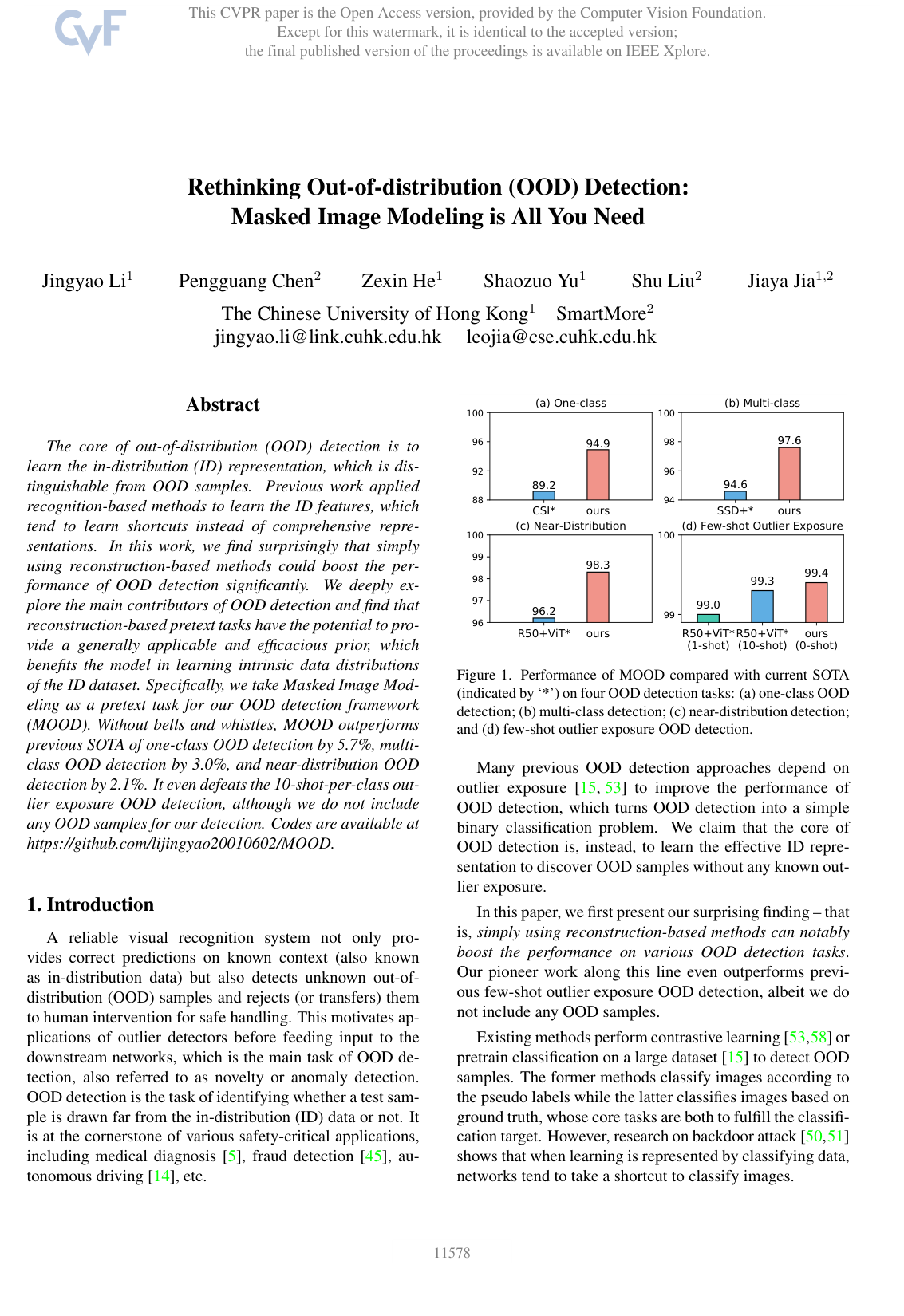
Rethinking Out-of-distribution (OOD) Detection: Masked Image Modeling is All You Need
Jingyao Li, Pengguang Chen, Zexin He, Shaozuo Yu, Shu Liu, Jiaya Jia
Why you should read this
Demonstrates that pretraining vision transformers with masked image modeling enables models to capture intrinsic data distributions rather than classification shortcuts, outperforming existing out-of-distribution detection methods without requiring any outlier exposure.
The core of out-of-distribution (OOD) detection is to learn the in-distribution (ID) representation, which is distinguishable from OOD samples. Previous work applied recognition-based methods to learn the ID features, which tend to learn shortcuts instead of comprehensive representations. In this work, we find surprisingly that simply using reconstruction-based methods could boost the performance of OOD detection significantly. We deeply explore the main contributors of OOD detection and find that reconstruction-based pretext tasks have the potential to provide a generally applicable and efficacious prior, which benefits the model in learning intrinsic data distributions of the ID dataset. Specifically, we take Masked Image Modeling as a pretext task for our OOD detection framework (MOOD). Without bells and whistles, MOOD outperforms previous SOTA of one-class OOD detection by 5.7%, multi-class OOD detection by 3.0%, and near-distribution OOD detection by 2.1%. It even defeats the 10-shot-per-class outlier exposure OOD detection, although we do not include any OOD samples for our detection. Codes are available at https://github.com/lijingyao20010602/MOOD.
Added
2026-09-26
Deep Learning for Anomaly Detection
Guansong Pang, Chunhua Shen, Longbing Cao, Anton van den Hengel
Why you should read this
Synthesizes deep anomaly detection methods into an eleven-category taxonomy, critically analyzing their objective functions, theoretical assumptions, and practical trade-offs to guide future model design.
Anomaly detection, a.k.a. outlier detection or novelty detection, has been a lasting yet active research area in various research communities for several decades. There are still some unique problem complexities and challenges that require advanced approaches. In recent years, deep learning enabled anomaly detection, i.e., deep anomaly detection, has emerged as a critical direction. This paper surveys the research of deep anomaly detection with a comprehensive taxonomy, covering advancements in three high-level categories and 11 fine-grained categories of the methods. We review their key intuitions, objective functions, underlying assumptions, advantages and disadvantages, and discuss how they address the aforementioned challenges. We further discuss a set of possible future opportunities and new perspectives on addressing the challenges.
Added
2026-09-25
Toward Open Set Recognition
W. Scheirer, A. Rocha, Archana Sapkota, T. Boult
Why you should read this
Formalizes the open set recognition problem and introduces the 1-vs-Set Machine to limit classification risk in unconstrained spaces where unseen classes emerge at test time.
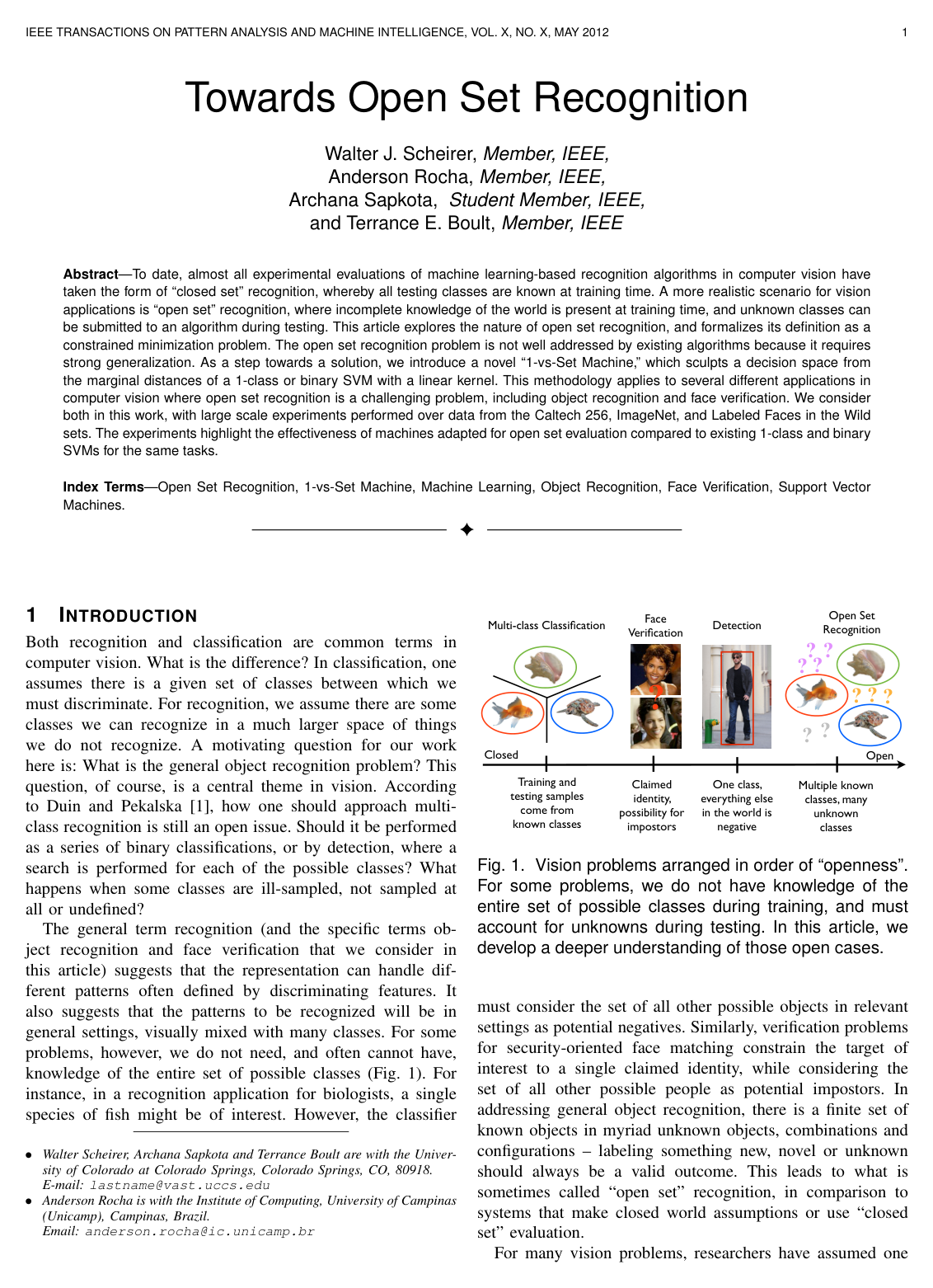
To date, almost all experimental evaluations of machine learning-based recognition algorithms in computer vision have taken the form of "closed set" recognition, whereby all testing classes are known at training time. A more realistic scenario for vision applications is "open set" recognition, where incomplete knowledge of the world is present at training time, and unknown classes can be submitted to an algorithm during testing. This article explores the nature of open set recognition, and formalizes its definition as a constrained minimization problem. The open set recognition problem is not well addressed by existing algorithms because it requires strong generalization. As a step towards a solution, we introduce a novel "1-vs-Set Machine," which sculpts a decision space from the marginal distances of a 1-class or binary SVM with a linear kernel. This methodology applies to several different applications in computer vision where open set recognition is a challenging problem, including object recognition and face verification. We consider both in this work, with large scale experiments performed over data from the Caltech 256, ImageNet, and Labeled Faces in the Wild sets. The experiments highlight the effectiveness of machines adapted for open set evaluation compared to existing 1-class and binary SVMs for the same tasks.
Added
2026-09-24
Support Vector Data Description
DAVID M.J. TAX, ROBERT P.W. DUIN
Why you should read this
Proposes Support Vector Data Description (SVDD), a foundational method that computes a minimal enclosing hypersphere with kernel flexibility to perform one-class classification and outlier detection without requiring complete probability density estimation.
Data domain description concerns the characterization of a data set. A good description covers all target data but includes no superfluous space. The boundary of a dataset can be used to detect novel data or outliers. We will present the Support Vector Data Description (SVDD) which is inspired by the Support Vector Classifier. It obtains a spherically shaped boundary around a dataset and analogous to the Support Vector Classifier it can be made flexible by using other kernel functions. The method is made robust against outliers in the training set and is capable of tightening the description by using negative examples. We show characteristics of the Support Vector Data Descriptions using artificial and real data.
Added
2026-09-24
GANomaly: Semi-Supervised Anomaly Detection via Adversarial Training
Samet Akcay, Amir Atapour-Abarghouei, Toby P. Breckon
Why you should read this
Presents an encoder-decoder-encoder conditional generative adversarial network that identifies unseen visual anomalies by measuring reconstruction discrepancies across both image and latent feature spaces.
Anomaly detection is a classical problem in computer vision, namely the determination of the normal from the abnormal when datasets are highly biased towards one class (normal) due to the insufficient sample size of the other class (abnormal). While this can be addressed as a supervised learning problem, a significantly more challenging problem is that of detecting the unknown/unseen anomaly case that takes us instead into the space of a one-class, semi-supervised learning paradigm. We introduce such a novel anomaly detection model, by using a conditional generative adversarial network that jointly learns the generation of high-dimensional image space and the inference of latent space. Employing encoder-decoder-encoder sub-networks in the generator network enables the model to map the input image to a lower dimension vector, which is then used to reconstruct the generated output image. The use of the additional encoder network maps this generated image to its latent representation. Minimizing the distance between these images and the latent vectors during training aids in learning the data distribution for the normal samples. As a result, a larger distance metric from this learned data distribution at inference time is indicative of an outlier from that distribution - an anomaly. Experimentation over several benchmark datasets, from varying domains, shows the model efficacy and superiority over previous state-of-the-art approaches.
Added
2026-09-24
Towards Total Recall in Industrial Anomaly Detection
Karsten Roth, Latha Pemula, Joaquin Zepeda, Bernhard Schölkopf, Thomas Brox, Peter Gehler
Why you should read this
Introduces PatchCore, an industrial anomaly detection method that leverages a representative memory bank of patch features to more than halve error rates on the standard MVTec AD benchmark while maintaining fast inference speeds.
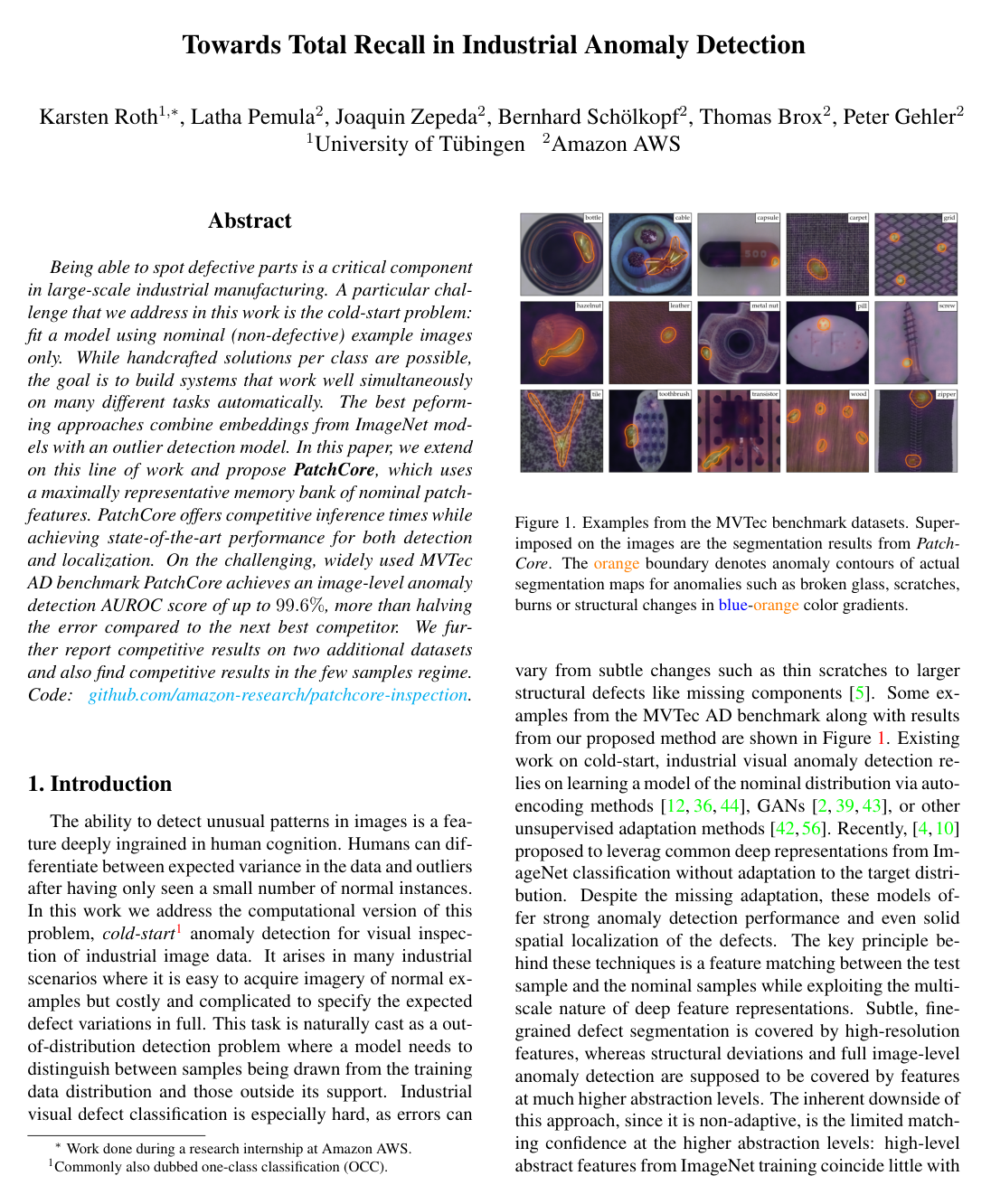
Being able to spot defective parts is a critical component in large-scale industrial manufacturing. A particular challenge that we address in this work is the cold-start problem: fit a model using nominal (non-defective) example images only. While handcrafted solutions per class are possible, the goal is to build systems that work well simultaneously on many different tasks automatically. The best performing approaches combine embeddings from ImageNet models with an outlier detection model. In this paper, we extend on this line of work and propose \textbf{PatchCore}, which uses a maximally representative memory bank of nominal patch-features. PatchCore offers competitive inference times while achieving state-of-the-art performance for both detection and localization. On the challenging, widely used MVTec AD benchmark PatchCore achieves an image-level anomaly detection AUROC score of up to , more than halving the error compared to the next best competitor. We further report competitive results on two additional datasets and also find competitive results in the few samples regime.\freefootnote{ Work done during a research internship at Amazon AWS.} Code: this http URL.
Added
2026-09-18
Deep Learning for Anomaly Detection: A Survey
Raghavendra Chalapathy, Sanjay Chawla
Why you should read this
Classifies deep learning anomaly detection methods across diverse application domains, evaluating their underlying assumptions, computational complexities, and practical limitations to guide model selection and identify critical research challenges.
Anomaly detection is an important problem that has been well-studied within diverse research areas and application domains. The aim of this survey is two-fold, firstly we present a structured and comprehensive overview of research methods in deep learning-based anomaly detection. Furthermore, we review the adoption of these methods for anomaly across various application domains and assess their effectiveness. We have grouped state-of-the-art research techniques into different categories based on the underlying assumptions and approach adopted. Within each category we outline the basic anomaly detection technique, along with its variants and present key assumptions, to differentiate between normal and anomalous behavior. For each category, we present we also present the advantages and limitations and discuss the computational complexity of the techniques in real application domains. Finally, we outline open issues in research and challenges faced while adopting these techniques.
Added
2026-09-18
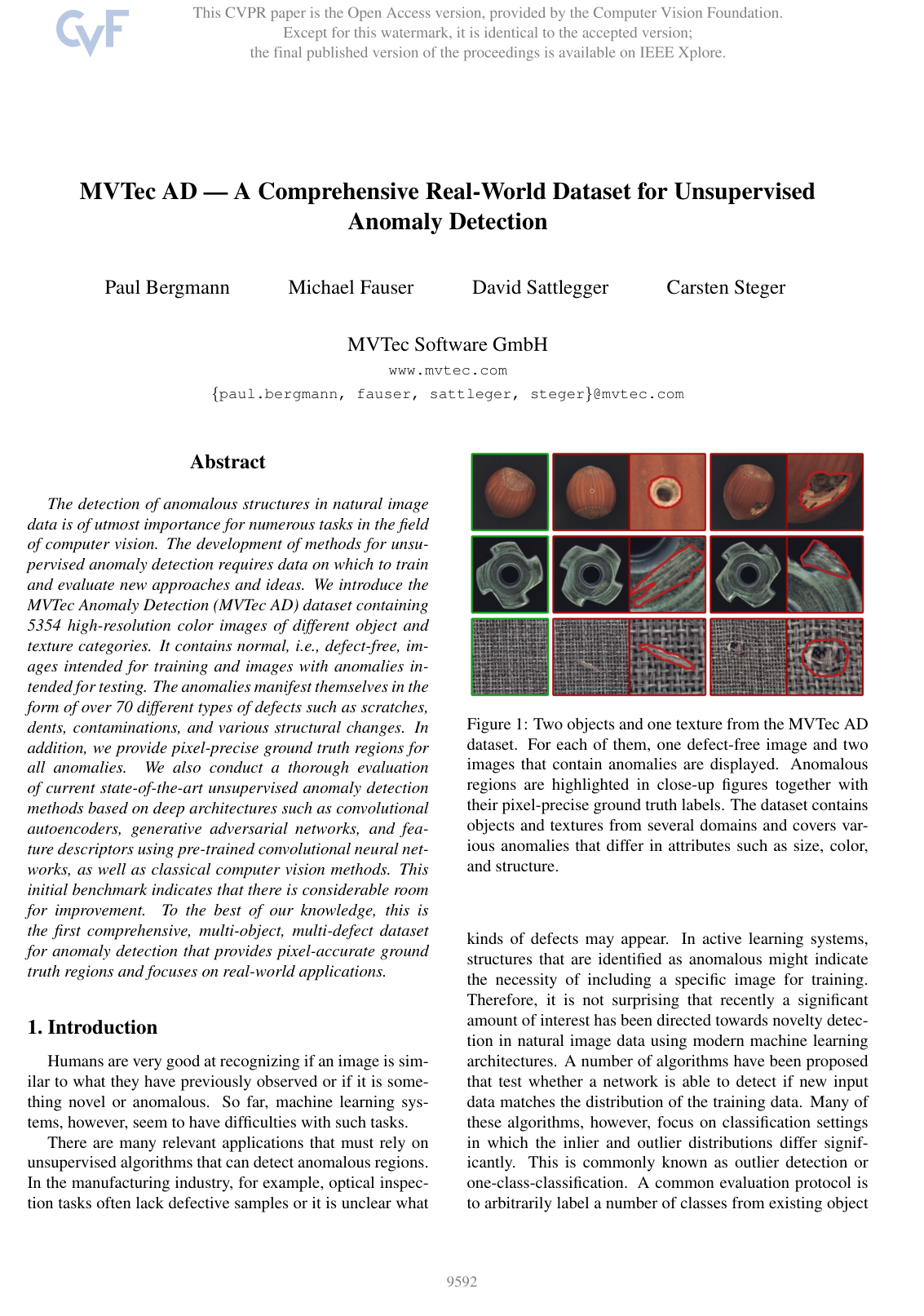
MVTec AD — A Comprehensive Real-World Dataset for Unsupervised Anomaly Detection
Paul Bergmann, Michael Fauser, David Sattlegger, C. Steger
Why you should read this
Introduces the first comprehensive real-world industrial inspection dataset with pixel-accurate defect annotations across fifteen object and texture categories, establishing a rigorous benchmark that reveals key limitations in current unsupervised anomaly detection and localization methods.
The detection of anomalous structures in natural image data is of utmost importance for numerous tasks in the field of computer vision. The development of methods for unsupervised anomaly detection requires data on which to train and evaluate new approaches and ideas. We introduce the MVTec Anomaly Detection (MVTec AD) dataset containing 5354 high-resolution color images of different object and texture categories. It contains normal, i.e., defect-free, images intended for training and images with anomalies intended for testing. The anomalies manifest themselves in the form of over 70 different types of defects such as scratches, dents, contaminations, and various structural changes. In addition, we provide pixel-precise ground truth regions for all anomalies. We also conduct a thorough evaluation of current state-of-the-art unsupervised anomaly detection methods based on deep architectures such as convolutional autoencoders, generative adversarial networks, and feature descriptors using pre-trained convolutional neural networks, as well as classical computer vision methods. This initial benchmark indicates that there is considerable room for improvement. To the best of our knowledge, this is the first comprehensive, multi-object, multi-defect dataset for anomaly detection that provides pixel-accurate ground truth regions and focuses on real-world applications.
Added
2026-09-15
Unsupervised Anomaly Detection with Generative Adversarial Networks to Guide Marker Discovery
Thomas Schlegl, Philipp Seeböck, Sebastian M. Waldstein, Ursula Schmidt-Erfurth, Georg Langs
Why you should read this
Introduces AnoGAN, a deep generative adversarial framework that detects and localizes pathological markers in medical images without labeled disease data by mapping unseen scans against a learned distribution of healthy anatomy.
Obtaining models that capture imaging markers relevant for disease progression and treatment monitoring is challenging. Models are typically based on large amounts of data with annotated examples of known markers aiming at automating detection. High annotation effort and the limitation to a vocabulary of known markers limit the power of such approaches. Here, we perform unsupervised learning to identify anomalies in imaging data as candidates for markers. We propose AnoGAN, a deep convolutional generative adversarial network to learn a manifold of normal anatomical variability, accompanying a novel anomaly scoring scheme based on the mapping from image space to a latent space. Applied to new data, the model labels anomalies, and scores image patches indicating their fit into the learned distribution. Results on optical coherence tomography images of the retina demonstrate that the approach correctly identifies anomalous images, such as images containing retinal fluid or hyperreflective foci.
Added
2026-09-14
Support Vector Method for Novelty Detection
B. Schölkopf, R. C. Williamson, Alex Smola, J. Shawe-Taylor, John C. Platt
Why you should read this
Introduces the support vector method for novelty detection, which estimates the support of an unknown distribution by separating unlabeled data from the origin in a kernel feature space with direct theoretical control over the outlier fraction.
Suppose you are given some dataset drawn from an underlying probability distribution P and you want to estimate a “simple” subset S of input space such that the probability that a test point drawn from P lies outside of S equals some a priori specified ν between 0 and 1. We propose a method to approach this problem by trying to estimate a function f which is positive on S and negative on the complement. The functional form of f is given by a kernel expansion in terms of a potentially small subset of the training data; it is regularized by controlling the length of the weight vector in an associated feature space. We provide a theoretical analysis of the statistical performance of our algorithm. The algorithm is a natural extension of the support vector algorithm to the case of unlabelled data.
Added
2026-09-14
A Simple Unified Framework for Detecting Out-of-Distribution Samples and Adversarial Attacks
Kimin Lee, Kibok Lee, Honglak Lee, Jinwoo Shin
Why you should read this
Introduces a simple, architecture-agnostic Mahalanobis distance-based method that uniquely achieves state-of-the-art performance in simultaneously detecting both out-of-distribution samples and adversarial attacks, even under challenging conditions like noisy labels or limited data, and enables class-incremental learning without retraining.
Detecting test samples drawn sufficiently far away from the training distribution statistically or adversarially is a fundamental requirement for deploying a good classifier in many real-world machine learning applications. However, deep neural networks with the softmax classifier are known to produce highly overconfident posterior distributions even for such abnormal samples. In this paper, we propose a simple yet effective method for detecting any abnormal samples, which is applicable to any pre-trained softmax neural classifier. We obtain the class conditional Gaussian distributions with respect to (low- and upper-level) features of the deep models under Gaussian discriminant analysis, which result in a confidence score based on the Mahalanobis distance. While most prior methods have been evaluated for detecting either out-of-distribution or adversarial samples, but not both, the proposed method achieves the state-of-the-art performances for both cases in our experiments. Moreover, we found that our proposed method is more robust in harsh cases, e.g., when the training dataset has noisy labels or small number of samples. Finally, we show that the proposed method enjoys broader usage by applying it to class-incremental learning: whenever out-of-distribution samples are detected, our classification rule can incorporate new classes well without further training deep models.
Added
2026-04-27
License
Published with permission
Failing Loudly: An Empirical Study of Methods for Detecting Dataset Shift
Stephan Rabanser, Stephan Günnemann, Zachary C. Lipton
Why you should read this
Demonstrates that a two-sample-testing-based approach, leveraging pre-trained classifiers for dimensionality reduction, effectively detects and characterizes dataset shift, enabling ML systems to "fail loudly" rather than silently.
We might hope that when faced with unexpected inputs, well-designed software systems would fire off warnings. Machine learning (ML) systems, however, which depend strongly on properties of their inputs (e.g. the i.i.d. assumption), tend to fail silently. This paper explores the problem of building ML systems that fail loudly, investigating methods for detecting dataset shift, identifying exemplars that most typify the shift, and quantifying shift malignancy. We focus on several datasets and various perturbations to both covariates and label distributions with varying magnitudes and fractions of data affected. Interestingly, we show that across the dataset shifts that we explore, a two-sample-testing-based approach, using pre-trained classifiers for dimensionality reduction, performs best. Moreover, we demonstrate that domain-discriminating approaches tend to be helpful for characterizing shifts qualitatively and determining if they are harmful.
Added
2026-04-27