
keyword
unsupervised anomaly detection
Unsupervised anomaly detection is a machine learning approach that identifies data points, patterns, or regions that deviate significantly from normal behavior without requiring labeled examples of anomalies during training. Instead of relying on supervision from pre-annotated defects or outliers, algorithms learn the baseline characteristics and underlying distribution of normality from unlabeled or anomaly-free training data. During inference, test instances that fail to conform to this established representation of normal data, often indicated by high reconstruction errors, low probabilistic density, or significant latent feature discrepancies, are flagged or localized as anomalies. This paradigm is widely utilized across diverse domains, including industrial quality inspection, time-series system monitoring, and medical image analysis, where anomalous occurrences are rare, diverse, or unpredictable.
12 items
Towards a Rigorous Evaluation of Time-Series Anomaly Detection
Siwon Kim, Kukjin Choi, Hyun-Soo Choi, Byunghan Lee, Sungroh Yoon
Why you should read this
Reveals that the widely used point adjustment evaluation protocol severely inflates time-series anomaly detection performance to the point where random guessing outperforms state-of-the-art models, while establishing a rigorous evaluation protocol and baseline to properly measure genuine progress.
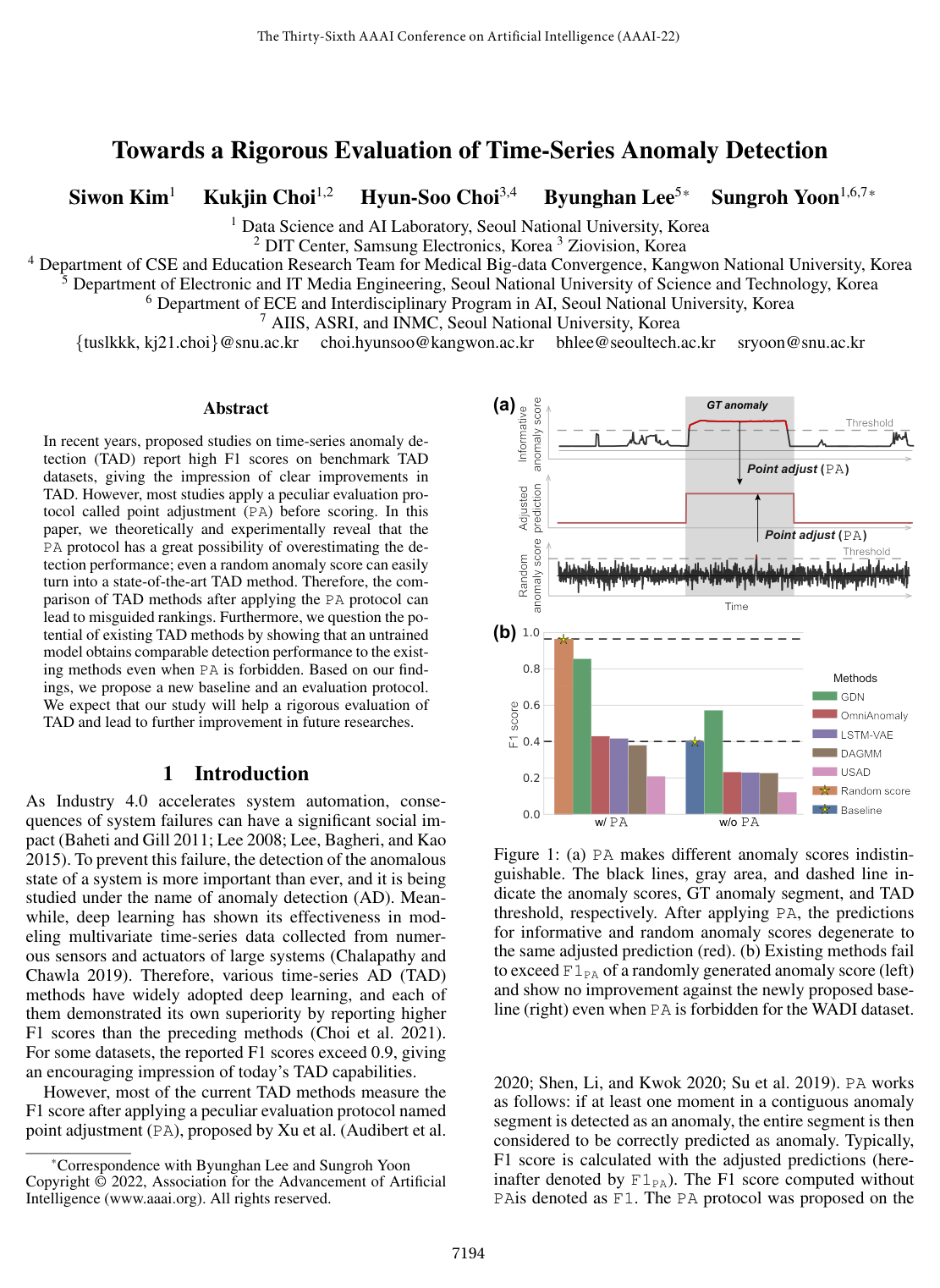
In recent years, proposed studies on time-series anomaly detection (TAD) report high F1 scores on benchmark TAD datasets, giving the impression of clear improvements in TAD. However, most studies apply a peculiar evaluation protocol called point adjustment (PA) before scoring. In this paper, we theoretically and experimentally reveal that the PA protocol has a great possibility of overestimating the detection performance; even a random anomaly score can easily turn into a state-of-the-art TAD method. Therefore, the comparison of TAD methods after applying the PA protocol can lead to misguided rankings. Furthermore, we question the potential of existing TAD methods by showing that an untrained model obtains comparable detection performance to the existing methods even when PA is forbidden. Based on our findings, we propose a new baseline and an evaluation protocol. We expect that our study will help a rigorous evaluation of TAD and lead to further improvement in future researches.
Added
2026-10-05
Shape-Guided Dual-Memory Learning for 3D Anomaly Detection
Yu-Min Chu, Chieh Liu, Ting-I Hsieh, Hwann-Tzong Chen, Tyng-Luh Liu
Why you should read this
Proposes a shape-guided dual-memory framework that combines neural implicit signed distance fields with aligned 2D visual features to achieve state-of-the-art unsupervised 3D anomaly detection and localization on the MVTec 3D-AD benchmark.
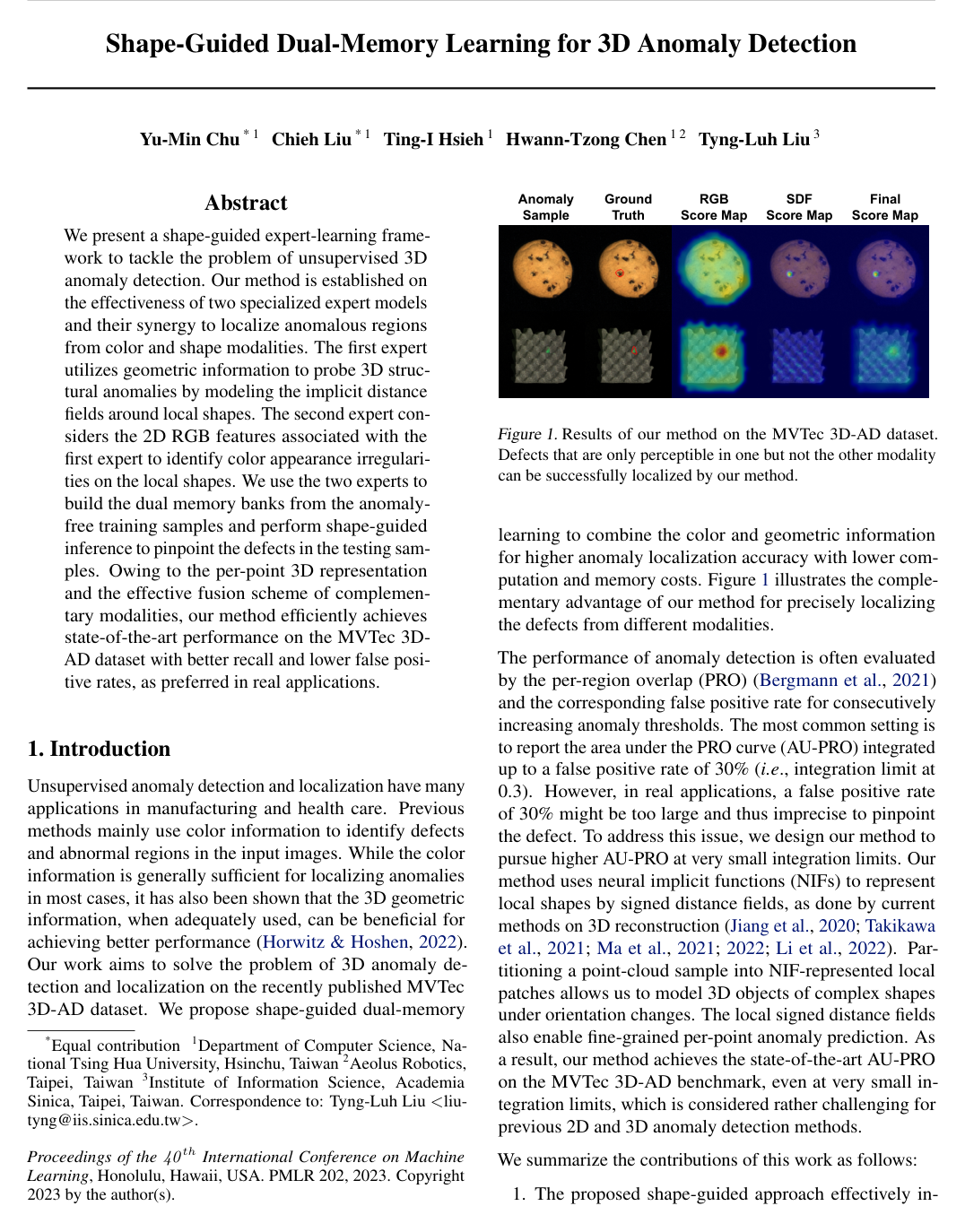
We present a shape-guided expert-learning framework to tackle the problem of unsupervised 3D anomaly detection. Our method is established on the effectiveness of two specialized expert models and their synergy to localize anomalous regions from color and shape modalities. The first expert utilizes geometric information to probe 3D structural anomalies by modeling the implicit distance fields around local shapes. The second expert considers the 2D RGB features associated with the first expert to identify color appearance irregularities on the local shapes. We use the two experts to build the dual memory banks from the anomaly-free training samples and perform shape-guided inference to pinpoint the defects in the testing samples. Owing to the per-point 3D representation and the effective fusion scheme of complementary modalities, our method efficiently achieves state-of-the-art performance on the MVTec 3D-AD dataset with better recall and lower false positive rates, as preferred in real applications.
Added
2026-10-02
SoftPatch: Unsupervised Anomaly Detection with Noisy Data
Xi Jiang, Jianlin Liu, Jinbao Wang, Qiang Nie, Kai Wu, Yong Liu, Chengjie Wang, Feng Zheng
Why you should read this
Proposes SoftPatch, a patch-level denoising and memory re-weighting method that prevents defective training samples from distorting decision boundaries in real-world unsupervised anomaly detection.
Although mainstream unsupervised anomaly detection (AD) algorithms perform well in academic datasets, their performance is limited in practical application due to the ideal experimental setting of clean training data. Training with noisy data is an inevitable problem in real-world anomaly detection but is seldom discussed. This paper considers label-level noise in image sensory anomaly detection for the first time. To solve this problem, we proposed a memory-based unsupervised AD method, SoftPatch, which efficiently denoises the data at the patch level. Noise discriminators are utilized to generate outlier scores for patch-level noise elimination before coreset construction. The scores are then stored in the memory bank to soften the anomaly detection boundary. Compared with existing methods, SoftPatch maintains a strong modeling ability of normal data and alleviates the overconfidence problem in coreset. Comprehensive experiments in various noise scenes demonstrate that SoftPatch outperforms the state-of-the-art AD methods on the MVTecAD and BTAD benchmarks and is comparable to those methods under the setting without noise.
Added
2026-09-26
Anomaly Transformer: Time Series Anomaly Detection with Association Discrepancy
Jiehui Xu, Haixu Wu, Jianmin Wang, Mingsheng Long
Why you should read this
Proposes the Anomaly Transformer, which exploits attention-weight discrepancies between local and global temporal associations through a minimax optimization strategy to achieve state-of-the-art unsupervised time series anomaly detection.
Unsupervised detection of anomaly points in time series is a challenging problem, which requires the model to derive a distinguishable criterion. Previous methods tackle the problem mainly through learning pointwise representation or pairwise association, however, neither is sufficient to reason about the intricate dynamics. Recently, Transformers have shown great power in unified modeling of pointwise representation and pairwise association, and we find that the self-attention weight distribution of each time point can embody rich association with the whole series. Our key observation is that due to the rarity of anomalies, it is extremely difficult to build nontrivial associations from abnormal points to the whole series, thereby, the anomalies' associations shall mainly concentrate on their adjacent time points. This adjacent-concentration bias implies an association-based criterion inherently distinguishable between normal and abnormal points, which we highlight through the \emph{Association Discrepancy}. Technically, we propose the \emph{Anomaly Transformer} with a new \emph{Anomaly-Attention} mechanism to compute the association discrepancy. A minimax strategy is devised to amplify the normal-abnormal distinguishability of the association discrepancy. The Anomaly Transformer achieves state-of-the-art results on six unsupervised time series anomaly detection benchmarks of three applications: service monitoring, space & earth exploration, and water treatment.
Added
2026-09-26
AnomalyCLIP: Object-agnostic Prompt Learning for Zero-shot Anomaly Detection
Qihang Zhou, Guansong Pang, Yu Tian, Shibo He, Jiming Chen
Why you should read this
Introduces AnomalyCLIP, a prompt-learning framework that adapts vision-language models for zero-shot anomaly detection and segmentation across diverse industrial and medical domains by decoupling generic abnormality patterns from object-specific semantics.
Zero-shot anomaly detection (ZSAD) requires detection models trained using auxiliary data to detect anomalies without any training sample in a target dataset. It is a crucial task when training data is not accessible due to various concerns, eg, data privacy, yet it is challenging since the models need to generalize to anomalies across different domains where the appearance of foreground objects, abnormal regions, and background features, such as defects/tumors on different products/organs, can vary significantly. Recently large pre-trained vision-language models (VLMs), such as CLIP, have demonstrated strong zero-shot recognition ability in various vision tasks, including anomaly detection. However, their ZSAD performance is weak since the VLMs focus more on modeling the class semantics of the foreground objects rather than the abnormality/normality in the images. In this paper we introduce a novel approach, namely AnomalyCLIP, to adapt CLIP for accurate ZSAD across different domains. The key insight of AnomalyCLIP is to learn object-agnostic text prompts that capture generic normality and abnormality in an image regardless of its foreground objects. This allows our model to focus on the abnormal image regions rather than the object semantics, enabling generalized normality and abnormality recognition on diverse types of objects. Large-scale experiments on 17 real-world anomaly detection datasets show that AnomalyCLIP achieves superior zero-shot performance of detecting and segmenting anomalies in datasets of highly diverse class semantics from various defect inspection and medical imaging domains. Code will be made available at this https URL.
Added
2026-09-26
Unsupervised Out-of-Distribution Detection with Diffusion Inpainting
Zhenzhen Liu, Jin Peng Zhou, Yufan Wang, Kilian Q. Weinberger
Why you should read this
Introduces Lift, Map, Detect (LMD), an unsupervised out-of-distribution detection framework that identifies anomalous images by masking them and measuring reconstruction error after inpainting with a diffusion model trained only on in-domain data.
Unsupervised out-of-distribution detection (OOD) seeks to identify out-of-domain data by learning only from unlabeled in-domain data. We present a novel approach for this task – Lift, Map, Detect (LMD) – that leverages recent advancement in diffusion models. Diffusion models are one type of generative models. At their core, they learn an iterative denoising process that gradually maps a noisy image closer to their training manifolds. LMD leverages this intuition for OOD detection. Specifically, LMD lifts an image off its original manifold by corrupting it, and maps it towards the in-domain manifold with a diffusion model. For an out-of-domain image, the mapped image would have a large distance away from its original manifold, and LMD would identify it as OOD accordingly. We show through extensive experiments that LMD achieves competitive performance across a broad variety of datasets. Code can be found at https://github.com/zhenzhel/lift_map_detect.
Added
2026-09-26
Rethinking Out-of-distribution (OOD) Detection: Masked Image Modeling is All You Need
Jingyao Li, Pengguang Chen, Zexin He, Shaozuo Yu, Shu Liu, Jiaya Jia
Why you should read this
Demonstrates that pretraining vision transformers with masked image modeling enables models to capture intrinsic data distributions rather than classification shortcuts, outperforming existing out-of-distribution detection methods without requiring any outlier exposure.
The core of out-of-distribution (OOD) detection is to learn the in-distribution (ID) representation, which is distinguishable from OOD samples. Previous work applied recognition-based methods to learn the ID features, which tend to learn shortcuts instead of comprehensive representations. In this work, we find surprisingly that simply using reconstruction-based methods could boost the performance of OOD detection significantly. We deeply explore the main contributors of OOD detection and find that reconstruction-based pretext tasks have the potential to provide a generally applicable and efficacious prior, which benefits the model in learning intrinsic data distributions of the ID dataset. Specifically, we take Masked Image Modeling as a pretext task for our OOD detection framework (MOOD). Without bells and whistles, MOOD outperforms previous SOTA of one-class OOD detection by 5.7%, multi-class OOD detection by 3.0%, and near-distribution OOD detection by 2.1%. It even defeats the 10-shot-per-class outlier exposure OOD detection, although we do not include any OOD samples for our detection. Codes are available at https://github.com/lijingyao20010602/MOOD.
Added
2026-09-26
Memorizing Normality to Detect Anomaly: Memory-Augmented Deep Autoencoder for Unsupervised Anomaly Detection
Dong Gong, Lingqiao Liu, Vuong Le, Budhaditya Saha, Moussa Reda Mansour, Svetha Venkatesh, Anton van den Hengel
Why you should read this
Develops a memory-augmented autoencoder that prevents unsupervised anomaly detectors from mistakenly reconstructing abnormal inputs by constraining latent representations to retrieve learned prototypes of normal data.
Deep autoencoder has been extensively used for anomaly detection. Training on the normal data, the autoencoder is expected to produce higher reconstruction error for the abnormal inputs than the normal ones, which is adopted as a criterion for identifying anomalies. However, this assumption does not always hold in practice. It has been observed that sometimes the autoencoder "generalizes" so well that it can also reconstruct anomalies well, leading to the miss detection of anomalies. To mitigate this drawback for autoencoder based anomaly detector, we propose to augment the autoencoder with a memory module and develop an improved autoencoder called memory-augmented autoencoder, i.e. MemAE. Given an input, MemAE firstly obtains the encoding from the encoder and then uses it as a query to retrieve the most relevant memory items for reconstruction. At the training stage, the memory contents are updated and are encouraged to represent the prototypical elements of the normal data. At the test stage, the learned memory will be fixed, and the reconstruction is obtained from a few selected memory records of the normal data. The reconstruction will thus tend to be close to a normal sample. Thus the reconstructed errors on anomalies will be strengthened for anomaly detection. MemAE is free of assumptions on the data type and thus general to be applied to different tasks. Experiments on various datasets prove the excellent generalization and high effectiveness of the proposed MemAE.
Added
2026-09-19
Deep Learning for Anomaly Detection: A Survey
Raghavendra Chalapathy, Sanjay Chawla
Why you should read this
Classifies deep learning anomaly detection methods across diverse application domains, evaluating their underlying assumptions, computational complexities, and practical limitations to guide model selection and identify critical research challenges.
Anomaly detection is an important problem that has been well-studied within diverse research areas and application domains. The aim of this survey is two-fold, firstly we present a structured and comprehensive overview of research methods in deep learning-based anomaly detection. Furthermore, we review the adoption of these methods for anomaly across various application domains and assess their effectiveness. We have grouped state-of-the-art research techniques into different categories based on the underlying assumptions and approach adopted. Within each category we outline the basic anomaly detection technique, along with its variants and present key assumptions, to differentiate between normal and anomalous behavior. For each category, we present we also present the advantages and limitations and discuss the computational complexity of the techniques in real application domains. Finally, we outline open issues in research and challenges faced while adopting these techniques.
Added
2026-09-18
Deep Autoencoding Gaussian Mixture Model for Unsupervised Anomaly Detection
Bo Zong, Qi Song, Martin Renqiang Min, Wei Cheng, Cristian Lumezanu, Daeki Cho, Haifeng Chen
Why you should read this
Proposes an end-to-end unsupervised anomaly detection framework that jointly optimizes deep autoencoding reconstruction and Gaussian mixture density estimation, eliminating decoupled two-stage training to significantly improve detection accuracy on high-dimensional data.
Unsupervised anomaly detection on multi- or high-dimensional data is of great importance in both fundamental machine learning research and industrial applications, for which density estimation lies at the core. Although previous approaches based on dimensionality reduction followed by density estimation have made fruitful progress, they mainly suffer from decoupled model learning with inconsistent optimization goals and incapability of preserving essential information in the low-dimensional space. In this paper, we present a Deep Autoencoding Gaussian Mixture Model (DAGMM) for unsupervised anomaly detection. Our model utilizes a deep autoencoder to generate a low-dimensional representation and reconstruction error for each input data point, which is further fed into a Gaussian Mixture Model (GMM). Instead of using decoupled two-stage training and the standard Expectation-Maximization (EM) algorithm, DAGMM jointly optimizes the parameters of the deep autoencoder and the mixture model simultaneously in an end-to-end fashion, leveraging a separate estimation network to facilitate the parameter learning of the mixture model. The joint optimization, which well balances autoencoding reconstruction, density estimation of latent representation, and regularization, helps the autoencoder escape from less attractive local optima and further reduce reconstruction errors, avoiding the need of pre-training. Experimental results on several public benchmark datasets show that, DAGMM significantly outperforms state-of-the-art anomaly detection techniques, and achieves up to 14% improvement based on the standard F1 score.
Added
2026-09-16
MVTec AD — A Comprehensive Real-World Dataset for Unsupervised Anomaly Detection
Paul Bergmann, Michael Fauser, David Sattlegger, C. Steger
Why you should read this
Introduces the first comprehensive real-world industrial inspection dataset with pixel-accurate defect annotations across fifteen object and texture categories, establishing a rigorous benchmark that reveals key limitations in current unsupervised anomaly detection and localization methods.
The detection of anomalous structures in natural image data is of utmost importance for numerous tasks in the field of computer vision. The development of methods for unsupervised anomaly detection requires data on which to train and evaluate new approaches and ideas. We introduce the MVTec Anomaly Detection (MVTec AD) dataset containing 5354 high-resolution color images of different object and texture categories. It contains normal, i.e., defect-free, images intended for training and images with anomalies intended for testing. The anomalies manifest themselves in the form of over 70 different types of defects such as scratches, dents, contaminations, and various structural changes. In addition, we provide pixel-precise ground truth regions for all anomalies. We also conduct a thorough evaluation of current state-of-the-art unsupervised anomaly detection methods based on deep architectures such as convolutional autoencoders, generative adversarial networks, and feature descriptors using pre-trained convolutional neural networks, as well as classical computer vision methods. This initial benchmark indicates that there is considerable room for improvement. To the best of our knowledge, this is the first comprehensive, multi-object, multi-defect dataset for anomaly detection that provides pixel-accurate ground truth regions and focuses on real-world applications.
Added
2026-09-15
Unsupervised Anomaly Detection with Generative Adversarial Networks to Guide Marker Discovery
Thomas Schlegl, Philipp Seeböck, Sebastian M. Waldstein, Ursula Schmidt-Erfurth, Georg Langs
Why you should read this
Introduces AnoGAN, a deep generative adversarial framework that detects and localizes pathological markers in medical images without labeled disease data by mapping unseen scans against a learned distribution of healthy anatomy.
Obtaining models that capture imaging markers relevant for disease progression and treatment monitoring is challenging. Models are typically based on large amounts of data with annotated examples of known markers aiming at automating detection. High annotation effort and the limitation to a vocabulary of known markers limit the power of such approaches. Here, we perform unsupervised learning to identify anomalies in imaging data as candidates for markers. We propose AnoGAN, a deep convolutional generative adversarial network to learn a manifold of normal anatomical variability, accompanying a novel anomaly scoring scheme based on the mapping from image space to a latent space. Applied to new data, the model labels anomalies, and scores image patches indicating their fit into the learned distribution. Results on optical coherence tomography images of the retina demonstrate that the approach correctly identifies anomalous images, such as images containing retinal fluid or hyperreflective foci.
Added
2026-09-14