PoseNet: A Convolutional Network for Real-Time 6-DOF Camera Relocalization

Alex KendallMatthew GrimesRoberto Cipolla

article2015ICCV2,515 citations

Introduces PoseNet, a deep convolutional network that regresses 6-DOF camera pose directly from a single RGB image in real time, eliminating the need for traditional feature matching and graph optimization pipelines.

Listen

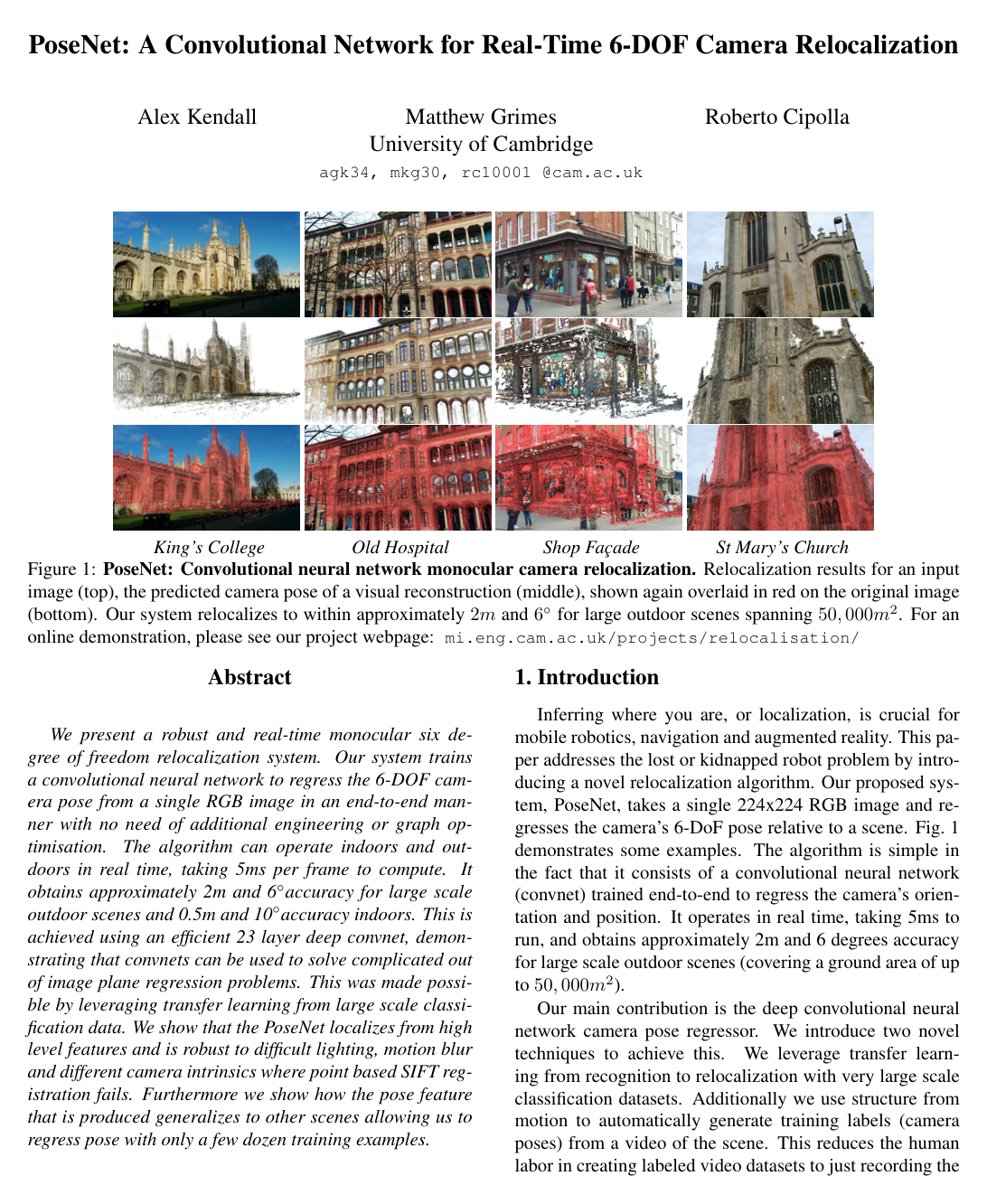
The article addresses the challenge of real-time camera relocalization for applications such as mobile robotics, navigation, and augmented reality. Traditional methods like SLAM require dense maps, frame-to-frame feature matching, and separate systems for coarse and fine pose estimation, which limits scalability and robustness in changing conditions. PoseNet offers a simpler alternative by directly estimating six-degree-of-freedom camera pose from a single monocular RGB image.

The work evaluates whether a convolutional neural network can learn to regress continuous camera position and orientation end-to-end without additional optimization or engineering. Researchers modified GoogLeNet and trained it on two datasets: Cambridge Landmarks for large outdoor scenes and the 7 Scenes dataset for indoor environments. Training labels came from structure-from-motion on video, and transfer learning from large classification datasets accelerated convergence and improved accuracy.

The system localizes to roughly 2 meters and 6 degrees in outdoor areas up to 50,000 square meters and to 0.5 meters and 10 degrees indoors, processing each frame in 5 milliseconds. It outperforms nearest-neighbor matching on the learned features and remains competitive with depth-based methods on the most difficult frames. The network proves robust to motion blur, varying lighting, weather, dynamic objects, and changes in camera intrinsics where point-feature methods fail. Feature analysis shows the network relies on high-level contours and even textureless regions rather than isolated points, and the internal representation generalizes across scenes with only a few dozen additional examples.

These results indicate that a fixed-size neural network can replace map storage and tracking pipelines while maintaining usable accuracy for many tasks. The approach reduces memory use from gigabytes to 50 megabytes and eliminates the need for keyframe databases that grow with scene size. Performance holds even when training images are spaced several meters apart, suggesting lower data collection costs than traditional methods.

Further development should focus on probabilistic pose outputs and on determining the maximum physical area a single network can reliably cover. Additional labeled video from diverse environments would help establish performance boundaries before deployment at scale.

Cover for PoseNet: A Convolutional Network for Real-Time 6-DOF Camera Relocalization

Abstract

We present a robust and real-time monocular six degree of freedom relocalization system. Our system trains a convolutional neural network to regress the 6-DOF camera pose from a single RGB image in an end-to-end manner with no need of additional engineering or graph optimisation. The algorithm can operate indoors and outdoors in real time, taking 5ms per frame to compute. It obtains approximately 2m and 6 degree accuracy for large scale outdoor scenes and 0.5m and 10 degree accuracy indoors. This is achieved using an efficient 23 layer deep convnet, demonstrating that convnets can be used to solve complicated out of image plane regression problems. This was made possible by leveraging transfer learning from large scale classification data. We show the convnet localizes from high level features and is robust to difficult lighting, motion blur and different camera intrinsics where point based SIFT registration fails. Furthermore we show how the pose feature that is produced generalizes to other scenes allowing us to regress pose with only a few dozen training examples. PoseNet code, dataset and an online demonstration is available on our project webpage, at this http URL

Table of Contents

  • 1 Introduction
  • 2 Related work
  • 3 Model for deep regression of camera pose
  • 3.1 Simultaneously learning location and orientation
  • 3.2 Architecture
  • 4 Dataset
  • 5 Experiments
  • 5.1 Robustness against training image spacing
  • 5.2 Importance of transfer learning
  • 5.3 Visualising features relevant to pose
  • 5.4 Viewing the internal representation
  • 5.5 System efficiency
  • 6 Conclusions
  • References

Knowls

  1. Knowl 1 — PoseNet Architecture for 6-DOF Monocular Camera Pose Regression

    model/method

    PoseNet is a deep convolutional neural network designed to regress the 6-degree-of-freedom (6-DOF) camera pose directly from a single monocular RGB image II. The model is based on the 22-layer GoogLeNet architecture with Inception modules, modified to have 23 parameterized layers:

    1. The three standard softmax classification heads in GoogLeNet are replaced with affine regressors.

    2. Before each final regression layer, an additional fully connected layer with feature dimension 2048 is inserted to form a high-dimensional localization feature representation.

    3. Each final fully connected layer outputs a 7-dimensional pose vector p=[x,q]\mathbf{p} = [\mathbf{x}, \mathbf{q}], where xR3\mathbf{x} \in \mathbb{R}^3 represents the 3D camera position (translation in Cartesian coordinates relative to a global frame) and qR4\mathbf{q} \in \mathbb{R}^4 is a quaternion representing 3D camera orientation.

    4. The weights of the final position regression layer are randomly initialized such that the norm of the weights corresponding to each position dimension is proportional to the spatial extent of that dimension in the scene.

    5. At test time, the intermediate classifiers are discarded, and the predicted 4-dimensional orientation vector is normalized to unit length: q^/q^\hat{\mathbf{q}} / \|\hat{\mathbf{q}}\|.

    Input images are preprocessed by rescaling such that the smallest dimension is 256 pixels, followed by taking a 224×224224 \times 224 crop. During inference, evaluation is performed either on a single center crop (taking approximately 5 ms on a GPU) or by averaging predictions across 128 uniformly spaced dense crops (taking approximately 95 ms).

  2. Knowl 2 — PoseNet Joint 6-DOF Position and Orientation Loss Function

    equation

    PoseNet is trained end-to-end to jointly predict 3D translation and 4D quaternion orientation using the following Euclidean loss function:

    loss(I)=x^x2+βq^qq2\text{loss}(I) = \|\hat{\mathbf{x}} - \mathbf{x}\|_2 + \beta \left\|\hat{\mathbf{q}} - \frac{\mathbf{q}}{\|\mathbf{q}\|}\right\|_2

    where:

    • II is the input RGB image.
    • x^R3\hat{\mathbf{x}} \in \mathbb{R}^3 and xR3\mathbf{x} \in \mathbb{R}^3 denote the ground truth and predicted 3D camera position vectors, respectively.
    • q^R4\hat{\mathbf{q}} \in \mathbb{R}^4 and qR4\mathbf{q} \in \mathbb{R}^4 denote the ground truth unit quaternion and predicted orientation quaternion, respectively.
    • 2\|\cdot\|_2 denotes the standard Euclidean L2L_2 norm.
    • β\beta is a positive weighting hyperparameter that balances the position and orientation penalties.

    The optimal balance parameter β\beta is chosen via grid search and corresponds to the ratio between the expected position error and orientation error at the end of training. In practice, β\beta is set between 120 and 750 for indoor environments, and between 250 and 2000 for larger-scale outdoor scenes where translation errors have larger relative magnitudes.

    Although quaternions lie on the unit 3-sphere, the loss function omits an explicit spherical constraint during stochastic gradient descent. In practice, predicted q\mathbf{q} converges sufficiently close to q^\hat{\mathbf{q}} such that Euclidean distance approximates spherical geodesic distance without impeding optimization.

  3. Knowl 3 — Necessity of Joint Position and Orientation Representation

    empirical result

    Training a convolutional neural network with full 6-DOF pose targets ([x,q][\mathbf{x}, \mathbf{q}]) significantly outperforms training separate networks for position and orientation independently, as well as branching the network at lower layers into distinct sub-networks.

    When trained solely on position labels or solely on orientation labels, the network is unable to disentangle positional perspective shifts from camera rotations. Sharing intermediate network representations up to the final feature layer forces the network to retain both orientation and translation cues, allowing it to factor out the effect of orientation from translation estimation and vice versa.

  4. Knowl 4 — Transfer Learning from Image Classification to 6-DOF Pose Regression

    empirical result

    Pretraining the convolutional backbone on large-scale image classification datasets (such as ImageNet with 14 million images or Places with 7 million images) is critical for effective 6-DOF camera pose regression on modest-sized localization datasets:

    1. Starting from classification weights accelerates convergence speed and achieves substantially lower final localization errors compared to random weight initialization.

    2. Even though classifiers are trained to produce class labels that are invariant to camera viewpoint and pose, intermediate representations preserve spatial and pose information in order to separate identity features from viewpoint perturbations.

    3. Pretraining on the Places dataset yields superior localization accuracy compared to ImageNet pretraining, demonstrating that feature representations learned on scene-centric datasets are more transferable to visual relocalization tasks than object-centric representations.

  5. Knowl 5 — Cambridge Landmarks Dataset for Outdoor Relocalization

    experimental setup

    The Cambridge Landmarks dataset is an outdoor urban localization benchmark designed for evaluating 6-DOF camera relocalization across large geographic footprints (up to 50,000 m250,000\text{ m}^2).

    The dataset comprises 5 distinct scenes in Cambridge, UK:

    • King's College (140×40 m140 \times 40\text{ m}, 1220 train / 343 test frames)
    • Street (500×100 m500 \times 100\text{ m}, 3015 train / 2923 test frames)
    • Old Hospital (50×40 m50 \times 40\text{ m}, 895 train / 182 test frames)
    • Shop Façade (35×25 m35 \times 25\text{ m}, 231 train / 103 test frames)
    • St Mary's Church (80×60 m80 \times 60\text{ m}, 1487 train / 530 test frames)

    Data was acquired using an LG Nexus 5 smartphone capturing HD video walking sequences subsampled at 2 Hz (approximately 1 m spacing between consecutive poses). Ground truth 6-DOF camera poses were computed using an offline Structure from Motion (SfM) pipeline. Training and testing sequences were recorded along distinct walking trajectories at different times of day, incorporating environmental clutter (pedestrians, moving vehicles) and varying lighting and weather conditions.

  6. Knowl 6 — PoseNet Relocalization Accuracy Across Outdoor and Indoor Benchmarks

    data/table

    PoseNet was evaluated on outdoor scenes from the Cambridge Landmarks dataset and indoor scenes from the 7 Scenes dataset. Evaluation is reported as median translation error (in meters) and median orientation error (in degrees).

    Scene Spatial Extent (m) Train Frames Test Frames Nearest Neighbour PoseNet Dense PoseNet
    King's College 140×40140 \times 40 1220 343 3.34 m,5.923.34\text{ m}, 5.92^\circ 1.92 m,5.401.92\text{ m}, 5.40^\circ 1.66 m,4.861.66\text{ m}, 4.86^\circ
    Street 500×100500 \times 100 3015 2923 1.95 m,9.021.95\text{ m}, 9.02^\circ 3.67 m,6.503.67\text{ m}, 6.50^\circ 2.96 m,6.002.96\text{ m}, 6.00^\circ
    Old Hospital 50×4050 \times 40 895 182 5.38 m,9.025.38\text{ m}, 9.02^\circ 2.31 m,5.382.31\text{ m}, 5.38^\circ 2.62 m,4.902.62\text{ m}, 4.90^\circ
    Shop Façade 35×2535 \times 25 231 103 2.10 m,10.42.10\text{ m}, 10.4^\circ 1.46 m,8.081.46\text{ m}, 8.08^\circ 1.41 m,7.181.41\text{ m}, 7.18^\circ
    St Mary's Church 80×6080 \times 60 1487 530 4.48 m,11.34.48\text{ m}, 11.3^\circ 2.65 m,8.482.65\text{ m}, 8.48^\circ 2.45 m,7.962.45\text{ m}, 7.96^\circ
    Chess 3×2×13 \times 2 \times 1 4000 2000 0.41 m,11.20.41\text{ m}, 11.2^\circ 0.32 m,8.120.32\text{ m}, 8.12^\circ 0.32 m,6.600.32\text{ m}, 6.60^\circ
    Fire 2.5×1×12.5 \times 1 \times 1 2000 2000 0.54 m,15.50.54\text{ m}, 15.5^\circ 0.47 m,14.40.47\text{ m}, 14.4^\circ 0.47 m,14.00.47\text{ m}, 14.0^\circ
    Heads 2×0.5×12 \times 0.5 \times 1 1000 1000 0.28 m,14.00.28\text{ m}, 14.0^\circ 0.29 m,12.00.29\text{ m}, 12.0^\circ 0.30 m,12.20.30\text{ m}, 12.2^\circ
    Office 2.5×2×1.52.5 \times 2 \times 1.5 6000 4000 0.49 m,12.00.49\text{ m}, 12.0^\circ 0.48 m,7.680.48\text{ m}, 7.68^\circ 0.48 m,7.240.48\text{ m}, 7.24^\circ
    Pumpkin 2.5×2×12.5 \times 2 \times 1 4000 2000 0.58 m,12.10.58\text{ m}, 12.1^\circ 0.47 m,8.420.47\text{ m}, 8.42^\circ 0.49 m,8.120.49\text{ m}, 8.12^\circ
    Red Kitchen 4×3×1.54 \times 3 \times 1.5 7000 5000 0.58 m,11.30.58\text{ m}, 11.3^\circ 0.59 m,8.640.59\text{ m}, 8.64^\circ 0.58 m,8.340.58\text{ m}, 8.34^\circ
    Stairs 2.5×2×1.52.5 \times 2 \times 1.5 2000 1000 0.56 m,15.40.56\text{ m}, 15.4^\circ 0.47 m,13.80.47\text{ m}, 13.8^\circ 0.48 m,13.10.48\text{ m}, 13.1^\circ

    Across outdoor scenes, PoseNet obtains approximately 1.43.7 m1.4\text{--}3.7\text{ m} positional accuracy and 4.98.54.9\text{--}8.5^\circ angular accuracy. Indoors, it reaches approximately 0.30.6 m0.3\text{--}0.6\text{ m} and 6.614.46.6\text{--}14.4^\circ accuracy.

    PoseNet consistently outperforms matching to the nearest neighbor feature vector in training data, demonstrating that the convnet learns continuous regression and spatial interpolation rather than acting as a discrete nearest-neighbor classifier. Dense multi-crop averaging further improves localization accuracy, especially in scenes with heavy dynamic occlusion.

  7. Knowl 7 — Visual Saliency Patterns and Textureless Feature Utilization

    empirical result

    Analysis of PoseNet via loss gradient saliency maps (Iloss2\|\nabla_I \text{loss}\|_2 with respect to pixel intensities) reveals how deep convolutional pose regressors utilize visual information:

    1. Strongest local point sensitivities correspond to prominent structural and architectural elements such as windows, spires, and building contours.

    2. Large, homogeneous textureless patches (such as roads, grass, and sky) exhibit high cumulative sensitivity because the total impact on the predicted pose is the integrated sum of gradients across the entire patch. This enables localization in areas where local point-feature descriptors (e.g., SIFT or SURF) fail completely.

    3. Saliency values on dynamic objects (such as pedestrians and moving vehicles) are strongly attenuated, indicating that the network learns to implicitly ignore and mask non-stationary scene clutter.

  8. Knowl 8 — Robustness to Sensor, Spacing, and Environmental Perturbations

    empirical result

    PoseNet exhibits strong invariance and robustness across challenging imaging conditions where point-based feature matching pipelines fail:

    1. Severe motion blur, extreme low-light/dusk illumination where buildings appear in silhouette, and adverse weather conditions (fog, rain) do not prevent relocalization because the network utilizes high-level object contours.

    2. The network generalizes to cameras with different focal lengths without retraining (e.g., test imagery captured with 35 mm and 45 mm lenses compared to the 30 mm lens used during training).

    3. Localization error degrades gracefully as training frame baseline spacing increases. In outdoor scenes, spacing training images up to 4 m apart yields virtually no performance loss, and reasonable localization is maintained with as few as a few dozen training images.

  9. Knowl 9 — PoseNet Computational Efficiency and Memory Scalability

    empirical result

    PoseNet achieves constant O(1)O(1) runtime and memory complexity with respect to the number of reference images in the scene:

    • Inference latency is approximately 5 ms per frame for single center-crop evaluation and 95 ms for 128-crop dense evaluation on an NVIDIA Titan Black GPU.
    • Memory footprint is fixed at approximately 50 MB, which corresponds strictly to the network weight storage.

    In contrast, traditional Structure from Motion and feature database metric relocalization approaches require gigabytes of map storage and query times scaling at O(N)O(N) or O(N2)O(N^2) with respect to dataset size NN.

  10. Knowl 10 — Physical Capacity Limitation of Fixed-Capacity Deep Relocalizers

    limitation

    A convolutional neural network with a fixed parameter count (such as a 23-layer PoseNet model storing 50 MB of weights) possesses a finite representational capacity. Consequently, there exists an upper bound on the total physical environment area and geometric complexity that a single network can encode before localization performance saturates or degrades.

Coverage note — None was omitted; all key architectural components, equations, training setups, datasets, experimental benchmarks, saliency analyses, and limitations are fully covered.

References

  1. 1.S. Agarwal, Y. Furukawa, N. Snavely, I. Simon, B. Curless, S. M. Seitz, and R. Szeliski. Building rome in a day. Communications of the ACM, 54(10):105–112, 2011.
  2. 2.Y. Bengio, A. Courville, and P. Vincent. Representation learning: A review and new perspectives. Pattern Analysis and Machine Intelligence, IEEE Transactions on, 35(8):1798–1828, 2013.
  3. 3.A. Bergamo, S. N. Sinha, and L. Torresani. Leveraging structure from motion to learn discriminative codebooks for scalable landmark classification. In Computer Vision and Pattern Recognition (CVPR), 2013 IEEE Conference on, pages 763–770. IEEE, 2013.
  4. 4.M. Cummins and P. Newman. FAB-MAP: Probabilistic localization and mapping in the space of appearance. The International Journal of Robotics Research, 27(6):647–665, 2008.
  5. 5.J. Deng, W. Dong, R. Socher, L.-J. Li, K. Li, and L. Fei-Fei. Imagenet: A large-scale hierarchical image database. In Computer Vision and Pattern Recognition, 2009. CVPR 2009. IEEE Conference on, pages 248–255. IEEE, 2009.
  6. 6.J. Donahue, Y. Jia, O. Vinyals, J. Hoffman, N. Zhang, E. Tzeng, and T. Darrell. Decaf: A deep convolutional activation feature for generic visual recognition. arXiv preprint arXiv:1310.1531, 2013.
  7. 7.J. Engel, T. Schöps, and D. Cremers. LSD-SLAM: Large-scale direct monocular slam. In Computer Vision–ECCV 2014, pages 834–849. Springer, 2014.
  8. 8.Y. Furukawa, B. Curless, S. M. Seitz, and R. Szeliski. Towards internet-scale multi-view stereo. In Computer Vision and Pattern Recognition (CVPR), 2010 IEEE Conference on, pages 1434–1441. IEEE, 2010.
  9. 9.Q. Hao, R. Cai, Z. Li, L. Zhang, Y. Pang, and F. Wu. 3d visual phrases for landmark recognition. In Computer Vision and Pattern Recognition (CVPR), 2012 IEEE Conference on, pages 3594–3601. IEEE, 2012.
  10. 10.Y. Jia, E. Shelhamer, J. Donahue, S. Karayev, J. Long, R. Girshick, S. Guadarrama, and T. Darrell. Caffe: Convolutional architecture for fast feature embedding. arXiv preprint arXiv:1408.5093, 2014.
  11. 11.M. Kaess, H. Johannsson, R. Roberts, V. Ila, J. J. Leonard, and F. Dellaert. iSAM2: Incremental smoothing and mapping using the bayes tree. The International Journal of Robotics Research, page 0278364911430419, 2011.
  12. 12.A. Kendall and R. Cipolla. Modelling uncertainty in deep learning for camera relocalization. arXiv preprint arXiv:1509.05909, 2015.
  13. 13.G. Klein and D. Murray. Parallel tracking and mapping for small ar workspaces. In Mixed and Augmented Reality, 2007. ISMAR 2007. 6th IEEE and ACM International Symposium on, pages 225–234. IEEE, 2007.
  14. 14.Y. Li, N. Snavely, D. Huttenlocher, and P. Fua. Worldwide pose estimation using 3d point clouds. In Computer Vision–ECCV 2012, pages 15–29. Springer, 2012.
  15. 15.D. G. Lowe. Distinctive image features from scale-invariant keypoints. International journal of computer vision, 60(2):91–110, 2004.
  16. 16.R. A. Newcombe, S. J. Lovegrove, and A. J. Davison. DTAM: Dense tracking and mapping in real-time. In Computer Vision (ICCV), 2011 IEEE International Conference on, pages 2320–2327. IEEE, 2011.
  17. 17.M. Oquab, L. Bottou, I. Laptev, and J. Sivic. Learning and transferring mid-level image representations using convolutional neural networks. In Computer Vision and Pattern Recognition (CVPR), 2014 IEEE Conference on, pages 1717–1724. IEEE, 2014.
  18. 18.A. S. Razavian, H. Azizpour, J. Sullivan, and S. Carlsson. Cnn features off-the-shelf: an astounding baseline for recognition. In Computer Vision and Pattern Recognition Workshops (CVPRW), 2014 IEEE Conference on, pages 512–519. IEEE, 2014.
  19. 19.P. Sermanet, D. Eigen, X. Zhang, M. Mathieu, R. Fergus, and Y. LeCun. Overfeat: Integrated recognition, localization and detection using convolutional networks. arXiv preprint arXiv:1312.6229, 2013.
  20. 20.J. Shotton, B. Glocker, C. Zach, S. Izadi, A. Criminisi, and A. Fitzgibbon. Scene coordinate regression forests for camera relocalization in RGB-D images. In Computer Vision and Pattern Recognition (CVPR), 2013 IEEE Conference on, pages 2930–2937. IEEE, 2013.
  21. 21.K. Simonyan, A. Vedaldi, and A. Zisserman. Deep inside convolutional networks: Visualising image classification models and saliency maps. arXiv preprint arXiv:1312.6034, 2013.
  22. 22.N. Snavely, S. M. Seitz, and R. Szeliski. Photo tourism: exploring photo collections in 3d. In ACM transactions on graphics (TOG), volume 25, pages 835–846. ACM, 2006.
  23. 23.N. Sünderhauf, F. Dayoub, S. Shirazi, B. Upcroft, and M. Milford. On the performance of convnet features for place recognition. arXiv preprint arXiv:1501.04158, 2015.
  24. 24.C. Szegedy, W. Liu, Y. Jia, P. Sermanet, S. Reed, D. Anguelov, D. Erhan, V. Vanhoucke, and A. Rabinovich. Going deeper with convolutions. arXiv preprint arXiv:1409.4842, 2014.
  25. 25.A. Toshev and C. Szegedy. Deeppose: Human pose estimation via deep neural networks. In Computer Vision and Pattern Recognition (CVPR), 2014 IEEE Conference on, pages 1653–1660. IEEE, 2014.
  26. 26.L. Van der Maaten and G. Hinton. Visualizing data using t-SNE. Journal of Machine Learning Research, 9(2579-2605):85, 2008.
  27. 27.J. Wang, H. Zha, and R. Cipolla. Coarse-to-fine vision-based localization by indexing scale-invariant features. Systems, Man, and Cybernetics, Part B: Cybernetics, IEEE Transactions on, 36(2):413–422, 2006.
  28. 28.C. Wu. Towards linear-time incremental structure from motion. In 3D Vision-3DV 2013, 2013 International Conference on, pages 127–134. IEEE, 2013.
  29. 29.B. Zhou, A. Lapedriza, J. Xiao, A. Torralba, and A. Oliva. Learning deep features for scene recognition using places database. In Advances in Neural Information Processing Systems, pages 487–495, 2014.

Citation

MLA
Kendall, A., et al. “PoseNet: A Convolutional Network for Real-Time 6-DOF Camera Relocalization”. 2015 IEEE International Conference on Computer Vision (ICCV), 2015, pp. 2938–46, https://doi.org/10.1109/ICCV.2015.336.
APA
Kendall, A., Grimes, M., & Cipolla, R. (2015). PoseNet: A Convolutional Network for Real-Time 6-DOF Camera Relocalization. 2015 IEEE International Conference on Computer Vision (ICCV), 2938–2946. https://doi.org/10.1109/ICCV.2015.336
Chicago
Kendall, A., M. Grimes, and R. Cipolla. 2015. “PoseNet: A Convolutional Network for Real-Time 6-DOF Camera Relocalization”. 2015 IEEE International Conference on Computer Vision (ICCV), 2938–46. https://doi.org/10.1109/ICCV.2015.336.
Harvard
Kendall, A., Grimes, M. and Cipolla, R. (2015) “PoseNet: A Convolutional Network for Real-Time 6-DOF Camera Relocalization”, 2015 IEEE International Conference on Computer Vision (ICCV). IEEE, pp. 2938–2946. Available at: https://doi.org/10.1109/ICCV.2015.336.
Vancouver
1. Kendall A, Grimes M, Cipolla R (2015) PoseNet: A Convolutional Network for Real-Time 6-DOF Camera Relocalization. In: 2015 IEEE International Conference on Computer Vision (ICCV). IEEE, pp 2938–2946

BibTeX

@inproceedings{Kendall_2015, title={PoseNet: A Convolutional Network for Real-Time 6-DOF Camera Relocalization}, url={http://dx.doi.org/10.1109/ICCV.2015.336}, DOI={10.1109/iccv.2015.336}, booktitle={2015 IEEE International Conference on Computer Vision (ICCV)}, publisher={IEEE}, author={Kendall, Alex and Grimes, Matthew and Cipolla, Roberto}, year={2015}, month=Dec, pages={2938–2946} }
Metadata:Crossref

Source Code

This paper has an official code repository available. Click below to access the source code.

View Repository

Access the Paper

This paper is available from its original source. Click below to access the PDF.

Open PDF

License: IEEE