Scaffold-GS: Structured 3D Gaussians for View-Adaptive Rendering
Tao LuMulin YuLinning XuYuanbo XiangliLimin WangDahua LinBo Dai
Proposes a structured 3D Gaussian Splatting framework that dynamically predicts neural Gaussian attributes from anchor points to reduce model redundancy, lower storage requirements, and improve novel view synthesis across varying viewing angles and distances.
Photo-realistic, real-time 3D scene rendering is essential for applications such as virtual reality and large-scale visual simulation. While recent breakthroughs in 3D Gaussian Splatting have achieved rapid frame rates and strong visual quality, the baseline method tends to overfit training views by generating redundant representations that ignore the underlying scene geometry. Consequently, existing models suffer from excessive storage demands and degrade when encountering significant shifts in viewing angles, distances, texture-less surfaces, or complex lighting conditions.
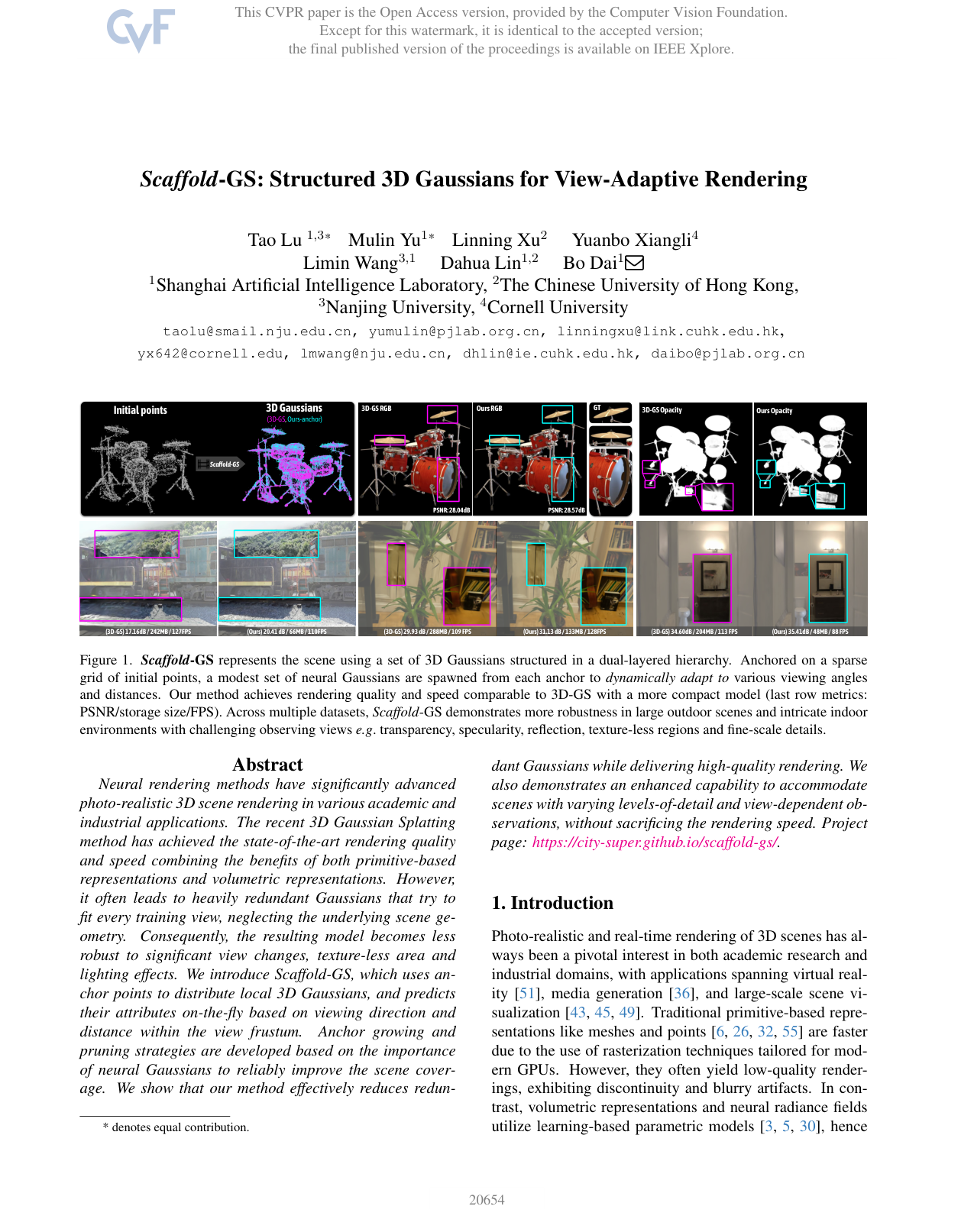
The article evaluates Scaffold-GS, a structured neural rendering framework designed to improve novel view synthesis while drastically reducing model size. The method constructs a sparse grid of anchor points derived from initial spatial data to establish a hierarchical, region-aware scene representation. Rather than storing millions of static elements, each anchor spawns local neural elements whose geometric and appearance properties are dynamically predicted on the fly based on the camera’s relative distance and angle within the visible field of view. The framework also introduces dynamic growing and pruning strategies to refine anchor coverage and filter out low-opacity elements.
Evaluations across 27 benchmark scenes demonstrate that Scaffold-GS matches or exceeds current state-of-the-art visual quality while maintaining real-time display speeds of 100 to 140 frames per second at 1K resolution. Crucially, the approach reduces storage footprints significantly, achieving roughly 4- to 10-fold compression ratios compared to standard 3D Gaussian Splatting across complex datasets (e.g., dropping from 676 MB to 66 MB on the Deep Blending dataset and from 1.6 GB to 203 MB on the BungeeNeRF dataset). The framework also exhibits superior robustness against visual artifacts in challenging scenarios, including specular reflections, fine-scale geometry, and unseen zoom-in distances.
These findings suggest that anchoring neural representations to regularized spatial structures offers a highly scalable and cost-effective path for deploying immersive 3D visualization pipelines on memory-constrained devices. Organizations seeking to deploy real-time digital twins or virtual spaces should consider adopting structured, view-adaptive Gaussian architectures over unstructured baselines to lower storage and streaming bandwidth without sacrificing rendering fidelity. Future efforts should focus on mitigating initialization risks in extremely sparse, texture-less environments where initial spatial points are difficult to acquire.
- Paper: 3D Gaussian Splatting for Real-Time Radiance Field Rendering, Bernhard Kerbl et al. (2023). It introduces standard 3D Gaussian Splatting and its optimization pipeline, which Scaffold-GS directly builds upon and modifies via anchor points.
- Paper: NeRF: Representing Scenes as Neural Radiance Fields for View Synthesis, Ben Mildenhall et al. (2020). It establishes the foundational volume rendering and neural radiance field paradigm that underpins modern novel view synthesis methods.
- Paper: Mip-NeRF: A Multiscale Representation for Anti-Aliasing Neural Radiance Fields, Jonathan T. Barron et al. (2021). It formalizes multiscale view rendering and anti-aliasing principles that motivate view-adaptive level-of-detail representations in 3D rendering.
- Paper: Instant neural graphics primitives with a multiresolution hash encoding, Thomas Müller et al. (2022). It introduces multiresolution spatial feature indexing for fast neural graphics, informing compact neural feature anchor structures.
- Paper: 4D Gaussian Splatting for Real-Time Dynamic Scene Rendering, Guanjun Wu et al. (2023). It pioneers neural field conditioning and parameter prediction over 3D Gaussian primitives for view synthesis.
- Paper: GaussianPro: 3D Gaussian Splatting with Progressive Propagation, Kai Cheng et al. (2024). It extends 3D Gaussian Splatting by using progressive multi-view stereo propagation to resolve geometry and textureless area issues.
- Paper: 2D Gaussian Splatting for Geometrically Accurate Radiance Fields, Binbin Huang et al. (2024). It advances beyond 3D splats by constraining primitives to planar 2D Gaussians to improve surface geometry consistency.
- Paper: VastGaussian: Vast 3D Gaussians for Large Scene Reconstruction, Jiaqi Lin et al. (2024). It scales Gaussian Splatting to vast scenes by partitioning space and decoupling appearance variations across viewpoints.
- Paper: DrivingGaussian: Composite Gaussian Splatting for Surrounding Dynamic Autonomous Driving Scenes, Xiaoyu Zhou et al. (2024). It applies composite Gaussian splatting strategies to reconstruct unbounded, dynamic outdoor driving environments.
- Paper: 3D Geometry-aware Deformable Gaussian Splatting for Dynamic View Synthesis, Zhicheng Lu et al. (2024). It incorporates explicit 3D geometric structure into dynamic Gaussian splatting deformation models.
- Paper: GaussianEditor: Swift and Controllable 3D Editing with Gaussian Splatting, Yiwen Chen et al. (2024). It builds interactive and controllable 3D editing capabilities directly on top of explicit Gaussian splat representations.
- Paper: Relightable Gaussian Codec Avatars, Shunsuke Saito et al. (2024). It demonstrates high-fidelity geometric and appearance modeling for animatable, relightable avatars using 3D Gaussians.