Missing Counter-Evidence Renders NLP Fact-Checking Unrealistic for Misinformation
Max GlocknerYufang HouIryna Gurevych
Reveals that automated fact-checking models fail on real-world misinformation because they rely on leaked counter-evidence from post-hoc reports rather than disproving the underlying reasoning behind novel claims.
Misinformation frequently emerges during times of high public uncertainty when credible information is scarce, leading to significant real-world harm across public health, politics, and social stability. Natural language processing systems have been developed to automate the fact-checking pipeline, but these systems typically rely on finding direct counter-evidence in trusted databases to disprove false claims. The article evaluates whether standard automated fact-checking methods can realistically refute novel, real-world misinformation in the same way professional human fact-checkers do.
To assess this, the researchers compared automated fact-checking task formulations against human journalistic practices through an analysis of 100 verified misinformation claims from PolitiFact and Snopes. They established two critical criteria for realistic evaluation: evidence must be sufficient to justify a verdict and must remain unleaked, meaning it does not incorporate reports produced only after the claim was already fact-checked. The authors surveyed 16 established fact-checking datasets and conducted empirical experiments using a large-scale dataset, MultiFC, training deep learning language models on claim-evidence pairs to observe their reliance on leaked text.
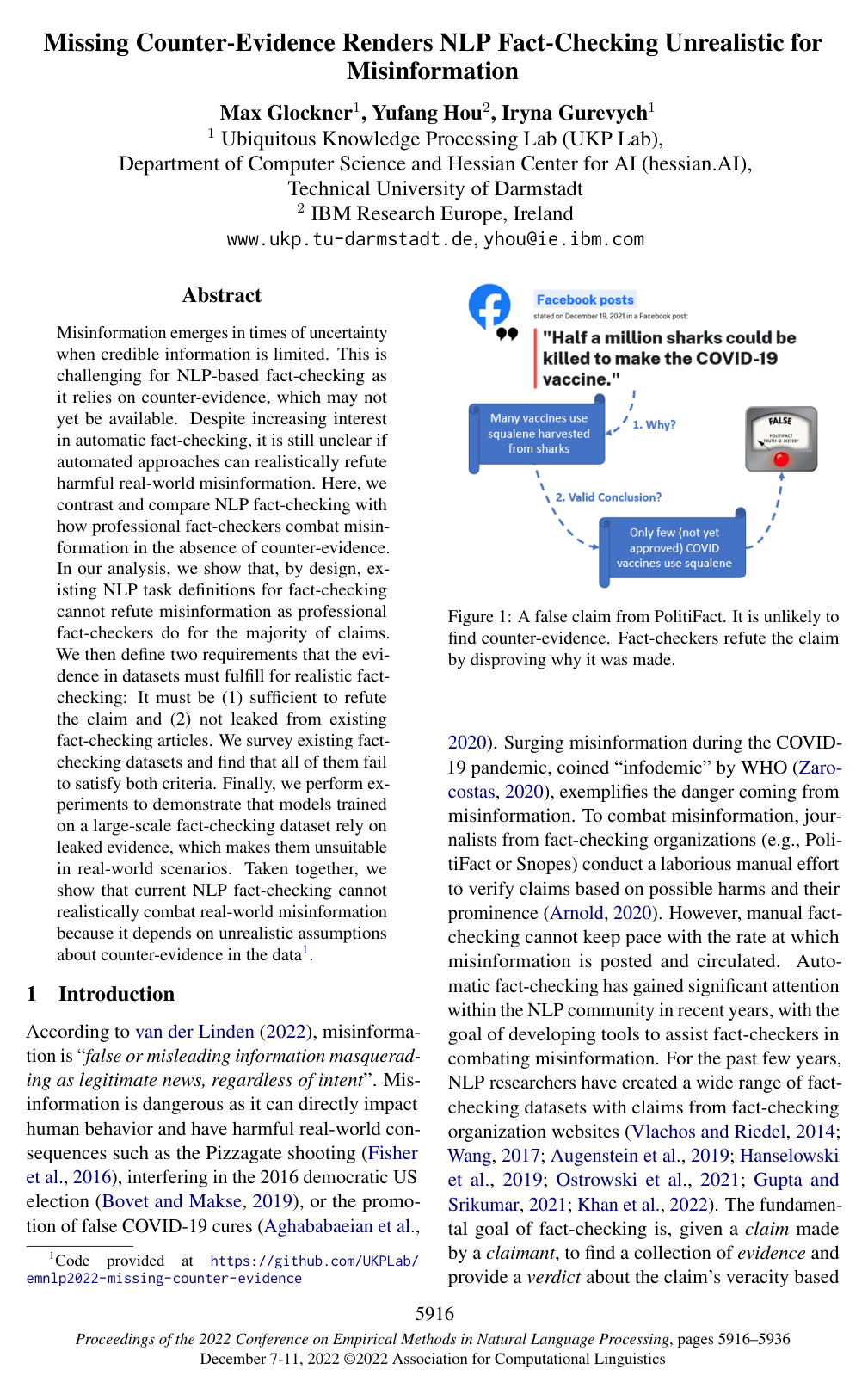
The findings show that current automated systems operate on fundamentally unrealistic assumptions. In the human verification study, professional journalists used direct global counter-evidence for only about 26.7% of claims. For roughly 65.3% of claims, journalists refuted misinformation by identifying the underlying premise or claimant's original source and disproving that specific rationale. Furthermore, the dataset survey revealed that not a single existing dataset containing real-world misinformation satisfies both the sufficient and unleaked evidence criteria. In MultiFC, approximately 69.7% of misinformation claims were found to contain leaked evidence from post-verification articles. When tested on PolitiFact data, language models experienced severe performance drops when deprived of leaked cues, with accuracy falling from 57.6% on leaked evidence to 25.8% on unleaked evidence.
These results demonstrate that existing automated fact-checking models do not genuinely reason over evidence to debunk novel false claims. Instead, they exploit statistical shortcuts and leaked conclusions from existing journalistic fact-checks, rendering them ineffective for newly emerging rumors where no prior debunking exists. Relying on current benchmarks introduces substantial operational risk, as stakeholders might deploy systems that appear highly accurate in testing but fail entirely when confronted with zero-day misinformation campaigns.
The article recommends restructuring natural language processing fact-checking pipelines to emulate human journalistic methodology. Rather than assuming global counter-evidence exists, automated systems should incorporate automated provenance detection, context tracking across online platforms, and the identification of logical fallacies. Stakeholders should avoid deploying automated verification tools for novel claims until evaluation benchmarks eliminate data leakage and support source-tracing workflows.
The main limitations of the study include its focus on English-language political and news claims from two prominent fact-checking platforms, which may not capture all forms of digital misinformation, such as multi-modal images or non-English content. While confidence in the technical findings regarding benchmark leakage and current model shortcomings is very high, further research and improved dataset designs are required before automated systems can reliably verify novel misinformation in production environments.
- Paper: FEVER: a Large-scale Dataset for Fact Extraction and VERification, James Thorne et al. (2018). FEVER established the evidence-retrieval-and-verdict benchmark paradigm that this paper scrutinizes for its assumptions about available evidence.
- Paper: “Liar, Liar Pants on Fire”: A New Benchmark Dataset for Fake News Detection, William Yang Wang (2017). LIAR provides an early large-scale PolitiFact benchmark whose claim labels and analysis reports help contextualize this paper’s critique of fact-checking datasets.
No sufficiently relevant recommendations were found.