
keyword
fake news detection
Fake news detection is the automated process of identifying and classifying fabricated, false, or intentionally misleading information presented as legitimate news. Situated primarily within artificial intelligence, natural language processing, and data mining, the task involves analyzing linguistic cues, stylistic patterns, and semantic content within articles or claims, as well as verifying assertions against credible external evidence. In digital and social media environments, detection systems often extend beyond text analysis to incorporate auxiliary signals, including user interaction behaviors, propagation structures across networks, source metadata, and broader media context, to distinguish deceptive material from verified reporting.
8 items
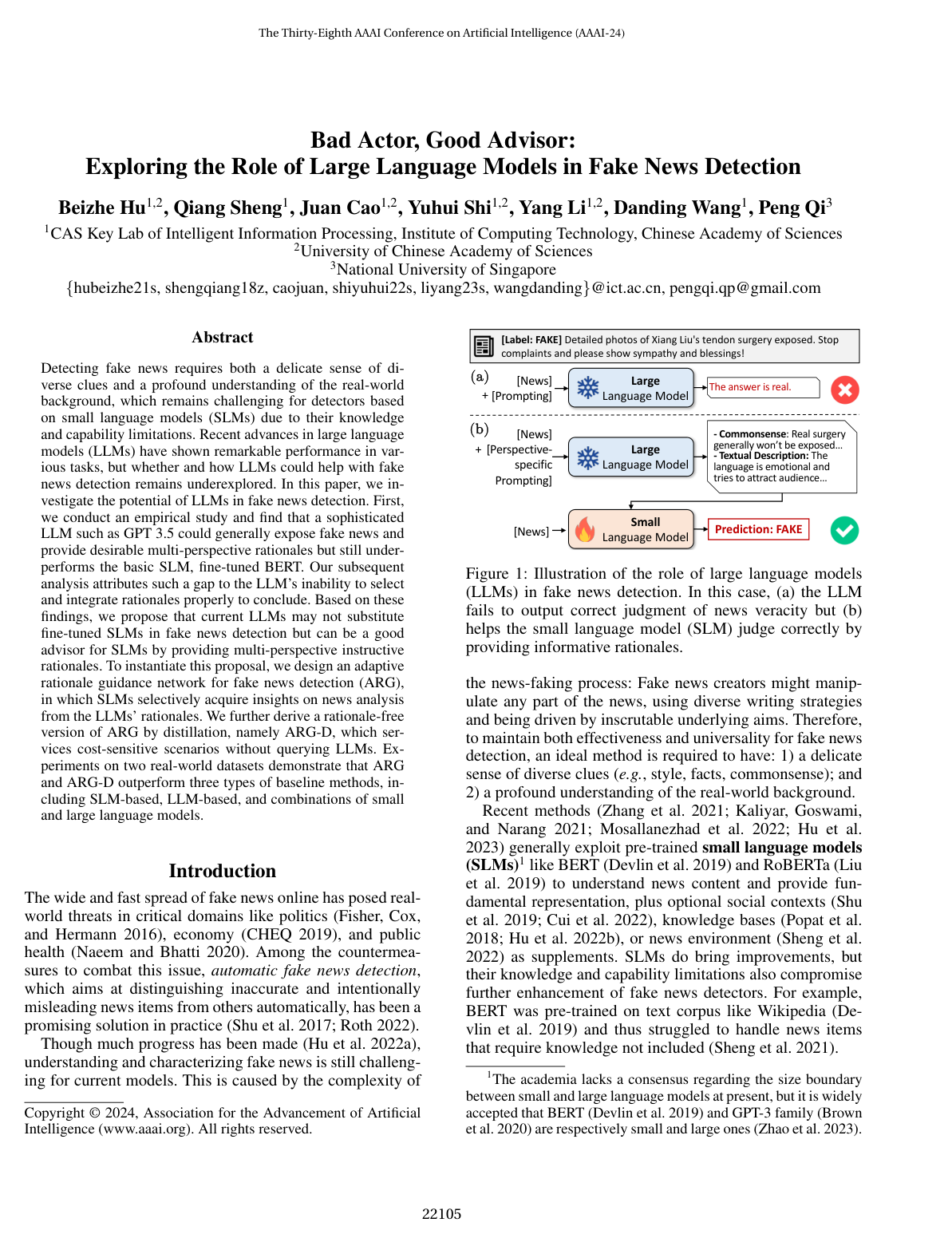
Bad Actor, Good Advisor: Exploring the Role of Large Language Models in Fake News Detection
Beizhe Hu, Qiang Sheng, Juan Cao, Yuhui Shi, Yang Li, Danding Wang, Peng Qi
Why you should read this
Demonstrates that large language models struggle as standalone fake news detectors but excel as advisors, proposing an adaptive rationale guidance network that uses LLM-generated reasoning to boost small language model performance and enable cost-effective distillation.
Detecting fake news requires both a delicate sense of diverse clues and a profound understanding of the real-world background, which remains challenging for detectors based on small language models (SLMs) due to their knowledge and capability limitations. Recent advances in large language models (LLMs) have shown remarkable performance in various tasks, but whether and how LLMs could help with fake news detection remains underexplored. In this paper, we investigate the potential of LLMs in fake news detection. First, we conduct an empirical study and find that a sophisticated LLM such as GPT 3.5 could generally expose fake news and provide desirable multi-perspective rationales but still underperforms the basic SLM, fine-tuned BERT. Our subsequent analysis attributes such a gap to the LLM's inability to select and integrate rationales properly to conclude. Based on these findings, we propose that current LLMs may not substitute fine-tuned SLMs in fake news detection but can be a good advisor for SLMs by providing multi-perspective instructive rationales. To instantiate this proposal, we design an adaptive rationale guidance network for fake news detection (ARG), in which SLMs selectively acquire insights on news analysis from the LLMs' rationales. We further derive a rationale-free version of ARG by distillation, namely ARG-D, which serves cost-sensitive scenarios without querying LLMs. Experiments on two real-world datasets demonstrate that ARG and ARG-D outperform three types of baseline methods, including SLM-based, LLM-based, and combinations of small and large language models.
Added
2026-10-05
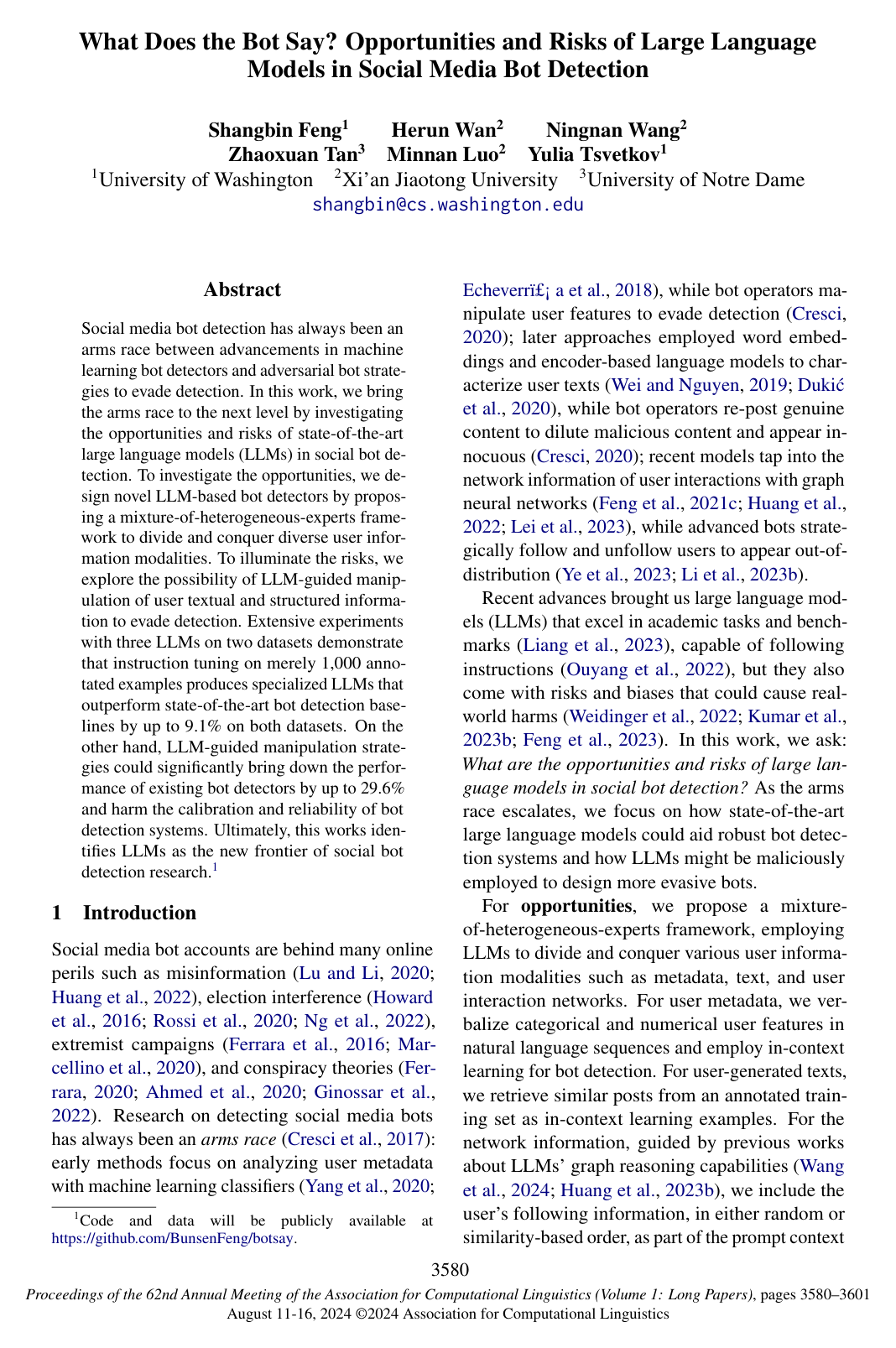
What Does the Bot Say? Opportunities and Risks of Large Language Models in Social Media Bot Detection
Shangbin Feng, Herun Wan, Ningnan Wang, Zhaoxuan Tan, Minnan Luo, Yulia Tsvetkov
Why you should read this
Demonstrates how large language models can simultaneously advance social media bot detection through a mixture-of-heterogeneous-experts framework and undermine existing detectors by generating evasive text and network manipulation strategies.
Social media bot detection has always been an arms race between advancements in machine learning bot detectors and adversarial bot strategies to evade detection. In this work, we bring the arms race to the next level by investigating the opportunities and risks of state-of-the-art large language models (LLMs) in social bot detection. To investigate the opportunities, we design novel LLM-based bot detectors by proposing a mixture-of-heterogeneous-experts framework to divide and conquer diverse user information modalities. To illuminate the risks, we explore the possibility of LLM-guided manipulation of user textual and structured information to evade detection. Extensive experiments with three LLMs on two datasets demonstrate that instruction tuning on merely 1,000 annotated examples produces specialized LLMs that outperform state-of-the-art bot detection baselines by up to 9.1% on both datasets. On the other hand, LLM-guided manipulation strategies could significantly bring down the performance of existing bot detectors by up to 29.6% and harm the calibration and reliability of bot detection systems. Ultimately, this works identifies LLMs as the new frontier of social bot detection research.
Added
2026-10-04
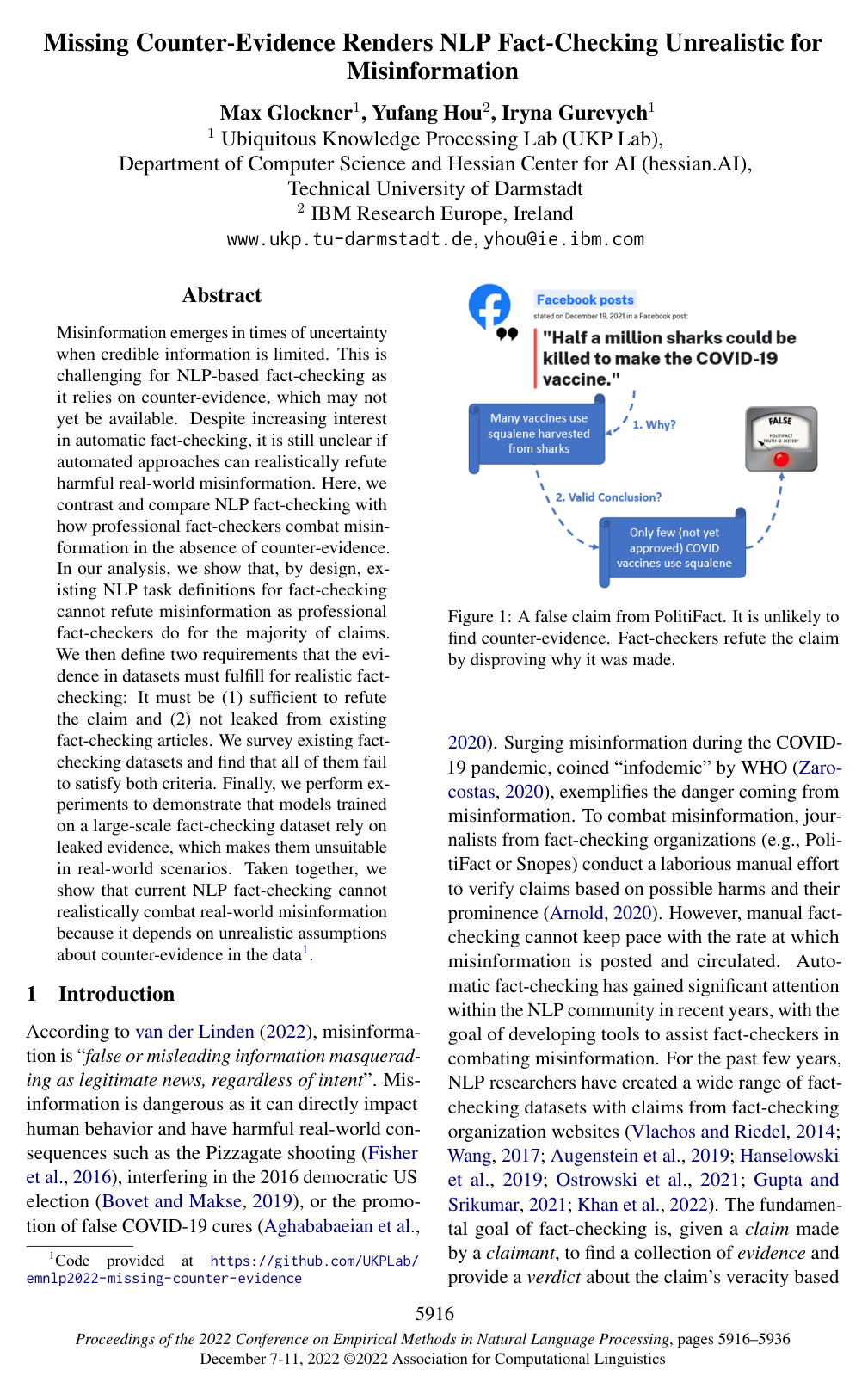
Missing Counter-Evidence Renders NLP Fact-Checking Unrealistic for Misinformation
Max Glockner, Yufang Hou, Iryna Gurevych
Why you should read this
Reveals that automated fact-checking models fail on real-world misinformation because they rely on leaked counter-evidence from post-hoc reports rather than disproving the underlying reasoning behind novel claims.
The task of misinformation detection has tremendous potential to make a significant contribution to society. However, current automatic fact-checking systems ignore an important aspect of fact-checking: the lack of counter-evidence. In this paper, we analyze the prevalence of counter-evidence in real-world fact-checking datasets. We find that counter-evidence is almost always present in the evidence used by human fact-checkers, but is missing in the evidence retrieved by current automatic fact-checking systems. We argue that this discrepancy is a major reason for the lack of robustness of current systems. To address this issue, we propose a new task setting that requires the system to identify the lack of counter-evidence and to abstain from making a prediction in such cases. We show that this is a challenging task for current systems, and that our proposed method can improve the robustness of fact-checking systems.
Added
2026-10-03
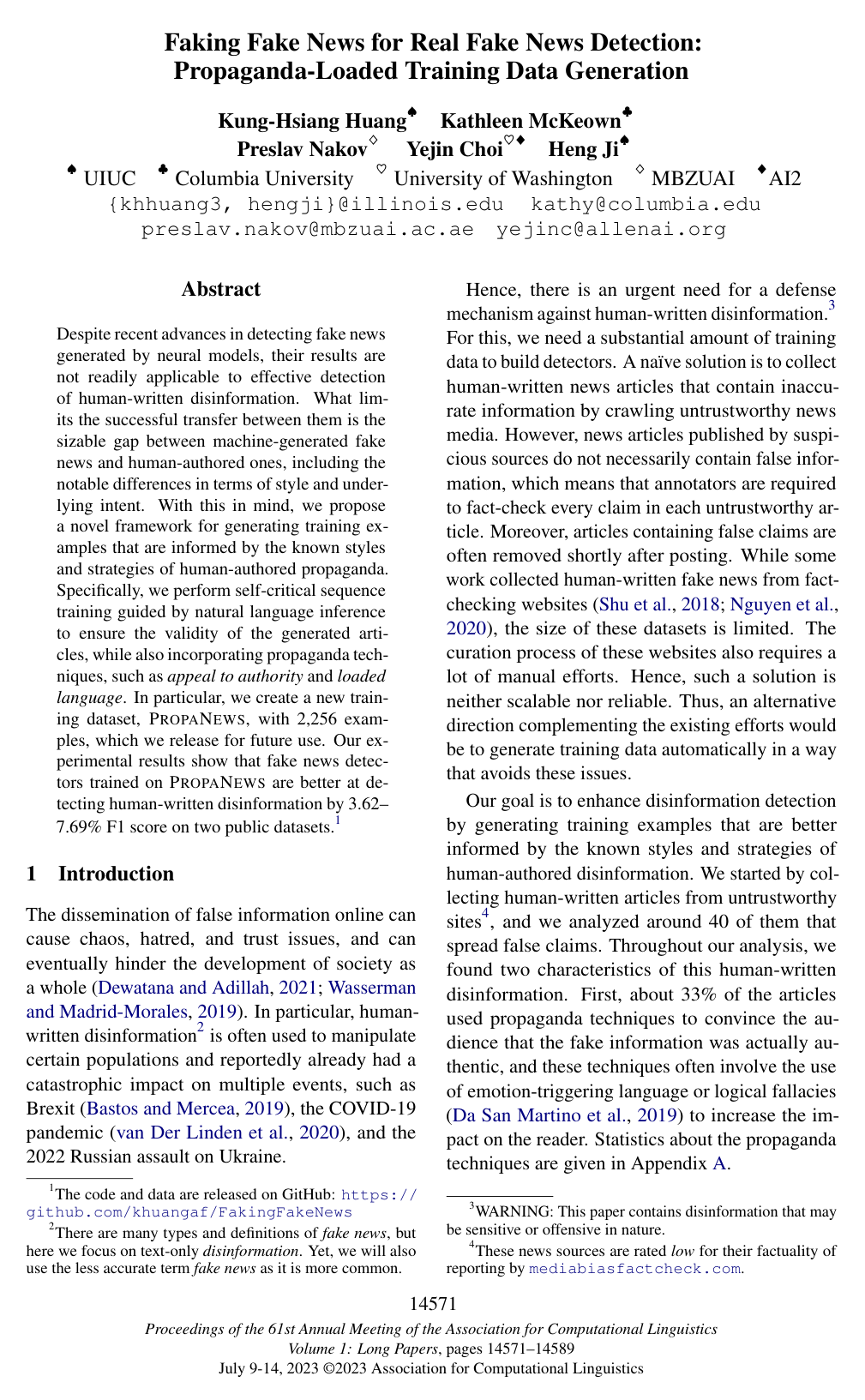
Faking Fake News for Real Fake News Detection: Propaganda-Loaded Training Data Generation
Kung-Hsiang Huang, Kathleen R. McKeown, Preslav Nakov, Yejin Choi, Heng Ji
Why you should read this
Proposes an automated framework that combines natural language inference-guided infilling with propaganda generation to create realistic synthetic disinformation that significantly improves the detection of human-written fake news.
Added
2026-10-02
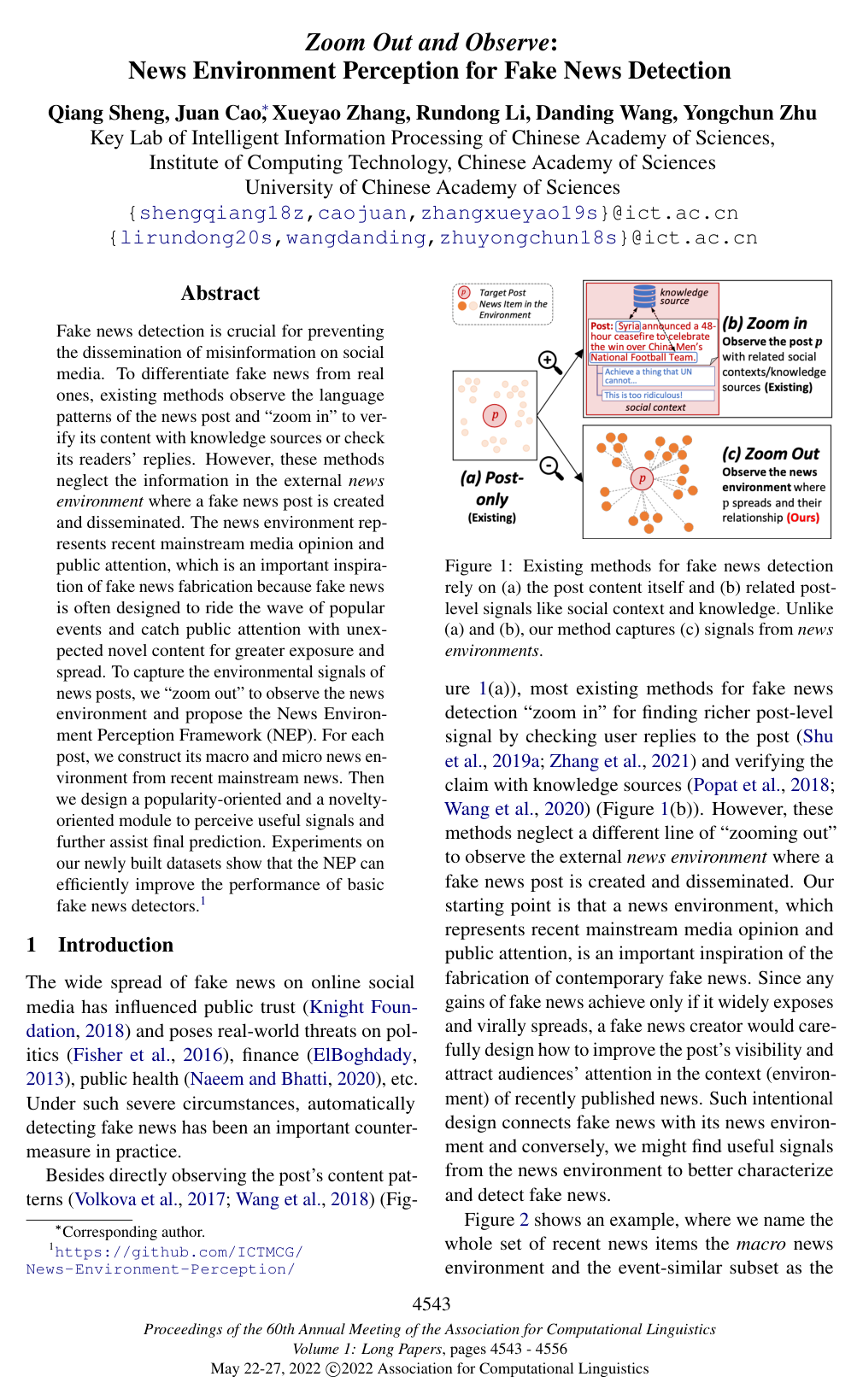
Zoom Out and Observe: News Environment Perception for Fake News Detection
Qiang Sheng, Juan Cao, Xueyao Zhang, Rundong Li, Danding Wang, Yongchun Zhu
Why you should read this
Proposes the News Environment Perception framework to improve fake news detection by analyzing external mainstream media trends through macro- and micro-level popularity and novelty signals instead of relying solely on isolated post content.
Fake news detection is crucial for preventing the dissemination of misinformation on social media. To differentiate fake news from real ones, existing methods observe the language patterns of the news post and “zoom in” to verify its content with knowledge sources or check its readers’ replies. However, these methods neglect the information in the external news environment where a fake news post is created and disseminated. The news environment represents recent mainstream media opinion and public attention, which is an important inspiration of fake news fabrication because fake news is often designed to ride the wave of popular events and catch public attention with unexpected novel content for greater exposure and spread. To capture the environmental signals of news posts, we “zoom out” to observe the news environment and propose the News Environment Perception Framework (NEP). For each post, we construct its macro and micro news environment from recent mainstream news. Then we design a popularity-oriented and a novelty-oriented module to perceive useful signals and further assist final prediction. Experiments on our newly built datasets show that the NEP can efficiently improve the performance of basic fake news detectors.
Added
2026-10-01
Zero-Shot Rumor Detection with Propagation Structure via Prompt Learning
Hongzhan Lin, Pengyao Yi, Jing Ma, Haiyun Jiang, Ziyang Luo, Shuming Shi, Ruifang Liu
Why you should read this
Proposes a response-aware prompt learning framework that integrates domain-invariant propagation structures and hierarchical prompt encoding into multilingual pre-trained language models to accurately detect rumors across unseen languages and domains without target-specific annotations.
The spread of rumors along with breaking events seriously hinders the truth in the era of social media. Previous studies reveal that due to the lack of annotated resources, rumors presented in minority languages are hard to be detected. Furthermore, the unforeseen breaking events not involved in yesterday's news exacerbate the scarcity of data resources. In this work, we propose a novel zero-shot framework based on prompt learning to detect rumors falling in different domains or presented in different languages. More specifically, we firstly represent rumor circulated on social media as diverse propagation threads, then design a hierarchical prompt encoding mechanism to learn language-agnostic contextual representations for both prompts and rumor data. To further enhance domain adaptation, we model the domain-invariant structural features from the propagation threads, to incorporate structural position representations of influential community response. In addition, a new virtual response augmentation method is used to improve model training. Extensive experiments conducted on three real-world datasets demonstrate that our proposed model achieves much better performance than state-of-the-art methods and exhibits a superior capacity for detecting rumors at early stages.
Added
2026-09-26
“Liar, Liar Pants on Fire”: A New Benchmark Dataset for Fake News Detection
William Yang Wang
Why you should read this
Introduces the LIAR benchmark dataset of 12,800 fact-checked statements from PolitiFact alongside a hybrid neural network architecture that integrates contextual metadata with text to improve automated fake news detection.
Automatic fake news detection is a challenging problem in deception detection, and it has tremendous real-world political and social impacts. However, statistical approaches to combating fake news has been dramatically limited by the lack of labeled benchmark datasets. In this paper, we present liar: a new, publicly available dataset for fake news detection. We collected a decade-long, 12.8K manually labeled short statements in various contexts from this http URL, which provides detailed analysis report and links to source documents for each case. This dataset can be used for fact-checking research as well. Notably, this new dataset is an order of magnitude larger than previously largest public fake news datasets of similar type. Empirically, we investigate automatic fake news detection based on surface-level linguistic patterns. We have designed a novel, hybrid convolutional neural network to integrate meta-data with text. We show that this hybrid approach can improve a text-only deep learning model.
Added
2026-09-24
Fake News Detection on Social Media: A Data Mining Perspective
Kai Shu, Amy Sliva, Suhang Wang, Jiliang Tang, Huan Liu
Why you should read this
Systematizes social media fake news detection by connecting psychological theories, data mining algorithms, and benchmark datasets to guide research on combating online misinformation.
Social media for news consumption is a double-edged sword. On the one hand, its low cost, easy access, and rapid dissemination of information lead people to seek out and consume news from social media. On the other hand, it enables the wide spread of "fake news", i.e., low quality news with intentionally false information. The extensive spread of fake news has the potential for extremely negative impacts on individuals and society. Therefore, fake news detection on social media has recently become an emerging research that is attracting tremendous attention. Fake news detection on social media presents unique characteristics and challenges that make existing detection algorithms from traditional news media ineffective or not applicable. First, fake news is intentionally written to mislead readers to believe false information, which makes it difficult and nontrivial to detect based on news content; therefore, we need to include auxiliary information, such as user social engagements on social media, to help make a determination. Second, exploiting this auxiliary information is challenging in and of itself as users' social engagements with fake news produce data that is big, incomplete, unstructured, and noisy. Because the issue of fake news detection on social media is both challenging and relevant, we conducted this survey to further facilitate research on the problem. In this survey, we present a comprehensive review of detecting fake news on social media, including fake news characterizations on psychology and social theories, existing algorithms from a data mining perspective, evaluation metrics and representative datasets. We also discuss related research areas, open problems, and future research directions for fake news detection on social media.
Added
2026-09-11