Zoom Out and Observe: News Environment Perception for Fake News Detection

Qiang ShengJuan CaoXueyao ZhangRundong LiDanding WangYongchun Zhu

article2022ACL110 citations

Proposes the News Environment Perception framework to improve fake news detection by analyzing external mainstream media trends through macro- and micro-level popularity and novelty signals instead of relying solely on isolated post content.

Listen

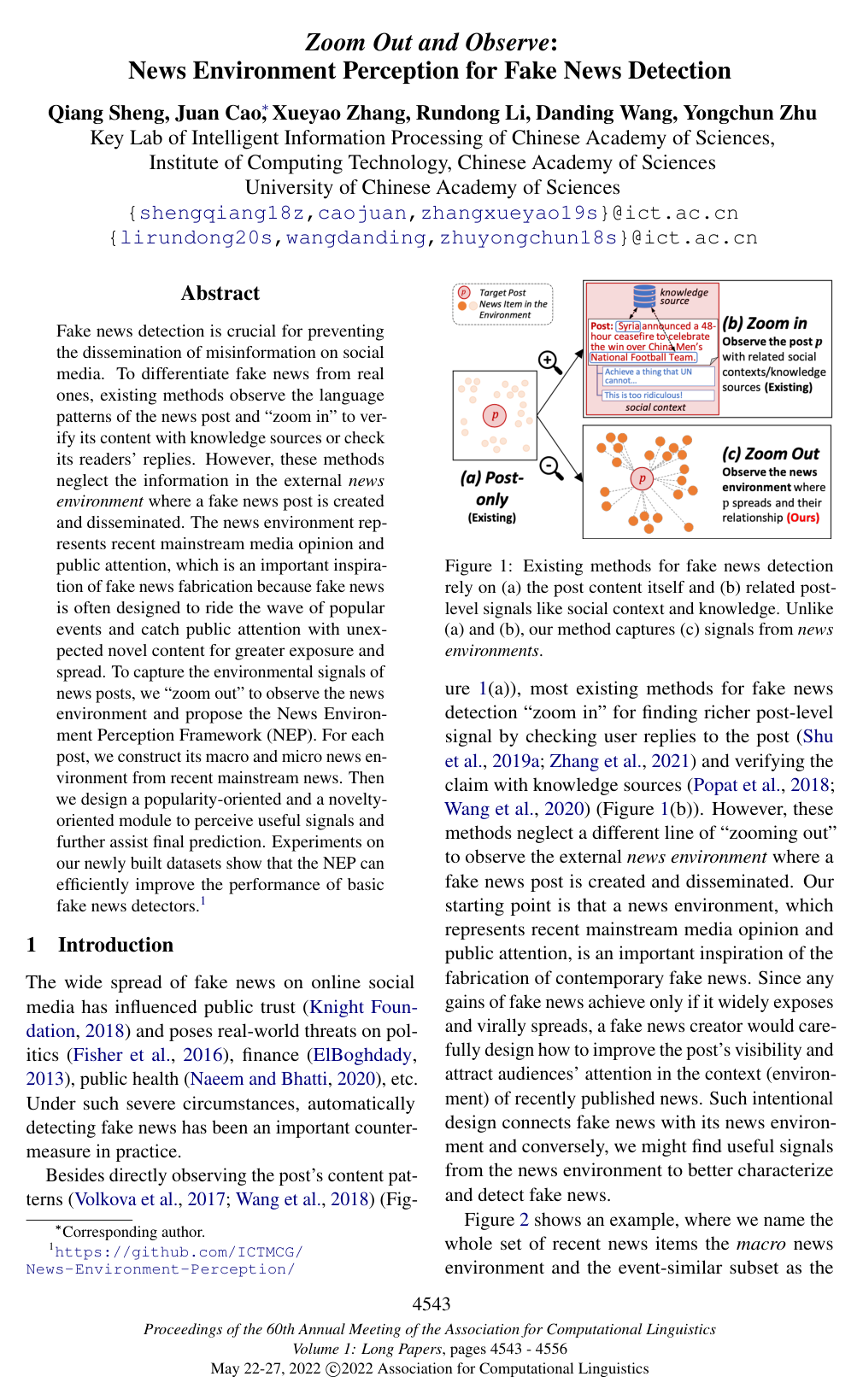
The rapid proliferation of misinformation across digital platforms poses major risks to public health, financial stability, and civic trust. Existing automated detection tools generally evaluate posts in isolation by examining text patterns, checking reader responses, or querying external fact-checking databases. However, these methods overlook the broader information ecosystem in which misinformation is created to exploit trending topics. The article aims to demonstrate that observing the contemporary news environment—specifically the surrounding volume and focus of mainstream media reports—significantly enhances automated fake news detection.

To capture this context, the authors developed the News Environment Perception framework. The approach models two distinct contextual layers from recent mainstream reporting: a macro environment covering general news published in the preceding three days to measure overall event popularity, and a micro environment filtering for topic-related reports to evaluate whether a post introduces unusual or novel claims. These contextual signals are integrated into existing detection algorithms. The researchers evaluated the framework across extensive Chinese and English datasets comprising over 45,000 verified social media posts mapped against more than 1.5 million contemporary news articles, alongside a seven-month real-world stream from an operational detection system.

The findings confirm that incorporating environmental context consistently enhances detection accuracy across diverse model architectures. Across balanced test datasets, the framework improved detection performance across all evaluated baseline models, showing particularly strong gains in identifying fabricated content. In a highly skewed real-world operational dataset with a 100-to-1 ratio of legitimate to fake posts, the framework achieved a 16.89% relative improvement in macro F1 score and a 5.20% gain in standardized partial accuracy under low false-positive constraints. Furthermore, contextual analysis demonstrated specialized strengths: the broad macro environment proved most effective for sensational events like natural disasters, while the micro environment excelled at flagging fabricated details within routine societal and lifestyle reporting.

These results demonstrate that environmental perception provides an efficient, low-latency layer of defense against deceptive content. By leveraging publicly accessible mainstream news feeds rather than waiting for user comment accumulation or querying scarce fact-checking records, organizations can detect viral misinformation much earlier in its lifecycle. This capability lowers operational response times, reduces moderation risks, and complements traditional knowledge-based verification methods with minimal architectural overhead.

Organizations operating social media or content monitoring platforms should consider integrating rolling news-environment feeds into their detection pipelines as a lightweight pre-filter or enhancement. Because the system performs best with a three-day historical window, engineering teams can maintain rolling news caches to ensure real-time responsiveness. Platform operators should remain aware of clear boundary conditions: the approach provides limited benefit for evergreen misinformation or historical claims that do not correlate with recent news cycles. While confidence in the framework's effectiveness for breaking and event-driven news is strong, future work should address these limitations by exploring historical news archives, multi-modal media formats, and the influence of media outlet bias on contextual accuracy.

No sufficiently relevant recommendations were found.
Cover for Zoom Out and Observe: News Environment Perception for Fake News Detection

Abstract

Fake news detection is crucial for preventing the dissemination of misinformation on social media. To differentiate fake news from real ones, existing methods observe the language patterns of the news post and “zoom in” to verify its content with knowledge sources or check its readers’ replies. However, these methods neglect the information in the external news environment where a fake news post is created and disseminated. The news environment represents recent mainstream media opinion and public attention, which is an important inspiration of fake news fabrication because fake news is often designed to ride the wave of popular events and catch public attention with unexpected novel content for greater exposure and spread. To capture the environmental signals of news posts, we “zoom out” to observe the news environment and propose the News Environment Perception Framework (NEP). For each post, we construct its macro and micro news environment from recent mainstream news. Then we design a popularity-oriented and a novelty-oriented module to perceive useful signals and further assist final prediction. Experiments on our newly built datasets show that the NEP can efficiently improve the performance of basic fake news detectors.

Table of Contents

  • 1 Introduction
  • 2 Related Work
  • 3 Proposed Method
  • 3.1 News Environment Construction
  • 3.2 News Environment Perception
  • 3.3 Prediction under Perceived Environments
  • 4 Experiment
  • 4.1 Datasets
  • Chinese Dataset
  • English Dataset
  • 4.2 Experimental Setup
  • 4.3 Performance Comparison (EQ1)
  • 4.4 Evaluation on Variants of NEP (EQ2)
  • 4.5 Environment Analysis (EQ3)
  • 5 Discussion in Practical Systems
  • 6 Conclusion and Future Work
  • Acknowledgements
  • Ethical Considerations
  • References
  • A Sources of News Items as the Environmental Elements
  • B Supplementary Implementation Details
  • B.1 Kernel Settings
  • B.2 Post-Training SimCSE
  • B.3 Implementation of Base Models
  • C Calculation of spAUC
  • D Analysis on the Case Weakly Related to News Environments

Knowls

  1. Knowl 1 — NEP adds news-environment perception to fake-news detectors

    model/method

    The News Environment Perception Framework (NEP) supplements a fake-news detector with signals from recent mainstream news. For each target post, NEP builds a broad, time-bounded macro environment and a relevance-filtered micro environment. A popularity-oriented module summarizes the post’s similarity distribution across the macro environment, while a novelty-oriented module compares the post with similar-event news in the micro environment. NEP then combines the two environment representations and fuses them with a feature from the base detector to classify the post as real or fake. The design is intended to work with different detectors that expose a post representation, including both post-only and evidence-aware methods.

  2. Knowl 2 — Construction of macro and micro news environments

    definition

    For a target post pp, let EE be the set of collected mainstream-news items published before the post; let tpt_p and tet_e denote the publication times of pp and item ee. Given a time window of TT days, NEP defines the macro environment as Emac={e∈E:0<tp−te≤T}E_{\mathrm{mac}}=\{e\in E:0<t_p-t_e\leq T\}. The micro environment is the kk most relevant items in that macro environment: Emic={e:e∈TopK⁡(p,Emac)}E_{\mathrm{mic}}=\{e:e\in\operatorname{TopK}(p,E_{\mathrm{mac}})\}, where k=⌈r∣Emac∣⌉k=\lceil r|E_{\mathrm{mac}}|\rceil and r∈(0,1)r\in(0,1) is the selected proportion. In the experiments, relevance is obtained by querying with the post representation. The post and news-item representations are the pretrained language model’s [CLS] outputs; the BERT-based sentence encoder was post-trained on collected news and frozen while NEP was trained. The macro environment represents the recent overall news distribution, while the micro environment represents news relevant to the target post.

  3. Knowl 3 — Popularity perception through soft similarity counting

    model/method

    NEP estimates a post’s popularity in the macro environment from how many recent mainstream-news items resemble it. Let pp and eie_i be vector representations of the target post and the iith macro-environment item. Their cosine similarity is s(p,ei)=p⋅ei∥p∥∥ei∥s(p,e_i)=\frac{p\cdot e_i}{\|p\|\|e_i\|}. Because the environment can contain a variable number of items, NEP converts the similarities into a fixed-length feature using CC Gaussian kernels. For kernel jj, with mean μj\mu_j and standard deviation σj\sigma_j, the soft count is Kj(p,Emac)=∑i=1∣Emac∣exp⁡ ⁣(−(s(p,ei)−μj)22σj2)K_j(p,E_{\mathrm{mac}})=\sum_{i=1}^{|E_{\mathrm{mac}}|}\exp\!\left(-\frac{(s(p,e_i)-\mu_j)^2}{2\sigma_j^2}\right). The concatenated kernel counts are normalized to form K(p,Emac)K(p,E_{\mathrm{mac}}). The macro-perceived vector is vp,mac=MLP⁡(p⊕m(Emac)⊕K(p,Emac))v^{p,\mathrm{mac}}=\operatorname{MLP}(p\oplus m(E_{\mathrm{mac}})\oplus K(p,E_{\mathrm{mac}})), where m(Emac)m(E_{\mathrm{mac}}) is the mean news-item vector and ⊕\oplus denotes concatenation. The kernels softly count similarities near their respective means, allowing the feature to represent the distribution rather than only a single similarity score. The experiments used 22 kernels: 21 with means from −1-1 to 11 in increments of 0.10.1 and variance 0.050.05, plus one with mean 0.990.99 and variance 0.010.01.

  4. Knowl 4 — Novelty perception relative to similar-event news

    model/method

    NEP represents novelty in the micro environment by comparing the target post’s similarity pattern with the similarity pattern of the micro-environment center. Let m(Emic)m(E_{\mathrm{mic}}) be the average vector of the micro-environment items, and let K(x,Emic)K(x,E_{\mathrm{mic}}) denote the normalized Gaussian-kernel similarity feature between a vector xx and those items. NEP forms a semantic representation usem=MLP⁡(p⊕m(Emic))u^{\mathrm{sem}}=\operatorname{MLP}(p\oplus m(E_{\mathrm{mic}})) and a similarity representation usim=MLP⁡(h(K(p,Emic),K(m(Emic),Emic)))u^{\mathrm{sim}}=\operatorname{MLP}(h(K(p,E_{\mathrm{mic}}),K(m(E_{\mathrm{mic}}),E_{\mathrm{mic}}))), then combines them as vp,mic=MLP⁡(usem⊕usim)v^{p,\mathrm{mic}}=\operatorname{MLP}(u^{\mathrm{sem}}\oplus u^{\mathrm{sim}}). The comparison function is h(x,y)=(x⊙y)⊕(x−y)h(x,y)=(x\odot y)\oplus(x-y), where ⊙\odot is elementwise multiplication; the MLPs have separate parameters. The center’s similarity profile provides a reference for judging whether the post is atypical among news about similar events. NEP uses the micro rather than macro environment for this novelty comparison to reduce the effects of event shifts.

  5. Knowl 5 — Gated fusion and final classification

    model/method

    NEP adaptively combines its macro- and micro-environment representations using a gate conditioned on a feature from the base fake-news detector. Let oo be the detector’s selected post feature, and let vp,macv^{p,\mathrm{mac}} and vp,micv^{p,\mathrm{mic}} be the macro- and micro-perceived vectors. The gate is a=sigmoid⁡(Linear⁡(o⊕vp,mac))a=\operatorname{sigmoid}(\operatorname{Linear}(o\oplus v^{p,\mathrm{mac}})), with each gate component in [0,1][0,1], and the fused environment vector is vp=a⊙vp,mac+(1−a)⊙vp,micv^p=a\odot v^{p,\mathrm{mac}}+(1-a)\odot v^{p,\mathrm{mic}}. The prediction is y^=softmax⁡(MLP⁡(o⊕vp))\hat y=\operatorname{softmax}(\operatorname{MLP}(o\oplus v^p)). For detectors using additional information sources, their feature vectors can also be concatenated for classification. Training minimizes cross-entropy. This arrangement allows a detector to weight popularity- and novelty-related information differently for different posts.

  6. Knowl 6 — Datasets pair verified posts with contemporary mainstream news

    data/table

    The paper constructs Chinese and English evaluation datasets by combining verified posts with news items from the corresponding time periods, enabling the news items to serve as the NEP environments. The Chinese set contains 39,066 Weibo posts from 2010–2021 and 583,208 news items from six influential Weibo outlets: People’s Daily, Xinhua Agency, Xinhua Net, CCTV News, The Paper, and Toutiao News. Its train/validation/test totals are 17,779/10,054/11,233; the respective real/fake counts are 8,787/8,992, 5,131/4,923, and 5,625/5,608. The English set contains 6,483 posts from 2014–2018 and 1,003,646 news items, using headlines and short descriptions from Huffington Post, NPR, and Daily Mail. Its train/validation/test totals are 3,900/1,294/1,289; the respective real/fake counts are 1,976/1,924, 656/638, and 661/628. English claims use claim dates when available rather than fact-checking-article publication dates, to avoid later environment items directly supplying fact-checking evidence. In both datasets, NEP uses news from the three days before a post; the reported minimum/average/maximum macro-environment sizes are 41/505/1,563 items for Chinese and 308/1,614/2,211 for English.

  7. Knowl 7 — NEP improves six detectors on Chinese and English offline tests

    empirical result

    On roughly class-balanced Chinese and English test sets, adding NEP improved both accuracy and macro F1 for each of six base detectors: Bi-LSTM, EANN, BERT, BERT-Emo, DeClarE, and MAC. The reported results below give accuracy and macro F1, respectively, as base-model scores followed by scores with NEP. For Chinese: Bi-LSTM, (0.727,0.713)→(0.776,0.771)(0.727,0.713)\to(0.776,0.771); EANN, (0.732,0.718)→(0.776,0.770)(0.732,0.718)\to(0.776,0.770); BERT, (0.792,0.785)→(0.810,0.805)(0.792,0.785)\to(0.810,0.805); BERT-Emo, (0.812,0.807)→(0.831,0.829)(0.812,0.807)\to(0.831,0.829); DeClarE, (0.764,0.758)→(0.800,0.797)(0.764,0.758)\to(0.800,0.797); MAC, (0.755,0.751)→(0.764,0.760)(0.755,0.751)\to(0.764,0.760). For English: Bi-LSTM, (0.705,0.704)→(0.718,0.718)(0.705,0.704)\to(0.718,0.718); EANN, (0.700,0.699)→(0.722,0.722)(0.700,0.699)\to(0.722,0.722); BERT, (0.709,0.709)→(0.718,0.718)(0.709,0.709)\to(0.718,0.718); BERT-Emo, (0.718,0.718)→(0.728,0.728)(0.718,0.718)\to(0.728,0.728); DeClarE, (0.714,0.714)→(0.717,0.716)(0.714,0.714)\to(0.717,0.716); MAC, (0.706,0.705)→(0.716,0.716)(0.706,0.705)\to(0.716,0.716). The authors also report that fake-class F1 generally benefited more than real-class F1 for post-only detectors. Adding NEP to evidence-aware methods provided gains beyond those methods’ retrieved evidence, consistent with environment signals being complementary to evidence-based information.

  8. Knowl 8 — Ablations show complementary contributions from both environments

    empirical result

    Ablations indicate that the macro and micro environments contribute complementary information. When NEP environment vectors were used without a fake-news detector feature, macro F1 for macro-only, micro-only, and combined environments was, respectively, 0.6590.659, 0.6260.626, and 0.6660.666 on Chinese data, and 0.6930.693, 0.6950.695, and 0.6960.696 on English data. The complete BERT-Emo+NEP model reached macro F1 of 0.8290.829 (Chinese) and 0.7280.728 (English); removing the macro environment reduced these scores to 0.8190.819 and 0.7260.726, while removing the micro environment reduced them to 0.8200.820 and 0.7230.723. For DeClarE+NEP, the full model scored 0.8000.800 and 0.7160.716; removing the macro environment yielded 0.7710.771 and 0.7110.711, and removing the micro environment yielded 0.7730.773 and 0.7090.709. These results support using both environments alongside a detector representation rather than relying on environment vectors alone.

  9. Knowl 9 — NEP improves performance under severe class imbalance

    empirical result

    The authors evaluated BERT-Emo and BERT-Emo+NEP on a separate seven-month online-system dump containing 30,977 real posts and 309 fake posts, approximately a 100:1 real-to-fake ratio. They evaluated macro F1 and standardized partial AUC restricted to false-positive rates at most 0.10.1 across real/fake ratios from 10:1 to 100:1. For the first nine ratios, samples were drawn 100 times from the 100:1 set; the 100:1 condition used the full set. Relative to BERT-Emo, NEP improved macro F1 by 16.89% and the restricted standardized partial AUC by 5.20%. This online test set did not overlap with the offline datasets. The result addresses a setting where accuracy alone can be misleading—for example, predicting every item as real would yield accuracy of about 0.990 on the 100:1 set.

  10. Knowl 10 — Recent-news dependence limits posts weakly connected to current events

    limitation

    NEP can provide limited help when a post is weakly related to the recent news environment, because its construction relies on recent items and relevance retrieval. The paper’s example is a post about a purported visual test of personal stress: its words did not match macro-environment keywords, and the retrieved micro-environment items were not topically related. Although the post had novelty, it concerned the long-discussed topic of mental health rather than a currently prominent event. The authors identify historical news and background references as possible ways to better handle posts of this kind.

Coverage note — The parameter-sensitivity sweeps and manual category/case analyses are omitted as secondary exploratory material; the weak-environment case is retained because it illustrates a stated limitation.

References

  1. 1.Oluwaseun Ajao, Deepayan Bhowmik, and Shahrzad Zargari. 2019. Sentiment aware fake news detection on online social networks. In 2019 IEEE International Conference on Acoustics, Speech and Signal Processing, pages 2507–2511. IEEE.
  2. 2.Rami Aly, Zhijiang Guo, Michael Sejr Schlichtkrull, James Thorne, Andreas Vlachos, Christos Christodoulopoulos, Oana Cocarascu, and Arpit Mittal. 2021. FEVEROUS: Fact extraction and VERification over unstructured and structured information. In Proceedings of the 35th Conference on Neural Information Processing (NeurIPS 2021).
  3. 3.Pepa Atanasova, Lluís Màrquez, Alberto Barrón-Cedeño, Tamer Elsayed, Reem Suwaileh, Wajdi Zaghouani, Spas Kyuchukov, Giovanni Da San Martino, and Preslav Nakov. 2018. Overview of the CLEF-2018 checkthat! lab on automatic identification and verification of political claims. task 1: Check-worthiness. In Working Notes of CLEF 2018 - Conference and Labs of the Evaluation Forum, volume 2125 of CEUR Workshop Proceedings. CEUR-WS.org.
  4. 4.Isabelle Augenstein, Christina Lioma, Dongsheng Wang, Lucas Chaves Lima, Casper Hansen, Christian Hansen, and Jakob Grue Simonsen. 2019. MultiFC: A real-world multi-domain dataset for evidence-based fact checking of claims. In Proceedings of the 2019 Conference on Empirical Methods in Natural Language Processing and the 9th International Joint Conference on Natural Language Processing (EMNLP-IJCNLP), pages 4685–4697, Hong Kong, China. Association for Computational Linguistics.
  5. 5.Steven Bird. 2006. NLTK: The Natural Language Toolkit. In Proceedings of the COLING/ACL 2006 Interactive Presentation Sessions, pages 69–72. Association for Computational Linguistics.
  6. 6.Juan Cao, Peng Qi, Qiang Sheng, Tianyun Yang, Junbo Guo, and Jintao Li. 2020. Exploring the role of visual content in fake news detection. In Disinformation, Misinformation, and Fake News in Social Media: Emerging Research Challenges and Opportunities, pages 141–161. Springer.
  7. 7.Limeng Cui, Haeseung Seo, Maryam Tabar, Fenglong Ma, Suhang Wang, and Dongwon Lee. 2020. DETERRENT: Knowledge guided graph attention network for detecting healthcare misinformation. In Proceedings of the 26th ACM SIGKDD International Conference on Knowledge Discovery & Data Mining, pages 492–502. Association for Computing Machinery.
  8. 8.Jacob Devlin, Ming-Wei Chang, Kenton Lee, and Kristina Toutanova. 2019. BERT: Pre-training of deep bidirectional transformers for language understanding. In Proceedings of the 2019 Conference of the North American Chapter of the Association for Computational Linguistics: Human Language Technologies, Volume 1 (Long and Short Papers), pages 4171–4186, Minneapolis, Minnesota. Association for Computational Linguistics.
  9. 9.Dina ElBoghdady. 2013. Market quavers after fake ap tweet says obama was hurt in white house explosions. The Washington Post.
  10. 10.Marc Fisher, John Woodrow Cox, and Peter Hermann. 2016. Pizzagate: From rumor, to hashtag, to gunfire in dc. The Washington Post.
  11. 11.Tianyu Gao, Xingcheng Yao, and Danqi Chen. 2021. SimCSE: Simple contrastive learning of sentence embeddings. In Proceedings of the 2021 Conference on Empirical Methods in Natural Language Processing, Punta Cana, Dominican Republic. Association for Computational Linguistics.
  12. 12.Alex Graves and Jürgen Schmidhuber. 2005. Framewise phoneme classification with bidirectional LSTM and other neural network architectures. Neural networks, 18(5-6):602–610.
  13. 13.J. A. Hartigan and M. A. Wong. 1979. Algorithm AS 136: A K-Means Clustering Algorithm. Journal of the Royal Statistical Society. Series C (Applied Statistics), 28(1):100–108.
  14. 14.Naeemul Hassan, Fatma Arslan, Chengkai Li, and Mark Tremayne. 2017. Toward Automated Fact-Checking: Detecting Check-Worthy Factual Claims by ClaimBuster. In Proceedings of the 23rd ACM SIGKDD International Conference on Knowledge Discovery and Data Mining, page 1803–1812. Association for Computing Machinery.
  15. 15.Hamid Karimi and Jiliang Tang. 2019. Learning hierarchical discourse-level structure for fake news detection. In Proceedings of the 2019 Conference of the North American Chapter of the Association for Computational Linguistics: Human Language Technologies, Volume 1 (Long and Short Papers), pages 3432–3442, Minneapolis, Minnesota. Association for Computational Linguistics.
  16. 16.Yoon Kim. 2014. Convolutional neural networks for sentence classification. In Proceedings of the 2014 Conference on Empirical Methods in Natural Language Processing (EMNLP), pages 1746–1751. Association for Computational Linguistics.
  17. 17.Knight Foundation. Perceived accuracy and bias in the news media [online]. 2018.
  18. 18.Elena Kochkina, Maria Liakata, and Arkaitz Zubiaga. 2018. All-in-one: Multi-task learning for rumour verification. In Proceedings of the 27th International Conference on Computational Linguistics, pages 3402–3413, Santa Fe, New Mexico, USA. Association for Computational Linguistics.
  19. 19.Shen Li, Zhe Zhao, Renfen Hu, Wensi Li, Tao Liu, and Xiaoyong Du. 2018. Analogical Reasoning on Chinese Morphological and Semantic Relations. In Proceedings of the 56th Annual Meeting of the Association for Computational Linguistics (Volume 2: Short Papers), pages 138–143, Melbourne, Australia. Association for Computational Linguistics.
  20. 20.Zhenghao Liu, Chenyan Xiong, Maosong Sun, and Zhiyuan Liu. 2020. Fine-grained fact verification with kernel graph attention network. In Proceedings of the 58th Annual Meeting of the Association for Computational Linguistics, pages 7342–7351, Online. Association for Computational Linguistics.
  21. 21.Ilya Loshchilov and Frank Hutter. 2019. Decoupled Weight Decay Regularization. In International Conference on Learning Representations.
  22. 22.Jing Ma, Wei Gao, Shafiq Joty, and Kam-Fai Wong. 2019. Sentence-level evidence embedding for claim verification with hierarchical attention networks. In Proceedings of the 57th Annual Meeting of the Association for Computational Linguistics, pages 2561–2571, Florence, Italy. Association for Computational Linguistics.
  23. 23.Jing Ma, Wei Gao, Prasenjit Mitra, Sejeong Kwon, Bernard J Jansen, Kam-Fai Wong, and Meeyoung Cha. 2016. Detecting rumors from microblogs with recurrent neural networks. In Proceedings of the Twenty-Fifth International Joint Conference on Artificial Intelligence, pages 3818–3824. AAAI Press.
  24. 24.Jing Ma, Wei Gao, and Kam-Fai Wong. 2018. Rumor detection on Twitter with tree-structured recursive neural networks. In Proceedings of the 56th Annual Meeting of the Association for Computational Linguistics (Volume 1: Long Papers), pages 1980–1989, Melbourne, Australia. Association for Computational Linguistics.
  25. 25.Donna Katzman McClish. 1989. Analyzing a portion of the roc curve. Medical decision making, 9(3):190–195.
  26. 26.Merriam-Webster. Definition of environment by merriam-webster [online]. 2021.
  27. 27.Rada Mihalcea and Paul Tarau. 2004. TextRank: Bringing Order into Text. In Proceedings of the 2004 Conference on Empirical Methods in Natural Language Processing, pages 404–411, Barcelona, Spain. Association for Computational Linguistics.
  28. 28.Salman Bin Naeem and Rubina Bhatti. 2020. The covid-19 ‘infodemic’: a new front for information professionals. Health Information & Libraries Journal, 37(3):233–239.
  29. 29.Qiong Nan, Juan Cao, Yongchun Zhu, Yanyan Wang, and Jintao Li. 2021. MDFEND: Multi-domain fake news detection. In Proceedings of the 30th ACM International Conference on Information and Knowledge Management. Association for Computing Machinery.
  30. 30.Van-Hoang Nguyen, Kazunari Sugiyama, Preslav Nakov, and Min-Yen Kan. 2020. FANG: Leveraging social context for fake news detection using graph representation. In Proceedings of the 29th ACM International Conference on Information & Knowledge Management, pages 1165–1174. Association for Computing Machinery.
  31. 31.Adam Paszke, Sam Gross, Francisco Massa, Adam Lerer, James Bradbury, Gregory Chanan, Trevor Killeen, Zeming Lin, Natalia Gimelshein, Luca Antiga, Alban Desmaison, Andreas Kopf, Edward Yang, Zachary DeVito, Martin Raison, Alykhan Tejani, Sasank Chilamkurthy, Benoit Steiner, Lu Fang, Junjie Bai, and Soumith Chintala. 2019. PyTorch: An imperative style, high-performance deep learning library. In Advances in Neural Information Processing Systems, volume 32. Curran Associates, Inc.
  32. 32.Jeffrey Pennington, Richard Socher, and Christopher Manning. 2014. GloVe: Global Vectors for Word Representation. In Proceedings of the 2014 Conference on Empirical Methods in Natural Language Processing (EMNLP), pages 1532–1543, Doha, Qatar. Association for Computational Linguistics.
  33. 33.Kashyap Popat, Subhabrata Mukherjee, Andrew Yates, and Gerhard Weikum. 2018. DeClarE: Debunking fake news and false claims using evidence-aware deep learning. In Proceedings of the 2018 Conference on Empirical Methods in Natural Language Processing, pages 22–32, Brussels, Belgium. Association for Computational Linguistics.
  34. 34.Piotr Przybyla. 2020. Capturing the style of fake news. In Proceedings of the AAAI Conference on Artificial Intelligence, volume 34, pages 490–497. AAAI Press.
  35. 35.Peng Qi, Juan Cao, Xirong Li, Huan Liu, Qiang Sheng, Xiaoyue Mi, Qin He, Yongbiao Lv, Chenyang Guo, and Yingchao Yu. 2021. Improving fake news detection by using an entity-enhanced framework to fuse diverse multimodal clues. In Proceedings of the 29th ACM International Conference on Multimedia, pages 1212–1220, Virtual Event, Chengdu, China. Association for Computing Machinery.
  36. 36.Peng Qi, Juan Cao, Tianyun Yang, Junbo Guo, and Jintao Li. 2019. Exploiting multi-domain visual information for fake news detection. In 2019 IEEE International Conference on Data Mining (ICDM), pages 518–527. IEEE.
  37. 37.Nils Reimers and Iryna Gurevych. 2019. Sentence-BERT: Sentence Embeddings using Siamese BERT-Networks. In Proceedings of the 2019 Conference on Empirical Methods in Natural Language Processing and the 9th International Joint Conference on Natural Language Processing (EMNLP-IJCNLP), pages 3982–3992, Hong Kong, China. Association for Computational Linguistics.
  38. 38.Shaden Shaar, Nikolay Babulkov, Giovanni Da San Martino, and Preslav Nakov. 2020. That is a known lie: Detecting previously fact-checked claims. In Proceedings of the 58th Annual Meeting of the Association for Computational Linguistics, pages 3607–3618, Online. Association for Computational Linguistics.
  39. 39.Qiang Sheng, Juan Cao, Xueyao Zhang, Xirong Li, and Lei Zhong. 2021a. Article reranking by memory-enhanced key sentence matching for detecting previously fact-checked claims. In Proceedings of the 59th Annual Meeting of the Association for Computational Linguistics and the 11th International Joint Conference on Natural Language Processing (Volume 1: Long Papers), pages 5468–5481, Online. Association for Computational Linguistics.
  40. 40.Qiang Sheng, Xueyao Zhang, Juan Cao, and Lei Zhong. 2021b. Integrating pattern-and fact-based fake news detection via model preference learning. In Proceedings of the 30th ACM International Conference on Information & Knowledge Management, pages 1640–1650, Virtual Event, Queensland, Australia. Association for Computing Machinery.
  41. 41.Kai Shu, Limeng Cui, Suhang Wang, Dongwon Lee, and Huan Liu. 2019a. dEFEND: Explainable Fake News Detection. In Proceedings of the 25th ACM SIGKDD International Conference on Knowledge Discovery & Data Mining, pages 395–405, Anchorage, AK, USA. Association for Computing Machinery.
  42. 42.Kai Shu, Suhang Wang, and Huan Liu. 2019b. Beyond News Contents: The Role of Social Context for Fake News Detection. In Proceedings of the twelfth ACM International Conference on Web Search and Data Mining, pages 312–320. Association for Computing Machinery.
  43. 43.Amila Silva, Yi Han, Ling Luo, Shanika Karunasekera, and Christopher Leckie. 2021. Propagation2Vec: Embedding partial propagation networks for explainable fake news early detection. Information Processing & Management, 58(5):102618.
  44. 44.Changhe Song, Cheng Yang, Huimin Chen, Cunchao Tu, Zhiyuan Liu, and Maosong Sun. 2019. CED: Credible early detection of social media rumors. IEEE Transactions on Knowledge and Data Engineering.
  45. 45.James Thorne, Andreas Vlachos, Oana Cocarascu, Christos Christodoulopoulos, and Arpit Mittal. 2018. The Fact Extraction and VERification (FEVER) Shared Task. In Proceedings of the First Workshop on Fact Extraction and VERification (FEVER), pages 1–9. Association for Computational Linguistics.
  46. 46.Nguyen Vo and Kyumin Lee. 2021. Hierarchical multi-head attentive network for evidence-aware fake news detection. In Proceedings of the 16th Conference of the European Chapter of the Association for Computational Linguistics: Main Volume, pages 965–975, Online. Association for Computational Linguistics.
  47. 47.Svitlana Volkova, Kyle Shaffer, Jin Yea Jang, and Nathan Hodas. 2017. Separating facts from fiction: Linguistic models to classify suspicious and trusted news posts on Twitter. In Proceedings of the 55th Annual Meeting of the Association for Computational Linguistics (Volume 2: Short Papers), pages 647–653, Vancouver, Canada. Association for Computational Linguistics.
  48. 48.Soroush Vosoughi, Deb Roy, and Sinan Aral. 2018. The spread of true and false news online. Science, 359(6380):1146–1151.
  49. 49.Yaqing Wang, Fenglong Ma, Zhiwei Jin, Ye Yuan, Guangxu Xun, Kishlay Jha, Lu Su, and Jing Gao. 2018. EANN: Event adversarial neural networks for multi-modal fake news detection. In Proceedings of the 24th ACM SIGKDD International Conference on Knowledge Discovery & Data Mining, pages 849–857, London, United Kingdom. Association for Computing Machinery.
  50. 50.Youze Wang, Shengsheng Qian, Jun Hu, Quan Fang, and Changsheng Xu. 2020. Fake news detection via knowledge-driven multimodal graph convolutional networks. In Proceedings of the 2020 International Conference on Multimedia Retrieval, pages 540–547, Dublin, Ireland. Association for Computing Machinery.
  51. 51.Thomas Wolf, Lysandre Debut, Victor Sanh, Julien Chaumond, Clement Delangue, Anthony Moi, Pierric Cistac, Tim Rault, Remi Louf, Morgan Funtowicz, Joe Davison, Sam Shleifer, Patrick von Platen, Clara Ma, Yacine Jernite, Julien Plu, Canwen Xu, Teven Le Scao, Sylvain Gugger, Mariama Drame, Quentin Lhoest, and Alexander Rush. 2020. Transformers: State-of-the-art natural language processing. In Proceedings of the 2020 Conference on Empirical Methods in Natural Language Processing: System Demonstrations, pages 38–45, Online. Association for Computational Linguistics.
  52. 52.Lianwei Wu, Yuan Rao, Yuqian Lan, Ling Sun, and Zhaoyin Qi. 2021. Unified dual-view cognitive model for interpretable claim verification. In Proceedings of the 59th Annual Meeting of the Association for Computational Linguistics and the 11th International Joint Conference on Natural Language Processing (Volume 1: Long Papers), pages 59–68, Online. Association for Computational Linguistics.
  53. 53.Chenyan Xiong, Zhuyun Dai, Jamie Callan, Zhiyuan Liu, and Russell Power. 2017. End-to-end neural ad-hoc ranking with kernel pooling. In Proceedings of the 40th International ACM SIGIR Conference on Research and Development in Information Retrieval, pages 55–64, Shinjuku, Tokyo, Japan. Association for Computing Machinery.
  54. 54.Xueyao Zhang, Juan Cao, Xirong Li, Qiang Sheng, Lei Zhong, and Kai Shu. 2021. Mining dual emotion for fake news detection. In Proceedings of the Web Conference 2021, pages 3465–3476, Ljubljana, Slovenia. Association for Computing Machinery.
  55. 55.Xinyi Zhou and Reza Zafarani. 2019. Network-based Fake News Detection: A Pattern-Driven Approach. ACM SIGKDD Explorations Newsletter, 21(2):48–60.

Citation

MLA
Sheng, Q., et al. “Zoom Out and Observe: News Environment Perception for Fake News Detection”. Proceedings of the 60th Annual Meeting of the Association for Computational Linguistics (Volume 1: Long Papers), 2022, pp. 4543–56, https://doi.org/10.18653/v1/2022.acl-long.311.
APA
Sheng, Q., Cao, J., Zhang, X., Li, R., Wang, D., & Zhu, Y. (2022). Zoom Out and Observe: News Environment Perception for Fake News Detection. Proceedings of the 60th Annual Meeting of the Association for Computational Linguistics (Volume 1: Long Papers), 4543–4556. https://doi.org/10.18653/v1/2022.acl-long.311
Chicago
Sheng, Q., J. Cao, X. Zhang, R. Li, D. Wang, and Y. Zhu. 2022. “Zoom Out and Observe: News Environment Perception for Fake News Detection”. Proceedings of the 60th Annual Meeting of the Association for Computational Linguistics (Volume 1: Long Papers), 4543–56. https://doi.org/10.18653/v1/2022.acl-long.311.
Harvard
Sheng, Q. et al. (2022) “Zoom Out and Observe: News Environment Perception for Fake News Detection”, Proceedings of the 60th Annual Meeting of the Association for Computational Linguistics (Volume 1: Long Papers). Association for Computational Linguistics, pp. 4543–4556. Available at: https://doi.org/10.18653/v1/2022.acl-long.311.
Vancouver
1. Sheng Q, Cao J, Zhang X, Li R, Wang D, Zhu Y (2022) Zoom Out and Observe: News Environment Perception for Fake News Detection. In: Proceedings of the 60th Annual Meeting of the Association for Computational Linguistics (Volume 1: Long Papers). Association for Computational Linguistics, pp 4543–4556

BibTeX

@inproceedings{sheng-etal-2022-zoom,
    title = "Zoom Out and Observe: News Environment Perception for Fake News Detection",
    author = "Sheng, Qiang  and
      Cao, Juan  and
      Zhang, Xueyao  and
      Li, Rundong  and
      Wang, Danding  and
      Zhu, Yongchun",
    editor = "Muresan, Smaranda  and
      Nakov, Preslav  and
      Villavicencio, Aline",
    booktitle = "Proceedings of the 60th Annual Meeting of the Association for Computational Linguistics (Volume 1: Long Papers)",
    month = may,
    year = "2022",
    address = "Dublin, Ireland",
    publisher = "Association for Computational Linguistics",
    url = "https://aclanthology.org/2022.acl-long.311/",
    doi = "10.18653/v1/2022.acl-long.311",
    pages = "4543--4556"
}
Metadata:ACL Anthology

Source Code

This paper has an official code repository available. Click below to access the source code.

View Repository

Access the Paper

This paper is available from its original source. Click below to access the PDF.

Open PDF
License: https://creativecommons.org/licenses/by/4.0/