Mutual-Enhanced Incongruity Learning Network for Multi-Modal Sarcasm Detection
Yang QiaoLiqiang JingXuemeng SongXiaolin ChenLei ZhuLiqiang Nie
Presents a multi-modal sarcasm detection network that combines local graph-based semantic reasoning with global cross-attention fusion to capture incongruities across text and images while using mutual learning to transfer knowledge between the two perspectives.
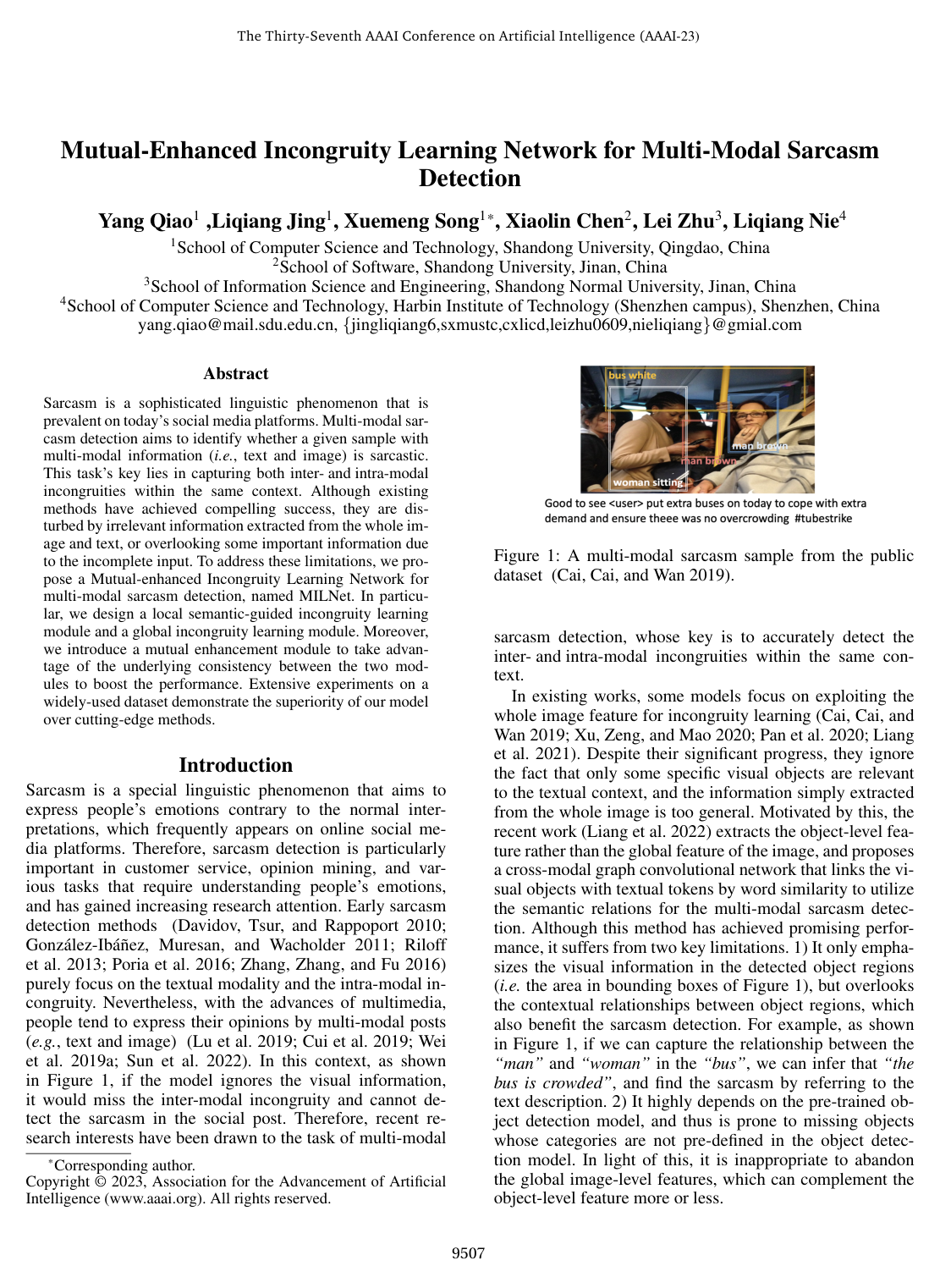
Online communication increasingly relies on multimedia posts combining images and text. Sarcasm detection in these posts is critical for accurate sentiment analysis, opinion mining, and automated customer service. However, identifying sarcasm is challenging because the intended meaning directly contradicts the literal words. Previous automated systems typically analyzed either the entire image or focused strictly on isolated detected objects. Global approaches often pick up irrelevant background noise, while local object-based approaches miss broader contextual scenes or fail when objects fall outside pre-trained recognition categories.
The article demonstrates a novel framework called the Mutual-Enhanced Incongruity Learning Network (MILNet) that unifies fine-grained local object relationships with global contextual imagery. The objective is to accurately identify sarcastic contradictions within and across textual and visual elements.
The authors designed a multi-step neural network architecture evaluated on an established benchmark dataset of 24,635 English social media posts. The system encodes text and any embedded image text using modern language models, while processing images through both object detectors and global vision transformers. It maps detailed connections using a local module that links words and visual objects via an external knowledge graph and spatial overlap measurements. Concurrently, a global module extracts broad image-text interactions through an attention mechanism. A mutual learning strategy then enables both modules to continuously exchange reliable insights during training using a selective sample-screening mechanism.
The evaluation produced several significant findings. First, MILNet established a new performance benchmark on the dataset, achieving an overall accuracy of 89.50% and a macro-average F1-score of 89.12%, outperforming all existing single-modal and multi-modal baselines with statistical significance. Second, multi-modal methods consistently outperformed text-only and image-only approaches, proving that analyzing image-text incongruity is essential. Third, ablation testing showed that both local semantic modeling and global context modeling are necessary; removing either component degraded performance. Finally, the mutual enhancement module and its sample screening mechanism contributed directly to accuracy gains, confirming that transferring only confident, accurate knowledge between modules prevents error propagation.
These findings indicate that effective automated understanding of nuanced social media content requires combining fine-grained object analysis with overall scene context rather than treating them as separate alternatives. For organizations relying on social listening, customer feedback analysis, or automated moderation, adopting such hybrid multi-modal architectures can significantly reduce misclassification risks, protect brand sentiment tracking from misleading literal interpretations, and improve automated response quality.
Organizations developing or deploying emotion and opinion analysis tools should integrate multi-modal architectures that incorporate embedded image text and external knowledge graphs. For future technical development, practitioners should focus on refining cross-modal alignment methods and expanding evaluation beyond single-platform English datasets to ensure robust generalization across diverse, real-world social platforms.
- Paper: Multi-Modal Sarcasm Detection via Cross-Modal Graph Convolutional Network, Bin Liang et al. (2022). It establishes the foundational benchmark and cross-modal graph modeling approach for multi-modal sarcasm detection using conflicting image-text relations upon which MILNet directly builds and compares.
- Paper: MISA: Modality-Invariant and -Specific Representations for Multimodal Sentiment Analysis, Devamanyu Hazarika et al. (2020). It introduces essential techniques for disentangling modality-invariant and modality-specific representations in multimodal sentiment and humor analysis, directly motivating MILNet's mutual enhancement strategy.
- Paper: Multimodal Transformer for Unaligned Multimodal Language Sequences, Yao-Hung Hubert Tsai et al. (2019). It provides the foundational cross-modal attention mechanisms necessary for understanding how attention aligns disparate visual and textual sequences.
- Paper: Tensor Fusion Network for Multimodal Sentiment Analysis, Amir Zadeh et al. (2017). It offers prerequisite methodology for modeling multi-way intra-modal and inter-modal feature interactions in multimodal sentiment analysis.
- Paper: Scene Graph Generation by Iterative Message Passing, Danfei Xu et al. (2017). It lays the groundwork for extracting structured visual-object relationships and scene graphs, which form the core of local semantic modeling in multi-modal incongruity detection.
- Paper: Sniffer: Multimodal Large Language Model for Explainable Out-of-Context Misinformation Detection, Peng Qi et al. (2024). It extends multi-modal cross-modal incongruity reasoning to detect and explain out-of-context image-text misinformation using modern multimodal large language models.
- Paper: Visual CoT: Advancing Multi-Modal Language Models with a Comprehensive Dataset and Benchmark for Chain-of-Thought Reasoning, Hao Shao et al. (2024). It builds on the combination of global and local visual processing by formalizing visual chain-of-thought focal zooming in multimodal language models.
- Paper: Unifying Large Language Models and Knowledge Graphs: A Roadmap, Shirui Pan et al. (2023). It provides a comprehensive architectural roadmap for advancing the integration of external knowledge graphs with deep language models, extending the knowledge-enhanced reasoning used in MILNet.
- Paper: MMBench: Is Your Multi-modal Model an All-around Player?, Yuanzhan Liu et al. (2023). It evaluates fine-grained multi-modal reasoning and cross-modal perception across modern vision-language models using robust multi-pass benchmarking.