Unifying Large Language Models and Knowledge Graphs: A Roadmap
Shirui PanLinhao LuoYufei WangChen ChenJiapu WangXindong Wu
Presents a structured framework for integrating large language models and knowledge graphs, detailing concrete methods to resolve factual hallucinations, automate graph construction, and enable bidirectional reasoning.
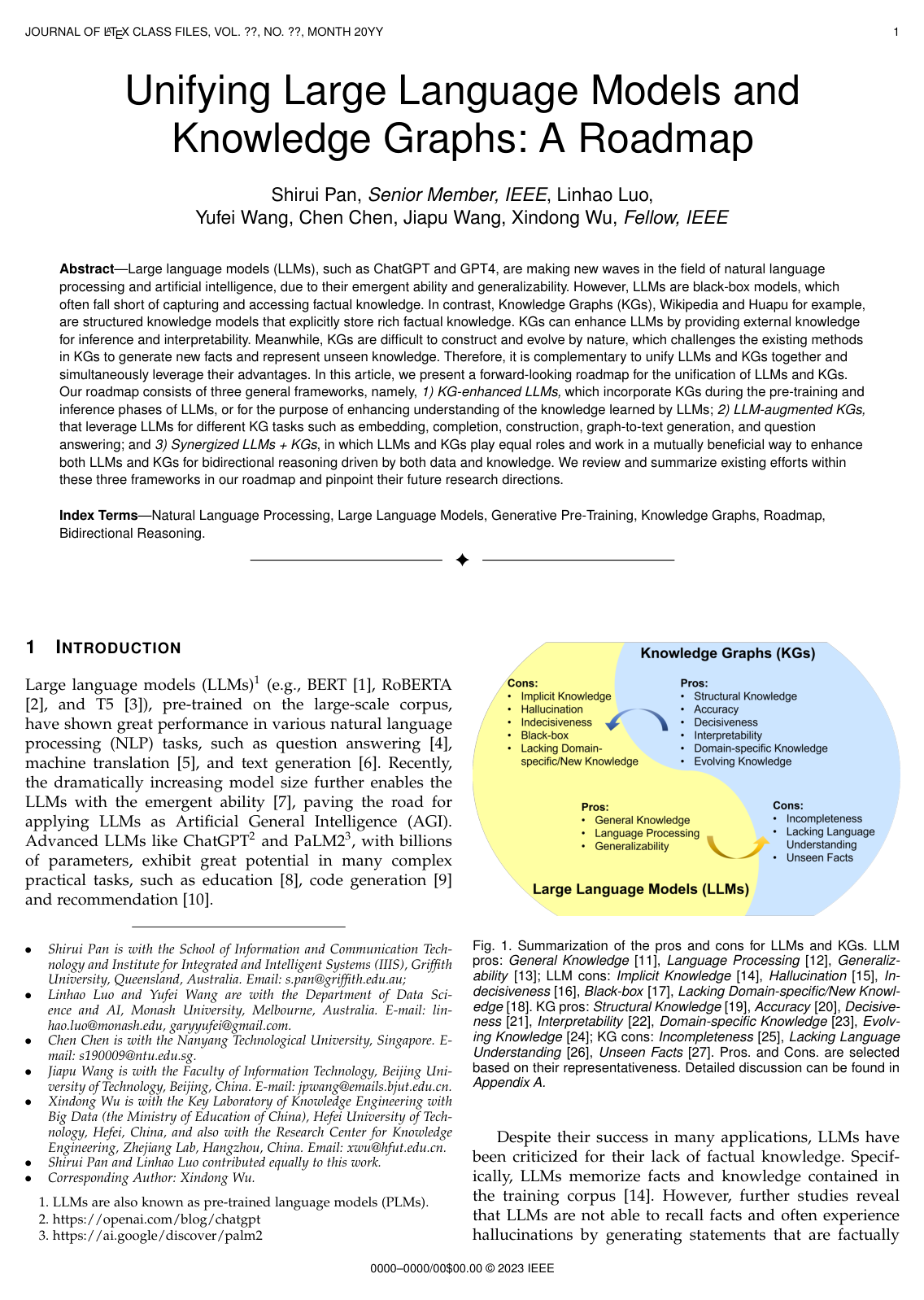
Modern artificial intelligence systems increasingly depend on large language models that excel at natural language processing and general reasoning across diverse domains. However, these models operate largely as black-box systems prone to generating factually inaccurate statements—often termed hallucinations—and struggle to access fresh or domain-specific data. In contrast, knowledge graphs offer structured, decisive, and fully interpretable factual repositories, but they are expensive to construct, frequently incomplete, and incapable of flexible linguistic reasoning. Because these two technologies have complementary strengths and weaknesses, integrating them represents an important opportunity to create more dependable and explainable artificial intelligence systems.
The article establishes a comprehensive roadmap for unifying language models and structured knowledge bases. It categorizes current integration paradigms, evaluates their operational mechanisms, and demonstrates how combining explicit symbolic data with statistical neural networks enhances factual accuracy, reasoning capability, and interpretability across downstream applications.
To map this landscape, the article conducts an extensive, high-level review of recent literature spanning natural language processing and graph neural architectures. It organizes existing methodologies into three core frameworks: knowledge-enhanced language models, language-model-augmented knowledge graphs, and fully synergized systems where both components operate as equal partners in bidirectional reasoning.
The review yields several critical findings regarding system performance and design trade-offs. First, integrating structured knowledge during model pre-training deeply embeds factual representations into neural parameters, but it prevents subsequent knowledge updates without costly re-training. Second, inference-time knowledge retrieval and structured prompting provide dynamic access to up-to-date facts without requiring model re-training, though they depend heavily on manual prompt engineering and retriever performance. Third, using language models as sequence-to-sequence generators directly completes missing graph facts more efficiently and generalizes better to unseen entities than classification-based scoring methods. Fourth, synergized frameworks that merge bidirectional attention across text tokens and graph entities achieve superior multi-hop reasoning and explainability compared to isolated systems.
These findings indicate that unifying language models with structured knowledge bases directly mitigates operational risks and compliance challenges in high-stakes fields like medical diagnosis and legal decision-making. By grounding neural text generation in verified facts, organizations can curtail factual errors, reduce computational expenses associated with continuous re-training, and provide auditable reasoning paths to satisfy regulatory demands.
Decision-makers should choose integration architectures according to their operational requirements. When handling static, domain-specific foundational knowledge, teams should adopt pre-training injection methods, whereas fast-evolving operational data requires retrieval-augmented inference pipelines. Furthermore, organizations should deploy language models to automate the extraction and construction of proprietary knowledge bases, while preparing workflows to test synergized agent-based reasoning frameworks on complex tasks.
Nevertheless, several limitations remain that warrant cautious deployment. Most existing integration techniques require access to internal model weights, making them difficult to implement on closed-source, API-only models. Additionally, transforming large-scale graph structures into text sequences risks information loss due to token input constraints. Future progress depends on establishing robust multimodal alignment, automated hallucination detection pipelines, and standardized methods for live knowledge updating.
- Paper: A Survey on Knowledge Graphs: Representation, Acquisition, and Applications, Shaoxiong Ji et al. (2020). This survey provides essential foundational knowledge on knowledge graph representation, acquisition, and completion paradigms that form one half of the unification roadmap.
- Paper: A Survey of Large Language Models, Wayne Xin Zhao et al. (2023). This comprehensive overview covers the pre-training, fine-tuning, and utilization lifecycle of large language models, providing the core LLM concepts integrated throughout the roadmap.
- Paper: Retrieval-Augmented Generation for Knowledge-Intensive NLP Tasks, Patrick Lewis et al. (2020). This foundational paper establishes the retrieval-augmented generation paradigm that underpins methods for incorporating external factual knowledge into language models.
- Paper: Language Models as Knowledge Bases?, Fabio Petroni et al. (2019). This work pioneered the investigation into whether pretrained language models function as relational knowledge bases, directly motivating the need to unify them with structured knowledge graphs.
- Paper: Modeling Relational Data with Graph Convolutional Networks, Michael Schlichtkrull et al. (2018). This paper establishes relational graph convolutional networks for modeling multi-relational graph data, providing core background for neural graph embedding and completion techniques.
- Paper: A Review of Relational Machine Learning for Knowledge Graphs, Maximilian Nickel et al. (2015). This review covers foundational statistical relational learning and extraction methods for constructing and predicting facts in massive knowledge graphs.
- Paper: Relational inductive biases, deep learning, and graph networks, Peter W. Battaglia et al. (2018). This paper establishes the theoretical foundation of relational inductive biases and graph networks that underpin structured reasoning alongside deep neural representations.
- Paper: From Local to Global: A Graph RAG Approach to Query-Focused Summarization, Darren Edge et al. (2024). This paper realizes the roadmap's vision of synergizing LLMs and knowledge graphs by using LLMs to extract graph community summaries and using the structured graph to guide global retrieval.
- Paper: Retrieval-Augmented Generation for Large Language Models: A Survey, Yunfan Gao et al. (2023). This survey provides a comprehensive taxonomy of retrieval-augmented generation paradigms, detailing the technical mechanisms used to ground LLM inference in external structured and unstructured knowledge.
- Paper: Selective Forgetting: A Graph-Based Memory Framework for Long-Term LLM Agents, Theo Rusu et al. (2026). This work practically implements a knowledge graph memory representation to augment long-term LLM reasoning and agent interactions.
- Paper: Self-RAG: Learning to Retrieve, Generate, and Critique through Self-Reflection, Akari Asai et al. (2024). This paper develops an adaptive framework that teaches LLMs to selectively retrieve external knowledge and self-critique factual support during generation.
- Paper: Active Retrieval Augmented Generation, Zhengbao Jiang et al. (2023). This research extends external knowledge integration by introducing active, forward-looking retrieval during multi-step LLM text generation.
- Paper: REPLUG: Retrieval-Augmented Black-Box Language Models, Weijia Shi et al. (2024). This work demonstrates modular knowledge augmentation by integrating frozen black-box LLMs with external retrievers without internal parameter access.